As has been widely reported, CBS’ “60 Minutes” announced that it would release a program about the notorious prison in El Salvador– CECOT–where the U.S. sent migrant prisoners, who were allegedly hardened criminals, “the worst of the worst.”
The program interviews released prisoners, who describe torture, beatings, and inhumane conditions that would never be permitted in U.S. prisons. It also reviewed records and concluded that few of those sent to CECOT were hardened criminals or terrorists.
Bari Weiss, the editor-in/chief of CBS News, stopped the release of the segment because no one in the Trump administration agreed to respond to it. Critics said that if that was legitimate grounds for blocking a story, the Trump administration could block all critical coverage by refusing to comment.
After CBS was sold to the Ellison billionaires, David Ellison hired Bari Weiss to be editor-in-chief and bought her website “The Free Press” for $150 million. Weiss has no experience in the broadcast industry.
Apparently the show aired in Canada, where a viewer copied it and posted it on Reddit.
Here is the link on Reddit. Decide for yourself whether Weiss was right to stop the show until someone from the Trump administration commented.
The 60 minutes interview that was not aired in the US was aired and recorded in Canada and posted on YouTube. It has since been taken down. No worries though, I screen recorded it.“
See it before it is taken down.
It was originally posted on YouTube but was taken down.
Trump filed a lawsuit against the board of the Pulitzer Prizes in 2022, demanding that it retract any prizes awarded to reporters from The New York Times and The Washington Post who covered the investigation into Trump’s relationship with Russia in his first term.
Trump refers to the episode and the FBI’s investigation as the “Russia, Russia, Russia Hoax.”
The Pulitzer board issued the following response:
A Statement from the Pulitzer Prize Board
The Pulitzer Prize Board has an established, formal process by which complaints against winning entries are carefullyreviewed. In the last three years, the Pulitzer Board has received inquiries, including from former President Donald Trump, about submissions from The New York Times and The Washington Post on Russian interference in the U.S. election and its connections to the Trump campaign–submissions that jointly won the 2018 National Reporting prize.
These inquiries prompted the Pulitzer Board to commission two independent reviews of the work submitted by those organizations to our National Reporting competition. Bothreviews were conducted by individuals with no connection to the institutions whose work was under examination, nor any connection to each other. The separate reviews converged in their conclusions: that no passages or headlines, contentions or assertions in any of the winning submissions were discredited by facts that emerged subsequent to the conferral of the prizes.
The 2018 Pulitzer Prizes in National Reporting stand.
The case has dragged on. Recently the board of the Pulitzer Prizes announced a new twist. It has asked Trump to provide full records of his medical history, his psychological tests, and his income tax returns since 2015.
Trump might rethink this particular lawsuit. Other groups sued by the litigious Trump should scrutinize the Pulitzer board’s strategy.
Australia took the extraordinary step of banning access to social media for children under 16. This article explains their rationale and the steps the government is taking to enforce the ban.
It’s hard to imagine that the U.S. would impose such a ban. We can’t even get parents to agree to vaccinate their children, even though the safety of vaccines has been demonstrated for decades. Some parents would oppose a ban because they want to know their children can contact them in the event of a crisis or emergency. Maybe Australia will develop cell phones that permit communication only between parents and children, children and 911, controlled by parents, not the big tech companies.
Madison Burgess writes:
The world’s first social media ban begins today (December 10), and people are already flagging problems.
If you missed the news, don’t panic. It currently only affects under-16s in Australia, so if you’re elsewhere in the world, feel free to scroll to your heart’s content.
Australian Prime Minister Anthony Albanese welcomed the rule but warned the implementation would be difficult.
He told the Australian Broadcasting Corp: “This is the day when Australian families are taking back power from these big tech companies, and they’re asserting the right of kids to be kids and for parents to have greater peace of mind.
“This reform will change lives. For Australian kids… allowing them to just have their childhood. For Australian parents, enabling them to have greater peace of mind.”
CNN reported that South Korea’s crucial national test contained questions so difficult that the top official resigned. And, of course, there was no end to the parents and students who expressed their outrage about exam questions that were hopelessly obtuse. To read the exam questions, open the link.
Imagine this: You’re a South Korean teenager taking a notoriously grueling 8-hour college entrance exam. You’ve been prepping for this for months, perhaps years. You reach the English portion, and you see this:
If you thought that was difficult, how about this?
These were among the questions students faced in the exam – known locally as the Suneung – this November, which prompted such intense outcry that the exam body’s top official stepped down last week, according to public broadcaster KBS.
The exam body even issued a formal apology earlier this month, saying it “takes seriously the criticism that it did not meet the appropriate level of difficulty… for the English portion.”
The body “deeply apologizes for causing concern to the test takers and parents,” the statement said, adding that administrators would consult schools to “create questions within the scope of school education.”
But many angry test-takers and parents say an apology isn’t enough to make up for the damage in test scores and college applications – which are often seen as the key to a successful future in hyper-competitive South Korea.
Only about 3% of test takers earned a top score in the English portion – the lowest since a new grading system was introduced in 2018, according to the exam body.
“The former head of the evaluation admitted the faults, as he resigned,” wrote one online user surnamed Choi on the Suneung’s website. “Is it not common sense to come up with a measure for test takers and parents, who are the victims impacted by the fault?”
“How can an investigation saying what they will do for next year’s entrance exam comfort the test takers that are discouraged this year?”
‘Killer questions’
The Suneung has long been famed for its difficulty and the intense pressure it places on young teenagers. For many, the education rat race begins before they can even talk, with parents racing to secure coveted spots in elite preschools.
By the time students are in middle and high schools, their days often revolve around studying – going straight from regular classes to after-school cram centers known as hagwons until late at night. All this hard work, families hope, can secure them a spot at a top university, and an advantage in the similarly ruthless job market.
It’s not just the families – the whole country takes this exam seriously.
Passengers walk past an information board showing delayed flights at Gimpo airport in Seoul on November 13, on the day of the annual college entrance exam. Jung Yeon-Je/AFP/Getty Images
On November 13, as more than half a million students nationwide sat down for the Suneung, all flights across the country were barred from taking off or landing for half an hour to make sure there were no noisy distractions during a listening comprehension section. Financial markets opened an hour late and police were mobilized to make sure candidates could make it to their test venues on time.
But there’s a danger to such highly competitive tests: they are often viewed as both a symptom and contributor to wealth inequality, with richer students able to access more resources that could give them a leg up.
There’s also an illicit market involved. Police booked 126 people earlier this year on suspicion of selling Suneung questions to hagwons and tutors, according to Yonhap News Agency.
The heavy burden on students is frequently blamed for poor mental health in the country, which had the highest suicide rateamong OECD nations in 2020, the latest figures available.
It may influence the country’s steeply falling fertility rate, too.
Experts believe the staggering tuition expenses are a major factor behind South Koreans’ reluctance to have children – along with other burdens like long working hours, stagnant wages and sky-high housing costs.
The government has tried to crack down on hagwons to even the playing field, and to lower the difficulty of the entrance exam.
In 2023, it announced it would remove so-called “killer questions” from the Suneung, which sometimes included material that isn’t covered in the public school curriculum – which, the then-education minister argued, gave an unfair advantage to those who can afford private tutoring.
Clearly, however, even the questions that remain may be too much.
“I’m so angry,” wrote a commenter surnamed Jung on the exam body’s website. “What are you going to do with the kids’ lives?”
Every year, Science magazine highlights the most innovative development of the year. While the United States retreats from efforts to protect the environment, China surges ahead with the use of American technology.
Solar panels armor a hillside in China’s Anhui province, parting only for an access road. Distant ridges host wind turbines, another fast-growing component of an energy revolution that has helped ease air pollution and slow the growth of China’s carbon emissions. GEORGE STEINMETZ
This year—for the first time—the world produced more energy via renewable sources than with coal. The meteoric rise of these greener energy technologies, particularly in China, has brought us tantalizingly close to the turning point where annual global carbon emissions plateau and even decline. “To many, the continued growth of renewables now seems unstoppable,” wrote Science News Editor Tim Appenzeller—“a prospect that has led Science to name the renewable energy surge its 2025 Breakthrough of the Year.”
While renewable technologies were pioneered in the U.S., it was China’s industrious production of them that changed the game. The country now makes 80% of the world’s solar cells, 70% of its wind turbines, and 70% of its lithium batteries. Increased production led to lower prices and increased demand, which in turn fueled even more production and even lower prices. As a result, “wind and solar became the cheapest energy in much of the world,” Appenzeller noted. Instead of investing in renewables because they are environmentally friendly, countries—and individuals—started buying them up because they were more affordable. “That change in motivation may be the most important breakthrough of all, ensuring that this year’s inflection points are just the beginning,” he concluded.
But there is one notable exception: the United States. “The U.S. is now squandering an opportunity to reap the benefits of its own technology, ceding the income and the geopolitical power to a nation that repeatedly puts technological prowess above politics,” wrote Science Editor-in-Chief Holden Thorp in an accompanying editorial. While much of the world continues to increase its renewable energy capacity, “the U.S. marches boldly backward toward the past,” Thorp wrote.
The school will be supplied by a giant online corporation called Stride, which used to be K-12 Inc.
K-12 Inc. was known for low-quality instruction, low graduation rates, and scandals. Its executives are paid multi-million dollar salaries.
It’s ironic that the government is paying Stride to provide low-quality online instruction to hapless children whose families are about to be ousted from America.
CoreCivic was founded as Corrections Corporation of America (CCA) in 1983, by Thomas W. Beasley, Robert Crants and T. Don Hutto. Beasley served as the chairman of the Tennessee Republican Party; Crants was the chief financial officer of a real estate company in Nashville; Hutto was the president-elect of the American Correctional Association, and according to a 2018 Time Magazine investigation, ran a Manhattan-sized Tennessee cotton plantation where Black convicts picked cotton for no pay…
One of its first big investors was Michael Milken. That investment came a decade after he pled guilty to six felonies in the “biggest fraud case in the securities industry” ending his reign as the “junk bond king.” In 1996, he had established Knowledge Universe, an organization he created with his brother Lowell and Larry Ellison (Oracle), who both kicked in money for K12. Steve Fink, a trusted Milliken confidant and lead independent director of Stride, is the brother of Larry Fink, chairman and CEO of Blackrock, which has been a longtime investor in Stride.
In 2013 K12 settled a class action lawsuit in Virginia for $6.75 million after stockholders accused the company of misleading them about“the company’s business practices and academic performance.” In 2014, Middlebury College faculty voted to end a partnership with K12 saying the company’s business practices “are at odds with the integrity, reputation and educational mission of the college.”
In 2016 K12 got in yet another round of trouble in California for lying about student enrollment, resulting in a $165 million settlement with then Attorney General Kamala Harris. K12 was repeatedly dropped in some states and cities for poor performance.
Well, who cares? Who cares if Stride-K12 provides high-quality education? So what if it’s a waste of taxpayer money? The “students” are children who are being deported. Their parents are being deported too. Who cares?
Trump’s hand-picked board of the John F. Kennedy Center for the Performing Arts in the nation’s Capitol has voted to rename it. It is now the Trump-Kennedy Center for the Performing Arts.
Early in his term, Trump fired Biden’s appointees to the Kennedy Center board and replaced them with his close allies, including his chief of staff Susie Wiles and Usha Vance, the vice-president’s wife. He named himself chairman of the board. He installed Ric Grennell, former Trump-named Ambassador to Germany, as the new president and executive director, although Grennell had no relevant experience. Trump made decisions about programming, and some groups canceled their appearances to protest his takeover.
Ticket sales and attendance have declined sharply since Trump took over. Many employees have been fired or quit, and were replaced by unqualified friends of Trump. He intends to remodel the center, and patrons of the arts are apprehensive about what he will do. In the decades that he lived in New York City, he never associated himself with venues for the arts, like Lincoln Center and Carnegie Hall.
Republicans have mused about renaming the Kennedy Center and changing it to the Donald J. Trump Center for the Performing Arts. Some speculated about renaming the Opera House of the Kennedy Center for Melania.
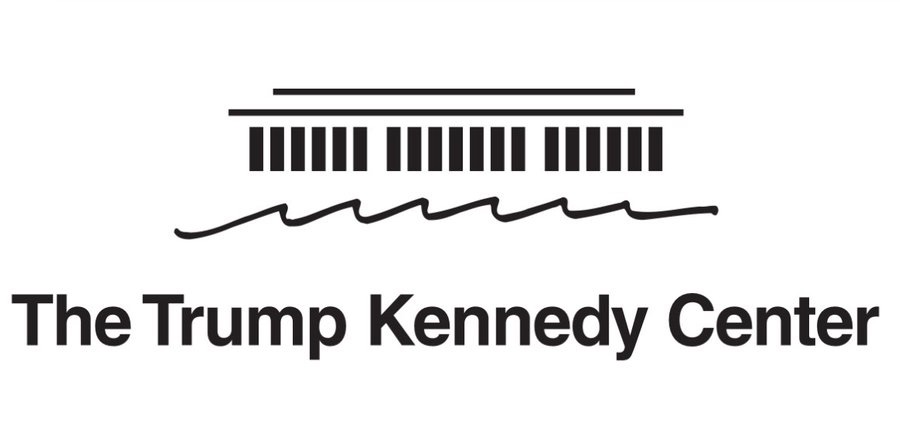
Yesterday, the board changed the name to the Trump-Kennedy Center for the Performing Arts. Trump’s press secretary said the vote was unanimous, but the only Democrat on the board, Rep. Joyce Pratt of Ohio, was muted during the vote and not allowed to speak.
This was no surprise. The board was prepared. The new logo was immediately rolled out:
In reality, the board does not have the power to rename the Kennedy Center. Its name was authorized by law and can be changed only by Congress, just as the Department of Defense cannot be renamed the Department of War without Congress.
What else can he rename for himself? Should the Washington Monument be declared the Trump Monument? Can he replace Lincoln in the Lincoln Monument? Instead of a brooding Lincoln, the new statue would be Trump swinging a golf club. Maybe that’s the purpose of the Arc d’Trump that he intends to build.
The Trump administration is engaged in a war against science and medicine. It has eliminated funding in many crucial areas of research conducted by universities and by the National Institutes of Health. Incalculable damage has been done to set back the search for cures for cancer, Alzheimer’s, heart disease, infectious diseases, HIV, respiratory diseases, and pediatric cancer. People will die because of the ignorance of those who close down ongoing, vital research.
Trump has consistently claimed that “climate change” is a hoax. He has said that the term “climate change” refers to the weather. He hates wind farms and has cut federal funding for them. He has hated wind farms since wind turbines were built near his Trump International Golf Links in Scotland. He sued to block them but repeatedly lost.
Now he is closing down a major hub of climate research.
The Trump administration said it will be dismantling the National Center for Atmospheric Research in Colorado, one of the world’s leading Earth science research institutions.
The center, founded in 1960, is responsible for many of the biggest scientific advances in humanity’s understanding of weather and climate. Its research aircraft and sophisticated computer models of the Earth’s atmosphere and oceans are widely used in forecasting weather events and disasters around the country, and its scientists study a broad range of topics, including air pollution, ocean currents and global warming.
But in a social media post announcing the move late on Tuesday, Russell Vought, the director of the Office of Management and Budget, called the center “one of the largest sources of climate alarmism in the country” and said that the federal government would be “breaking up” the institution.
Mr. Vought wrote that a “comprehensive review is underway” and that “any vital activities such as weather research will be moved to another entity or location.”
Scientists, meteorologists and lawmakers said the move was an attack on critical scientific research and would harm the United States.
The National Center for Atmospheric Research was originally founded to provide scientists studying Earth’s atmosphere with cutting-edge resources, such as supercomputers, that individual universities could not afford on their own. It is now widely considered a global leader in both weather and climate change research, with programs aimed at tracking severe weather events, modeling floods and understanding how solar activity affects the Earth’s atmosphere.
The center’s research has often proved useful in unexpected places, such as when its studies of downdrafts in the lower atmosphere in the 1970s and 1980s led to development of wind shear detection systems around airports that helped address the cause of hundreds of aviation accidents during that era.
I have said before that I love Peter Greene. He has turned his four decades of experience as a high school English teacher into a compendium of wisdom. He knows when to listen carefully to new ideas and when to throw them out with the garbage. He usually says what I have been thinking, but writes it up better than I could. This is one of those wonderful pieces that are trademark Peter Greene.
He writes:
Last week I had a bluesky post blow up, a simply referral to Dana Goldstein’s New York Times pieceabout how nobody reads whole books in school any more. It’s a good piece, pretty fairly balanced even as it points out the role of technology, Common Core, and testing in the decline of whole-book reading (and allows some folks to try to defend the not-very-defensible).
The article itself drew well over a thousand comments, most of them supportive of the idea of reading whole books. The responses to my post were a more mixed bag, with responses that included variations on “Students would read more books if they were assigned good stuff like [insert your fave here] and not crap like [insert author who bugs you and/or Shakespeare here].” Also variations on “Aren’t books over, really?” and its cousin “I didn’t read any books and I am just swell.”
Goldstein gives Common Core a few graphs of defense, because the world still includes people who think it’s great. I am not one of those people, and I have filled up a lot of space explaining why. But in the drop in book reading we can see a couple of the long-term ill effects of the Core (including all the versions hiding in states under an assumed name).
One problem is the Core’s focus on reading as a set of discrete skills that exist in some sort of vacuum absent any content, like waves without water or air. The Core imagined reading as a means of building those skills, and imagined in that context that it doesn’t matter what or how much you read. If today’s lesson is on Drawing Inferences, it doesn’t matter whether you read a scene from Hamlet or a page from a description of 12th century pottery techniques. You certainly don’t need to read the entire work that either of those excerpts came from. Read a page, answer some questions about inferences. Quick and efficient.
And that emphasis on speed and efficiency is another problem.
The Big Standardized Test doesn’t just demand that students get the right answer. It demands that they come up with the right answer RIGHT NOW! And that scaffolds its way backwards through the whole classroom process. The test prep emphasizes picking the One Correct Answer to the question about the one page slice o’writing, and it emphasizes picking it quickly. There is no time allotted for mulling over the reading, no time for putting it in the context of a larger work, certainly no time for considering what other folks have thought about the larger work.
To read and grapple with a whole book takes time. It takes reflection, and it can be enhanced by taking in the reactions of other readers (including both fancy pants scholars and your own peers). I reread Hamlet every year for twenty-some years, each time with a different audience, and I was still unpacking layers of ideas and language and understanding at the end. I taught Nickel and Dimed for years, and the book would lend itself very easily to being excerpted so that one only taught a single chapter from it; but the many chapters taken together add up to more than the sum of their parts. And it takes a while to get through all of it.
If you think there is more value in reading complete works than simply test prep for reading “skills,” then you have to take the time to pursue it.
It is easy as a teacher to get caught up on the treadmill. There is so much you need to cover, and only so much time. There were many times in my career when I had to take a deep breath and walk myself back from hammering forward at breakneck speed. And education leaders tend only to add to the problem and pressure (the people who want you to put something else on your classroom plate rarely offer any ideas about taking something off to make room).
And look– I don’t want to fetshize books here. We English teachers love our novels, but it’s worth remembering that the novel as we understand is a relatively recent development in human history. Some works that we think of as novels weren’t even first published as books; Dickens published his works as magazine serials. And reading novels was, at times, considered bad for Young People These Days. For that matter, complaints about how Kids These Days don’t read full works takes me back to a college class where we learned that pre-literate cultures would sometimes bemoan the rise of literacy– “Kids These Days don’t remember the old songs and stories any more.”
Reading entire works is not automatically magical or transformative. But there is a problem that comes with approaches to comprehending the world that emphasize speed rather than understanding, superficial “skills” over grappling with the ponderable complexities of life. The most rewarding relationships of your life will probably not be the ones that are fast and superficial. And I am reflexively suspicious of anyone who does not themselves want to be seen, heard, or understood on anything beyond a swift and shallow read.
If education is about helping young humans grasp the better version of themselves while understanding what it means to be fully human in the world (and I think it is) then students need the opportunity to grapple with works that mimic the depth and size and complexity of real humans in the real world.
The case has been made for slow school, analogous to the slow food movement, and it can have its problems, like fetishizing a selective view of tradition. But I like the basic idea, the concept of slowing down enough to be able to take in and digest large slices of the world. That should certainly take the form of engaging students with complete works, but I expect that it can take other forms as well.
Test-centric schooling has narrowed and shallowed our concept of education in this country, and while there has never been a reason to stop discussing this issue over the last twenty years, much of the conversation has moved on to other issues, like the current emphasis on culture panic and dismantling the system. But we can do better, dig deeper, tap richer educational veins, if we are just honest about our goals and our obstacles. I hope we’ll get there before my children and grandchildren get too much older.
Mark Green is a progressive activist in New York City. He was the city’s Consumer Affairs commissioner, then New York City’s first Public Advocate. He is a lawyer and author.
He writes on his Substack blog,
Trump taking over 250th celebrations of July 4, 1776 is less urgent than going to war with Venezuela over oil or deporting law-abiding immigrants without due process..but it’s maddening and obscene to allow such a Tory to lecture us Patriots about The Story of America. Fyi, this Substack explains why and how to slow down his narcissistic nationalism.
Celebrating Trump on July 4, 2026
Mark Green wrote on his Substack blog:
“It was the most consequential Revolution in history…When you control how people discuss the past, you control how they see the present and imagine the future.” – Ken Burns
It’s bad enough that a raging egomaniac wants to paste his name on physical public assets: a Peace Institute, Washington Arch, “Trump Baby Bonds,” coinage, the Commanders football stadium, the Kennedy Center, and a new White House ballroom larger than the White House itself. But it would be historically obscene for a temporary Oval Office occupant, far closer in philosophy to the Tories than the Patriots, to rewrite the very idea of 1776.
Donald Trump’s irresistible urge to imitate Ozymandias and Caesar should be opposed, mocked, and someday reversed. But until the jury of voters issue their 2026 and 2028 verdicts, that resistance should at least mean rejecting his attempts to view the Semiquincentennial (the 250th anniversary) through the lens of narcissistic nationalism. Instead, we should adhere to the radical principles of the Declaration, Constitution, and Bill of Rights: freedom, rule of law, separation of powers, free speech, and consent of the governed.
In his effort to renounce loyalty to royalty, Jefferson laid out eighteen “facts” in his July 4th Bill of Particulars involving trade, taxes, armies, and courts that justified rebellion against England. Below are eighteen parallel reasons to rebel against Trump’s contemporary power-grab and his attempt to redefine the Story of America for generations to come.
A BILL OF PARTICULARS, July 4th, 2026
1. Sedition January 6, 2021. Trump inspired the worst insurrection since 1861 and later pardoned hundreds of convicted rioters, including Proud Boys and others who assaulted 139 police officers, leading to five deaths. He called it a “day of love.”
2. The Department of Retribution He publicly ordered the DOJ to indict political enemies, leading to humiliating dismissals targeting James Comey and Letitia James (“she’s very guilty of something”). This inverts equal justice by targeting people first and searching for crimes second. Reuters has tallied at least 470 names on what could be considered his vendetta list. The words “retribution” and “vendetta” do not appear in Article 2.
3. “Faithfully execute the laws” Trump interpreted “execute” in his oath literally, engaging in unlawful conduct over 170 times in ten months, according to federal and state courts, while dismantling agency Inspectors General. Replacing the rule-of-law with the law-of-rule led numerous judges from both parties to condemn DOJ deception and hundreds of experienced lawyers to resign.
4. The First Felon President He was found guilty of 34 felonies by a New York City judge and jury for falsifying business records and campaign finance fraud, avoiding prosecution in four other criminal cases largely due to reelection.
5. Pardon Abuse He transformed a constitutional prerogative into a near fourth branch of government, issuing pardons to donors, corporate executives, white-collar criminals, crypto partners, and drug traffickers based not on mercy but on blandly and unspecifically repeating ‘“people have told me they were treated very unfairly. When granting clemency to twelve Members, including the clownish George Santos, he actually admitted all were “loyal Republicans.”
6. Usurpation of Congress Acting as both president and de facto speaker, Trump routinely violates the separation of powers by, for example, governing through executive orders and ignoring Congress’s Article I power to tax. Justice Jackson condemned the “stench” of rulings based not on what’s precedent but who’s president.
7. Foreign Affairs for “America Alone” While history shows the U.S. succeeds with allies, Trump embraces dictators and threatens to abandon NATO. Nor did he impress Western leaders by predicting Europe’s “civilizational erasure” and dispatching two realtors to negotiate about the Ukraine and Gaza conflicts with strongmen Putin and Netanyahu.
8. Speech Not Free Calling the press “enemies of the people” and belittling journalists who ask tough questions reveals his belief that everyone’s-entitled-to…his opinion. MAGA-style McCarthyism seeks to shake down law firms, universities, news networks, and even individual targets —SNL, Jimmy Kimmel— using the immense power of federal spending and law enforcement.
9. Emolumental Self-Enrichment Despite attacking Hunter Biden, Trump turned the presidency into a personal ATM. Family ventures in crypto, memecoins, and branded properties increased their net worth by an estimated $3.5 billion in 2025, according to The New Yorker.
10. Economic Inequality Wealth disparity now rivals the Gilded Age due to policy choices, not natural law. Shifting trillions from the middle class to the ultra-rich reflects the priorities of Reagan-Trump-Norquist economics, as documented by Piketty, Stiglitz, and Reich.
11. Spurring Violence He governs through menace, encouraging assaults on protesters, failing to condemn mass shootings, and using dehumanizing language repeated by actual mass murderers in, for example, the Pittsburgh synagogue and Buffalo supermarket slayings. Even the suspect in Charlie Kirk’s murder was a Trump supporter who repeated that Biden stole the 2020 election. FBI data shows roughly 80 percent of political murders originate from the Far-Right.
12. Commander-in-Chief Abuse Renaming the Department of Defense the “Department of War” was a tell. Trump invoked fabricated emergencies to deploy troops domestically, treating soldiers as personal enforcers and flirting with war crimes to look like, in Hegseth’s favorite words, “warriors” who favor “lethality not legality.”
13. Racism From “shithole countries” to mass deportations without due process, his rhetoric and policies reflect collective guilt and ethnic scapegoating. If “racism” is considered too strong a word to describe Trump telling all citizens of Somali descent “to go back to your country” and J.D. Vance supporting those who object to non-English speaking neighbors, what’s a better word?
14. Repeated Sexual Misconduct He actively covering up his close ties to Jeffrey Epstein, was accused by dozens of women of sexual abuse, and was found by a civil jury to have raped E. Jean Carroll, resulting in an $80 million judgment.
15. Chronic Indecency Trump openly declares hatred for opponents, refers to them as “scum” and “traitors,” and celebrates their humiliation. After the White House posted a cartoon of a Trump-labeled plane dropping tons of excrement on protesters, renowned Conservative columnist George Will labeled Trumpism a “moral slum.”
16. Opposing the Franchise He supports restricting mail ballots, discarding valid votes, and eliminating the Voting Rights Act, last reauthorized unanimously in 2006 and signed into law by W43..
17. Incorrigible Lying While past presidents lied episodically, Trump normalized deception, producing over 34,000 falsehoods in his first term alone, including claims about a stolen 2020 election. This volume sabotages an informed democracy and ought to persuade voters and judges not to give him the traditional benefit-of-the-doubt of earlier presidents that, as columnist David French put it, “others have earned.”
18. Soft on Fascism Trumpism checks nearly every box of fascism: extreme nationalism, one-man rule, plutocracy, xenophobia, suppression of dissent, lawlessness, and normalized violence. Complaints about the label rang hollow when he told General John F. Kelly that Hitler “did some good things.”
CONCLUSION: Yes to July 4th. But not HIS July 4th.
Individually, many of these abuses justify impeachment or invocation of the 25th Amendment. A compliant Congress and devoted MAGA base make accountability impossible…for now.
Progressive patriots can still resist symbolically by rejecting co-opted celebrations and embracing Enlightenment values of reason, science, and law. Alternatives include:
• Local and state celebrations—which utilize community groups and schools—can explicitly counter historical revisionism. As founding father Benjamin Rush said, “the Revolution never truly ends.” Democracy requires renewal, not Originalism weaponized by power.
• A national coalition, such as “No Kings Days,” should organize a July 4, 2026, alternative with mass participation and prominent public speakers.
• Blunt editorials from major media that dramatically begin on their front pages should reframe Real Patriotism and rise to the unique threat of an American Despot.




 Diane Ravitch's blog