Michael Waldman of the Brennan Center for Justice demonstrates that Republicans won control of the House thanks to gerrymandering. Legislatures in red states drew districts that were designed to favor members of their party.
In other words, they rigged the elections.
Democrats have also gerrymandered districts to win seats, but never as methodically or as systematically as Republicans.
He wrote:
Many things propelled Donald Trump’s election victory. Inflation. A worldwide anti-incumbent backlash. Anger at institutions. A swing to the right among working-class voters of all racial backgrounds. And more. Analysts are still chewing on all the data (and Democrats are chewing on each other).
As we sift through the results and look forward, Republican control of the House of Representatives will matter greatly. That control is very, very narrow. And it turns out to rest on a shaky foundation of gerrymandering and manipulated maps, all encouraged by the Supreme Court.
The last time a new president took office without a “trifecta” of House and Senate control was 35 years ago. But this will be the slimmest House majority on record. With yesterday’s announcement by Indiana Rep. Victoria Spartz that she will not participate in the Republican caucus, control may effectively come down to one vote.
And according to my colleague Michael Li in a new analysis, Republicans won a net 16-seat advantage due to manipulated maps drawn for party advantage. (Democrats garnered an edge in 7 seats through gerrymandering, but the GOP gained a total of 23 seats that way — hence, 16 seats.)
How did this skew happen? Simply, Republican legislators control the drawing of many more districts than Democrats do. In some states, nonpartisan commissions or state courts have actually produced fairer maps. But in most places, politicians are free to press for partisan advantage.
North Carolina is split relatively evenly between Republican and Democratic voters. This year, Trump won the state even as Democrat Josh Stein swept into the governor’s mansion. However, the heavily gerrymandered legislature drew congressional maps that produced 10 seats for Republicans and only 4 for Democrats. The state high court had blocked the gerrymander, a move upheld by the U.S. Supreme Court in Moore v. Harper. But then a judicial election shifted partisan control of the North Carolina court, which abruptly blessed the gerrymander it had previously banned. That judicial reversal alone gave the GOP an extra 3 seats in Washington — enough to control the House.
Today Republicans are strutting, but that swagger may not last long. Speaker Mike Johnson will have to manage a fractious majority that could be defeated by one or two defections. Individual members will be empowered to extort policy concessions, no matter how extreme.
In fact, what may matter even more than the gerrymandered seats is the collapse of electoral competition. Only 27 districts nationwide saw margins of less than 5 percent. Lawmakers will look more nervously at the prospect of primary challenges than at the risk of alienating the broad mass of persuadable voters.
It did not have to be this way. In 2013, the Supreme Court gutted the Voting Rights Act, which had prevented the most egregious gerrymanders along racial lines. Then in 2019, John Roberts led the justices to rule that federal courts could not police partisan gerrymandering at all.
Congress has the power to act, and in 2022 it tried — coming within two Senate votes of passing the Freedom to Vote Act and the John R. Lewis Voting Rights Advancement Act, which together would have barred gerrymandering for congressional seats nationwide. Both parties would have been forced to compete on a level field. (This legislation would also have undone other damage wrought by rulings such as Citizens United, which legalized the campaign system that saw Elon Musk spend a quarter of a billion dollars to help elect Trump.)
All this is a reminder that the rules of American politics, often arcane, often hidden, bear tremendous weight. It should caution us from drawing too many conclusions about any recent victor’s supposed “mandate.”
Voters are mad as hell about a government they feel does not deliver for them. Rigged rules are a big part of why Washington too frequently does not work. Partisans must do more than battle for inches of advantage. To truly reconnect the seats of power to a sullen electorate, real reform and real competition must be part of the answer.
Sherrilyn Ifill is a veteran civil rights litigator and one of the most thoughtful leaders of the democratic resistance to authoritarianism. She is a former President of the NAACP Legal Defense Fund.
In this post, she offers sound advice about how to survive until the next election (in 2026) and then in 2028). Never give up!
She writes:
Sherrilyn Ifill
In one of the most important and climatic scenes in the 2006 film Titanic, Rose and her beau Jack are holding on as they stand on tiptoe outside the rails of the upside down ship. As the ship begins its final, rapid descent into the dark, cold waters of the Atlantic, Jack tells Rose, “This is it.” They have received instructions from the ship’s architect on how they might survive once they are in the water. They are both clear about the goals: survive and stay together.
This feels like the moment this country faces as we approach Trump 2.0. In just a few short weeks Donald Trump will return to the White House, bringing with him a coterie of some of the most incompetent and vile miscreants to serve in some of the highest and most consequential civil positions in our government. Their intentions are clear. Their penchant for lies and targeting has already been on display. Their ham-fisted approach to governance is clumsy, cruel, and unethical, but that won’t stop it from being effective. They are prepared to fight battles small and large. With the wind of a conservative Supreme Court and Republican-controlled Congress at their backs, Trump and his team are feeling bold and unstoppable. The outcome seems clear.
But like Rose and Jack, we have goals as well. To survive personally and nationally, with the remnants of democracy still in place so that we have a platform on which to build a new, stronger, healthier democracy. Our other goal is to stay together. We can and must do both.
The greatest obstacle to our fight to survive as a democracy (even a deeply flawed one) and to hold together a semblance of unity among those who believe in the fight for equality and justice in this country, is the inclination to give up – to believe that Trump’s plans cannot be stopped. I agree that they cannot be stopped in total. But I do believe that they can be upended in part, and we must use what powers we have to thwart as many of his harmful policies and plans as we can. It’s also critical for us to play for the future and not just for the present moment. That means it matters that we make a record – a record of Trump’s excesses and lies, but also of police, prosecutor, and judicial misconduct, of corruption – documents and money exchanged, of quid pro quos, and of collaboration with foreign enemies.
Many of us are fighting powerful exhaustion and an ongoing measure of shock that this giant, seemingly unsinkable state-of-the-art democracy (however flawed) can really be about to sink. That exhaustion and disbelief can lead to paralysis, something we can ill afford. I’m reminded that the first thing Jack and Rose did was take deep breaths before holding one long breath as the ship descended. And we must do the same. First pulling in as oxygen those things that nourish us and keep us going. I have encouraged people to lean-in to art, and nature and family and spiritual practice. Establishing a regimen of these things that you will engage and absorb regularly over the next four years is critical. An exercise schedule, morning meditation or prayer, monthly museum visits or concerts, a book club, monthly family dinners, Netflix nights, leaning into your favorite sports team. All of this can help ensure that you are regularly oxygenated throughout what I can guarantee will be moments that will take our breath away in their cruelty and audacity.
Lastly, like Jack and Rose, hold hands. Stay connected to our cohort of democratic survivors. Those determined to make it to shore. There’s room on the floating door for more than one if we don’t panic and if we understand that our fate is inextricably linked to those who share our vision for democracy, justice and equality.
Generosity and encouragement will be key. Our hands may come apart from time to time, but we can still stay close. Fight those who are opposed to democracy, equality and justice. Not those who are your allies. You can disagree with your allies. Correct them, edify them, firmly push back against them when necessary. But try to reserve your fight for your opponents.
Once we’ve established our oxygen routine, we will have to focus. There will be many things competing for our attention. But we must decide what are the things or areas to which we’ve committed ourselves. We cannot exhaust ourselves. There are civil rights and civil liberties organizations ready to file suit. Support them. There are representatives in Congress who know the rules and are ready to resist the excesses of the Republicans. We don’t have to do their work – but we must support them.
But there is work for every citizen to do. When your friends or family members get tired, and start thinking we can’t survive this, give them the number to call their Senator or House member. Remind them that it matters. And remind yourself. Never make it easy for those in power to trample our rights. Make them hear your voices, no matter what. Speak, write, call, march. If we stop doing those things, it won’t be long before we no longer remember where the line is for decency, truth, justice and democracy.
There’s another reason it matters. Remember that the fear of losing their jobs is the prime motivator of most elected representatives, and they are in constant fear that they have lost sight of which way the wind is blowing. The 2022 midterms loom large, and Republicans remain in disarray. They too, are exhausted just from trying to keep up with what Trump, or Musk have ordered in their most recent tweets.
So when you call, leave messages, send texts and emails, send postcards and letters. Trust me – they worry, and they waver. And if you are blessed to have terrific representatives, then they need the encouragement and the reminder of who they are fighting for. We must call our our elected representatives when they do wrong, but we must also pat them on the back when they do right.
Get engaged locally. Go with a friend or family member to the next school board meeting. Showing up at city council meetings. Visit your library as a way of showing your community who you are, and that you care. Do not cede the space to your opponents. They win whenever we fail to show up. Our presence is powerful and destabilizes the sense that we are intimidated. This is especially important if you live in a blue state or district. We need to hold the spaces, cities and states we have.
When you reel your resolve flagging, look at your children, your young cousin, your niece, or nephew and ask yourself if you are too intimidated to protect their future. If the answer is no, then act like it. Enter the space that is yours. Decide that in 2025 you will be come an active citizen, not an observer.
For my friends in media, many of you are already failing this preliminary moment. Tighten up your language. Stop conceding the rationality of things that are fundamentally irrational and the legality of things that are illegal. Musk and Ramaswamy are leading at best a “project on government accountability.” Maybe and “ad hoc committee” or study group. It is not a “Department” which is a legal term for federal agencies. The creation of federal departments requires an Act of Congress, not the mere whim of a president-elect and his benefactor. Think “Department of Homeland Security.” There is no “Department of Government Efficiency.” And if giving legal imprimatur to this ad hoc initiative is not reason enough to refrain from referring to it as DOGE, engaging in cost-free advertising for Elon Musk’s cryptocurrency (called DOGE) should be reason enough.
Restore your obligation to help your readers understand what is out-of-the-ordinary and antidemocratic. Trump’s stated plans to seize the Panama Canal, to make Canada the 51st state, and to “buy” Greenland is not “Trump being Trump.” It is not a “policy plan.” And it is certainly not an “approach to diplomacy.” If you had 11th grade social studies you know that it reflects imperialist ambitions, that it is an act of hostility towards those nations, and that is destabilizing to those nations, their people, and their markets. Report on it as such. Trump is the President-elect. When he makes these kinds of threats they should be treated seriously and presented as the threat they constitute. This is not normal behavior. It could and may yet lead to trade wars or armed conflict.
It is also critical that the media compel elected representatives to stand with or against Trump’s most excessive plans. I would have expected a responsible press to be camped outside of Senator Marco Rubio’s house who, as Trump’s Secretary of State nominee, would be charged with handling the fallout from Trump’s intemperate and menacing threats against sovereign nations. What are his views about Trump’s stated plan to seize the Panama Canal? There is a pretty healthy Panamanian American population in Florida. What is Rubio saying to that community?
The Matt Gaetz ethics report was an explosive revelation. Seems long ago. He has moved on to prime-time show on OANN. That does not mean the press should move on. This is the man Trump wanted as Attorney General – to represent the United States and lead the largest law enforcement force in the world. His selection of Gaetz is, in and of itself, disqualifying. But he has yet to be pressed on the Gaetz report and what he knew about it. If he didn’t know then he didn’t do basic due diligence before selecting a nominee. If he did, well then, the Senate has no reason to give any Trump nominee the benefit of the doubt -something one might remind those Democratic senators who have announced their willingness to consider voting for RFK, Jr. as HHS Secretary.
The public doesn’t sustain its outrage because the news moves on to something else. Stop letting Trump set the news cycle. Your job is to keep the citizenry educated so that we can make good decisions. Trump’s election is evidence that this has failed. But it’s never too late to do better.
For all of us, even when the media fails, we are still obligated to stay informed. Start following the terrific lawyers, journalists, activists, and writers who have shown that they have the ability to meet the moment and who can share with you information you are unlikely to get other places.
Faith leaders who believe in democracy and justice? There’s work for you to do, and it is urgent. Now is the time to reach out to your local police precinct captains. Make sure they know who you are. Ask for a cell number where you can reach them. Invite them to your places of worship and let them know what you expect. When and if we see our neighbors being targeted, taken away by ICE or other law enforcement, faith leaders should be on-call for their communities, with a direct high level point of contact to find out where individuals have been taken and how they can be reached. Let your local police know that you expect humane treatment of arrestees and detainees.
Finally, we all end the year with a little less money than we would like but make a decision once your finances stabilize about which two or three public, non-profit sources of information or advocacy you will support. PBS? Democracy Now? Pro Publica? Wikipedia (now under threat from Elon)? Your library? Black press? Your town’s alternative weekly? Then do it. Do it now.
Begin printing out articles that contain important information and social media posts that shed important light on controversial issues. There’s a great deal of “scrubbing” happening on the internet right now and many of the most nefarious figures of this time that have stayed under the radar will reappear in the days of our future rebuilding, espousing brand-new positions and ideas.
I intend to use this space to shed light and do some deep dives on the meaning and context behind the anti-democratic plans and proposals that are unfolding, especially those that strike at the heart of our constitution’s guarantee of equality, so please tune in. As I always say, I don’t have all the answers. I’m only absolutely clear about the need to fight.
There’s all kinds of graft, both legal and illegal. The Trump family seems to have mastered the art of legal graft. Tech billionaires and others have fallen to their knees to kiss Trump’s ring and to humbly offer him $1 million to help pay for his inauguration ceremonies. So far, the inauguration fund has swelled to $170 million, probably the most in history.
The ABC network paid Trump $1 million for his inauguration and, for good measure, gave $15 million to Trump rather than fight a lawsuit defending George Stephanopoulos for saying on air that Trump had “raped” E. Jean Carroll. ABC might have won in court on First Amendment grounds, but it capitulated.
Amazon, owned by Jeff Bezos, was even more ingenious. It agreed to pay the Trumps $40 million to license a documentary about Melania. She will be the executive producer. Of course, Bezos had already paid his $1 million into the inauguration fund. He is the publisher of The Washington Post, the guy who prevented the publication of an editorial endorsing Kamala.
The documentary will surely be a glowing reprise of the life of Mrs. Trump, since she is in charge. But will it include her career as a nude model? The photos are all over the internet, and no kidding, she has a stunning body. But will they be in the documentary? Doubtful.
Remember that part of the Constitution called the “Emoluments Clause”? It has been generally understood to mean that the President should not take any gifts or compensation from anyone, presumably to avoid the appearance of a bribe.
However, Trump flouted that clause with the permission of the Supreme Court, which never found a conflict in Trump’s ownership of a hotel in close proximity to the White House, where foreign leaders rented elaborate suites.
Trump can accept major gifts now because he is not President yet. However, he sought to block his sentencing in a New York court in the grounds that the President-elect enjoyed the same immunity from criminal proceedings as a sitting President. Trump is ingenious.
Tom Ultican is a retired teacher of physics and advanced mathematics. He is now a tireless blogger who unearths the machinations of the elites and billionaires intent on privatizing public education. Tom has been a strong supporter of the Network for Public Education. He explains here why he will attend the next NPE conference in Columbus, April 5 and 6.
He writes:
I am going to Columbus, Ohio for the 2025 NPE conference the weekend of April 5 and 6. Since 2015, these conferences have been a forward looking delight for me. (I missed the 2014 conference in Austin, Texas.) It is a place to hear from heroes of human rights and amazing defenders of public education. It is here where we unite and organize to take on ruthless billionaires; out to end taxpayer funded free education for all. Meeting and hotel reservations are still available.
Chicago 2015
My first NPE conference, in 2015, was held in the historic Drake Hotel on the shore of Lake Michigan. I had been reading blogs by Diane Ravitch, Mercedes Schneider and Anthony Cody. They were all there. In fact, when I arrived the quite tall Cody was walking down a staircase to greet new arrivals. This got my conference off to a thrilling start. Yong Zhao, the keynote speaker, was amazing plus I personally met Deborah Meier and NEA president, Lily Eskelsen García. Always close to my heart will be the wonderful and all too short relationship I developed with our host, Karen Lewis.
Raleigh 2016
In Raleigh, I met Andrea Gabor, who was working on a book that was released in 2018, “After the Education Wars; How Smart Schools Upend the Business of Reform.” She had been an agnostic on charter schools until she went to New Orleans and discovered a mess. The amazing speaker, Rev. William Barber, gave the keynote address. This leader of the “poor people’s campaign” is a truly gifted speaker.
Oakland 2017
Nicole Hanna-Jones who had just won the MacArthur Foundation genius award and recently published “The 1619 Project” was our keynote speaker. Susan Dufresne lined the walls of the Oakland Marriot’s main conference room with her art depicting institutional racism that was published in book form 6-months later (The History of Institutional Racism in U.S. Public Schools). At a KPFA discussion featuring Diane Ravitch and Dyett High School hunger strike hero, Jitu Brown, I ran into Cindy Martin, then the Superintendent of San Diego Unified School District. She has been the number two at the Department of Education for most of the past four years. Too bad she was not the number one.
Indianapolis 2018
Diane Ravitch opened the conference declaring, “We are the resistance and we are winning!” Finnish educator, Pasi Sahlberg, coined the apt acronym for the worldwide school privatization phenomena by calling it the “Global Education Reform Movement (GERM).” In Indianapolis, we met many new leaders in the resistance like Jesse Hagopian from Seattle. In his introduction, Journey for Justice leader, Jitu Brown, declared, “Jesse is a freedom fighter who happens to be a teacher.” Jesse’s new book “Teach Truth; the Struggle for Antiracist Education” was just released.
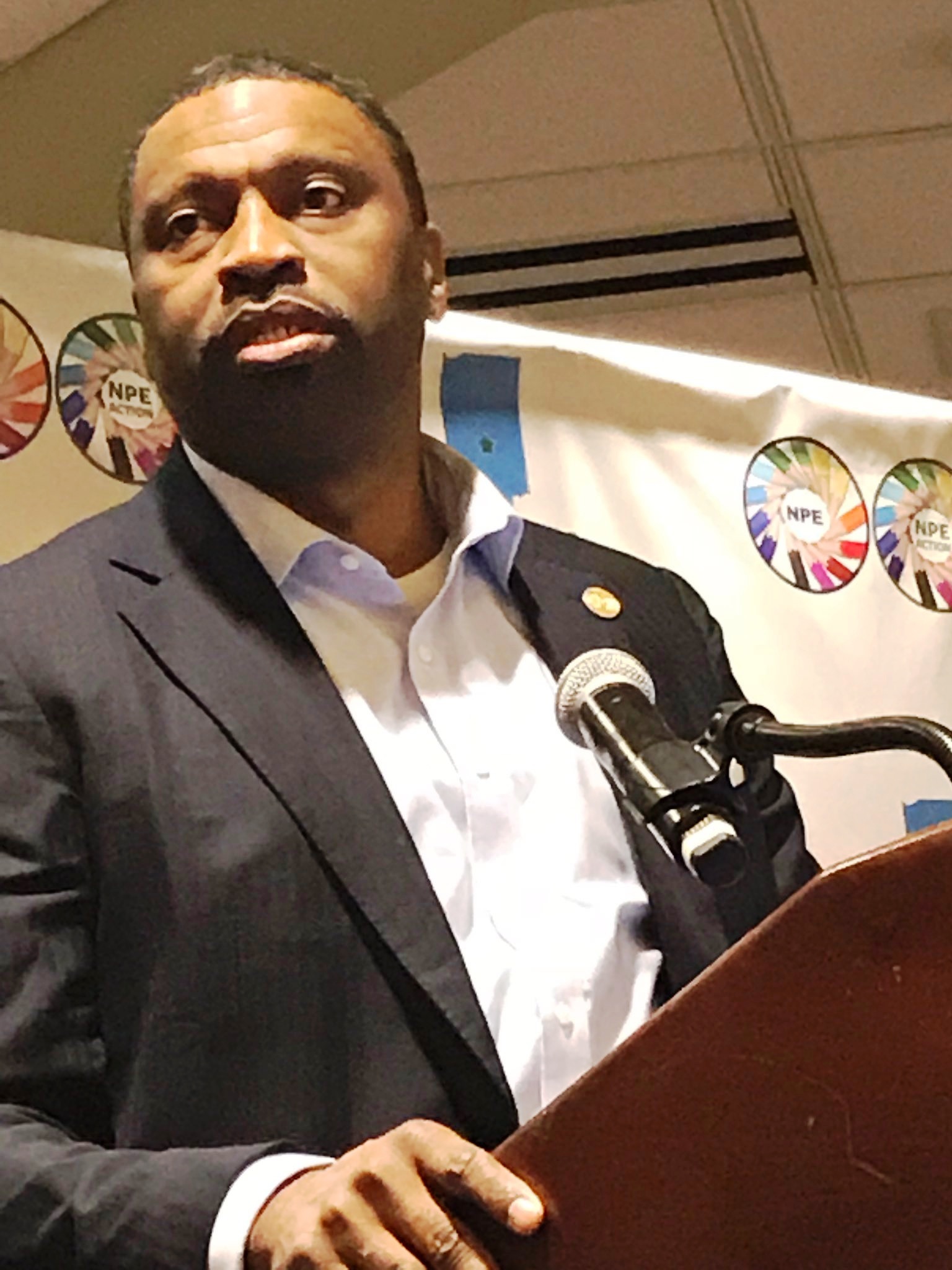
America’s leading civil rights fighter and president of the NAACP, Derrick Johnson, was our keynote speaker. He said the NAACP was not opposed to charter schools, but is calling for a moratorium until there is transparency in their operations and uniformity in terms of requirements is repaired. Derrick noted the NAACP had conducted an in depth national study of charter schools and found a wide range of problems that needed to be fixed before the experiment is continued.
Derrick Johnson, President of NAACP, Speaking at #NPE18Indy – Photo by Anthony Cody
Philadelphia 2022
Like the entire world, NPE activities were seriously interrupted by COVID-19. We were finally able to meet on Broad Street in Philadelphia March 19-20, 2022. This gathering was originally scheduled in 2020. My good friend Darcie Cimarusti, who worked for NPE, called me about joining her for a breakout session on The City Fund, the billionaire founded organization pushing the portfolio model of school management. By 2022, she was so weakened by cancer that I ended up leading the session. Sadly, Darcie passed a few months after the conference.
At the 2022 meeting, we also paid tribute to Phyllis Bush, an NPE founding board member and wonderful person. She was dealing with cancer at the Indianapolis conference and passed some time afterward.
The lunchtime conversation between Diane Ravitch and social activist, musician and actor, Stevie Van Zandt, was special. “Little Stevie” co-founded South Side Johnny and the Asbury Jukes, became a member of the E-Street band with Bruce Springsteen and starred on the Sopranos. It turned out that Diane and Stevie became friends when they were walking a picket line in support of LA teachers.
Ravitch posted afterwards, “I wish you had been in Philly to hear the wonderful “Little Stevie” (formerly the EST band and “The Sopranos”) talk about his love for music, kids, teachers, and arts in the schools at #npe2022philly. Everyone loved his enthusiasm and candor.”
Diane Ravitch and Steven Van Zandt at NPE Philadelphia
Washington DC 2023
October 28-29, 2023, brought the Washington DC NPE conference, a special event. Of particular interest to me was the preconference interview (October 27 evening) of James Harvey by Diane Ravitch. Harvey is known as the author of a “Nation at Risk.” There were so many more of us there than expected; the interview was moved to the old Hilton Hotel’s large conference room. After the change and everyone settled down, Harvey commented, “I remember being at a meeting in this room fifty years ago when we heard that Alexander Butterfield had just testified that there were tapes of the oval office.” There is nothing like being there with people who made and witnessed history.
James also shared that the two famous academics on the panel, Nobel Prize winner, Glen Seaborg, and physicist, Gerald Holton, were the driving forces for politicizing the report. Strangely these two scientists did not come to their anti-public school conclusions based on evidence and they were significant to the reports demeaning public schools using phony data.
Gloria Ladson-Billings from the University of Wisconsin Madison delivered the first Keynote address on Saturday morning. She claimed, “Choice is a synonym for privatization.” And also stated there is money in the public which wealthy elites do not think common people should have. She also noted, “We are in the business of citizen making.” Ladson-Billings indicated that we do not want to go back to normal because it was not that great.
Conclusion
From the beginning, NPE has not sought donations from wealthy elites. The organization is 100% grass roots supported mainly by educators. When it holds a conference, the information has one purpose and that is protecting public education. If you can break free on the first weekend in April and you regard saving public education important, I encourage joining us in Columbus, Ohio for the 2025 NPE conference.
My first big assignment as a journalist was covering President Jimmy Carter’s 1995 visit to Rwanda, a doomed mission that brought him little acclaim.
Carter didn’t fight disease, promote democracy or negotiate peace to make headlines. He did the work quietly and diligently to make the world a better place. His life was a master class in a leadership style firmly out of fashion but will hopefully return.
I was in my third month as the Associated Press and Voice of America stringer in Kigali, Rwanda’s capital. A civil war between an ethno-fascist Hutu government and rebels from the Tutsi minority had culminated in the 1994 genocide that slaughtered 1 million people, most of them Tutsi civilians, in 100 days.
The Tutsi-led rebels drove the Hutu leadership and 1.2 million of their followers into neighboring Zaire, rnow known as Democratic Republic of the Congo. Insurgents from the Zairian refugee camps were still killing 300 people a week in Rwanda more than a year later.
I trailed Carter through Rwanda and the Zairian refugee camps. His Secret Service detail was minimal, yet he moved through these dangerous places with a confidence, kindness and humility that only comes from tremendous inner strength.
He spoke to political leaders, genocide victims, refugees and me with the same courtesy and respect. He knew Mobutu would probably never agree to a peace deal, but unlike most famous people, he didn’t allow the likelihood of failure to stop him from trying.
Carter wanted to negotiate a deal between the new Tutsi-led Rwandan government and Zaire’s dictator Mobutu Sese Seko, whose murderous misrule had made him a pariah.
“These leaders know that I’m their last chance to rejoin the international community,” Carter told me while driving to a church where the skeletons of the dead were displayed as a genocide memorial. He laughed and added, “If Jimmy Carter gives up on you, there’s no one else coming.”
Carter met with Mobutu, and he agreed to a summit with the Rwanda foreign minister. Diplomats knew Mobutu had cancer and hoped he might cut a deal to boost his legacy.
Carter’s staff asked me to join the trip to Mobutu’s palace in Gbadolite, Zaire. I watched Mobutu turn the summit into a farce. Eighteen months later, Rwanda overthrew him, installed a new president and forced the refugees home. The old dictator died in exile. Carter kept lobbying for world peace.
I saw the former president many more times over my 11 years in Africa. His foundation, the Carter Center, monitored elections and fought preventable diseases like river blindness, guinea worm and other neglected tropical diseases. Carter’s work saved tens of millions of people from suffering, but he never made a big deal out of it.
No one can accomplish so much without steely determination. Too often, I hear people describe Carter as the weak and bumbling caricature that President Ronald Reagan created to win the 1980 election. Folks should stop confusing courtesy for weakness.
After the Watergate scandal and the Vietnam debacle, Carter, in 1976, offered an alternative to Richard Nixon’s imperial presidency. He practiced what has become known as servant leadership, the theory that a leader’s primary duty is ensuring subordinates have the tools they need to accomplish their mission.
In the Army, my brigade commander instilled servant leadership in me when I joined his staff as a newly minted sergeant in 1986. He explained that junior enlisted members did not serve me because I outranked them; my rank meant I was responsible for their success, and the colonel promised to hold me accountable if they failed.
The term servant leadership is hackneyed, but it captures valuable techniques that have caught on in the business world. It emphasizes listening, empathy, persuasion, stewardship and community building while discouraging egotism and authoritarianism.
The greater good comes first, not any individual.
While president, Carter rejected much of the pomp at the White House. His speeches focused on addressing problems, not promoting himself. Despite attending the U.S. Naval Academy and serving in the nuclear navy, he was never a warrior-king style leader, which American voters tend to favor.
Humility does not do well in the current culture, where conspicuousness is valued. Politicians must constantly self-promote while denigrating their rivals. Compromise is considered a failure, and vulgarity is considered clever.
The strongest people I’ve encountered in the most difficult places don’t puff up their chests. They don’t need others to bow before them. People with inner strength don’t use cruelty to prove their power.
Here’s hoping kindness makes a comeback, courtesy becomes cool, and strength is demonstrated by lifting people up, not knocking them down.
The Indianapolis Public School District is approaching a red zone: the total elimination of public schools. A bill sponsored by a Republican legislator would require the dissolution of the district, the conversion of every public school into a privately-managed charter school, and the replacement of the elected board by an appointed one.
“This story was originally published by Chalkbeat. Sign up for their newsletters at ckbe.at/newsletters”.
She wrote:
The Indianapolis Public Schools board is strongly opposing a bill that would dissolve the district and force it to convert to charter schools, a proposal that has spurred calls for an organized campaign against it.
The pushback against HB 1136 at the first meeting of the new school board on Tuesday comes as IPS faces the start of yet another legislative session Wednesday that could leave the district more financially strapped and struggling to stay alive.
The bill also became the focus at Tuesday’s meeting, where new board members were sworn in at a historic moment for IPS — for the first time, a board made up entirely of women of color leads a district overseen by its first Black female superintendent.
“This legislation is not student focused, and fails to reflect the community’s input on how they envision their public schools thriving,” board President Angelia Moore said in a statement on behalf of the board at the meeting. “Instead of fostering growth and innovation, HB 1136 risks dismantling the very foundation that supports student success and community collaboration.”
The bill would require Indiana districts to dissolve and transition into charter schools if more than half of students living in the district boundary enroll in a school outside the district. Under the proposal, IPS would dissolve, and 50 of its schools would convert to charters, according to the bill’s latest fiscal impact statement.
Four other districts — Gary Community School Corp., Union School Corp. in east-central Indiana, Tri-Township Consolidated School Corp. in the north, and Cannelton City Schools in the south — would also dissolve.
The bill, proposed by Republican State Rep. Jake Teshka of North Liberty, would also dissolve the IPS’ elected board and replace it with a seven-member board appointed by the governor, the mayor, the president of the city-county council, and the executive director of the Indiana Charter School Board.
IPS to face challenging legislative session
In addition to this bill, a number of other proposals could spell financial ruin for the district, at a time when it faces mounting pressure to share more resources with charter schools. Amid mounting competition from the charter sector, the district has already tried to right-size itself through its Rebuilding Stronger reorganization, which closed several schools last school year and reconfigured grades districtwide this school year.
A new charter advocacy group, the Indiana Charter Innovation Center, will push for charters to receive the same amount of funding from property taxes that traditional districts receive. That would require IPS to give more than the $4 million in property tax revenues it is estimated to give to charters this year, in accordance with a law passed last year.
And incoming Gov. Mike Braun has pushed for capping increases in property taxes, which could further restrict funding for traditional public schools.
IPS grapples annually with competition from Indiana’s strong school choice environment, which state lawmakers have bolstered in previous sessions. The district faces a fiscal cliff once additional property taxes from the 2018 operating referendum expire in 2026. Federal pandemic relief funds have also expired.
“Urban education systems face complex and nuanced challenges that may be unfamiliar to some policymakers,” Moore said at the meeting. “We invite legislators who are genuinely interested in public education to visit our district, gain firsthand insight on our unique mission and vision, and work alongside us to ensure sustainable and meaningful outcomes for students, educators, and families.”
Community members raise opposition to bill
Parents and staff also voiced their opposition to HB 1136 at the meeting Tuesday and called on the board to loudly protest it. Four people spoke against the bill, while three others suggested the board partner with charters, respond to the demand for educational choice, or work with lawmakers to improve the district.
The public support follows a separate call from a group of community leaders who last week called on IPS to consider how to remain operational amid “strong financial headwinds.”
“The legislature has taken notice and seems ready to act if needed,” read the statement from former mayors Bart Peterson and Greg Ballard; former IPS board president Mary Ann Sullivan; and city-county councilors Maggie Lewis, Carlos Perkins, and Leroy Robinson. “It is preferable, however, that any structural changes in IPS are driven locally and to the benefit of our Indianapolis students and community.”
“Rebuilding Stronger shut down schools. The loss this community felt cannot be overstated. Don’t let their loss be in vain,” parent Kristen Phair told the board in between sobs. “I am asking each of you commissioners to take a united stand and be loud in advocating against this bill. Please help us organize. Our families want to organize against this.”
The group urged IPS to share more property tax funding with charter schools.
But Noah Leninger, a teacher at Robert Frost School 106, urged the board not to accept any such compromises.
“More charter schools will not save IPS,” he said. “No matter what they’re called — if we’re honest and we call them charter schools, if we lie to ourselves and our community and call them Innovation Network schools — whatever the name, the rapid and unchecked expansion of these unaccountable grift mills has not gotten IPS out of this mess.”
“My definition of partner does not include any entity that is actively seeking to destroy or dissolve our district, as noted in the proposed legislation,” she said.
Board member Nicole Carey said the challenging times will require courage from district leaders.
“To everyone tonight, I want to say stand with us, stay engaged, hold us accountable to this promise of prioritizing the needs of our students,” she said. “It is going to take all of us.”
Scott Dworkin, a prominent leader in the resistance to the Orange Menace, watched Trump’s self-glorifying rant and reports on it here. I subscribe to his Substack commentary, where this appeared. Just think: we will have to listen to this self-obsessed know-nothing for the next four years. I’m glad to let someone else do it for me.
He wrote:
Yesterday, unhinged madman Donald Trump held what he calls a “press conference.” They’re actually dangerous propaganda sessions.
In order to fight back, we have to stay aware and engaged at a constant. But I don’t want you to have to watch or listen to this bozo, so I summed up what happened for you here.
Donald spent some time pointlessly attacking President Biden. He once again admitted to lying about bringing down grocery prices, and mused that Facebook is likely doing away with fact-checking due to his threats.
He lied about Jack Smith executing people, whined like a baby for being prosecuted for his crimes, and railed against judges who are just doing their jobs. Trump complained about electricity itching—or something—and said he was going to change the name of the Gulf of Mexico to “Gulf of America.” Very original.
“The windmills are driving the whales crazy,” Donald said at one point, for no reason whatsoever.
He even went on some bizarre tirade about water pressure. “It’s called rain,” he blabbed. “It comes down from heaven. And they want to do no water comes out of the shower. It goes drip, drip, drip. So what happens? You’re in the shower 10 times as long.” There are so many things wrong with that word salad.
Trump lied and said Hezbollah was responsible for the violence on Jan 6th—when we all know Donald and his rabid cult followers are to blame. He also nonchalantly promised “major pardons” for the rioters who attacked the Capitol—possibly even for those who assaulted police officers. What a disgrace.
Donny “Cheap Suit” then rambled incoherent threats about using military force to take over Greenland and the Panama Canal, and economic attacks to absorb Canada.
The orange ogre replied to a question about his plans for Gaza negotiations saying, “all hell will break out in the Middle East,” if hostages aren’t released before January 20th. Are you kidding me? That’s not even a “concept of a plan.”
And one of the looniest things that came out of his blubbering mouth was: “We did nothing wrong on anything,” related to the crimes he committed. Remember that every Trump denial is an admission.
This is the sort of unhinged nonsense we will be dealing with as long as Trump is around. And I’ll be right here keeping an eye on him, so you don’t have to.
We’ll be sharing this article with millions of people on 10 social media networks, so we aren’t just singing to the choir.
The editorial boards of the Miami Herald and the Orlando Sentinel warned about the economic consequences of Trump’s plan to deport immigrants with Temporary Protected Status. They are “our neighbors, our friends, and our relatives.” Why didn’t Floridians think of that before they voted?
The editorial says:
It’s like 2017 all over again when it comes to Donald Trump and his threats about ending Temporary Protected Status.
TPS, a federal program familiar to Floridians, protects some immigrants from deportation for a limited time because of emergency conditions in their home countries, such as Venezuela and Haiti. To qualify, they must be living in the U.S. when their country is designated for TPS and must meet a certain cutoff date. It allows them to live and work legally in the U.S. but does not offer a pathway to permanent legalization.
In his previous term, Trump tried and failed to end TPS for immigrants from Haiti and Nicaragua. This time, the president-elect should think twice. His home state of Florida would be affected more than any other. Almost a third of about 863,880 TPS recipients now live in this state, many from Venezuela and Haiti, places with well-documented turmoil and failures.
TPS recipients have legal status in the country, even if they initially came without documents. And TPS recipients pay into the system, through taxes. An estimate from 2019 put the number at $4.6 billion in federal, state and local taxes each year.
Their ranks are growing
As the Miami Herald has reported, the number of TPS recipients in Florida has more than quadrupled in the past three years, up from about 65,000 in April 2021 to about 295,720 now.
The Biden administration expanded TPS, including for about 472,000 Venezuelans, a move that translates into many more who could potentially be affected if Trump targets TPS — a program created in 1990 under President George H. W. Bush.
TPS emerged as an issue in the 2024 Trump campaign during that shameful episode in September, when Trump’s running mate, Vice President-elect JD Vance, spread debunked conspiracy theories about Haitians eating pets in Springfield, Ohio, and Trump continued to spread that misinformation at a presidential debate.
“They are eating the dogs … they are eating the cats,” Trump said repeatedly.
Ominous threats in Ohio
In early October, when Trump was asked whether, if reelected, he would revoke TPS for Haitians — at least those in Springfield — and deport them, he responded: “Absolutely. I’d revoke it, and I’d bring them back to their country.”
Vance also mentioned TPS at an Arizona campaign event in October: “What Donald Trump has proposed doing is we’re going to stop doing mass parole. We’re going to stop doing mass grants of Temporary Protected Status.”
All of that was well before the election.
Now, with a second Trump administration in the offing, theory could become reality. Look at his appointments: immigration hardliner Stephen Miller as deputy chief of staff for policy — he has criticized the Biden administration’s humanitarian parole program aimed at slowing the number of migrants at the southern border — and Tom Homan as the “border czar.” Homan led Immigration and Customs Enforcement when families were separated during Trump’s first term.
Immigration was one of the main drivers of Trump’s 2024 campaign. Much attention was focused on his vows to conduct mass deportations, especially of undocumented people. About 11 million immigrants without legal status were in the U.S. in 2022, according to the U.S. Department of Homeland Security.
Trump has also talked about a host of other immigration actions, including ending birthright citizenship and restarting construction of the border wall. After the fearmongering in Ohio, TPS is on the table, too. Lawsuits derailed Trump’s efforts the last time. Will it happen again?
We understand that TPS is, by definition, supposed to be temporary. That’s fair. But in many of these countries — Haiti, certainly, and Venezuela — conditions are just as bad as they were or worse. Returning TPS recipients to their countries could put them in danger. In Florida, where TPS recipients are our neighbors and friends and relatives, we should already know that.
This editorial was originally published in the Miami Herald. The Sentinel sometimes republishes editorials that reflect our point of view. Send letters to insight@orlandosentinel.com.
Reuters reports that Trump sympathizes with Putin’s desire to keep Ukraine out of NATO. Presumably that sentiment justifies Russia’s brutal invasion of Ukraine nearly three years ago and its destruction of homes, schools, churches, the power grid, hospitals, and entire towns and cities.
As usual, Trump can be counted on to defend his dear friend Putin. He is indeed Putin’s puppet. Trump probably doesn’t know that Finland and Sweden shed their neutrality and joined NATO after Putin invaded Ukraine in February 2022.
Trump is sad that he won’t have a chance to meet his good buddy Vlad before Inauguration Day.
Reuters reported:
WASHINGTON, Jan 7 (Reuters) – President-elect Donald Trump said on Tuesday he sympathized with the Russian position that Ukraine should not be part of NATO, and he lamented that he will not meet Russian President Vladimir Putin before his inauguration.
Speaking at a news conference at his Mar-a-Lago club in Palm Beach, Florida, Trump also blamed outgoing Democratic President Joe Biden for allegedly changing the U.S. position on NATO membership for Ukraine…
Members of the North Atlantic Treaty Organization have officially expressed support for Ukraine’s eventual membership since the Bucharest Summit of 2008, and the Biden administration continues to support Ukraine’s eventual NATO accession, though Ukraine has never been extended an invitation.
Trump’s aides and allies generally oppose NATO membership for Ukraine, at least in the foreseeable future, seeing it as an unnecessary provocation toward Moscow.
Sure, why provoke Putin unnecessarily? He might go to war. Uh. He did.
What will Trump do and say if Putin invades Estonia, Lithuania, and Latvia? They are already members of NATO. Putin has said that he wants to rebuild the Soviet empire. He’s a big man. We can’t offend him.
Yesterday was a day jam-packed with news, which Heather Cox Richardson puts into perspective. We can look forward to–or dread– four years of non-stop lying and bragging and insulting and threatening by Convicted Felon Trump. Among other crazy things he said yesterday, he claimed that Hezbollah terrorists were part of the Jan 6 mob that stormed the U.S. Capitol. Were they carrying Trump banners? Will he pardon them?
She writes:
Today, President Joe Biden signed proclamations that create the Chuckwalla National Monument and the Sáttítla Highlands National Monument, protecting 848,000 acres (about 3,430 square kilometers) of land in southern California’s Eastern Coachella Valley. Under the 1906 Antiquities Act, the president can designate national monuments to protect areas of “scientific, cultural, ecological, and historic importance.”
Yesterday, Biden protected the East Coast, the West Coast, the eastern Gulf of Mexico, and Alaska’s Northern Bering Sea—an area that makes up about 625 million acres or 2.5 million square kilometers—from oil and natural gas drilling. While there is currently little interest among oil companies in drilling in those areas, the new designation will protect them into the future. Noting that nearly 40% of Americans live in coastal communities, Biden said the minimal fossil fuel potential was not worth the risks that drilling would bring to the fishing and tourist industries and to environmental and public health.
The White House noted that Biden and Vice President Kamala Harris have “conserved more lands and waters”—more than 670 million acres of them—and have “deployed more clean energy, and made more progress in cutting climate pollution and advancing environmental justice than any previous administration.” At the same time, oil and gas production is at an all-time high, demonstrating that land protection and energy production can coexist.
While oil executives blasted Biden’s proclamation protecting the coastal waters, Democratic lawmakers on the newly protected coasts cheered his action, recognizing that oil spills devastate the tourism and fishing on which their constituents depend: the 2010 Deepwater Horizon oil spill in the Gulf of Mexico, for example, killed 11 people, closed 32,000 square miles (82,880 square kilometers) of the Gulf of Mexico to fishing, and has cost more than $65 billion in compensation alone.
Biden protected the oceans under the 1953 Outer Continental Shelf Lands Act, which enables presidents to withdraw federal waters from future oil and gas leasing and development but does not say that future presidents can revoke that protection to put those waters back into development, meaning that Trump—who similarly protected coastal waters when he was president—will have a hard time overturning Biden’s action.
Nonetheless, Trump’s spokesperson Karoline Leavitt called Biden’s decision “disgraceful” and claimed it was “designed to exact political revenge on the American people who gave President Trump a mandate to increase drilling and lower gas prices. Rest assured, Joe Biden will fail, and we will drill, baby, drill.”
Journalist Wes Siler, who writes about the outdoors, environment, and the law, notes that there is a major effort underway among Republicans to privatize public lands to benefit oil and gas industries, as well as other extractive industries, just as Project 2025 outlined. Melinda Taylor, senior lecturer at the University of Texas at Austin Law School, told Bloomberg Law in November: “Project 2025 is a ‘wish list’ for the oil and gas and mining industries and private developers. It promotes opening up more of our federal land to energy development, rolling back protections on federal lands, and selling off more land to private developers.”
In September, Siler wrote in Outside that politicians in Utah have designed a lawsuit to put in front of the Supreme Court. It argues that all the land in Utah currently in the hands of the Bureau of Land Management—18.5 million acres—should be transferred to the control of the state of Utah.
Those eager to get their hands on the land use the word “unappropriated lands” from the 1862 Homestead Act to claim that the federal government is holding the land “without any designated purpose.”
But, as Siler notes, in 2023, BLM-managed land supported 783,000 jobs and produced $201 billion in economic output, and in Utah alone the use of BLM land created more than 36,000 jobs and $6.7 billion in economic output as more than 15 million people visited the state’s public lands. Utah realized hundreds of millions of dollars in taxes on that activity, and while it’s true that states cannot tax federal government lands—as lawmakers say—the government pays the state in lieu of taxes: $128.7 million in 2021.
Transferring that land to the state would sacrifice these funds, and because the state constitution requires the state both to balance its budget and to realize profits from state land, that transfer would facilitate the land’s sale to private interests.
Twelve states have now joined Utah’s lawsuit, arguing that federal control of “unappropriated” land within states impinges on state sovereignty, and they are asking the Supreme Court to take up the case as part of its original jurisdiction. As Siler noted in a May article in Outside, Chief Justice John Roberts has expressed an eagerness to revisit the legality of the Antiquities Act the presidents use to protect land—as Biden did today—suggesting he would be willing to side with the states against the federal government. Project 2025 also calls for Congress to repeal the Antiquities Act.
In Wes Siler’s Newsletter yesterday, Siler noted that the new rules package adopted for the 119th Congress makes it easier to transfer public lands to state control. The rules strip away the need to justify the cost of such a transfer and to offset it with budget cuts or increased revenue elsewhere.
In a press conference today, Trump said he would rescind Biden’s policies and “put it back on day one,” and complained that the 625 million acres Biden protected feels “like the whole ocean,” although the Pacific Ocean alone is almost 38 billion acres more than Biden protected.
Also today, Trump announced that a developer from Dubai, DAMAC Properties, will invest at least $20 billion in the U.S. to create new data centers that support artificial intelligence and cloud services. Trump claimed that the company’s chief executive officer, Hussain Sajwani, is investing in the U.S. “because of the fact that he was very inspired by the election,” but DAMAC has been connected to Trump for a while.
Sajwani attended Trump’s first inauguration, and a company tied to chair and current board member of DAMAC Farooq Arjomand paid $600,000 to the key witness for the House Republicans seeking to dig up dirt on President Biden. That man was Alexander Smirnov, who in December 2024 pleaded guilty to lying to the FBI when he claimed Biden had taken bribes from the Ukrainian company Burisma.
Data centers are notoriously high users of energy. They consume 10 to 50 times as much energy per floor space as does a typical commercial office building, which might have something to do with why Trump’s team is so eager to increase American energy production even as it is already at an all-time high. Trump has promised companies that invest a billion or more dollars in the U.S. that they will get expedited approvals and permits, including those covering environmental concerns.
But if the larger story of this moment is the plunder of our public resources for private interests, Trump’s press conference in general seemed to have a different theme. It was what CNN perhaps euphemistically called “wide ranging,” as he abandoned his “America First” isolationism to suggest using force against China as well as U.S. allies Denmark, Panama, Mexico, and Canada, which would destabilize the globe by rejecting the central principle of the North Atlantic Treaty Organization (NATO) that countries must respect each other’s sovereignty. He wildly suggested that the Iran-backed Lebanese paramilitary group Hezbollah was part of the January 6, 2021, attack on the U.S. Capitol and that his people were part of the negotiations for the return of the Israeli hostages.
Trump’s performance was reminiscent of his off-the-wall press conferences during the worst of the coronavirus pandemic, which tanked his popularity enough to get his team to stop him from doing them. Trump might have chosen to speak today to keep attention away from the arrival of the casket carrying former president Jimmy Carter to Washington, D.C., where it was transported by horse-drawn caisson to the Capitol, where Carter will lie in state in the Rotunda until his Thursday funeral at Washington National Cathedral. The snow and frigid weather were not enough to keep mourners away, and Trump has already expressed frustration that Carter’s death will mean that flags will be at half-staff for his own inauguration.
But he also might have been trying to demonstrate that the transition from Biden’s administration to his own is taking his time and energy in order to add heft to the argument his lawyers made yesterday. They demanded that Attorney General Merrick Garland prevent the public release of special counsel Jack Smith’s report about his investigation into Trump’s attempt to overturn the results of the 2020 presidential election because making Trump respond to the media frenzy the report will stir up would take his attention away from the presidential transition.
Trump managed to defang most of the legal cases against him by being elected president, but he apparently still fears the release of Smith’s report. Today, Judge Aileen Cannon, whom he appointed to the bench and who dismissed the charges against Trump in his retention of classified documents, issued an order preventing the Department of Justice from releasing the report. Constitutional law professor Laurence Tribe noted that the order “has no legal basis and ought to be reversed quickly—but these days nobody can be confident that law will matter.”
The presidential immunity on which Trump apparently is relying has also failed to protect him from being sentenced in the election interference case in which a Manhattan jury found him guilty of 34 felonies. In Civil Discourse, legal analyst Joyce White Vance explained that Trump wants to stop the sentencing process because it triggers a thirty-day period for Trump to appeal. “Once the appeal is concluded,” she explains, “the conviction is final.” Trump was apparently hoping to hold off that process and buy four years to come up with a way out of a permanent designation as a felon.It didn’t work. Today, appeals court judge Ellen Gesmer rejected his attempt to stop the sentencing. It will go forward on Friday as planned.








 Diane Ravitch's blog