In the wake of the brutal murder of United Healthcare’s CEO, there has been an outpouring of stories about UnitedHealthcare’s strategy of denying claims to increase profits.
As a result, we have a very expensive healthcare system, in which people’s claims for coverage are frequently denied. Many people pay through the nose and don’t get the medical care they need because of their insurance companies.
His article is titled: “When Profits Kill: The Deadly Costs of Treating Healthcare as a Business.”
Hartmann wrote:
The recent assassination of the CEO of UnitedHealthcare — the health insurance company with, reportedly, the highest rate of claims rejections (and thus dead, wounded, and furious customers and their relations) — gives us a perfect window to understand the stupidity and danger of the Musk/Trump/Ramaswamy strategy of “cutting government” to “make it more efficient, run it like a corporation.”
Consider health care, which in almost every other developed country in the world is legally part of the commons — the infrastructure of the nation, like our roads, public schools, parks, police, military, libraries, and fire departments — owned by the people collectively and run for the sole purpose of meeting a basic human need.
The entire idea of government — dating all the way back to Gilgamesh and before — is to fulfill that singular purpose of meeting citizens’ needs and keeping the nation strong and healthy. That’s a very different mandate from that of a corporation, which is solely directed (some argue by law) to generate profits.
The Veterans’ Administration healthcare system, for example, is essentially socialist rather than capitalist. The VA owns the land and buildings, pays the salaries of everybody from the surgeons to the janitors, and makes most all decisions about care. Its primary purpose — just like that of the healthcare systems of every other democracy in the world — is to keep and make veterans healthy. Its operation is nearly identical to that of Britain’s beloved socialist National Health Service.
UnitedHealthcare similarly owns its own land and buildings, and its officers and employees behave in a way that’s aligned with the company’s primary purpose, but that purpose is to make a profit. Sure, it writes checks for healthcare that’s then delivered to people, but that’s just the way UnitedHealthcare makes money; writing checks and, most importantly, refusing to write checks.
Think about it. If UnitedHealthcare’s main goal was to keep people healthy, they wouldn’t be rejecting 32 percent of claims presented to them. Like the VA, when people needed help they’d make sure they got it.
Instead, they make damn sure their executives get millions of dollars every year (and investors get billions) because making a massive profit ($23 billion last year, and nearly every penny arguably came from saying “no” to somebody’s healthcare needs) is their real business.
On the other hand, if the VA’s goal was to make or save money by “being run efficiently like a company,” they’d be refusing service to a lot more veterans (which it appears is on the horizon).
This is the essential difference between government and business, between meeting human needs (social) and reaching capitalism’s goal (profit).
It’s why its deeply idiotic to say, as Republicans have been doing since the Reagan Revolution, that “government should be run like a business.” That’s nearly as crackbrained a suggestion as saying that fire departments should make a profit (a doltish notion promoted by some Libertarians). Government should be run like a government, and companies should be run like companies.
Given how obvious this is with even a little bit of thought, where did this imbecilic idea that government should run like a business come from?
Turns out, it’s been driven for most of the past century by morbidly rich businessmen (almost entirely men) who don’t want to pay their taxes. As Jeff Tiedrich notes:
“The scariest sentence in the English language is: ‘I’m a billionaire, and I’m here to help.’”
Rightwing billionaires who don’t want to pay their fair share of the costs of society set up think tanks, policy centers, and built media operations to promote their idea that the commons are really there for them to plunder under the rubric of privatization and efficiency.
They’ve had considerable success. Slightly more than half of Medicare is now privatized, multiple Republican-controlled states are in the process of privatizing their public school systems, and the billionaire-funded Project 2025 and the incoming Trump administration have big plans for privatizing other essential government services.
The area where their success is most visible, though, is the American healthcare system. Because the desire of rightwing billionaires not to pay taxes have prevailed ever since Harry Truman first proposed single-payer healthcare like most of the rest of the world has, Americans spend significantly more on healthcare than other developed countries.
In 2022, citizens of the United States spent an estimated $12,742 per person on healthcare, the highest among wealthy nations. This is nearly twice the average of $6,850 per person for other wealthy OECD countries.
Over the next decade, it is estimated that America will spend between $55 and $60 trillion on healthcare if nothing changes and we continue to cut giant corporations in for a large slice of our healthcare money.
On the other hand, Senator Bernie Sanders’ single-payer Medicare For All plan would only cost $32 billion over the next 10 years. And it would cover everybody in America, every man woman and child, in every medical aspect including vision, dental, psychological, and hearing.
If we keep our current system, the difference between it and the savings from a single-payer system will end up in the pockets, in large part, of massive insurance giants and their executives and investors. And as campaign contributions for bought off Republicans. This isn’t rocket science.
And you’d think that giving all those extra billions to companies like UnitedHealthcare would result in America having great health outcomes. But, no.
Despite insanely higher spending, the U.S. has a lower life expectancy at birth, higher rates of chronic diseases, higher rates of avoidable or treatable deaths, and higher maternal and infant mortality rates than any of our peer nations.
Compared to single-payer nations like Canada, the U.S. also has a higher incidence of chronic health conditions, Americans see doctors less often and have fewer hospital stays, and the U.S. has fewer hospital beds and physicians per person.
No other country in the world allows a predatory for-profit industry like this to exist as a primary way of providing healthcare. Every other advanced democracy considers healthcare a right of citizenship, rather than an opportunity for a handful of industry executives to hoard a fortune, buy Swiss chalets, and fly around on private jets.
This is one of the most widely shared graphics on social media over the past few days in posts having to do with Thompson’s murder…
Sure, there are lots of health insurance companies in other developed countries, but instead of offering basic healthcare (which is provided by the government) mostly wealthy people subscribe to them to pay for premium services like private hospital rooms, international air ambulance services, and cosmetic surgery.
Essentially, UnitedHealthcare’s CEO Brian Thompson made decisions that killed Americans for a living, in exchange for $10 million a year. He and his peers in the industry are probably paid as much as they are because there is an actual shortage of people with business training who are willing to oversee decisions that cause or allow others to die in exchange for millions in annual compensation.
That Americans are well aware of this obscenity explains the gleeful response to his murder that’s spread across social media, including the refusal of online sleuths to participate in finding his killer.
It shouldn’t need be said that vigilantism is no way to respond to toxic individuals and companies that cause Americans to die unnecessarily. Hopefully, Thompson’s murder will spark a conversation about the role of government and the commons — and the very real need to end the corrupt privatization of our healthcare system (including the Medicare Advantage scam) that has harmed so many of us and killed or injured so many of the people we love.
For five days, the public was obsessed with the search for the man who murdered the CEO of United Healthcare. For a while, he seemed to be a mastermind, evading the surveillance state that so closely monitored his movements. But then he was caught while eating breakfast at a McDonald’s in Altoona, PA.
There is no excuse for murder. None, unless you are acting in self-defense, which Luigi Mangione was not. He has ended the life of Brian Thompson, the CEO of UHC, and simultaneously destroyed his own life. He is likely to spend the rest of his life in prison. Couldn’t he have thrown a bucket of red paint in protest? Or a cream pie?
The health insurance industry in this country is a mess. Most insurance companies operate for profit, and their actions seem to based on the prospect of profit, not the well-being of their customers. The industry makes obscene profits, based on its frequent denials of reimbursement.
This post was written by Qasid Rashid. When he learned that his child had a deadly disease, he sought help from his insurance company but was repeatedly denied any help. Read the story. It shows how repellent privatized for-profit insurance is. The insurance company was willing to let the child die rather than pay the cost of her desperately needed treatment.
He and his wife wrote:
This article is a deeply personal and vulnerable piece about our daughter Hannah Noor. It is primarily written by my wife Ayesha Noor. We are sharing this not because our daughter’s story is special, but sadly, because her story is all too common. Every year thousands of children and adults suffer incomprehensible pain, suffering, and even death. They suffer not because we lack the means to treat them, but because exploitative insurance companies, incompetent bureaucrats, and apathetic politicians deny them access to the life saving care they need. In light of recent events [See: America’s Violent Health System], we are sharing this story to bear witness to the preventable suffering of so many, the deadly violence imposed upon them, and to give hope that even in the darkest of times things can get better if we demand it. Let’s Address This.
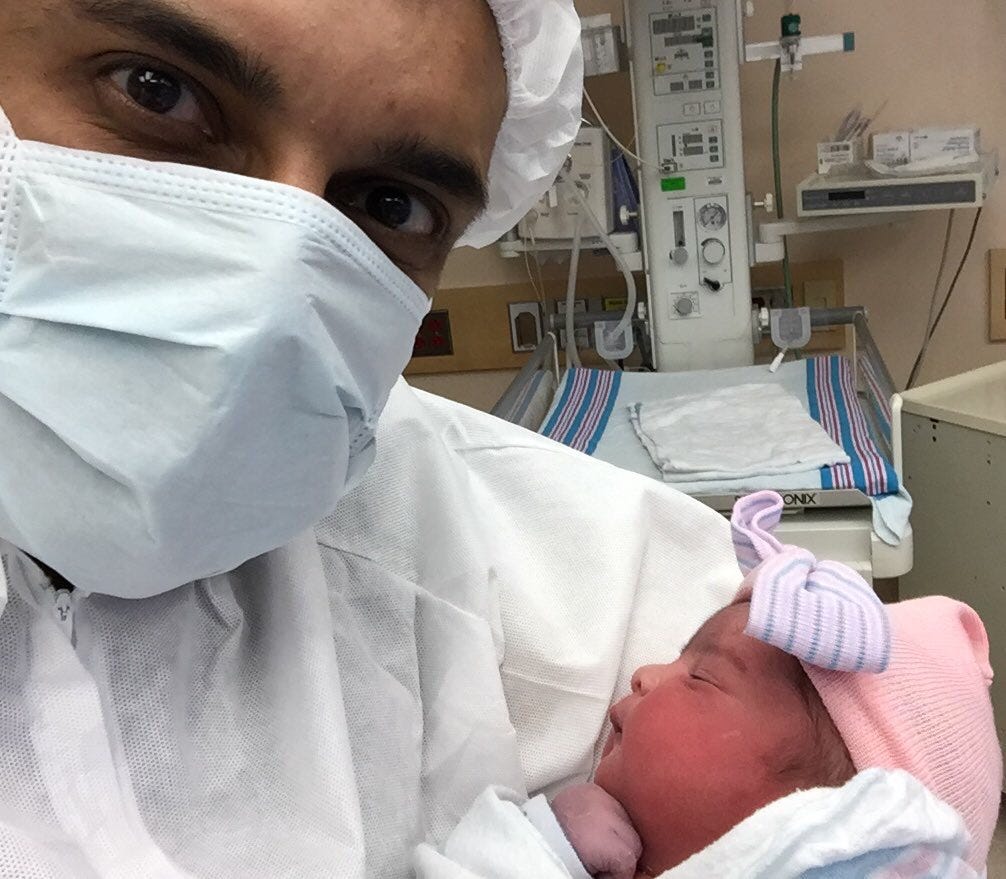
Hannah Noor (Pictured Right) at 5 hours old.
A Scream in the Dark
It was just after her sixth birthday in 2021 when our daughter screamed from her bed in the middle of the night. We rushed to her room to find she had thrown up all over her bed. We cleaned her up, changed her sheets, and blamed the incident on the Oreos she’d eaten after dinner. The next day she complained of a stomach ache and rushed to the bathroom, experiencing diarrhea. Like most parents, we dismissed it as a passing bug—kids get diarrhea now and then. But something felt different this time, even though it was her first experience.
When it happened again just a short time later, the stomach pain was more severe. She screamed, cried, and rushed to the bathroom, but this time there was blood—so much blood. It terrified us. Before we could even make it to urgent care, she had another episode with even more bleeding. We hurried her in, only to be told by the nurse practitioner to “keep her hydrated” and that it was probably a stomach virus. But again, something in our gut told us otherwise.
This was just before Thanksgiving 2021, and I convinced myself she’d recover over the break and be able to return to school. She loved school, as most kindergarteners do. But the bleeding continued. The pain worsened. More urgent care and pediatrician visits followed, but answers did not. By now, our once energetic and chatty daughter was pale, frightened, and visibly losing weight.
Navigating Through the Dark
We reached out to a close friend who happened to be a pediatric gastroenterologist. His questions and careful listening indicated it was not a simple virus, but he didn’t say much directly. He urged us to connect with the GI team at Children’s National Hospital in Washington D.C. Unfortunately, we were met with insurance hurdles and skepticism from her pediatrician. Weeks passed, and her condition deteriorated until, thanks to our friend’s intervention, we finally secured an appointment with a pediatric GI doctor in December.
Hannah Noor, now frail and scared, was put on iron supplements, and an colonoscopy was scheduled for January. She now weighed just 30 pounds—skin and bones, and we feared the worst. Her fear of eating, going to the bathroom, or even moving too much consumed her days. Our winter break became a period of sleepless nights, endless tears, and prayers. We felt like prisoners trying to navigate through treacherous terrain while blindfolded and shackled.
The preparation for the scope was grueling—a 24-hour liquid diet. To make matters worse, a severe snowstorm in early January 2022 left us without power for three days. Despite the chaos, we made it to the hospital. As I held her tiny hand, she bravely went under anesthesia. Hours later, the doctors confirmed what we feared: Hannah had ulcers all over her colon.
Inflammatory Bowel Disease (IBD) was the diagnosis—a chronic, lifelong condition that would require extensive management. Even as the doctor explained, I couldn’t fully grasp the gravity of it. I naively asked, “How long will she need the medication?” The doctor replied—“Do you understand what it means to have IBD? This is for life.”
It shattered me. My world crumbled.
Steroids, with their array of side effects, initially helped stabilize her condition, and she was subsequently started on mesalamine. However, managing IBD is never straightforward. Moving homes and finding a new doctor compatible with our insurance became an uphill battle. Procuring mesalamine was a nightmare, as our insurance kept on requiring prior-authorization—a term we’d never even heard before. Evidently, even though our doctor had prescribed a specific medication to save our daughter’s life, the insurance company required their non-medically trained admins to agree that our board certified physician knew what she was doing in prescribing the medication she prescribed. Spoiler: They disagreed and repeatedly denied the critical medication our daughter needed.
Making matters worse, moving meant we were in between doctors. Desperate to try anything to improve Hannah’s quality of life, we spent hours consulting with a nutritionist to see if dietary changes could make a difference. We invested extensive time and resources into a gluten-free diet, but it did not help at all; in fact, it made her averse to eating. We also tried the FODMAP diet, which was recommended during a flare, but it added to the confusion of what she should or shouldn’t eat. Every day became a battle over something as simple as food—one filled with uncertainty and frustration. Despite our efforts, Hannah’s condition remained unpredictable, with debilitating flares continuing to disrupt her life. By late 2023, we had pursued every imaginable route to find a way to protect our daughter’s health and life, and yet felt exhausted and at a dead end.
It was clear that only one option remained—she needed a quickly advancing form of therapy known as biological treatment. This would be a direct IV infusion of medication to stabilize the IBD, every six to eight weeks, forever.
A Dark Dead End
We were at the end of the road. If we couldn’t access biologic treatment, there was nowhere left to go. But what we hoped would finally bring us closure and healing, resulted in yet another emotional roller coaster and painful circus—our insurance corporation blocked us. Turns out, insurance corporations block more than 51% of patients whose doctors prescribe them biologic treatment to save their lives.
The recommended biologic promised not a cure, but a chance at living a healthy life. Our insurance rejected us outright reasoning that we hadn’t tried other medications first—a policy called “step therapy.” Despite our daughter’s life threatening condition, they wanted us to try every other variation of every other possible medication—knowing full well they would likely fail just as much and make our daughter suffer, vomit, bleed, and lose weight. But that did not matter to them, because that was the preferable path to ensure they “maximized shareholder value.”
Our doctor stepped in and conducted a peer-to-peer direct meeting with the insurance company to show all the data, blood tests, and medical reports to prove that our daughter needed biologics to live. To show without a shadow of a doubt that the yet untried medications they demanded we try were not substantively different than the plethora of medications we had tried and had not worked. Yet, that meeting also went in vain. The insurance company still refused to approve our claim. And Hannah Noor’s condition worsened. She was pale, swollen from steroids, in pain, losing weight, and back to missing school.
We finally contemplated paying for the biologic treatment out of pocket. We knew it would only require six doses a year. How much could one dose be, after all? We checked and our hearts sank once more. Each dosage cost and administration would run into the tens of thousands of dollars. A year’s supply to keep our daughter alive would run into the hundreds of thousands. We certainly did not have that kind of money. We were cornered and desperate.
We contemplated what any parents might. Do we sell the house and cars and move into a small apartment? Do we set up a GoFundMe? Do we borrow money from family and friends? Do we take out a second mortgage?
Do we file for medical bankruptcy, as 500,000 Americans do annually?
But we soon learned another sinister result of hyper-privatization of health insurance—even if we had the excessive means to pay the hundreds of thousands of dollars out of pocket, the hospital would not accept the funds. Why? The industry is such that not only do insurance companies deny 51% of claims, they have enacted policies forbidding people from paying for the critical medication they need out of pocket, lest the insurance company lose control and revenue. “Either you pay us, or you pay no one,” is a line you’d expect out of a mafia handbook—not out of a health provider. This is not health insurance, this is health exploitation.
A Spark of Light in the Darkness
In that moment of confusion we happened to run into to a fellow parent who, now is a great friend, and learned her children shared a similar medical struggle. She suggested calling the biologic manufacturers directly and applying for their patient assistance program. An idea that seems so obvious now, but something we did not even know was a possibility then.
The application process was tedious, and even then, it was initially rejected. But after weeks of back-and-forth, countless phone calls, and sleepless nights, a miracle happened—we finally secured approval. We let out a cathartic sigh of relief after more than two years of suffocation. And to be sure, the approval was not through our insurance company, who never even bothered to offer such an option, likely because it would cost them money. Rather, the approval was from the drug manufacturer directly. To this day our health insurance company has refused to budge on their cruel and calloused “maximizing shareholder value” decision to deny our daughter the medicine she needs to live.
On March 6, 2024—more than two months after the doctor first prescribed it, a period in which our daughter suffered horrific and unimaginable pain, bleeding, and vomiting—Hannah Noor received her first infusion at Comer Children’s Hospital in Chicago. And since then, everything has changed. Her spark of light returned. Our daughter was back.
The Light We Create
A process that should have only taken 30-60 days from the night we heard that scream in the dark, took us on a 28 month torturous journey to finally see light again. Hannah Noor’s journey since starting biologic treatment has been a blessing. She’s eating, playing, drawing, and even learning karate (currently a Yellow Belt). The last three years of her life had been a torture for her, but now she is finally thriving as any 9-year-old girl should. Though the fear of flares always looms, we refuse to let it dictate our lives. Herbal and homeopathic treatments complement her medical regimen, and her strength inspires us daily.
As for our insurance company? Those corporate leeches also denied covering the hospital costs as well. Fortunately, despite that high price tag still running into the thousands, we tightened our belts and found a way to pay for that out of pocket, and continue to pay for that out of pocket. (We were shocked there wasn’t some additional insurance rule preventing us from paying our hospital directly). Despite us paying our insurance premiums every single month without exception, our insurance company has not covered a single penny of our daughter’s critical healthcare needs. The care she needs to live. But at least they’re maximizing shareholder value.
This story isn’t just about one child’s struggle with IBD; it’s about the systemic barriers hundreds of millions of families face every single day. From insurance denials to inaccessible care, to step therapy nonsense, to prior authorization red tape, the system fails the most vulnerable. What if we didn’t speak English? What if we couldn’t afford out-of-pocket costs for tests and treatments? What if one of our close friends didn’t just happen to be a national expert on this particular rare disease, and couldn’t leverage his relationships to get us access to a world leading expert? What if we didn’t have a network of supportive friends to recommend new ways to acquire this life saving medicine?
A Brighter Future Is Possible
We named our daughter Hannah Noor because Hannah was the mother of Mary Mother of Jesus, and Noor means light. We couldn’t think of a more beautiful name for our only daughter, and she has lived up to it every day of her life.
In these darkest of times, she is the Light of our eyes.
Hannah Noor (now 9) at a recent family vacation in Lahore, Pakistan. Here she is giggling at a cat that wandered over to say meow, which Hannah Noor reminded us means “hello” in cat language.
Hannah Noor’s story highlights a flawed and cruel system that places profits over people. Yet it also underscores the power of advocacy, persistence, and community. To every parent navigating the complexities of chronic illness: stay strong, fight relentlessly for your child, and lean on the resources available, like the Crohn’s and Colitis Foundation, and do not underestimate support groups on Facebook. If I can be of any support, do not hesitate to reach out at ayesha [dot] noor @ gmail.com.
Hannah Noor is living proof that even in the darkest moments, there is hope. She teaches us daily to believe in miracles—and to fight for them when necessary. It is also a reminder that our for profit exploitative health insurance system will always only serve the wealthy elites, the stock market, and whatever private investor who decides to buy and sell these corporations. They will not serve the people. Not our beautiful baby girl, nor the nearly 70,000 Americans who die annually due to lack of care, nor the 500,000 Americans who are forced to file for medical bankruptcy every single year. It is by the sheer grace of the Almighty that we still have our wonderful Light with us today. But for so many parents and families, the end result is not so fortunate.
Perhaps the most frustrating part about all of this is that the medication to save our child’s life existed all along. But because some calloused business person decided her life wasn’t profitable enough and worth saving, it was an acceptable cost to reject her claim and let her die.
It is our responsibility to demand better, not just for our daughter, but for all the daughters, sons, and children out there. We do not suffer from a lack of resources, but from an excess of greed. We can ensure high quality, accessible, and affordable healthcare for all people in this country—but we cannot ensure the satiation of greed for the billionaire corporations, corrupt politicians, and elitists who care more about shareholder value than the survival of innocent children. We have to choose one side. And we choose the children of this great country—we hope you do too.
In this post, Robert Hubbell explains the budget impasse and its implications. This is really worth a read. It is very informative.
He writes:
On Wednesday, Elon Musk instructed congressional Republicans to walk away from a bipartisan agreement to fund government operations through March 2025. Congressional Republicans dutifully obeyed Musk even though he hasn’t a clue about the consequences of his actions. Musk ordered Republicans not to pass “any bill” until Trump is sworn in on January 20, 2025. If Republicans follow Musk’s command, there will be no government funding for a month (at least)–from Friday, December 20, 2024, through Monday, January 20, 2025.
If that happens, chaos will ensue.
The urge to pick a newsletter headline of “President Musk” or “The Musk Administration” was strong. But, in truth, Musk is not in charge; he is an agent provocateur of chaos. Musk lobbed a political hand grenade into the GOP congressional caucus and ran in the opposite direction.
There is much to unpack in today’s events, which will dominate the headlines for days (if not weeks). So, let’s examine today’s events to understand the chaos that Musk has inflicted on the GOP and the American people.
How the budget process is supposed to work.
There is a rhythm to the federal budgeting process that is more honored in the breach than in the observance. Understanding that rhythm is key to understanding just how disruptive Musk’s order to Republicans will be.
Congress has the “power of the purse.” “Section 9 of Article I states that funds may be drawn from the Treasury only pursuant to appropriations made by law.” See Congressional Research Service, Introduction to the Federal Budget Process.
The Budget and Accounting Act of 1921 requires the President to gather requests from agencies for funding, which are then collated into a consolidated request for funds that is submitted to Congress. The President is required to submit the consolidated funding request at the beginning of the calendar year. President Biden submitted the FY 24-25 request in March 2024.
The federal fiscal year is October 1 through September 30. In a perfect world, the budget would be passed by Congress before the beginning of the fiscal year (i.e., October 1).
Taken together, the above deadlines drive the schedule set forth below:
For clarity, the “bipartisan” funding bill killed by Elon Musk on Wednesday was the bill for the fiscal year October 2024 through September 2025.
Continuing resolutions—a patchwork remedy when Congress fails to pass a budget
In reality, Congress rarely passes a budget “on time” to begin the new fiscal year (Oct – Sep). To keep the government running in the absence of a budget, Congress passes a “continuing resolution” that funds agencies at the funding levels of the prior fiscal year.
The current continuing resolution expires this Friday, December 20, at midnight.
What happened on Wednesday
On Wednesday, Speaker Mike Johnson and Minority Leader Hakeem Jeffries announced they had negotiated a continuing resolution that would have funded government operations until March 14, 2025.
The GOP House caucus is a fractious majority that has failed to pass budgets or continuing resolutions on their own at any point in the 118th Congress. So, Speaker Mike Johnson has relied on majority support from Democrats to pass continuing resolutions and budgets during the 118th Congress.
Because Mike Johnson needed help from Democrats to pass the bill, Democrats were able to include new spending in the continuing resolution for the following items (per CBS News)
Disaster relief“$110.4 billion in disaster aid: $29 billion for FEMA’s disaster relief fund; $8 billion for federal highways and roads; $12 billion for the Community Development Block grants and disaster relief.”
Baltimore Bridge Rebuilding
Health care policy extenders and reforms
Transparency in ticket and hotel prices
Transfer of ownership of RFK Stadium to the District of Columbia
As usual, some member of the GOP House caucus objected to the continuing resolution, but passage seemed assured because Hakeem Jeffries promised to deliver sufficient Democratic support.
Elon Musk tweets, “This bill should not pass.”
On Wednesday, Elon Musk tweeted that “This [bill] should not pass” and that “no bill” should pass until Trump is inaugurated on January 20, 2025. Musk also tweeted that
Any member of the House or Senate who votes for this outrageous spending bill deserves to be voted out in 2 years
It is not clear whether Elon Musk understands that the bill he killed was designed to keep the government open until March of 2025. In tweets throughout the day, Musk betrayed a shocking but unsurprising ignorance of the federal budget process or the consequences of the federal government not having money to operate. See Politico, Elon Musk fueled backlash to spending plan with false and misleading claims.
Per Politico,
Musk didn’t seem to think a government shutdown would have significant consequences for the country. He responded “YES” to a post that read, “Just close down the govt until January 20th. Defund everything. We will be fine for 33 days.” Another Musk post said a shutdown “doesn’t actually shut down critical function.
While it is true that some “critical functions” will continue during a shutdown, many critical government employees—like US military members—will not be paid even though they are expected to remain on duty. About 800,000 workers went without pay for a month during the last shutdown (2018). Although Musk could survive without a bi-weekly paycheck for a month, millions of Americans could not.
Trump reacts, rather than leads
Trump remained on the sidelines of the budget debate until after Musk tweeted “This bill should not pass.” Trump posted a statement that “Any Republican that would be so stupid as to do this should, and will, be Primaried.”
But then Trump threw a curveball. He also posted, “Unless the Democrats terminate or substantially extend the Debt Ceiling now, I will fight ’till the end.”
Increasing the debt ceiling is something that does not need to be done until June of 2025. But Trump doesn’t want a debt ceiling increase to happen on his watch. We know this because Trump said so in a post on Truth Social:
If Republicans try to pass a clean Continuing Resolution without all of the Democrat ‘bells and whistles’ that will be so destructive to our Country, all it will do, after January 20th, is bring the mess of the Debt Limit into the Trump Administration, rather than allowing it to take place in the Biden Administration,”
The reason that Trump wants to force a debt limit increase under Biden is that Trump needs a debt limit increase to pay for the proposed extensions of his 2017 tax cuts for millionaires and corporations. See The Hill, Lawmakers caught off guard by Trump debt ceiling demand.
Per The Hill,
And in a post on X, Sen. Chris Murphy (D-Conn.) accused Trump of wanting Democrats “to agree to raise the debt ceiling so he can pass his massive corporate and billionaire tax cut without a problem.”
“Shorter version: tax cut for billionaires or the government shuts down for Christmas,” he added.
The fallout
Trump looks like he is subordinate to Elon Musk.
JD Vance has been “disappeared.”
Musk has—for now—seized momentum from Trump as the dominant political force in the second Trump administration.
It is difficult to see how Mike Johnson survives as Speaker—or why he would want to. Johnson has been humiliated and back-stabbed by Trump and Musk. Mike Johnson’s credibility with his own caucus and Democratic counterparts is non-existent. It is a waste of time to negotiate with Johnson.
The chaos caused by Musk foreshadows a second Trump administration with unelected, unaccountable billionaires mucking about in the people’s business. What could go wrong?
Heather Cox Richardson ably sums up the Republicans’ irresponsibility yesterday, as they tried to rewrite the events of January 6 and cowered at the feet of Elon Musk.
Loudermilk was himself involved in the story of that day after video turned up of him giving a tour of the Capitol on January 5 despite its being closed because of Covid. During his tour, participants took photos of things that are not usually of interest to visitors: stairwells, for example. Since then, he has been eager to turn the tables against those investigating the events of January 6.
Yesterday, Representative Barry Loudermilk (R-GA) released an “Interim Report on the Failures and Politicization of the January 6th Select Committee.” As the title suggests, the report seeks to rewrite what happened on January 6, 2021, when rioters encouraged by former president Donald Trump attacked the U.S. Capitol. Loudermilk chairs a subcommittee on oversight that sits within the Committee on House Administration. The larger committee—House Administration—oversees the daily operations of the House of Representatives, including the Capitol Police. Under that charge, former House speaker Kevin McCarthy permitted MAGA Republicans to investigate security failures at the Capitol on January 6.
Loudermilk turned the committee’s investigation of security failures into an attack on the House Select Committee to Investigate the January 6th Attack on the U.S. Capitol, more commonly known as the January 6th Committee. Yesterday’s report singled out former representative Liz Cheney (R-WY), who has taken a strong stand against Trump’s fitness for office after his behavior that day, as the primary villain of the select committee. In his press release concerning the interim report, Loudermilk said that Cheney “should be investigated for potential criminal witness tampering,” and the report itself claimed that “numerous federal laws were likely broken by Liz Cheney” and that the FBI should investigate that alleged criminality.
The report seeks to exonerate Trump and those who participated in the events of January 6 while demonizing those who are standing against him, rewriting the reality of what happened on January 6 with a version that portrays Trump as a persecuted victim.
Trump’s team picked up the story and turned it even darker. At 2:11 this morning, Trump’s social media account posted: “Liz Cheney could be in a lot of trouble based on the evidence obtained by the subcommittee, which states that ‘numerous federal laws were likely broken by Liz Cheney, and these violations should be investigated by the FBI.’ Thank you to Congressman Barry Loudermilk on a job well done.”
To this, conservative writer David Frum responded: “After his successful consolidation of power, the Leader prepares show trials for those who resisted his failed first [violent attempt to overthrow the government].”
Liz Cheney also responded. “January 6th showed Donald Trump for who [he] really is—a cruel and vindictive man who allowed violent attacks to continue against our Capitol and law enforcement officers while he watched television and refused for hours to instruct his supporters to stand down and leave.” She pointed out that the January 6th committee’s report was based on evidence that came primarily from Republican witnesses, “including many of the most senior officials from Trump’s own White House, campaign and Administration,” and that the Department of Justice reached the similar conclusions after its own investigation.
Loudermilk’s report “intentionally disregards the truth and the Select Committee’s tremendous weight of evidence, and instead fabricates lies and defamatory allegations in an attempt to cover up what Donald Trump did,” Cheney wrote. “Their allegations do not reflect a review of the actual evidence, and are a malicious and cowardly assault on the truth. No reputable lawyer, legislator or judge would take this seriously.”
CNN aired clips today of Republican lawmakers blaming Trump for the events of January 6.
Last night, Trump also filed a civil lawsuit against pollster J. Ann Selzer, her polling company, the Des Moines Register, and its parent company Gannett over Selzer’s November 2 poll showing Harris in the lead for the election. Calling it “brazen election interference,” the suit alleges that the poll violated the Iowa Consumer Fraud Act. Robert Corn-Revere, chief counsel for the Foundation for Individual Rights and Expression, told Brian Stelter, Katelyn Polantz, Hadas Gold, and Paula Reid of CNN: “This absurd lawsuit is a direct assault on the First Amendment. Newspapers and polling firms are not engaged in ‘deceptive practices’ just because they publish stories and poll results President-elect Donald Trump doesn’t like. Getting a poll wrong is not election interference or fraud.”
Conservative former representative Joe Walsh (R-IL) wrote: “Trump is suing a pollster and calling for an investigation of[Liz Cheney]. Don’t you dare tell me he’s not an authoritarian. And don’t you dare look the other way. Donald Trump is un-American. The resistance to him from Americans must be steadfast & fierce.”
This afternoon, Trump’s authoritarian aspirations smashed against reality.
The determination of the MAGA extremists in the House to put poison pills in appropriations measures over the past year meant that the Republicans have been unable to pass the necessary appropriations bills for 2024 (not a typo), forcing the government to operate with continuing resolutions. On September 25, Congress passed a continuing resolution that would fund the government through December 20, this Friday. Without funding, the government will begin to shut down…right before the holidays.
At the same time, a farm bill, which Congress usually passes every five years and which outlines the country’s agriculture and food policies including supplemental nutrition (formerly known as food stamps), expired in 2023 and has been continued through temporary extensions.
Last night, news broke that congressional leaders had struck a bipartisan deal to keep the government from shutting down. The proposed 1,500-page measure extended the farm bill for a year and provided about $100 billion in disaster relief as well as about $10 billion in assistance for farmers. It also raised congressional salaries and kicked the government funding deadline through March 14. It seemed like a last-minute reprieve from a holiday government shutdown.
But MAGA Republicans immediately opposed the measure. “It’s a total dumpster fire. I think it’s garbage,” said Representative Eric Burlison (R-MO). They are talking publicly about ditching Johnson and voting for someone else for House speaker.
Trump’s sidekick Elon Musk also opposed the bill. Chad Pergram of the Fox News Channel reported that House speaker Mike Johnson explained on the Fox News Channel that he is on a text chain with Musk and Vivek Ramaswamy, both of whom are unelected appointees to Trump’s proposed “Department of Government Efficiency” charged with cutting the U.S. budget.
Johnson said he explained to Musk that the measure would need Democratic votes to pass, and then they could bring Trump in roaring back with the America First agenda. Apparently, Musk was unconvinced: shortly after noon, he posted, “Any member of the House or Senate who votes for this outrageous spending bill deserves to be voted out in 2 years!” Later, he added: “No bills should be passed Congress [sic] until Jan 20, when [Trump] takes office.”
This blueprint would shut down the United States government for a month, but Musk—who, again, does not answer to any constituents—seems untroubled. ″‘Shutting down’ the government (which doesn’t actually shut down critical functions btw) is infinitely better than passing a horrible bill,” he tweeted.
Pergram reported that Musk’s threats sent Republicans scrambling, and Musk tweeted: “Your elected representatives have heard you and now the terrible bill is dead. The voice of the people has triumphed! VOX POPULI VOX DEI.”
But Trump and Vice President–elect J.D. Vance seem to recognize that shutting down the government before the holidays is likely to be unpopular. They issued their own statement against the measure, calling instead for “a streamlined bill that doesn’t give Chuck Schumer and the Democrats everything they want.”
Then Trump and Vance went on to bring up something not currently on the table: the debt ceiling. The debt ceiling is a holdover from World War I, when Congress stopped trying to micromanage the Treasury and instead simply gave it a ceiling for borrowing money. In the last decades, Congress has appropriated more money than the country brings in, thus banging up against the debt ceiling. If it is not raised, the United States will default on its debt, and so Congress routinely raises the ceiling…as long as a Republican president is in office. If a Democrat is in office, Republicans fight bitterly against what they say is profligate spending.
The debt ceiling is not currently an issue, but Trump and Vance made it central to their statement, perhaps hoping people would confuse the appropriations bill with the debt ceiling. ”Increasing the debt ceiling is not great but we’d rather do it on Biden’s watch. If Democrats won’t cooperate on the debt ceiling now”—again, it is the Republicans who threaten to force the country into default—“what makes anyone think they would do it in June during our administration. Let’s have this debate now.”
Senator Chris Murphy (D-CT) explained: “Remember what this is all about: Trump wants Democrats to agree to raise the debt ceiling so he can pass his massive corporate and billionaire tax cut without a problem. Shorter version: tax cut for billionaires or the government shuts down for Christmas.”
President and Dr. Biden are in Delaware today, honoring the memory of Biden’s first wife, Neilia, and his one-year-old daughter Naomi, who were killed in a car accident 52 years ago today, but White House press secretary Karine Jean-Pierre issued a statement saying:
“Republicans need to stop playing politics with this bipartisan agreement or they will hurt hardworking Americans and create instability across the country. President-elect Trump and Vice President–elect Vance ordered Republicans to shut down the government and they are threatening to do just that—while undermining communities recovering from disasters, farmers and ranchers, and community health centers. Triggering a damaging government shutdown would hurt families who are gathering to meet with their loved ones and endanger the basic services Americans from veterans to Social Security recipients rely on. A deal is a deal. Republicans should keep their word.”
Josh Marshall of Talking Points Memo pointed out the relationship between Trump’s authoritarianism and today’s chaos on Capitol Hill. Trump elevated Musk to the center of power, Marshall observes, and now is following in his wake. Musk, Marshall writes, “is erratic, volatile, impulsive, mercurial,” and he “introduces a huge source of unpredictability and chaos into the presidency that for once Trump doesn’t control.”
Ron Filipkowski of MeidasNews captured the day’s jockeying among Trump’s budding authoritarians and warring Republican factions over whether elected officials should fund the United States government. He posted: “The owner of a car company is controlling the House of Representatives from a social media app.”
Richardson refers to Musk as “Trump’s sidekick.” It might be more accurate to refer to Trump as “Musk’s sidekick.” Musk is setting the agenda, Trump is obeying. The only other time in our history when a President ceded his authority was when Woodrow Wilson had a massive stroke and his wife filled in.
Emily Baumgaertner is a science writer for the New York Times. She wrote this article about the deadly diseases that have been vastly diminished–almost eliminated– because of vaccines that targeted them. She notes that resistance to vaccines has created a resurgence in these diseases. If RFK Jr. encourages fear of vaccines as Director of the Department of Health and Human Services, we can expect that these fatal scourges will return, imperiling the lives of millions of children.
She writes:
Some of President-elect Donald J. Trump’s picks for the government’s top health posts have expressed skepticism about the safety of childhood vaccines. It’s a sentiment shared by a growing number of parents, who are choosing to skip recommended shots for their children.
But while everyone seems to be talking about the potential side effects of vaccines, few are discussing the diseases they prevent.
It has been half a century or more since many of the inoculations became routine in the United States, and the experience of having these illnesses has been largely erased from public memory. Questions today about the risk-benefit ratio of vaccines might just be a product of the vaccines’ own success.
Here is what people should know about six once-common illnesses that vaccines have contained for decades.
Measles
Measles, a viral infection often spread by a cough or sneeze, is extraordinarily contagious: Nine out of 10 people around an infected person will catch measles if they have not been vaccinated. Measles can be contracted in a room up to two hours after a person with the disease has left it.
Measles is not a mild illness, particularly for children under 5. It can cause a high fever, coughing, conjunctivitis and rashes, and if it leads to pneumonia or encephalitis — brain swelling — it can quickly become lethal. Before the vaccine was licensed in the United States in 1963, almost every child had contracted measles by age 15. Tens of thousands of measles patients were hospitalized each year, and between 400 and 500 of them died.
Two doses of the MMR vaccine together are about 97 percent effective at preventing measles. But epidemiologists say a 95 percent vaccine coverage rate is necessary to prevent transmission of the virus in a community. Over the past four school years, the kindergarten vaccination rate has fallen below that threshold — in some communities, far below.
About 280,000 kindergarten students in the United States are now unprotected, according to the Centers for Disease Control and Prevention, and measles — which was eliminated from the United States in 2000 — has since seen a resurgence. There have been 16 measles outbreaks in 2024, compared with four outbreaks in 2023. In communities where the spread is rampant, even a vaccinated child can occasionally contract the disease, though their symptoms are generally less severe.
Diphtheria
The Greek word diphthera means leather — a fitting reference for a bacterial infection that creates a thick, gray membrane over the throat and tonsils, suffocating its victims. There was a time in the United States when up to eight children in a single family suffered that fate — a burden so grave that a science historian called it “childhood’s deadly scourge.”
The toxin driving the disease is produced by a strain of bacterium in respiratory droplets and works by killing healthy tissues, which can lead to difficulty breathing and swallowing, especially among young children with smaller airways. It can also gravely damage the cardiac and nervous systems, resulting in heart failure or paralysis.
Even with treatment, one in 10 people who have respiratory diphtheria die from it, according to the C.D.C.
The infection is now preventable in young children through multiple DTaP vaccine doses, and preteens and adults get boosters called Tdap. Thanks to vaccinations, cases in the United States have gone from more than 100,000 per year in the 1920s to — on average — less than one.
A fully developed tetanus infection can be an alarming sight: fists clenched, back arched, legs rigid from extreme, excruciating muscle spasms that last several minutes. Extreme fluctuations in blood pressure. A racing heart. Neck and stomach muscles tight enough to impair breathing.
Treatment for tetanus must be immediate, and up to 20 percent of people who become infected will die.
It all starts with a bacterium that lies dormant in soil and animal feces until it enters the body through broken skin like a cut. The microbe begins to grow, divide and release a toxin that impairs nerves.
Vaccines containing the tetanus toxoid began being administered to children in the U.S. in the 1940s, when there were more than 500 cases per year. Children are now protected through multiple doses of the DTaP vaccine, which also guards against diphtheria and pertussis (also known as whooping cough). Since 2000, the annual number of cases has been below 50.
Mumps
The mumps virus, spread through saliva and respiratory droplets triggers a fever and swollen salivary glands in the ears — which is why patients often have a puffy jaw and cheeks — and can, in severe cases, cause deafness.
The disease is dangerously insidious: It can lie dormant for up to a month before symptoms appear, and most people are infectious before their salivary glands begin to swell. Complications are more common in adults than children, but they can include inflammation in the ovaries and testicles — which can cause infertility or sterility — or in the brain and spinal cord, which can put patients at risk of seizures and strokes.
The United States began vaccinating against mumps in 1967 and subsequently saw a 99 percent decrease in cases. But annual cases in the United States — which previously hovered between 200 and 400 — have surpassed 1,000 nine times since 2006. On three occasions, they surpassed 6,000.
The first sign of rubella is often a rash on the face, and while the infection often remains mild in children, it can prove devastating for pregnant women whom the children infect.
When passed on to a fetus, rubella can cause a miscarriage or lead to severe birth defects, such as heart problems, liver or spleen damage, blindness, and intellectual disability. At least 32,000 babies worldwide are born annually with congenital rubella syndrome. About a third of them die before their first birthday.
Carol Burris, executive director of the Betwork for Public Education, describes the devastating advance of privatization in West Virginia. In 2019, the teachers of West Virginia banded together and went on strike, closing down every school in the state.
Burris writes:
West Virginia is closing its public schools. Seven schools will close in the next few years due to declining enrollment. These schools will join the 53 that closed in the past five years, and there are an additional 25 that counties have proposed or approved to close.
These numbers are not small in the context of West Virginia. The National Center for Education Statistics reported only 643 public schools with enrollment in the state in 2023-2024.
West Virginia’s population and student enrollment were in decline. In 2015, there were 277,452 students in West Virginia public schools. By 2020, enrollment was down to 253,930. In 2021, however, the drop seemed to level off—the public schools lost only 1,100 students the next year.
And then school privatization began.
In 2019, the legislature passed a charter law. It was cautious. Three charter schools were allowed to open as pilot schools under the control of districts, but none opened.
And then greed kicked in. The for-profit operators wanted to open schools in the state. In 2021, the legislature expanded the number of charters to ten a year, not including online schools, which they then approved. The authority to approve them was given to a politically appointed state board.
Six charter schools were rapidly approved, five of which are open.
Three of those five are run by for-profit corporations. In 2023-2024, those three for-profit-run charters enrolled 87% of the charter school students in the state.
Charter schools in West Virginia operate on the “money follows the child” system, depleting school district budgets. That money accounts for a whopping 99% of state per-pupil funding, even though most charter students (70%) attend low-cost, low-quality online schools run by for-profits.
To add insult to injury to the state’s public schools, the U.S. Department of Education, under Secretary Cardona, awarded $12.2 million to the state’s charter board to open new charter schools or expand existing ones in West Virginia.
Over $905,000 was given to open a “classical” academy run by the notorious for-profit ACCEL. ACCEL already operates two of the state’s five charter schools. The new school will be operated on a sweeps contract, violating 2022 CSP regulations. Three of the existing five charter schools would be given funds to expand.
I registered a complaint with the U.S. Department of Education regarding West Virginia’s violation of its own regulations. I have not received a response.
In 2022, the same year that the law to expand charter schools was enacted, the state passed a voucher law called the Hope Scholarship, heralded by Ed Choice as one of the most expansive voucher laws in the country. That law gives vouchers to fund homeschooling, private schooling, tutoring, and “enrichment” activities for students who do not attend a public or charter school.
The scholarship is worth 100% of the average per-pupil state funding. There are no income limits. Beginning in 2026, any student, including a private school student or home-schooled student who has never attended public school, can apply.
In 2023-2024, West Virginians used a voucher. In 2024-2025, the number jumped to 10,000.
Let’s do the math.
During the 2021-2022 school year, there were 252,830 students in public schools. That was the year before charters and the voucher law. In 2023-2024, that number dropped to 243,560.
Just when West Virginia enrollment had begun to stabilize, 2,277 students were siphoned off along with funding to charter schools, and 6,000 students received vouchers. In West Virginia, privatization through charter schools and vouchers is now the primary source of public school enrollment and funding decline.
As charter schools continue to expand, thanks in part to the federal Charter School Program, and vouchers become accessible to 100% of students in the state, school closings will accelerate.
For the right-wing Libertarians who run education policy for the Republican Party, this is not a bug; this is the main feature.
Yesterday he fired off 100+ tweets demanding that Republicans reject a budget deal that House Speaker Mike Johnson negotiated to keep the government funded until March.
Musk ridiculed the deal. He called it calling it “terrible,” “horrible,” “criminal,” “outrageous,” “unconscionable,” “crazy” and “an insane crime.” Trump and Vance came out against it. The Republican members of the House scurried for cover. The deal collapsed.
Trump is back to his established practice of sowing chaos.
Musk claimed that the bill would give members of Congress a 40% raise. Untrue. Their salaries ($174,000) have not gone up since 2009. The bill would have given them an increase of 3.8% or $6,600. Musk lied.
Musk reposted a claim that the bill included $3 billion for a new stadium in DC. Another lie. It transferred title of the existing RFK stadium to the DC government. No federal cost.
Musk claimed that the deal shielded the January 6 Committee from future investigations. Another lie.
Musk retweeted a post claiming that the bill funded “bioweapons labs.” Another lie.
Musk approvingly tweeted a post saying that the government should be shut down until Trump’s inauguration in 33 days.
Read the article.
Musk demonstrated that he is reckless and dangerous. He leads Trump around by the nose.
An arrogant, ignorant billionaire leading a doddering, confused old man.
Dan Patrick is the Lieutenant Governor of Texas, a powerful position in the state. He used to be a rightwing radio talk show host, a little Rush Limbaugh. Now he’s in a position to do real damage, not just blow off steam. He recently told the superintendents of rural schools that the state couldn’t afford to give them any new money, although not long ago Governor Greg Abbott bragged about a $30 billion surplus and about cutting property taxes.
Lt. Gov. Dan Patrick has laid out his plan for dismantling public schools, even if it means failing to produce a workforce that will keep Texas’ economy going.
The man who calls himself a Christian first, a conservative second and a Republican third exercises an iron fist over the Texas Senate. He recently told the Texas Association of Rural Schools & Texas Association of Midsize Schools not to expect a significant increase in state funding, which has been unchanged since 2019 despite rampant inflation.
Instead, Patrick has promised to divert taxpayer money to private, mostly Christian schools backed by his billionaire benefactors.
Texas Republicans are heading into the 89thLegislature in honey-badger mode, heedlessly pursuing ideological goals regardless of public opinion. Because just like the honey badger that has become an Internet meme, Patrick “don’t care.”
“We’re not underfunding you in our view,” Patrick told school superintendents on Dec. 6, my colleague Jeremy Wallace reported in his newsletter. “We are funding you the most we can.”
Correction: it’s the most he’s willing to do.
The state provides a basic allotment of $6,160 per student, which is $4,000 less than the national average. School districts are slashing budgets and laying off staff due to inflation. Advocates have asked for another $1,000 per student to keep providing essential services.
“I’m just being honest with you; there is no way we can increase the student allotment by $1,000,” Patrick said.
That’s a lie. The state left $30 billion unspent in 2023 when Patrick refused to increase school funding until lawmakers approved taxpayer funding for religious private schools. An extra $1,000 per student would cost $14 billion, well within the budget.
Patrick frequently claims he supports public schools, but actions speak louder than words. He criticizes teachers, prioritizes tax cuts and praises religious education, falling back on a clichéd conservative playbook.
Step One: Underfund and hamstring a government service, in this case, public schools, until it starts falling apart. Step Two: Blame underpaid, under-resourced public servants for the failure and proclaim only the private sector can help. Step Three: Send taxpayer money to your cronies to provide the service, with a significant markup, and make the public pay more for it.
Abbott and Patrick say they have the votes necessary to pass a school voucher bill next year. Past promises to boost funding for public schools now appear off the table.
Private schools do not face the same regulation or scrutiny as public schools. Private schools are free to teach whatever the sponsoring group wants outside of a few minimum requirements. Private school students are not required to take the state’s standardized STAAR Test.
Polls show most Texans support public schools and want the state to spend more. But with a handful of donors writing multimillion-dollar checks, Patrick has entered the honey-badger stage of one-party rule.
Most Texans and major corporations think women should have more reproductive rights. Patrick don’t care.
Most Texans support legalized gambling to boost local economies. Patrick don’t care.
Most Texans support legalizing marijuana. Patrick don’t care; he wants to ban the $4 billion-a-year hemp industry.
Republicans have controlled every statewide office for 30 years. At the state and national level, conservatives control every branch of government. The GOP is feeling strong, like they honey badger.
Patrick wants Texas and the United States to be a Christian nation and Texas laws to reflect his interpretation of the Bible. Sabotaging public schools is a key step to fulfilling that dream.
He writes about the dangerous shenanigans of the gang in the Legislature that hates public schools:
So the bill that impressed me was an attempt to do something about this growing black hole.
Specifically, the bill would have:
2) required that private schools receiving vouchers administer the same standardized tests that public school students take, allowing an apples to apples comparison of the private school’s performance;
1) required that private schools receiving vouchers provide an annual report on how they are spending the public dollars they receive (and post that report on-line);
3) required that schools provide data on the income of students/families that receive vouchers along with other scholarships. (In states like Ohio, where they have removed all income limitations on vouchers recipients, the vast majority of voucher recipients were already attending, and could already afford, the private school they now use the voucher to pay for).
Again, these would be the bare minimum of safeguards for this out-of-control approach.
Which is, of course, exactly why the provisions were ultimately stripped out of the bill that ultimately passed the House Education Committee (where the original bill had been submitted).
Note: One of the points made by private school advocates was that the tests used to measure public school outcomes were not a good measure of the work they did.
So as the billions flow to private schools through vouchers, we taxpayers still don’t know how the funds are actually being spent. And we still don’t have an apples-to-apples comparison to see if all this unaccountable money is actually leading to improved or worse education results. (Other data show the answer is “worse”).
But for Public Schools…Shut them Down
So that’s the treatment of private schools receiving public dollars via vouchers.
But wouldn’t you know it? For Ohio’s publicschools, constantly the target of attack and criticism, we see the exact opposite approach.
Rushing through the current “lame duck” Ohio legislative session is a brand new bill that takes seriously the same standardized tests the voucher-funded private schools convinced lawmakers they need not take (remember, they testified it’s not a good measure of their work). So seriously, the new bill proposes that all Ohio public school buildings that fall in the bottom five and 10 percent of two measures (both determined by standardized tests) for three years be shut down.
Public school advocates have pointed out many of the flaws of this approach, including that many of the entities that would “take over” these schools have no experience providing K-12 education at all. They’ve also pointed out that this approach bears similarities to the failed top-down approach from a 2015 bill which created Academic Distress Commissions for struggling districts. After stripping away local control, the Commissions did not generate improvements, and the approach was ultimately repealed.
But bigger picture, of course, is the differential treatment of the two systems: One type of publicly funded Ohio schools doesn’t have to provide even the bare minimum of accountability and transparency, while the other set would face turmoil and even shutdowns for failing to meet certain criteria not applied to the first group.
It’s yet another blatant tipping of the scales towards privatizing public education.
Take Action
They are trying to rush this bill through the Ohio Senate’s Education Committee tomorrow. Here are steps you can take to stop it:
Tell Committee Chair Andrew Brenner NOT TO PASS the school closure bill:
Contact your State Rep. Tell them the Ohio Senate is trying to pass a massive new school closure bill (SB 295) without any input from the House. Ask them, “Shouldn’t the House get a say on this issue??”
SB 295 would remove local control from elected school board members and parents
The state should not be making big, closed-door decisions with little to no community involvement.
Our students deserve safe, equitable, fully-resourced, engaging schools in their own area! In most cases, closing local schools is bad for our communities and bad for Ohio. In ALL cases, parents and students should be heavily involved in the decision-making processes!




 Diane Ravitch's blog