Archives for the month of: December, 2024

Former federal prosecutor Joyce Vance explains in plain English the latest court case that Trump lost.

His lawyers appealed a decision awarding E. Jean Carroll $5 million, claiming that the trial judge erred by allowing admission of evidence about previous accusations of sexual assault by other women, as well as the infamous “Access Hollywood” tape.

The U.S. Court of Appeals for the Second Circuit rejected Trump’s appeal.

After I read the post below, I asked a friend who is a lawyer whether Trump could evade accountability by pardoning himself, and she replied, “No, the President can pardon only criminal convictions, and this is a civil conviction.”

Joyce Vance explains:

After an inexplicable delay, the Second Circuit Court of Appeals issued its opinion, affirming the jury verdict in the first of E. Jean Carroll’s two defamation cases to go to trial against Donald Trump (for those of you who followed closely, you’ll recall this was actually “Carroll II,” the second of the cases Carroll filed, but it made it to trial first for reasons discussed here.)

Trump Unleashes on E. Jean Carroll While Attending Defamation Trial

At the start of it’s 79 page opinion, the court recites that “after a nine-day trial, a jury found that plaintiff-appellee E. Jean Carroll was sexually abused by defendant-appellant Donald J. Trump at the Bergdorf Goodman department store in Manhattan in 1996. The jury also found that Mr. Trump defamed her in statements he made in 2022. The jury awarded Ms. Carroll a total of $5 million in compensatory and punitive damages.” 

The Second Circuit’s decision today does not involve the other case, where Carroll was awarded $83.3 million by a second jury. That happened in large part because Trump, after losing the first go-round, was simply incapable of letting it drop and continued to defame Carroll, including in a CNN town hall the day after the $5 million verdict.

The most important part first: The court ruled in Carroll’s favor, finding that Trump failed to show that the trial court committed errors that entitled him to a new trial. This is the final word in the Second Circuit’s view. Trump can ask the full court to rehear the case en banc, which it is unlikely to do. Or, he can petition the Supreme Court for certiorari review. But the Supreme Court doesn’t have to take the case and, in fact, it would be surprising if it did. 

If that topline from the case is enough for you, stop here. But if you want more, I’ve read the entire opinion, and I have some hot takes for you. Yes, it’s a lot of legalese, but I think you’ll find it worth your time. (And if you’re done here, do skip down five paragraphs and read the two starting with “In it’s recitation of the case,” because whether it’s intentional or not, the court has something to say about why E. Jean Carroll didn’t come forward for years.)

Keep in mind that as the court is careful to say, in an appeal like this, it’s required to view the evidence in the light most favorable to the plaintiff—that’s E. Jean Carroll—so the legal assumption the court proceeds with is that her version of the facts is accurate. This is the legal device used in an appeal of this nature: the Court of Appeals is evaluating the verdict and whether it can stand, assuming Carroll’s version of events, which the jury accepted, is true. Even with that in mind, the court’s recitation and evaluation of the evidence is a timely reminder of who the next president of the United States that is worth reviewing, even if you’re already thoroughly disgusted.

This appeal is primarily about whether the trial court erred when it admitted certain types of evidence at trial (see below), and in our legal system, those decisions are committed to the sound discretion of the trial judge and are only reversed if there is an abuse of that discretion. The Court of Appeals put it this way, “We accord ‘great deference’ to a district court, however, in ruling ‘as to the relevancy and unfair prejudice of proffered evidence, mindful that it sees the witnesses, the parties, the jurors, and the attorneys, and is thus in a superior position to evaluate the likely impact of the evidence.’” It is the trial court’s unique opportunity to eyeball the evidence and the witnesses during trial that puts it in the best position to make these calls.

Trump complained that Judge Kaplan improperly admitted certain types of evidence at trial. The Court of Appeals found there was no abuse of discretion and affirmed the verdict and award of damages to E. Jean Carroll.

There is nothing unique or novel in this case beyond the identity of the defendant. There is nothing to take it beyond the realm of the thousands of cases where decisions made by the courts of appeals across the country stand as a final decision every year. This decision should be the end of this case. If the Supreme does decide to take it, that, even in this era, would be a shocking abuse and indication of special treatment for Trump. 

It takes four Justices votes for the Court to agree to hear a case. Of the 7,000-8,000 cert petitions filed each term, the Court typically hears about 80 of them. Fact based questions about whether a trial judge abused their discretion in admitting evidence that demonstrates intent, motive, pattern of behavior, and so forth—evidence that is frequently used in cases—typically doesn’t rise to that level.

In its recitation of the facts of the case, the court seems to grasp something that Donald Trump never did, and that society at large often misses. Trump claimed Carroll made the whole thing up, that she wouldn’t have waited so long to tell the story if it was true. Of course, Carroll did tell two of her closest friends at the time, but she never went to the police. One of her friends had cautioned her: Trump was too powerful; it would end her career. It’s an all too familiar story for women.

Here is the court’s take: “While conducting interviews for a book that she was writing in 2017, the accounts of assaults perpetrated by Harvey Weinstein came to light and received nationwide attention. As a consequence of the many women who came forward to report their experiences of sexual assault, Ms. Carroll finally decided to share more broadly what Mr. Trump had done to her in 1996.” Me too was a watershed moment for so many women. It was for E. Jean Carroll too. In an era where women have faced taunts of “your body, my choice” in the wake of the election, we might want to stay focused on what women have gained—and lost—in recent American history.

In discussing the trial judge’s decision to permit Carroll’s lawyer to put on evidence of other alleged sexual assaults committed by Trump, the Court of Appeals writes, “Rules 413 and 415 permit a jury to consider evidence of a different sexual assault ‘precisely to show that a defendant has a pattern or propensity for committing sexual assault.’” They continue, “Congress ‘considered knowledge that the defendant has committed [sexual assault] on other occasions to be critical in assessing the relative plausibility of sexual assault claims and accurately deciding cases that would otherwise become unresolvable swearing matches.’ … ‘[T]he practical effect of Rule 413 [and Rules 414 and 415] is to create a presumption that evidence of prior sexual assaults is relevant and probative’ in cases based on sexual assault.”

A trial judge has the ability to prevent a jury from hearing evidence of prior sexual assaults if the value of the evidence in proving the plaintiff’s case is outweighed by undue prejudice to the defendant. That doesn’t mean that any prejudice is enough to keep the evidence out—all good evidence offered at trial is prejudicial, in the sense that it helps prove that one of the parties did or said something that they are being sued for. The question is whether there is unfair prejudice.

The court relates the evidence Carroll’s lawyers used at trial and concludes that all of it was properly admitted:

  • Jessica Leeds was assaulted on an airplane by Trump in 1978 or 1979 after he had a flight attendant invite her to come sit with him in first class. Leeds testified, “he was trying to kiss me, he was trying to pull me towards him. He was grabbing my breasts, he was — it’s like he had 40 zillion hands, and it was a tussling match between the two of us. And it was when he started putting his hand up my skirt that that kind of gave me a jolt of strength, and I managed to wiggle out of the seat and I went storming back to my seat in the coach.” Leeds acknowledged the groping and patting women frequently endured in that era, but testified, “when somebody starts to put their hand up your skirt, you know they’re serious and this is not good.”
  • Natasha Stoynoff testified that, in December 2005, she was areporter for People magazine on assignment at Mar-a-Lago to do a story about Trump and Melania’s one-year anniversary and the birth of Barron Trump. Donald Trump took Stoynoff to a room where he said he wanted to show her a painting. She testified, “I hear the door shut behind me. And by the time I turn around, he has his hands on my shoulders and he pushes me against the wall and starts kissing me, holding me against the wall.” Trump was interrupted when his Butler walked in, but he told Stoynoff afterward that they were going to have “an affair” and told her to remember what his second wife, Marla Maples, had said about him, “best sex she has ever had.” 
  • The infamous Access Hollywood tape was played twice for the jury. In the recording, Mr. Trump states that he “moved on” a woman named Nancy “like a bitch” and “did try and fuck her.” The first block below is what Trump says in the tape, as related by the court. The second one is Trump’s deposition testimony about it (the same deposition where he misidentified a photo of Carroll at the time as one of his second wife, Maples):

Here’s what the court has to say about this evidence adding up to show a pattern of sexual assault by Trump: “In each of the three encounters [Leeds, Stoynoff, and Carroll], Mr. Trump engaged in an ordinary conversation with a woman he barely knew, then abruptly lunged at her in a semi-public place and proceeded to kiss and forcefully touch her without her consent. The acts are sufficiently similar to show a pattern or ‘recurring modus operandi.’ … Moreover, the [Access Hollywood] tape was ‘directly corroborative’ of the testimony of Ms. Carroll, Ms. Leeds, and Ms. Stoynoff as to the pattern of behavior each allegedly experienced, and ‘the matter corroborated’ was one of the most ‘significant’ in the case — whether the assault of Ms. Carroll actually occurred.” On the question of undue prejudice, the court concludes, “we also find that the other act evidence was not unfairly prejudicial, as the incidents in question were ‘no more sensational or disturbing’ than the acts that Ms. Carroll alleged Mr. Trump to have committed against her.” The jury was entitled to hear all of this evidence against Trump.

Trump also objects to areas the trial judge didn’t permit his lawyers to go into in front of the jury, including why she never DNA tested her decades-old dress and why she didn’t file a police report. Using the same standard, the Court of Appeals concluded the trial judge did not abuse his discretion when he excluded this evidence.

So there you have it. The next president of the United States of America. A timely reminder.

As I’m writing this, the opinion is still only available on Pacer, the U.S. Court’s ridiculously expensive documents system. Unfortunately, that means I can’t link to it now, but I’ll update as soon as it’s available publicly. Taxpayers fund the courts, and they are well-funded. There is no reason the document system shouldn’t be available free of charge to everyone—open courts, and all that.

We’re in this together,

Joyce

Scott Maxwell is an opinion writer for The Orlando Sentinel. I consistently enjoy his writings. Here he explains what he believes. I agree with him, although I am not a Presbyterian.

He writes:

Every new year, I follow a tradition started by former Orlando Sentinel columnist Charley Reese who believed that, if a newspaper columnist is going to tell you what he thinks all year long, he should first tell you who he is and where he stands.

I am a married father with two grown kids, both of whom picked up their best attributes from their mother.

I’m not a Republican nor a Democrat. I’m a lifelong unaffiliated voter who has seen too many people defend indefensible deed-doers simply because they share a party affiliation.

That said, I lean left of center. I believe in public education, free speech, equal rights, balanced budgets and the U.S. Constitution.

I believe most of the politicians who lead this state and claim to be constitutionalists are full of it. We have the court rulings to prove it.

I believe censorship is favored by those with weak minds. If you crave government censorship, you’re an authoritarian’s dream disciple.

I think the world has two kinds of people: Those who hear an idea and immediately think: How will this affect me? And those who hear a new idea and also wonder: How will this affect society? I have a lot more respect for the latter.

One of my favorite quotes involves the definition of privilege — when something doesn’t strike you as a problem because it’s not a problem to you. I believe that explains why families with disabilities are on seven-year-waiting lists for basic services in this state.

Another one of my favorite quotes is: Fifty percent of the enjoyment you get from a vacation comes from the anticipation beforehand. My wife and I always have several vacations planned.

We love our children. I’d throw myself in front of a bus for either one. That said, now that they’re both grown, I’m glad that any buses they might take nowadays will drop them off at their own respective homes. My wife and I have fully embraced being empty-nesters.

Our daughter works with children in the arts. Our son writes and also substitute teaches. Both of our kids are good with kids. We take great pride in that.

I believe teachers are underappreciated. So are social workers, public defenders and full-time caregivers.

I believe arts and culture are an essential part of any community. So are nonprofit organizations. If cultural groups are the heart of a community, nonprofits represent the backbone.

My wife and I have two main sources of income — my salary at the newspaper and hers with the Department of Veterans Affairs. We’ve worked at both jobs for the past quarter century. Her job is a lot more stable.

We both read voraciously. She reads books — at least two a week. I read lengthy court rulings, drafted legislation and just about every piece of current-event info published about Florida.

We also diverge a bit when it comes to film. She likes Hallmark movies where a busy, big-city boss lady stumbles into a small town and discovers love on a Christmas tree farm. I like ridiculous, scary movies where the big-city boss lady stumbles into giant insects that have mutated in size thanks to toxic sludge dumped in that small town’s water reservoir.

My wife says her book and movie tastes are more normal. She’s usually right. About most things in life.

We own two houses — the one in which we live near downtown Orlando and our starter home that we still own and rent out in Seminole County.

I don’t have or accept any other streams of income. Mainly because I try to avoid financial conflicts of interest. But also because I find my one job pretty exhausting.

I start most days by 4 a.m. and work 60 to 80 hours a week, partly because our newsroom has only a fraction of the journalists and editors it used to have.

This newspaper business has changed a lot, in many ways for the worse when it comes to staffing and customer service. But I still believe in the mission and am honored to work alongside feisty, smart and curious  journalists who aren’t easily intimidated, virtually all of whom are still in local journalism because they care about this community.

I’m also honored to work for a paper with editors and publishers who have never — ever — told me what I can or can’t write.

I welcome dissenting opinions. In fact, I seek them out. When I’m writing a column, I usually spend as much time looking up arguments against my premise as I do ones that support it. I’d much rather hear the best arguments before I publish a piece.

I don’t worship any politician and am a bit puzzled by those who do. I’ve yet to meet one who was flawless. I respect elected officials who truly study the issues, question what they’re told and are willing to challenge the status quo.

I believe in checks and balances and that one-party control is a recipe for both extremism and corruption.

I’m a Presbyterian and church elder, a die-hard Tar Heel, a decent poker player, solid Worldler and much less-solid pickleball player.

I love laughter and plot twists and loathe bigotry and standing in lines.

I think Tesla Cybertrucks look ridiculous.

I feel privileged to have this job and honored to know so many of you read and share your own stories with me.

I hope you all have a happy, healthy new year.

smaxwell@orlandosentinel.com

Trump created an advisory group called the “Department of Government Efficiency,” led by Elon Musk and Vivek Ramaswamy. It is an advisory commission, not a “department.” It has no official mandate. Musk claims it will cut the federal budget by $2 trillion, though he hasn’t said whether that’s a cut in by the annual budget or a cut over years.

Musk has billions in federal contracts, so his participation in this exercise raises questions about his conflicts of interest and whether he will injure his competitors.

Three ethics experts wrote an article for MSNBC about the conflicted role that Musk has. They are: Virginia Canter, chief anticorruption counsel, State Democracy Defenders Fund, Richard W. Painter, MSNBC Columnist and Gabe Lezra, policy director for State Democracy Defenders Fund.

The so-called “Department of Government Efficiency” is officially a mere advisory commission. But DOGE is nevertheless poised to help restructure the federal government and perhaps upend decades of regulation of everything from vehicle safety to space exploration. Co-chair Elon Musk is one of the most politically powerful private citizens in the country, as evidenced by his role in the recent budget crisis in Washington. Through his wealth and his ownership of X, he has enormous influence over President-elect Donald Trump, lawmakers in Congress and the national narrative.

Musk’s clout and his role as DOGE co-chair are even more significant given the billions of dollars in federal contracts held by his various companies and the array of federal agencies that regulate those companies. Americans are entitled to know about his communications and activities with the federal government before he and Trump go about overhauling it. That’s why our organization, the State Democracy Defenders Fund, has begun our inquiry into DOGE by filing Freedom of Information Act requests across the federal government.

As leaders of a federal advisory committee, Musk and his co-chair, Vivek Ramaswamy, plan to serve as “outside volunteers, not federal officials or employees. As such, they will not be bound by conflict-of-interest law binding federal employees. But the Federal Advisory Committee Act of 1972 says that such groups must operate with transparency and allow public participation. Our inquiry about Musk’s interests before the federal government is part of the transparency that is required for DOGE to instill public confidence rather than sow distrust.

In announcing the creation of DOGE, Trump wrote that the commission would pave the way for his administration to “dismantle Government Bureaucracy, slash excess regulations, cut wasteful expenditures, and restructure Federal Agencies.” Musk’s companies receive billions of dollars in government contracts. DOGE’s broad mandatecould give Musk vast sway over the very same agencies that administer those contracts, as well as agencies investigating his companies.

The scope of the potential problem we are facing is immense. Musk’s companies have been the subject of more than a dozen federal investigationsor reviews with various agencies, including the Federal Aviation Administration, the U.S. Fish and Wildlife Service and the National Park Service, the National Labor Relations Boardthe Securities and Exchange Commission, the National Highway and Traffic Safety Administration, the Federal Communications Commission and the Federal Trade Commissionamong others.

Most recently, Musk reportedly failed to secure from the Air Force “high-level security access” due to “potential security risks,” and he and SpaceX reportedly “triggered” at least three federal reviews for noncompliance with federal reporting protocols in place to ensure the protection of state secrets. Accordingly, we’ve sent our requests for records to all of these agencies — and the agencies with which he or his companies appear to have (or have had) contracts, including NASA, the U.S. Space Force, the Department of Defense, the Air Force and the National Oceanic and Atmospheric Administration.

The possible conflicts of interest are too many to enumerate. The “de facto monopoly” that Musk’s aerospace company SpaceX has on rocket launches should raise flags at the Federal Trade Commission — an agency that is already in Musk’s crosshairs. Even minor changes in an agency’s enforcement priorities or procurement policies could cost — or make — Musk tens or even hundreds of millions of dollars. And given the sheer array of Musk-owned companies, decisions affecting competitors are almost inevitable. Earlier this month, Ramaswamy said that DOGE is already looking at a Department of Energy loan to one of Tesla’s rivals, Rivian Automotive.

The mere appearance of conflict in government can quickly undermine the public’s confidence in its government.

series of press reports indicate that Musk and Ramaswamy have already begun work on DOGE: They’ve been meeting with government officials, developing DOGE’s priorities and targets, and recruiting other technology executives to join the department. They’ve even launched a podcast. Musk has solicited applications on X (formerly Twitter) to join DOGE, with applicants expected to put in 80-hour weeks doing “tedious work…& compensation is zero.”

That is why we are beginning our investigation now, a month before the beginning of the new Trump administration. Presidential transitions have extensive contacts with the agencies the new administration will be taking over. If Musk, Ramaswamy or their agents are beginning to work on projects that could benefit them, the public must know.

The mere appearance of conflict in government can quickly undermine the public’s confidence in its government. Absent strong ethics controls and adequate oversight mechanisms, Musk’s participation in regulatory and other executive policy decisions could lead Americans to question whether his recommendations are truly in their interest — or in his financial interest.

If DOGE’s work has indeed begun, transparency must begin as well. Its leaders’ and agents’ communications with federal agencies are obviously in the public interest. They offer the first glimpse into how Musk and Ramaswamy may use DOGE to attempt to restructure the government — and the extent to which those plans may benefit DOGE’s leaders. Without these records, the public will remain in the dark as Musk and Ramaswamy begin this project, and will therefore not be able to assess whether DOGE will serve the nation — or the interests of a privileged few.

What a great story!

Michael Burry, a woodworking teacher at a private trade school in Boston, had the thrill of working on the restoration of Notre Dame. The Roth Bennett Street School was founded in 1881 to teach immigrants the skills they needed to get gainful employment. Today, it operates as a school to teach hand crafts like violin making, bookbinding, and furniture making.

How did an American earn the great privilege of working on the restoration of Notre Dame? Read on.

Michael Burrey, a teacher at North Bennet Street School, recently worked on the restoration of Notre Dame in Paris. DAVID L. RYAN/GLOBE STAFF

Billy Baker of The Boston Globe reported:

In 2019, as Notre Dame Cathedral in Paris was burning, Michael Burrey was 3,000 miles away, in the North End of Boston, watching the television coverage with his students and asking himself a question: What can we do to help?

It’s a thought many people had. Ultimately, hundreds of thousands of individual donors would contribute toward the cathedral’s reconstruction. But Burrey was in a unique position — he’s an expert in medieval carpentry who spent 11 years as an interpretive artisan at what was formerly called Plimoth Plantation, and he is currently a teacher at the North Bennet Street School, one of the country’s leading traditional trade schools.

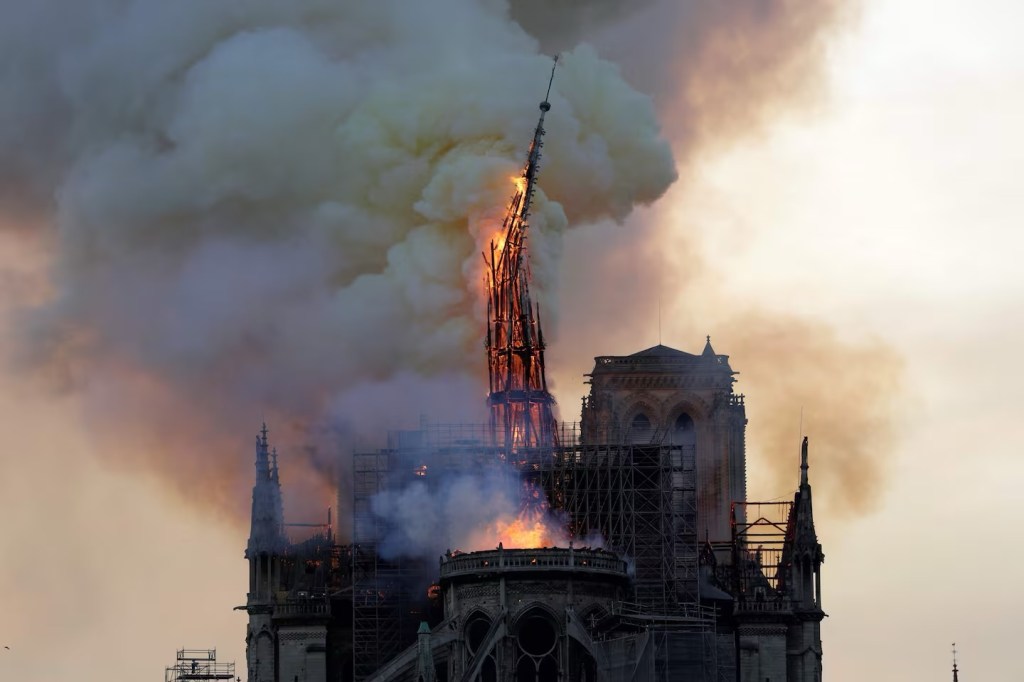
The spire of the Notre Dame Cathedral collapsed as the landmark was engulfed in flames in central Paris on April 15, 2019.AFP VIA GETTY IMAGES

Soon Burrey would begin a journey that would end with him becoming one of just a handful of American artisans to work on the French team that completed a stunning reconstruction of one of the world’s great cultural artifacts.

“It’s the pinnacle of my career,” Burrey said recently, following the grand reopening of the cathedral on Dec. 8. “I have such great appreciation for being able to be a part of the group effort that demonstrated that the traditional trades that built Notre Dame 800 years ago are still here, still viable and teachable and learnable for people today.”

His work on the project was made possible by Handshouse Studio, a nonprofit based in Norwell that focuses on building large historical objects as educational projects. In the past, the studio has recreated a Revolutionary War-era wooden submarine as well as a 17th century Polish synagogue.

Burrey has been collaborating with Handshouse for a quarter century, and they, too, were looking for ways to help Notre Dame. Thus, the Handshouse Studio Notre Dame Project was born.

The first thing they did, both as an educational exercise and out of a show of solidarity with the French, was build a full-scale model of one of the wooden trusses that supported the roof of Notre Dame. These were the hidden structures inside the massive cathedral where the devastating fire started.

Burrey brought a team of students from his restoration carpentry class at North Bennet Street to Washington, D.C., in 2021. For two weeks they worked with skilled traditional craftsmen from the Timber Framers Guild to build the massive wooden structure, known as Choir Truss #6, working all the way from white oak logs hewed with broad axes to the finished product.

“It was a way for us to say that building something as it was originally made is not only possible but also important,” said Marie Brown, executive director of Handshouse Studios. The original hope, she said, was that they might donate the truss to the French for inclusion in the cathedral. But something else happened, something even cooler.

The build was so successful that the two architects overseeing the reconstruction of Notre Dame, Rémi Fromont and Philippe Villeneuve, traveled to the United States to see the structure. As a result, they invited two American timber framers to join the reconstruction team in France. One invitation went to Michael Burrey. The other went to Jackson Dubois, a Washington state man who is president of the Timber Framers Guild.

For three months in the summer of 2023, Burrey and Dubois joined 18 carpenters from a French company called Asselin working on the wooden components of the Notre Dame spire. They operated out of the medieval town of Thouars in western France, about three hours from Paris, and Burrey worked on the decorative elements of the spire — the quatrefoils, trefoils, railings, and dormers. There were language barriers, Burrey said, but the one thing they had in common was that they all spoke carpentry.

“[Burrey] called me a couple times from France and was telling me about what he was working on, where he was sitting, what he was seeing in this medieval town,” said Claire Fruitman, the provost and interim president of North Bennet Street School.

Burrey (third from left) joined French carpenters for a picture. The French carpenters built the quatrefoils for the nave of Notre Dame cathedral. MICHAEL BURREY

“No one ever wants any sort of heritage to have something go wrong,” she added. “But when it does it’s amazing to say we have people who can fix it and bring it back to life, and the lessons he learned over there are things he’s brought back into the classroom for the next generation of preservationists.”

Burrey, who lives in Plymouth, was not the only local craftsperson to work on the project. Hank Silver, who owns Ironwood Timberworks in Hatfield, worked as lead carpenter for the nave, the central, large space of the cathedral that accommodates the congregation during religious services. Silver declined an interview request, but told Elle Décor that “for someone like me, being able to work on this building, which is the birthplace of this technique, is particularly meaningful. When I look at Notre Dame, I will be able to say, ‘I built that.’”

Burrey, meanwhile, has not been to the cathedral since it reopened, but he said he has marveled at the photos of the completed work.

“There’s nothing but a smile on my face, and a feeling of deep appreciation for being part of a group effort, when I think of everybody coming together to get things back the way they should be,” he said.

In President Joe Biden’s tribute to President Jimmy Carter, there is an implicit contrast with the man who will be inaugurated as the 47th President of the United States. Just take every self-evident statement about Carter’s integrity, honor, and humanity, and flip it to its opposite extreme. You will have a portrait of 47: a man who never donned the uniform of his country; a man who never did an unselfish act for anyone else; a man whose business career was noted for bankruptcies, thousands of lawsuits, and unpaid bills; a man known for serial lies; a man who has been married three times and cheated on all his wives. A man whose name is synonymous with lying, cheating, greed, and selfishness.

Now, read about the other extreme: a man who devoted his life to his country and service to others. President Jimmy Carter. A man who had a lifelong devotion to his wife. A man who sent his only child Amy to public schools in D.C. when he was President.

President Biden released this statement:

Today, America and the world lost an extraordinary leader, statesman, and humanitarian.


Over six decades, we had the honor of calling Jimmy Carter a dear friend. But, what’s extraordinary about Jimmy Carter, though, is that millions of people throughout America and the world who never met him thought of him as a dear friend as well.


With his compassion and moral clarity, he worked to eradicate disease, forge peace, advance civil rights and human rights, promote free and fair elections, house the homeless, and always advocate for the least among us. He saved, lifted, and changed the lives of people all across the globe.


He was a man of great character and courage, hope and optimism. We will always cherish seeing him and Rosalynn together. The love shared between Jimmy and Rosalynn Carter is the definition of partnership and their humble leadership is the definition of patriotism.


We will miss them both dearly, but take solace knowing they are reunited once again and will remain forever in our hearts.


To the entire Carter family, we send our gratitude for sharing them with America and the world. To their staff – from the earliest days to the final ones – we have no doubt that you will continue to do the good works that carry on their legacy.


And to all of the young people in this nation and for anyone in search of what it means to live a life of purpose and meaning – the good life – study Jimmy Carter, a man of principle, faith, and humility. He showed that we are great nation because we are a good people – decent and honorable, courageous and compassionate, humble and strong (love this line).


To honor a great American, I will be ordering an official state funeral to be held in Washington D.C. for James Earl Carter, Jr., 39th President of the United States, 76th Governor of Georgia, Lieutenant of the United States Navy, graduate of the United States Naval Academy, and favorite son of Plains, Georgia, who gave his full life in service to God and country.

The death of President Jimmy Carter at age 100 reminds us of how far we have fallen as a nation. Where once we elected a man to lead the nation who was a model of honesty, integrity, humility, faith, and conviction, we just re-elected a man who lacks any principles and who lives to make more and more money. Where Carter spent his post-presidential years serving others, Trump spent four years whining and threatening revenge and retribution. Carter’s selflessness was legendary; no one has ever mentioned any selfless act ever performed by Trump.

Adam Kinzinger was one of the few Republican members of Congress who stood up to Trump. Along with Liz Cheney, he served on the Commission that investigated January 6, 2021. He left Congress and now writes a blog, commenting on current events. If the Republican Party ever breaks free of the dead hand of MAGA, Adam is one of the people who should lead it.

He wrote this tribute to Jimmy Carter:

As I sit down to reflect on the passing of Jimmy Carter, my heart is heavy with both sorrow and profound gratitude. President Carter’s life was a testament to the power of humility, faith, and a commitment to serve others. He wasn’t just a former president; he was a moral compass for our nation, a reminder of the values that should guide us as Americans and as human beings.

Born into modest beginnings in Plains, Georgia, Jimmy Carter’s faith was a cornerstone of his life. A devout Christian, Carter lived out the teachings of his faith with quiet resolve. He taught Sunday school well into his 90s, often drawing crowds who came not only to hear his words but to witness the authenticity of a man who practiced what he preached. His commitment to human dignity and compassion wasn’t confined to words or sermons—it was demonstrated through decades of action.

After leaving the White House, Carter could have easily faded into a life of comfort and prestige. Instead, he chose a path of service that extended far beyond his presidency. Through the Carter Center, he fought tirelessly for human rights, free elections, and the eradication of preventable diseases. His work in global health alone saved countless lives, exemplifying what it means to leave the world better than you found it.

Perhaps one of the most visible symbols of his post-presidential legacy was his dedication to Habitat for Humanity. Even in his later years, you could find him with a hammer in hand, building homes for families in need. This was Jimmy Carter—a man who believed that faith without works is dead, who lived his life proving that service to others is the highest calling.

In a time when our nation often feels divided, President Carter’s life offers a blueprint for unity. He believed in the power of kindness and the necessity of justice. Whether championing peace in the Middle East or advocating for marginalized communities at home, Carter’s moral clarity reminded us that politics should serve the people, not the other way around.

The country is better because of Jimmy Carter. Not just because of his policies or achievements, but because of the example he set. He showed us what leadership grounded in humility and grace looks like. He reminded us that faith can be a force for good, that it should inspire us to build bridges and extend a helping hand.

As we mourn his loss, let us also celebrate the remarkable legacy he leaves behind. May we strive to embody the values he lived by—faith, service, and an unwavering belief in the potential for good in every person. Rest in peace, President Carter. You were a beacon of light in a world that often seems dark, and your impact will endure for generations to come.

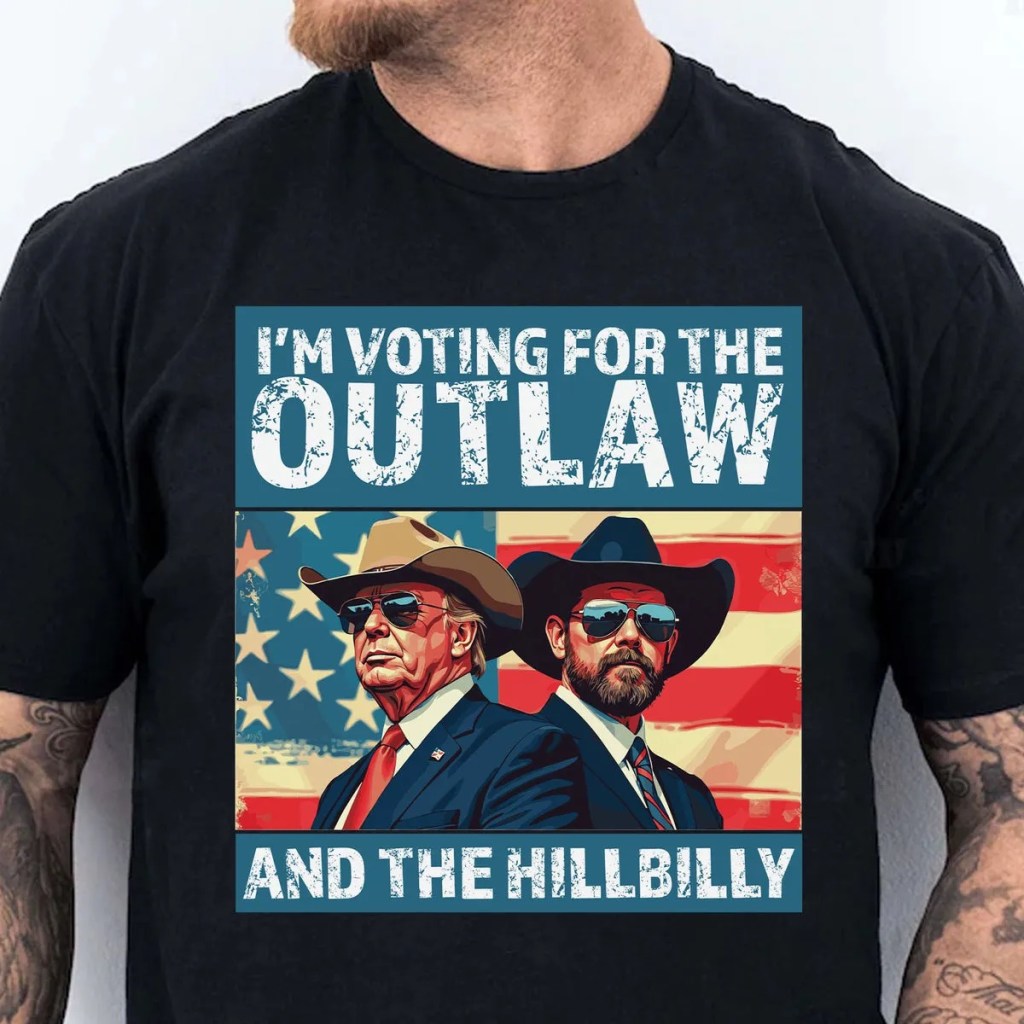
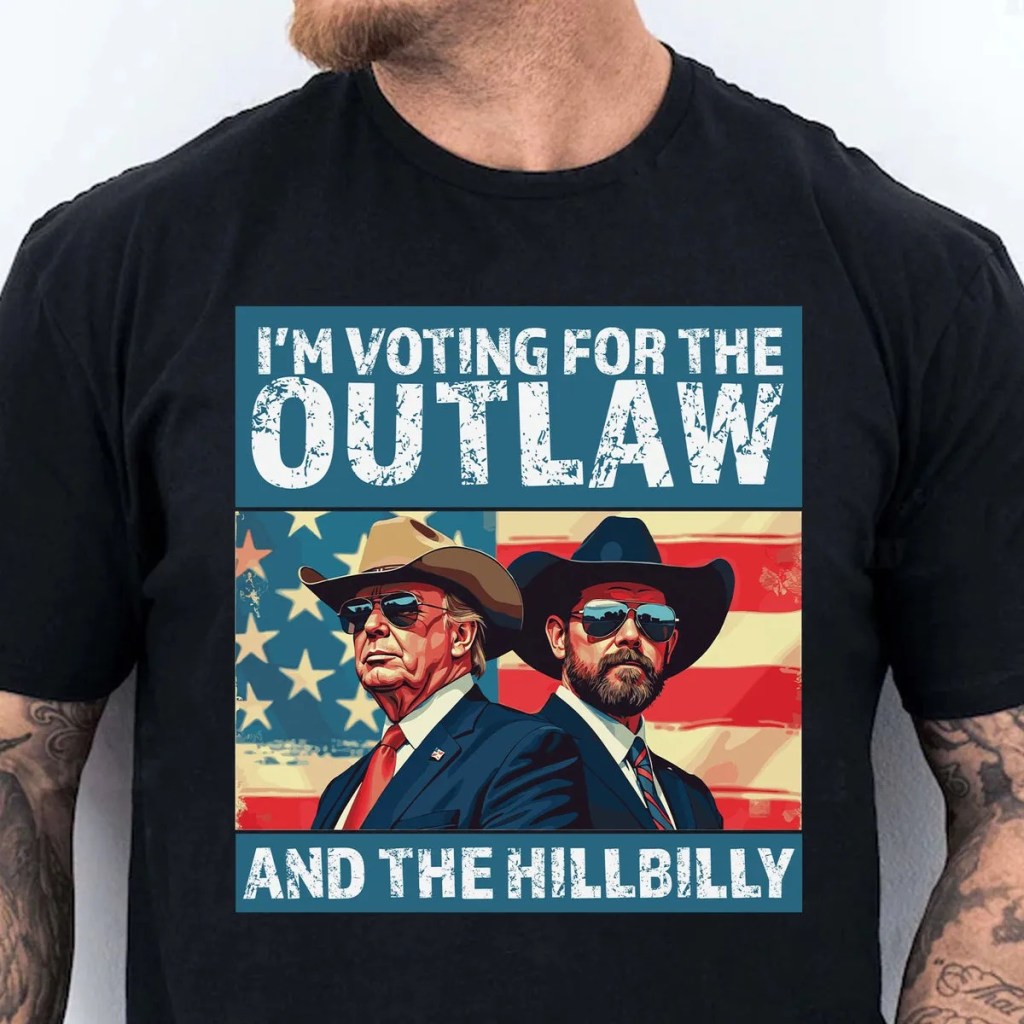
In the post at 9 a.m today, Joyce Vance included a photo of a T-shirt of Trump and Vance, billed as “the Outlaw and the Hillbilly.” Now, that’s clever marketing!

An Outlaw is often an admirable figure in westerns. He’s a folk hero. He’s the guy who goes up against the Establishment. He’s the Sundance Kid, he’s Robin Hood, he’s the handsome guy who gets the girl, he’s a lot of characters who live on the fringes of society and stand up for the little guy.

This is not Donald Trump. He is reverse Robin Hood. He steals from the poor and fattens the bank accounts of the rich. He doesn’t defend the helpless damsel, he sexually asssults her, then laughs about it and defames her. He does not stand outside society on its fringes, he owns the biggest, gaudiest mansion and installs solid gold toilet seats. Far from being handsome and buff, he is an obese old man with thinning hair and sagging jowls. He is a coward who dodged the draft five times yet pretends to be a tough guy.

As for J.D. Vance, he was once a hillbilly but that was long, long ago. Now he plays a hillbilly. He is a graduate of Yale Law School who made millions of dollars in the financial sector, where his patron was Peter Thiel, the woman-hating billionaire.

Not an Outlaw! Just a womanizing convicted felon who is a superb liar, braggart, and bully.

Not a Hillbilly! Just another far-cat who attached himself to super-rich patrons.

Trump passed one piece of legislation in his first term: a big tax cut for his billionaire buddies, corporations, and himself.

We know what his priorities are. Ego. Money. Power. Control.

He’s already forgotten about the people who voted for him. They can’t do anything for him any more. He won’t lower the price of food or gasoline or home insurance. He might take away their Social Security or Medicaid. He might cut programs they rely on.

He will take care of the people rich enough to belong to Mar-a-Lago.

Joyce Vance is a veteran federal prosecutor; she was the U.S. Attorney for the Northern district of Alabama from 2009-2017. She writes a blog called “Civil Discourse with Joyce Vance.” She usually writes about the law, the justice system, and Trump’s efforts to avoid accountability for his misdeeds. But in this post, she addresses the root cause of his appeal: low-information voters who are hoodwinked by his lies and believe he will fight for them. Ha. Not funny.

She writes:

It’s no wonder that Project 2025 calls for putting an end to the Department of Education. Trump’s electoral success depended on so-called low-information voters, members of the electorate who couldn’t or didn’t distinguish between the tough talk and tough guy image the candidate portrayed and the reality of the policies that come with his win. That’s often true for MAGA candidates, who are inexplicably able to attract the voters who are harmed by the policies they subsequently pass, as with tax cuts for the extremely wealthy and the working-class voters who didn’t benefit from them, but made them possible.

The Washington Post had this story today about the hopes of low-income voters who went for Trump in 2024, like a single mom who said she sometimes has to choose between buying toilet paper and milk and told reporters, “He is more attuned to the needs of everyone instead of just the rich … I think he knows it’s the poor people that got him elected, so I think Trump is going to do more to help us.” So far, that’s not looking good.

This very predictable reporting about voters suffering from buyers’ remorse is emerging even before Trump takes office. These people hope he won’t do exactly what he said he would during the campaign and has been focused on during his transition with programs like the Department of Government Efficiency, Elon Musk’s DOGE—cut government spending that they depend on. Whether it’s low-income people, mixed-status immigrant families, people who rely on Social Security, or parents with immune-compromised kids who rely on immunized classrooms, people voted against their own self-interest and are now facing that reality.

There are no do-overs in presidential elections. Successful disinformation campaigns or campaigns where image trumps consequences have lasting effects.

But spin, or disinformation—however you want to characterize it—designed to redirect voters away from focusing on bad facts about candidates can work, and this past election proved it. This T-shirt ad that the algorithm fed me earlier this week is an example of how Trump’s criminal conviction was sold to voters: the mythical outlaw, not the corrupt criminal. It’s hard to believe Americans fell for that, but they did, giving Trump a pass and letting him cultivate an image that was one step further out there than Sarah Palin’s maverick. 

Voters who lack the backbone of a solid education in civics can be manipulated. That takes us to Trump’s plans for the Department of Education.

Stepping on education and staunching the flow of information is a key goal for any authoritarian. Remember when Trump told an evangelical group during the campaign that if they voted in 2024 it would be the last time they had to vote? That’s something that Americans, hopefully, will not fall for, because the 2026 midterms will be key. If guardrails are going to be rebuilt, that’s where an important part of it will happen. And while we’re all burned out from the last election, this next one will matter; we will need to reengage, because a big Democratic win could staunch the bleeding from unfettered acquiescence by the legislative branch to Trump, who currently commands majorities in both chambers. That means the provision of accurate information and accurate analysis of that information to voters who will put it to use is important. But what does that look like in a country that voted for Trump?

One thing that is clear from the ease with which Trump seems to have stripped so many voters of their common sense is the need to restore civics education in this country. That’s a long-term plan and a big topic that we need to take on over time, but it’s not too early for us to begin to think about what we can do in the coming year ahead of the midterms. For one thing, if it’s right for you, even if it’s a stretch, consider running or seeking appointment to a school board. Republicans got the jump on Democrats in this arena. It’s time to catch up. Or, if that’s not in your lane, make the time to show up at school board meetings and demand civics education in our schools. Progress in this area will take time, but we can all set a good example and encourage people around us to do a better job of understanding what matters in government. Ironically, if 2017 is any indication, people caught off guard (although who knows how) by some of the worst excesses Trump is likely to engage in will be ready to be better informed and reengage in democracy. Capturing that moment will be important.

One of the goals of Project 2025 is terminating the Department of Education. There is growing Republican support for that plan at the state level by leaders who want to restore state control (much like conservatives sought restoration of abortion policy to the hands of red state officials in Dobbs). Enter Trump’s nominee to head the Department, Linda McMahon, who ran the Small Business Administration (SBA) for him from 2017 to 2019.

Trump’s appointment of the professional wrestling magnate has drawn little comment as the media has focused on Matt Gaetz, Pete Hegseth, and others. Suffice it to say she does not appear to possess much of a background in public education. She was on the Connecticut Board of Education for one year, but there has been reporting she received that appointment after lying about having a degree in education. When that report came to light while McMahon was running, unsuccessfully, for a Connecticut Senate seat, she said that “she mistakenly thought her degree was in education because she did a semester of student teaching, and that she had written to the governor’s office the previous year to correct the error after another newspaper noticed the mistake.” (I, too, did some student teaching in college, but I was always clear my degree was in political science and international relations.)

McMahon is a longtime Trump ally and financial backer, apparently key qualifications for the job. After two years at the SBA, she stepped aside to run Trump’s America First Action PAC. Other qualifications: Yahoo News reported that “Donald Trump’s nominee for education secretary was once pile-driven by a 7ft wrestler and feigned being drugged unconscious while her husband cheated on her.” Yahoo went on to recount that “Mr. Trump served as a sponsor and host for WWE events in Atlantic City in the late 1980s and years later appeared in the ring himself, when he took a razor to the head of Ms. McMahon’s scandal-ridden husband, Vince, as the wrestling boss wailed. In 2013, WWE inducted Mr. Trump into its hall of fame.” 

The National Education Association ran an editorial opposing McMahon’s confirmation. They called her “unqualified” and wrote that she “spent years pushing policies that would defund and destroy public schools.” That sounds like a good fit if your agenda involves destroying the Department of Education. Start at the top.

NEA President Becky Pringle said, “McMahon’s only mission is to eliminate the Department of Education and take away taxpayer dollars from public schools, where 90% of students – and 95% of students with disabilities – learn, and give them to unaccountable and discriminatory private schools.”

So while we begin to think about ways to repair democracy, medium-term goals like winning midterm elections, and long-term goals like restoring civics education, spare a moment for some short-term plans: write to your senators about McMahon’s nomination. It’s flying largely under the radar screen, and it should not be. Do not obey in advance, and do not make it easy for Trump to destroy democratic institutions like the Department of Education with the complicity of your state and federal elected officials. We have a lot of work to do when it comes to public education. We have to insist that free, publicly funded, high-quality education is available to every child. Our engagement as citizens is everything. Let’s get to work.

We’re in this together,

Joyce

Open the link to see the illustrations.

Allison Gill is a Navy veteran, a comedian, a podcaster, and a blogger. Her blog “Mueller, She Wrote,” was launched at the beginning of that long-ago investigation of Trump’s connections to Russia. This post appeared on her blog:

I’m not a lawyer, but usually, when the Supreme Court hears a case, they are supposed to rule on that specific case. Yet somehow, in two crucial cases about holding Donald Trump accountable for insurrection, the corrupt court went out of its way to decide on questions not before it, and create “a rule for the ages,” as Neil Gorsuch put it during oral arguments this past spring.

The first bomb they dropped to destroy accountability for Trump was their ruling overturning the Colorado Supreme Court on Section 3 of the 14th Amendment. The justices decided 9-0 that Colorado could not keep a federal candidate off the state ballot – but a 5-4 majority took it a step further by deciding that Section 3 of the 14th amendment is not self-executing; meaning Congress has to first pass legislation disqualifying Trump. An idea so wrong that even Amy Coney Barrett joined the liberal justices and objected to that part of the ruling in her concurrence.

The second bomb they dropped was the immunity ruling. Not only did they grant Trump presumptive immunity in the case before them, but they granted all presidents presumptive immunity, and took it a step further by disqualifying official acts from being used as evidence to prosecute unofficial acts.

But that’s not all! Rather than deciding which acts in the Trump case were subject to immunity, they kicked it back down to the lower court, teeing up a second interlocutory appeal on whatever the lower court ruled. That effectively added another year to the delay. Additionally, it would give the corrupt court another swing at the DoJ case on the second appeal, where I imagine they’d rip it apart once and for all. When all was said and done, they decided that they themselves would be the ultimate arbiter of rulings on official acts for criminal presidents while adding ridiculously long pre-trial appeals to the process.

That’s nothing compared to the official acts evidence part of the ruling. Again – so bad and so wrong that Amy Coney Barrett joined the liberal justices to disagree. The gist is this: let’s say you want to prosecute a president after he leaves office for accepting a million dollar bribe in exchange for an ambassadorship. And let’s say you have emails between the president and the potential ambassador explicitly stating “I will give you this ambassadorship in exchange for a million dollars.” This Supreme Court ruling says you can’t mention the appointment of the ambassador (the quo) while trying to prosecute the bribe (the quid). Absolutely bonkers.

These two rulings are the reason we can’t have nice things. That and Mitch McConnell failing to convict Trump of Insurrection after his impeachment. These decisions are the reasons Trump has not been held accountable. All because a bought-and-paid-for supreme court, funded by dark money with corporate interests before the court, needed to protect Trump from prosecution and accountability.

Were it not for the immunity ruling, Donald would have faced trial for his role in the insurrection in March of 2024. Would a conviction have made a difference in the election given he was already a 34-count convicted felon? I don’t know, but we would have had a trial were it not for the Supreme Court. The immunity ruling also contained a permission slip from Clarence Thomas in his concurrence for Aileen Cannon to dismiss the documents case, opining apropos of NOTHING that Jack Smith was probably appointed and funded improperly.

POOF. Both DoJ trials were scrapped from the pre-election calendar. But even if Trump had lost the election, there’d be a second interlocutory appeal of Judge Chutkan’s immunity determinations that would have gone all the way back up to the Supreme Court – adding at least a year to the trial calendar. Would the corrupt court have left Judge Chutkan’s ruling in place, allowing the case to go to trial? If you believe that, I have a luxury motor coach to sell you.

People have been trying to convince me that if Trump were indicted sooner, he would have gone to trial before the election and wouldn’t have been re-elected. For that to be true, you’d have to convince me that the dark money funded oligarchs on the Supreme Court would have been cool one time and allowed the trial to happen. You’d also have to convince me that people are fine electing a man convicted of 34 felonies, but not a man convicted of 38 felonies. I have my doubts.

Regardless, I will forever blame the billionaire-funded Supreme Court. They are part of the oligarchy, and were installed to dismantle democracy. 

~AG

Mercedes Schneider read a story last spring about a man who contracted polio in 1952 when he was six years, survived it, but spent the next 72 years dependent on an iron lung. Despite his limited ability to survive outside the machine, Paul Alexander finished college and law school, then practiced law. Before his death, he became a TikTok star.

When she read the story, it was interesting– but now it’s timely. After all, Trump has appointed a vaccine critic to run the Department of Health and Human services. Trump himself said in a national interview that he is skeptical about mandating vaccines for school children.

So Mercedes decided it was time to do some research about polio. Her post is engaging and brings back memories for those of us who were in school before the first vaccine was discovered and made available. We lived in terror of getting polio.

Alexander said:

In one video, Mr. Alexander detailed the emotional and mental challenges of living inside an iron lung.

“It’s lonely,” he said as the machine can be heard humming in the background. “Sometimes it’s desperate because I can’t touch someone, my hands don’t move, and no one touches me except in rare occasions, which I cherish.”