Archives for the year of: 2023

We keep hoping that some sane Republican will emerge and eclipse The Former Guy. It’s probably a vain hope, but one likely prospect was Nikki Haley, former Governor of South Carolina and Trump’s Ambassador to the UN.

While campaigning in Londonderry, New Hampshire, Haley expressed her negative views about the nation’s public schools. Sadly, she parroted the standard Republican tropes.

She said:

“Stop the gender pronoun classes that are happening in the military,” Haley said, as the crowd cheered in response.

Mirroring the recent culture wars that have unfolded in local school districts like Goffstown, Haley called for “complete transparency in the classroom.”

“No parent should ever wonder what’s being said or taught to their children in the classroom,” Haley said.

Haley implored for the end of “national self-loathing” in schools. “Our kids need to know to love America,” Haley said, claiming that kids are being told America is a racist, rotten country.

“I was elected the first female minority governor in history,” Haley said. “America is not racist, we’re blessed.”

Jeanne Kaplan was a tireless champion of public schools in Denver. She was elected to two terms on the Denver school board. She fought for better, more equitable, fully funded schools. She opposed charter schools because they drained funding from public schools. She was a long-time crusader for civil rights, and she appalled by the takeover of the Denver schools by charter interests, who flew a false flag, pretending to care about equity.

Jeannie learned that she had lung cancer last April. Her medical treatment did not slow the disease. She died yesterday. She was 78.

I met Jeannie in Denver in 2010 as I was traveling the country to promote my book The Death and Life of the Great American School System: How Testing and Choice Are Undermining Education. When I met her, we became fast friends. We were on the same page, and she told me about the damage that charter schools were doing to Denver’s public schools. Candidates for the Denver school board were funded by Dark Money, privatizers, and out-of-state billionaires. It was almost impossible for a parent to raise the money to be competitive with the corporate reform candidates.

Jeannie was a warm and caring person who inspired others to get involved, despite the odds crested by Big Money. She started her own blog called “Kaplan for Kids,” and I reposted some of them here.

I think the best way to honor her memory here is to post what seems to be her last commentary, which overflows with wisdom, candor, experience, and common sense. I humbly add her name to the honor roll of the blog.

Jeannie Kaplan wrote:

CHARTERS, CHOICE, and COMPETITION = CLOSURES, CHAOS, and CHURN Principles of Privatization

Posted on November 1, 2022 by Jeannie Kaplan

Reap what you sow and the chickens come home to roost. The elephant in the room.  Aphorisms appropriate to describe what is happening in public education in Denver. 

After 20 years,  more than 5  superintendents, and 11 different school boards, the results of education reform in Denver have become clear, and they aren’t pretty. After opening 72 charters in the last 20 years, 22 of which have closed, the declining enrollments in neighborhood schools have forced the prospect of school closures.  Who knew opening 26 privately run elementary charter schools in competition with district-run schools would ultimately force the district to make some hard financial decisions?  And who knew that ignoring its own 2007 data showing stagnant population growth would lead to less demand for elementary school seats in the 2020s?  Apparently, not those with the power for the last 20 years.  And, as an ironic aside, many of the same people who were the decision-makers in the past and who were unable to make substantive change then, have now decided they will somehow make these previously unattainable changes from their outside “oversight” committee, EDUCATE Denver. In fact one of the co-chairs, Rosemary Rodriguez, was a DPS board member when on March 16, 2017, a Strengthening Neighborhoods Resolution passed, stating:

NOW, THEREFORE, BE IT RESOLVED, that a citywide committee be formed to review changing demographics and housing patterns in our city and the effect on our schools and to make recommendations on our policies around boundaries, choice, enrollment and academic programs in order to drive greater socio-economic integration in our schools.

BE IT FURTHER RESOLVED, that in the face of the sharp decline in the number of school-aged children in gentrifying neighborhoods, the committee is also charged with how to think about school choice and school consolidation to ensure that our schools are able to offer high-quality, sustainable programs for our kids.

These former school board members and former and current civic leaders have formed a “shadow school board” to evaluate and oversee the current superintendent and school board.  Why?  It appears they don’t like what they are seeing being proposed by the current superintendent. What don’t they like?  It appears they have determined the current superintendent is not committed enough to their reform agenda.  You know – the one that has been in place when they were in power, the one that has produced the biggest gaps in the nation, more segregation, and more resource inequity.

As school closures have risen to the fore this week Chalkbeat disclosed these statistics:

“Over the past 20 years, Denver Public Schools has added a lot of schools. It has added students, too — but at a much slower rate.

  • The number of public schools in Denver grew 55% between the 2001-02 and 2021-22 school years, while the number of students grew just 12%.
  • Denver went from having 132 schools serving about 72,000 students in 2001-02 to 204 schools serving nearly 89,000 students in 2021-22.
  • The number of elementary schools in Denver grew 23% over the past 20 years, while the number of students grew just 4%.”

Through expensive marketing and often false narratives, charter schools have had free reign to prey on susceptible families resulting in DPS losing 7400 elementary school students who would have otherwise most likely attended a neighborhood school. Then add in:

  • a state law that prohibits a district from shutting down low enrollment charters, 
  • a district that has ignored demographic information predicting declining enrollment, 
  • a district that employs “attendance zones” and a secretive CHOICE system to often force place students into heavily marketed, often unwanted CHARTER SCHOOLS, and 
  • a competitive financial model called Student Based Budgeting (SBB – money follows the kid) to fund schools, depending on student needs, the goal of which is to close the achievement and resource gaps.  The 2010 Denver Plan/ Strategic Vision and Action Plan describes SBB this way:  
  • Established student-based budget formulas that increase dollars for middle and high school students, special education, English language learners, gifted and talented programs, and students living in poverty. Resource distribution is now more closely aligned with the costs of serving these students. p. 51
  • Refine Student-Based Budgeting formulas to ensure they are best meeting the needs of all of the district’s students. Continue to evaluate and adjust student-based budgeting formulas to 1) meet student needs, 2) make progress on closing the achievement gap, and 3) grow the number of high school graduates and college-ready students. p. 53

No one should be surprised the DPS superintendent is saying schools must be closed (new word is UNIFIED but it still means CLOSURE), given the quagmire he entered.  What would you expect to happen when 72 new charter schools are opened in a landscape of stagnant or declining population growth? Who should be held responsible for the chaos and churn caused by this over-expansion of new charter schools? 

I know, I know. One isn’t supposed to talk about charters any more. But it is the elephant in the room. Education “reformers” want you to believe charters are an irrevocable fact of life in public education, stare decisis if you will. But as we have recently witnessed, that precedent is non-binding. So let’s use it to the advantage of neighborhood school advocates. Let us not assume charters are inevitable, especially given the chaos and poor academic outcomes charters are producing. Denver isn’t the only place experiencing the madness of so many charters. Just this week lifelong educator Arthur Camins wrote:

It is time for Democrats–voters and the politicians who represent them–to abandon charter schools as a strategy for education improvement or to advance equity. Charter schools, whether for- or non-profit, drain funds from public schools that serve all students, increase segregation, and by design only serve the few.

It is worth repeating that in 20 years, DPS has added 72 charter schools, 22 of which have closed.  As students of public education repeatedly attest to, charters have been particularly harmful to neighborhood schools for they gut these schools of resources. Charters have also been disruptive to communities and have contributed to increasing inequity and segregation in our schools. It is not possible to have an honest conversation without addressing that elephant in the room.  Charter schools along with their partners – choice and competition – have had their chance in Denver and their biggest accomplishment has been to pressure neighborhood schools to close.

Let us not overlook the demographic projections DPS has been aware of since the mid 2000’s. 

“It’s really simple, we’ve seen a slow down in births,” said Elizabeth Garner, demographer for the state. “Starting back in 2007, that was our peak birth year, we’ve seen a slowing in births ever since. So with fewer kiddos, that means lower school enrollment.”

Let us not overlook who was supporting and approving this unchecked expansion.  DPS had strong indicators from as early as 2007 onward the population of the city and the number of school-age children was flattening, and yet the district with the strong support of many of the aforementioned  “oversight committee”, EDUCATE Denver, pushed for this proliferation of new charter schools without giving demographics its proper due.

Loss of students = loss of funding (SBB) = loss of programming and supports = closure

Superintendent Alex Marerro has been charged with improving student outcomes and reducing gaps by implementing his strategic plan.  School unifications are one way he has chosen to start this process.  He inherited a district suffering from years of “feel good” oversight from boards and the nonprofit world determined to paint a rosy picture of reform education success, a district more focused on good public relations stories than actual educational outcomes. Now he has to try to provide solutions to problems that have not been dealt with honestly for years. And yes, “unification” has raised as many questions as it has provided answers such as how transportation and language services will be provided and what will be done with these empty buildings. And there is the elephant in the room – again.  Charter schools. Why are they not included in his recommendations? Again, he has no authority to recommend closing them, even though several are also suffering from declining enrollment.  Given this reality, it will be interesting to see how he chooses to address this issue. In the end, how can the board fairly evaluate him according to measures both they and he just agreed on, if it rejects his operational ideas?

As for what neighborhoods these closures would most heavily affect – What would one expect to happen when new charters are opened in neighborhoods heavily populated by families of color and families struggling economically?  Why is there any surprise that most of the schools on the “unification” list affect these neighborhoods?  How could it be otherwise when these are the sites of uncontrolled, privately run options to public schools.  Sadly, it only makes sense that these are the neighborhoods that would suffer the highest impact of school closures.

Few like to close schools.  It is a heart-wrenching, disruptive, negative process. But given the lack of thoughtful planning and oversight for 20 years, what is the better option? Keeping schools open without the financial ability to provide necessary services and supports, or providing unified schools with the money to provide language support,  art, music, nurses, librarians, psychologists, speech therapists?  

Imagine a great school district that had paid attention to population warnings and  hadn’t opened so many charter schools over the last 20 years. Imagine all those charter school children filling those neighborhood schools.

The chickens have come home to roost.

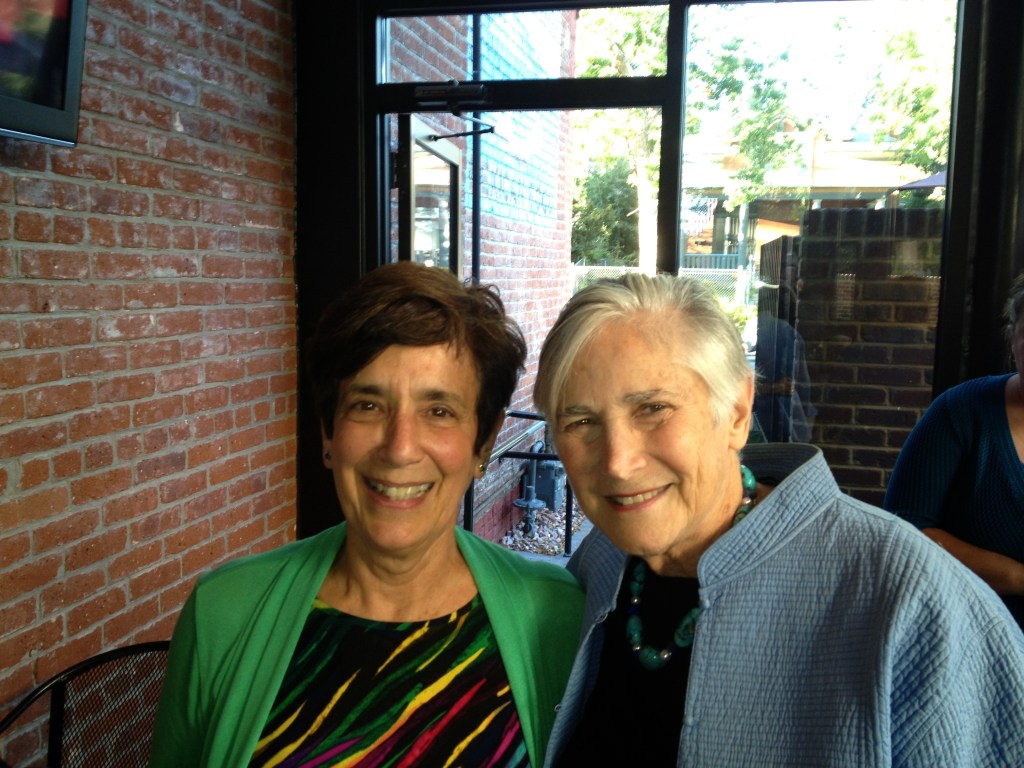
Jeannie and I in Denver, 2013.

When Governor Ron DeSantis declared war on “woke,” the Disney Corporation spoke out, objecting to DeSantis’ hostility towards gays. DeSantis lashed out at Disney, dissolved its self-governing district, and placed the district under the control of a new board, whose members were selected by DeSantis.

Scott Maxwell, a regular opinion writer for the Orlando Sentinel, reports that the DeSantis board has serious issues caused by its incompetence and cronyism.

He writes:

If you look at the headlines coming out of Ron DeSantis’ new governor-controlled Disney district, you might think that Central Florida’s newest attraction is Mickey’s Wide World of Governmental Dumpster Fires.

New reports show veteran employees and managers are fleeing, saying incompetent management is in charge.

Spending on road maintenance is down while $795-an-hour checks to politically connected lawyers are increasing.

And now we’ve learned that the district awarded a $240,000 no-bid contract to yet another political insider — a member of the state’s now-infamous ethics commission who used to serve alongside the district’s ethically embattled new director, Glen Gilzean. That contract was canceled Monday after media raised questions.

Gee, who could’ve ever imagined that asking political cronies to mount a politically motivated takeover of a private business would lead to trouble?

Let’s start with the staff exodus. The Florida watchdog website, Seeking Rents, reported over the weekend that more than 30 district employees — including nearly half the senior leadership team — have resigned amid claims of mismanagement.

The numbers were significant, representing more than 350 years of combined experience and about a tenth of the district’s workforce resigning over the course of nine months. But just as significant were the reasonsthey gave for leaving.

One departing department director called the new leadership “unqualified and incompetent,” saying in an exit survey obtained via public-records requests that: “With the departure of more than 3 dozen employees, the district is no longer functional.”

A departing accountant described “a toxic workplace right now.” A former manager with more than 30 years of experience said the new political appointees “show a severe lack of trust for employees.”

And a departing executive assistant said the new leaders “could care less about the work that needs to be done for the taxpayers.”

Then there’s the no-bid contract that the new Central Florida Tourism Oversight District recently awarded to another political crony — DeSantis ally Freddie Figgers (whose name actually sounds like a Disney character).

As WFTV reported last week, the district awarded Figgers a contract to help provide 911 services without giving other Florida companies the chance to bid on the gig.

Now, the district’s procurement policy states that contracts worth more than $100,000 should be competitively bid. And this contract was worth $242,500. Even Tweedledum knows that second number is bigger than the first.

But the district said that — gosh, darn it — it just didn’t have time to competitively bid this job out and that their policies allow “emergency” contracts to be issued without bids.

That sounds like a lot of Bibbidi Bobbidi bunk — especially since the contract ended up going to another DeSantis appointee.

Yes, these guys want you to believe that in a state of 22 million people, the only company capable of doing this emergency-communications work happens to be run by another gubernatorial appointee who serves on this state’s joke of an ethics commission.

It’s truly a small world, after all.

After local media asked questions, Figgers sent a letter to the district Monday agreeing to cancel his no-bid contract to “err on the side of caution,” saying: “We welcome the opportunity for an open bidding process …” Good for him. That’s how it should’ve been all along.

Speaking of the ethics commission, I still don’t understand how anyone thinks it’s proper for Gilzean to be pulling down this $400,000-a-year paycheck after the ethics commission’s own attorney said he was violating state statutes earlier this year by trying to serve as both an ethics commissioner and a paid public employee. Gilzean was forced to give up his ethics post, but this governor has yanked duly elected public officials out of office who have broken no rules while he leaves this statute-violating guy in a cushy job.

Meanwhile, the district is racking up legal bills. The district’s budget shows spending on “professional services … due to legal fees” has skyrocketed from $4.2 million to $11.1 million with some of that money going to $795-an-hour law firms, including one whose partners include DeSantis’ former roommate and campaign supporter.

At the same time, the amount budgeted for road repairs and maintenance — you know, the kind of work the district is actually supposed to be doing — has been cut by several million dollars, even though the park is growing and costs are rising.

So, cronies are cashing in while services suffer under this gubernatorial board whose members include a Moms for Liberty member and a pastor who made headlines for suggesting that contaminated tap water was turning people gay. The Mad Hatter would be proud…

Meredith Lee Hill of Politico reports that House Republicans are itching to cut the food stamp program, but running into opposition from Democrats and farm-state Republicans.

Mike Johnson‘s new role as House speaker heightens the chances of a major political clash next year over one of the nation’s largest welfare programs and the government’s preeminent aid package for farmers and rural America.

The fallout is likely to reverberate in countless congressional races, not to mention President Joe Biden’s attempts to win back rural votersin the 2024 presidential race.

Johnson, more so than previous Speaker Kevin McCarthy, is a proponent of more hardline GOP efforts to overhaul the Supplemental Nutrition Assistance Program, the country’s largest anti-hunger program that serves 41 million low-income Americans. As a senior member of the conservative-leaning Republican Study Committee, Johnson backed proposals to roll back food aid expansions under Biden and block states from exempting some work requirements for SNAP, formerly known as food stamps. In 2018, Johnson referred to SNAP as “our nation’s most broken and bloated welfare program.”

Now, the RSC, Freedom Caucus hardliners and other Republicans are pressing to include similar measures in the next farm bill. Such a move would upend the fragile bipartisan coalition needed to pass the legislation — a blow to House Republicans who represent the majority of rural and farm districts, including Johnson, as well as more centrist GOP members who will be fighting for their political lives in 2024.

Open the link to read more.

Didn’t Jesus say something about feeding the hungry and clothing the needy? Why do these people rattle on about Christianity but ignore the words of its leader?

Texas clergy spoke out against Governor Gregg Abbott’s plan to promote voucher legislation. Governor Abbott has vowed to keep convening special sessions of the legislature until he wins vouchers, which will benefit students already in private and religious schools. Abbott has campaigned for vouchers by visiting private schools, which stand to benefit from his plan. Meanwhile the state has a budget surplus of nearly $33 billion. The governor has blocked any increase in teachers’ salaries until he gets vouchers. To date, rural Republicans have stood strong against vouchers, which would hurt their communities and turn off the “Friday night lights” (the football games).

The Network for Public Educatuon distributed their statement. In addition to the three who wrote the statement, it was co-signed by more than 100 other members of the clergy.

Texas Clergy: Texas schools don’t need vouchers.

Three Texas religious leaders say that Abbot’s voucher plan is not what schools need. Dr. Michael Evans, Re. Dr. Mary Spradlin, and Rabbi Brian Zimmerman wrote this op-ed for the Star-Telegram, and over 100 other clergy signaled their agreement.

We are Fort Worth- area clergy and advocates for public education, driven by our faith to support the well-being of our state’s children. Our belief in community responsibility to provide the best possible education for every child is unwavering. The sad truth, however, is that we are falling short of this commitment.

Across Texas, our schools grapple with underfunding, overcrowded classrooms and overworked teachers. Educators face numerous challenges, including the disruptions brought about by the COVID-19 pandemic. Most are disheartened by the increasingly politicized environment that undermines their abilities and integrity without a factual basis.

Some argue that the main issue in public education is teachers promoting controversial ideologies, undermining traditional values and neglecting core subjects such as reading and math.

This is a false narrative. As pastors, many of us regularly convene with school leaders to assess students’ progress. Our teachers are driven to improve education for their kids in the classroom. Elementary teachers aim to help early readers move toward goals set by people with little understanding of the life of families who, for example, may have already had to move many times in their young child’s life.

The claim that “public schools are failing” is overly simplistic and diverts attention from our collective responsibility. We fail our kids when we buy into this hysteria — part of a national playbook determined to undermine public education. We fail our kids when we have a historic $32.7 billion state budget surplus but refuse to raise the basic allotment to fund schools.

We fail our kids when we blame school districts and teachers for campus ratings without speaking against a system that prioritizes one STAAR test score. We fail our kids when we refuse to acknowledge the correlation between poverty and school performance. We fail our kids when we buy into the claim that the best thing to do is to “pull kids out” of public schools.

Some argue that vouchers or education savings accounts, known as ESAs, would provide options for all students, but the numbers reveal otherwise. Texas has more than 347,000 kids in private schools and more than 5.5 million in public schools. An ESA allotment of $8,000 for a child from the projected $500 million the Legislature is considering would help only 57,500 students after administrative costs. The cost/benefit analysis of this plan doesn’t add up.

Read the full op-ed here. 

You can view the post at this link : https://networkforpubliceducation.org/blog-content/texas-clergy-texas-schools-dont-need-vouchers/

Thom Hartmann writes here about the most consequential Supreme Court decision of our time: Citizens United. That decision unleashed the power of big money to control our politics. It’s consequences have diminished our ability as a nation to take action on pressing issues. It has allowed the Uber-rich to buy politicians. That always existed to some extent. Citizens United established the practice as business as usual.

Hartmann writes:

According to Talkers Magazine, the “Bible of the Talk Radio Industry,” I talk with around 6 million people every week on my nationally syndicated call-in radio/TV show. What I’m hearing, increasingly (I’ve been doing this program for 20 years now), is frustration bordering on despair about the inability of America to get basic, necessary things done.

Why is it, people ask, that we can’t do anything about guns amidst all these mass shootings? Or homelessness? Or affordable healthcare and education? Why are we moving so slowly on climate change? How did social media get excused from responsibility for its own content and then become overrun by Putin bots and Nazis?

And why do we let the billionaires who own social media (along with all the other billionaires) get away with only paying an average 3.2% income tax when the rest of us are making up for it by paying through the nose? Why can’t Congress pass a simple budget or raise taxes enough to stop running deficits?

What happened, people ask, that caused America’s politicians — in the years after JFK — to stop listening to the people who elect them? Why is it that (other than tax cuts), when Republicans have power or the ability to block Democrats efforts, nothing gets done?

The simple and tragic answer to all these questions comes back to a single root cause: money in politics. Or, to be more specific, Republicans on the Supreme Court having legalized political bribery (and, thus, functional ownership) of judges and legislators, both federal and state.

In 1976, in response to an appeal by uber-rich New York Republican Senator James Buckley, the Court ruled that wealthy people in politics couldn’t be restrained from using their own money to overwhelm their political opponents. They then went a step farther and struck down other limitations on billionaires using their own money to “independently” promote the campaigns of politicians they like.

Their rationale was that restrictions on rich people buying political office “necessarily reduce the quantity of expression by restricting the number of issues discussed, the depth of the exploration, and the size of the audience reached. This is because virtually every means of communicating ideas in today’s mass society requires the expenditure of money.”

In other words, for morbidly rich people to have “free speech,” they must be able to spend as much money on politicking as they want. If you don’t have millions or billions, your free speech is pretty much limited to how loud you can yell: this was a decision almost entirely of, by, and for the morbidly rich.

Two years later, in 1978, four Republicans on the Court went along with a decision written by Republican Lewis Powell himself in declaring that corporations are “persons” entitled to human rights under the Bill of Rights (the first 10 amendments to the Constitution), including the First Amendment right of free speech.

And free speech, as they’d established two years earlier, meant the ability to shovel money into political campaigns. Effective in April of 1978, elections could go to whoever spent the most money.

Democrats largely ignored the rulings (until 1992). They hadn’t been the party of the rich since the 1920s, and, with a third of American workers in a union, those unions provided plenty of money for political campaigns.

But Republicans — specifically, the 1980 Reagan campaign — jumped forward with both hands out for all the cash they could grab. The gift they offered wealthy people who supported them? Tax cuts, even if they drove the deficit sky high.

There were still quite a few campaign restrictions in place in 2010, when five Republicans on the Supreme Court did it again, striking down literally hundreds of state and federal laws and regulations by doubling-down on their assertion that “money is free speech” and “corporations are persons with human rights.”

Thus, we can track many of the worst aspects of America’s political dysfunction to these three corrupt Supreme Court decisions, as I detail in The Hidden History of the Supreme Court and the Betrayal of America and The Hidden History of American Oligarchy.

Prior to the Court’s Citizens United decision, for example, there was a bipartisan consensus in Congress that climate change was caused by burning fossil fuels and that we should do something about it, as Senator Sheldon Whitehouse so eloquently documents.

John McCain campaigned for president on a platform of doing something about climate change: he was the lead cosponsor of the Climate Stewardship Act, which had multiple other Republican cosponsors. At the time, he said:

“While we cannot say with 100 percent confidence what will happen in the future, we do know the emission of greenhouse gases is not healthy for the environment. As many of the top scientists through the world have stated, the sooner we start to reduce these emissions, the better off we will be in the future.”

The Clean Air Planning Act was supported by Republican Senators Lamar Alexander, Lindsay Graham, and Susan Collins. Republican Senator Olympia Snow was the lead cosponsor of the Global Warming Reduction Act of 2007. Multiple Republicans supported the Low Carbon Economy Act and the Clean Air/Climate Change Act.

In 2009, Republicans supported the Raise Wages, Cut Carbon Act and the Waxman-Markey carbon cap-and-trade proposal. Maine Republican Susan Collins was the lead cosponsor of the Carbon Limits and Energy for America’s Renewal Act, a bill that would have imposed a fee on burning fossil fuels. At the time, she said:

“In the United States alone, emissions of the primary greenhouse gas carbon dioxide have risen more than 20 percent since 1990. Clearly climate change is a daunting environmental challenge…”

And then, in 2010, everything changed.

Clarence Thomas, actively groomed for decades by fossil fuel and other billionaires, became the deciding vote in Citizens United, legalizing not only his own corruption but that of every Republican in Congress.

Once the fossil fuel industry could pour unlimited money into either supporting — or, perhaps more importantly, destroying — the candidacy of any Republican politician, every Republican in the House and Senate began to say, “What climate change?”

As Senator Whitehouse said on the floor of the Senate:

“I believe we lost the ability to address climate change in a bipartisan way because of the evils of the Supreme Court’s Citizens United decision. Our present failure to address climate change is a symptom of things gone awry in our democracy due to Citizens United. That decision did not enhance speech in our democracy; it has allowed bullying, wealthy special interests to suppress real debate.”

When Poppy Bush was president, the world confronted a crisis with acid rain destroying monuments and buildings; Democrats and Republicans came together and put into law a sulfur dioxide cap-and-trade “free market solution” that largely solved the problem.

Why can’t we do the same with a cap-and-trade system for carbon pollution from fossil fuels like the European Union, Australia, New Zealand, and South Korea have already done? Citizens United.

Similarly, why can’t America get our gun crisis under control? We’re the only country in the world where schoolchildren are subjected to the monthly terror of active shooter drills.

Bullets are the leading cause of death among our nation’s children. But no Republican will take on the issue because they know the firearms industry and its front groups will destroy them with a waterfall of money for their inevitable opponent in the next election. Citizens United.

Our public schools are crumbling as the charter and private school industries pour millions into politicians’ coffers. Instead of fixing our schools and raising our educational standards, the private school industry has gotten Republican governors in several states to offer vouchers to every student in the state.

It’s busting the budgets of states (once the public schools are dead, they’ll cut back on the generosity of the vouchers), but making literally billions in profits for the private school industry — money that’s then, in part, recycled back to the politicians promoting their interests. Citizens United.

Please, please, please open the link and read the rest of this brilliant article.
Thomas Ultican of California has become a regular attendee at the annual meetings of the Network for Public Education. He attended every keynote and many panels, and he reports here on what he heard.

Ultican wrote:

NPE met at the Capitol Hilton for a weekend conference beginning on Friday, October 27. The old hotel seemed well maintained. That first evening, Diane Ravitch interviewed James Harvey who was a key contributor to “A Nation at Risk.”We gathered in a large conference room which caused Mr. Harvey to comment, “I remember being at a meeting in this room fifty years ago when we heard that Alexander Butterfield had just testified that there were tapes of the oval office.” With that historical reference, the conference was off to a wonderful start.

A Nation at Risk” is seen as an unfair turning point that undermined public education. Mr. Harvey’s job was to synthesize the input from members of the National Commission on Excellence in Education, which was created by Secretary of Education Terrence Bell to produce the report. He shared with us that two famous academics on the panel, Nobel Prize winner Glen Seaborg and physicist Gerald Holton, were the driving forces for politicizing public education.

Diane Ravitch and James Harvey

That first night’s presentation was actually an added event for the benefit of us coming in on Friday afternoon. The conference had three keynote addresses, two panel discussions and seven breakout sessions. The difficult problem was choosing which of the six offerings in the breakout sessions to attend.

Pastors for Children

For session one, I attended “Mobilizing Faith Leaders as Public Education Allies.” The amazing founder of Pastors for Children, Charles Foster Johnson, and his two cohorts were well reasoned and did not proselytize us. Their movement really does seem to be about helping communities and not building their church. Among Johnson’s points were,

  • “Privatized religion teachers believe “God likes my tribe best.”
  • “We are the reason there is not a voucher program in Texas.”
  • “Conservatives and liberals come together over education.”
  • “Faith leaders have a different effect when lobbying politicians.”
  • “We are making social justice warriors out of fundamentalist Baptist preachers.”

Houston School Takeover

I have no intention of writing about each of the 7 sessions I attended, but the session on the Houston School District takeover needs mention.

Texas took-over Houston Independent School District (ISD) on June 1, 2023. It is the largest school district in the state and eighth largest in the country with more than 180,000 students attending 274 schools. The student demographics are 62% Hispanic, 22% African-American, 10% White and 4% Asian with 79% identified as economically disadvantaged.

In 2021, Millard House II was selected by a unanimous vote of the Houston ISD school board to be Superintendent. Under his leadership, Houston ISD was rated a B+ district and the school in one of Houston’s poorest neighborhoods that was used to excuse the takeover received a passing grade on Texas’s latest STAR testing. The take-over board replaced House with Mike Miles, a charter school operator from Colorado who previously only lasted 2 years of his five year contract to lead the Dallas ISD.

Ruth Kravetz talked at some length about the how angry Houstonians are and their effective grassroots organizing. Kravetz stated, “We want Mike Miles gone.” She noted that the local media started turning against the takeover when citizens were locked out of the first takeover board meetings. Kravetz intoned,

  • “Teachers no longer need a certificate or college degree to teach in Houston ISD.”
  • “Seven year-olds are not allowed to use restrooms during instructional times. They must wait.”
  • “People are being fired for ridiculous reasons. Five people were fired last week over a made up story.”
  • Expect more student action against the takeover.
  • “Rolling sickouts are coming.”

Jessica Campos is a mother in one of Houston’s poorest communities. She said her school is made up of 98% Mexicans with 68% of them being Spanish speakers. Jessica claims, “Our school community has been destroyed” and reported that all teachers were removed with many being replaced by uncertified teachers.

Daniel Santos (High School social studies teacher) said,

“It is all about dismantling our school district. We wear red-for-Ed every Wednesday and Mayor Turner lights up city hall in red.”

The Keynote Addresses

Gloria Ladson-Billings from the University of Wisconsin Madison delivered the first Keynote address on Saturday morning.

She mentioned that we were really dealing with 4 pandemics:

  1. Covid-19
  2. George Floyd murder
  3. Economic Shesession” (Large numbers of women were forced to leave the workforce.)
  4. Climate catastrophe

Professor Ladson-Billings claims the larger agenda is the complete eradication of public education in what she sees as an evolving effort.

  • The evacuation of the public spaces which are being privatized.
  • Affordable, Reliable and Dependable (public space keys) is being undermined.
  • Public housing is closing.
  • The last domino is public education!

Ladson-Billings says, “choice is a synonym for privatization.” There is money in the public and wealthy elites do not think the public should have it.

She noted, “We are in the business of citizen making.” We do not want to go back to normal because it was not that great.

Ladson-Billings ended on a positive note about the attack on public education in Florida, “All is not lost – people on the ground in Florida are working hard to reverse it.”

History Professor Marvin Dunn from Florida was our lunch time keynote speaker. Professor Dunn has been working hard to educate the children of Florida about the states racist past including giving guided tours of the site of the 1923 Rosewood Massacre of an African American community.

He noted that “Racism is in our national DNA” and shared that George Washington owned 500+ slaves. When he was 11 years-old, Washington was given his first slave. Still, 500 black soldiers were with him at the crossing of the Delaware river.

Another American icon mentioned by Professor Dunn was Thomas Jefferson. The third president of the United States was 41 years-old when first having sexual relations with Sally Hemings; she was 14.

Julian Vasquez Heilig, Josh Cowen and Jon Hale held a public discussion late in the afternoon on Saturday. The moderator, Heilig, made the point that instead of funding one system, now many states are funding three systems with the same amount of dollars.

Josh Cowen, from Michigan State University, noted that using evidence based data, since 2013, vouchers have been catastrophic. If we were using evidence informed education policy, vouchers would have died 5 years ago. Test score losses from voucher students are greater than those experienced in either Katrina or Covid-19. He also noted that 20% – 30% of children give up their voucher each year.

Cowen added don’t believe a word coming out of Iowa Governor Kim Reynolds’ mouth. She has instituted vouchers, opposed abortion and supported child labor. Reynolds is pushing Christian nationalism.

Jon Hale, from the University of Illinois says white architects of choice have a 70 year history. He says it was never about improving schools. The white supremacist movement sprung up after Brown versus the Board of Education in 1954…

What I Found

Several participants showed up kind of down in the mouth. However, by the end of the conference they were heading back home with new energy and resolve. Billionaires are spending vast sums of money trying to end public school because if public education goes then all of the commons will follow. Their big problem is that vast wealth and spending is not a match for the grassroots organizing that is happening throughout America.

Diane Ravitch, Carol Burris and the members of NPE have become a bulwark for democracy and public education.

Paul Thomas of Furman University is a clear-sighted analyst of education policy. He is fearless when it comes to calling out frauds. This post is a good example.

He writes:

“The administrations in charge,” write Gilles Deleuze in Postscript on the Societies of Control, “never cease announcing supposedly necessary reforms: to reform schools, to reform industries, hospitals, the armed forces, prisons” (p. 4).

Deleuze’s generalization about “supposedly necessary reforms” serves as an important entry point into the perpetual education crisis in the US. Since A Nation at Risk, public education has experienced several cycles of crisis that fuel ever-new and ever-different sets of standards and high-stakes testing.

Even more disturbing is that for at least a century, “the administrations in charge” have shouted that US children cannot read—with the current reading crisis also including the gobsmacking additional crisis that teachers of reading do not know how to teach reading.

The gasoline that is routinely tossed on the perpetual fire of education crisis is test scores—state accountability tests, NAEP, SAT, ACT, etc.

While all that test data itself may or may not be valuable information for both how well students are learning and how to better serve those students through reform, ultimately all that testing has almost nothing to do with either of those goals; in fact, test data in the US are primarily fuel for that perpetual state of crisis.

Here is the most recent example—2023 ACT scores:

I have noted that reactions and overreactions to NAEP in recent years follow a similar set of problems found in reactions/overreactions to the SAT for many decades; the lessons from those reactions include:

  • Lesson: Populations being tested impact data drawn from tests.
  • Lesson: Ranking by test data must account for population differences among students tested.
  • Lesson: Conclusions drawn from test data must acknowledge purpose of test being used (see Gerald Bracey).

The social media and traditional media responses to 2023 ACT data expose a few more concerns about media, public, and political misunderstanding of test data as well as how “the administrations in charge” depend on manipulating test data to insure the perpetual education crisis.

Many people have confronted the distorting ways in which the ACT data are being displayed; certainly the mainstream graph from Axios above suggests “crisis”; however, by simply modifying the X/Y axes, that same data appear at least less dramatic and possibly not even significant if the issues I list above are carefully considered….

This crisis-of-the-day about the ACT parallels the central problem with NAEP, a test that seems designed to mislead and not inform since NAEP’s “Proficient” feeds a false narrative that a majority of students are not on grade level as readers.

The ACT crisis graph being pushed by mainstream media is less a marker of declining educational quality in the US and more further proof that “the administrations in charge” want and need testing data to justify “supposedly necessary reforms,” testing as gas for the perpetual education crisis fire.

Please open the link to read this excellent analysis in full.

If you have never experienced Halloween on Garden Place in Brooklyn, you are missing a treat. I lived on Garden Place for 25 years and participated in the Halloween frenzy annually. Typically, I bought 3,000 pieces of candy and started handing them out at 4 pm. By 7, we were cleaned out. Three wild and wonderful hours.

This article catches the flavor of happy mayhem.

Nancy Flanagan thought, as I did, that most parents would be happy to send their children to school when the pandemic ended (note: it’s not really ended). But neither of us anticipated what really happened.

This is an excerpt from a longerpiece. You should read it all.

Flanagan writes:

Here are eight pandemic-driven outcomes impacting the functioning of public schools, as the health crisis fades.

1. Vaccination rates, already worrisomely dropping, now have hit their lowest point since 2011, in spite of laws requiring vaccinations for schoolchildren. You have to ask yourself why parents are not eagerly seeking a vaccination that undoubtedly saved countless lives and reduced hospitalizations: Health officials attributed a variety of factors to this drop in vaccinations, including families being less likely to interact with their family doctor during the pandemic and a “spill-over” effect from misinformation around the COVID-19 vaccine. 

2. Book banning, an issue that schools have perennially wrestled with, especially in conservative communities, has now spread to public libraries.  ALA President Emily Drabinski explained that while “attacks on libraries right now are shaped and framed as attacks on books” these efforts are really “attacks on people and attacks on children.” In retaliation for advocating against book bans, some conservative states — including MontanaMissouri and Texas — have announced they are “severing ties with the ALA.”

3. The four-day workweek and remote work elbowed their way into traditional M-F/face to face classrooms at the same time they were conceived as the solution to keeping a workplace open during a pandemic. For schools in rural areas where transportation eats up budgets, fewer schooldays and more Zoom classes can keep public schools aliveHybrid work arrangements have killed the return-to-office hype. Employees equate a mix of working in the office and working from home to an 8 percent raise. They don’t have to deal with the daily hassle and costs of a commute. Remote work saves companies money. It cuts overhead, boosts productivity and is profitable. And what is profitable in a capitalist economy sticks. Remote work also has major benefits for society, including improving the climate by cutting billions of miles of weekly commuting and supporting families by liberating parents’ time.

4. Higher education also seems to be undergoing a metamorphosis, as high school graduates and returning-to-school adults have reassessed the value of a college degree: In a study conducted by the U.S. Census Bureau, the majority of adults who had household members enrolled in college for the fall 2021 term said that their school plans changed.

32% said their classes would occur in different formats.

16% canceled all plans to attend.

12% took fewer classes.

It goes without saying that what impacts our colleges and universities will trickle down to K-12 public schools.

5. Shifts in the need for labor and workforce development have impacted the need for teachers, and what teachers are willing to work for, especially in long-term careers in education. Perhaps Sean Fain, leader of the UAW best expressed this: “Our fight is not just for ourselves but for every worker who is being undervalued, for every retiree who’s given their all and feels forgotten, and for every future worker who deserves a fair chance at a prosperous life. We are all fed up of living in a world that values profits over people. We’re all fed up with seeing the rich get richer while the rest of us continue to just scrape by. We’re all fed up with corporate greed. And together, we’re going to fight to change it.”

6. The incessant media drumbeat of “learning loss” has persuaded people that test scores are more reliable than our own observations about what students are learning, how they’re progressing. From a brilliant article in Rethinking Schools: Shifting blame away from the for-profit healthcare system and the government’s response to the coronavirus is part of what makes the learning loss narrative so valuable to politicians who have no interest in challenging existing patterns of wealth and power. It is a narrative meant to distract the public and discipline teachers. Here’s the recipe: 1. Establish that closing schools hurt students using a narrow measure like test scores; 2. Blame closure of schools on teacher unions rather than a deadly pandemic; 3. Demand schools and teachers help students “regain academic ground lost during the pandemic” — and fast; 4. Use post-return-to-normal test scores to argue that teachers and schools are “failing”; 5. Implement “teacher-proof” (top-down, standardized, even scripted) curriculum or, more insidiously, argue for policies that will mean an end to public schools altogether. 

7.  School leaders and the education community, used to hard-trimming back budgets year after year, have now witnessed unprecedented levels of greed and corruption in corporate and political circles, taking tax dollars away from struggling schools.  From Heather Cox Richardson’s August 24th newsletter:  The Department of Justice is bringing federal criminal charges against 371 defendants for offenses related to more than $836 million in alleged COVID-19 fraud, most of it related to the two largest Small Business Administration pandemic programs: the Paycheck Protection Program and Economic Injury Disaster Loans. It’s hard not to wonder how many library books, STEM kits and teachers that $836 million could have bought, as we all rebound from disaster.

8. A mishandled pandemic will likely be followed by political unrest—or, at least, uncertainty. In Ottawa County, Michigan, always a solidly red, conservative county, the 2022 election overturned a more moderate governing board and put in place a collection of people who were angry—furious, in fact– about what happened during the pandemic. Here’s a well-written, balanced story on the impact this political shift is having on people in Ottawa County—a young woman who delivers food to families who need it, a local health department administrator, and other essential programs: