Tony Evers was the Wisconsin Superintendent of Public Instruction when he first ran for Governor and was elected. His first election was a triumph, because he succeeded the rightwing extremist Scott Walker, who hated unions, public schools, and public higher education, three of the jewels in Wisconsin’s crown. The celebrated “Wisconsin Idea” was centered on those policies, policies that advanced opportunity and equity.
Evers brought that rightwing extremism in the governor’s office to a halt, but he still had to deal with a Republican legislature, intent on frustrating everything he hoped to do.
Despite Republicans’ smear campaign, Evers was re-elected by a margin of 51-47, while his Lt. Governor Mandela Barnes lost to Republican Senator Ron Johnson, a reprehensible Trumper, by 1%.
This post is so important that it is the only one I have scheduled today. Please read it and share it with your friends, your local newspaper, your local radio station, your elected representatives, social media, anyone who cares about the future of our society. This is not a reprint. The author, Josh Cowen, wrote this post for this blog.
Josh Cowen, a professor at Michigan State University, has been studying vouchers for more than 20 years. He has been a member of the teams conducting major studies of vouchers. When I read his article in The Hechinger Report, where he declared that he was convinced that vouchers were disastrous for students who use them, I wanted to know more about him and his experience. I wanted to ask him, “Why did you change your mind?” That’s the question that’s been asked of me hundreds of times. I have a simple answer and a complicated answer: the simple answer is “I was wrong.” The complicated answer is contained in my recent books, starting with The Death and Life of the Great American School System: How Testing and Choice Are Undermining Education.
I invited Josh to explain his views for my blog, and he graciously accepted. I consider this piece to be one of the most important statements I have posted in the decade this blog has been live. Please note two points he makes:
One, vouchers harm the children who leave public schools to use them.
Two, most of the early voucher research was conducted by researchers who were partisan supporters of vouchers.
Josh Cowen writes:
It’ll be a few more days for the final election results to be tallied nationwide, but it seems clear that with midterm wins by voucher supporters in places like Oklahoma, Texas and even Pennsylvania—where even the Democratic gubernatorial victor is on record in cautious favor—voucher opponents are going to have to keep working hard to block public funding of private and religious schools.
School vouchers have devastating effects on student outcomes. Full stop. That’s something even the nation’s voucher advocate-in-chief Betsy DeVos has had to admit, because the data are so stark.
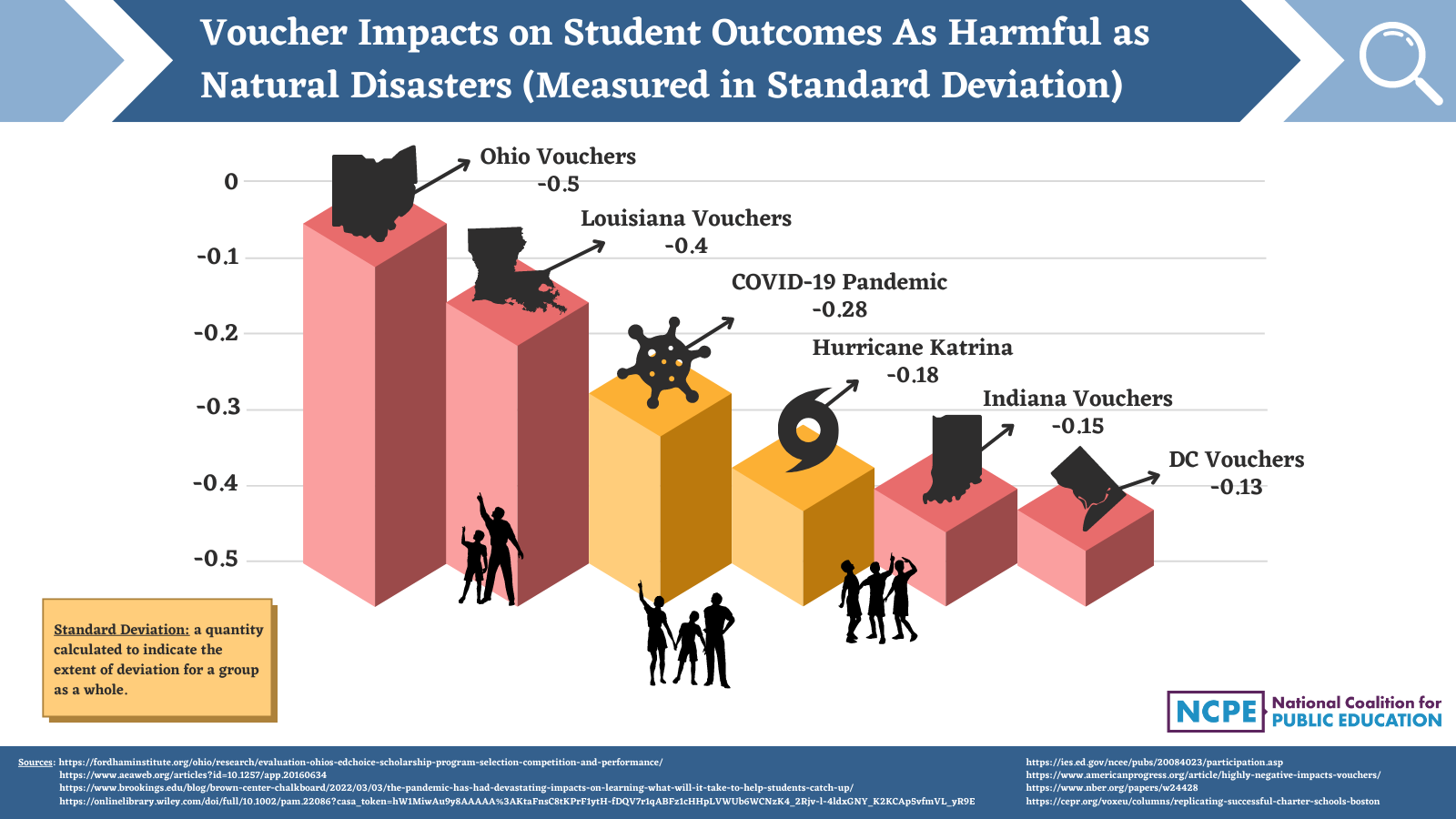
Large-scale independent studies in D.C.,Indiana, Louisiana, and Ohio show that for kids who left public schools, harmful voucher impacts actually meet or exceed what the pandemic did to test scores. That’s also a similar impact in Louisiana to what Hurricane Katrina did to student achievement back in 2005.
Think about that next time you hear a politician or activist claim we need taxpayer support for private schools to offset what the pandemic did to student learning. Here, their cure would in test score terms be quite literally worse than the disease.
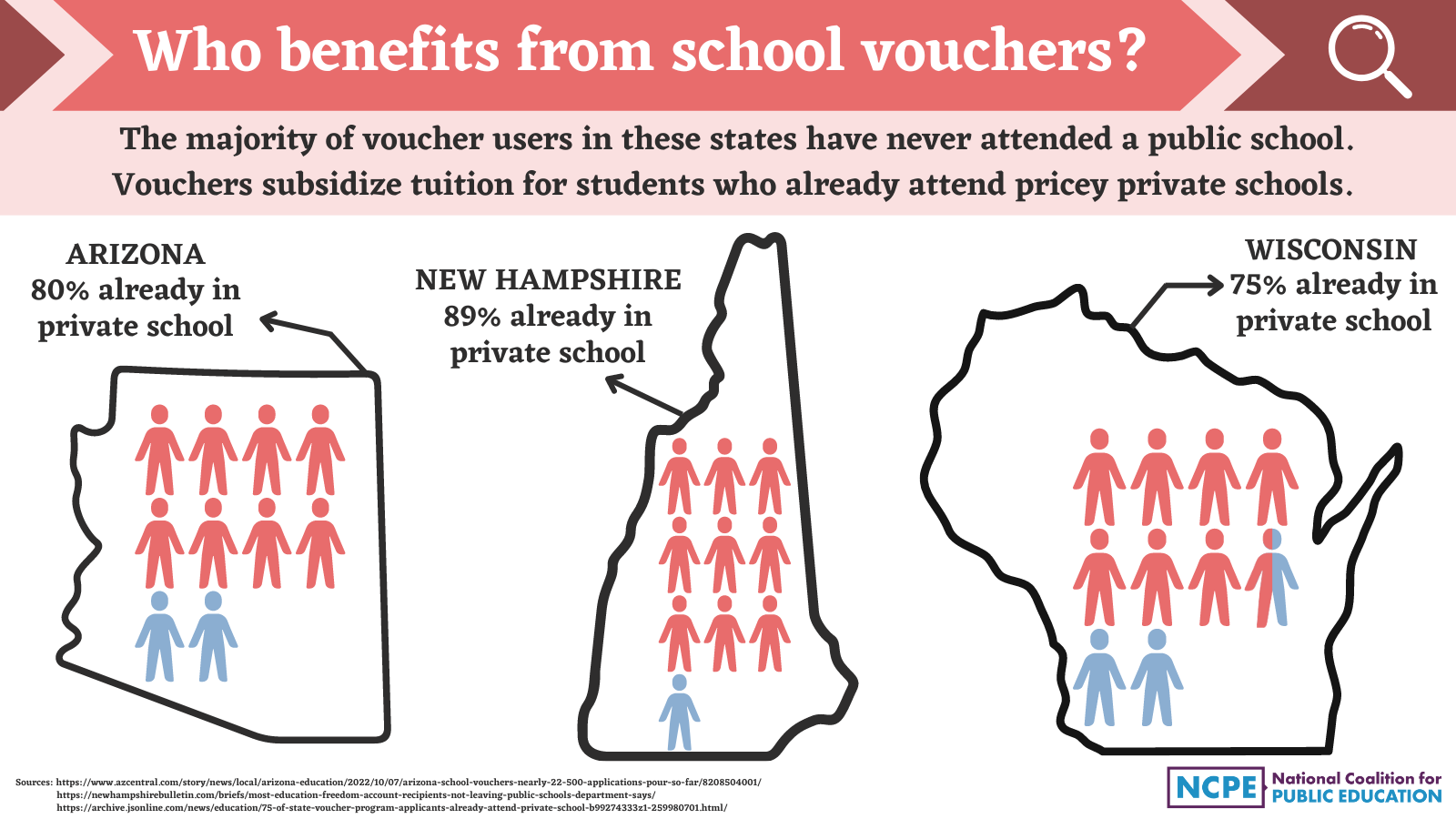
There’s another data point you need to know up front: vouchers overwhelmingly fund children who were already in private school without them. In states that have released those numbers—Arizona, New Hampshire, and Wisconsin—we know more than 75% of voucher applicants came from private schools.
The bottom-line: most kids using vouchers didn’t need them to go to private school, and the few kids who actually did use vouchers to transfer sectors schools suffer average test score drops on par with what a once-in-a-generation pandemic did to test scores too.
If you’re a picture person, our friends at the National Coalition for Public Education were kind enough to put their considerable talents into two graphics based on these data I provided to them.
Notice the citations these graphs include. They’re the same as the hyperlinks above. These data come from independent sources and from non-partisan journalists. That’s a critically important part of this story.
And then there’s this, before we get into the details: the same people pushing vouchers are the same people working to undermine fair elections and the right to vote.
None of these are metaphors, and this is not a drill.
So how did we come to this?
1. A Quick History of Voucher Research
First let’s talk about the evidence.
I came into the school voucher research community early. It was around 2001 or so, as a young graduate student assistant for a study of privately funded vouchers led by the conservative professor Paul E. Peterson who was based at both Harvard and the conservative Hoover Institution at Stanford (never heard of Hoover? Think Condoleeza Rice.)
Peterson and his protégé Jay Greene had already done one study of Milwaukee’s publicly funded voucher program, as well as the one in Cleveland that was about to be the subject of the U.S. Supreme Court’s first favorable ruling on voucher funding. That work generally showed positive results for vouchers. As did the research of a young academic named Cecilia Rouse, who is now President Biden’s chief economist.
But they were small programs. What policymakers and researchers call a “pilot phase.” Back then when both parties cared at least nominally about evidence, you wouldn’t expand a program like vouchers without testing it. So those early tests seemed somewhat positive.
The first research I joined was Peterson and team’s next project: multi-site studies in Dayton, New York City, and Washington D.C. Those programs were also pilot-size. And the New York site in particular showed some limited evidence of voucher success. But overall the lead researchers focused as much on things like parental satisfaction and measures of civic engagement as metrics. That work resulted in a book called The Education Gap. You can find my name in the credits if you own a copy. If you don’t own one, don’t waste your money.
No one knew it at the time, but the mixed results documented in The Education Gap were to be the best vouchers were ever going to do—and ever have done since by an academic based team looking at voucher test scores.
Just a short time later in 2005, I joined a new voucher evaluation led by Patrick Wolf, another Peterson protégé and contributor to The Education Gap. Wolf was by then ensconced with Jay Greene at the University of Arkansas Department of Education Reform, a Walton Family-funded academic group that was about to train a new generation of voucher advocates. Most notably Corey DeAngelis, now at Betsy DeVos’s 501(c)4 voucher lobbying group American Federation for Children.
The Milwaukee evaluation, which was officially done for the state of Wisconsin, lasted from 2005-2010. We found no evidence in five years that voucher kids outperformed public school kids. Two exceptions: we found limited evidence that graduation rates and college enrollment were somewhat higher for the voucher kids. We also found that voucher kids improved when the state required private schools to participate in the same No Child Left Behind-style accountability systems as public schools. In particular once voucher schools knew their performance would be made public they—shockingly!—improved their outcomes.
At the same time as the Milwaukee evaluation, Patrick Wolf and other Arkansas colleagues were working on a new evaluation of Washington D.C.’s federally funded voucher program. That study showed no difference in test scores, but large positive graduate results.
That pattern of “no test score benefits, some attainment benefits” has stuck in the research narrative even among voucher skeptics. But as I recently explained in a piece for the Brookings Institution, it’s just that: a narrative. Other studies in New York, Louisiana and Florida all show no real advantages for vouchers on educational attainment.
And certainly nothing to offset the cataclysmic results that began to come out after the early-stage evaluations I just described. The newer D.C.,Indiana, Louisiana, and Ohio studies that took place after 2013 and have showed pandemic and Katrina-sized harm to student test scores are all of at-scale voucher programs.
What do I mean by “at scale?” I mean that despite limited evidence in those pilot programs, vouchers have been steadily expanding across the country, and within states. So those D.C., Indiana Louisiana and Ohio studies represent our best understanding to date of what happens when you expand vouchers beyond the initial test phase. The answer: horrific impacts on student outcomes.
There are a number of reasons this could be, but I tend to argue we need not overthink this. Vouchers just don’t work. The kids who stand to gain from private schooling were and are already there. For the vast majority of kids, they’re better off in public schools. That’s what the latest voucher research shows.
As an example of what I mean: consider that in Wisconsin (which has not had a statewide study since ours ended in 2010), 41% of voucher-receiving schools have opened and then closed and failed since public funding began in the early 1990s.
That’s what happens when policymakers divert tax dollars to private schools: it’s like venture capitalism for education. It’s like Theranos but for private schooling. New providers race to gobble up new taxpayer money, but most of them have no business near kids.
Now, to fully understand why these terrible policies exist and in fact have never spread faster and further than they are today, we need to understand the politics. And to understand the politics, we need to understand the money.
On the one hand it’s pretty simple. Once you understand that the same people pushing vouchers are the same people funding groups that insist Donald Trump won the election and are now organizing a similar “Big Lie” for 2022’s results, you understand a lot. But read on.
2. Funding Vouchers, Funding Election Lies
It’s difficult to tell how much money has been spent to advocate for school vouchers over the years. But we know perhaps the biggest single funder—perhaps even larger than Betsy DeVos herself—is the Lynde and Harry Bradley Foundation. The Bradley Foundation is a little-known group based in Wisconsin and they’ve given tens of millions of dollars to voucher activism over the years.
Bradley not only funds voucher activism, it funds voucher research too. It was a major funder of the Milwaukee evaluation I was part of and described above. I don’t think they directly influenced our results, but generally speaking you don’t want activism and research funding to mix. Think about it this way: should the Sackler family fund research on the addictive properties of oxycontin? Should Exxon fund studies about the existence of climate change?
For me though, the real problem today is that the Bradley Foundation is hardly limiting itself to supporting research and political advocacy for private schooling. As the New Yorker’s Jane Mayer has meticulously documented in her reporting on financing behind Big Lie activism sowing doubts about President Biden’s 2020 victory, the Bradley Foundation is the convening funder around those activities—the “extraordinary force”, in Mayer’s words, funding and coordinating the Big Lie and other efforts to undermine the integrity of democratic elections.
Bradley is not alone. The Heritage Foundation, a right-wing organization known for its pro-voucher advocacy is, according to Mayer, “working with the American Legislative Exchange Council (ALEC)—a corporate-funded nonprofit that generates model laws for state legislators—on ways to impose new voting restrictions.”
In recent months, Heritage has also distributed talking points that under the guise of objective research attack school diversity and inclusion and directly question health care support for LGBTQ children. Heritage has recently released a report-card style rubric rating state laws on a so-called “Education Freedom” index for tax-supported private tuition. That report card includes the extent to which issues like diversity or sexual preference are components of public school teaching curricula.
The author of each of these documents is a Heritage Senior Fellow named Jay P. Greene. The same Jay Greene who while a conservative scholar at the University of Arkansas was co-director of that Bradley-funded voucher project that hired me back in 2005.
Greene is not alone in the Heritage-Bradley nexus. Cleta Mitchell, a lawyer who participated in Donald Trump’s infamous phone call to the Georgia Secretary of State demanding evidence that would overturn the state’s election results, was actively training poll watchers to question voters leading up to the 2022 midterms in places like my own state of Michigan. The night before the election, the New York Times even ran a story about Mitchell’s work in Michigan. The headline read: “Fueled by Falsehoods, a Michigan Group is Ready to Challenge the Vote.”
Mitchell is a known elections conspiracy theorist, according to CNN, and figures prominently in Mayer’s New Yorker reporting on broader election-related organizing. In her spare time Mitchell is on the Board of Directors of—wait for it!—the Lynde and Harry Bradley Foundation. She’s actually an officer on the Board too.
Michigan is important because we have a voucher proposal waiting to go to the state legislature—even though voucher opponent Gretchen Whitmer has won reelection. That proposal, backed by billionaire and privatization advocate Betsy DeVos, exploits a quirk in the state law allowing lame-duck Republicans to pass the voucher plan without the governor’s signature.
The spokesman for the DeVos voucher campaign is a man named Fred Wszolek. Wszolek is also the strategist for a group that tried unsuccessfully to prevent abortion access from becoming enshrined in the Michigan state constitution. And he heads a political action committee (PAC) called Michigan Strong, which has worked to elect now-defeated DeVos-backed GOP gubernatorial candidate Tudor Dixon.
Also working for Dixon was Kyle Olson of the Education Action Group, an entity devoted to right-wing education reform that’s received money from Charles Koch, the DeVos Family and Harry Bradley—he of the Bradley Foundation.
That’s just one example, but you get the idea: the same people working to push school vouchers are the same people working to undermine elections. And in some cases even reproductive rights.
3. So Why Now?
I’ve spent the last six months writing column after column in opinion pages across the country trying to warn ordinary readers who aren’t education lifers about the dangers of vouchers. You can read samples here or here or here or here if you like. There are more than 10 in all.
Because of my long career working in the middle of all these voucher advocates and researchers, I’ve been asked multiple times what changed my mind. Or, more specifically, why am I speaking out today?
I hope the story I’ve told you above answers some of that. But the reality is, I was also doing other things. I had a young family, other research interests, and other professional tasks like editing the country’s premier education policy journal.
Most of all I had a naïve sense that the facts would speak for themselves. Remember, those pandemic-sized voucher failures began appearing back in 2013. I was an associate professor then, newly arrived at Michigan State University after receiving tenure at the University of Kentucky.
To me, after a decade of mixed-at-best results that I outlined here, I assumed that catastrophic results like those in Louisiana—and then confirmed in Indiana, Ohio, and D.C.—would have killed vouchers a thousand times over.
It’s sort of quaint now, that assumption of mine. In my research community, which is centered in the Association for Education Finance and Policy, we talk a lot about using evidence to inform policy. It’s a nice idea, but vouchers are the big, glaring and alarming counterpoint. We have never seen such one-sided, consistently negative research results as we have for school vouchers in the education research community.
And yet they thrive.
To me, the piece to that puzzle is politics. Negative voucher results aren’t the only thing to happen since 2013.
2016 happened. Donald Trump happened. January 6th happened. Dobbs v. Jackson happened.
Voucher advocates are overwhelmingly on one side of those events. And they’ve racked up some wins.
We know voucher programs exist today not for how they might help some kids, but for how they might exclude others. We know private schools taking public money can and often do discriminate against certain children. In Florida for example, one private school barring LGBTQ kids has received $1.6 million so far in taxpayer funding. In Indiana, more than $16 million has gone to schools refusing to admit LGBTQ kids—or even kids with LGBTQ parents!—or about 1 out of every 10 private schools on the taxpayer dime.
I wish I had come around earlier to the level of alarm I’m raising today. Others have even without having to take a kind of road to Damascus like I did.
I’m a tenured full professor now. I’ve had a successful career working hard to bring evidence to public policy. I firmly believe that school vouchers are a fundamental threat not just to student learning, but also to democracy and to human rights.
So on vouchers I’ve come to the same view any number of us would if we stumbled onto a massive fraud in our workplace, or if we saw a young child being bullied simply for being who they are. None of it is okay.
And if you see something, you have to say something.
We have been following the activities of various rightwing groups that purport to represent parents. Many if not all are funded by Dark Money, meaning their funders are anonymous. “Parents Defending Education” is now active in Massachusetts, suing districts for events related to race, gender, and sexual orientation. As the article notes, PDE has a staff of 13, some with a Koch background, and is represented by a Trump-connected lawyer. The goal of such groups is to undermine public confidence in public schools and in the judgment of professional educators. The ultimate goal is to heighten the teacher shortage and encourage privatization of schools.
The Boston Globe story begins:
An increasingly active right-leaning non-profit called Parents Defending Education filed a federal civil rights complaint against Newton North High School last month, alleging that a student-led theater production broke the law by limiting auditions to people of color only.
The same group sued Wellesley Public Schools last year for alleged illegal discrimination when Wellesley High School hosted a forum for Asian students and students of color to discuss a mass shooting at an Asian massage parlor in Atlanta. The teacher who organized the session wrote that it was “not for students who identify only as White.”
So far, the national group has identified 43 “incidents” in which they say Massachusetts schools inappropriately – or even illegally – taught students about race, sexual orientation or gender, setting school districts across the Commonwealth on edge that they might be sued next.
“I’ve never seen anything like this before in all my years here,” said Wellesley School Superintendent David Lussier, who settled the lawsuit with the organization in February. “They try to go after superintendents and get people fired.”
Parents Defending Education did not return repeated requests for comment, but supporters say the group offers a vital counterweight to an education system steeped in liberal values.
“I think it’s good because, for a long time, education has been very one-sided,” said Jennifer McWilliams, a consultant to Parents Defending Education who runs her own advocacy group in Indiana. “Schools have decided that they need to teach children morals, values, attitude and worldview over academics.”
The two-year-old organization, based in Washington D.C., urges parents across the country to report incidents in which they believe schools are dividing students on racial lines or inappropriately teaching students about sex or gender roles. The group states on its website that education must be based on “scholarship and facts” and says ethnic studies divides “children into oppressor and ‘oppressed’ groups,” while teaching white students “guilt and shame.”
And the organization has a sizable, well-connected staff to promote their agenda. Parents Defending Education’s website lists 13 staff members including Nicole Neily, former president of an organization affiliated with the Koch Brothers called Speech First and Aimee Viana, a former Trump Administration appointee.
Schools have long been battlegrounds in the nation’s culture wars, but experts say Parents Defending Education marks something new: an attempt to nationalize the agenda. The group has been promoting conservative values across the country, enlisting local groups with names like Moms for Liberty and No Left Turn in Education along the way.
“We see increased coordination, national coordination among groups of all political stripes and partisan stripes, thanks to social media,” said Meira Levinson, a professor at Harvard’s Graduate School of Education. “The right more than the left seems to have mastered techniques of developing language that then can be replicated in legislation, or policy across different municipalities and state governments.”
For Massachusetts educators facing criticism from Parents Defending Education, it suddenly feels like the group is everywhere. The group criticized Brookline schools in April after teachers organized a walkout to protest a Florida measure opponents have characterized as the “Don’t Say Gay” bill. In June, the organization condemned Milton for teaching a lesson about the country’s first openly gay politician Harvey Milk and the importance of the letters LGBTQ.
“Who the hell wants to go into this profession anymore if this is going to be the type of community that we’re serving and the type of pressure that we’re going to experience,” Wellesley Educators Association President Kyle Gekopi said. “It’s really been forcing a lot of people to question their choices.”
Most recently, Parents Defending Education filed a federal civil rights complaint on Oct. 4 against Newton North High School.
The group alleged to the United States Department of Education that the school violated the Civil Rights Act of 1964 and the Equal Protection Clause of the 14th Amendment. Both are meant to protect people from discrimination based on race, color or national origin in programs or activities that receive federal financial assistance. That protection extends to white students, they say.
Parents Defending Education claims the school’s student-led production, “Lost and Found: Stories of People of Color by People of Color,” restricted auditions to only students of color. The show, which organizers described as “a no-cut, cabaret-style show for students of color,” was meant to “provide a safe community space for students of color to express themselves through the performing arts.”
But Newton Public Schools put out a statement stressing that “no one is turned away or excluded from participating” in the play.
Educators far beyond Newton are nervously watching the case unfold. Brian Fitzgerald, president of the Plymouth County Education Association, said Parents Defending Education remind him of activists in past decades who have fought to curtail sex education, making it difficult to teach students about health.
“My fear is that they’re going to impact the ability of a student to learn,” Fitzgerald said.
Republicans across the country are eying Florida Governor DeSantis as the new Trump, who will lead them to victory in 2024.
Given his hard-right politics, it’s hard to understand the breadth of his victory as similar hardliners across the country were losing.
The Miami Herald wrote:
What forecasters predicted would be a “red wave” did make landfall in Florida on Tuesday night, but it washed over so much of the state that it sent only a “ripple” in races across the country as Democrats had a better-than-expected showing up and down the ballot.
Shortly after polls closed on election night, Ron DeSantis quickly and overwhelmingly won a second term as governor, with a margin of victory that reached nearly 20 percentage points statewide. The Republican governor made gains in each of Florida’s 67 counties, managing to flip eight of the 13 counties he had lost in his first election in 2018.
One of those counties — Miami-Dade — is where DeSantis saw his biggest gain, with a 16-point improvement over his 2018 performance. He also improved by nearly 16 points in Hendry County and by more than 14 points in Osceola County.
Those three counties, not coincidentally, are also the three most Hispanic counties in the state, and DeSantis’ ability to win a larger share of Hispanic voters was a key driver of his remarkable victory. The governor also narrowly won the vote in majority white precincts and more than doubled his vote share in majority Black precincts, capturing more than 16% of the vote in those areas.
DeSantis’ decisive victory, contrasted with Republicans’ lackluster performance elsewhere in the country, have become fodder for conservatives, who are increasingly wondering if DeSantis may make a more effective party leader than former President Donald Trump.
☝️ You can watch highlights from DeSantis’ victory speech at our TikTok.
As DeSantis works to raise his influence at the national level, back in Florida, he is likely to double down on his conservative policy agenda. Republican legislative leaders have signaled they intend to keep moving Florida forward under his vision, including whether to further restrict access to abortion.
Why was abortion a crucial issue in other states, but not in Florida? Why did usually Democratic districts turn red?
Gary Rubinstein is a high school math teacher and blogger. He has been following Success Academy charter chain, which has been nationally acclaimed for its high test scores. In his latest post, Rubinstein examines the case of a student who thrived at Success Academy until the pandemic, but struggled when the school switched to remote learning. Read the story and answer the question, was she treated fairly by her school?
Success Academy is known for its high 3-8 standardized test scores and its extreme rigidity. In a way, the rigidity is part of what causes them to have such high test scores. They demand compliance from their students and from the families of those students. When a student or the family of a student is not conforming to the expectations of the school, that student or family are going to be harassed, humiliated, and punished until they either fall into line or ‘voluntarily’ transfer to another school.
The heartbreaking saga of a girl I will call ‘Carla’ began pleasantly enough eight years ago when she was accepted into Success Academy Springfield Gardens as a kindergartener. From kindergarten through fourth grade, she thrived at the school. Her fourth grade report card grades were mostly the highest or second highest category, except for writing where she was struggling….
In fifth grade, she started having problems academically, though not catastrophically, and then as we all know, the pandemic hit and schools in New York went remote for the next year and a half. For the end part of fifth grade and all of sixth grade, Carla struggled to learn remotely. She had various connection issues and would wait in zoom waiting rooms endlessly. She was really traumatized by the pandemic year and was eager to return to in person classes for her seventh grade year.
But she was still suffering the effects of the 18 months of remote learning. She was having mental health issues and was seeing a therapist about them. At school she was failing several classes. Carla is a very hard working student and someone who really tries her best and her parents work very hard to support her needs and to keep on top of what assignments Carla was missing. Everyone knows that Success Academy has one trick in their playbook which is to make students repeat grades for failing courses. So Carla managed to improve most of her grades but she still failed two subjects, writing and science and was told that she would have to pass those two courses in summer school or she would have to repeat the entire seventh grade.
How Success Academy can make such a threat is incomprehensible to me. For elementary school grades it makes more sense, but in a secondary school setting, why not just retake the courses that you failed? But that wasn’t the threat, it was that she had to pass both courses with a 70 or higher or she would be repeating the entire seventh grade, including all the classes that she had passed.
Please read the rest of the post to learn what happened to Carla? Was it fair? Was it just? What do you think?
Valerie Strauss published an article by David Kirp about his new book, Disrupting Disruption. Kirp is one of my favorite education thinkers because he doesn’t believe in miracles or instant success. He believes in commitment and steady work. His new book describes three districts that have applied that formula successfully.
Valerie Strauss begins:
We live in an era where public school districts are routinely slammed for being hidebound and resistant to change. Some are, but others make changes all the time, sometimes with success. This post looks at a few districts that have done just that.
It was written by David Kirp, a professor of public policy at the University of California at Berkeley and co-author of “Disrupting Disruption: The Steady Work of Transforming Schools.” A senior fellow at the Learning Policy Institute, a nonprofit education think tank based in California, Kirp has written more than 15 other books and dozens of articles about social issues and have been focused on education and children’s policy. He was the founding director of the Harvard Center for Law and Education, a national support center and advocacy organization that offers help to people experiencing difficulty in the implementation of key education programs and initiatives.
By David Kirp
Public schools are frequently in the news these days, and seldom is the news good. The spotlight is on ideological donnybrooks over how race and gender-related topics are discussed in classrooms; the growing demand that parents, not teachers, decide what their children should be taught; assaults on the system by opportunistic politicians; and the learning loss blame game, with schools faulted for keeping schools closed during the pandemic. Some state lawmakers have proposed junking the common school and replacing it with a market-based regime.
The good news is that it doesn’t have to be this way.
In “Disrupting Disruption,” my co-authors and I shine a light on three racially and ethnically diverse school systems: Roanoke, nestled in Virginia’s Shenandoah mountains; Union, Okla., Tulsa’s neighbor; and Union City, N.J., across the Hudson River from Manhattan. Their students don’t resemble those in highflying places like Wilmette, Ill., or Lexington, Mass., predominantly White and well-off, with their off-the-charts test scores and graduation rates, and they do not appear on any list of the nation’s highest-performing districts. But they look like much of America, where White students don’t constitute a majority, and many come from low-income families.
These districts have earned the support of their communities. Parents have not fled to charter schools because (as their surveys show) they trust their schools to do the right thing. Rather than engaging in school-bashing, local politicians take pride in generously funding their schools, and taxpayers vote for school bonds.
There’s good reason for this vote of confidence — in each instance, the graduation rate is substantially higher than in school systems with similar demographic characteristics; what’s more, the opportunity gap that in most places separates minority students from their classmates is at or near the vanishing point. In other words, they have managed to combine excellence and equality of opportunity.
There is nothing fantastical about what is taking place, no feats of legerdemain, no superman or superwoman running the show. What they are doing to overcome the demographic odds sounds dishwater-dull, no match for the livelier terminology of markets and choice. But genuine reform isn’t sexy, and the “secret sauce” isn’t much of a secret. Here’s their “to do” list.
● Meet the diverse needs of the students; don’t batch-process them. ● Make equity a priority. ● Deliver high-quality early education. ● Fixate on maintaining high-quality education systemwide, rather than islands of excellence, while constantly seeking ways to do better. ● Beware of fads. ● Help teachers become more effective through mentoring and coaching. ● Use data to drive decisions. ● Engage teachers and parents in decision-making. ● Build an administrative structure that incorporates networks of teachers. ● Forge ties with local organizations and the political system. ● Maintain stable leadership and minimize teacher turnover. Everything on this list will be familiar to any educator with a pulse. The hard part is getting it right.
There’s more. Open the link. This is a realistic, upbeat book that you will want to read. It describes school reforms built on professional knowledge, not hat tricks. If only Arne Duncan had asked David Kirp to advise him, instead of the crew from the Gates and Broad Foundations.
I want to congratulate you for your courage in running for the Michigan State Board of Education and double-congratulate you for winning! You have been a faithful member of the Network for Public Education, and I have been proud to post your writings here.
You entered the race knowing that it was supposed to be a bad year for Democrats. You jumped in anyway because you thought you could make a difference. You will!
You entered knowing that you, a professor of music education at Michigan State University, would be pitted against the billionaire DeVos machine. I’m thrilled to see that the entire Democratic ticket swept the State Board of Education and both houses of the Legislature.
You beat Betsy DeVos!
When frustated educators ask me what they can do, I tell them I can think of two options: join your state union (if you have one) and fight back or run for office, for local board, state board or the legislature.
You did it and you won! I know you are thrilled to be part of Michigan’s blue wave. You inspire the rest of us.
I am happy to add you to the honor roll of this blog for your courage, your persistence, and your devotion to Michigan’s children and their public schools.
Despite threats of a Trump-led Red Wave, Democrats retained control of the Senate, with the re-election of Catherine Cortez Masto in Nevada. If Rev. Warnock wins in Georgia, the party will have 51 votes in the Senate and won’t be held hostage by one Democratic Senator (looking at you, Joe Manchin). The control of the House may go to the Republicans, but by a small margin.
The extremism that characterizes today’s Republican party was largely repudiated. This election was not a good one for QAnon crazies and assorted lunatics of the far-right fringe. Some were re-elected, but it should be clear to the Republican Party that it needs a major course correction and a return to sanity and sensible conservatism. Time to oust those who want to destroy our democracy and to crush those who don’t think as they do. The future belongs to those who want to govern responsibly, not those who want to burn down the house we live in.
No less important was the defeat of all but one election denier running in the states to be Secretary of State, the official who controls elections.
Every election denier who sought to become the top election official in a critical battleground state lost at the polls this year, as voters roundly rejected extreme partisans who promised to restrict voting and overhaul the electoral process.
The national repudiation of this coalition reached its apex on Saturday, when Cisco Aguilar, the Democratic candidate for secretary of state in Nevada, defeated Jim Marchant, according to The Associated Press. Mr. Marchant, the Republican nominee, had helped organize a national right-wing slate of candidates under the name “America First.”
With Mr. Marchant’s loss to Mr. Aguilar, all but one of those “America First” candidates were defeated. Only Diego Morales, a Republican in deep-red Indiana, was successful, while candidates in Michigan, Arizona and New Mexico were defeated.
Their losses halted a plan by some allies of former President Donald J. Trump and other influential donors to take over the election apparatus in critical states before the 2024 presidential election. The “America First” candidates, and their explicitly partisan statements, had alarmed Democrats, independent election experts and even some Republicans, who feared that if they gained office, they could threaten the integrity of future elections.
Mr. Marchant not only repeatedly claimed that Mr. Trump had won the 2020 election, but he pledged that if he were elected, Mr. Trump would again be president in 2024.
“When my coalition of secretary of state candidates around the country get elected, we’re going to fix the whole country, and President Trump is going to be president again in 2024,” Mr. Marchant said at a rally held by the former president in October….
After years of watching Republicans dominate in down-ballot races, Democrats turned the tables to their own advantage in the midterm elections, flipping some legislative chambers from GOP control and blocking efforts to create veto-proof majorities in others.
In Pennsylvania, where votes continued to be counted, Democrats are on the precipice of taking control of the state House for the first time since 2008. Democrats also won Michigan’s House and Senate, as well as the Minnesota Senate. The reelection victories for Govs. Gretchen Whitmer (Mich.) and Tim Walz (Minn.) give Democrats total control over those two states — for the first time in Michigan since after the 1982 election.
If the early results hold up in states where some races remain undetermined, Democrats will not have lost control of a single legislature that they previously held, a feat not accomplished by the president’s party during a midterm election since 1934.
The victories blunted Republican plans to push further restrictions on abortion, transgender rights, school curriculums and spending, and in some states expanded Democrats’ possibilities of passing their own priorities….
With some states still counting, Republicans control both chambers of 26 state legislatures, down from 30 before the election. Democrats fully control 19, up from 17 before Tuesday.
I was thinking about how the Republican Party has a major internal battle brewing between Trump and DeSantis. The GOP establishment knows that Trump and Trumpism is a drag on the party and the last election demonstrated that Trump lunatics are likely to lose. Party leaders and major conservative media have been expressing their desire to move past Trump and eyeing Ron DeSantis as their Savior. Of course, DeSantis sees himself as God’s anointed one; he had a commercial during his campaign showing himself as God’s Creation on the Eighth Day.
So in my imagination, I see an epic battle brewing. Trump will not go easily. His ego won’t allow it.
My hope is that he will fight DeSantis in the primaries, and if he loses, he will launch his own third party, to punish the Republicans who abandoned him. He has his fanatical base, and they will not easily transfer their affection to another candidate, even one who is more far-right than Trump.
So my fantasy scenario is that the 2024 elections will feature a Democratic candidate, the Republican candidate Ron DeSantis, and Donald Trump of the Patriot Party.
The idea that Republican elites could simply swap Trump for another candidate without incurring any serious damage rests on two assumptions: First, that Trump’s supporters are more committed to the Republican Party than they are to him, and second, that Trump himself will give up the fight if he isn’t able to win the party’s nomination.
I think these assumptions show a fundamental misunderstanding of the world Republican elites brought into being when they finally bent the knee to Trump in the summer and fall of 2016. Trump isn’t simply a popular (with Republicans) politician with an unusually enthusiastic group of supporters. No, he leads a cult of personality, in which he is an almost messianic figure, practically sent by God himself to purge the United States of liberals (and other assorted enemies) and restore the nation to greatness. He is practically worshiped by a large and politically influential group of Americans, who describe him as “anointed.”
It is one thing for Republican elites to try to break a political fandom. It is another thing entirely to try to break the influence of a man whose strongest, most devoted supporters were willing to sack the Capitol or sacrifice their lives in an attack on an F.B.I. office. Some Trump supporters will leave the fold for an alternative like DeSantis, but there will be a hard-core group who came to the Republican Party for Trump, and won’t settle for another candidate.
This gets to the second assumption: the idea that Trump would go quietly if he lost the nomination to DeSantis or another rival. Donald Trump might have been a Republican president, but he isn’t really a Republican. What I mean is that he shows no particular commitment to the fortunes of the party as an institution. His relationship to the Republican Party is purely instrumental. He also cannot admit defeat, as you may have noticed.
There is a real chance that Trump, if he loses the nomination, decides to run for president anyway. And if he pulls any fraction of his supporters away from the Republican Party, he would play the spoiler, no matter who the party tried to elevate against him. Republican elites might be done with Trump, but Trump is not done with the Republican Party.
It will take a while to get a full picture of how public education was affected by the election, but Carol Burris, executive director of the Network for Public Education, sums up some of the highlights (and lowlights) here. we will keep reporting as we gather more information.
Carol writes:
The two foremost issues on voters’ minds this election were the economy and reproductive choice. The National Alliance for Public Charter Schools’s “parent power” push poll earlier this year and Jeanne Allen’s (Center for Education Reform) claim that privatized school choice was responsible for some candidates’ victories are two thinly veiled attempts to ingratiate their organizations with those elected.
Nevertheless, who won and who lost will influence education policy. Below are some notable outcomes as well as what we are watching that is still underdetermined.
State Legislatures
When it comes to charters and vouchers, the state level is most important. Resistance to both consistently comes from Democrats, at times, with rural Republican support. For example, the wild expansion of vouchers coincided with former Republican sweeps in state legislatures in 2020. There was no red wave through most state houses, which is good news.
Although we still await vote counts in some states, Republicans have not flipped any state legislatures their way so far, and there have been some realized and still possible victories for Democrats that can bode well for public education.
Michigan:
Michigan is the brightest spot of all. Democrats now have control of the governorship and both houses of the legislature in a state where they have not controlled either chamber since 1984. This provides a long-awaited opportunity to pass laws to make that state’s low-quality charter schools, run predominantly by for-profit operators, more transparent and accountable.
NPE Board member Cassandra Ulbrich retired from the Michigan State Board of Education. However, a great long-time friend of NPE, Mitchell Robinson, was elected, which is wonderful news.
And what about that voucher bill that Betsy De Vos attempted to push through a super-majority? Unless the Secretary of State goes through all of those signatures by the end of the year, it will go to the next legislature, which will not push it through. It will then go on the ballot where just as before, it will fail.
Pennsylvania:
Although Josh Shapiro voiced some support for private-school vouchers on the campaign trail, it is doubtful he will follow through, especially since the House will flip to the Democrats when all the votes are counted. In any case, the super-majority that held school funding increases hostage when the former Governor attempted modest charter reforms is now gone. School board members, teachers, and superintendents who have long fought for reforms to the charter funding system will now have a fighting chance.
And the state’s newest Senator, John Fetterman, is not only opposed to vouchers, he strongly supports Governor Wolf’s charter reforms.
Arizona
While the House will likely remain under Republican control, there is an outside chance that the Senate will split and the Governor will be Democrat Katie Hobbs. If that were to happen, there might be a respite from dismantling the public school system in that state by Republicans.
Federal
The House of Representatives:
Rosa De Lauro is one of the strongest friends of public education in the House of Representatives. She has kept the federal Charter Schools Program in check during her tenure as the leader of the House Appropriations Committee. While Rosa easily won re-election, if control shifts again to the Republicans, education budget priorities will likely change. There will be an attempt to overturn the Charter School Program reform regulations of the Education Department.
Senate:
Continued control of the Senate by Democrats means that even if the House flips, there will be some check on Republican attempts. And if Bernie Sanders assumes control of the HELP committee, that will mean good news for public schools.
But if the Republicans prevail, there is a strong possibility that Rand Paul will lead HELP. Libertarian Paul makes his disdain for public education apparent, and his leadership would lead to constant battles over the education budget and the Department of Education itself, which he would like to abolish.
Propositions
Finally, in some states, voters passed propositions for which we should cheer.
For example, California’s Proposition 28 passed with overwhelming support. The state will now put in about one billion dollars a year to support education in music and the arts, ensuring that arts education will not be dependent on where a child lives. And in Colorado, with the passage of Proposition FF,all children will now receive free lunch in schools even as they did during the Pandemic.
If you have more information about your district and state, please send it to me or to Carol, or both.

 Diane Ravitch's blog