Archives for the month of: March, 2022

Sweden is debating the effects of its program for school privatization, which began under a conservative government in 1992.

The following article, translated from Swedish, was written by Lars Anell. Anell is an economist with a degree from the Stockholm School of Economics. He has worked at the Ministry of Finance and the Ministry of Foreign Affairs. He was head of the development agency SAREC 1980-83, and was on the Prime Minister’s Committee under Olof Palme. In the years 1994–2001, he was responsible for social issues at Volvo. He has also been chairman of FAS, the Research Council for Working Life and Social Sciences, as well as UN Ambassador and EU Ambassador. Lars Anell is currently Chairman of the Board of the Arena Group.”

The article has lessons for the U.S. First, the bold promises of privatization are seldom, if ever, realized. Second, once privatization takes root, its economic and political beneficiaries strongly defend it, regardless of the consequences for students and society.

Lars Anell writes:

The author of the book Barnexperimentet, Per Kornhall, wrote an article in Dagens Nyheter in 2012 under the heading The principle of a good school for everyone no longer applies in Sweden. He had then decided to leave the National Agency for Education but was formally still employed there – and realized that he had probably crossed the line of what an official should say in public. When he entered the coffee room on Monday morning, the employees raised a spontaneous applause. Those who worked with school issues knew that the activities no longer met the school law’s requirements for an equivalent school. But politically, nothing happened. There was no debate at all

There is a short narrative about how this came about. When joint-stock companies were allowed to run tax-financed schools in the early 1990s, they received compensation that corresponded to 85 percent of the municipal cost per student. An inquiry found this too generous and suggested a level of 75 percent. Instead, a Social Democratic government gave the school entrepreneurs more than what they could have dreamt of – 100 percent. This story is not entirely true. Many would probably say that it is misleading. On the other hand, it is obvious that no one thought about the consequences of allowing schools run for profit.

Stage 1

In September 1991, Ingvar Carlsson’s Social Democratic government commissioned the school director in Stockholm, Mr Sven-Åke Johansson, to investigate “certain issues concerning fees at independent schools.” At this time, there were no for-profit schools. The assignment essentially concerned Waldorf schools, Montessori-inspired and confessional schools that were largely financed by fees and parents’ voluntary efforts. In total, less than 1 percent of pupils with compulsory school attendance were in the schools affected.

The investigator emphasized that the basis for assessing student costs was shaky. Questionnaires were “incomplete and forms not properly filled in.” All schools concerned were dependent on extensive voluntary efforts, but “only a small number of schools in the survey have been able to assess this value.”

If you took the actual cost per pupil, it stayed at SEK 28,000 – 40 percent less than the municipal schools´ average cost. After trying to estimate the value of parents´ voluntary contributions, the investigator calculated that the student cost in independent schools was 13 percent lower.

An interesting aspect is that the investigator took a clear political position. The activities at the independent schools were characterized by a lack of money, low salaries and large non-profit efforts. “Now we notice,” writes the lone investigator, “a clear will to change these unfair conditions. The change is justified and positive. “

However, the investigator was bypassed by Carl Bildt´s right-of center government, which took office after the 1991 election. The new Minister of Education, Ms Beatrice Ask, proposed, in bill 1991/92:95, that municipalities should be allowed to reduce the compensation to private for-profit schools by 15 percent.

The investigator nevertheless completed his assignment and pointed out that the municipalities responsibility for the whole system justified a larger deduction. Most independent schools would fully cover their costs with a public subsidy of 75 – 85 percent of the municipal average cost. He also pointed out that the establishment of independent schools inevitably led to increased costs – especially for premises.

The central conclusion in this context is:

“The basic and statutory grant percentage for independent schools must be set so that competition between municipal and independent schools takes place on equal terms. According to my analysis, its lowest limit can then not exceed 75 percent of the municipality’s average cost per pupil.”

But this conclusion must be qualified. The investigator was tasked to design a system that would free non-profit schools from the obligation to charge fees to finance the activities. He also suggested that these schools should continue to be able to charge certain student fees.

Stage 2

The above-mentioned bill 1991/92:95 on Freedom of choice and independent schools is surprisingly short, which is due to the fact that there was no basis whatsoever to refer to. The ongoing inquiry is mentioned in passing but its report was not yet available. The dramatic change in the Swedish school system, unparalleled in the surrounding world, which this bill portended was not preceded by any preparation and was not met by any organized political opposition.

As said, one explanation is that there were no profit-driven schools yet – dreaming was allowed. And Swedish pupils still scored exceptionally well in international competition.

It is quite clear that Ms Ask, wanted to see more alternatives to the municipal school in order to increase the opportunity for students and parents to choose freely. This would also increase parental involvement and municipalities’ sensitivity to citizens’ wishes. Above all, there was a need for new ideas and pedagogical creativity. “It can be about parent cooperatives, focus on special subjects or schools in sparsely populated areas that can get a new chance under new leadership.” Ms Ask said that this would lead to “better incentives for cost-effectiveness” so that we get “a more efficient use of resources within the overall school system.”

She emphasizes commitments that independent schools can avoid (health care, school transport, home language teaching, especially resource-intensive students and the obligation to take care of students who have left an independent school) but still maintains that the student grant may not be reduced by more than 15 percent. But nowhere is it said that a municipality must adapt the grant to the independent school’s lower cost. It is worth adding that neither Mr Johansson’s 75 nor Ms Ask’s 85 percent are based on any reported analysis.

We must continue to keep in mind that this bill was presented when all independent schools were non-profit and still had the right to charge tuition fees. Ms Ask announces that she intends to return to the Riksdag in the matter. Bill 1991/92: 95 is therefore in many ways a signal of what is yet to come.

However, two sentences are worth remembering:

“My aim is to control the activities of independent schools as little as possible. At the same time, however, there are strong reasons to make it clear that, as they receive general grants similar to the public school system, they must not contribute to economic and social segregation “

The Bildt Government´s second bill on freedom of choice in schools (1992/93: 230) is a somewhat more comprehensive document that is based on an internal paper (Ds 1992: 115) and a public report on grants and student fees (SOU 1992: 38).

The paper dealt with opportunities to choose a school, financial conditions for independent upper secondary schools and opportunities to outsource all or part of an education to another principal. The proposal is that “municipalities and county councils may enter into agreements with a joint-stock company, a trading company, an economic association, a non-profit association or a foundation to perform some of the tasks for which the municipalities and county councils are responsible according to the Education Act.” However, the public responsibility for the school system may not be transferred. The municipality must have full control and a municipal employee must “perform some of the principal’s tasks that involve the exercise of authority, e.g. the issuance of grades. ” Swedish Employers´ Association and the Swedish Association of Local Authorities were in favor of outsourcing schools, but most other consultative bodies were negative. The National Audit Office pointed out that the memorandum did not contain any impact assessment or even a discussion of whether there was a need for contracting solutions.

In the above-mentioned public report, reference was made to the Riksdag decision that the minimum contribution to independent schools shall be 85 per cent of the municipality’s student costs. ” This means that “there is a risk that the independent schools will have more favorable conditions for running activities than the municipal schools.” To create equal conditions, the level should be 75 percent. Only a few of many institutions that provided comments (Nacka and Västerås municipalities and the National Association for Waldorf Pedagogy) wanted to keep a minimum contribution corresponding to 85 percent of the municipality’s own costs. Virtually everyone else wanted to reduce it to 75 percent – some municipalities (Haninge, Hudiksvall and Sundsvall) wanted to go even further. Several consultative bodies pointed to the risk that municipal schools will be disadvantaged.

The bill is interesting in several ways. The ideological attitude is that more independent schools is positive in all dimensions – above all, it leads to pedagogical renewal and increased freedom of choice – and problem-free for all concerned. Even increased bureaucracy is welcomed – “the municipal accounting systems have become more sophisticated when the municipalities have been forced to produce different types of costs and average costs for the school system.” The fact that parents and pupils will be forced “to make an active choice of school” is seen as progress. For some unknown reason it is asserted that competition between several principals is expected to give “the municipalities completely new opportunities to achieve coordination and synergy benefits.”

Against this background, it is interesting that the actual proposals are so timid. “I am not prepared to propose a general opportunity to outsource primary schools,” writes Ms Ask. However, it will be possible for the government to grant an application from a municipality to contract out a school to another principal.” As regards upper secondary schools, the area that will primarily be relevant is vocational training related to relevant companies. Education in economics, technology and aesthetic subjects may also be considered if the teaching has a “vocational character.” In other respects, special reasons are required for the government to approve an independent school.

Most surprising is that the principal and her duties cannot be relinquished. The municipality’s control is thus guaranteed by the requirement to appoint a head-master for independent schools. This means that the term grades are set by teachers, while the principal is responsible for the grade documents issued in the municipality’s name.

The consultative bodies’ solid support for lowering the minimum level for the student allowance to 75 per cent is rejected. But the only argument is that the decision of 85 percent was made less than a year ago.

This bill was written when the expansion of independent schools had begun. In just one year, the number of students had doubled. But there are no thoughts at all about what this development could lead to. The language is toned down. In the internal paper there was talk of joint-stock companies. The bill calls the contractors natural and legal persons and the word profit is never mentioned. But there was nothing that presaged the coming of a capitalist school market.

Stage 3

After the 1994 election, responsibility for the country’s education system again fell to a government led by Ingvar Carlsson. The first measure was to give municipalities the opportunity to reduce the student grant to independent schools by a maximum of 25 percent of their own average cost (Bill 1994/95: 157). The Minister of Education, Ms Ylva Johansson, bases this position entirely on the investigation Mr Johansson made three years earlier. Nothing is said about the risk that independent schools will still receive more than the full cost. The municipalities are not forced to stay at the minimum level.

One year later, in bill 1995/96: 200, the minimum level is replaced by the rule that a student in an independent school must receive a grant according to the same principles that apply to the municipality’s own schools based on the school’s commitment and students’ needs. This opens the way for a powerful overcompensation of independent schools.

The bill is based on two investigations. The report Equal education on equal terms is permeated, like all other documents from this time, by the notion that independent schools are a complement that enriches the municipal school system by increasing diversity and pedagogical creativity. Equal conditions for schools with different principals are seen as “a prerequisite for all parents and students to have freedom of choice and not just financially strong groups.”

The report emphasizes the teachers’ competence as a prerequisite for a school to be able to respond to the requirements of the School Act and the goals of the curriculum. No special admission principles should be applied, but the Education Act should not force an independent school to accept a student “if the reception would lead to significant organizational or financial problems.” The municipality’s contribution shall be based on “the school’s commitment and the students’ needs on the same grounds and according to the same principles” that apply to its own compulsory school. A municipality must be able to prevent the establishment of an independent school if it has “significant negative consequences for other students” or if it “can have serious effects on the municipality’s compulsory school activities as a whole.”

The report Independent upper secondary schools (SOU 1995: 113) initially states that independent schools often “received grants that were higher than the amounts prescribed by the government” and emphasized that equal conditions are a prerequisite for equivalent education. It is then determined that “nationally prescribed amounts” shall no longer occur. Municipalities must calculate the student allowance on the basis of the school’s actual costs, based on the school’s commitments and the students’ needs. The calculation shall be made on the same basis and according to the same principles that the municipality applies in terms of costs for students who attend a corresponding program in a municipal school. “

Bill 1995/96: 200 is dominated, like all other texts, by promises of a good and equal education for all students, regardless of where they live, socio-economic conditions and the school’s owner. This will be achieved through competition on equal terms between municipal and independent schools. “Diversity itself is positive and does not stand in opposition to equality and good quality. On the contrary, diversity is usually a prerequisite for development and pedagogical renewal.” Great emphasis is placed on the influence of parents and students over school and teaching, while the role of teachers is given a less prominent place.

Ms Johansson, followed the inquiry’s (SOU 1995:109) advice regarding the size of school fees. The current order was considered to have been too rigid. The proposal was thus that grants should be given “according to the same principles that are applied to the municipality’s own” schools “based on the school’s commitment and the students’ needs.” If the establishment of a school can have significant negative consequences for a municipality’s school system, the National Agency for Education may refuse to pay grants.

A key aspect that was only touched on by a few consultative bodies was that the municipalities have dual roles – they finance and compete with independent schools. Surely there was a risk that a municipality would favour its own schools? I do not see that Ms Johansson answered this question. The only thing said is “that the municipalities develop clear rules for their resource allocation that can be evaluated.”

This bill sets out the basics for calculating school fees, which does not mean that all schools should receive the same amount. According to the public report A common concern (SOU 2020: 46), however, an agreement with the Green Party led to the level of compensation being raised to 100 percent in 1997. This laid the foundation for the sharp overcompensation and competitive advantage for profit-driven schools that still applies.

It is worth mentioning that the Bildt government’s proposal was to outsource teaching. This indicates an agreement between the municipalities and the contractor in which the assignment to be performed is specified. The Social Democrats did not argue against the idea of independent schools but opposed it being done on a contract basis. In reality, the joint-stock companies that established themselves came to enjoy almost total freedom from oversight.

In the rearview mirror:

With the fragile authority of hindsight, it is easy to judge these bills, investigations and memoranda as clueless and vacuous – and full of hopes that proved pious. If you want to find a single insight into possible consequences, you have to look in the rich harvest of comments from consultative bodies – and even there they are thin on the ground. It must therefore be repeated that even in the mid-1990s, only a few percent of the students went to what could still be called independent schools. And most of them applied an alternative pedagogy. There were not yet any school companies with the venture capitalist’s required rate of return and tax domicile in Luxembourg.

It is only in the rearview mirror that we see that it was unfortunate to abandon the model with a recommended minimum level for grants to independent schools. Judging by the consultation responses to the report Grants and student fees (SOU 1992:38), there was solid support for a compensation level of 75 percent. The argument in Bill 1995/96:200 that it means “an overly rigid allocation of resources, without regard to the needs of the students or the commitment of the schools” is not true. It is not a standard rigidly applied but a guaranteed minimum level for the entrepreneur who wants to establish an independent school and takes into account the fact that municipalities have a greater and more costly responsibility. From this floor, municipalities have all the flexibility in the world to adapt the grant to the commitment of independent schools in addition to the minimum requirements.

Another fundamental condition is that the market to be exposed to competition is autonomous in the sense that effects do not spill over into the surrounding society. If we accept that human capital is a nation’s most important asset – a rule of thumb says that it is worth five times more than other physical production resources – then the school market is by far the least autonomous. This is also a reason to nationalize the school. The state has an extraordinarily strong reason to guarantee that that all young people receive a solid education and opportunities to realize their full potential. This incentive is not at all as strong in municipalities that lose all their young people to universities in larger cities.

Why did we not see it coming?

In fact, it should have been possible to see what would happen. It is extremely attractive to sell goods and services to public authorities. The customer is not only flushed with cash but legally obliged to buy; the cost of capital is low; it is easy to enter the market; the risk is almost non-existent; advance payment is common and the cost of product development is negligible. In the early 1990s, the “school market” in Sweden was opened to virtually anyone who could rent a square room for thirty students. The state abdicated and during the first fifteen years, in practice, all applicants were approved.

The main players in this market were municipalities; a number of companies of varying size that ran schools for profit as well as students and parents who were free to choose school. Students brought with them a voucher of a fixed value. Crucial to the success of private actors was therefore to fill the classrooms. They could choose between two strategies. The hope expressed in the government’s bills was that they would invest in high quality and pedagogical renewal at the same time as competition would guarantee a wise management of resources. This strategy requires investment over a longer period of time. The company must be able to recruit the best teachers; provide attractive premises; have a well-equipped library and access to various types of support staff. It may work, but it requires at least two things. There must be an independent body that evaluates and informs about the high quality and customers must demand a good education and not primarily be interested in good grades. A faster way is to keep costs down. If this strategy is chosen, the quality-adjusted teacher density will be lower; the school library may be missing; premises and schoolyards are less efficient and the nurse is seldom seen. The most important thing for frugal school entrepreneurs is to be able to select students. If it succeeds, the dividend will be doubled. Caring and problem-free students with highly educated parents create an attractive study environment that attracts other students and teachers while keeping costs down. A troubled boy with reading and writing difficulties costs more than school fees. For a school that invests in reducing costs, it becomes almost inevitable to dog-whistle that high grades can be obtained without too much work.

That competition would lead to grade inflation should not have come as a surprise. It arises in all markets where schools have a financial incentive to compete for students. This is very true for many American universities. Michael Parkin states in his textbook Macroeconomics that “grade inflation, well documented in many schools, is particularly characteristic of Ivy League universities.” The cost of studying at the top universities is very high. It is then natural that the customer wants value for money and the universities have every reason to oblige. At Princeton, the situation became so alarming that management was forced to decide that only a third of the students could be considered for the highest grade. It is actually quite obvious that schools-for-profit will provide high grades if that is what the customer demands. Swedish parents and students are very keen to get good grades – they may be worth millions – and Swedish for-profit schools have at least as strong arguments as American universities to satisfy the customer’s wishes. However, we are alone in letting the taxpayer foot the bill.

If high grades become a desirable benefit for students and parents (regardless of whether they reflect knowledge and skills), we should expect that this demand is primarily met in municipalities where private and municipal schools compete. Profit-driven schools must fill the classrooms and the municipal ones must keep up. The high grades are then not necessarily a result of increased knowledge but of the competition itself. The effect is likely to be visibly greater in upper secondary schools than in primary schools.

We can now see the results. The quality-adjusted teacher density is and has always been much higher in municipal schools and the difference is greatest at upper secondary school level. The cost of students is clearly lower in schools run by joint-stock companies. These companies have been extremely successful in selecting students from socio-economically strong backgrounds. Admission on the basis of queuing time practically excludes newly arrived young people.

High school diplomas are worth many millions because they provide access to attractive higher education. All indications show that parents and students prioritize grades over education and educational experiments. Children of highly educated parents manage even if the school’s teaching is mediocre. Teachers complain about late evening calls from aggressive parents. Complaints are almost always about grades – rarely about substandard education. It is therefore inevitable that competition drives joy ratings. At the same time as Swedish students’ performance according to all measurements has fallen since the mid-1990s, the grades have skyrocketed. The tendency to give joy ratings is greater in profit-driven schools and in municipalities where competition with municipal schools is stronger.

When the state handed over the responsibility of education to the municipalities, several school politicians warned of what would happen. What no one seems to have expected is that many municipal politicians would abandon their own schools and wholeheartedly invest in attracting profit-driven schools to establish themselves. The large school groups, especially the International English School, have not only been overcompensated by the regular school fees. In many cases, they have also received bespoke subsidies from municipalities.

Who gets the money and what did we get for it?

Despite the fact that schools run by joint-stock companies since almost thirty years have received 10 – 25 percent more than they have earned, they apparently have a hard time making ends meet. The standard answer from the National Association of Independent Schools is that the profit margin is a modest 3,5 percent. This is reminiscent of the old story of the CEO who asked his auditor what the profit was and got the counter-question: What do you want it to be? When Mr Ilmar Reepalu was commissioned to investigate a profit ceiling of 7 percent, we were told that the industry would wither away if this became a reality. The finance company in Luxembourg, Paradigm Capital, which in 2020 bought out the International English School from the stock exchange for just over SEK 3 billion, is not known for investing in low-yielding assets. The capital that forms the basis for the percentage is a highly malleable entity. The traditional way to hide an uncomfortably large profit is to buy services from other companies in the group (which are often in a more attractive tax jurisdiction) at a premium. For instance, school companies can pay high rents for the premises they have in many cases acquired for a song from a friendly-minded municipality. High executive salaries also lower profits. Managers in private companies have a remuneration that the country’s prime minister does not even dare to dream of. Ann-Marie Lindgren reports, in her well-documented paper Every wasted tax crown, that the CEO salaries in the six largest health and care companies in 2019 averaged 7 million or 580,000 a month. In the same year, the directors general who led three authorities with supervisory responsibility for healthcare (the National Board of Health and Welfare, the Swedish Public Health Agency and the Swedish Health and Care Inspectorate) together received a monthly salary of approximately 370,000.

We can also be sure that the money does not go to high teacher salaries and student care. In both these respects, private schools have clearly lower costs. Many municipalities have also used the opportunity to subsidize rents. Mr Tobias Johansson-Berg, professor of business administration, has recently suggested that instead of limiting profits, school companies should open their books and openly show what money is used for.

But more important, of course, is the added value we are promised as a result of competition between municipal schools and those run as joint-stock companies. The award-winning journalist Mr Kristoffer Örstadius has for several years studied results and grades in Swedish schools. In a popular article, he anonymised some schools’ PISA results and was able to show that the students in the acclaimed English school in Bromma had clearly worse results in mathematics than those who went to the municipal low-performing Petrus Magni school in Vadstena – but the girls and boys in Bromma received better grades. His latest fact-checked article in Dagens Nyheter (2022-02-18) is mainly about primary schools and is based on a comparison between the schools’ final grades and the national tests. It then turns out that “the grades are…systematically more generous in independent schools than in municipal schools. The difference is significant in all school subjects with national tests except Swedish” An interesting circumstance is that the independent schools that are run as joint-stock companies are more likely to give joy ratings than those that are run in the form of foundations. It is also clear that national tests have a restraining effect. In uncontrolled subjects such as art, music and home economics, all inhibitions are thrown to the winds as far as grade inflation is concerned in private schools – especially in the three largest groups.

Örstadius refers to several studies that show that independent upper secondary schools give more generous grades than municipal ones. But despite its lower grade point average, “municipal” students perform better in the first year of university than students from high schools that are run as joint-stock companies. This is in line with the conclusion of a study from the National Agency for Education, From upper secondary school to university, which studied the students who went directly from high schools to the university in the academic year 2014/15:

“The students who have attended an independent upper secondary school have lower performance – despite the fact that this group generally has slightly higher grades from upper secondary school. This difference applies to students at different levels of grade points, and to each of the college preparatory programs.”

The School Commission stated, like many others, that the Swedish schools no longer provide equivalent education for all pupils. Above all, the young people who have the worst conditions have been left in the lurch. The growing segregation is essentially due to other factors, but the promised reduction has not materialized. That competition would contribute to cooperation and synergy was never credible. Home and School associations no longer have a meaningful role in municipalities with a fragmented school system. The pedagogical renewal is not visible. If we accept that higher education credits are an adequate way of measuring the quality of the school, the experiment that began in 1991/92 seems to have produced negative added value.

Towards a brighter future?

The legal institution of limited companies was created in order to give entrepreneurs the opportunity to run profitable businesses with limited personal risk. As long as we allow these companies to sell educational services in Sweden, it will be difficult and expensive to steer development in the right direction with rules and controls. The incentives to provide customers with joy ratings and keep costs down by choosing “cheap” students are compellingly strong. When the “children’s experiment” (Barnexperimentet) began shortly after the school was communalized, the state largely relinquished responsibility for the activities. For a short time, even the activities of private schools were classified. As the need for transparency and control increases, a chorus of teachers testifies to the documentation hysteria that has befallen them.

Nationalizing the school is a step in the right direction, even if part of the business is still run by profit-motivated joint-stock companies. Education from an early age to university studies is society’s most important “production” of genuine public benefit. As shown, the state has a clearly stronger interest than municipalities in giving students a solid foundation for a future professional career and competence to pursue university studies. No matter how a grant system is designed, it must be equal in all municipalities according to the Education Act.

It is of course possible to let university entrance exams determine who gets admission to university studies. However, it will be expensive and opportunistic. The training would focus on passing a test. But above all, we would lose the information value of the grades. An old-fashioned high school diploma – a teacher’s assessment after following their students for three years – has proved to be an excellent and broad proof of competence. The focus should preferably be on strengthening the legitimacy of the grades.

Magnus Henrekson et. al. mention, in the book Kunskapssyn och pedagogi the possibility of having anonymised tests corrected by independent assessors. One such system – the International Baccalaurate Diploma Program – is available in 127 countries and offers tuition at 30 upper secondary schools in Sweden. It is expensive but possible.

Penalty fees against schools that obviously issue joy grades are not appealing. Neither is it possible to tolerate that some schools raise the grades and steal university places from young people who have earned them. In a state system, it would be easier to solve this problem for the simple reason that the state really wants to do something about it.

A simpler alternative is to set the minimum subsidy at 75 percent of the average municipal school fee (it was enough once upon a time) and pay private schools for reported extra costs. This would require the open accounting of the school groups that professor Johansson-Berg advocates.

All these proposals will be met with furious criticism from the school groups’ advocates. It is then important to remember that the experiment was never aimed at creating profitable joint-stock companies that ran schools, but at developing a school system that give all children and young people a chance to “realize the desire of their best moods.”

The program that the present Minister of Education, Ms Lina Axelsson Kihlbom, recently announced is very promising. It addresses a number of issues. Student admission should be fair. The school’s focus on knowledge must be strengthened. We will have better conditions for security and study peace – and the teachers will decide in the classroom. Municipalities should be given the opportunity to reduce the compensation to profit-driven schools because they have a lower cost responsibility. It is all well and good but what happens if municipalities want to overcompensate the school groups?
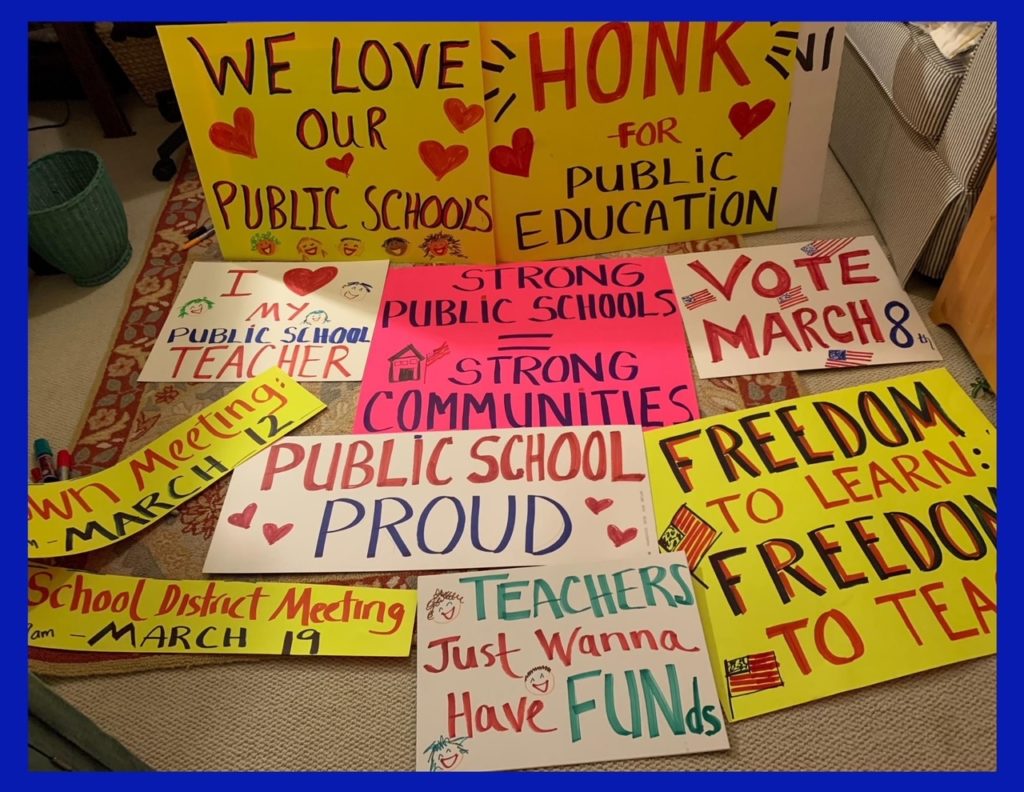
Tuesday’s school board election in New Hampshire was a triumph for parents and citizens who love their public schools!

This must have shocked Republican Governor Chris Sununu, the Republican-controlled legislature, and State Commissioner Frank Edelblut, who home-schooled his own children and is pushing a sweeping voucher plan for the state.

AfterGlenn Youngkin was elected Governor of Virginia by pandering to parents angry about “critical race theory,” mask mandates, and eager to control what children learned and what books they read, the media bombarded us with stories predicting that Republicans would win next November by running against public schools.

New Hampshire families and citizens said on Election Day, “Not so fast! We love our public schools.”

I Love Public Education Sign Visibility

In first town elections since onslaught of attacks on public education and a honest, accurate education, voters send clear message that they support strong public schools and a honest, accurate education

CONCORD, NH – In race after race across New Hampshire on Town Meeting Day, concerned parents and community members in communities large and small successfully organized to elect pro-public education candidates and reject those seeking to dismantle public education and censor history.

“These results should raise serious doubts about any Republican 2022 election strategy that is built around pitting parents against local public schools and educators,” said Zandra Rice Hawkins, Executive Director of Granite State Progress. “In nearly every school board race, Granite State voters chose out-spoken champions for public education and an honest, accurate, inclusive education. This is a big win for public schools and for our future. These leaders are committed to keeping our public schools strong and making sure every student’s history and experience is valued.”

The results from the election are all the more astounding for record-shattering voter turnout, and for the blatant differences between the candidates on everything from public education, COVID public health measures, and attempts to whitewash American history and censor educators. A priority list of school board results can be found here.

Key examples from around the state:

  • Merrimack Valley School District, home to some of the state’s most vocal anti-vaccine, anti-mask, and classroom censorship activists, experienced a 56% increase in voter turnout from 2019, and supported public education candidates while also defeating a classroom censorship/anti-equity warrant resolution.
  • Bedford experienced a 36% increase in voter turnout and elected pro-public education candidate and teacher Andrea Campbell with 2832 votes, compared to 1293 votes for Sean Monroe, a candidate supported by right-wing organization Defend Our Kids, and 856 for incumbent John Schneller; both of whom supported efforts to censor teachers and ban conversations about race and racism in public schools.
  • Londonderry elected pro-public education candidates Amanda Butcher and Kevin Gray, defeating vocal anti-masker Rachel Killian (seen here harassing school board members during a public meeting). Voters also rejected a warrant resolution to make masks completely optional and the sole decision of parents instead of school leaders and public health experts; a significant decision given Gov. Sununu’s recent decision to ban schools from enacting COVID public health measures like masks.
  • Governor Wentworth School District elected Republican State Rep. Brodie Deschaies over far-right activist Jessica Williams, who believes public schools are indoctrinating students and was arrested at a GWSD school board meeting on September 13, 2021.
  • Weare elected pro-public education candidates William “Bill” Politt and Alyssa Small, and passed full-day kindergarten; and Hollis elected pro-public education candidates Carryl Roy, Krista Whalan, and Holly Babcock.
  • Exeter and SAU 16 elected a full slate of pro-public education and honest education candidates, despite a nearly $20,000 effort by the opposition and months of voter mailings from those who oppose diversity, equity, and inclusion justice efforts in the school districts.

“We are in awe of how our communities have come together to protect and support public education,” said Sarah Robinson, Education Justice Campaign Director for Granite State Progress. “Parents, students, educators, and community leaders have been working for months to organize, recruit strong candidates, and support pro-public education campaigns. Watching the results come in and knowing that so many public education champions are going to be serving in these roles gives us all hope. Our schools have been under constant attack from privatization schemes, neo-Nazi’s, and of course Governor Sununu’s statewide ban on a honest education. We all know that serving on a school board right now is challenging, and we thank these leaders for stepping up for our students. We hope the folks at the State House are paying attention, because this showdown will play out again in November unless they stop the attacks on our public schools.”

You may remember Fiona Hill. She was the nonpartisan Russia expert on the National Security Council who testified in Trump’s first impeachment trial. Politico interviewed her at length soon after Putin invaded Ukraine. Hill provides interesting political and historical insights into why Putin invaded Ukraine. She has been observing both Russia and Ukraine for many years, as well as Putin.

Hill says we are already in the midst of World War 3.

She warns:

Reynolds: The more we talk, the more we’re using World War II analogies. There are people who are saying we’re on the brink of a World War III.

Hill: We’re already in it. We have been for some time. We keep thinking of World War I, World War II as these huge great big set pieces, but World War II was a consequence of World War I. And we had an interwar period between them. And in a way, we had that again after the Cold War. Many of the things that we’re talking about here have their roots in the carving up of the Austro-Hungarian Empire and the Russian Empire at the end of World War I. At the end of World War II, we had another reconfiguration and some of the issues that we have been dealing with recently go back to that immediate post-war period. We’ve had war in Syria, which is in part the consequence of the collapse of the Ottoman Empire, same with Iraq and Kuwait.

All of the conflicts that we’re seeing have roots in those earlier conflicts. We are already in a hot war over Ukraine, which started in 2014. People shouldn’t delude themselves into thinking that we’re just on the brink of something. We’ve been well and truly in it for quite a long period of time.

But this is also a full-spectrum information war, and what happens in a Russian “all-of-society” war, you soften up the enemy. You get the Tucker Carlsons and Donald Trumps doing your job for you. The fact that Putin managed to persuade Trump that Ukraine belongs to Russia, and that Trump would be willing to give up Ukraine without any kind of fight, that’s a major success for Putin’s information war. I mean he has got swathes of the Republican Party — and not just them, some on the left, as well as on the right — masses of the U.S. public saying, “Good on you, Vladimir Putin,” or blaming NATO, or blaming the U.S. for this outcome. This is exactly what a Russian information war and psychological operation is geared towards. He’s been carefully seeding this terrain as well. We’ve been at war, for a very long time. I’ve been saying this for years…

What Russia is doing is asserting that “might makes right.” Of course, yes, we’ve also made terrible mistakes. But no one ever has the right to completely destroy another country — Putin’s opened up a door in Europe that we thought we’d closed after World War II.

Education Week reported a new study that confirms the value of masking during the pandemic.

Mask requirements still offer one of the strongest tools to prevent COVID-19 outbreaks in schools, say new studies.

The findings come from the Centers for Disease Control and Prevention and from a nationwide study published this morning in the journal Pediatrics. They land as the latest pandemic wave recedes, federal masking guidelines begin to relax, and education leaders work toward more flexible approaches to masking for staff and students.

In the Pediatrics study, Duke University researchers in the ongoing ABC Science Collaborative—which tracks pandemic mitigation efforts in schools—analyzed masking policies and infection rates in 61 districts, more than 3,000 schools, and more than 1.1 million students and adults in nine states. For the first time, the national study looked at mitigation from July through December 2021, during the delta wave and the start of the omicron waves of the pandemic.

Schools that required universal masking for adults and students saw 72 percent fewer secondary infections—in which students infected with COVID-19 in the community spread the virus to others in school—than did schools that had no mask requirements or partial masking. Once school size, vaccination rates, and other characteristics were taken into account, schools with universal masking had nearly 90 percent lower infection rates.

Moreover, about half of the students and staff in the study had completed vaccination against COVID-19 by the end of the study, and Duke researchers found universal masking policies were associated with fewer infections even among those who were already vaccinated.

As of March 7, just over 26 percent of U.S. children ages 5 to 11 have been fully vaccinated, as have less than 58 percent of those ages 12 to 17, according to the latest CDC data.

Now that Republican state legislatures have had their way imposing their personal views on what may or may not be taught in the public schools, they are taking aim at what may be taught in state universities. In Wyoming, the legislature wants to defund gender studies.

Legislation to defund gender and women’s studies at the University of Wyoming has stoked faculty fears about how far lawmakers will go to stop public colleges from teaching courses they don’t like.

The Wyoming Senate voted on Friday to pass a budget amendment that would prevent the university from using state money for its gender and women’s studies program and courses, a move that would effectively eliminate them. While a version of the amendment died in the state’s House and its future is unclear, the mere possibility of its passage has left some Wyoming professors shaken by what they see as an infringement on their academic freedom.

This is censorship, plain and simple. Will they next come after science professors who teach about evolution? Or legal scholars who study critical race theory?

Please consider registering for the long-delayed annual conference of the Network for Public Education, April 30-May 1 in Philadelphia.

The speakers and panels will be outstanding. You will meet your favorite bloggers and supports of public schools.

Join us!

Jennifer Berkshire writes powerfully in The Forum about the outraged parents of students at elite private schools who want to squash critical race theory and anything that smacks of liberalism.

Bret Stephens had come to Boston’s historic Copley Plaza Hotel bearing an ominous warning: Illiberalism is on the march, and free speech is under siege. As it happens, his claim was borne out by the growing number of states that have now enacted education gag orders, restricting how teachers can talk about race, but this was not the scourge that the New York Times opinion columnist had in mind. No, Stephens’ ire was trained on the schools—or as he described them, “feeders for woke culture in every part of society.”
 

It was familiar Stephens fare, dished up in column after column. But attendees at the Parents Unite conference, who’d shelled out $350 a pop to spend a recent fall weekend commiserating over the rising tide of wokeness in the nation’s elite schools, ate it up. After all, Stephens’ ties to the world of top-tier prep schools run deep. Not only did he board down the road in Concord at the Middlesex School as a lad, but he also serves on its board of trustees. These parents want their schools back, and Stephens was happy to help lead the charge.
 
     In the increasingly crowded market catering to parent outrage, the Boston-based Parents Unite stands out for its pedigree. Yes, Moms for Liberty offers $500 bounties for teachers who violate education gag orders, and Parents Defending Education seeks to root out politics in the classroom via anonymous snitching. But Parents Unite, not to be confused with the pro-charter school, anti-union Massachusetts Parents United, aims for higher ground: “diversity of thought.” The group represents parents of children enrolled at top “independent” schools in New England, and according to its official origin story, the homeschooling measures of the Covid pandemic gave those parents a scarifying crash course in the sort of agitprop fare that their hefty tuition checks were underwriting. More specifically, it was what these parents saw as the over-the-top response by many private schools to the murder of George Floyd that launched them into full-scale revolt. For hundreds of years, parents have sent their children off to the elite precincts of Phillips and Hotchkiss, secure in the knowledge that the Ivy League awaits. And now all of a sudden these same schools wanted them to feel bad about their privilege?

But the outrage didn’t end there. As the proceedings at the weekend-long Parents Unite confab made clear, anti-wokeness is a slippery slope. What began as a howl of protest against “critical race theory” has quickly built to include a seemingly endless litany of conservative complaints about what gets taught in schools and by whom. As the conference wore on, grievance piled up upon fresh grievance. Classrooms were being “racialized, sexualized and politicized,” as one speaker put it. Kids were coming home defeated and deflated, charged another. Schools no longer teach real-world knowledge, complained one of the student attendees. The vast majority of his classmates don’t know the difference between a stock and a bond, he reported in astonishment. Wouldn’t they gain more from learning about that than about how to combat racism?
 
     A panel discussion with the rather too-on-the-nose title “DEI: Under the Hood,” quickly moved on from the alleged excesses of diversity, equity and inclusion to fresh outrages, like social and emotional learning (SEL). This brand of instruction, it turns out, was actually brought into schools at the behest of businesses looking to recruit future knowledge-economy workers outfitted with “soft skills,” like team building and collaboration. But in the hothouse culture-war reveries of Parents United, SEL has taken its place alongside DEI and CRT as another sinister form of woke-ist mind control masquerading as sensitivity and empathy.

What began as a howl of protest against “critical race theory” has quickly built to include a seemingly endless litany of conservative complaints about what gets taught in schools and by whom.     

      Then there’s “gender ideology.” Erika Sanzi, who has herself recently transitioned from Obama-era charter school advocate to parents’ rights crusader, explained from the stage, parents who might be too fearful to speak out about CRT are going to revolt when they realize that the schools are trying to turn their kids trans.
 
     What or whom specifically is carrying out all of this indoctrination? Teachers unions are to blame, naturally, along with graduate schools of education—a perennial source of political ire dating back to the early nineteenth century. (That private schools are overwhelmingly union free, and do not require the credentials dispensed by schools of education seemed to matter not at all here.) Most of all, though, it was young teachers—social justice warriors all—who bore the brunt of the ire. These self-styled revolutionaries eschew not just the classic texts but all texts, one panelist bemoaned. Older, tenured teachers—the same reliable villains who’ve been depicted as the enemy of progress throughout the modern era of education reform—are evidently now the last remaining bulwark against wokeism.
 
     For parents rebelling against leftist indoctrination in the public schools, politicians have seized on a favorite conservative cure: school choice. This, too, was a baffling refrain at the Parents United conference: private school parents have already exercised that option. Indeed, one striking plaint running through the sessions in Boston was that parents who send their children to elite private schools are uniquely powerless—victimized by the meritocracy itself. To voice their grievances is to risk not just their youngster’s spot at Groton or Deerfield Academy, but also to jeopardize the great brass ring at the end of the prep school carousel: entrée into the Ivy League.
 
     Desperate times, then, call for desperate measures. Kerry McDonald, the senior education fellow at the liberty-loving think tank, Foundation for Economic Education, proposed that instead of continuing to support “school,” parents return to the time-honored tradition of teaching their children themselves. But rather than going into despairing cultural retreat mode, in the manner of many latter-day evangelical homeschoolers, the refugees from the woke prep academies can count on the largess and thought-leading cachet of Silicon Valley. “Marc Andreessen has been talking a lot about homeschooling,” McDonald reported, citing the great market imprimatur of the Netscape founder-turned-venture-capitalist.

Please open the link and finish reading the article. And shed salty tears for the parents of children in elite private schools who think they have no voice.

David Sirota, investigative journalist, former speechwriter for Presidential candidate Bernie Sanders, and writer of the hit film “Don’t Look Up,” recently launched a blog called The Daily Poster. It’s well worth your time to read and to support The Daily Poster.

This important post by Walker Bragman and Alex Kotch documents the Koch money behind the campaign to get schools open, regardless of the risks, and to eliminate mask mandates. The goal of Charles Koch and others on the right was to get the economy back to normal.

Here is an excerpt:

The updated CDC guidance signals the Democratic party’s shift from beating the virus to surrendering to it as a fact of life — including in schools. The new approach was likely shaped by a number of factors, including declining COVID numbers, concerns about far-reaching public COVID fatigue, and the fact that many of those now most at risk of severe disease have refused to get vaccinated for non-medical reasons.

But the end of school masking is also in part due to a campaign by right-wing business interests, including the dark money network of oil billionaire Charles Koch, to keep the country open for the sake of maintaining corporate profits. These interests have been meddling in the education debate, first pushing to reopen schools and then fighting in-school safety measures, even as COVID case numbers were rising and children were ending up in hospitals. For nearly two years, these groups have been promoting questionable science and creating wedges between parents, teachers, and administrators in order to get America back to work — even at the risk of the nation’s children.

“Tapping Into The Full Productive Capacity Of The Workforce”

When the pandemic first hit the U.S. in the spring of 2020, Koch-affiliated groups saw an opportunity to reassess American education, moving away from public schools to private and homeschool alternatives. Koch and his brother David, who died in 2019, had spent decades fighting teachers’ unions, pushing school privatization, and attacking state education funding.

On March 13, 2020, Yes Every Kid — a front group founded by the Koch network in 2019 as part of a larger effort to shape K-12 education in the states — launched a #LearnEverywhere campaign promoting remote learning and homeschooling. Three days later, the Cato Institute, a libertarian think tank co-founded and heavilysubsidized by Koch, published a commentary declaring that the U.S. could “tap into” charter, private, and homeschooling “if brick-and-mortar schooling is substantially disrupted.”

The Heritage Foundation, a right-wing nonprofit heavily funded by the Charles Koch Foundation and Charles Koch Institute, also published articles in March 2020 in favor of using public school funds to pay parents to homeschool their kids. Heritage senior policy analyst Jonathan Butcher wrote a policy brief for the Koch-founded-and-funded Mercatus Center, a free-market think tank based at George Mason University, calling to funnel state funds into for-profit charter school companiesproviding virtual learning.

The message was blasted out by other groups in Koch’s orbit, including his flagship political advocacy outfit, Americans For Prosperity (AFP); the Independent Women’s Forum, a dark money group bankrolled by Koch organizations and the heirs to the Walmart fortune; and the State Policy Network, a web of libertarian state-based policy organizations.

But within a few months, the school narrative out of Koch world began to shift, coinciding with growing concerns about labor shortages and changing workplace dynamics caused by nationwide school closures. According to Education Week, a staggering 55.1 million students were impacted by the closures at their peak.

The closures meant a loss of childcare for many parents, which contributed to plummeting labor force participation early in the pandemic. An April 2020 guide to school reopenings from the consultancy McKinsey & Co., whose clients include many of the world’s largest companies, estimated that 27 million Americans were dependent upon childcare in order to work.

“Where a significant proportion of workers rely on schools for childcare, reopening schools (at least for younger children) might be a prerequisite to tapping into the full productive capacity of the workforce,” the report noted.

The tight labor market changed the relationship between employers and their workers, who began demanding moreflexibility and better work-life balance. Companies were forced to respond by raising wages — albeit inadequately — in order to attract workers.

Enterprises like Koch’s were eager to force a return to the old paradigm. These interests had already begun employing the same think tanks and quasi-academic networks they had pioneered a decade before promoting the anti-government Tea Party movement to fuel and legitimize attacks on pandemic safety measures, so they could force a return to normalcy and boost corporate profits.

Now, these interests began to use the same playbook to try to force schools back to normal.

“Keeping Children At Home Might Expose Them To Considerable Risks”

The very groups that had celebrated remote learning as an opportunity for public school alternatives began demanding that schools reopen, citing concerns about learning loss as well as student mental health. These groups downplayed the risks of the virus and slammed teachers’ unions for holding up the return to normalcy.

In May 2020, two months after the World Health Organization declared COVID a global pandemic, the Hoover Institution, a right-wing think tank based at Stanford University that has received substantial backing from Koch over the years, held a virtual conference at which senior fellow Eric Hanushek argued that remote learning was causing learning loss among low-resourced students and damaging “teacher accountability” through the elimination of standardized testing.

The Koch-backed reopening push kicked into high gear after President Donald Trump, facing reelection and a slowing labor market recovery, tweeted in early July 2020, “SCHOOLS MUST OPEN” in the fall.

The Koch-affiliated right-wing think tank American Enterprise Institute (AEI), meanwhile, published a “blueprint” for reopening schools, citing the need to get parents back to work. The State Policy Network and its affiliates also started pushing for school reopening.

Two days after Trump’s tweet, Yes Every Kid published a playbook for reopening schools. Soon after that, Hoover senior fellow Scott Atlas, a radiologist who Trump would soon tap as his senior COVID advisor, called for reopening schools in an interview published that same day. Atlas argued that schools were an “essential business” and that the risk COVID presented to anyone under the age of 18 was incredibly low.

A few days later, the Heritage Foundation joined in, claiming in an online article that in-person learning was possibly “one of the safest activities the nation can restart,” and that “keeping children at home might expose them to considerable risks to their educational progress, their mental health, their nutrition, and alarmingly, even their safety and welfare…”

The drumbeat to return to in-person schooling continued throughout the summer and into the fall. Koch’s flagship group, AFP, put out an online recruiting call for people to reach out to Kansas state legislators and urge them to give school districts and schools the “flexibility” to reopen. A week later, the Mercatus Center published a policy brief warning of “educational scarring” if schools remain closed. Mercatus would later start funding the work of Brown University economics professor and parenting blogger Emily Oster after she began publishing controversial research and articlessupporting school reopenings and downplaying concerns about children and COVID.

On August 12, 2020, the Independent Women’s Forum called on schools to reopen across the country, citing detrimental impacts on student learning and mental well-being. And in October 2020, Hoover’s Center for Research on Education Outcomes released a study estimating that in spring 2020, students lost 57 to 183 days of learning in reading and 136 to 232 days of learning in math.

Big industry groups also fought school closures, including the U.S. Chamber of Commerce, the nation’s premier corporate lobby group. In September 2021, Chamber executive vice president and chief policy officer Neil Bradley said that “we have to have the schools fully reopen” in order to help solve the labor shortage.

“The Dangers Of Masks”

As schools started reopening under the new Democratic administration, Koch-affiliated groups adopted a harder line. In the lead-up to the 2021 state elections, the organizations began opposing in-school mask requirements for students and teachers in addition to closures…

Meanwhile, Koch groups and their affiliates have also quietly worked to support grassroots efforts to end mask mandates.

The Maine Policy Institute put up a petition on its website opposing mask mandates in schools, arguing that “many parents are uncomfortable with their children being required to wear masks in schools” and that “families deserve a choice.” The Federalisthelped promote a lawsuit against Indiana state officials over school mitigation measures brought by parents who erroneously claimed COVID wasn’t infectious in children.

The Koch network also has ties to the shadowy nonprofit Parents Defending Education (PDE). Founded in early 2021, PDE promotes private schooling and combats liberal “indoctrination” in public schools around the country, often by ginning up anger at school boards. The nonprofit’s vice president, Astra Nomani, as well as its director of outreach, Erika Sanzi, have been vocal critics of school mask mandates, and the organization keeps a directory of conservative parents groups that support ending such mandates and other conservative causes….

Please open the link and read the full article. Before reading it, I was unaware of this well-funded, well-coordinated campaign. I was also unaware that the work of Professor Emily Oster at Brown University was funded by the Koch-related Mercatus Institute as well as the Walton Family Foundation, and the Arnold Foundation.


For Immediate Release
March 7, 2022

Contact:
Natasha Dockter
Minneapolis Federation of Teachers and
Education Support Professionals
natasha.dockter@gmail.com
651-387-5681


Minneapolis educators to strike Tuesday for safe and stable schools

MINNEAPOLIS, March 7, 2022 – The educators of the Minneapolis Federation of Teachers and Education Support Professionals will go on strike Tuesday for the safe and stable schools students deserve. Despite days in public bargaining and mediations, including more than 65 hours in the last week, the district continues to refuse to work with MFT to create systemic change and remains entrenched in the unacceptable status quo. 
 
President Greta Callahan of the MFT teachers chapter, President Shaun Laden of the MFT ESP chapter and the presidents of Education Minnesota, the American Federation of Teachers and the National Education Association will attend a news conference at 7:30 a.m. Tuesdayoutside Justice Page Middle School, 1W. 49th S., Minneapolis.
 
The members of the MFT will begin picketing outside their schools and other worksites at 7:30 a.m. Tuesday. The membership will come together for a large rally at 12:15 p.m. at the Minneapolis Public Schools Nutrition Center, 812 Plymouth Avenue North, Minneapolis, before marching approximately 1 mile to the MPS Davis Center, 1250 W Broadway Ave, Minneapolis.
 
Logistics:
Picketing begins at schools and other worksites at 7:30 a.m. Tuesday
News conference with MFT presidents and state and national presidents 7:30 a.m. Tuesday at Justice Page Middle School, 1W. 49th S., Minneapolis
Rally starting at 12:15 p.m. Tuesday at Minneapolis Public Schools Nutrition Center, 812 Plymouth Avenue North, Minneapolis
Laden said:  “This bargaining campaign started with the very simple idea that for the education support professionals who are told every day that our schools can’t run without us, one job should be enough. We’re the most racially diverse group of educators in a district with administrators who say they care about racial equity. We have been demanding that the administrators at the bargaining table put their money where their mouth is and they have refused. Now is the time for the school board to intervene and settle a deal that pays ESP a starting wage of $35,000 a year.”
 
Callahan said: “For almost two years, we’ve been trying to reach agreements around safe and stable schools for students and those closest to them, but the administration has stubbornly defended an unacceptable status quo. We are the defenders of public education and we’re not going to slow down, or give up, until we make real progress addressing the mental health crisis in our schools, reducing class sizes and caseloads so students are receiving the individualized attention they need, and increasing educator compensation so that we don’t continue to lose staff, especially educators of color, to surrounding districts and other professions.”
 
Denise Specht, president of Education Minnesota, said: “Nearly 90,000 educators across Minnesota are standing with our union family in Minneapolis because what they’re fighting for is what we’re all fighting for: Schools that will give every student the chance to pursue their dreams. The same issues are being negotiated all over the state, from living wages for ESPs, to more mental health supports for students, to managing the crushing caseload for SpEd teachers, to recruiting and retaining more teachers of color,  to creating time for educators to give their students enough individual attention. We’re in a rich state with a $9.25 billion surplus. No educator should have to fight this hard for the schools our students deserve, but if that’s what it takes, we’re with you.”
 
Becky Pringle, president of the National Education Association, said: “With over $250 million in pandemic relief funds, the time is now to invest in the safe and stable schools that Minneapolis students need now more than ever. The three million members of the National Education Association are proud to stand with our siblings in Minneapolis. The last two years have demonstrated that the status quo is not good enough. Minneapolis students and their families have weathered a pandemic, continued police violence, and an economic system that has left students, their families, and educators behind. These students deserve class sizes small enough for one-to-one attention as well as investments in mental health services and social-emotional learning.  MPS must also invest in systematic changes that improve the recruitment and retention of educators of color as well as a living wage for education support professionals. Education support professionals represent a critical workforce in our schools providing essential supports students depend on. MPS has the resources to make these investments. The question is whether they value Minneapolis students as much as their educators do.”
 
Randi Weingarten, president of the American Federation of Teachers, said: “The federal government has provided an unprecedented amount of recovery funding to school districts to address problems related to the pandemic, including student recovery, staff shortages and school safety. There is no excuse for districts to make cuts in light of this historic infusion of funds. And the economy is showing real signs of growth. Indeed, Minnesota just announced a $9.25 billion surplus.
 
“Our kids, their families and educators have been through tremendous challenges in the last two years; they have done their share to navigate the rough seas together. Educators and students should be the priorities, and districts should provide the conditions and environment they need to succeed. School districts should respect their educators and ensure that students have the programs and services they need to thrive,” Weingarten said.
 
The union’s safe and stable schools agenda includes:

  • Paying a living wage for education support professionals to stabilize this critical workforce, because students need the stability of working with one paraprofessional throughout the school year. For ESPs, this means raising the starting salary from about $24,000 a year to $35,000 through increases in hours and rate of pay.
  • Making systemic changes to improve the recruitment and retention of educators of color, which benefits all of MPS.
  • Improving student-to-mental health professional ratios because students shouldn’t have to wait weeks for an appointment with a counselor or social worker.
  • Lowering class sizes because students learn best when their classrooms aren’t overcrowded and underfunded.
  • Paying competitive salaries for licensed staff to stop the exodus of teachers from MPS. State data show the average salary of Minneapolis teachers is ranked 28 out of 46 districts in the seven-county metro area.

###

Thanks for Donald Cohen of “In the Public Interest” for drawing my attention to this important victory in Virginia.

Members of AFSCME (American Federation of State, County, and Municipal Employees) mobilized to repeal an attack on their newly-won right to bargain collectively as a union. Unions offer a path to a secure middle-class existence. We need them now more than ever.

AFSCME members in Virginia are rejoicing in their success in protecting collective bargaining rights for local public employees across the commonwealth.

Their actions helped persuade the Virginia Senate to first defeat anti-worker bills filed in the Senate and, in February, to block House-passed anti-worker bills.

Members celebrated on Feb. 21 after the Senate Commerce and Labor Committee voted to defeat Del. Kathy Byron’s bill, which would have repealed a 2020 law that empowered localities to give their employees the freedom to collectively bargain for a contract.

Since taking effect last year, Del. Elizabeth Guzman’s HB 582 and Sen. Dick Saslow’s SB 939 have triggered a slew of collective bargaining ordinances. In Northern Virginia, AFSCME members began organizing during the pandemic and helped pass the first collective bargaining ordinance in April in the city of Alexandria. Arlington County soon followed suit in June.

Luis Velez Sr., an Arlington County construction management specialist and a member of AFSCME Local 3001, recounted the spring and summer he began organizing for collective bargaining rights.

“As a resident of Alexandria, I was proud to stand with Alexandria city employees as they won a strong collective bargaining ordinance. I was even more excited, a few months later, as an Arlington County employee when we passed our own collective bargaining ordinance,” he said. “We have a lot of work to do as our localities continue to recover from the pandemic and we are stronger when public employees are respected, have a voice on the job, and strong unions to advocate for the communities that we serve.”

The 2022 legislative session saw two versions of a total repeal of collective bargaining, and a series of bills introduced by Del. Nick Freitas that would have chipped away at collective bargaining and union rights. These bills sought to redefine a union election, eliminate automatic dues deductions and force employees to pay for any time and resources employees used while engaging in union work like representation during work hours. Freitas also wanted to dictate how and what localities could include in their collective bargaining ordinances and agreements.

Harlie White, a traffic and lights technician for the city of Alexandria, submitted written testimony twice.

“I stand in opposition to any bill that would repeal my collective bargaining rights and take away my freedom to join a union,” he said. “I am glad Senator Dick Saslow was willing to protect the 2020 law that empowers localities to give public service workers the freedom to join a union, and local municipalities the autonomy to enact union agreements as they see fit.”

The threat of losing collective bargaining mobilized AFSCME Virginia activists. Aside from testifying via Zoom and submitting written testimony, many sent letters and called their delegates and senators to make clear how important collective bargaining rights are for public employees, especially as cities and counties slowly recover from the pandemic.

Charlotte Malerich, an Arlington public library assistant, wanted Virginia elected officials to understand that chipping away at rights meant employees would lose their voice on the job.

“My co-workers and I need actual, concrete support: sick leave, child care, flexible schedules, teleworking for the things we can do at home …  and PPE for things we can’t do at home,” she said, referring to personal protective equipment. “And we need to have a voice at work to tell our managers what those needs are. Collective bargaining and union rights give us that freedom.”