On February 3, Duke University historian Nancy MacLean and I held a Zoom conversation called “Public Education in Chains,” about the nefarious conspiracy to undermine and privatize our public schools. The discussion was sponsored by Public Funds Public Schools and the Network for Public Education.
Dr. MacLean is the author of many books, including the brilliant Democracy in Chains: The DeepHistory of the Radical Right’s Stealth Plan for America.
We discussed the historical origins of the movement, calling out the privatizers as a combination of libertarians, anti-government ideologues, the radical right, segregationists, and rightwing evangelicals, funded by billionaires who hate taxes, public institutions, and unions. Their movement threatens not only public schools but our democracy.
Nancy MacLean is an esteemed historian at Duke University, where she is the William H. Chafe Professor of History and Public Policy. She specializes in the study of race, gender, labor history and social movements in the United States. Her book Democracy in Chains: The Deep History ofthe Radical Right’s Stealth Plan for America is must reading. In this important paper, she examines the role of economist Milton Friedman in promoting school choice, segregation, and privatization. The abstract:
This paper traces the origins of today’s campaigns for school vouchers and other modes of public funding for private education to efforts by Milton Friedman beginning in 1955. It reveals that the endgame of the “school choice” enterprise for libertarians was not then— and is not now–to enhance education for all children; it was a strategy, ultimately, to offload the full cost of schooling onto parents as part of a larger quest to privatize public services and resources. Based on extensive original archival research, this paper shows how Friedman’s case for vouchers to promote “educational freedom” buttressed the case of Southern advocates of the policy of massive resistance to Brown v. Board of Education. His approach—supported by many other Mont Pelerin Society members and leading libertarians of the day –taught white supremacists a more sophisticated, and for more than a decade, court-proof way to preserve Jim Crow. All they had to do was cease overt focus on race and instead deploy a neoliberal language of personal liberty, government failure and the need for market competition in the provision of public education.
She describes the spread of ”school choice” legislation and writes:
A well-funded, laser-focused and integrated long game helped achieve these legislative triumphs. Indeed, it is difficult to find an institution on the American right that has not advocated “school choice.” Think tanks such as the Cato Institute and the Heritage Foundation, along with affiliates of the State Policy Network, make the case for it. Engines of legal and judicial change such as the Federalist Society and the Institute for Justice workshop the constitutional issues and litigate for it. The American Legislative Exchange Council (ALEC) produces templates of “model laws” for its overwhelmingly Republican members to introduce it in state legislatures. Fox News broadcasts the talking points. Organizing efforts including Americans for Prosperity drive calls and letters to elected officials. Deep-pocketed donors underwrite the work. The campaigners employ a common language of personal liberty and anti-government, pro-market catch phrases. They tout the benefits of parents gaining the “freedom to choose” to send their children to private schools. And they claim that breaking up the “government monopoly” will promote “competition” that will improve the overall quality of education.2
“School choice” sounds like it offers options. But as I will show, the whole concept, as first implemented in the U.S. South in the mid-1950s, aimed to deny the choice of equal, integrated education to Black families. Further, Milton Friedman, soon to become the best-known neoliberal economist in the world, abetted the push for private schooling that southern states used to evade the reach of Brown v. Board of Education, the Supreme Court’s unanimous 1954 ruling that the segregation of public education violated the constitutional right of Black children to equal protection of the laws. So, too, did other libertarians of the day, among them leading pioneers of the cause that today avidly pushes private schooling.3 Perhaps most tellingly, though, the ultimate purpose was not really to benefit parents and children, even the white ones who patronized the new segregation academies. For Friedman and the libertarians, school choice was and is a strategy to ultimately offload the burden of paying for education onto parents, thus harming the educational prospects of most youth. As we will see, Friedman himself hoped it would discourage low-income parents from having children in a form of economic social engineering reminiscent of eugenics. He predicted that once they had to pay the entire cost of schooling from their own earnings, they would make different reproductive decisions.4
Please read this thoughtful, well-researched and alarming study to understand the dark history of “school choice.” This is a case where history illuminates the future.
Kate McGee of the Texas Tribune writes that Lt. Governor Dan Patrick has threatened to kill tenure in Texas universities to compel compliance with his wish to stop any teaching about race or racism, which he calls “critical race theory.”
Dan Patrick is a phony Texan. He wears boots, but he was born and raised in Baltimore. His birth name was Dannie Scott Goeb. He was the little Rush Limbaugh of Texas until he entered politics. He has never abandoned the politics of hatred and division that have made him successful. He has advocated for teaching creationism in the schools and backed legislation last year to prevent public schools from requiring that students read writings by prominent civil rights figures, such as Susan B. Anthony, Cesar Chavez, and Martin Luther King Jr., when covering women’s suffrage and the civil rights movement in social studies classes.” He is a 21st century Know-Nothing.
McGee writes:
Lt. Gov. Dan Patrick said Friday that he will push to end professor tenure for all new hires at Texas public universities and colleges in an effort to combat faculty members who he says “indoctrinate” students with teachings about critical race theory.
“Go to a private school, let them raise their own funds to teach, but we’re not going to fund them,” said Patrick, who is running for reelection. “I’m not going to pay for that nonsense.”
Patrick, whose position overseeing the Senate allows him to drive the state’s legislative agenda, also proposed a change to state law that could make teaching critical race theory grounds for revoking tenure for professors who already have it. His announcement tees up the next major fight at the Texas Capitol over how college students learn about the history of race and racism in the United States.
Tenure is an indefinite appointment for university faculty that can only be terminated under extraordinary circumstances. Academics said Friday that tenure is intended to protect faculty and academic freedom from exactly the kind of politicization being waged by Patrick.
“This kind of attack is precisely why we have faculty tenure,” said Michael Harris, a professor at Southern Methodist University studying higher education, who likened tenure to lifetime appointments given to federal judges. “The political winds are going to blow at different times, and we want faculty to follow the best data and theory to try to understand what’s happening in our world.”
Patrick on Friday also proposed making tenure review an annual occurrence instead of something that takes place every six years. At the press conference, he said his proposals already have the support of state Sen. Brandon Creighton, R-Conroe, who chairs the Senate Higher Education Committee…
Patrick’s plan drew swift condemnation from the American Association of University Professors, the body that helped develop the 1940 Statement of Principles on Academic Freedom and Tenure that has been adopted by universities and colleges nationwide.
“There’s always been attempts to interfere in higher education, but I have never seen anything as egregious as this attack,” said Irene Mulvey, president of the AAUP. “This is an attempt to have government control of scholarship and teaching. That is a complete disaster. I’ve never seen anything this bad…”
Patrick said his latest priority is in response to the UT-Austin Faculty Council after it passed a nonbinding resolution Monday to reaffirm instructors’ academic freedom to teach on issues of racial justice and critical race theory.
“Legislative proposals and enactments seek to prohibit academic discussions of racism and related issues if the discussion would be ‘divisive’ or suggest ‘blame’ or cause ‘psychological distress,’” the resolution stated. “But fail to recognize that these criteria … chill the capacity of educators to exercise their academic freedom and use their expertise to make determinations regarding content and discussions that will serve educational purposes.”
One day after the resolution passed, Patrick signaled on Twitter that he would continue the fight against teaching the discipline in the next legislative session.
“I will not stand by and let looney Marxist UT professors poison the minds of young students with Critical Race Theory,” Patrick wrote on Twitter. “We banned it in publicly funded K-12 and we will ban it in publicly funded higher ed. That’s why we created the Liberty Institute at UT.…”
The proposal to end tenure would fundamentally change the way Texas universities operate in terms of hiring, teaching and research. Faculty members warn it’s likely to impose major challenges for Texas universities to recruit and retain researchers and scholars from across the country…
Harris said even the headlines to propose ending tenure could hurt Texas universities that are hiring faculty members for next year who might think twice about whether to take a job at a public university.
A few strategic phone calls from public university presidents to their alumni in the state legislature could shut down Dan Patrick mighty quick. He is an embarrassment to the state of Texas.
Don’t believe the hype about charter ”success.” As the Network for Public Education has documented in several reports, the failure and closure rate of charter schools is high. in Philadelphia, the district has battled to close two low-performing charter schools for years and only now is on the cusp of regaining their students.
A state panel on Tuesday upheld the Philadelphia school board’s decision not to renew two charter schools, setting a course for ASPIRA Olney High School and ASPIRA Stetson Middle School to return to district control later this year.
The move comes nearly six years after the Philadelphia School District’s charter schools office first recommended that the district cut ties with ASPIRA Olney and Stetson for academic, operational, and financial reasons. The school board eventually voted against renewing the charters in 2019 over strong objections from the powerful Hispanic nonprofit that has run them since 2010 and 2011.
The charter nonrenewals mark the first time the district will take back control of schools it had turned over under the Renaissance Schools initiative, a school-turnaround approach launched in 2010 that the district has backed away from in recent years. (In 2016, Scholar Academies abruptly surrendered control of Kenderton Elementary, citing the high cost of educating its large special-education population; the district took back Kenderton and still runs it.)
ASPIRA officials said they plan to file court paperwork to overturn Tuesday’s ruling of the Charter Appeals Board, which voted 4-1 in both the Olney and Stetson cases. Among those voting in favor was Jennifer Faustman, CEO of the Belmont Charter Network in Philadelphia. Tom Killion, a former Republican state senator from Delaware County, was the lone no vote…
Olney, a high school that enrolls more than 1,700 students at Front and Duncannon, and Stetson, which educates 860 students in grades 5 through 8 on B Street in Kensington, will remain open in their current buildings, district and board officials emphasized. Students’ educations will not be interrupted…
The old School Reform Commission gave struggling Olney and Stetson to ASPIRA as part of its Renaissance initiative that tapped outside providers to run schools. According to a hearing officer’s report, while ASPIRA made progress in improving the schools’ climates, it didn’t live up to the academic promises it made and had financial shortcomings, too.
ASPIRA has fought to maintain control of the schools, which have been in limbo since their charters expired more than five years ago. In 2019, the company sued the School District, accusing it of unlawfully delaying charter renewal decisions to pressure the company into agreeing to conditions like enrollment caps.
A federal judge ruled in favor of the district last year, determining that while ASPIRA was selected to manage the two schools, there was no contract between the company and the district.
ASPIRA, which manages a total of five charter schools in the city, including a cyber charter, has also faced scrutiny from state officials. It was the subject of an auditor general’s report in 2018 that highlighted significant increases in payments the charters made to ASPIRA as an example of flaws in Pennsylvania’s charter school law.
It has taken the district six years to regain control of these two charters, whose charters were not renewed. And the charters are again appealing the decision to turn over their students and buildings to the district.
When a bright young man or woman gets an idea to replace experienced educators with inexperienced tyros and is quickly funded by billionaire foundations, you can guess that the ultimate goal is privatization. For one thing, the enterprise rests on a base claim that “our schools are failing,” and that experience is irrelevant and probably harmful.
The idea was so spot-on that the organization attracted millions of dollars from the plutocrats of privatization: Eli Broad, Bill Gates, the Walton Family Foundation, and many more.
Where are the miracle schools led by New Leaders? That’s a hard question to answer.
What Ultican demonstrates is the continuing relevance of New Leaders for New Schools. One of its illustrious graduates was behind the recent decision by the board of the Oakland Unified School District to resume closing schools, despite overwhelming opposition by students, parents, and educators.
I am pleased to report that I was selected as ”Global Guru #1” by an organization that selects “global gurus” in different fields. I am happy to see my friends Deborah Meier, Andy Hargreaves, and Pasi Sahlberg on the same list. I’m honored to be in the company of such distinguished educators. In case you read the bio, there are two updates. I retired from active service at New York University on September 1, 2020. And the blog has received more than 39 million page views (not 32) since it started in 2012.
This is when 21st century McCarthyism gets serious.
Dan Patrick, the talk-show host who is now Lieutenant Governor of Texas, wants to ban the teaching of “critical race theory” in higher education. Critical race theory, the study of systemic and institutionalized racism, has been taught and debated in law schools and colleges since the mid-1980s.
Patrick wants to quash academic freedom in higher education. He thinks he can prevent professors who have devoted their academic careers to the study of racism from talking about it. Maybe, he believes, if they don’t talk about and study racism, no one will know it exists. Or maybe it will just go away.
Erica Grieder wrote in the Houston Chronicle about Patrick’s plans to restrict academic freedom and to have the state spend $6 million on a “think tank” called the “Liberty Institute” to prevent errant professors from exercising their freedom to teach and speak. Last year, the state passed a law to ban CRT in K-12 schools, where (he thinks) children are being stuffed with left wing propaganda and with the claim that racism is real.
“I will not stand by and let looney Marxist UT professors poison the minds of young students with critical race theory,” he announced in a tweet.
“We banned it in publicly funded K-12 and we will ban it in publicly funded higher ed,” he continued, adding: “That’s why we created the Liberty Institute at UT.”
This was in response to a report, in the Austin American-Statesman, that the Faculty Council of the University of Texas at Austin had passed a resolution defending academic freedom.
In other words, Patrick, hearing of an innocuous nonbinding resolution in support of freedom, responded by threatening to pursue even more aggressive restrictions on freedom, while also wrapping himself in the banner of “liberty.” Naturally. This is from the lieutenant governor, arguably the state’s most powerful elected official.
Patrick, a rabid supporter of vouchers, as well as limits on free speech, is a public nuisance who menaces the freedom of students, teachers, and professors in Texas.
Paul Bowers, previously the education journalist for the Charleston, South Carolina, Post & Courier, writes his own blog. In this post, he calls on the state legislators not to pass voucher legislation that would predictably defund the state’s already underfunded public schools. South Carolina has a large budget surplus and one of the lowest tax rates in the nation. Governor Henry McMaster announced that the surplus would be used to lower taxes instead of funding public schools and other public services.
Paul wrote the members of the S.C. Senate Education Committee in opposition toSenate Bill 935, which is an attempt to divert public school funding to private schools.
Senators Massey, Jackson, Hutto, Rice, and Talley:
I write to you as a South Carolinian and parent of 3 public school students asking you to scrap Senate Bill 935, the so-called “Put Parents in Charge Act,” which would redirect public funds to private schools via the creation of Education Savings Accounts.
Every few years, South Carolina teachers and parents have to band together to fight the latest iteration of the school voucher meme, which has spread virally across the states thanks to millions upon millions of dollars of dark-money political contributions, astroturfed special-interest groups, and a network of libertarian billionaires’ pet thinktanks. We fought this idea when New York real estate investor Howard Rich tried to buy a voucher law here in the early 2000s, and we’re fighting it again now that ALEC, Palmetto Promise, and the like are trying to ram the same idea through the Statehouse in Year of Our Lord 2022. There is truly nothing new under the sun.
No money shall be paid from public funds nor shall the credit of the State or any of its political subdivisions be used for the direct benefit of any religious or other private educational institution.
Now, I am sure our attorney general would happily defend such an act against the inevitable lawsuits that would follow. I am no legal scholar, but I think it’s reasonable to assume he would employ some of the same arguments used to defend Gov. Henry McMaster when, in the thick of a global pandemic, he tried diverting $32 million worth of federal emergency funding from public schools to private schools. Notably, he lost that fight.
So, I suppose you and your colleagues in the General Assembly could enact this law, and you could win the legal battle that follows. Stranger things have happened. But the question remains whether you should go down this road.
I say no, you should not.
South Carolina’s most reactionary politicians have been clamoring for public divestment from the school system ever since radical Black Republicans created a free public school system for all in the Constitution of 1868. White supremacists clawed back at the notion of public goods with the Jim Crow Constitution of 1895; the Interposition Resolution of 1956; and the cavalcade of privatization laws, segregation academies, and district-level resegregation efforts that have continued without ceasing since Brown v. Board of Education was decided in 1954.
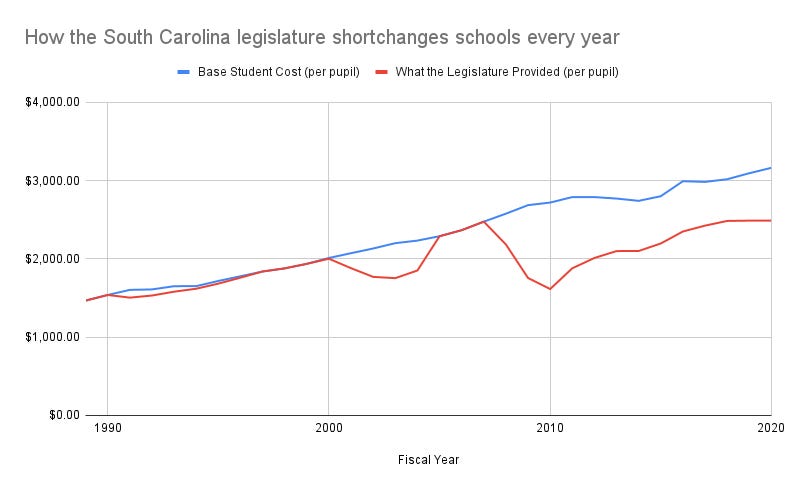
Data compiled by Steve Nuzum, via S.C. Revenue and Fiscal Affairs Office
As a matter of policy, you and your colleagues in the General Assembly have been steadily defunding public education since the start of the Great Recession. You have broken your own promises as outlined in the Education Finance Act and are currently under-funding the Base Student Cost by about a half-billion dollars per year. The results have been disastrous: Our teachers are underpaid and quitting by the thousands, classroom sizes have ballooned, our rural schools are in physical shambles, and a system of separate and unequal education along racial and economic lines has returned with a vengeance.
It is difficult to predict how much money public schools would lose as a result of Education Savings Accounts, which would allow public funds to “follow” individual students to private schools. Our state’s Revenue and Fiscal Affairs Office has tried to guess, though. According to a fiscal impact summary published in December, the ESA program could divert as much as $35 million to private schools within the first year it takes effect, depending how many families participate in the program. By 2026, they estimated the program could cost the state as much as $2.9 billion. Compounded by the General Assembly’s ongoing policy of public disinvestment, this could constitute a death blow to public schools.
The bill is built on a few faulty premises, including the underlying assumption that private schools could or would serve South Carolina students better. The authors of the bill also seem to believe that our state’s private schools could handle a sudden influx of new enrollment while accommodating students’ learning, transportation, and health needs. These are dicey propositions at best.
S. 935 is a direct attack on the notion of education as a public good. Its authors would leave us all to fend for ourselves as atomized individuals, cut loose from mutual obligations that once tied us together. For a certain type of doctrinaire conservative, this may sound like a dream scenario. For the rest of us living in the real state of South Carolina, it is a nightmare come true.
ATHENS, Tenn. (WATE) – An Englewood woman has been indicted on more than 20 sex charges after investigators say she traded items for sexual encounters with male students who attend McMinn Central High School.
Melissa Blair, 38, is charged with 18 counts of aggravated statutory rape, four counts of human trafficking by patronizing prostitution and one count of solicitation. She turned herself in Tuesday and was booked into the McMinn County Jail on a $100,000 bond. She is not, nor has she ever been, a school employee.
This is the same county where the school board voted unanimously to remove the Pulitzer Prize-winning graphic novel MAUS from the curriculum. They said it was inappropriate because, it contained nudity (of mice)
Seems to me that McMinn town officials and parents have a whole lot more to worry about than a book about the Holocaust. The reading list is the least of their troubles.
A friend of public schools in Missouri sent the following excerpt of a report by the League report by the state League of Women Voters.
EDUCATION Senate Education Committee Votes Out Bills
The committee voted out all bills heard thus far this session on February 10, including:
SB 869 (Koenig) to revise the law specifying payments to charter schools and shift more local school funds to charter schools. The League opposes this, based on our position on charter schools and support for public school funding.
SB 650 (Eigel) to allow charter schools to be sponsored by outside entities (other than the local school board) and operate in many districts around the state. Sen. Eigel also offered a proposed SCS version that would add several other provisions, including moving school board elections to the November election, adding restrictions on approval of debt service levies, preventing schools from requiring face masks, and preventing school districts from requiring students or staff to have COVID vaccinations. The League opposes the bill.
House Elementary & Secondary Education Committee
The committee met on February 8 and heard HB 2428 (Dogan) to impose restrictions on instruction relating to race and history. The bill authorizes lawsuits against school employees for violations of the new requirements in the bill. The League opposes the bill.

 Diane Ravitch's blog