The well-organized Pastors for Texas Children is engaged in rhetorical battles with the well-funded privatizers. Whether by Tweet, in the media, or on the lecture platform, Pastor Charles Foster Johnson and his colleagues lead the battle on behalf of public schools, taking on the rich and powerful and their political lackeys.
After Congressman Chip Roy attacked Pastors for Texas children and classroom teachers on Twitter, Pastor Johnson responded forcefully:
On Twitter, the group responded to Congressman Roy: “Congressman @chiproytx, your repeated lies about our [public school] teachers & the pastors who support them, are shameful, embarrassing, and shockingly immoral. You may mock them and us with your political lies against these servants. But you cannot mock God.”
Pastors For Texas Children, a Fort Worth-based organization, says it is an independent organization that advocates for public schools…
Cruz would not cite specific examples, according to Business Insider, “but instead pointed to books that have made parents angry at school board meetings in general.”
“Take a look at some of the portions from books that parents are going to school boards and reading out loud; this is what my child is being taught,'” the senator told the on-line publication.
Rev. Johnson said it’s all a political smokescreen to create chaos.
“If CRT (critical race theory) is a problem, if pornography is a problem, you guys have been in charge in Texas for 27-years,” Johnson said. “Are you just now discovering it? Are you producing it? What if we were to go all over the state and say that you were pornographers? You’re more responsible than our public school teachers. Obviously, we’re not going to do that, but you get the point.”
“We’re in this program of sheer destructive chaos,” he added. “That’s their only agenda. The only agenda. And that is wrong.”
Teachers are an easy target, Johnson continued, because the far-right knows that educators are too busy in the classroom to push back. Many school districts also drew the ire of Texas Republican leaders during COVID-19 when some – even in conservative areas – refused to ban masks like the governor ordered.
In an op-ed last week for Baptist News Global, publisher Mark Wingfield argued that “it’s time to stop the insanity that is killing public education.”
“It is disgusting, dismaying and disheartening to see the continued attack on public education from conservative evangelical Christians and people who pretend to be evangelical Christians but couldn’t find John 3:16 in the Bible if you asked them,” Wingfield wrote. “It is time to stop being shocked at this behavior and stand up against it.”
You see why I admire, respect and love Pastors for Texas Children? They are fearless, wise, and animated by a sense of mission.
I just watched the film called WINTER OF FIRE, an amazing documentary about the Ukrainian uprising against the government in the winter of 2013-2014. It is streaming on Netflix.
It’s a story of patriotism and courage. You will see the incredible determination of the Ukrainian people to live lives of freedom and dignity.
I urge you to watch it. It shows up the bobble-head pundits who claim to have the inside track as fools.
The expansion of Torchlight Academy Schools in Raleigh, North Carolina, is in trouble. Despite their mishandling and misreporting of students in special education, their financial irregularities and missing records, they are still in business. The state charter board has closed two of their charters, but others are still operating, and Torchlight hopes to add more charters. One–the Three Rivers Academy–was closed in January after numerous deficiencies were identified. According to NC Policy Watch:
Don McQueen, operator of Three Rivers Academy, allegedly padded enrollment numbers, paid families so students would attend class, and took other extreme measures to ensure state per-pupil funds kept flowing to the troubled charter school in Bertie County.
A state advisory board will discuss Monday the fate of a 600-student Raleigh charter school that is under fire for for its handling of special education programming.
Monday’s meeting will be the latest in a string of tense meetings with state charter school officials for Donnie McQueen, executive director of Torchlight Academy Schools. In less than a year, the state has revoked charters for two of his schools because of violations.
The meeting will take place just days after records show the state was still waiting for Torchlight Academy to produce financial and contractual records — including records that would be legally public for traditional public schools but that are not legally public for public charter schools…
The school is on the highest level of state noncompliance status, following state findings that the school had been “grossly negligent” in its oversight of the exceptional children program, also known as special education. The state is now overseeing, but not controlling, school finances.
The State Board of Education asked the Charter School Advisory Board to review:
Potential misuse of federal and state funds, including grant funds.
Governance concerns, including a lack of oversight.
Potential conflicts of interest by its principal and executive director — Cynthia and Donnie McQueen. Specifically, whether their actions on behalf of or in lieu of board of directors or management organization have benefited them personally…
The school has posted average performance grades and academic growth in recent years.
Last year, the state found the school didn’t properly implement the program as required by the federal Individuals with Disabilities in Education Act, altered and falsified student records, falsely reported training compliance, did not provide adequate access to student and finance records, and had unqualified staff.
The school protested being moved to the highest level of noncompliance, citing new training for staff and other changes the school was making to improve.
Officials complained of the voluminous records requested by the state and argued it was being treated differently than others schools…
Charter schools are public schools, but they are not subject to the same public disclosure laws as traditional public school districts. For example, charter schools don’t have to make employees’ salaries public. They also don’t need to disclose contracts, such as a lease contract.
The records the state sought related to financial documents included any records between the school or Torchlight Academy Schools and three organizations owned by other school officials.
Torchlight Academies currently manages two charters and hopes to manage another five.
Florida Republicans proposed a bill that would prohibit school districts from “encourag[ing] classroom discussion about sexual orientation or gender identity in primary grade levels or in a manner that is not age-appropriate or developmentally appropriate for students.” As originally crafted, the bill singles out sexual orientation as a prohibited topic for discussion—creating an implicit stigma for LGBTQ students. That reprehensible bill is about to get worse.
GOP Rep. Joe Harding proposed an amendment requiringschool administrators to disclose “personal information” about students to parents within six weeks of learning that information or face lawsuits for civil damages. State Rep. Carlos Guillermo Smith, an Orlando Democrat and LGBTQ activist, called the amendment “horrifying” and said,
[I]f the concept becomes law, it would put some of Florida’s most at-risk teens into precarious situations where they feel more isolated and unable to talk to adults about their situations.
Let’s hope that the national outcry over this bill, and the amendment, will prevent its passage. But let me pause here to make a point about “identity politics.” Readers frequently complain that Democrats should stop engaging in “identity politics.” Those readers have adopted a right-wing talking point designed to deter Democrats from defending groups targeted by Republicans because of their identity. In Florida (and everywhere else, for that matter), it is Republicans who are making identity an issue by seeking to discriminate against people based on their inherent human attributes. If rising to the defense to those targeted groups is “identity politics,” we need more of it, not less—as Florida’s “Don’t Say Gay” bill demonstrates. But most importantly, Democrats should stop spreading the false rumor that Democrats are focused on identity politics. They are not; they are focused on making the lives of all Americans better.
Robert Hubbell is a blogger who is always informative and insightful. Today he digs into Putin’s aggression and its frightening implications for the other states that were once part of the Soviet Union. Be sure to open the link to Charlie Sykes’s review of the Republicans who are shilling for Putin, led by Tucker Carlson. For more on Putin’s useful idiots, see what Hubbell wrote yesterday.
He writes:
In quick succession on Monday, Putin recognized two Ukrainian provinces as independent nations, endorsed a “mutual aid” treaty with the newly recognized states, and announced that Russia would send “peacekeeping troops” into territory that every other nation in the world recognizes as part of the sovereign nation of Ukraine. One European diplomat described Putin’s lies as follows:
Putin just put Kafka and Orwell to shame: no limits to the dictator’s imagination, no lows too low, no lies too blatant, no red lines too red to cross. What we witnessed tonight might seem surreal for the democratic world. But the way we respond will define us for the generations to come.
There is much to understand about what happened Monday on the ground in Ukraine, but the most consequential development occurred inside the Kremlin—a speech in which Putin effectively claimed dominion over former Soviet republics. Putin denied the legitimacy of Ukraine as a sovereign nation, saying, “modern Ukraine was entirely and completely created by Russia” and “Ukraine never had a tradition of genuine statehood.”
Putin’s theory of Russian dominion can be employed against every former Soviet republic and therefore poses a threat to the peace and stability of Europe. That is why the current crisis over Ukraine matters to the United States— and why the GOP’s embrace of Putin is so dangerous. Indeed, Putin is relying on political division in the U.S. to provide cover for a war against Ukraine that will kill thousands of innocent civilians, politicians, journalists, and people who do not conform to Putin’s view of what constitutes “normal” human behavior. Republicans are providing aid and comfort to an enemy of the United States—a scandal of historic proportions that defies explanation.
Russia’s gambit of “recognizing” regions of sovereign nations as independent states as a pretext for invasion is a recurring theme. Putin used similar strategies to invade parts of Georgia in 2008 and the Ukrainian Crimean Peninsula in 2014. His strategy will not end with the Donbas region of Ukraine in 2022—and Republicans are fools to believe otherwise. The world must punish Russia severely for this latest invasion so that it will never resort to the same strategy again. If we fail to do so, we signal to Putin that his unfounded theory of Russian dominion justifies future expansion. Tonight, that is the message that Republicans are sending to Putin. Charlie Sykes, writing in The Bulwark, has cataloged the sorry list of Republican apologists for Putin. See Charlie Sykes, Putin’s Right-Wing Shills.
As Republicans fall over themselves to praise Putin, President Biden has handled the Ukrainian situation expertly. It is doubtful that any U.S. president could have avoided Russia’s invasion of Ukraine, but few could have handled the situation as well. See Loren Thompson in Forbes, Whether Russia Invades Or Not, Biden Has Handled The Ukraine Crisis Well. Thompson writes,
Within the geopolitical and military constraints that limit Washington’s options, President Biden and his security team have exhibited a clear sense of purpose, a willingness to act decisively, and a good deal of imagination in addressing the Russian threat. . . . Meanwhile, the Biden administration has persevered in preparing the diplomatic battlefield for whatever comes next.
The road ahead with Ukraine will be difficult, and there will be plenty of opportunities for failure and disappointment. Every decision Biden makes will be second-guessed by armchair experts who will operate with the benefit of hindsight and an astonishing lack of humility. But everyone who hopes for a strong America on the global stage should support Biden as he tries to navigate a challenge that would test any American president. You can help Biden by knowing the facts about how he is succeeding and ensuring that others know, as well.
==========================================
Me: My concern is not how America is perceived on “the global stage.” I worry about Putin’s ambition to restore the USSR, which was a brutal dictatorship. I worry about the future of Lithuania, Estonia, Latvia, and all the other former puppet states that gained freedom from a repressive regime when the USSR collapsed. It’s been three decades since that happy moment, and most people under the age of 50 have no memory of the Gulags, the invasion of Hungary in 1956 and Czechoslovakia in 1968.
Dale C. Farran was one of the lead researchers in a study of the effects of an academic pre-kindergarten program in Tennessee. The study concluded that the children who participated in the program eventually fell behind those in the control group who were not in the program.
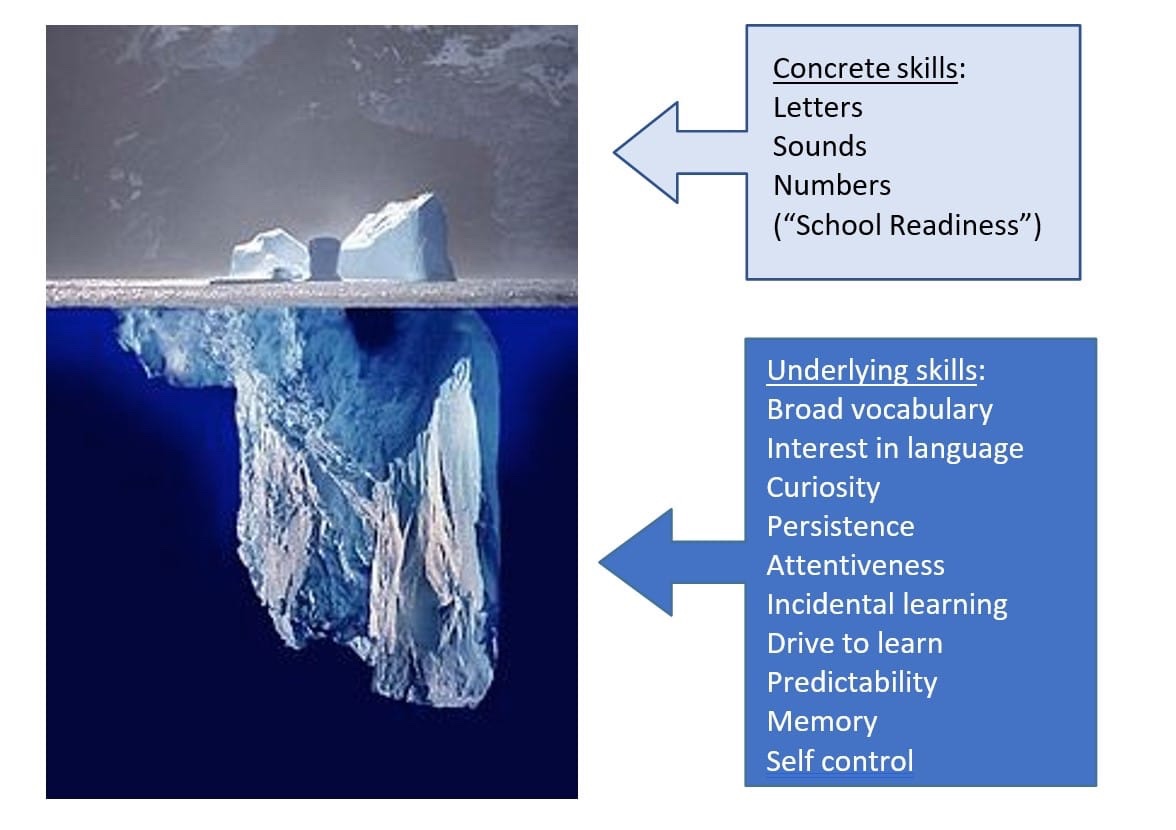
In an article on the blog of DEY (Defending the Early Years), Farran expressed her views about child development. She used the metaphor of an iceberg.
She wrote:
Years ago, few teachers believed that children should be taught to read in kindergarten; a more recent survey shows that 80% of kindergarten teachers now think children should know how to read before leaving the grade.
As recently as 1993 the great majority of kindergarten teachers did not believe an academic focus in preschool was important for children’s school success.
However, concern for the “fade out” of pre-kindergarten effects has led several researchers and policy makers to argue for a stronger academic focus in those classrooms, including the use of an intentional scripted, academically focused curriculum.
Not only do effects from pre-k classrooms fade, but also results from one study of the longitudinal effects of pre-k attendance conducted by my colleagues and me demonstrated that in the long run the effects turned negative.
A greater focus on academics for three- and four- year-olds is not the solution.
As an author of the recent paper on long term effects and as a primary investigator on the only randomized control trial of a statewide pre-k program with longitudinal data, and, finally, as a developmental psychologist whose career focused on young children’s development, I have thought extensively about what the causes of these unexpected effects might be.
I AM PROPOSING AN “ICEBERG MODEL OF EARLY DEVELOPMENTAL COMPETENCIES.”
The tip of the iceberg, the section floating above the surface, is composed of things that are easily measured.
These types of skills have recently been characterized as “constrained” skills meaning they are finite and definable.
All standard school readiness assessments focus on these types of skills.
But they do so because assessors believe that the skills represent deeper competencies.
They measure these skills somewhat like taking a finger-prick for evidence of the information the assessments provide into other more important characteristics of children.
BOTH THE FOCUS OF CURRENT PRE-K PROGRAMS AND THE PEDAGOGICAL STRATEGIES EMPLOYED FOCUS ALMOST EXCLUSIVELY ON THE TIP OF THE ICEBERG SKILLS.
Many who have been in early childhood for a long time testify to the changes in classrooms.
I believe these changes are accelerated by the process of subsuming preschool into the K-12 system.
In many states the department of education administers the pre-kindergarten program, and the program behaves like an additional grade level below kindergarten – the classrooms are open for the school day (5-6 hours a day) and the school calendar (9 months a year).
The classrooms are most often in elementary schools, where the push down from the K- 12 system is almost impossible to avoid.
Many of the elementary schools are older and unsuitable for younger children – no bathroom connected to the classroom, the requirement to have meals in the large cafeteria, and no appropriate playground.
These physical features mean that children spend a lot of time transitioning from the classroom, necessitating a high level of teacher control as children walk through the halls and endure long wait times.
Descriptions from a number of large studies of the instructional strategies used in current pre-k classrooms show them to be dominated by whole group instruction focused on basic skills (the tip of the iceberg).
TEACHERS TALK AT CHILDREN A MAJORITY OF THE TIME, SELDOM LISTENING TO CHILDREN, AND MULTI-TURN CONVERSATIONS ARE A RARE OCCURRENCE.
Learning opportunities that involve other than right-answer questions are almost never observed, and a high level of negative control from teachers characterizes many classrooms.
This content focus and the teaching strategies, I argue result in a detachment of the tip of the iceberg from the deeper skills under the surface.
Thus, children can score well on school readiness skills at the end of pre-k – especially on those related to literacy – but not maintain any advantage by the end of kindergarten when all children attain these skills with or without pre-k experience.
The tip of the iceberg skills no longer symbolizes those under the surface.
They are no longer the visible and measurable aspects of more important competencies.
Only when the deeper skills are enhanced should we expect continued progress based on early experiences.
A very different set of experiences likely facilitates the development of those deeper skills.
We have known for many years that the developmental period between four and six years is a critical one.
Neuroscience confirmed the importance of this period for the development of the pre-frontal cortex.
The pre-frontal cortex is involved in many of the skills described in the model as being below the surface.
Research does not provide good evidence for which experiences facilitate the development of important skills like curiosity, persistence, or working memory.
But research has demonstrated the importance of these kinds of skills for long term development.
For instance, some argue that early attention skills are more important than early academic skills as predictors of long-term school success including the likelihood of attending college.
In a large longitudinal study, researchers identified the importance of the development of internal self-control during the ages of four to six.
Some children with initially low self- control developed self-control during early childhood and had subsequent better outcomes via what the researchers called a “natural history change.”
Whether an intervention-induced change would yield the same positive outcomes is an open question.
So far, no early childhood curriculum has been able to bring about sustained changes in self-control or any of the below- the-surface skills listed above.
WHAT IS CLEAR IS THAT CHILDREN FROM MORE AFFLUENT HOMES ENTER KINDERGARTEN SCORING HIGHER ON SCHOOL READINESS SKILLS.
Moreover, they maintain that advantage across the school years.
But they did not learn those “readiness” skills from a didactic pre-k experience.
While these children may have had magnetic alphabet letters to play with, for example, parents did not sit them down in front of the refrigerator and force them to learn the letters.
Most of those tip-of-the-iceberg skills were learned through a variety of experiences and the opportunity to learn through interactions with adults and friends.
For these children, measuring the tip does provide information about the beneath the surface competencies that are so important.
Guidance may come from comparing the developmental contexts of families who are economically secure to the pre-k classroom context.
Children of economically secure families are more likely to succeed in school, more likely to matriculate in a two or four year college and more likely to graduate when they enter….
GOVERNMENTS IN MOST HIGHLY DEVELOPED COUNTRIES HEAVILY SUBSIDIZE THE CARE FOR YOUNG CHILDREN PRIOR TO SCHOOL AGE.
Nordic countries all provide a child supplement to parents, which most parents use to offset the modest cost of the government-subsidized group care, care that looks nothing like U.S. pre-k programs.
These programs stress different sorts of competencies in young children, capabilities like “participation” or the ability to be a functioning member of a group (not sitting “criss-cross applesauce” for 20-40 minutes during large group instruction).
The programs stress self-reliance and independence, the ability to make good decisions and to be responsible for one’s actions.
Most of these countries delay formal instruction in academic skills until children are six or seven. Their children do quite well in international comparisons in the later grades.
Concerns about the accelerating academic focus in early childcare education are being voiced by many.
I hope this “iceberg” model will provide a useful visual depiction of the danger of concentrating on basic skills instruction in pre-k.
I hope also that it will help people understand why getting early childhood right is so important and the imperative need to fix the childcare situation in the U.S. for families of poor children – in fact for all our children.
Pre-k is not the magic bullet policy makers hoped it would be. Quite the contrary. The reason it is not may lie with the unavoidable focus of the program when it becomes part of the K-12 system.
Denisha Jones is a lawyer, an early childhood educator, and a member of the board of DEY (Defending the Early Years). She writes here about the necessity of protecting young children from the resurgence of bad ideas. The worst of these bad ideas is standardized testing.
She writes:
As protectors of childhood, we have a duty to resist bad ideas, policies, and laws and be as vocal in our resistance as the proponents are in their insistence.
Though the effects of standardized testing have permeated certain aspects of childhood, young children typically are immune to mandated standardized testing.
When the testing accountability era began with No Child Left Behind, children below third grade escaped the yearly testing requirement.
This does not mean young children are not subject to many assessments as many schools give practice tests to first graders, but children in grades K-2 rarely take national standardized tests.
Five days into the new year, a proponent of standardized testing argues for beginning the NAEP (National Assessment of Education Progress) tests in kindergarten.
He argues that since advances in technology make it feasible to mass test young children on iPads and computers, we should collect more data in the early years.
Though many feel that NAEP is a good standardized test because it only tests a sample of students, even if this bad idea became the norm, it would only impact a sample of young children.
A THREAT TO SOME CHILDREN’S CHILDHOOD IS A THREAT TO ALL CHILDREN’S CHILDHOOD.
Testing children in kindergarten is a bad idea, period.
We do not need more tests to know what young children learn in school.
More tests lead to more scripted curriculums, teacher-led instruction, and less time to play, explore, and discover.
Last month, when antiabortion activists and anti-vaccine protesters staged mass protests in the capital, speakers at both rallies quoted the Rev. Martin Luther King Jr. “Today, we are going to reclaim Martin’s dream!” the first speaker at the anti-vaccine rally, Kevin Jenkins, declared from the Lincoln Memorial, the site of King’s immortal speech. “Are we ready to reclaim the dream?” “Yeah!” shouted back the overwhelmingly White crowd.
“Martin is alive!” Jenkins told them. “We are here today fighting for the same thing he fought for.” The crowd rejoiced at this discovery that King, like them, had battled for the right to take deworming medication instead of highly effective vaccines. We shall overcome … mask mandates?
At the same time, Fox News host Tucker Carlson has been making a strong bid to become the Hanoi Jane of the Ukraine conflict, calling for kumbaya with Russia. Night after night, he has been taking Vladimir Putin’s side and parroting Kremlin propaganda in the standoff against NATO and the United States. (Poor Putin’s just trying “to keep his western borders secure.”)
Carlson’s flower-child viewers have been calling lawmakers with a message that would have enraged Republicans just a few years ago: Give appeasement a chance.
Now, truckers are staging mass civil disobedience to occupy Ottawa and shut down border crossings with the United States in protest of public health rules. And Republican officials say: Right on, man. Sen. Ted Cruz (R-Tex.) hailed the truckers as modern-day Freedom Riders, “heroes” who are “marching for your freedom and for my freedom,” while Rep. Jim Jordan (R-Ohio) said they want only “what God gave them: freedom.”
“Civil disobedience is a time-honored tradition in our country, from slavery to civil rights,” Sen. Rand Paul (R-Ky.) told the Heritage Foundation’s Daily Signal. “Peaceful protest, clog things up, make people think about the mandates.”
Stick it to the man — by, um, refusing to take a jab. Just how far will this new New Right go in flattering the New Left with imitation? Well, they aren’t burning bras and draft cards — but they have been known to burn face masks. As Politico’s Jack Shafer argued last week, the truckers’ takeover of Ottawa streets is an “occupation”-style protest popularized by the left with 1930s labor sit-ins, the 1968 student occupation of the Columbia University president’s office and the Occupy Wall Street movement of about a decade ago.
“The American Right Hits Its Hippie Phase” was the headline atop a July article in National Review by Kevin D. Williamson. Like the leftist radicals of the 1960s, he wrote, “the contemporary Right also hates the government, the business establishment, much of organized religion, compromise, etc., but instead of LSD and Transcendental Meditation it has hydroxychloroquine, Ivermectin, absurd mask politics, election trutherism, anti-vaccine activism, 1,001 conspiracy theories, and QAnon.”
Turn on, tune in — and drop your sense of irony. Covering the hypocrisy of the Trump right is a full-time beat these days. “Law and order” Republicans now embrace insurrectionists. Those who decried “cancel culture” now ban books and history lessons. Conservatives who supported “tort reform” now enshrine the rights of private citizens to sue one another. A party that welcomed libertarians now has officials incentivizing people to report on their neighbors. Onetime Cold Warriors now sympathize with Putin.
The inconsistency over street protests is particularly black and white.
When a convoy of White people in trucks promotes chaos and lawlessness on the northern border, Republican officials call them heroes, and former president Donald Trump invites them to the United States. When a caravan of Brown people on foot posed a remote chance of chaos and lawlessness on the southern border in 2018, Trump called in the military to protect against the “MANY CRIMINALS.”
When (predominantly White) crowds protest for the right to ignore public health rules in mostly peaceful but occasionally violent and highly disruptive actions, Republican officials hail the glory of civil disobedience. When (heavily Black) crowds protested for racial justice in mostly peaceful but occasionally violent and highly disruptive actions, Trump called them “rioters, looters and anarchists” not to mention “terrorists,” “arsonists” and “violent mobs.”
“I’m old enough to remember when Black Lives Matter shut down highways and the right responded with laws making it easier to run protesters over — and get away with it!” conservative Matt Lewis wrote in the Daily Beast. It’s true: Last year, Florida’s Republican governor, Ron DeSantis, signed a law granting civil immunity to people who drive through protesters blocking a street. Texas, Oklahoma and other states enacted similar laws.
Now, Republican officials are lending rhetorical support and financial protection to the White men blocking the streets of Ottawa? This isn’t “reclaiming the dream.” It’s a bad acid trip.
Governor Ron DeSantis and the Florida Legislature passed a law to ban any discussion of homosexuality in school; the legislation is known as the “Don’t Say Gay” law. Other red states are rushing to pass copycat legislation. Some are using their gag orders to target both critical race theory and any discussion of LGBT.
PEN America, the authors’ organization, summarized this frenzy:
Last month PEN America reported that 2022 had seen a steep rise in the introduction of educational gag orders. So far this year, 103 different bills have been introduced in state legislatures across the country, many of which target higher education and feature severe punishments. Cumulatively, they represent a national assault on our education system, censoring both what teachers can say and what students may learn.
Some top line numbers:
Since January 2021, 156 educational gag order bills have been introduced or prefiled in 39 different states
12 have become law in 10 states
113 are currently live in 35 different states
Of those currently live:
105 target K-12 schools
49 target higher education
62 include a mandatory punishment for those found in violation
The effort to censor anti-LGBTQ identities is expanding rapidly
Of the bills currently live, many are progressing quickly through their state legislatures. Florida’s HB 1557, better known as the “Don’t Say Gay” bill, is a typical example. Having won support from Governor Ron DeSantis last week, it was swiftly voted out of the state senate. This bill would prohibit public K-12 teachers from “encourag[ing] classroom discussion about sexual orientation or gender identity” in primary grade levels, as well as teachers in any other grade level from doing so in a manner that is not “age-appropriate or developmentally appropriate for students.” As commentators have noted, HB 1557 would be a magnet for censorious lawsuits, allowing a school’s most conservative parent to dictate what every other student learns.
But Florida’s “Don’t Say Gay” bill is just the tip of the iceberg. While race, sex, and American history remain the most common targets of censorship, bills silencing speech about LGBTQ+ identities have also surged to the fore. Currently, 15 such bills are under consideration in 9 states. This is in addition to the wave of book bans sweeping through schools and public libraries, bans that overwhelmingly target materials dealing with gender and sexuality or that center LGBTQ+ characters. Many other bills currently under consideration target LGBTQ+ students for special scrutiny and exclusion in other ways.
What’s behind this sudden interest in censoring these topics and themes? In reality, it is not very sudden. Rather, what we are seeing in 2022 is a convergence between two distinct but related sets of actors: First, anti-LGBTQ+ activists, well-established but with limited success in penetrating public schools; and second, the “anti-Critical Race Theory” movement. The latter has primed the public to support sweeping censorship of classroom speech. For anti-LGBTQ+ activists, this is a once-in-a-generation opportunity, a chance to ram through bills that are far more restrictive than anything the public would normally accept. The goal is quite simply to lock LGBTQ+ topics on the wrong side of the schoolhouse gate.
No bill better exemplifies this trend than Kansas’s HB 2662. Introduced last week, it appears at first glance to be a typical “curriculum transparency” and “parents’ rights” bill, similar to many others we have seen this year. The first six pages are a long list of rules about curricular materials, where they must be posted, how parents are to be notified, etc., all of it punctuated by occasional broadsides against “racially essentialist doctrines.” In other words, standard “anti-CRT” fare. But tucked back toward the end, HB 2662 also proposes to make a change to the state’s obscenity law, making it a class B misdemeanor for a teacher to use any material in the classroom depicting “homosexuality.” Note well: not sexually explicit depictions of homosexuality. Just homosexuality in general.
Bills like this are piling up. South Carolina’s H 4605 begins by enumerating a now-familiar list of concepts to be prohibited in the classroom (e.g. that “one race or sex is inherently superior or inferior to another race or sex”), but abruptly shifts halfway through to forbid teachers from “subject[ing]” students to “controversial and age-inappropriate topics” like “gender identity or lifestyles.” Indiana HB 1040 operates similarly: The bill contains 19 pages of rules about race, sex, and American history, before declaring on page 20 that teachers would be prohibited from discussing in any context “sexual orientation,” “transgenderism,” or “gender identity” without parental consent.
The list goes on. A bill introduced last month in Indiana would require schools to consult with parents before inquiring about a student’s preferred pronouns. Arizona HB 2011 would force students to seek their parents’ permission before joining any school club “involving sexuality, gender or gender identity.” As a result, gay and bisexual students seeking support from their classmates would essentially have to out themselves to their parents first. HB 800 in Tennessee would prohibit public K-12 schools from adopting any instructional materials that “promote, normalize, support, or address lesbian, gay, bisexual, or transgender (LGBT) issues or lifestyles.” And under North Carolina’s S 514, teachers and college faculty would have to report to a parent if their child displays signs of “gender nonconformity.” This last bill has stalled in the state senate, but it remains live and a renewed push could come at any time.
Everywhere across the country, anti-LGBTQ+ advocates and the “anti-CRT” movement are converging. The more that lawmakers warm to classroom censorship, the more anti-LGBTQ+ activists will seek to exploit that fact. And as the “Don’t Say Gay” bill’s speedy progress in Florida shows, this strategy can be successful.
Spotlight: Oklahoma
Perhaps no state has gone further or with greater speed than Oklahoma. As of today, lawmakers there are considering ten separate educational gag orders of varying scope and severity. Of the five most extreme, all contain major implications for how teachers, librarians, and school administrators talk about LGBTQ+ identities.
The first is SB 1142. If passed, public school libraries would be prohibited from placing on the shelf any books that:
make as their primary subject the study of sex, sexual preferences, sexual activity, sexual perversion, sex-based classifications, sexual identity, or gender identity or books that are of a sexual nature that a reasonable parent or legal guardian would want to know of or approve of prior to their child being exposed to it.
SB 1654 contains a similar ban (no library may distribute any materials that “make as their primary subject the study of lesbian, gay, bisexual, or transgender issues or recreational sexualization”), but extends the prohibition to teachers.
Higher education is being targeted as well: SB 1141 would bar public colleges and universities from requiring students to enroll in any course “that addresses any form of gender, sexual, or racial diversity, equality, or inclusion.” This bill supplements HB 1775, which was passed in Oklahoma last year and applies a similar ban to college training and counseling. That law has already chilled classroom instruction on race and sex, as detailed in a federal lawsuitfiled by the Oklahoma ACLU.
Lastly, there are two Oklahoma bills that, while not addressing LGBTQ+ related issues explicitly, would nevertheless likely expel all mention of them from the classroom. SB 1470 forbids public schools from employing any person who “promotes positions in the classroom or at any function of the public school that is in opposition to closely held religious beliefs of students.” And HB 614 requires colleges and universities to offer an “unbiased education that does not endorse, favor, promote, demean, show hostility toward or intentionally undermine any particular religion, nonreligious faith or religious perspective.” If passed, the bill would also establish a hotline that students can use to report a professor who besmirches their faith. Again, these bills do not mention LGBTQ+ identities explicitly. Nevertheless, it requires little imagination to see how they could silence any discussion of such topics, to say nothing of conversations about natural history, cosmology, or biology.
Censorship goes mainstream
It is important to understand that to their supporters, these bills are not extreme. On the contrary, they are the natural extension of the “anti-CRT” movement and its critique of classroom “indoctrination.” State senator Robert Standridge, for example, justified his support for SB 1142 this way:
The purpose of our common education system is to teach students about math, history, science and other core areas of learning – all of which are further expanded on in college as students pursue their fields of interest. Unfortunately, however, more and more schools are trying to indoctrinate students by exposing them to gender, sexual and racial identity curriculums and courses. My bill will ensure these types of lessons stay at home and out of the classroom.
This sort of “indoctrination” argument opens the door to all manner of classroom censorship. Anti-CRT activists did not invent it, but they certainly have made it popular. And in the wake of their success, many more ideas and values will be targeted for exclusion next. After all, LGBTQ+ identities are clearly regarded by some as “divisive concepts.” If systemic racism is unfit for classroom discussion, what is the principled argument against censoring conversations about homophobia too?
From book bans to educational gag orders, schools and universities are being threatened today to a degree that has no recent parallel. There is a willingness, and even eagerness, to bring the weight and power of government to bear on controlling classroom speech. And as is always the case in such times, students will be the ones to pay the price.
Sure, Democrats are predominant in New York and California, but rising sea levels will also devastate Florida, Georgia, Texas, and the Carolinas.
Waldman says that as recently as 1994, Republicans cared about the environment. No more.
He wrote:
Back in 2008, House Speaker Nancy Pelosi (D-Calif.) and former speaker Newt Gingrich recorded a television ad in which they acknowledged their bitter political differences, but made a shared commitment on one critical issue.
“We do agree,” said Gingrich, “our country must take action to address climate change.” He added: “If enough of us demand action from our leaders, we can spark the innovation we need.”
Let’s take a look at some of the latest major climate news:
Somehow, that new Republican understanding of the importance of addressing climate change never quite caught on. If anything, as the effects of climate change intensify, the GOP has become more committed to opposing any and all efforts to do something about it.
• The National Oceanic and Atmospheric Administration released a report showing that coastal sea levels will rise by an entire foot between now and 2050, “intensifying the threat of flooding and erosion to coastal communities across the country.”
• A new study shows that the ongoing drought in the western states has made this the driest period there in 1,200 years.
• The climate provisions in the Build Back Better bill are on ice, now that BBB has stalled amid lockstep Republican opposition. The Post reports that this has “frozen hundreds of billions of dollars in private capital” earmarked for climate projects across the country, which has “complicated America’s much-touted clean energy revolution.”
• Republicans are trying to block President Biden’s nomination of Sarah Bloom Raskin as chief banking regulator at the Federal Reserve. Why? Because she has advocated for the financial industry to do more to plan for the economic effects of climate change.
• Spurred by climate-denial organizations, Republican legislators at the state level are working to prevent officials from dealing with businesses that are moving to wean themselves from fossil fuels or otherwise taking climate change seriously.
• In Florida — where there is ample sunshine — Republicans in the legislature are working with the state’s largest utility to undermine net metering, the hugely popular system under which customers with solar panels send back surplus energy to the grid. Solar companies in Florida say if the bill passes, they’ll have to shut down and move to other states
.It wouldn’t be fair to portray the Republican Party as an absolute monolith on climate — a smattering of Republican officials here and there say they would like to do something on climate, even if their solutions always seem to include uninterrupted drilling and burning of fossil fuels.
And the Republican electorate has complicated views on the topic. Depending on how pollsters ask them, a majority of Republicans sometimes express concern about climate and support various ideas to reduce emissions. But by other measures, Republicans have actually grown less concerned about climate in recent years.
If that’s the case, it could be partly because the administration of Republican god-king Donald Trump was the most aggressively anti-environment in history. Or it could be because as you move down the funnel from vague popular notions to elite opinion and finally to policies the party supports, the closer you get to the apparent belief that conservative identity-signaling requires one to oppose doing anything at all to slow global warming.

 Diane Ravitch's blog