When I started the new blog format, I said I would repost blogs from others only in rare instances. This is one of those rare instances. Peter Greene has written a devastating analysis of the oligarchs’ plans to attack public school teachers and defund public schools in Arizona. You need to read this story. The privatizers’ game plan is on full display, in all its ugliness. It’s a reverse Robin Hood scheme, which will steal from everyone so as to reward the rich.
Here are a few excerpts from the exceptionally vicious legislation that has been filed:
Arizona has lost its damn mind, this week passing some of the stupidest, most aggressively anti-public ed laws anywhere, including an absolutely insane law requiring teachers to file lesson plans a year in advance.
Arizona has always been a strong contender for most anti-public education state in the county. They’ve had trouble convincing teachers to work there for years (at one point they were recruiting in the Phillipines), using the one two punch of low salaries along with rock-bottom spending on classrooms (this is the state wherethe house GOP leader contended that teachers were just working second jobs so they could buy boats). In the meantime, they have done their best to foster charter profiteering and set up vouchers at the expense of public ed. Did I mention that Arizona is the Koch home base?
This week Ducey issued an executive order requiring all schools to return o in-person learning by March 15, with exceptions only for the counties (there are three) with high transmission–there, the middle and high schools can stay remote. No other exceptions, no consideration for local concerns, issues, situations, etc.
But now for the legal highlights of the week.
SB1058 is the one I mentioned above. In this bill, every school (charters get hit with this foolishness, too) must, by July 1 of each year, post, where parents can see it, all lesson plans, materials, activities, textbooks, videos, online stuff. Parents in Arizona already have the right to review all materials, so nthis is just a next step. “It should be reasonably easy to access the information.” This bill passed the Senate on Tuesday.
This is more than just an unnecessary burden on teachers. It’s more than just a way to legislate bad teaching (if you already know what you’re doing in class on a particular Tuesday five months from now, you are not doing a great job teaching). It also makes each teacher’s lesson planning–their professional intellectual property–open to the public. Starting a charter school but you don’t know a damn thing about teaching? Just log on and lift your curriculum, scope, sequence, plans, etc from any actual teacher…
All of this comes on the heels of a massive voucher expansion in Arizona, worth noting because it was one more example of the state’s GOP working in direct defiance of Arizona voters, who decisively rejected voucher expansion just two years ago. It’s an ugly frustrating mess. What exactly is your next move if you’re in a state where the reaction to “If you keep this up, you’ll destroy public schools” is “Good.”Jeb Bush is a big fan of Arizona’s work, mostly because it so closely follows his own playbook in Florida. It all points to an ugly future in which the wealthy can buy the education they want and not have to pay taxes to educate Those People’s Children.
Seriously, if you want to place bets on which state will be first to destroy its public schools, you wouldn’t be wrong to bet on Arizona. It is a wholly-owned Koch franchise.
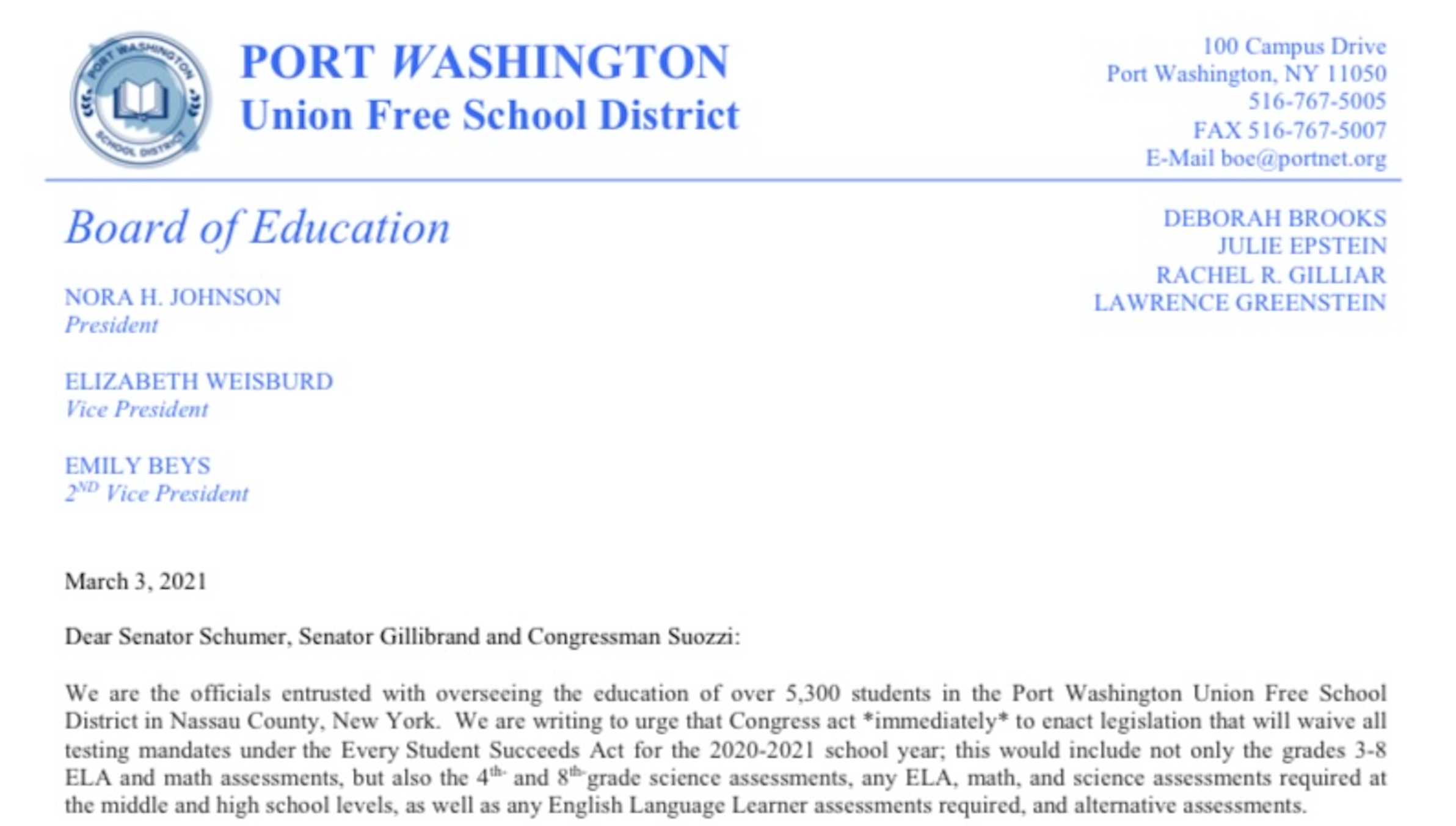
The Port Washington Union Free School District on Long Island in New York wrote an excellent letter to their representatives in Congress. It is a model letter that should inspire other local and state school boards.
We are the officials entrusted with overseeing the education of over 5.300 students in the Port Washington Union Free School District in Nassau County, New York. We arc writing to urge that Congress act ‘immediately’ to enact legislation that will waive all testing mandates under the Every Child Succeeds Act for the 2020-2021 school year. This would include not only the grades 3-8 ELA and math assessments, but also the 4th and 8th grade science assessments, any ELA, math, and science assessments required at the middle and high school levels, as well as any English Language Learner assessments required, and alternative assessments.
The pandemic has caused our country’s children immense psychological harm and stress. Children arc best served by face-to-face interactions and connections with teachers. staff. and know students, in a school building setting. Our school buildings arc our children’s ccosystem, and for many, it’s their primary source of emotional and social sup, (not to mention food and nutrition and sometimes even clothing). Last March. all of that was taken from them. literally overnight. Sadly. to this very day. many schoolchildren nationwide. including in Ncw York Statc, have yet to rctum to in-person instruction, and even for those who have rcturned. in-person instruction is often not full time and is plagued by constant quarantines of both students and staff.
Safely reopening our schools during this pandemic and creating a fully virtual K-5 school required spending to the mine of over S3.7 million – a staggering amount for any local school district. Yet. even with this immense expenditure. only our elementary school kids arc attending school in person full time, and our secondary students arc still in a hybrid cnvironmcnt that is less than ideal. Additionally. we have the constant quarantines of classes and teachers that further stalls Teaming.
These federally-mandated tests constitute an unfunded mandate. Many districts, such as Port Washington, have already dipped into reserve funds in order to safely reopen our schools. Administering the ESSA assessments is an incredibly wasteful endeavor, and a breach of our fiduciary duty to our taxpayers. Every moment that a teacher has with our nation’s children should and must be spent on substantive learning while focusing on their social and emotional well-being. Our students arc living in crisis. The very last thing these children need is to be subjected to assessments. Congress must act now to enact legislation that will waive all testing mandates under the Every Student Succeeds Act for the 2020-2021 school year.
Before he became a member of Congress, Jamaal Bowman was principal of a middle school in the Bronx. He knows what kids need: more support, not more testing. He is now vice chair of the House Education Committee. In New York, before entering Congress, he was an active member of the opt-out of testing movement. He is now spearheading an effort to roll back the Biden administration’s refusal to grant waivers to states from the mandated federal testing.
Bowman said that requiring testing this year would add stress to kids who are already traumatized and divert school administrators’ resources and attention away from reopening safely.
“We absolutely should not be doing this now in the middle of a pandemic,” he said in an interview, adding that it would be “too much of a heavy lift” for states.
“We already know where the gaps are because we’ve been testing for 20 years,” Bowman said, adding that the federal government should engage with teachers and principals to determine where resources need to be targeted as a result of the pandemic.
The new testing guidance was unveiled by the Education Department on Feb. 22, before Cardona was confirmed by the Senate. The guidance was signed by Ian Rosenblum, former executive director of The Education Trust-New York, who is the acting assistant Education secretary for elementary and secondary education.
“Mr. Rosenblum, with all due respect, has never been a teacher or school administrator in his life, and it’s important that our parents and educators know that these decisions are being made by people who do not have the experience to make those decisions,” Bowman said. “That’s unacceptable in and of itself.”
The resumption of testing is supported by the chairs of the House and Senate education committees, Rep. Bobby Scott of Virginia and Senator Patty Murray of Washington State. They imagine that the standardized tests will somehow promote equity and measure “learning loss.” It will do neither.
“We must do everything in our power to make up for lost learning time and address achievement gaps that have been exacerbated by the pandemic — and that starts by understanding the scope of the problem,” Scott and Murray said in a joint statement last month.
They should listen to Jamaal Bowman, who knows what he is talking about.
And they should read this article, which explains why standardized testing does not close achievement gaps and does not promote equity and will not measure “learning loss.”
Please call or write your members of Congress to register your views about the resumption of standardized testing as we are still in the pandemic, following a year of disrupted schooling, in which educational opportunity was unevenly available. If you want to know how your kids are doing, ask their teachers.
After thirty years of devotion to “reform” (aka, deform or disruption), reform leaders in Minnesota are proposing a state constitutional amendment that will install more mischief into the state’s public schools. Rob Levine, an ardent critic of privatization, has written this account of their multiple failures and their plans to try yet again to impose their ideas on the state’s schools. He wrote this post at my request, after I saw his tweets about the travesty that “reformers” are promoting. Rob is a “follow the money” kind of person, which unsurprisingly removes the veil from bold promises that never come true. Minnesota is allowing big money to dictate the fate of its schools. Is there any accountability in the state for thirty years of failure? Why do “reformers” never learn from their failures?
He writes:
In the Fall of 2022 Minnesotans may be voting on a constitutional amendment that will fundamentally change state law around public education. How will this change public education? Surprisingly, even the authors profess not to know the answer to this question. The only thing certain about the proposed amendment is that it will empower courts and throw districts, parents and others into constant legal battles.
That’s because the amendment upends state law and tradition both in the language it removes and the language it adds. It doesn’t really say anything about how children should be educated, only that they will have a right to a ‘quality’ education as measured by standardized tests and as determined by the courts, with nothing in the amendment to guide them as to permissible remedies.
A lot of ink has been spilled in Minnesota over the proposed ‘Page’ amendment, but almost no one has investigatedeither the organizations and people behind the amendment, nor the subtext of it. The education discourse is same as it ever was, but in this case the education reformers – who have failed for 30 years to improve educational outcomes – want to open Pandora’s box.
The amendment is a half-baked, dangerous idea, as a number of scholars and experts recently wrote to Minnesota legislators. It would weaken protections against segregation while simultaneously enshrining invalid standardized test scores in the state constitution.
Who’s really behind this proposed amendment? The powerful philanthropies who for decades have meddled in Minnesota education, almost always to failure. They have been trying to privatize public education for decades. They favor a system where the public pays for things but public employees don’t provide the services.
For 30 years the Minneapolis Foundation has been meddling in the affairs of the Minneapolis Public School District, often actually telling it what to do while at the same time driving the privatization of public schools through ‘school choice.’ Since about 2008 the vehicle for the destruction is charter schools, a movement it both created and sustained in myriad ways. The result has been stagnant learning across the state for 20 years, increased segregation, and public school districts on the brink.
The Federal Reserve Bank in Minneapolis is also playing a role in advocating for the amendment: a creature of the federal government applying substantial resources and trying to influence and change Minnesota constitutional law.
The bad faith of these foundations and advocates started decades ago when the state considered the nation’s first charter school legislation. History shows that the prime mover behind this legislation was the Minneapolis Foundation, and its ideological guru Ted Kolderie, the charter whisperer. Most people have probably never heard of him, but there are more than a hundred references to him in former DFL legislator and author of the charter school legislation Ember Reichgott Junge’s book, Zero Chance of Passage: The Pioneering Charter School Story, that chronicled how that first charter school legislation came to be.
In a 1990 monograph titled “The states will have to withdraw the exclusive” that argued for competition in the education space, Kolderie told a bunch of whoppers, including that charter schools would increase teacher pay, allow them to control schools, and characterized students as “customers.” None of those predictions have come true. Minnesota now has about 170 charter schools. TWO of them are unionized, so, no, charter schools have not empowered teachers.
Then there’s the organization actually leading this constitutional amendment campaign, Our Children MN, an opaque non-profit incorporated just a year ago whose sole purpose seems to be passing the amendment. Our Children has not disclosed one penny of its funding.
The organizing leading the charge is Our Children, an opaque non-profit that has not disclosed one penny of its funding.
According to Our Children’s website, Michael Ciresi, Minnesota philanthropist and former DFL senate candidate sits on its board of directors. Ciresi hates the Minneapolis Public School District so much that he bought billboards across the street from district headquarters to spread racial disinformation.
Ciresi himself is no slouch when it comes to failing at education reform. His foundation has funded a number of now closed charter school entities, including Charter School Partners, MinnCAN, Harvest Prep charter school, and last but not least, Minnesota Comeback.
Ciresi’s foundation gave Comeback about a half million dollars over five years. Comeback was a project of the Minneapolis Foundation, which incubated it internally as the Education Transformation Initiative. Lots of other local foundations, including the Bush, John & Denise Graves, General Mills, and others contributed to the nascent effort.
When it opened in 2016 Comeback announced $30 million in commitments from funders and promised to create “30,000 rigorous and relevant charter school seats in Minneapolis.” Whatever that meant educationally it was really a death threat to the Minneapolis Public School District, which had about 35,000 students at the time.
Three years later Comeback disappeared into the night with no announcement or media reports after reporting less than $4 million in philanthropic contributions. But don’t fear for them – Comeback was merged into Great MN Schools, an organization it formerly owned, and which is now a “Page Partner.”
This kind of abject failure of philanthropic avatars in the field of education in Minnesota is more the rule than the exception. In 2009 the Bush Foundation, a philanthropy born of 3M money, started the largest project in its history – the 10 year, $50 million Teacher Effectiveness Initiative (TEI) (not to be confused with the Minneapolis Foundation’s failed Education Transformation Initiative).
The TEI postulated that the problem with education is teachers, and by the foundation’s strategic application of its largess so-called ‘achievement gaps’ would be ELIMINATED in three states and 50% more kids would be going to college. The foundation was also so confident of its success that it predicted the changes it would help implement would spread like wildfire nationwide. They also announced that not only would it perform this educational miracle, it would prove it with metrics!
This feat would be done by extending the so-called Value Added Model (VAM) to gauge the ‘effectiveness’ of teachers by analyzing the test scores of their students. The job, and a promise of millions of dollars in revenue, was awarded to a place called the Value Added Research Center at the University of Wisconsin.
Their task was to extend this discredited model originally invented to increase production of farm animals to apply to places where teachers are taught. The idea was to judge schools of education based on the standardized test scores of students taught by their graduates! One doesn’t need a PhD in social science or statistics to know that this is an insane, impossible and worthless goal.
Sure enough halfway through the project the Bush Foundation abandoned its quixotic VAM method and VARC had to be satisfied with only $2 million for its efforts. By the end of the 10 year project ‘achievement gaps’ were the same or worse, and in Minnesota instead of there being 50% more students in college, enrollment actually was down six percent. By any measure – including their own! – this project was a spectacular failure. Turns out teachers aren’t the problem! But that’s not how they saw it.
In an in-house magazine article titled “Goals for a decade revisited,” Jen Ford Reedy, president of the foundation, offered up a bold summary of the project: “We [the Bush Foundation] are proud of what we helped to make happen!”
Failure can also take different forms for the philanthropies. In 2013 the Minneapolis Foundation launched yet another huge education project called RESET Education. They even created a website for it and brought in John Legend to sing at the kickoff. Along with blaming teachers for poor test scores among some demographic groups, RESET was essentially a formula to turn Minnesota schools into testing factories. Sandra Vargas, the head of the foundation at the time, got an op-ed in the Star Tribune to tout the project, just as Our Children got one there a few weeks ago to tout the Page Amendment.
And of course the Minneapolis Foundation turned to MinnPost for coverage, as it often had, as it has been funding the organization to the tune of over $1 million since its inception. For the year of 2013 – the year of RESET – the Bush Foundation also gave MinnPost $82,000 for “Coverage and writings on K-12 education issues, best practices and overall reform efforts.”
At MinnPost reporter Beth Hawkins put the best possible face on the RESET program with gushing words about meeting celebrities and flogging the factually wrong assertions of the Minneapolis Foundation about education. That same year RESET faded into the ether just as Comeback, Charter School Partners, MinnCan and others have.
And as usual when Beth Hawkins wrote at MinnPost it was left to commenters to correct the record. It fell to Jim Barnhill, a former union leader and former Board of Teaching Member who currently works in high school administration, to get to the heart of the matter:
“How about exploring the real agenda of the Minneapolis Foundation? Why not ask the obvious question, ‘How does a business foundation posit themselves as experts in education?’”
The same question could be posed to the Federal Reserve Bank. And just what gives these foundations that have failed at education reform time and time again the right to continue intervening? A prescient person once said that “Insanity is doing the same thing, over and over again, but expecting different results.” A corollary might apply to self-appointed ‘experts’ with deep pockets who repeatedly fail and hurt society. It’s time for Alan Page, Mike Ciresi and the Minneapolis Foundation to grab some bench.
Los Angeles studentsare a critical step closer to a return to campus beginning in mid-April under a tentative agreement reached Tuesday between the teachers union and the L.A. Unified School District, signaling a new chapter in an unprecedented year of coronavirus-forced school closures.
The agreement, which must be ratified by members, establishes safety parameters for a return to campus and lays out a markedly different schedule that still relies heavily on online learning. The school day would unfold under a so-called hybrid format — meaning that students would conduct their studies on campus during part of the week and continue with their schooling online at other times.
Families would retain the option of keeping students in distance learning full time.
Our wonderful allies, Pastors for Texas Children, send us wonderful news: Friends of public education raised their voices, stood together, and stopped new voucher legislation!
Vouchers Blocked Again!
Last week, we celebrated the victory of your tireless advocacy for public education funding for our children when we announced Gov. Greg Abbott’s decision to extend “hold harmless.” Today, we have another piece of good news:
The voucher proposal in this session’s House Bill 3 has been removed.
In a meeting earlier today with Pastors for Texas Children and Raise Your Hand Texas, HB 3 author Dustin Burrows (R-Lubbock) indicated that all education issues, including vouchers, are being taken out of the bill. This change will be reflected in a committee substitute later this week. We thank Chairman Burrows and Gov. Abbott for their wisdom in removing the voucher from the bill.
PTC Executive Director Rev. Charles Johnson gives “joyous testimony to the love and support Texans have for their neighborhood and community public schools – and firm opposition to the privatization of them through vouchers.”
“That we have to keep delivering that memo to the Governor and a third of the Legislature is outrageous and unacceptable,” he says.
Year after year, Pastors for Texas Children will continue to deliver that message, with your help.
In case you missed it, HB3 is a pandemic response bill that deals with many issues, among them school vouchers. Here is the language of the voucher: If a district of residence fails to compensate the off-campus instructional program before the 46th day after the date of receiving a bill, the commissioner of education shall reimburse the off-campus instructional program from funding deducted from the district.
According to this bill, the commissioner of education would get to decide which programs qualify for reimbursement from the state, which would be “deducted from the district” directly.
A voucher bill has been filed in every Texas Legislature since 1995, so we were not surprised, nor were we unprepared. The people of Texas do not want vouchers taking money from their public schools. Furthermore, we will remain vigilant to block any future voucher proposals.
We are thankful that this dangerous proposition was short-lived, and especially thankful for the public education advocacy community, which includes each of you, for making sure of that.
Last week, we were honored to join dedicated public education advocates in a webinar with Americans United for the Separation of Church and State. We love the different perspectives given by all the panelists, covering this issue thoroughly from all angles. The webinar is called “Fighting Voucher Legislation in 2021: An Update on State Voucher Bills and Tools to Oppose Them.” You can view it here to brush up on your talking points, as they will continue to be relevant.
Here is an excellent suggestion from our reader Laura Chapman, whose original research and writing will always find a home here. We have already missed the first Thursday but perhaps TCM will do reruns:
For adults who are fans of Turner Classic Movies, TCM has introduced programing to examine stereotypes in films. This is in addition to programing on women who have and are making films, and many rarely seen films for Black history month.
The TCM experts for the current effort do not mince words and they use clips from many films (older and newer) that depict, for example, male violence against women as if perfectly acceptable, the slaughter of American Indians and ersatz appropriations of native clothing, black actors cast in yes-suh roles, white actors pretending to be black and so on.
You may recall that sociologist and author Eve Ewing wrote an opinion piece in the New York Times that said it was time to end the debate about charter schools and celebrate all good schools, whatever they are called. This is one of the talking points of the charter industry, which prefers the public not to notice how many charter schools close every year, how many are low-performing, and how many are run by non-educators who turn a handsome profit.
The New York Times published letters to the editor about the Ewing article. Only one was favorable, written by Jeanne Allen, who runs a charter advocacy organization called the “Center for Education Reform,” funded by rightwing billionaires and Wall Street financiers. CER promotes all kinds of school choice and is hostile to public schools.
The first letter was written by Denis Smith of Ohio, who has appeared on this blog:
Why do we allow two separate but seemingly parallel systems of education, using scarce public funds that are taken from traditional public schools to fund charters, a seeming experiment gone awry? Why do we allow one entity that is accountable and has governance conveyed from the voters in each community and allow the other to avoid the same transparency and accountability?
Here in Ohio, charters are exempt from 150 sections of law that the public schools must be in compliance with to legally operate, yet the public schools are required to support charters with the school district’s transportation system and other services at no cost.
So no, we can’t stop fighting about the subject of charters until we have the same rules for both. If one is exempt from wholesale sections of the law, then by definition it is not a public school but something else, a school that acquires public funds to operate yet has its own rules and is free from much oversight.
Denis D. Smith Westerville, Ohio The writer, a charter school critic, is a former consultant in the Ohio Department of Education’s charter school office, responsible for assuring legal compliance in the operations of these schools.
The nation’s two teachers’ unions joined together to issue an unusual joint statement that advises federal, state, and local leaders what must be done not only to revive education after the pandemic but to restart it with a fresh vision that focuses on the needs of children, not assumptions about their “learning loss” or “COVID slide.”
They introduce the document and its visionary proposals with these words:
Nation’s educators release shared agenda to ensure all students succeedOrganizations offer proven ways to help students overcome Covid-19 opportunity gaps and meet students’ academic, social, and emotional needs
WASHINGTON, DC – Today the National Education Association (NEA) and American Federation of Teachers (AFT), the nation’s two largest educators’ unions, released a bold, shared agenda to ensure that all students receive the supports and resources they need to thrive now and in the future.
Over the course of the last month, AFT and NEA have come together to define the essential elements needed to effectively understand and address the ways in which the COVID-19 pandemic has disrupted students’ academic, social, and developmental experiences. “We have an unprecedented opportunity to create the public schools all our students deserve,” said NEA President Becky Pringle. “It is our mission to demand stronger public schools and more opportunities for all students- Black and white, Native and newcomer, Hispanic and Asian alike. And we must support the whole learner through social, emotional and academic development. The ideas presented in this roadmap will lay the groundwork to build a better future for all of our students.”
“COVID-19 has laid bare this country’s deep fissures and inequities and our children, our educators and our communities have endured an unprecedented year of frustration, pain and loss,” said AFT President Randi Weingarten. “As vaccine access and effectiveness suggest the end is in sight, it is incumbent on us to not only plan our recovery, but to reimagine public schooling so our children, families and educators can thrive.
“The crises gripping our country are weighing heavily on young people, who are the future of our communities. That’s why our schools must, at a minimum, be supported and well-resourced to address our students their trauma, social-emotional, developmental and academic needs. This framework is an invaluable tool to help us get there,” Weingarten added.
Shared with Sec. of Education Cardona last week, Learning Beyond Covid-19, A Vision for Thriving in Public Education offers the organizations’ ideas on ways our education systems can meet students where they are academically, socially, and emotionally. The framework outlines five priorities that can serve as a guide for nurturing students’ learning now and beyond COVID-19 including learning, enrichment and reconnection for this summer and beyond; diagnosing student well-being and academic success; meeting the needs of our most underserved students; professional excellence for learning and growth; and an education system that centers equity and excellence.
Florida’s State Constitution has explicit language forbidding public schools fir religious schools. Voters in Florida passed a referendum in 2012 against vouchers.
No matter. Republican legislators are expected to endorse SB 48, which will decrease funding for the public schools that most students attend. Students will be able to get a voucher even if they never attended a Public school.


 Diane Ravitch's blog