Who is Jeff Yass? He is a multi-billionaire, the richest man in Pennsylvania. He is passionate about school choice, even though he is a graduate of the New York City public schools.
When Governor Gregg Abbott was fighting to impose a voucher plan on Texas, he was stopped by a solid bloc of Republicans who were devoted to their community’s public schools, the schools everyone attended, the schools that were the biggest employer in town, the schools where everyone knew the teachers.
Jeff Yass gave Gregg Abbott $10 million to run hardline, pro-voucher candidates against the moderates. He deeeated enough of them to get his voucher bill passed.
Now Jeff Yass has decided that Vivek Ramaswamy should be governor of Ohio. Ohio already has charters and vouchers, but apparently that’s not enough for billion as ire Yass.
A single billionaire may now have given more money to help elect Republican Vivek Ramaswamy as Ohio’s next governor than Democrat Amy Acton has received from all her donors combined.
Politico reported this week that Jeffrey Yass of Pennsylvania had made a “fresh ten-figure donation of cash” – in other words, at least $10 million – to V-PAC: Victors not Victims, a political action committee set up to support Ramaswamy’s run for governor in this year’s elections. The money will help fund even more attack ads against Acton that attempt to paint her as unqualified, erratic and too liberal.
That new contribution, which a source familiar with the group confirmed to Andrew, adds to the $20 million that Yass previously gave to V-PAC. The $30 million (at least) from Yass now exceeds the $21.8 million Acton has reported raising for her entire campaign, based on the most recent publicly available numbers. As a federal super PAC, V-PAC is allowed to raise and spend unlimited amounts of money, unlike official campaign committees, which must follow state campaign finance limits.
The new check from Yass – who’s among the country’s biggest financial supporters of taxpayer-funded private school vouchers and other school choice programs – further contributes to Ramaswamy’s lopsided fundraising advantage. Ramaswamy and his allies have now spent or reserved $82.3 million on TV and digital ads this year, compared to $11.1 million in expected pro-Acton spending, according to Medium Buying, a Republican political ad tracking firm. Team Ramaswamy’s ads have been running all year, while most of the pro-Acton ads, including an $9.4 million campaign funded by the Democratic Governors Association, are set to begin after Labor Day.
Republicans’ strategy to defeat Acton relies in part on convincing Ohio voters that she’s a liberal Democrat. But she’s taken a few conspicuous stances this year that align her in some instances more closely with Republicans.
As Andrew wrote this week, Acton has come out in support of Issue 3, the voter ID amendment, as well as Medicaid work requirements and Ohio’s ban on transgender girls and women participating in girls’ and women’s sports. Acton’s positions put her at odds with most Democrats, including repeated past statements from her running mate, former Ohio Democratic Party chair David Pepper.
Acton made a couple more policy announcements on Tuesday that burnish her centrist bona fides.
Appearing in Columbus to tout a new endorsement from the Ohio Patrolmen’s Benevolent Association, the state’s second-largest police union, Acton announced her opposition to a longshot citizens’ effort to eliminate qualified immunity, the enhanced legal protections that cover police officers and other government officials. Acton also said she would not block local police from helping federal agencies enforce immigration laws.
“We always work with the federal law enforcement, and we will do so – whatever it takes to keep Ohioans safe,” Acton said, according to cleveland.com.
The OPBA, which represents 8,000 law enforcement officials statewide, announced other endorsements this week. They were a bipartisan variety pack, including Democrats Sherrod Brown and Jennifer Brunner for U.S. Senate and Ohio Supreme Court, respectively, and Republicans Keith Faber and Dan Hawkins for state auditor and Ohio Supreme Court.
Another state police union with nearly three times as many members, the Ohio Fraternal Order of Police, previously endorsed Vivek Ramaswamy, Jon Husted and the rest of the Republican statewide slate this year.
As research continues to show the harmful effects of technology on student learning, parents are pushing against it. Los Angeles is the latest district to impose limits.
The district has a checkered history with technology, including massive purchases of a laptop for every student and allegations of payoffs by vendors.
AI has its strengths and weaknesses. It’s useful to obtain information, like where is a TV program streaming or who won the Presidency in 1920. But its interpretations are sometimes wrong, as is some of its information. It can write essays, after getting prompts. But when teachers assign essays, they expect students to write them, not AI.
I have corrected AI on several occasions, and the bot quickly apologized. On one occasion, I asked for NAEP scores in a particular state. The AI responded with a slant implying that NAEP “proficiency” was grade level, and those who did not reach it were below grade level. Of course, I pointed out that NAEP itself warns that “proficiency” is higher than grade level and represents “solid achievement, what most of us would call an A or B+. NAEP is not “grade level,” although many reporters think it is. The bot quickly admitted its error.
On another occasion, I asked for the bio of a friend, and AI had confused her with someone else. Again, it made a correction.
AI makes many errors. My college-age grandson told me he never uses it because it’s unreliable.
Worse, it is a shortcut to learning, like copying an answer from an encyclopedia. But it’s more dangerous because encyclopedias are usually subject to rigorous fact-checking. Students who turn in AI essays are not learning. They are cheating.
The Los Angeles public school system will vastly restrict the use of artificial intelligence at all grade levels, district officials said on Wednesday at a board of education meeting.
The move came shortly after the nation’s largest school system, in New York City, announced it would ban most A.I. through 8th grade. Both developments seem to respond to an extraordinary movement, driven by parents, to push back against the incursion of technology and screens into childhood.
The board of education in the Los Angeles Unified School District previously barred cellphone use during the school day and strictly limited the hours per day students could spend on laptops.
The new A.I. restrictions, reported earlier by the Los Angeles Times, will apply for the current school year, as a board committee considers how to potentially incorporate the technology in the future, according to a district spokeswoman.
Students may still see A.I. summaries on top of Google searches, but will not be able to engage with Google’s Gemini chatbot within those searches, according to the district.
And they will not be able to use chatbot helpers that Google offers inside its Classroom software, including Google Docs, Google Sheets and Google Slides. Google Classroom is near-universally used in American schools.
Nicholas Melvoin, a school board member who sits on the committee studying A.I., said the board had been surprised by district officials’ decision to fully pause the technology for students.
While Mr. Melvoin has led the push to restrict student screen time, he raised questions about the wisdom of a complete A.I. ban for older teenagers, arguing they would need to understand the technology to prepare for college and the workplace.
“High school is where I would have more teacher discretion, with guardrails,” he said — similar to the path New York City officials outlined on Wednesday.
He said his committee would also consider the many big questions about how educators are using the technology, for lesson planning, grading, student feedback and communication with parents.
Los Angeles teachers continue to have access to A.I.
A.I. chatbots can help students learn, acting as a research tool or tutor breaking down complex concepts.
But chatbots can present misinformation. They have also led to an epidemicof cheating, as students prompt A.I. tools to write essays for them or complete problem sets. Even A.I. apps marketed specifically to schools have few blocks to prevent plagiarism or other forms of academic misconduct.
A growing body of research shows individuals who use chatbots can experience reduced critical thinking.
Common Sense Media, an advocacy group, has broadly tested A.I. chatbots and recommended their use be limited for people under 18, in part because they allow students to avoid the productive struggle of learning.
The group has also raised questions about A.I. search summaries, which may prevent students from seeking out multiple sources of information on contested subjects.
Yvette Renteria, chief program officer at Common Sense, praised the Los Angeles decision, saying it made sense to take a pause on a rapidly evolving technology. While Common Sense believes students of all ages should be given lessons in A.I. literacy to better understand how the technology works, she said that did not generally require classroom access to A.I. tools.
“At this moment, there is oftentimes more danger than opportunity,” Ms. Renteria said. She noted that students would still use A.I. outside of school on their personal devices, and argued that it remains crucial that educators talk to young people about the risks and potential rewards of A.I. use.
In Florida, a couple were arrested and charged for keeping their four grandchildren confined in a truck for six years and allowing them to be sexually abused during their long confinement.
The good news is that they homeschooled the children by enrolling them in Khan Academy online classes.
Did the couple know they were eligible for $32,000 in voucher payments to pay for all their educational expenses from the state of Florida? Maybe they did and were collecting. Why pay for the Khan Academy classes when the state will pick up the bill?
A grandmother and her fiancé are accused of trapping four children for six years inside a semi truck’s cab, where the children endured sexual abuse, malnutrition and neglect, prosecutors in Florida said on Tuesday.
Starting in 2019, the victims, two girls and two boys who now range in age from 11 to 15, slept on a top bunk without all fitting on the mattress, the authorities said in an arrest warrant. They urinated in a plastic cup and defecated in a grocery bag, the warrant said.
One child scarred her hand permanently when hot noodles burned her, and she was not taken to the hospital, the warrant said. One girl contracted a sexually transmitted infection, the warrant said.
“This is just straight evil, and a scourge on our society,” Mark Glass, the commissioner of the Florida Department of Law Enforcement, said during a news conference held on Tuesday.
The ordeal began when Ms. Epps and her fiancé, Tamra Marshon Stewart, 37, of Jacksonville, Fla., traveled with the children from Atlanta to Miami, James Uthmeier, the state’s attorney general, said during the news conference. Ms. Epps was a licensed semi truck driver, Mr. Williams said.
The couple served as primary caregivers for the children, and they all lived inside the truck’s cab.
The cab included two seats for a driver and a passenger, a bunk bed, a refrigerator, a microwave and a space for storage all packed into tight quarters, the authorities said in the arrest warrant.
“This was a prison, a rolling prison,” Mr. Uthmeier said.
One of the girls, who is now 12, said Mr. Stewart had touched her inappropriately every day for two years, the authorities said. She said her grandmother knew what was happening to her, and in one instance pretended to be asleep, according to the arrest warrant.
Mr. Stewart furnished the other girl, now 11, with candy and money after sexual encounters in an effort to keep her quiet, according to the arrest warrant. The victim “said it didn’t work,” the warrant said.
A 15-year-old boy confronted Mr. Stewart, calling him a pedophile and a child molester, according to the arrest warrant from the state’s attorney general office. Mr. Stewart punched the victims after the dispute, according to an arrest warrant filed by the Jacksonville Sheriff’s Office.
The children did not attend school while with Ms. Epps and Mr. Stewart and instead used Khan Academy, a website with educational videos that is not accredited, the authorities said.
Should states permit parents to trust “faith healers” for their children’s medical care? Should the state do so when the child is seriously ill? Should the state stand by idly when children tested by “faith healers” die?
That is what happens in Idaho. Under the protection of freedom of religion, parents may trust their sick children to “faith healers,” even at the cost of their lives.
With the growth and political clout of old-time religions, this dangerous practice may spread to other states. When does freedom of religion become deadly?
Dutton writes:
In Idaho, parents who say their faith prohibits lifesaving medical care for their children can’t be charged with child neglect or manslaughter. Supporters of this protection over the years have included lawmakers who voiced support for “traditional” Idaho values.
But from at least the 1880s through the early 1970s, it was illegal for parents in Idaho to choose prayer over medical care when a child’s life was at stake, newspaper archives and historical documents show.
“Every parent of any child who willfully omits, without lawful excuse, to furnish necessary food, clothing, shelter, or medical attendance for such child, is guilty of a misdemeanor,” reads the 1887 edition of Idaho territory statutes, published before statehood.
The statutes included no mention of spiritual belief as a “lawful excuse.” Three years later, the state constitution explicitly put limits on Idaho’s freedom of religion. It would not excuse “acts of licentiousness,” polygamy or other practices “inconsistent with morality or the peace or safety of the state.”
It wasn’t long before the law came down on members of the Followers of Christ, a faith-healing sect that arrived in Idaho in 1899 and remains active in the state. From 2015 to 2025, the sect’s congregations in Idaho experienced 15 preventable deaths of children, according to ProPublica’s reporting.
Pearl Annis was a 13-year-old girl whose parents had moved from Oklahoma to Idaho’s Magic Valley in the spring of 1915 with at least one other Followers family. The Annises and their 13 children shared “a two-room shack,” a local newspaper reported. An officer and a doctor visited the home after neighbors voiced concern. They found Pearl in bed, fully dressed and on the cusp of death.
Her father, Lurid P. “Lewis” Annis, was arrested on a misdemeanor charge of refusing to provide medical attention. Pearl was taken to the hospital, according to the news story, and died there with what today would be described as septic shock from a bowel blockage. The newspaper, which didn’t appear to follow up on Annis’ criminal charge, called the Followers church “a religious cult” and Pearl’s death a consequence of “religious mania.”
News archives and historic records don’t say how many times Idaho acted on similar cases in the decades after.
But one legal battle over lifesaving care drew attention in the 1960s, as sickness made its way through a Followers family in a Boise suburb. The mother died in December 1965. Her 4-year-old daughter died the following June.
Days after the girl’s death, a judge ordered the state to take custody of her 10-year-old brother under Idaho’s child protection law. The boy was admitted to a local hospital with pneumonia, a complication of the measles. He spent days in critical condition but survived. The judge told the father that to regain custody, he would have to be willing to give the boy medical care as the law required.
A doctor testified that without the hospitalization, the child “almost certainly would have died,” a newspaper report said.
The father’s lawyer told the judge that his sect was rooted in “faith that God will heal the sick.” The law in the 1960s was clear, though: a parent had a duty to protect their child’s health, no exceptions. The judge told Samuel’s father: “The law governs conduct. Religion governs opinion.”
But the legal landscape was about to shift. It came with little public attention.
During a full-on rewrite of Idaho’s criminal code in 1971, the Legislature added a section that said the state could not bring endangerment charges against someone “who chooses for his child treatment by prayer or spiritual means alone.” Legislative records don’t make clear how the wording originated. The passage of another law one year later, affirming the “spiritual means” language and applying it to other crimes, has been credited to the Christian Science church, another Christian denomination with Idaho members.
(The Christian Science website says the church’s practice of “healing in the way Christ Jesus taught” is not “faith healing” and that members are free to choose any form of healthcare. The church also supported Oregon’s full removal of its faith-healing exemption in 2011.)
Faith-healing exemptions soon became widespread nationally. The trigger was the federal Child Abuse Prevention and Treatment Act of 1974, which set out to standardize the nation’s child welfare system by giving states grants to more effectively investigate reports of child abuse.
The Department of Health, Education and Welfare interpreted the law as requiring states to have a faith-healing exemption to qualify for the grants — an interpretation that records from the time don’t explain.
Open the link and keep reading to learn how federal law changed to deal with “faith healing.”
Back in 2011, Harvard Professor Raj Chetty and two esteemed colleagues (John Friedman at Brown University and Jonah Rockoff at Columbia University) published a dazzling study of teachers, asserting that the best teachers are those whose students get improved scores. Those students have a higher income ($250,000 over their lifetimes), and enjoy a multitude of benefits, all because of that one teacher who induced them to have higher scores. President Obama cited Chetty’s research in his 2012 State of the Union address to show how important it was to find the “best” teachers and fire the “worst’ teachers.
Chetty’s work supported the Obama-Duncan Race to the Top plan to encourage evaluating teachers by the test scores of their students. States that evaluated teachers by their students’ scores were eligible to apply for a share of RTTT funding. Those who did not were not eligible.
Most states, eager for a share of the $5 billion prize, agreed to adopt what was called “value-added modeling” or “value-added measurement.” (VAM)
I posted dozens of times about the flaws of VAM, first of all, because the American Statistical Association said that teachers account for only 1-14% of score changes; most changes were attributable to home life and school system issues. Secondly, because the VAM concept is very unstable and is highly affected by student demographics. Only teachers of reading and math in grades 4-9 could even be assessed by the annual tests, which are mandated only in grades 3-8. Schools started attributing scores to teachers not in those subjects and not in those grades, tied to the work of other teachers in the school.
The Los Angeles Times engaged researchers to calculate VAM scores for the district’s teachers, and the newspaper published them alongside the names of teachers. It was humiliating for teachers, but Arne Duncan thought this disclosure was wonderful.
I happened to be in Los Angeles on the day that a fifth grade teacher committed suicide after he received a poor VAM score. No one knows if that was the reason for his suicide, but it may have been. By all accounts, he was a good teacher in a tough school.
The New York Post did the same for New York City teachers. It listed names and scores. The teacher identified by the newspaper as the city’s “worst” teacher was hounded by Post reporters seeking an interview. It turned out that she taught classes of new immigrants, who moved in and then out of her class as they learned enough English to join regular classes. Her students in September were not the same students by June. The VAM scores for her were meaningless, as they were for other teachers. Teachers of the gifted saw few if any gains because their students were at the top year after year. Expert math teacher Gary Rubinstein noticed that some teachers had high scores in one subject, but not in the other. Should half the teacher get a bonus while the other half was fired?
It’s a long review, and I won’t post it all. Please open the link and read it.
He begins:
For a long time I’ve been getting some version of the comment, “What about Chetty!” in response to my perspective on education, as in Raj Chetty, the economist who for the past decade has made a lot of waves asserting that our education problems are straightforwardly the product of bad teachers and that replacing them will have implausibly large economic effects. I tend to try and work from a broader perspective than “this is why I think this guy is wrong,” but I get this request so often, here you go. This is why I think Raj Chetty is wrong.
Few empirical claims in modern education policy have traveled farther than Chetty et al’s findings on teacher “value-added.” In his famous 2014 American Economic Reviewpapers, he and his coauthors reported that students assigned to better (excuse me, higher value-added) teachers were more likely to attend college, earn higher salaries, save for retirement, and avoid teen pregnancy, and that replacing a teacher in the bottom five percent of the distribution with an average teacher would raise the present value of a single classroom’s lifetime earnings by roughly $250,000. Chetty’s research findings in this domain had been floating around for awhile at the time of publication, and President Obama cited the figure in his 2012 State of the Union address, and the judge who decided Vergara v. California leaned on it to strike down California’s teacher tenure laws. Take that, teachers! The findings are arresting, the dataset is impressive – 2.5 million children, linked to IRS tax records! – and the policy implications are clean: identify and remove bad (pardon me, low “value-added”) teachers, watch outcomes improve. It’s exactlythe kind of story our neoliberal policy establishment is desperate to tell, and was clearly catnip to the Obama administration, which was doggedly attached to a simplistic vision of delivery through better education, where the gutting of the uneducated labor market was ameliorated by turning every last child in the United States into a genius, scaling up the Stanford-to-Google pipeline until every American could pass through it.
Unfortunately, the Chetty story is ultimately another neoliberal just-so story, that is to say, a fable, a legend, a myth. The closer you look at what the “value-added” construct actually measures, how stable those measurements are, and how the Chetty results have fared under replication, the more reason there is to doubt both the magnitude of the claimed effects and, more fundamentally, whether “teacher quality” as the literature operationalizes it is a coherent, measurable attribute at all. (Spoiler: it is not.) Let us count the problems.
The construct itself puts the thumb on the scale. The first problem is conceptual. In the Chetty et al. studies, a teacher’s “value-added” is the residual variation in a student’s standardized test scores that remains after controlling for prior achievement and some demographic covariates. It’s not a measure of pedagogical skill, content knowledge, classroom climate, the cultivation of curiosity, or any other property normally meant by “good teaching.” It’s a statistical residual on a narrow set of assessments, usually math and reading tests in grades three through eight. That residual is then defined as quality. I want to be clear about this: any portion of variability in student outcomes that Chetty et al cannot or will not identify otherwise is assumed to be a product of teacher inputs. Since Chetty’s whole project is to argue that educational outcomes are the result of teacher quality, this is what we used to call begging the question – that is, he’s assuming the point he wants to prove, asserting the desired conclusion as a premise, by acting as though any uncaptured variation is necessary evidence of teaching quality. And it gets worse in the telling. When advocates and journalists and politicians summarize his work, the construct expands silently from “the part of test-score gains Chetty cannot otherwise explain” to “good teachers,” and the slippage is rarely flagged. But that’s the whole game, you guys.
Jeff Bryant, prolific education journalist, writes in The Progressive about the efforts by educators to fight back against the failed and punitive policies of No Child Left Behind and Race to the Top. It’s a valuable summary of the past 15 years. Teachers rallied. Teachers sounded alarms about the bipartisan attack is on teachers, teaching and public schools.
Did it make a difference?
Now, 15 years later, there are thousands of charters, and they are no better than the public schools, contrary to their promises. Now, most states have vouchers, and the public is funding religious schools, which was unthinkable in 2011.
But we can’t give up! At last, there are candidates running to fight for public schools. Gina Hinojosa is the most prominent of them. If she defeats Greg Abbott in Texas, expect major changes.
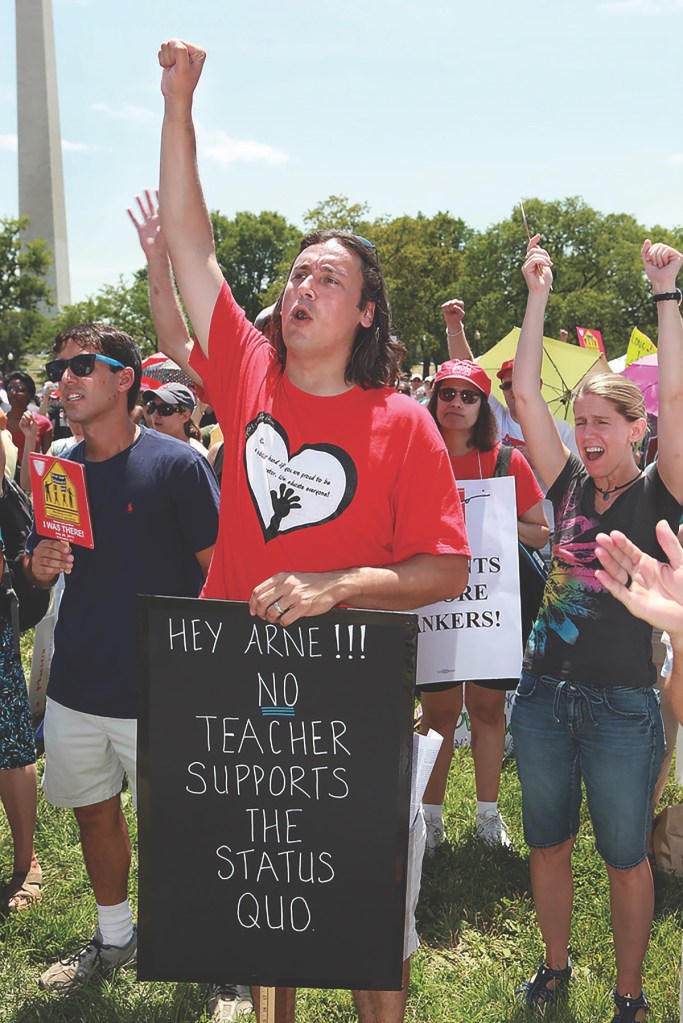
It was a sunny July day in Washington, D.C., the temperature was forecasted to hit 97 degrees Fahrenheit, and when I arrived at the Ellipse on the National Mall for the Save Our Schools march I realized I would need a hat. Among the vendors that lined Constitution Avenue, the least expensive hat I could find was a gaudy, red-white-and-blue affair with an embossed rendering of fireworks going off over the Lincoln Memorial and Washington Monument. “Some hat,” Anne Thompson, my videographer for the day, said when she arrived…
At the time, I was working on a project, partnered with the National Education Association, called “Starving America’s Schools: How Budget Cuts and Policy Mandates Are Hurting Our Nation’s Students.” The project documented how state governments, following the Great Recession, cut funding for schools and rolled out efforts to privatize them with charter schools and voucher programs.
I had read multiple analyses by the Center on Budget and Policy Priorities (CBPP) that found at least thirty-seven states responded to the economic downturn that started in 2007 and extended into 2009 by slashing their education budgets back to pre-recession levels. My Starving America’s Schools project would examine how the cuts caused districts to fire teachers, cancel art and music programs, close libraries and science labs, and cut extracurriculars like athletic programs, field trips, and drama performances.
Teachers turned out to denounce high-stakes testing, NCLB, Race to the Top, budget cuts, privatization, and the attacks on their profession, funded by Bill Gates, Eli Broad, and other billionaires.
….The estimated crowd of 3,000 to 5,000 roared in approval at an array of speakers that included the actor Matt Damon (whose mother is a professor of education), Ravitch, best-selling author Jonathan Kozol, renowned educator Deborah Meier, and policy experts Linda Darling-Hammond and Pedro Noguera. When the speeches were over and we marched to the White House, the line of people stretched for blocks and blocks…
The range of themes the speakers addressed included lack of pay and respect for teachers; the harms caused by poverty and privatization; the continuing racial discrimination and segregation in schools and glaring inequities in their funding; the unbearable class sizes teachers endure, and the injustices that result from using test scores to sanction schools and evaluate teachers.
What also animated the crowd, Anthony Cody tells The Progressive in a text message, was a sense of betrayal on education by the Democratic Party’s leadership. Cody, a fulltime classroom teacher at the time—he’s now retired—was one of the principal organizers of the march. “The great majority of teachers supported the election of Barack Obama in 2008,” he says. “[But] RTTT reinforced the worst elements of NCLB by encouraging states to link teacher pay and evaluations to standardized test scores.”
“A theme that ran through the rally was ‘how could a Democratic administration be so hostile to public schools?’ ” says Ravitch in an email to The Progressive.
“The speakers, me included, hated RTTT and saw it for what it was: encouragement for charters, high-stakes standardized testing, teacher evaluation based on student test scores, and other dreadful policies,” Ravitch continues. “We predicted [the policies] would fail, and they did.”
A particular target for invective at the rally was Obama’s Secretary of Education, Arne Duncan, Ravitch recalls. “He regularly assailed public schools as failing. He attacked public school teachers. He constantly praised charter schools, and whenever national test scores came out, he gleefully pointed to results and made them sound worse than they were.”
“Duncan could have fit in a Republican cabinet,” Ravitch adds.
Fifteen years later, did that outpouring in July 2011 matter?…
The sad truth is that the grievances that motivated people to board buses and gather on the Mall on a hot July day in 2011 continue to dominate the K-12 school landscape today.
For instance, one of NPE’s reports that Cody references, published in 2026, found that states that have been the most aggressive about redirecting public funds for schools to private education operators have been the most neglectful of funding and supporting their public schools.
Although No Child Left Behind was repealed in 2015, it was replaced that year by the Every Student Succeeds Act that still enforces standardized testing. And the legacy of the funding cuts enacted during the Great Recession continues to harm schools.
“In the decade following the Great Recession, students across the United States lost nearly $600 billion from the states’ disinvestment in their public schools,” an analysis by the Education Law Center reported in 2021. Calling the time, from 2008 to 2018, a “lost decade,” the organization noted that while states’ economic activity as measured by gross domestic product increased by 17 percent, state and local revenues for public schools lagged, increasing by only 6 percent.
A 2025 Education Law Center report, “Making the Grade,” assessed states on how they fund public schools and found that not a single state earned an A grade on three crucial measures of funding: whether state and local revenues are adequate, whether funding is fairly distributed, and whether funding lags a state’s economic capacity.
In the meantime, the charter school industry continues to expand, with thirty-nine out of forty-three states experiencing growth in charters in 2025, according to charter industry data. And voucher programs also continue to grow, as fifteen states now operate twenty-three programs, and the Trump Administration is set to roll out a nationwide federal voucher program in 2027. As the right wing’s “long game” to end public education continues apace, prominent centrist Democrats call for a return to the education policies of the Bush and Obama years.
“Democrats [have] walked away from standards and accountability [for schools], and our kids are falling through the cracks,” former Chicago mayor and Obama’s Chief of Staff Rahm Emanuel is telling anyone who will listen. And Arne Duncan is back in the media spotlight, encouraging Democratic governors to embrace the Trump Administration’s voucher program. That the politics of education in 2026 seem so similar to those of 2011 is evidence that a left-right binary over education policy doesn’t really exist.
As I observed all those years ago on the cusp of the march in D.C., there was no middle ground in education debates. Factions on the right wanted to get rid of public schools. Business interests represented by testing companies, charter schools, and tech firms wanted to make money off schools. And a “reform” community led by wealthy foundations and technocrats wanted to mold public schools to their ideological, and often political, agendas.
As I wrote at the time, “Faced with this array of antagonists toward public education, where does the ‘middle ground’ lie? When people openly admit they want to get rid of you, where should the bargaining start? When people have shown you they are more apt to use you for their own profit, and then walk away when the ‘market changes,’ why should you trust them? And when people say they are willing to align with your cause but only when you say and do things how they want you to do them—even when your ideals inform you to do otherwise—why should you simply bend to their will?”
Those questions are still relevant today. They will remain so until a progressive left faction adopts a robust message on education and articulates it repeatedly in advocacy documents and political stump speeches.
“Our battle for public schools is steeper now than it was when the Save Our Schools rally was held,” Ravitch says. “It will be a battle for many years to come.”
But in 2011, for at least a day, it seemed that public school advocates had the power to, as Ravitch put it in her email, “push back and give people a modicum of hope.”
The battle continues, and it’s not over. America needs a strong public school system, not a hodge-podge of pop-up schools.
We need well-prepared teachers who can knowledgeably teach history, science, mathematics, literature, and foreign languages. We need well-funded schools and respected, well-paid professionals. We need equality of opportunity for all children, and we need excellence.
We need the strong public schools that built the Aunited States into a great nation. We need education for democracy, where children are judged by the content of their character, not the color of their skin.
We need an education system that produces engineers, scientists, artists, musicians, athletes, mechanics, lawyers, doctors, pharmacists, teachers, social workers, idealists, scholars, young people eager to use their hands, their brains, and their hearts to make our society better for everyone.
We are now in a period of disruption and dissolution. That way lies disaster. It is the road to elitism, segregation, indoctrination, and decay.
We need to raise our sights and build better public schools that offer a goood education for all children.
Trump is clearly bitter that his name is not on the Kennedy Center facade. The tarp that covers the original name still hangs, hiding the humiliation of Trump’s name removal.
Last week he cut down 40 weeping willow trees on the Center grounds, which symbolized a grieving nation, grieving for the assassinated President Kennedy.
This week, the Kennedy Center is removing a piece of outdoor art called “Blue,” which was installed in 2019. The artist, Joel Shapiro, thought it was a permanent installation.
The John F. Kennedy Center for the Performing Arts began removing a major outdoor sculpture from the center’s grounds on Wednesday. The work, installed in 2019, was targeted for elimination after President Trump’s takeover of the center, according to internal documents obtained by The New York Times.
The Kennedy Center made no advance announcement of its plans to remove the towering, vivid blue metal sculpture of a stick-like human figure, called “Blue.”
On Wednesday morning, the limbs and torso of the figure were wrapped in protective material; an arm was the first to be removed.
The Kennedy Center confirmed in a statement on Tuesday that the sculpture was being deinstalled and that a foundation dedicated to the artist would determine its next location. It did not say the reason for the removal but noted that the deinstallation of artworks that had been donated or lent was common practice for conservation or preservation purposes.
A news release from around the debut of “Blue” describes it as a permanent sculpture for the grounds.
“We are deeply grateful to Joel Shapiro for the years ‘Blue’ has spent animating our campus and connecting visitors to his vision,” the statement said. “We are honored to have been stewards of his vibrant work and a part of his enduring legacy.”
Mr. Shapiro died in 2025. His daughter, Ivy Shapiro, who is president of his foundation, said in an interview that she thought her father would have been “alarmed” that the sculpture was being taken down from its intended location.
“In Joel’s mind, it was one of his greatest site-specific commissions, which celebrated joy, freedom and creativity,” she said.
Ms. Shapiro declined to discuss what she was told about the Kennedy Center’s reasoning for removing the sculpture. Her father had given it to the center as a gift, but she said that it was now owned by the foundation, and that she would like to see it installed at another public site.
The White House did not respond to a request for comment.
Josef Palermo, who was laid off in March as the curator of visual arts and special programming at the Kennedy Center, wrote in an essay for The Atlantic that he had been instructed to remove works from the center’s permanent art collection, and told that Mr. Trump’s renovations would include new art.
In an interview on Tuesday, Mr. Palermo recalled that “Blue” had been “targeted early on” and said he took issue with the lack of an announcement.
“The Kennedy Center,” he said, “is in effect holding these pieces in trust for the American people, and there should be a lot more transparency.”
The sculpture is on the grounds of the Reach, an addition to the Kennedy Center that opened in 2019. The sculpture was completed that same year by Mr. Shapiro, whose public art is found in cities around the world. One of his most prominent works is a tree-like bronze sculpture, called “Loss and Regeneration,” that is situated outside the U.S. Holocaust Memorial Museum in Washington.
“Blue,” which is visible from the Potomac and roads traversing the Kennedy Center, has become a local landmark. In a video about the work that was posted by the Kennedy Center around the time of its debut, Mr. Shapiro said he designed it so the figure would appear in different positions depending on the vantage point of the viewer.
“It’s about action and risk and performance and energy,” he said of the work. “It’s a celebration of possibility.”
Of course, Trump had to remove a sculpture that celebrated “Joy, freedom, and creativity.” These are qualities that Trump has never experienced and does not appreciate.
Will it be replaced by a statue of Trump? Gold, of course.
Trump is obsessed with stopping mail-in Voting, although he votes by mail. He has spent his time in office sowing doubt in our elections, which are the basis of our democracy. The very fact that this crooked con man was returned to the Presidency makes me doubt the security of our elections.
Nonetheless, a whistleblower at the United States Postal Service leaked a complaint claiming that the USPS is planning to take measures that will throw the midterms into chaos, thus giving Trump a reason to discredit the expected Blue Wave, which will sweep away Republican majorities in the House and possibly the Senate. In brief, Trump intends to use the USPS to determine which votes count. Bear in mind that the Cinstututuin explicitly assigns responsibility to the states, not the federal government.
The actions Trump is taking to discredit the midterm elections are unprecedented. But then so was his demolition of the East Wing of the White House, so are his efforts to control the media, universities, and law firms. So are his efforts to overturn civil rights laws. So is his defunding of medical and scientific research. So are his attacks on freedom of the press. So are his efforts to control the curriculum of the nation’s schools.
Yesterday, by a vote of 5–4, the United States Supreme Court allowed Trump to continue to build his ballroom. The five right-wing justices concluded that the National Trust for Historic Preservation, which had sued to stop the construction of the ballroom, did not have legal standing to sue and that national security considerations came down on the side of construction.
The majority said it was not resolving the issue of whether the project is legal.
It was Chief Justice John Roberts who covered that aspect of the controversy. He wrote in dissent that the project is “likely unlawful.” “The White House is an iconic American building whose symbolism and history are wrapped up in its architecture,” Roberts wrote. He wrote that it is critical to “ensure that those responsible follow the rules in deciding what to tear down and what to build up at the People’s House.”
Nonetheless, as Josh Gerstein of Politico reported, the project will likely be completed before the question of its legality is resolved.
Trump’s behavior in his second term is a logical outcome of the theory of the “unitary executive.” Under President Ronald Reagan in the 1980s, those eager to stop Congress from passing legislation that benefited the American people at the expense of businessmen began to argue for the idea that because the president was the head of one of the three branches of the U.S. government, he could not be checked by either of the other two branches: the legislative branch (Congress) or the judicial branch (the courts).
On July 1, 2024, the United States Supreme Court, stacked with Trump’s appointees, took this theory to a conclusion that overturned the central premise of American democracy: that no one is above the law.
It decided that the president of the United States has “absolute immunity” from criminal prosecution for crimes committed as part of the official acts at the core of presidential powers. The court also said it should be presumed that the president also has immunity for other official acts as well, unless that prosecution would not intrude on the authority of the executive branch.
Writing for the majority, Chief Justice Roberts said that a president needs such immunity to make sure the president is willing to take “bold and unhesitating action” and make unpopular decisions, although no previous president ever asserted that he was above the law or that he needed such immunity to fulfill his role. Roberts’s decision didn’t focus at all on the interest of the American people in guaranteeing that presidents carry out their duties within the guardrails of the law.
This permission structure appears to have convinced Trump he can do whatever he wishes, including rigging elections so he cannot lose.
Yesterday Senator Richard Blumenthal (D-CT) of the Senate Committee on Homeland Security and Governmental Affairs, who is the top-ranking Democrat on the Permanent Subcommittee on Investigations, exposed what appears to be a plot to steal the 2026 midterm elections.
Blumenthal released a letter he had written to Postmaster General David Steiner calling attention to an official whistleblower report, which he attached to the letter.
It’s eye-popping.
The whistleblower warns that there are “potentially catastrophic problems in the development of the United States Postal Service’s…new system for handling federal election ballot mail.” According to the whistleblower, the “process for the creation and implementation of an entirely new and untested set of IT systems” for delivering ballots to voters for the midterm election has been “secretive, rushed, chaotic, and fundamentally flawed.”
The whistleblower says “the administration has hidden the high likelihood that the new ballot mail verification processes will result in major disruptions in mail ballots ever getting delivered to voters. As presently designed, if even one bar code on one single ballot in a bulk-mailing of 10,000 ballots fails to properly scan during the verification process, the entire batch is rejected and sent back to the state—effectively stopping the ballots from being mailed to voters.”
The complaint continues: “Even under ordinary circumstances this would be problematic because of predictable errors in any barcode scanning process.” But the rushed IT development of the new system means it “will almost certainly have significant operating problems when released to the public.” The whistleblower notes that multiple officials from the USPS have described the development process for the system as “a sh*t show.”
The whistleblower said that work on the “USPS election ballot mail IT project” began in June 2026 and has continued despite an injunction from a federal court ordering work on it to stop. Normally, it would take “nine months to a year or more” to roll out a project “of this complexity, magnitude, and importance.” Considering the rush and the consequences, the whistleblower wondered “whether catastrophic failure would be a feature rather than a bug.”
The complaint says: “The apparently sloppy and rushed manner in which the Federal Ballot Mail Portal and supporting IT systems are being built poses significant risk. Potentially millions of American voters may not receive their mail-in ballot this election cycle in a timely manner, or at all.”
Blumenthal noted that the USPS has a restrained role as a mail carrier. It has never before played a gatekeeping function and yet is now building an entirely new system to put itself “in a position to refuse to mail ballots that state election officials have determined should be sent out.” He called for Postmaster General Steiner to “to abandon this ill-conceived, unconscionable plan and ensure that all Americans can exercise their constitutional right to vote, including by mail, without interference by USPS.”
Blumenthal demanded Steiner answer no later than Friday whether the USPS has stopped work on the project as ordered by the courts, as well as provide the names of those who worked on the project and the dates they were active. By September 8, he wants to see all records about the project.
Blumenthal told reporters: “The main takeaway for me is that the Postal Service has designed a system to disenfranchise millions of Americans. One third of all Americans cast their ballots by mail, and the USPS puts all of their votes at risk.”
The administration’s attack on elections is especially concerning considering the recent suggestions that Trump is spending most of his time on his legacy projects like the ballroom, leaving him largely unaware of what is going on in the administration. Nancy A. Youssef, Missy Ryan, and Michael Scherer of The Atlantic reported yesterday that when Army Secretary Dan Driscoll went directly to Trump with his concerns about what Hegseth is doing to the Army, Trump was surprised to learn “how many generals and other top officers had been fired, pushed out, or passed over for promotion under Hegseth” and “expressed concern about the deep cuts to the Army’s senior leadership.”
Driscoll resigned yesterday.
As for the plan to sabotage mail-in voting? Representative Joe Morelle (D-NY), the top-ranking Democrat on the House Committee on House Administration, which oversees the administration of federal elections, posted: “These whistleblower allegations are extraordinary. If Trump Administration officials knowingly built a system designed to prevent Americans from receiving their ballots, that is not election security. It is a betrayal of our Constitution and the American people.”
It’s a well-known fact that Donald Trump hates voting by mail, even though he votes by mail. He is trying to suppress the vote or at the very least persuade Americans that our elections are riddled with fraud and are decided by the votes of non-citizens. His efforts to produce evidence for these claims have turned out to be frauds, but nonetheless he will assert that Democratic wins were tainted.
If you are like me, you may be befuddled by the confluence of lawsuits, court cases, and the role of the United States Postal Service. As usual, Trump is sowing chaos, to keep us from understanding what he is up to.
The Constitution is clear: the states control elections. The President has no role in elections.
So far, the president’s plot to subvert the integrity of the midterm elections looks like this.
Issue a rule requiring states to give lists of mail-in voters to the Postal Service if their citizens hope to receive mail-in ballots. Knowing that this is a blatantly unconstitutional seizure of the states’ prerogative to run their own elections, count on a federal court to block the rule. Then challenge the injunction, arguing — under the Supreme Court’s “Purcell principle” — that it is too late to make any adjustments to voting procedures, and that the new rules should be treated as the status quo. Then hope that the Supreme Court accepts the argument that the new rules are the status quo and therefore can’t be blocked.
This would leave states that rely on mail-in voting scrambling to accommodate the new rules, leading to the kind of chaos that might keep voters from casting a ballot in the first place. And in states that reject the rules, the administration can tar the results as fraudulent. None of this would stop the public from electing a Democratic majority, but it could give that majority the taint of illegitimacy — and even tee up a situation where new members are challenged in the next session.
It is important to say that there is no way to know, at this point, if any of this will actually work in the end. But it clearly is the plan.
To wit, earlier this week the Supreme Court paused a lower court injunction on the proposed ballot rule, writing that it had not been formally issued yet by the U.S.P.S., so the states that sued could not demonstrate harm. Since then, the Postal Service has issued its rule and a Federal District Court has issued a temporary restraining order, blocking implementation. The administration has appealed this decision, and the Supreme Court is set to hear the case on the merits in a number of weeks, if not days.
From there, the court will have to decide whether it will follow the Constitution — which clearly leaves election administration to the states, unless Congress intervenes — or contrive again to contort the law and give the president a win, allowing him to pursue his irrational crusade against mail-in voting and giving him the tools — if not to sabotage the midterms outright — then to create chaos and disruption.
I would not put much faith in the Supreme Court, but we’ll see what happens.
The details of what is happening here are important — that’s why I laid them out — but it’s also important to step back and make a more fundamental point: the president of the United States is engaged in a conspiracy against the voting rights of the American people, which is to say that the president is engaged in a conspiracy against the Constitution itself. And this is part of a larger effort, spearheaded by the most fanatical of his allies, like Stephen Miller, to end the American republic and supplant it with an authoritarian regime in which President Trump holds sovereign authority over the whole nation.
It is important to say, as well, that this is all out in the open, as plain as day.
Life under Trump during his second term is defined by the aggressive use of unaccountable executive power, from illegal taxes — in the form of tariffs — and wars to the military occupation of American cities and a roaming deportation force used to terrorize entire communities. Thousands of people have been kidnapped in the street and whisked away to squalid detention centers, where dozens have died. Many thousands more, including some American citizens, have been deported, sometimes to countries they’ve never seen or visited in their lives.
The president has wielded his power against colleges and universities in a concerted effort to destroy the nation’s capacity for scientific research and weaken any institution capable of generating independent knowledge.
The administration continues to assault the First Amendment: both the freedom of assembly and the freedom of the press. Not a single member of this White House appears to believe in the public’s First Amendment rights or in its right to choose its own political leadership.
The attitude of the president and his advisers is that the 2024 election was an enabling act for a constitutional revolution, in which rule by the people was replaced by the Führerprinzip.
That the intent is clear does not mean it is the reality on the ground. I believe Trump has failed to accomplish authoritarian consolidation. But he has ripped an enormously damaging Trump-size hole in the constitutional order, and a future president with autocratic designs will have every tool he needs to push the envelope even further.
That’s why, should Democrats capture a majority, they must make the reconstruction of the American political order their first priority. That includes an impeachment trial against President Trump, if only to emphasize the gravity of his conspiracy against the Constitution.
Americans hate the idea of looking back. But we have to if we want any hope of moving forward.
I spend some time every day reading the discussions on Twitter and BlueSky. Given the perilous state of America’s role in the world–our failed war on Iran, our abandonment of Ukraine, the absurd trade war with Canada, Trump’s insults to our European allies, his admiration for Russia and North Korea, the cost of fuel–I am curious about how his supporters defend him.
No matter what happens, his most loyal fans believe he is wise and all-knowing. When anyone complains about the cost of gasoline, which affects everyone, they have a new answer. Trump just made a deal to get billions of gallons of oil from Venezuela! In a matter of days or weeks, the price of oil will plummet, not only to $3 a gallon but maybe lower. Take that, libtards!
If only they would read what Paul Krugman wrote about that deal! But I know they won’t.
The deal that Trump made will take years, even decades, to have any effect on the price of oil. American firms have to invest billions to develop the infrastructure needed to pump oil from the ground. And in the meanwhile, the Venezuelan government must be willing to honor the deal, which is deeply unpopular in that country. There are many “ifs” in the deal, and it will have no impact on the price of oil in the near future.
The United States has an ugly reputation in Latin America — a reputation that, I’m sorry to say, is mostly well deserved. Our government has a long track record of supporting dictators, assisting in the overthrow of democratic governments, and sometimes even sending in the Marines, often on behalf of American corporations trying to pillage other nations’ natural resources.
Excluding the Trump II presidency, we have, I think, behaved better in the recent past. And this was largely due to the role of enlightened self-interest.
The fact is that old-fashioned, extractive imperialism doesn’t pay. In fact, it hasn’t paid for well over a century. In the modern world nations grow rich through innovation and productivity, not conquest. In 1909 Norman Angell’s book The Great Illusion argued that even victorious wars cost far more than they can possibly yield in tribute, documenting his case with what was already extensive historical evidence. His argument has even more force now.
Let me give you a recent historical example. Portugal was the last European nation to maintain a large overseas empire. As late as 1973 Lisbon still ruled vast African territories — some of them rich in natural resources — with many times the home country’s population. It was also the poorest nation in Western Europe, its resources drained by the endless wars it fought in an attempt to keep its colonies subjugated.
Finally, in 1974, junior officers in the Portuguese military, fed up with the fighting and dying, rose up in the Carnation Revolution and overthrew the fascist government. A newly democratic Portugal quickly abandoned its empire, eventually joining the European Union — and while it’s still poorer than some of its peers, it is far closer than before to the standard of living in, say, France.
In short, at this point only someone deeply ignorant of both the realities of modern economies and of the lessons of history can believe that there are big payoffs to seizing other nations’ natural resources. In other words:
For those who need a refresher, in January U.S. forces raided Venezuela and kidnapped Nicolas Maduro, the nation’s brutal, corrupt dictator. Maduro surely deserved his fate. But the Trump administration made no move to help Venezuela’s democratic opposition. Instead, it made a deal with former members of the Maduro cabal,effectively installing a new regime that may well be even more brutal and corrupt than its predecessor. (There’s widespread suspicion that the kidnapping of Maduro was in part an inside job, engineered by his fellow cabalistas.)
In return, Trump got an agreement — details are scarce — that apparently will allow U.S. oil companies to extract and sell large quantities of Venezuelan oil but only if they put tens of billions of dollars into investments in Venezuela’s decrepit oil infrastructure.
So the Venezuela venture had nothing to do with democracy or freedom. It seems safe to say that it had nothing to do with crime or terrorism, which were the other excuses the administration offered. What happened in Venezuela was simply an old-fashioned, 19th-century-style resource grab, a sort of Caribbean version of the Belgian Congo.
In one stroke, Trump has just validated everything the Latin American left has ever said about U.S. imperialism. And we’ll be paying for that, diplomatically and strategically, for decades to come.
Now, it’s highly unlikely that this deal will hold. By all accounts, just about every faction in Venezuelan politics except the current ruling clique hates the deal. Since it will take years, maybe even decades, to realize the putative benefits of oil-company investments in Venezuela, how likely is it that whoever is running that country in the future will want to honor Trump’s terms? What are the odds that Venezuela will eventually expropriate U.S. oil-company investments? Or do we imagine a future in which the U.S. military maintains a permanent occupation of Venezuela, using force to prop up a puppet government the nation’s citizens hate?
Even if the deal holds, oil experts are extremely doubtful that Venezuela can significantly increase its oil production soon, if ever. It would take years to rebuild the oil infrastructure even if corporations are willing to sink in the necessary billions of dollars. There are also issues with the quality of Venezuelan oil. Venezuela appears on paper to have huge oil reserves. But much of these reserves are what I called a “black, sticky fantasy,” created by Maduro’s predecessor Hugo Chavez, when he reclassified oil in the OrinocoBasin that will be difficult if not impossible to recover as “proved” reserves.
But let’s suppose for the sake of argument that Trump really does manage to seize 65 billion barrels of Venezuelan oil. That sounds like a big number. Is it?
Venezuelan oil currently sells for around $70 a barrel on world markets. But as I said, getting that oil out will require huge investments in infrastructure. Nor does Venezuela oil come gushing out when you drill a well: As one expertput it, “it comes out of the ground with the consistency of cold peanut butter.”
So the profit margin on Venezuelan oil will be at most a small fraction of its market price. Surely $20 a barrel would be a highly generous estimate. So let’s go with that, in which case Trump’s deal might be worth $20*65 billion barrels = $1.3 trillion, a sum extracted over many years.
How big a deal would that be for the United States? Since this would be a many-year process if it happens at all, you want to compare it with U.S. wealth, not GDP (which is only the value created in a single year.) And total U.S. wealth is about $167 trillion.
So the chart at the top of this post shows how Trump’s triumphant Venezuela deal stacks up for the U.S. economy. Even if we make the most favorable assumptions — above all the assumption that the Venezuelan regime, unlike the Trump administration, can be trusted to honor its promises — the value of this deal to the United States is, to a first approximation … nothing.
Oh, and what about Trump’s claim that this will “substantially lower Gas Prices for all Americans”? Since any significant rise in Venezuelan production would take a long time, even crude oil prices won’t show any effects from this deal for years at best. And in any case the prices of gasoline and diesel — which are what people actually burn — have become increasingly disconnected from the price of crude.
So Trump’s Venezuela deal will do nothing for ordinary Americans, while solidifying our reputation for rapacious, short-sighted imperialism.
Thank you for wasting your attention on this matter.


 Diane Ravitch's blog