The big money promoting privatization in Denver tried to capture the Denver school board, but was defeated by candidates endorsed by the Denver Classroom Teachers Association.
Chalkbeat Colorado reported:
Denver school board candidates backed by the teachers union won all four open seats Tuesday, unofficial election returns show, making it likely the board’s current balance of power will hold.
Eleven candidates were vying for four seats on the seven-member Denver school board.
Union-backed candidates won by commanding leads in three of the races and a solid lead in the fourth, according to unofficial returns. Two of the three incumbents who ran for reelection, Michelle Quattlebaum and Scott Esserman, lost their seats.
Teachers union-backed board members have controlled the board of Colorado’s largest school district for the past six years. Members who support charter schools and other education reform strategies gained a bigger foothold in 2023 and had a chance to flip the board majority this year.
Now, the board will continue to be composed of four members who were endorsed by the teachers union and three who were backed by reform interests.
Denver Classroom Teachers Association President Rob Gould called the early returns on Tuesday a victory of “people over money.” Like in past elections, reform groups were on track to outspend the teachers union, according to the latest campaign finance reports.
If you’re reading this, you feel it. You see federal troops on American streets as a political tool. You see a multi-front assault on our elections. You see the machinery of government — from a supercharged ICE to a weaponized Department of Justice — being wielded against those the regime dislikes. You see courts wavering, Congress cowering, and other institutions choosing accommodation over confrontation. The danger is real, and the exhaustion is profound.
But it’s not just the individual threats that weigh on us. It’s the sheer volume. The autocrat’s playbook isn’t just about single acts of repression; it’s about creating a dozen crises at once. This is not incompetence; it is a strategy. As strategists from Sun Tzu onward have counseled, stretch an opponent’s defenses, exhaust them, and strike where they are then unprepared. By flooding the zone with outrages, they keep us perpetually reactive, divided, and off-balance. Our attention is their battleground, and they are winning by forcing us to fight on a thousand fronts at once.
The goal of this chaos is twofold. First, to spread us thinly so our responses are less effective. Second, to exhaust us and make the defense of democracy feel so futile that its defenders simply give up. Despair is a political weapon.
I’m not writing to tell you that you’re wrong to feel this way. I’m writing to tell you that this feeling is a designed part of the assault we’re facing. And I’m writing to tell you that we are not the first to stand in this spot, staring into what looks like an abyss. In the history of those who came before us, we can find a map not for a specific strategy but for a resilient mindset.
The long defeat as enduring hope
The phrase “the long defeat” comes from J.R.R. Tolkien, who has Galadriel speak of “fighting the long defeat” in The Lord of the Rings. That evil may never be fully vanquished and therefore that even victories against it are temporary. For Tolkien, a devout Catholic, it carried a tragic but defiant realism: History is a process of entropy, yet the fight for beauty, justice, and truth is still worth waging.
Over time, the idea that even in a period of decline doing the right thing remains a strategic and moral imperative has migrated from literature into political and theological commentary. Dissidents under Soviet rule, activists resisting authoritarianism, and modern democratic leaders have invoked versions of this concept to capture the paradox of resistance.
Victory may lie invisibly over some horizon, or may never be final. Setbacks are inevitable, and yet the very act of persevering is itself a form of hope.
To “fight the long defeat” is not to surrender to futility but to locate dignity and meaning in the struggle itself — and to recognize that what feels like defeat in one moment may seed the victories of another. Indeed history is replete with examples.
Lessons from a Polish winter
Consider Poland in the winter of 1981. The vibrant Solidarity movement was met with martial law. (If you don’t know the history of Solidarity, we’re planning to write about it later this week — stay tuned.) Its leaders were jailed; its organization shattered.
The pro-democracy cause appeared utterly defeated by the full weight of a Soviet-backed state.
What did they do when open confrontation became impossible? They didn’t stop. They began a patient, underground campaign — sustained organizing, covert communications, and cultural work that kept civic life alive. They understood that when you cannot win on the state’s terms, you must refuse to let the state define the terms of reality. They focused on keeping the idea of a free Poland alive. Through underground publishing and clandestine lectures — continuing traditions like the “Flying University” — they maintained a shared understanding of truth in the face of a regime dedicated to lies.
For roughly eight years they persisted. They were not just an opposition; they were the custodians of a democratic ideal. When a crack in the regime appeared in 1989 — with the Round Table Talks and semi-free elections — they were ready because they had never surrendered the moral and intellectual foundations of a free society.
Their lesson for us is this: When the machinery of the state is captured, the most critical ground to defend is our shared commitment to truth and democratic values. Doing so is necessary to be ready to seize the opening when it inevitably comes.
Clarity in our own history
We can find a similar lesson in our own history. Think of the lawyers and activists of the Civil Rights Movement in the 1950s and ’60s. They faced a legal and political system built to exclude them. The courts, the police, and the law itself were instruments of a brutal racial hierarchy.
Every institution that was supposed to deliver justice was instead architected to deny it. Their response was not to meet every injustice with a scattered, reactive defense
It was to maintain an unwavering focus on the core principle at stake: the moral and constitutional bankruptcy of segregation. They possessed profound strategic patience, persistence, and powerful moral clarity. Their fight reminds us that in an environment of institutional failure and constant attack, the most potent weapon is a disciplined focus on the fundamental principles being violated.
But history also shows that change can come with surprising speed. Consider the movement for marriage equality in the immediate aftermath of the 2004 election. Voters approved bans in 11 states that year, amending constitutions to prohibit same-sex marriage, and President George W. Bush — who supported a federal marriage amendment — was reelected. The political consensus was so strong that even in 2008, the Democratic nominee for president recanted his previous support for marriage equality. Yet within just a few years, everything shifted: in 2011 the Obama administration stopped defending the Defense of Marriage Act in court; in 2012 the president endorsed marriage equality; and public opinion moved rapidly until marriage equality was recognized in the Constitution. While we know that victory is now facing its own backlash, that moment is a powerful reminder that political winds can shift with breathtaking speed.
A moment of seeming hopelessness can be the prelude to a breakthrough.
A mindset for a hard moment
The history of these movements does not offer us an easy comfort or a simple to-do list. It offers us a way to think, a framework for how to situate ourselves and endure.
Find the signal in the noise — We must resist the autocrat’s strategy of distraction. We cannot respond en masse to every fire. Instead, we must anchor our work in the foundational principles at stake: the rule of law, the integrity of elections, and the ultimate sovereignty of a free people. By focusing on the core pillars of democracy, we refuse to have our attention fragmented and our energy dissipated.
Cultivate strategic readiness — This isn’t just about passively enduring a long winter. It is about actively preparing for a change in the weather and doing what we can to bring it about. We cannot ultimately control when the political winds will shift or when an unexpected event will create an opportunity. But we can control our readiness. The work of a hard moment is to get the sails ready. It is the time to lay the legal groundwork, build the coalitions, refine the strategies, and organize the resources. Our task is to be so prepared that when a crack of daylight appears, we are ready to sail through it with maximum force and not be caught scrambling.
Uphold a common truth — In an era of rampant disinformation, the simple act of insisting on objective reality is a profound form of resistance. The authoritarian project depends on breaking our collective understanding of facts. By committing ourselves to defending the institutions and norms that discern truth — in journalism, in science, in law — we are defending the very possibility of a self-governing society.
Bolster each other — In moments that feel like we’re spiraling backwards, when the forces of unfreedom are on the march, a common tendency is for the forces of freedom to fall into infighting. Rather than gaining strength from each other, our fears and anxieties and anger lead us to turn on each other. But in that reaction are the seeds of ultimate defeat; whereas movements that come together in times of adversity water the seeds of renewal.
There is no question we are being tested — as a country, as a movement, and as individuals. But we are not the first to have faced such tests and we will not be the last. Many who preceded us faced tests like this and even harder ones, and we have their example to remind us that whatever happens, no matter how dark the night, the world keeps turning and eventually comes the dawn.
Personally, I’m more optimistic than Tolkien. I don’t think human history bends towards decay. I’m partial to Martin Luther King’s vision that it bends towards justice. But what’s powerful about the idea of the long defeat is that it is agnostic about one’s optimism or pessimism — it simply reminds us that the task of being human (or elf) is to do right and to do good and to embrace beauty where we can find it.
And if I can play my small role in lifting you up in this difficult moment, it’s to remind us all to remember that. And to act on it.
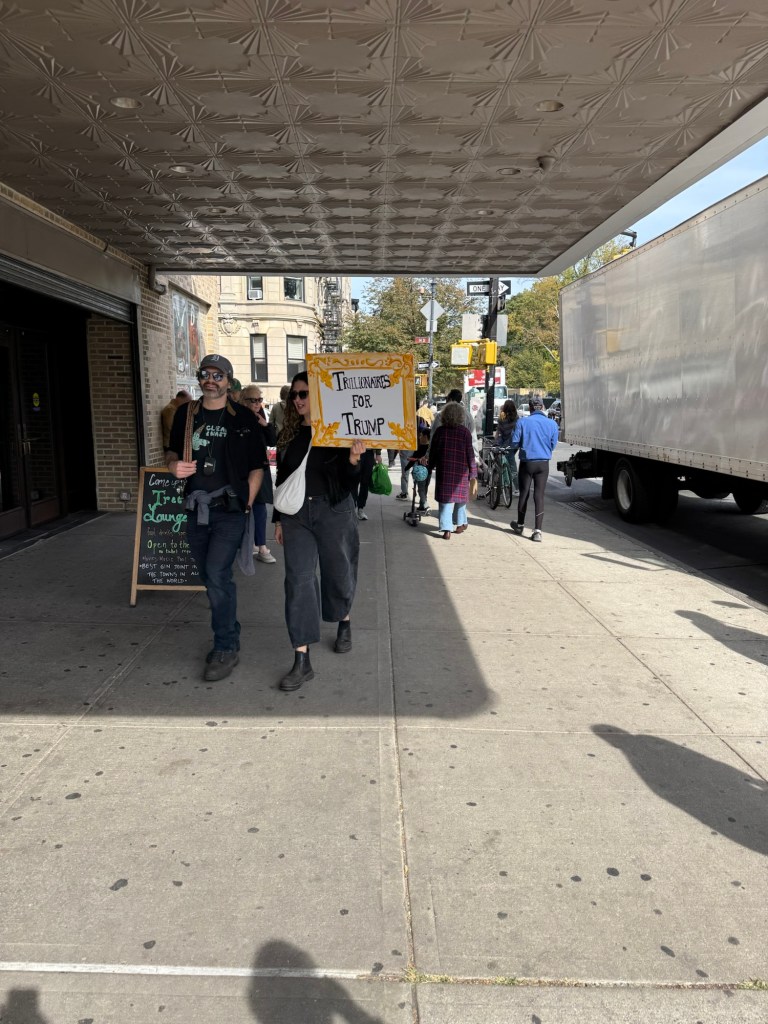
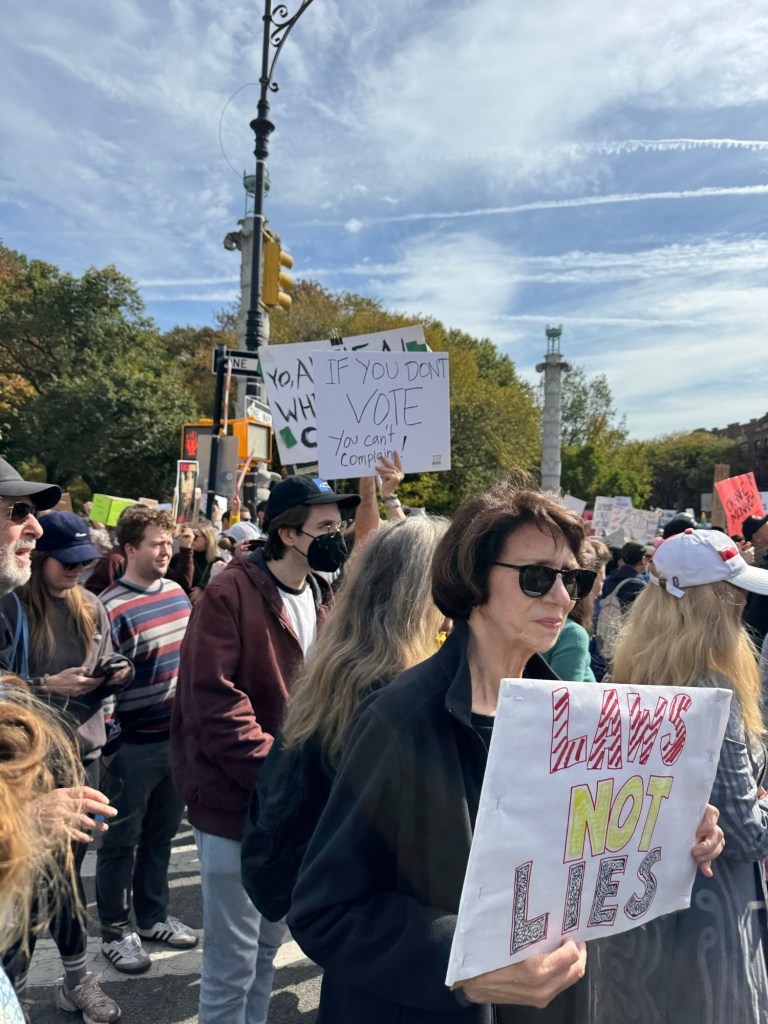
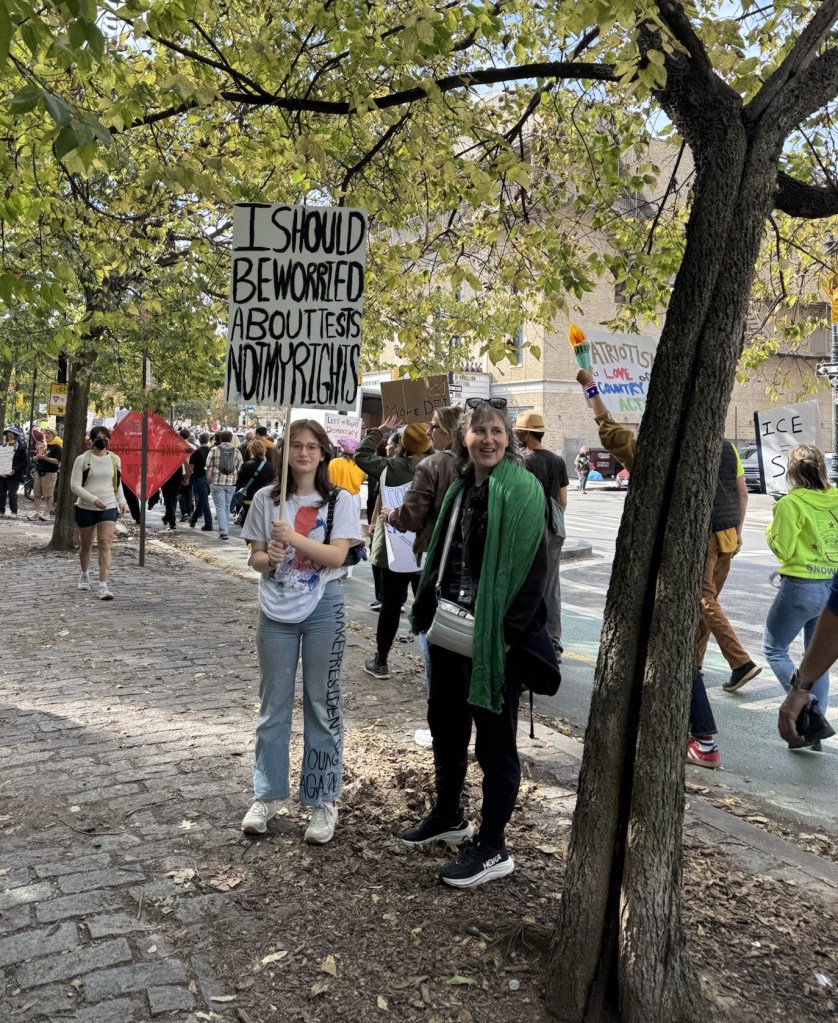
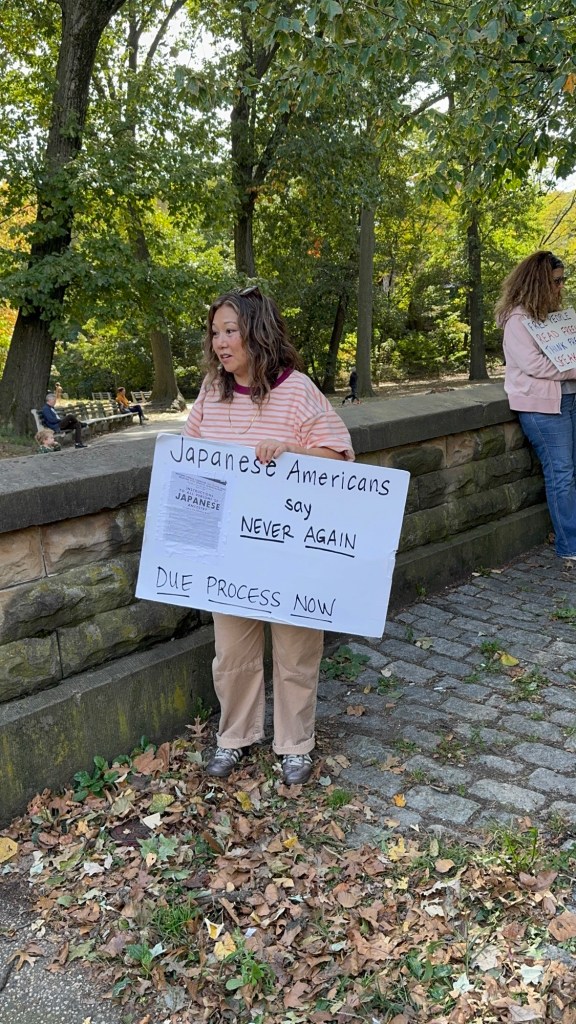
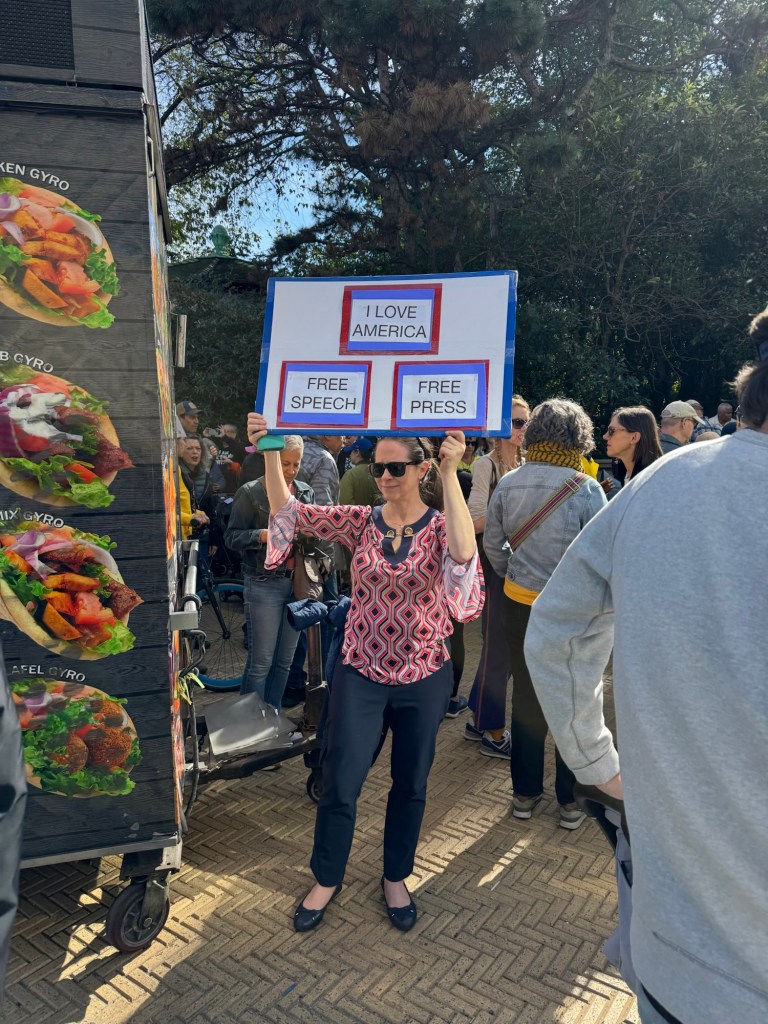
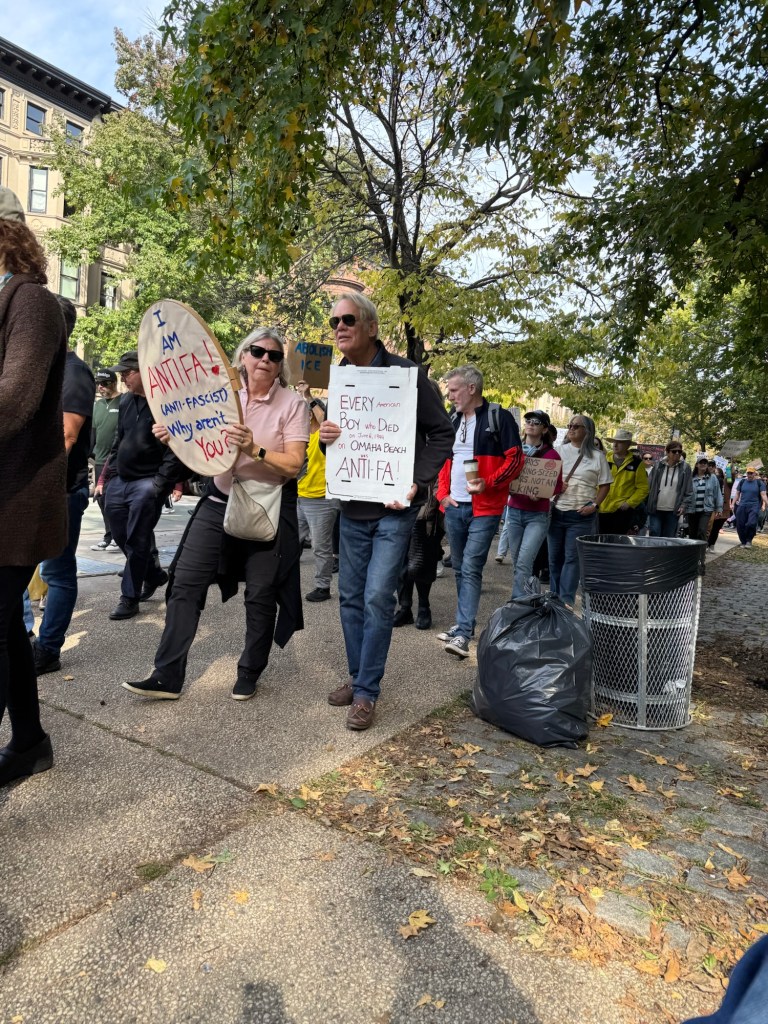
Thousands of people turned out to participate in the #NoKings March, which started at Grand Army Plaza and ended at the southern end of Prospect Park. We were surrounded by people carrying signs and chanting “Hey hey hi ho/Donald Trump has got to go.” Many signs were very clever. I couldn’t photograph them all.
I liked the little girl who had a sign that said, “I should be worried about tests/Not my rights.”
You may have read about Josh Cowen . He’s a professor of Education Policy at Michigan State University. For twenty years, he worked on voucher research, hoping to find definitive evidence that vouchers helped the neediest kids–or didn’t.
About two years ago, he concluded that the answer was clear: vouchers do not help the neediest kids. Most are claimed by kids who never attended public schools. In other words, they are subsidies for families who already pay for private schools. When low-income kids use vouchers, the academic results are abysmal. He concluded that the best way to improve the schooling of American students is to invest in public schools.
Josh did his best to stop the billionaire-funded voucher drive. He published a book about the evidence, called The Privateers. He wrote articles in newspapers across the nation. He testified before legislative committees.
He concluded that the most important thing he could do is to run for Congress. He’s doing that and needs our help. I’ve contributed twice. Please give whatever you can.
Public schools need a champion in Congress.
Josh writes:
Hey everyone. You may have heard that I’m running for Congress in my home district in Michigan. It’s one of the most important seats to flip next year for Democrats to retake the US House. I’m hoping you’d consider chipping in today to help us meet a big deadline by 9/30.
I’m probably the most prominent congressional candidate in the country running in part on the idea that we need to stand up for and renew our public schools.
I took on Betsy DeVos and the Koch operation all over the country, trying to stop school voucher schemes. I’m a union member and work closely with labor—check out my book excerpt about vouchers in AFT’s New Educator right now!—and I was just given NEA’s highest honor, the Friend of Education award. Diane herself won a few years back—I’m truly honored.
But the DeVoses and a MAGA Texas billionaire are going to spend big here to hold Congress and defund schools. Former MI GOP Governor Rick Snyder is planning to raise $30 million to make 2026 the “education election” for Republicans in Michigan. This is the same guy at the helm when kids were poisoned in Flint. And the same guy responsible for the disastrous EAA charter school fiasco.
My GOP opponent is the Koch’s bagman in Michigan. This is a guy who eked out a win in our district just last year when Elissa Slotkin had to give up her seat to run for Senate. So it’s a very winnable race. But we need help.
Last month just for starters: 14 statewide and local school and community leaders in Michigan endorsed us. Last week, UNITE HERE!, the big hospitality workers union, endorsed our campaign. And just this week, Dr. Jill Underly, the statewide elected chief of Wisconsin public schools, announced her support. You may remember that Dr. Underly beat back Elon Musk’s plan to buy the off-year elections just this spring in her state. She showed how a strong, positive message of standing up for public schools and standing up to billionaires can win a swing state election.
We can do that too. So I’m asking for your help to close this month strong.
This post is about the brutal tactics of ICE. In the instance described, ICE agents broke into the home of a U.S. citizen at 5:30 am, smashing his doors. Five people were arrested, two of them American citizens. One who was handcuffed and shown on television being led away by ICE was the homeowner, an American citizen, born in Texas.
Every time I see one of these ICE videos, I get outraged. I have seen them knocking people to the ground who were photographing them. I have seen them smash car windows and drag people out through the window. I have seen them brutalizing people suspected of being illegal. I have seen them beat up protestors. All while wearing a mask, but not a badge or shield. and I keep wondering, “is this America?”
Joyce Vance served as the U.S. Attorney for the Northern District of Alabama. She knows the law and she has a deep love of justice, compassion, and America.
She writes a blog called Civil Discourse, where this excerpt appeared. She is appalled by ICE’s thuggish tactics, and also by Kristi Noem’s showboat tactics. Noem’s behavior towards others reminds us that she killed a young dog because she couldn’t train him. She is known as “Ice Barbie.”
Vance reminds us that ICE in earlier days followed the law. Now, many people object to its actions, specifically, snatching people off the street, throwing them into an unmarked van, disappearing them, all without a warrant. And the masks! Are they being arrested or kidnapped? No one knows. No wonder people call them “Trump’s Brownshirts.”
Vance writes:
For weeks now, the news has been a deluge, making it impossible to keep up with everything. This week so far has been no exception. We know that this is intentional, at least in part. It tends to distract from things like the fact that the Epstein Files have yet to be released. There’s a constant hum of Trump’s incessant push to grow a more muscular, imperial presidency that will allow the Article II branch of government to eclipse the Article I and Article III branches.
But some days, it can be helpful to stop and focus on one small incident to get a snapshot of what’s happening. Today, I focused on some reporting about ICE, one of the agencies under the control of DHS Secretary Kristi Noem.
A lot has been written about how Trump has transformed ICE. I know many of you have seen that and are deeply concerned by it, as am I.
ICE’s congressionally designated mission focuses on immigration enforcement and transnational crime. When I was a prosecutor, we worked serious cases with ICE agents. They were competent investigators. They knew how to get cases done. We did some of the early crypto for crime cases with them and also international networks that were engaged in human sex trafficking, drug trafficking, and elder abuse. They worked computer intrusion cases that had a transnational aspect. We did immigration cases with them, focusing on prosecuting people who were illegally in the U.S. after a prior deportation and who had violent criminal history or were involved in gangs. But what we didn’t do was bust into an American citizen’s house at 5:30 a.m. with the DHS Secretary along.
Newsweek reported that Noem “joined federal immigration agents during an early morning operation in Elgin, Illinois, on Tuesday that resulted in multiple people being led away in handcuffs, and two U.S. citizens being briefly detained.” CBS reported that five people were arrested during the raid, among them two U.S. citizens, who were released after showing their papers.
It’s a simple, red brick, ranch-style house. Witness video, taken after a pre-dawn explosion was heard by neighbors, shows agents peeking into the home, a helicopter flying overhead with a spotlight right on the house in what people in the video describe as a “very quiet neighborhood.”
This is what Noem posted Tuesday morning, characterizing the men, including the two U.S. citizens who were subsequently released, as violent offenders.
By 8:30 a.m. local time, DHS was responding to these reports, tweeting that “No U.S. citizens were arrested, they were briefly held for their and officers’ safety while the operation in the house was underway. This is standard protocol. Please see our release on those arrested.”
American Immigration Council Senior Fellow Aaron Reichlin-Melnick tweeted that the man seen in the video was a U.S. citizen named Joe Botello. “They smashed in the doors, dragged him and his roommates out in handcuffs, then posted a video online suggesting he was a criminal, despite knowing he was released soon after,” he wrote, relying on a report from the Chicago Tribune. The agents were masked and armed when they made forcible entry into Botello’s home, destroying both his front door and a glass patio door, according to the Tribune. An agent asked the Texas-born Botello, “how he was able to speak English so well.”
It was another poorly executed raid where people’s rights, in this case, American citizens, were violated.
By the way, the Secretary’s presence might seem like a small thing here, but it’s not. It’s not amusing. It’s not cosplay. It’s not cute. It’s not shake your head and then look away. It’s dangerous. And it was done, apparently, for a photo op.
I spoke with my former colleague Sarah Saldaña, who served as the Director of ICE from 2014 to 2017 and as U.S. Attorney for the Northern District of Texas from 2011 to 2014. She was the last presidentially-appointed, Senate-confirmed Director of ICE. I asked her about participating in law enforcement actions. She told me, “ICE removal operations in the field are highly sensitive and potentially dangerous events. Enforcement removal officers are fully armed and trained to respond to various, often unexpected scenarios that they might encounter. Our focus in removal operations under the Obama Administration was on individuals who presented threats to national security and public safety, and those with convictions of serious criminal offenses. As Director and with training only as an attorney and agency manager, I would never have considered actually interjecting myself into the execution of such an operation. I could easily represent a distraction to officers and, without the proper training, present a danger to them, the persons sought, and to myself.”
Noem, too, should be concerned about the security risk her presence creates. Furthermore, if Noem accompanied agents to the scene, as the reporting indicates, she made herself a witness. If I’m a criminal defense lawyer for one of the men or a plaintiff’s lawyer in a civil suit, I’m cutting the subpoena for her testimony pronto. This is why smart prosecutors know better than to go along when a search warrant is executed, let alone an attorney general or a cabinet secretary. But Noem likes her photo ops. It’s just another sign of the less-than-professional way Trump’s appointees are running government, following Pam Bondi’s comments about prosecuting people for First Amendment-protected speech earlier this week.
Just as members of Congress challenged FBI Director Kash Patel during his oversight hearing on the Hill today, we have to continue to speak out and challenge Noem, Bondi, Kennedy, and others who aren’t up to doing the job the American people deserve. Americans speaking up is precisely what this administration doesn’t want. They want us to be overwhelmed by all the stories about all the things. They want us to be intimidated from exercising our right to speak, lest we fall under attack too. So, our job is to make sure that doesn’t happen. “Courage is contagious” is becoming one of our mottos for this administration. Keep focusing on the truth. Keep speaking out. Keep going.
The Idaho state legislature passed a $50 million plan to subsidize vouchers. The usual arguments for vouchers–choice and competition–don’t apply in a largely rural state. The primary beneficiaries will be wealthy families whose children are already enrolled in private schools. The biggest losers will be rural schools, which desperately need upgrades.
“(I)t shall be the duty of the legislature of Idaho, to establish and maintain a general, uniform and thorough system of public, free common schools.” — Article IX, Section 1, Idaho Constitution
A coalition of public school advocates announced Wednesday that it is asking the Idaho Supreme Court to rule that a refundable tax credit for families who send their kids to private schools is a violation of the Idaho constitution’s education clause.
We say it’s about time.
And just in time, since House Bill 93, which was passed last legislative session, allows families to start applying for the credits in January.
The law set aside up to $50 million for the tax credits.
We would much rather see that $50 million go toward the public education system, hiring more teachers, more counselors, repairing derelict school buildings and properly funding special education, which has an $80 million shortfall, according to the Office of Performance Evaluations.null
Most voucher schemes in other states started out like Idaho’s — small, limited and targeted. But state after state, the vouchers grew and are blowing holes in state budgets everywhere.
Many of these vouchers go to wealthy families who already have the means to pay for private school, and the vouchers merely subsidize part of the cost of a private school tuition.
The vouchers are open to fraud, waste and abuse.
There’s no accountability built into Idaho’s voucher system.
The Idaho Supreme Court won’t be interested in such policy discussions, but justices will be interested in hearing what we think is a valid constitutional argument.
One word, in particular, provides their best legal challenge: “uniform.”
We are compelled by the testimony Wednesday of one mother who said her children were denied entry to a public school based on their religion. A public school can’t do that.
The argument is not without precedent.
A district court judge in Salt Lake City halted Utah’s education savings account programearlier this year, according to Idaho Education News. The state’s teachers’ union argued that the Utah Constitution bars state dollars from funding an education system that’s not free or open to all students.
In June, an Ohio state judge struck down that state’s voucher program, ruling that the program created a separate, unfunded, nonpublic system and funneled public money to private religious institutions. That, the judge ruled, violated constitutional mandates to fund a single public school system.
In 2024, the South Carolina Supreme Court struck down a 2023 law that created a private school voucher system. The court said the law illegally funneled state public funds to private schools, which is prohibited by the state constitution. The decision said vouchers undermine the state’s mandate to support public schools for all students.
We find it particularly appropriate that Idaho’s organizers announced this legal challenge on Constitution Day. Yes, it’s referring to the U.S. Constitution, but Idaho legislators should hold Idaho’s Constitution in equally high regard.
Where are all of Idaho’s “original meaning,” “not a living document” conservatives in this state when it comes to the state constitution’s education clause?
Because, if you read the Idaho Constitution plainly, vouchers just don’t pass muster.
Let’s hope the Idaho Supreme Court sees it the same way.
Statesman editorials are the opinion of the Idaho Statesman’s editorial board. Board members are opinion editor Scott McIntosh, opinion writer Bryan Clark, editor Chadd Cripe, newsroom editors Dana Oland and Jim Keyser and community members John Hess, Debbie McCormick and Julie Yamamoto
John Kuhn is the superintendent of schools in Abilene, Texas. He was hired by the Abilene school board in April 2024. He previously served as superintendent in three small districts in Texas. The Abilene board introduced him this way
Dr. John Kuhn brings 27 years of proven experience in public education to Abilene ISD. Prior to joining the Abilene ISD team, Dr. Kuhn most recently served as Superintendent of Schools for Mineral Wells ISD. He has also served as superintendent of Perrin-Whitt CISD and as a high school principal, assistant principal, teacher, and bus driver in the Mineral Wells and Graford Independent School Districts.
I met John Kuhn at a conference of the Network for Public Education about a dozen years ago. At that time, he was superintendent of the Perrin-Whitt Distrist, which has about 320 students, half of whom are economically disadvantaged.
John is one of the most eloquent champions of public education that I’ve ever met. I remember him saying, “Send me the kids you don’t want. Send me the kids who don’t speak English. Send me the kids who are struggling to learn. Send me the kids with disabilities. I’m in a public school and we will teach them all.” Or words to that effect. I’m hoping he will be a keynote speaker at our next conference in Houston in April 2026. He’s the leader we need!
He posted this letter on his Facebook page and it drew a massive response and national attention.
Gosh where to begin? I’m eligible to retire in January, and I don’t want to because I feel like I owe the good people who hired me and this great community at least a few years of blood sweat and tears. I work for a great school board in a city I’ve absolutely fallen in love with. But holy moly do I want to pack it in right now. The burden is heavy.
Yesterday I spent hours at an update listening to the impacts on teachers and admins at public schools of bill after bill passed by our lege. Did you know that one bill says teachers are going to be required to catalogue every book in their classrooms? Kindergarten teachers have hundreds of tiny books. With what time? When?
Did you know that another bill says nurses can’t provide any health care whatsoever and counselors can’t provide any emotional support whatsoever without a written permission slip from parents? The bill language is so poorly written that—despite what it clearly says in black and white English—the bill author sent out a clarification saying nurses can provide a band-aid to a kid who is bleeding. He wouldn’t have to send out a clarification if they wouldn’t pass dumb bills—but legislators have been convinced by political groups who hate public schools that everyone inside them are wicked, evil people.
Did you know about the other new bill that says school administrators who work on the side as refs or one-act-play judges at any school anywhere are subject to a $10k fine per offense for working those jobs if they each individually don’t present a contract to their school board.
That doesn’t apply to me, but I know tons of APs and principals who ref and judge student drama contests. In fact, there’s a huge shortage of both, so if they didn’t do it, we’d be in an even bigger bind in trying to put on games. Again, the bill author had to put out a “clarification” claiming the bill doesn’t mean what it clearly says.
Because they refused to listen to the input of our educator groups—groups, by the way, that they are trying to get defunded because they consider them “taxpayer funded lobbyists” for representing school districts and municipalities.
There is a political movement to pull the teeth of local officials at schools and on city councils and county commissioners courts so that all we have is centralized state leadership. So local yokels like yours truly have to be continually demonized and legislated into submission.
I haven’t even talked about vouchers draining our public schools of resources so those education dollars can go toward private schools that aren’t subject to the crushing bureaucracy. I haven’t event talked about the new testing bill—the one that replaces STAAR with the 3x per year Death STAAR that, like its predecessor tests is solely owned and controlled by the TEA commissioner and is not norm-referenced so Texas student results can be compared to other states, which would keep things honest and prevent the manipulation of student results for political narrative-building.
Anyway, I go to a conference all day listening to this stuff the day after Republican Charlie Kirk is murdered and months after a Democratic state senator is murdered, and I just keep thinking, is it worth it? I can retire and keep to myself until I die of old age. I can just fish every single day. I can travel. I can camp. I can sleep in.
And I get to my hotel room and find some social media commenter calling my teachers “demons” because they assigned an chapter of the amazing book Extremely Loud and Incredibly Close as a reading passage for a freshman honors English class. This is a book written in the voice of a nine-year-old boy who lost his dad on 9/11 in the terrorist attack on the twin towers. It’s an award winning book. But the passage has the word “shit” in it. And it has a vulgar term that I’m told the teacher was unfamiliar with it. And it has a crude joke about talking butts, which I was a nine-year-old boy and that’s the kind of crudeness we giggle at, so the author was pretty spot on. It also has the word “pussy” but that was what the kid called his cat, but the Facebook post highlighted it as part of making a case that this book was inappropriate.
Thing is, it’s likely valid that this book should be restricted to older kids—17 and 18 year olds. It’s worth noting that this was assigned to only the honors kids because the other passage that the class was reading—also related to 9/11–was at too easy a reading level. So these poor teachers are trying to find something for advanced kids to read, and they don’t have time, and they’re making a good faith effort to push kids to Meets and Masters because they care (and if our A-F grade is too low, there is outrage over that too). And they pick this award-winning book. They decide one “shit” is tolerable. They aren’t offended by the word “pussy” because it literally isn’t a bad word in the context. They get it approved by a colleague.
And they are called “DEMONS.” (Ironically, in the comments of the outrage post, they’re also called “assholes,” which is literally worse than “anus,” which is one of the words the parent highlighted and took offense to, but nobody scolded the commenter for that vulgarity. What’s good for the goose… Commenters also typed “wtf” and “WTH,” which mean “what the fuck” and “what the hell” but nobody accused them of “grooming” children. Selective outrage, anyone.
Who needs this? Is everybody serious? Does everyone just feel absolutely compelled to post their moral superiority online by attacking perceived enemies they’ve never met or shared a meal with.
Our country is no longer capable of living in community. We’ve been driven to our corners. It is barely possible to be a public servant anymore. I totally get why our city manager retired.
My teachers aren’t demons. They may have made a mistake in assigning this book to 15-year-olds rather than 17-year-olds, and for that there are people online saying they need to be fired. Today Incredibly Loud and Extremely Close is likely temporarily coming off our library shelves while we review our book challenge policies. Read the book. It’ll make you cry.
We can’t win in public ed anymore. This is absolutely ridiculous. If I make it to December, it’s gonna be a miracle. I don’t need your sympathy replies, either. I’ll hang it up when I have to for my family and my health, and I’ll stick it out if I feel like I want to. In the meantime, I just want you to know I’m sick of politicians playing divisive politics and leaving local public servants to clean up the mess. Public schools are apolitical entities with the job of teaching kids to think critically and become awesome humans. We aren’t perfect. We have missteps, because we are human organizations. But don’t call my teachers DEMONS while you cuss in the comments.
Bill Phillis of the Ohio Coalition for Equity and Adequacy in Funding reported on the continuing fight to stop universal vouchers in Wyoming. Every student in the state is eligible for a voucher, regardless of family income. Parents are concerned that their child may be excluded by private schools, such as those with special needs. Parents and teachers sued to block the program, based on the state Constitution. A judge just approved their request to sue.
Phillis writes:
School vouchers have never been supported by a majority of the people of any state in a statewide ballot. Neither are school vouchers currently being approved by the courts. Wyoming judge denies state’s motion to dismiss. In June, EdChoice vouchers in Ohio were declared unconstitutional by Franklin County Court of Common Pleas Judge Jaiza Page.
All states have constitutional provisions for public education. (After the Civil War no state could be admitted into the Union without a constitutional provision for public education.) The plain language of state constitutions require public education available for all, but not private education as a state funding responsibility. Private schools should not expect to be supported by public funds.
Laramie District Court judge finds plaintiffs do have standing to claim harm in lawsuit against the state’s new school-choice program, which remains in limbo.
In the latest blow to Wyoming’s controversial universal school voucher program, a judge has denied the state’s motion to dismiss the lawsuit challenging it.
The Steamboat Legacy Scholarship Act program has been dogged by constitutionality concerns since well before it was enacted into law in March. Educators and parents filed suit in June, and Wyoming’s attempts to advance the voucher payments in the face of the lawsuit have repeatedly failed.
The program is designed to offer Wyoming families $7,000 per child annually for K-12 non-public-school costs like tuition or tutoring. The scholarship would also offer money for pre-K costs, but only to income-qualified families at or below 250% of the federal poverty level. It was passed amid a wave of school-choice laws, particularly in Republican-led states like Wyoming.
However, Wyoming’s constitution makes public education a paramount state commitment. Critics of the universal voucher program say spending public funds on private education violates several of the state’s constitutional obligations and have long warned the matter would end up in the courts.
So far, state gambits to circumvent legal challenges have been unsuccessful. Laramie County District Court Judge Peter Froelicher granted a temporary injunction pausing the voucher program in June, then extended that injunction in July. More recently, he denied a request by Wyoming Superintendent of Public Instruction Megan
Degenfelder and others to let the law take effect while they challenge the injunction.
In the newest decision, issued Aug. 28, Froelicher denied the state’s motion to dismiss, determining that plaintiffs do have standing to sue. In the order, Froelicher also determined that Wyoming’s State Treasurer Curt Meier, who the lawsuit names, is a valid defendant. The state asked that Meier be dropped from the suit.
Degenfelder, who championed the voucher program as a major school-choice win, has expressed dismay over the lawsuit’s impacts on families who had already applied and were awaiting funds to pay for costs like textbooks, tutoring or private school uniforms for the 2025-26 school year.
Rocky road
The universal voucher program represents a major expansion of the state’s 2024 education savings accounts, which offered money to income-qualified students for private school tuition or homeschool costs.
The 2025 bill transformed that program by stripping income qualifications so that the $7,000 would be available to everyone.
Lawmakers transformed it before it passed out of the Legislature; they brought 26 amendments, including 11 that passed. They also repeatedly questioned the constitutionality of the expanded program. Many urged colleagues to hold off and allow the existing education savings account program to roll out before changing it so drastically. Those requests did not sway the body.
The new program’s application opened on May 15, attracting nearly 4,000 student applications. But in June, nine parents of school-aged children and the Wyoming Education Association, which represents more than 6,000 of the state’s public school employees, sued Degenfelder, Meier and the state of Wyoming.
A previous Wyoming Supreme Court ruling on education funding “found that ‘education is a fundamental right’ in Wyoming, that ‘all aspects of the school finance system are subject to strict scrutiny,’ and that ‘any state action interfering with [the right to equal educational opportunity] must be closely examined before it can be said to pass constitutional muster,’” the lawsuit reads.
This voucher program, plaintiffs assert, does not pass that muster. That’s because “the state cannot circumvent those requirements by funding private education that is not uniform and that meets none of the required state constitutional standards for education.”
In addition, the program is unconstitutional because it violates constitutional language that allows the state to give public funds only for the necessary support of the poor, the lawsuit argues. Instead, it’s an example of “gratuitously funneling public funds to private individuals and entities, regardless of whether they are poor and regardless of whether that support is necessary.”
Parents who signed onto the case oppose the voucher plan due to the harmful impact it will have on their children, according to the lawsuit, “because private schools receiving voucher funding can refuse admission to children with disabilities … and are not required to provide special education services or comply with [individualized education programs].” They are also concerned that private schools can refuse to admit and educate children who identify as queer, transgender or non-binary.
The voucher program will also negatively impact funding at public schools that the parents’ children attend, the lawsuit says.
By rejecting the state’s motion to dismiss, Froelicher accepts “the individual harms alleged in the complaint as true,” according to his order.
What’s next
The Wyoming Attorney General’s office in July appealed Froelicher’s preliminary injunction preventing the Wyoming Department of Education from transferring or paying out funds to participants of the program.
In a July update on the Wyoming Department of Education’s site, Degenfelder said she is grateful the attorney general appealed to the Wyoming Supreme Court, but informed the public that “the appeals process is still extensive, and, unless the injunction is stayed while the appeal proceeds, may cause the program funds to be unavailable for most of the 2025-26 school year.”
Katie Klingsporn reports on outdoor recreation, public lands, education and general news for WyoFile. She’s been a journalist and editor covering the American West for 20 years. Her freelance work has… More by Katie Klingsporn
The Network for Public Education Action sent out the following alert. Please use the form to send a letter to your members of Congress.
Dear Friend of Public Schools.
They said they wouldn’t cut Title I. They lied.
Majority House leaders just dropped their FY26 education bill, slashing $12.1 billion (15%) in K-12 funding for public education. It guts the very programs that keep our public schools running — while boosting charter start-up/expansion to $500,000,000.
What they’re cutting:
Title I:–27% slashed — funding that provides targeted education services like remedial reading to students with maximum impact in high-poverty schools in cities and rural communities.
English Language Acquisition Grants: Gone.
Title II-A (teacher training & support): Eliminated.
“Despite outsized investment, America’s public schools continue to fail children and families.” That’s what they think of your neighborhood school.
Why this matters
Cuts of this magnitude will crowd classrooms, strip student supports, widen inequities, and push more schools into crisis — especially in rural and high-need communities.
Do these two things now
1) Email your Representative:
Use our action link to send a pre-written message in 15 seconds: Send your email now.
2) Call your Representative:
Find your member’s phone number here. Below is a script you can use right now: “Hello, I’m a constituent from [Representative’s name] district. I’m calling to urge the Representative to oppose the House education funding bill that cuts Title I by 27% and reduces K12 funding by 15%. These cuts will harm students and teachers in our district. Please vote NO and support full funding for public schools — not half-a-billion in funding for charter expansion while our classrooms are being cut. Thank you.”
Now spread the word
Forward this alert to friends, family, and colleagues.
Do not wait. Congress is back today (September 2). Let’s flood their inboxes and phone lines. The House’s education funding bill is a betrayal of America’s children.
We Can’t Do What We Do Without Your Support…
Every email we send out with our action alerts costs hundreds of dollars in addition to our other operational expenses that keep us going. We need your help. Please click on the image below to make a one-time donation, or better yet, a recurring donation. Even ten dollars a month makes a huge difference for us. Thank you in advance for your generosity that will help preserve our public schools.