This is when 21st century McCarthyism gets serious.
Dan Patrick, the talk-show host who is now Lieutenant Governor of Texas, wants to ban the teaching of “critical race theory” in higher education. Critical race theory, the study of systemic and institutionalized racism, has been taught and debated in law schools and colleges since the mid-1980s.
Patrick wants to quash academic freedom in higher education. He thinks he can prevent professors who have devoted their academic careers to the study of racism from talking about it. Maybe, he believes, if they don’t talk about and study racism, no one will know it exists. Or maybe it will just go away.
Erica Grieder wrote in the Houston Chronicle about Patrick’s plans to restrict academic freedom and to have the state spend $6 million on a “think tank” called the “Liberty Institute” to prevent errant professors from exercising their freedom to teach and speak. Last year, the state passed a law to ban CRT in K-12 schools, where (he thinks) children are being stuffed with left wing propaganda and with the claim that racism is real.
“I will not stand by and let looney Marxist UT professors poison the minds of young students with critical race theory,” he announced in a tweet.
“We banned it in publicly funded K-12 and we will ban it in publicly funded higher ed,” he continued, adding: “That’s why we created the Liberty Institute at UT.”
This was in response to a report, in the Austin American-Statesman, that the Faculty Council of the University of Texas at Austin had passed a resolution defending academic freedom.
In other words, Patrick, hearing of an innocuous nonbinding resolution in support of freedom, responded by threatening to pursue even more aggressive restrictions on freedom, while also wrapping himself in the banner of “liberty.” Naturally. This is from the lieutenant governor, arguably the state’s most powerful elected official.
Patrick, a rabid supporter of vouchers, as well as limits on free speech, is a public nuisance who menaces the freedom of students, teachers, and professors in Texas.
Paul Bowers, previously the education journalist for the Charleston, South Carolina, Post & Courier, writes his own blog. In this post, he calls on the state legislators not to pass voucher legislation that would predictably defund the state’s already underfunded public schools. South Carolina has a large budget surplus and one of the lowest tax rates in the nation. Governor Henry McMaster announced that the surplus would be used to lower taxes instead of funding public schools and other public services.
Paul wrote the members of the S.C. Senate Education Committee in opposition toSenate Bill 935, which is an attempt to divert public school funding to private schools.
Senators Massey, Jackson, Hutto, Rice, and Talley:
I write to you as a South Carolinian and parent of 3 public school students asking you to scrap Senate Bill 935, the so-called “Put Parents in Charge Act,” which would redirect public funds to private schools via the creation of Education Savings Accounts.
Every few years, South Carolina teachers and parents have to band together to fight the latest iteration of the school voucher meme, which has spread virally across the states thanks to millions upon millions of dollars of dark-money political contributions, astroturfed special-interest groups, and a network of libertarian billionaires’ pet thinktanks. We fought this idea when New York real estate investor Howard Rich tried to buy a voucher law here in the early 2000s, and we’re fighting it again now that ALEC, Palmetto Promise, and the like are trying to ram the same idea through the Statehouse in Year of Our Lord 2022. There is truly nothing new under the sun.
No money shall be paid from public funds nor shall the credit of the State or any of its political subdivisions be used for the direct benefit of any religious or other private educational institution.
Now, I am sure our attorney general would happily defend such an act against the inevitable lawsuits that would follow. I am no legal scholar, but I think it’s reasonable to assume he would employ some of the same arguments used to defend Gov. Henry McMaster when, in the thick of a global pandemic, he tried diverting $32 million worth of federal emergency funding from public schools to private schools. Notably, he lost that fight.
So, I suppose you and your colleagues in the General Assembly could enact this law, and you could win the legal battle that follows. Stranger things have happened. But the question remains whether you should go down this road.
I say no, you should not.
South Carolina’s most reactionary politicians have been clamoring for public divestment from the school system ever since radical Black Republicans created a free public school system for all in the Constitution of 1868. White supremacists clawed back at the notion of public goods with the Jim Crow Constitution of 1895; the Interposition Resolution of 1956; and the cavalcade of privatization laws, segregation academies, and district-level resegregation efforts that have continued without ceasing since Brown v. Board of Education was decided in 1954.
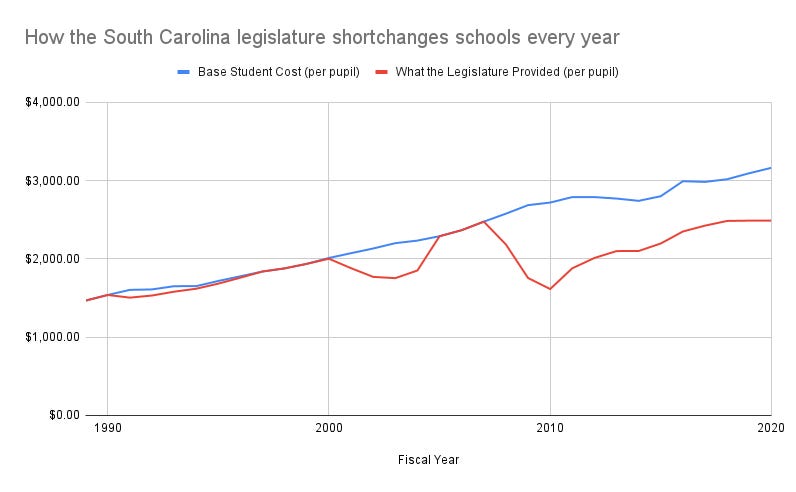
Data compiled by Steve Nuzum, via S.C. Revenue and Fiscal Affairs Office
As a matter of policy, you and your colleagues in the General Assembly have been steadily defunding public education since the start of the Great Recession. You have broken your own promises as outlined in the Education Finance Act and are currently under-funding the Base Student Cost by about a half-billion dollars per year. The results have been disastrous: Our teachers are underpaid and quitting by the thousands, classroom sizes have ballooned, our rural schools are in physical shambles, and a system of separate and unequal education along racial and economic lines has returned with a vengeance.
It is difficult to predict how much money public schools would lose as a result of Education Savings Accounts, which would allow public funds to “follow” individual students to private schools. Our state’s Revenue and Fiscal Affairs Office has tried to guess, though. According to a fiscal impact summary published in December, the ESA program could divert as much as $35 million to private schools within the first year it takes effect, depending how many families participate in the program. By 2026, they estimated the program could cost the state as much as $2.9 billion. Compounded by the General Assembly’s ongoing policy of public disinvestment, this could constitute a death blow to public schools.
The bill is built on a few faulty premises, including the underlying assumption that private schools could or would serve South Carolina students better. The authors of the bill also seem to believe that our state’s private schools could handle a sudden influx of new enrollment while accommodating students’ learning, transportation, and health needs. These are dicey propositions at best.
S. 935 is a direct attack on the notion of education as a public good. Its authors would leave us all to fend for ourselves as atomized individuals, cut loose from mutual obligations that once tied us together. For a certain type of doctrinaire conservative, this may sound like a dream scenario. For the rest of us living in the real state of South Carolina, it is a nightmare come true.
ATHENS, Tenn. (WATE) – An Englewood woman has been indicted on more than 20 sex charges after investigators say she traded items for sexual encounters with male students who attend McMinn Central High School.
Melissa Blair, 38, is charged with 18 counts of aggravated statutory rape, four counts of human trafficking by patronizing prostitution and one count of solicitation. She turned herself in Tuesday and was booked into the McMinn County Jail on a $100,000 bond. She is not, nor has she ever been, a school employee.
This is the same county where the school board voted unanimously to remove the Pulitzer Prize-winning graphic novel MAUS from the curriculum. They said it was inappropriate because, it contained nudity (of mice)
Seems to me that McMinn town officials and parents have a whole lot more to worry about than a book about the Holocaust. The reading list is the least of their troubles.
A friend of public schools in Missouri sent the following excerpt of a report by the League report by the state League of Women Voters.
EDUCATION Senate Education Committee Votes Out Bills
The committee voted out all bills heard thus far this session on February 10, including:
SB 869 (Koenig) to revise the law specifying payments to charter schools and shift more local school funds to charter schools. The League opposes this, based on our position on charter schools and support for public school funding.
SB 650 (Eigel) to allow charter schools to be sponsored by outside entities (other than the local school board) and operate in many districts around the state. Sen. Eigel also offered a proposed SCS version that would add several other provisions, including moving school board elections to the November election, adding restrictions on approval of debt service levies, preventing schools from requiring face masks, and preventing school districts from requiring students or staff to have COVID vaccinations. The League opposes the bill.
House Elementary & Secondary Education Committee
The committee met on February 8 and heard HB 2428 (Dogan) to impose restrictions on instruction relating to race and history. The bill authorizes lawsuits against school employees for violations of the new requirements in the bill. The League opposes the bill.
The 2021–22 school year has been marked by severe transportation problems across US school districts. In a nationwide survey of those in the pupil transportation industry conducted in August, 78 percent of respondents said their district’s bus driver shortages are getting worse, with 51 percent describing the situation as “severe” or “desperate.”
As a result, students are facing hours-long commutes, and parents are interrupting their work days to wait in lengthy pickup lines where busing is either unavailable or severely delayed. In September, Massachusetts governor Charlie Baker activated the National Guard to drive kids to school in communities hard hit by COVID-19.
But while school bus driver shortages are more pronounced than in years past, they’re hardly new. Jacqueline Smith, a driver-dispatcher for Indian River County School District in Florida and vice president of transportation for her union local, told Jacobin that staffing shortages were causing her and her colleagues to do “double work” long before the pandemic.
According to annual survey data from School Bus Fleet magazine, more than half of US school districts have experienced driver shortages every year since at least 2006, and more than 70 percent of districts have experienced shortages for most of those years.
Why are US school systems plagued by chronic bus driver shortages? The reason isn’t that there’s a lack of jobseekers willing in theory to work as school bus drivers. It’s that pay and benefits are grossly incommensurate with the incredibly challenging, multifaceted work that school transportation entails.
Whitney Kimball Coe, director of national programs for the Center for Rural Strategies, advises those who are outraged about the removal of MAUS from the eighth grade curriculum by the McMinn County School Board to support those in the South and rural areas who agree with them, instead of showering them with contempt and condescension. She was invited to appear on CNN to talk about the decision, and she had a sleepless night trying to find the right way to condemn the decision without condemning her neighbors.
Do they think we’re not outraged, too, here in East Tennessee? Do they think we can’t speak up and respond for ourselves? Because let me tell you, I lay awake the night before the CNN interview indulging my own outrage and constructing a commentary that would eviscerate all book ban supporters and signal to the rest of the world that I, too, am pissed off. It would feel good to give into the outrage, the indignation, the snark.
But I let the outrage pass over and through me because I live here. We live here. These are our people, our schools, our kids. We spend our days relying on the trust and goodwill of our neighbors to make a life here. Neil Gaiman doesn’t shop at the Food City downtown. Trevor Noah doesn’t volunteer with the local United Way. CNN isn’t interested in solutions journalism and outrage is where relationships go to die.
There’s no cure for opportunism. With each op-ed from another coastal publication, Tennessee becomes more alienated, and our public officials dig their heels in deeper. And those of us dissenting locally are left to bridge the gap, trying to figure out how to protect our hometown and organize for change.
As I lay awake, I remembered that the only side I’m on is the one that keeps the door open to a relationship, and one day, community transformation. When the rest of the world tires of tweeting, expounding and publishing op-eds about this ban, I’ll still be here: raising a family, living, working, organizing, and praying in a community that has my heart. I’ve got to be on the side of holding that together.…
The American Library Association says the number of attempts to ban school library books was 67% higher in September 2021 than in September 2020, fueled in large part by conservative activists organizing at a national level with an eye toward influencing local politics. This isn’t a McMinn County problem or a rural problem. We aren’t a novelty. We sure as hell shouldn’t be the scapegoats for deeper rifts in our national and global fabric.
If you must write about us, at least give a damn about us. Outrage is the quick and easy response if you’re not committed to the sum of us; that is, if you’re only committed to signaling which side you’re on and don’t really care about communities outside your bubble.
If you want to signal to the world that you’re on the side of solutions and repair, then write or tweet as a repairer of the breach.
Write about the donations that have poured into our local library these last days, both monetary and in the form of copies of the books! Look at the people who have been inspired to run for the school board. Talk about how one local parish is hosting a community-wide book discussion and conversation about the history of anti-Semitism in the Christian church. Celebrate Maus flying off bookshelves and selling out on Amazon. Find opportunities to deliver copies to kids in our community and around the world.
After reading her article, I went to the library website. I saw that every copy of MAUS had been checked out and had a hold on it when it was returned. I made a donation to the library. You could too.
Remember when Trump bragged about his great skills as a deal maker? Emremember when he ridiculed everyone else who preceded him? Guess what? He was a conman on that claim like so many others, according to Michael Hiltzik of the Los Angeles Times.
The final tally is in, and the numbers are grim: Donald Trump’s huge trade deal with China — the deal he trumpeted as a “transformative” victory for the U.S. — turned out to be a massive bust.
The deal, it may be remembered, required China to make $200 billion in new purchasesof agricultural and manufactured goods, services and crude oil and other energy.
The idea floated by Trump was that the deal would end the trade war he had started with China, while producing a massive infusion of new income for American manufacturers and growers.
Today the only undisputed ‘historical’ aspect of that agreement is its failure.
None of those outcomes happened. Although the trade war stopped escalating, most of the tariffs Trump had imposed on Chinese goods remained in place, as did retaliatory tariffs China imposed.
More to the point, “China bought none of the additional $200 billion of exports Trump’s deal had promised.”
That’s the finding of a study just published by Chad P. Bown of the Peterson Institute of International Economics, who has assiduously tracked China trade since the deal was reached.
Voters in San Francisco overwhelmingly recalled three board members because the board spent too much time on divisive equity issues and too little time on reopening schools, according to the account by Laura Meckler in the Washington Post.
The story subtitle is: “In a warning for the left, critics saw misplaced priorities, as the board focused on equity issues while schools remained closed”
Some voters were angry about the board’s failure to reopen schools. Asian-Americans were angry about the board’s decision to change the admissions procedure for Lowell High School to increase the number of Black and brown students. Others were frustrated by the lengthy deliberations about renaming schools where the name was associated to racism, not always accurately. More unrest was created by lengthy debates about whether to destroy or cover over a mural in Washington High School depicting George Washington as a slave owner and imperialist, which was considered “racist” by critics who did not realize it was a critical depiction. (The board ultimately voted to cover the mural, not destroy it.)
The recall was heavily funded by “reformers” like billionaire Arthur Rock, a major donor to TFA.
Meckler writes:
Voters in San Francisco opted overwhelmingly to recall three school board members from their positions Tuesday, fueled by dissatisfaction over what San Franciscans saw as the board’s focus on issues of social justice at the expense of reopening schools.
The recall election is the latest signal that mainstream voters, even in a liberal city like San Francisco, have grown frustrated with public schools during the pandemic. Education, particularly its struggles with coronavirus measures and racial justice, is expected to play a prominent role in elections across the country later this year. The results in San Francisco offer another warning sign for Democrats.
Preliminary results showed the vote to oust each of the school board members topping 70 percent. Those who lost their seats are school board president Gabriela López and members Alison Collins and Faauuga Moliga.
The recall effort was initiated by a couple frustrated by the board’s failure to reopen schools last academic year. Even as other districts opened or developed hybrid in-person and remote systems, San Francisco remained remote for nearly all students, who returned this fall.
At the same time, the board engaged in a series of divisive moves aimed at racial equity that critics say were ill-advised, particularly for a period when schools were closed and academic and emotional damage to the city’s children was accruing. It spent months deliberating about how to rename 44 schools after a committee found their namesakes had connections to slavery, oppression and racism, though many of the alleged ties were thin or, in some cases, historically questionable or inaccurate…
The leaders of the recall movement, Siva Raj and Autumn Looijen, appeared on Glenn Beck’s radio show in a segment about parents pushing back against schools, drawing criticism at home.
Months after the recall effort launched, the Virginia governor’s race showed the power of education as a political issue when Republican Glenn Youngkin won with a heavy emphasis on school closures and race.
As soon as he was elected NYC mayor in 2003, Michael Bloomberg asked the Legislature to give him full control of the schools. The Legislature, wowed by the billionaire mayor with a reputation for business acumen, gave him what he wanted. He promptly renamed the Board of Education, and turned it into the Department of Education, no longer an independent agency but a branch of city government, like the Fire Department or the Department of Sanitation. It’s previous governing board, called the Board of Education for more than 150 years, was dubbed the Panel on Educational Priorities. The PEP had a majority appointed by the mayor, who served at his pleasure. He could fire them at will. Bloomberg used his power to reorganize the entire school system four times, to close scores of schools, especially large high schools, to open hundreds of small schools and charter schools.
The old Board of Education had a public relations department of three people, whose main job was to write press releases. Under Bloomberg’s control, more than 20 people joined the PR department, and they existed to glorify and exalt every action or decision by the mayor and his chancellor.
This authoritarian structure has remained in place for almost 20 years. No mayor wants to give up control of the schools. The schools continue to be plagued with problems, not surprisingly. Mayoral control solved nothing, despite years of extravagant (and illusory) claims about a “New York City miracle.” Academics wrote books about the glories of mayoral control, now forgotten. The “miracle” faded away.
He noted that the long-term effects were negative.
He usefully points out that the German government conducted a similar study in the 1970s:
The German government was trying to decide whether it would be a good idea, or not, to start teaching academic skills in kindergarten rather than maintain kindergarten as purely a place for play, stories, singing, and the like, as it had always been before. So, they conducted a controlled experiment involving 100 kindergarten classrooms. They introduced some academic training into 50 of them and not into the other 50.
The graduates of academic kindergartens performed better on academic tests in first grade than the others, but the difference subsequently faded, and by fourth grade they were performing worse than the others on every measure in the study. Specifically, they scored more poorly on tests of reading and arithmetic and were less well-adjusted socially and emotionally than the controls.
The Germans, unlike we Americans, paid attention to the science. They followed the data and abandoned plans for academic training in kindergarten. They have stuck with that decision ever since.
The newly reported Tennessee study of pre-K was carefully designed and focused on academic skills.
Yet the students in the academic-intensive pre-K program fell behind the control group in later years.
The major findings of the study are that this expensive, carefully planned pre-K program caused, by 6th grade, reduced performance on all academic achievement tests, a sharp increase in learning disorders, and much more rule violation and behavioral offenses than occurred in the control group….
The most striking finding in the study, to me, is the large increase in diagnosed learning disorders in the pre-K group. It seems possible that this increase is the central finding, though the authors of the report don’t make that claim. Previously I’ve discussed evidence that learning disorders can be produced by early academic pressure (here) and evidence that being labeled with a learning disorder can, through various means, become a self-fulfilling prophesy and result in poorer academic performance than would have occurred without the diagnosis (here). It would be interesting to know if the deficit in achievement test scores was entirely the result of poor performance by those diagnosed with a learning disorder.
A related possibility is that the early academic training resulted in shallow learning of the skills, sufficient to pass the pre-K and kindergarten tests but which interfered with subsequent deeper learning (an idea I discussed here). That could account for the finding that the deficit produced by pre-K grew over the years. As years go on, success on tests may depend increasingly on real understanding, so anything that blocks such understanding might show up more in later grades than earlier ones.
Another possibility is that the pre-K academic grind and pressure caused children to develop a hatred and rebellious attitude toward school. This might account for the increased rule-breaking and offensive behavior of the pre-K group as they went through elementary school. The same rebelliousness might also have caused the children to take their lessons less seriously, which could, over the years, result in an ever-greater gap between them and the controls in test scores.
Still another possibility is that the deficit shown by the pre-K group was caused not so much by what was done in pre-K as by what did not happen there. Four-year-olds need lots of time to play, create, socialize, take initiative, figure things out on their own, and learn to manage themselves. The time spent in academic training is time that they cannot spend on learning the much more important skills that come from self-directed activities. Perhaps the pre-K children were less prepared for school, especially the later grades of school, because they had not had the usual opportunities to learn how to manage themselves before starting school. This suggestion is consistent with previous research showing better long-term outcomes for play-based preschools and kindergartens than for those that have an academic component (here).
I suspect that all these hypotheses have some validity…Regardless of the mechanism, it is now abundantly clear that we should stop even thinking about teaching academics to tots. We should finally make the decision that the Germans made half a century ago and stop formal academic training for children below age 6.
How likely is it that our policymakers will learn from the science?