It’s happening across the nation: Angry anti-maskers and anti-vaxxers are undermining democracy, science, and civil society. They are disrupting school board meetings, town council meetings, any gathering where a loud minority can shout down elected officials.

What’s happening in New Hampshire is emblematic of a frightening national trend. Garry Rayno of indepthnh.com writes here about the collapse of civility in the Granite State.

He writes:

Anyone who follows politics in New Hampshire had to be disturbed by what happened at the Executive Council meeting last week at Saint Anselm College.

To have the workings of government halted by a small group of aggressive and vocal mobsters is new for New Hampshire and a sad day for state government.

The meeting was halted after Department of Health and Human Services employees felt threatened and left the building under State Police escort, not something that has happened in New Hampshire before.

The state has long been known as fiscally conservative, but socially moderate or tolerant. That has changed in recent years, largely over abortion or reproductive rights for women.

But what happened last week is far more than the erosion of the state’s moderate views on social issues and that is also apparent in this year’s legislative session, when bills passed that never would have in the past.

New Hampshire’s political discourse can be heated and passionate, but it has always been essentially civil.

A new group of activists is creating foundational change to the political playing field.

The anarchistic outburst that halted the Executive Council meeting, was not the first and it surely will not be the last.

Traditional political philosophy is not the driving force for Free Staters, Libertarians, Rebuild NH or Liberty 603, individual freedom at all costs is and the consequences are monumental.

The goal of the uproar was ostensibly to prevent the Executive Council from approving $27 million in contracts to expand the state’s lagging COVID-19 vaccination programs to protect more people from the virus.

The COVID-19 pandemic and government actions to stop its spread have been the target of the groups, some that even propose the state secede from the union.

This movement does not follow the usual political processes to achieve its goal, but instead uses intimidation, threats and other tactics best described as bullying.

What they want to achieve is minority rule, because the vast majority of the state’s citizens do not agree with them.

The insurrectionists have had help along the way, as they have been allowed to drive the “Republican agenda” in the legislature and Gov. Chris Sununu, who was one of their main targets at the council meeting, tried to placate the near anarchists and signed a budget largely dictated by the Free Staters and Libertarians.

What happened at the Executive Council meeting was a significant victory for a couple hundred protesters who achieved far more than stopping the approval of a couple of contracts.

And that is the real problem New Hampshire faces going forward.

With about 50 law enforcement officers at the meeting, a number of particularly vocal, abrasive and threatening activists were allowed to “do their thing” to shut down the meeting and not one was arrested.

The next time there is no reason to stop going a little further and a little further.

Many of the same people picketed Sununu’s Newfields home after he instigated a mask mandate, the last one in New England and the first to be rescinded.

Protests at the State House or where a governor is making an appearance are acceptable behavior, but a governor’s or senator’s or official’s home has always been off limits, but not any more.

The anti-maskers planned to disrupt Sununu’s outdoor inauguration ceremony in January, but Sununu cancelled the event.

Instead he was sworn in with few present at the State House and gave his inauguration speech remotely.

Several weeks ago, a public hearing on proposed rules for the state’s vaccination registry had to be cancelled when the same groups turned out protestors and overflowed a hearing room in Concord.

And last month, they shouted down Republican legislative leaders at a press conference called to criticize President Biden’s vaccine mandates. The protesters told GOP leaders they and the governor had not done enough to protect them.

At a press conference after the council meeting Sununu downplayed the council protest and said it was a few unruly aggressive actors who crossed the line and that there was passion on both sides.

That sounded similar to President Trump saying there are good people on both sides after white supremacists’ violent protest in Charlottesville that claimed one life and injured many more.

And while Sununu, the Executive Council and state employees had a couple of dozen police to protect them, many school boards and selectmen do not and face the same aggressive behavior and unruly people objecting to whatever the boards decide.

People need to understand what the protesters and some politicians want. They want to stop the state from spending federal money on programs to increase vaccinations to stop the spread of COVID-19.

They do not want to be vaccinated, which is short-sighted in itself as they are willing to infect others for their “personal freedom,” and they are trying to stop anyone else from being vaccinated.

It is not enough for them not to be vaccinated, they don’t want you to be either and they don’t want you to wear a mask.

That is not freedom, that is tyranny. And it is just as tyrannical as they claim Biden’s mandates are.

While the state has fallen behind others in the percentage of citizens fully vaccinated, still almost 60 percent of the state’s residents are showing at least that many people do not agree with the anti-vaccers and maskers.

What is happening with disruptions like the one at the Executive Council meeting and at school boards around the state is tribalism and not democracy. It is mob rule by intimidation and threats. How civilized is that?

The real target here is not masks and mandates, it is government and their hate for it or anyone they perceive to be telling them what to do.

Please open the link and read the rest of this important article.

Enrollments in the Cleveland Independent School District in Texas was growing rapidly. Voters passed bond issues, but it wasn’t enough. The superindent turned to the state for help. Sadly, Governor Gregg Abbott and his hand-picked State Commissioner Mike Morath are obsessed with charters, despite the fact that their academic results are below those of public schools.

Here is the sad story of Abbott and Morath’s devotion to charter expansion.

TEXAS MONTHLY BREAKS STORY ON FAST-TRACK CHARTER EXPANSION IN EAST TEXAS
Texas Monthly, October 6, 2021

Texas Monthly writer Bekah McNeel breaks the story of how Commissioner Morath fast-tracked the approval of five new International Leadership of Texas (ILT) charter schools in Cleveland ISD within only three business days, skirting TEA’s own rules and process, and despite concerns raised by 12 area Superintendents whose districts will be affected.

The Superintendents co-signed a letter to the Commissioner that questioned ILT’s track record, especially with low-income students who are English Learners, and TEA’s rapid approval of the amendment application without input from the affected school districts.

The article also reinforces the concerns that local communities and school districts have been raising for years: The Commissioner ignores the impact of new charter campuses on local school districts and communities when he approves an unlimited number of new charter campuses without public notice or opportunities for input from the public.

The article is attached.
Link: https://www.texasmonthly.com/news-politics/texas-charter-school-expansion-cleveland/

Key Excerpts:

  • Instead of offering funding and flexibility to the public schools…the state fast-tracked the expansion of charter schools that aren’t held to the same standards of community accountability or required to find a seat for every student regardless of ability or disciplinary status.
  • Public school advocates worry that the process circumvents public accountability. Charter growth is driven by decisions made in Austin and charter network headquarters, not by the communities where those schools will be located or their elected school boards.
  • Kevin Brown, the executive director of the Texas Association of School Administrators, said that when decisions are made in a public school district about anything from curriculum to adding new schools, democratically elected boards create a conduit for parents and community members to offer their views. Charters, by contrast, whose appointed boards often do not live in the cities and towns whose students they serve, do not need a community’s approval to open a new school next door. “To a local community, it often feels like an invasion from outsiders,” Brown said.
  • On that same day, Conger and ILTexas chief financial officer James Dworkin broke the good news of their expansion on a call with investment managers. “If somebody’s looking for ‘where’s the local school?’ they’ll be pointed to an ILTexas school,” Dworkin said. “That is a change to the charter industry as I’ve seen it in my time here, and I’m proud to be part of ILTexas leading the way.”
  • In response to concerns that ILT is allowed to expand under state rules even though it currently has 2 F rated campuses and 6 D rated campuses out of a total of 32 campuses, State Board of Education member Pat Hardy from Fort Worth responded, as Texas Monthly wrote: “Hardy accepted that the policy allowed expansion, but pushed back: ‘I really think that any charter school that has an F should not have the privilege to expand.’ Morath advised her, politely, to take up the issue with the Legislature.”
  • For the record:
  • 884 new charter campuses have been approved between 2010 – 2021 in Texas through charter expansion amendments approved solely by the Commissioner of Education.
  • 586 new charter campuses have been approved since 2015.

Becky Peterson writes in Business Insider about the philanthropic ventures of Apple founder Steve Jobs’s widow, Laurene Powell Jobs. While Powell is apparently trying to brand the Emerson Collective as a progressive foundation, its education ideas are firmly rooted in the failed ideas of the NCLB-Race to the Top paradigm. We learn in the article that Ms. Jobs relies on Arne Duncan and his former aide Russlyn Ali for her education advice.

The Emerson Collective’s big idea was the XQ Project, which awarded $10 million to ten schools to reinvent the high school. in addition to the seed money of $100 million, Emerson spent another $200 million on XQ, part of which was a mega program on all three networks to declare the failure of the traditional high school and the debut of the XQ Project.

Unfortunately for Chalkbeat, it had the temerity to report honestly about the failures of the XQ Project. The Emerson Collective was a major donor to Chalkbeat. And then the funding stoppped.

For the first few years, Chalkbeat and Laurene Powell Jobs looked like the perfect match. 

The billionaire philanthropist and widow of Steve Jobs was known for her interest in education and school reform, and the Chalkbeat nonprofit newsroom had a compelling mission to report deeply on education policy and practice.

So in 2015, Emerson Collective, Powell Jobs’ personal office, issued a two-year grant to Chalkbeat. It was the first in a total of $1.6 million in checks written to the publication and one of the earliest media grants from Powell Jobs as she steadily transformed Emerson Collective from a small social-change organization into one of the most well-funded and ambitious philanthropy and investment firms in the country.

Chalkbeat might have remained just another example of Powell Jobs’ incalculable generosity— one of thousands — if it weren’t for some of its coverage. 

In May, Emerson Collective stopped funding the publication altogether. The decision, a former employee told Insider, was at least in part a response to Chalkbeat’s critical coverage of an education organization that is one of Emerson Collective’s marquee projects. 

(Emerson Collective denies the characterization.)

It was a surprising display of institutional pettiness at the mission-driven Emerson Collective, and it did not go unnoticed among the staff, most of whom had signed on in large part because of its founder’s “sincere connection” to a variety of progressive causes

Ali first joined Emerson Collective to lead its education investments in 2012; then in 2015 she and Powell Jobs cofounded XQ Institute, an independent nonprofit backed by Emerson Collective. 

“I think we share a common belief that this is among the most, if not the most, important civil-rights and social-justice issues of our generation,” Ali said of Powell Jobs. “Education was the path out for both of us.”

Behind XQ is a controversial thesis that technology will fundamentally transform the future of work and require a brand-new approach to education. The US education system, Ali wrote in a 2019 essay in The Atlantic, is “faltering.” The best way out, Ali argues, is to “rethink and reinvigorate” the way schools teach.

To address this, Ali and Powell Jobs launched XQ: The Super School Project, and issued $10 million grants to 10 winners of a competition to rethink American high schools in 2016. They followed up a year later with an hourlong star-studded network TV special that included a live performance by Kelly Clarkson, a school-bus sing-along with Tom Hanks and James Corden, and a key question: “What if schools unlocked the power of technology to transform education?” 

All told, Emerson Collective has put about $300 million toward XQ Institute, making it one of its most well-funded projects, according to people familiar with its finances. 

As might be expected with that amount of spending, the effort has drawn some scrutiny. 

In the fall of 2019, Chalkbeat reported that XQ had occasionally leaned on wrong or misleading data to support its thesis in promotional messages. Another Chalkbeat article asked a more pointed question: three years after XQ first issued its grants, “is it working?”

Later that year, Emerson Collective decided to wind down its support for Chalkbeat and give the publication a final $200,000 “exit” grant. 

Ali had indicated in conversation that Chalkbeat’s negative coverage would no longer be a problem once its grant ran out, a former employee said. And according to an email from 2021 viewed by Insider, Ali considered Chalkbeat’s critical coverage to be too opinionated….

Chalkbeat CEO Elizabeth Green told Insider in a statement: “I’m a strong believer that philanthropically supported journalism can and must be rigorously independent. Emerson Collective made a big bet on Chalkbeat’s model early on, and during the many years they supported our education reporting, they were a generous donor. In addition to financial resources, Emerson provided us with fundraising training that enabled us to mobilize a strong and stable slate of supporters who make our fearless independent reporting possible.”

In August 2021, the question about Emerson’s coverage of education resurfaced. For years, Ali had been pushing to fund a different education website called The 74, which was more aligned with Ali and Powell Jobs’ politics. 

The media team wouldn’t fund it after deeming the website too political, so Ali asked Powell Jobs’ second-in-command, Stacey Rubin, to fund it using money earmarked for political organizations, according to an email viewed by Insider. 

So far, the funding hasn’t happened.

Ms. Jobs and Russlyn Ali preferred to support the pro-privatization website “The 74,” not independent journalism. “The 74” was founded by Campbell Brown, who is anti-public school and anti-union, a close friend of Betsy DeVos.

Good for Chalkbeat and Elizabeth Green!

Duke historian Nancy MacLean, author of the superb Democracy in Chains: The Deep History of the Radical Right’s Stealth Plan for America, wrote recently in The Washington Post about the sinister origins of school choice. Its true purpose was to protect segregation and abolish public schools. (For my view, see this article in The New York Review of Books.)

MacLean writes:

The year 2021 has proved a landmark for the “school choice” cause — a movement committed to the idea of providing public money for parents to use to pay for private schooling.

Republican control of a majority of state legislatures, combined with pandemic learning disruptions, set the stage for multiple victories. Seven states have created new school choice programs, and 11 others have expanded current programs through laws that offer taxpayer-funded vouchers for private schooling and authorize tax credits and educational savings accounts that incentivize parents moving their children out of public schools.

On its face, this new legislation may sound like a win for families seeking more school options. But the roots of the school choice movement are more sinister.

White Southerners first fought for “freedom of choice” in the mid-1950s as a means of defying the U.S. Supreme Court’s 1954 Brown v. Board of Education decision, which mandated the desegregation of public schools. Their goal was to create pathways for White families to remove their children from classrooms facing integration.

Prominent libertarians then took advantage of this idea, seeing it not only as a means of providing private options, but also as a tool in their crusade to dismantle public schools altogether. This history reveals that rather than giving families more school options, school choice became a tool intended to give most families far fewer in the end.

School choice had its roots in a crucial detail of the Brown decision: The ruling only applied to public schools. White Southerners viewed this as a loophole for evading desegregated schools.

In 1955 and 1956, conservative White leaders in Virginia devised a regionwide strategy of “massive resistance” to the high court’s desegregation mandate that hinged on state-funded school vouchers. The State Board of Education provided vouchers, then called tuition grants, of $250 ($2,514 in 2021 dollars) to parents who wanted to keep their children from attending integrated schools. The resistance leaders understood that most Southern White families could not afford private school tuition — and many who could afford it lacked the ideological commitment to segregation to justify the cost. The vouchers, combined with private donations to the new schools in counties facing desegregation mandates, would enable all but a handful of the poorest Whites to evade compliance.


Other Southern states soon adopted voucher programs like the one in Virginia to facilitate the creation of private schools called “segregation academies,” despite opposition from Black families and civil rights leaders. Oliver Hill, an NAACP attorney key to the Virginia case against “separate but equal” education that was folded into Brown, explained their position this way: “No one in a democratic society has a right to have his private prejudices financed at public expense.”


Despite such objections, key conservative and libertarian thinkers and foundations, including economists Milton Friedman and Friedrich Hayek, Human Events editor Felix Morley and publisher Henry Regnery, backed the White Southern cause. They recognized that White Southerners’ push for “freedom of choice” presented an opportunity to advance their goal of privatizing government services and resources, starting with primary and secondary education. They barely, if ever, addressed racism and segregation; instead, they spoke of freedom (implicitly, White freedom).


Friedman began promoting “educational freedom” in 1955, just as Southern states prepared to resist Brown. And he praised the Virginia voucher plan in his 1962 book, “Capitalism and Freedom,” holding it up as a model for school choice everywhere. “Whether the school is integrated or not,” he wrote, should have no bearing on eligibility for the vouchers. In other words, he knew the program was designed to fund segregation academies and saw it as no barrier to receiving state financing.


Friedman was far from alone. His fellow libertarians, including those on the staff of the William Volker Fund, a leading funder on the right, saw no problem with state governments providing tax subsidies to White families who chose segregation academies, even as these states disenfranchised Black voters, blocking them from having a say in these policies.


Libertarians understood that while abolishing the social safety net and other policies constructed during the Progressive era and the New Deal was wildly unpopular, even among White Southerners, school choice could win converts.


These conservative and libertarian thinkers offered up ostensibly race-neutral arguments in favor of the tax subsidies for private schooling sought by white supremacists. In doing so, they taught defenders of segregation a crucial new tactic — abandon overtly racist rationales and instead tout liberty, competition and market choice while embracing an anti-government stance. These race-neutral rationales for private school subsidies gave segregationists a justification that could survive court review — and did, for more than a decade before the Supreme Court ruled them unconstitutional.

When challenged, Friedman and his allies denied that they were motivated by racial bigotry. Yet, they had enough in common ideologically with the segregationists for the partnership to work. Both groups placed a premium on the liberty of those who had long profited from white-supremacist policies and sought to shield their freedom of action from the courts, liberal government policies and civil rights activists.

Crucially, freedom wasn’t the ultimate goal for either group of voucher supporters. White Southerners wielded colorblind language about freedom of choice to help preserve racial segregation and to keep Black children from schools with more resources.

Friedman, too, was interested in far more than school choice. He and his libertarian allies saw vouchers as a temporary first step on the path to school privatization. He didn’t intend for governments to subsidize private education forever. Rather, once the public schools were gone, Friedman envisioned parents eventually shouldering the full cost of private schooling without support from taxpayers. Only in some “charity” cases might governments still provide funding for tuition.

Friedman first articulated this outlook in his 1955 manifesto, but he clung to it for half a century, explaining in 2004, “In my ideal world, government would not be responsible for providing education any more than it is for providing food and clothing.” Four months before his death in 2006, when he spoke to a meeting of the conservative American Legislative Exchange Council (ALEC), he was especially frank. Addressing how to give parents control of their children’s education, Friedman said, “The ideal way would be to abolish the public school system and eliminate all the taxes that pay for it.”

Today, the ultrawealthy backers of school choice are cagey about this long-term goal, knowing that care is required to win the support of parents who want the best for their children. Indeed, in a sad irony, decades after helping to impede Brown’s implementation, school choice advocates on the right targeted families of color for what one libertarian legal strategist called “forging nontraditional alliances.” They won over some parents of color, who came to see vouchers and charter schools as a way to escape the racial and class inequalities that stemmed from White flight out of urban centers and the Supreme Court’s willingness to allow White Americans to avoid integrating schools.

But the history behind vouchers reveals that the rhetoric of “choice” and “freedom” stands in stark contrast to the real goals sought by conservative and libertarian advocates. The system they dream of would produce staggering inequalities, far more severe than the disparities that already exist today. Wealthy and upper-middle-class families would have their pick of schools, while those with far fewer resources — disproportionately families of color — might struggle to pay to educate their children, leaving them with far fewer options or dependent on private charity. Instead of offering an improvement over underfunded schools, school choice might lead to something far worse.

As Maya Angelou wisely counseled in another context, “When people show you who they are, believe them the first time.” If we fail to recognize the right’s true end game for public education, it could soon be too late to reverse course.

Jeremy Mohler of the nonpartisan, anti-privatization organization called “In the Public Interest,” opposes ridiculing anti-maskers and anti-vaxxers. He thinks that those who support science should try to dispel their suspicion of government. Do we want to turn vital public services—like police, firefighters, the military, national parks, beaches, highways, protection of the air and water, and many other public services—to private entities? Ask them if they plan to refuse Social Security and Medicare.

Watch The Daily Show interview he refers to. It is horrifying.

Mohler writes:

You have to watch this Daily Show clip of anti-maskers at a school board meeting in North Carolina (despite the host, Jordan Klepper, self-righteously making fun of them, which doesn’t sit right with me).

It’s like an anthropological study of tactics that right-wing leaders use to divide us so that the wealthy few can maintain and expand their political and economic power.

“I’m against all mandates, whether it’s masks or vaccinations. I’m against it all,” said one protestor.

“[We’re here to] save the kids from all that’s going on with Critical Race Theory,” said another.

What really stood out was a phrase printed on t-shirts and written on protests signs throughout the clip: “I don’t co-parent with the government.” By which, I guess, protestors meant that democratically elected school boards shouldn’t be deciding how to make public schools safe for students and teachers.

This isn’t surprising. For decades, attacking government—perhaps more than any other idea or issue—has united right-wing forces, from white supremacists to the religious right. As political historian Nancy MacLean documents in her book Democracy in Chains, “The idea [is] to get voters to direct their ire at [public] institutions and divert their attention away from increasing income and wealth inequality.

Journalist Jeff Bryant nailed it when he tweeted, “The confluence of anti-masking with efforts to rid schools of teaching the truth about structural racism is where American libertarianism meets white supremacy.”

This is why we need to be loud and clear that public problems—inequity in public education, climate change, Covid-19—require public solutions.

We must defend our public institutions, make them more democratic, make sure they’re adequately funded, and wholeheartedly articulate the value of public things. (BTW, you can sign up for our Executive Director Donald Cohen’s new email newsletter—called Public Things—here.)

To be sure, it’s not that everything the government does is automatically great. I hate getting parking tickets. I get angry every time I go to the DMV. I’ve been waiting for a city-issued trash can for more than a year now.

But the answer isn’t to cut taxes on corporations and the wealthy few even more. Or get rid of the DMV. Or privatize the sanitation department. Or—in the case of public schools—hand them over to privately managed, unaccountable charter school management organizations.

It’s to defend, fund, and improve the public institutions we rely on every day. And it’s to call out the obvious attempts by right-wing leaders to divide us against each other.

Nora de la Cour is a high school teacher and writer. This article about the sham of for-profit remote instruction appeared in Jacobin. Study after study has demonstrated the poor results of virtual instruction, but the research does not deter the greedy entrepreneurs who see the profit in virtual charter schools. You may recall the recent press release from the National Alliance for Charter Schools about how charter schools increased enrollment by 250,000 during the pandemic; what the press release didn’t admit was that the “increase” was due entirely to growth in virtual charter enrollments, which may turn out to be a temporary response to the pandemic.

De la Cour sees the push for for-profit remote learning as another front in the privatization movement.

She begins:

In spring of 2020, we saw signs that billionaires and neoliberal politicians were looking to use the COVID-19 lockdown to finally eliminate one of the last remaining venues where Americans convene in the practice of democratic self-governance: the brick-and-mortar schoolhouse.

Plutocrat-funded techno-optimists giddily suggested we use the temporary requirement of virtual learning to test-drive modelsthat give families more “flexibility” and “freedom.” Then-governor Andrew Cuomo formed a partnership between New York state and the Bill & Melinda Gates Foundation to explore a post-pandemic future without “all these physical classrooms.” Betsy DeVos announced $180 million in grants for states to “rethink” K–12 learning, and her cohort of privatization pushers began licking their chops.

Advocates of public education were rightly horrified, recognizing that this would amount to a further hollowing out of one of our last remaining public goods. Fortunately, a combination of factors turned the discourse emphatically back in favor of preserving in-person K–12 learning as the American standard — for now.

The nearly universal problems with remote instruction last year made it politically impossible for the privatization crew to continue arguing that e-learning is the glittery new frontier of educational progress. In fact, survey data shows that a majority of parents disapprove of any kind of change to traditional schooling. This is despite a relentless onslaught of rhetorical attacks on public schools — from the bipartisan vilification of teachers’ unions to right-wing attempts to use mask mandates and critical race theory to breed ill will among parents. The term “school choice” has apparently become so distasteful that school choice conservatives are looking to rebrand their body blows to public education as a “school freedom” and “parents’ rights” movement. They’re winning legislative battles in diverse states, but they’re losing the war for public opinion.

It’s widely accepted that in-person schools meet critical developmental needs and are necessary for most students. Nevertheless, the pandemic has swiftly accelerated the expansion of digital instruction. Public education advocates are now at a crossroads. We can either proactively define the relationship between remote and in-person schooling, or we can watch from the sidelines as private companies claim a monopoly over distance learning and use it to undermine public education.

Open the link and read the whole article.

PRESS CONFERENCE ON UNIVERSAL VOUCHER BILL: 11:00 A.M., WEDNESDAY, OCTOBER 6

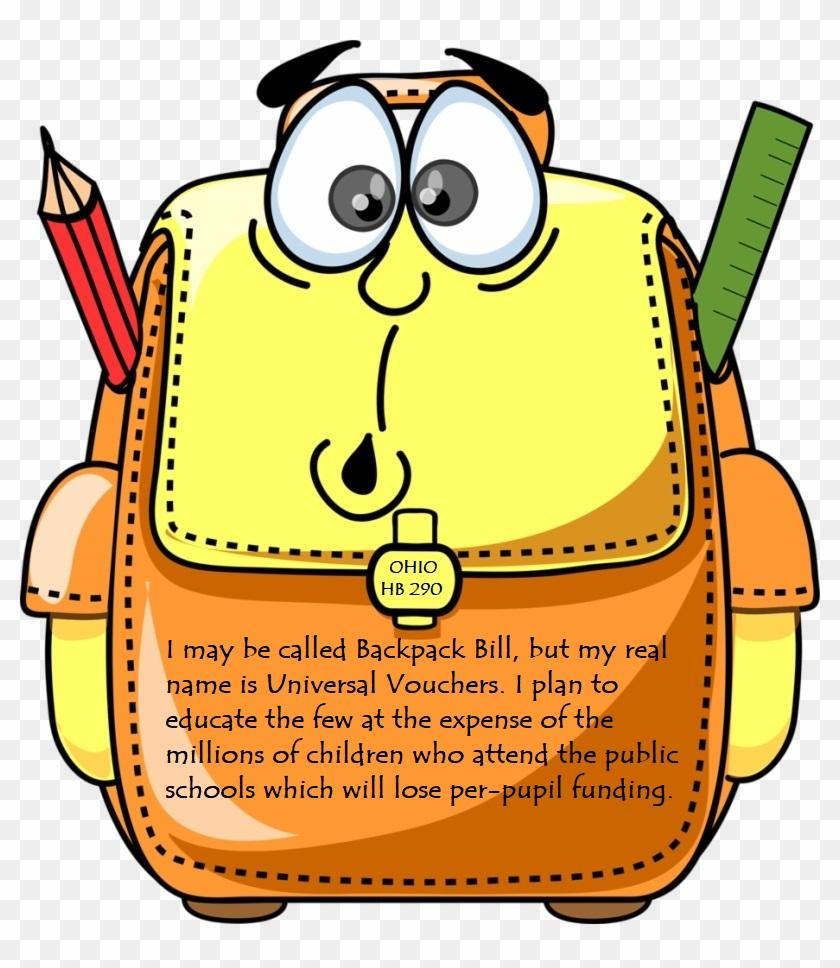
We have been warning the public school community and other Ohioans that the goal of voucher advocates has nothing to do with “rescuing poor kids from low performing school districts”; it is to give each kid a voucher. Fund the kid, not the system. Tune into the press conference to hear a universal voucher pitch first hand.

https://www.ohiochannel.org/

COLUMBUS – State Reps. Marilyn John (R-Richland County) and Riordan McClain (R-Upper Sandusky) will host a press conference on Wednesday, October 6th to announce new legislation known as the Backpack Bill. House Bill 290 will extend school choice to all students throughout Ohio, which will expand their educational opportunities.

During the press conference, the representatives will announce a sub-bill to HB 290. This very important legislation strives to ensure that Ohio maintains strong funding for public and private schools while also cultivating innovation and opportunity for all of Ohio’s children.

WHO: State Rep. Marilyn JohnState Rep. Riordan McClain

WHERE: Ohio Statehouse, Netzley Press Room,1 Capitol Square, Columbus, OH 43215

WHEN: Wednesday, October 6, 2021, at 11:00 a.m.

https://www.ohiochannel.org/


The No Child Left Behind Act Has Put The Nation At Risk

Vouchers Hurt Ohio

William L. Phillis | Ohio Coalition for Equity & Adequacy of School Funding | 614.228.6540 |ohioeanda@sbcglobal.net| http://ohiocoalition.orgSign up for our newsletter!

A new international organization has released five case studies of low- and middle-income nations, demonstrating that PUBLIC EDUCATION WORKS.

I received this mailing:

We are delighted to launch a new important piece of research on public education, titled Public education works: lessons from five case-studies in low- and middle- income countries”. The study shows that well-organised public education systems are possible and working everywhere, with political will and use of locally relevant practices.

It showcases positive examples of public education in different contexts and settings. The cases – from Bolivia to Namibia, including Vietnam – challenge the disseminated idea that public education needs privatisation for quality and point to a rights-aligned and socially committed definition of quality – including the aim for social inclusion and equity, the engagement of community and local actors, valuing teachers and respecting local culture.  It concludes that public education must be the way forward for building more equal, just and sustainable societies.

The research was produced collaboratively by 12 organizations and is part of GI-ESCR’s continuous efforts to reverse the adverse impact of the commercialisation of education in the context of the unprecedented expansion of private-sector involvement in education.

The launch of this study is a follow-up to the publication of a policy brief released ahead of the Global Partnership for Education summit in July 2021. Its release during the virtual session of the World Bank’s Civil Society Policy Forum adds to the call on the World Bank and other investors to prioritize their support for public education in their efforts to build back more resilient and equitable education systems for all.

The research is available in three formats: a Working paper, Research brief and Policy brief.

To support the publicity of this new, exciting research, please share widely.

#PublicEducationWorks

READ the Working paper or Research brief here

GI-ESCR is a non-governmental organisation that believes transformative change to end endemic problems of social and economic injustice is possible only through a human rights lens.

Jeanne Dietsch, former state Senator in New Hampshire, reports here on the predicted cost of the state’s new voucher program.

Voucher Update
Costs at 60 times budget, so far!

Taxpayers are in for a surprise when the bill comes due for vouchers. Instead of the $140,000 budgeted for 2022, current projected spending is $6.9 million, with 800 more applications pending! Applications soared after Americans For Prosperity [the Charles Koch organization] sent out mailers andcanvassed door-to-door urging parents to apply. Many applicants are parents already paying for religious, home or private education who might apply for free money. The NH scholarship organization decided that it could not handle program administration. It subcontracted Florida firm Class Wallet to distribute and track the funds. Class Wallet will take the lion’s share of the 10%-off-the-top administration fee.

Please read the report of NPE’s Grassroots Network.

There are now more than 175 local organizations working for their public schools against privatization. If your group hasn’t joined yet, consider doing so.

Here is a small part of the monthly report:

Giving Voice to Friends of Public Education: NPE Action’s New Project 

The Network for Public Education is proud to announce a new project from NPE Action called Public Voices for Public Schools. Public Voices for Public Schools will give voice to former voucher and charter parents, educators, and community members who work tirelessly in their communities every day to improve our public schools, even as they fight well-funded efforts to privatize their schools. Public Voices for Public Schools will publish a story each Monday.  Go here to subscribe to the website and get each story as it is launched.  Please like them on Facebook and give them a follow on Twitter.

National Organizing

Defending the Early Years Advisory Board Member, Marcy Guddemi, will be talking about childhood trauma and the healing powers of play on October 23rd. For more information, go here. In their Cashing in on Kids series In the Public Interest shared that California’s online charter schools are performing poorly, even as enrollment soars. The Journey for Justice Alliancedeployed an emergency response team to New Orleans to assist communities impacted by Hurricane Ida. Go here to listen to Jitu Brown, National Director of J4J, discuss their work. The Schott Foundation posted on their blog this month that the eviction crisis is also an education crisis. Be sure to keep up with the latest on testing by reading the Fairtest newsletter. Rethinking Schools staff and editors are saddened by the death of their friend Jim Loewen, whose work did so much to help students and teachers to rethink U.S. history. The Parent Coalition for Student Privacy posted a reportwith new information from the NYC Department of Education student data breach — with some critical unanswered questions, including lack of encryption and timely notification, both of which are required by NYS law. Parents for Public Schools publishedSeptember’s Kindergarten Readiness Calendar, from their friends at Excel By 5, Inc. The calendar this month is all about community helpers. PPS also advocated for competitive pay for Mississippi teachers this month in a statement to the Mississippi Senate Education Committee: Parents Across America has a public Facebook page that is great for interacting with others from across the nation about public education issues. Go here to join in the conversation.