Governor Ron DeSantis and the Florida Legislature passed a law to ban any discussion of homosexuality in school; the legislation is known as the “Don’t Say Gay” law. Other red states are rushing to pass copycat legislation. Some are using their gag orders to target both critical race theory and any discussion of LGBT.

PEN America, the authors’ organization, summarized this frenzy:

Last month PEN America reported that 2022 had seen a steep rise in the introduction of educational gag orders. So far this year, 103 different bills have been introduced in state legislatures across the country, many of which target higher education and feature severe punishments. Cumulatively, they represent a national assault on our education system, censoring both what teachers can say and what students may learn.

Some top line numbers:

  • Since January 2021, 156 educational gag order bills have been introduced or prefiled in 39 different states
  • 12 have become law in 10 states
  • 113 are currently live in 35 different states

Of those currently live:

  • 105 target K-12 schools
  • 49 target higher education
  • 62 include a mandatory punishment for those found in violation

The effort to censor anti-LGBTQ identities is expanding rapidly

Of the bills currently live, many are progressing quickly through their state legislatures. Florida’s HB 1557, better known as the “Don’t Say Gay” bill, is a typical example. Having won support from Governor Ron DeSantis last week, it was swiftly voted out of the state senate. This bill would prohibit public K-12 teachers from “encourag[ing] classroom discussion about sexual orientation or gender identity” in primary grade levels, as well as teachers in any other grade level from doing so in a manner that is not “age-appropriate or developmentally appropriate for students.” As commentators have noted, HB 1557 would be a magnet for censorious lawsuits, allowing a school’s most conservative parent to dictate what every other student learns.

But Florida’s “Don’t Say Gay” bill is just the tip of the iceberg. While race, sex, and American history remain the most common targets of censorship, bills silencing speech about LGBTQ+ identities have also surged to the fore. Currently, 15 such bills are under consideration in 9 states. This is in addition to the wave of book bans sweeping through schools and public libraries, bans that overwhelmingly target materials dealing with gender and sexuality or that center LGBTQ+ characters. Many other bills currently under consideration target LGBTQ+ students for special scrutiny and exclusion in other ways.

What’s behind this sudden interest in censoring these topics and themes? In reality, it is not very sudden. Rather, what we are seeing in 2022 is a convergence between two distinct but related sets of actors: First, anti-LGBTQ+ activists, well-established but with limited success in penetrating public schools; and second, the “anti-Critical Race Theory” movement. The latter has primed the public to support sweeping censorship of classroom speech. For anti-LGBTQ+ activists, this is a once-in-a-generation opportunity, a chance to ram through bills that are far more restrictive than anything the public would normally accept. The goal is quite simply to lock LGBTQ+ topics on the wrong side of the schoolhouse gate.

No bill better exemplifies this trend than Kansas’s HB 2662. Introduced last week, it appears at first glance to be a typical “curriculum transparency” and “parents’ rights” bill, similar to many others we have seen this year. The first six pages are a long list of rules about curricular materials, where they must be posted, how parents are to be notified, etc., all of it punctuated by occasional broadsides against “racially essentialist doctrines.” In other words, standard “anti-CRT” fare. But tucked back toward the end, HB 2662 also proposes to make a change to the state’s obscenity law, making it a class B misdemeanor for a teacher to use any material in the classroom depicting “homosexuality.” Note well: not sexually explicit depictions of homosexuality. Just homosexuality in general.

Bills like this are piling up. South Carolina’s H 4605 begins by enumerating a now-familiar list of concepts to be prohibited in the classroom (e.g. that “one race or sex is inherently superior or inferior to another race or sex”), but abruptly shifts halfway through to forbid teachers from “subject[ing]” students to “controversial and age-inappropriate topics” like “gender identity or lifestyles.” Indiana HB 1040 operates similarly: The bill contains 19 pages of rules about race, sex, and American history, before declaring on page 20 that teachers would be prohibited from discussing in any context “sexual orientation,” “transgenderism,” or “gender identity” without parental consent.

The list goes on. A bill introduced last month in Indiana would require schools to consult with parents before inquiring about a student’s preferred pronouns. Arizona HB 2011 would force students to seek their parents’ permission before joining any school club “involving sexuality, gender or gender identity.” As a result, gay and bisexual students seeking support from their classmates would essentially have to out themselves to their parents first. HB 800 in Tennessee would prohibit public K-12 schools from adopting any instructional materials that “promote, normalize, support, or address lesbian, gay, bisexual, or transgender (LGBT) issues or lifestyles.” And under North Carolina’s S 514, teachers and college faculty would have to report to a parent if their child displays signs of “gender nonconformity.” This last bill has stalled in the state senate, but it remains live and a renewed push could come at any time.

Everywhere across the country, anti-LGBTQ+ advocates and the “anti-CRT” movement are converging. The more that lawmakers warm to classroom censorship, the more anti-LGBTQ+ activists will seek to exploit that fact. And as the “Don’t Say Gay” bill’s speedy progress in Florida shows, this strategy can be successful.

Spotlight: Oklahoma

Perhaps no state has gone further or with greater speed than Oklahoma. As of today, lawmakers there are considering ten separate educational gag orders of varying scope and severity. Of the five most extreme, all contain major implications for how teachers, librarians, and school administrators talk about LGBTQ+ identities.

The first is SB 1142. If passed, public school libraries would be prohibited from placing on the shelf any books that:

make as their primary subject the study of sex, sexual preferences, sexual activity, sexual perversion, sex-based classifications, sexual identity, or gender identity or books that are of a sexual nature that a reasonable parent or legal guardian would want to know of or approve of prior to their child being exposed to it.

SB 1654 contains a similar ban (no library may distribute any materials that “make as their primary subject the study of lesbian, gay, bisexual, or transgender issues or recreational sexualization”), but extends the prohibition to teachers.

Higher education is being targeted as well: SB 1141 would bar public colleges and universities from requiring students to enroll in any course “that addresses any form of gender, sexual, or racial diversity, equality, or inclusion.” This bill supplements HB 1775, which was passed in Oklahoma last year and applies a similar ban to college training and counseling. That law has already chilled classroom instruction on race and sex, as detailed in a federal lawsuitfiled by the Oklahoma ACLU.

Lastly, there are two Oklahoma bills that, while not addressing LGBTQ+ related issues explicitly, would nevertheless likely expel all mention of them from the classroom. SB 1470 forbids public schools from employing any person who “promotes positions in the classroom or at any function of the public school that is in opposition to closely held religious beliefs of students.” And HB 614 requires colleges and universities to offer an “unbiased education that does not endorse, favor, promote, demean, show hostility toward or intentionally undermine any particular religion, nonreligious faith or religious perspective.” If passed, the bill would also establish a hotline that students can use to report a professor who besmirches their faith. Again, these bills do not mention LGBTQ+ identities explicitly. Nevertheless, it requires little imagination to see how they could silence any discussion of such topics, to say nothing of conversations about natural history, cosmology, or biology.

Censorship goes mainstream

It is important to understand that to their supporters, these bills are not extreme. On the contrary, they are the natural extension of the “anti-CRT” movement and its critique of classroom “indoctrination.” State senator Robert Standridge, for example, justified his support for SB 1142 this way:

The purpose of our common education system is to teach students about math, history, science and other core areas of learning – all of which are further expanded on in college as students pursue their fields of interest. Unfortunately, however, more and more schools are trying to indoctrinate students by exposing them to gender, sexual and racial identity curriculums and courses. My bill will ensure these types of lessons stay at home and out of the classroom.

This sort of “indoctrination” argument opens the door to all manner of classroom censorship. Anti-CRT activists did not invent it, but they certainly have made it popular. And in the wake of their success, many more ideas and values will be targeted for exclusion next. After all, LGBTQ+ identities are clearly regarded by some as “divisive concepts.” If systemic racism is unfit for classroom discussion, what is the principled argument against censoring conversations about homophobia too?

From book bans to educational gag orders, schools and universities are being threatened today to a degree that has no recent parallel. There is a willingness, and even eagerness, to bring the weight and power of government to bear on controlling classroom speech. And as is always the case in such times, students will be the ones to pay the price.

This update from PEN America was compiled by Jeffrey Sachs and Jonathan Friedman.

Note: the number of bills has been updated as of 2/15/22.
Paul Waldman of the Washington Post writes that Republicans, with only a few exceptions, refuse to do anything about climate change.

The news gets worse, but they are determined to do nothing. CNN posted illustrations of what rising sea levels would do to the coastal cities in the not distant future, and the visualizations are terrifying.

Sure, Democrats are predominant in New York and California, but rising sea levels will also devastate Florida, Georgia, Texas, and the Carolinas.

Waldman says that as recently as 1994, Republicans cared about the environment. No more.

He wrote:

Back in 2008, House Speaker Nancy Pelosi (D-Calif.) and former speaker Newt Gingrich recorded a television ad in which they acknowledged their bitter political differences, but made a shared commitment on one critical issue.

“We do agree,” said Gingrich, “our country must take action to address climate change.” He added: “If enough of us demand action from our leaders, we can spark the innovation we need.”

Let’s take a look at some of the latest major climate news:

Somehow, that new Republican understanding of the importance of addressing climate change never quite caught on. If anything, as the effects of climate change intensify, the GOP has become more committed to opposing any and all efforts to do something about it.


• The National Oceanic and Atmospheric Administration released a report showing that coastal sea levels will rise by an entire foot between now and 2050, “intensifying the threat of flooding and erosion to coastal communities across the country.”


• A new study shows that the ongoing drought in the western states has made this the driest period there in 1,200 years.


• The climate provisions in the Build Back Better bill are on ice, now that BBB has stalled amid lockstep Republican opposition. The Post reports that this has “frozen hundreds of billions of dollars in private capital” earmarked for climate projects across the country, which has “complicated America’s much-touted clean energy revolution.”


• Republicans are trying to block President Biden’s nomination of Sarah Bloom Raskin as chief banking regulator at the Federal Reserve. Why? Because she has advocated for the financial industry to do more to plan for the economic effects of climate change.


• Spurred by climate-denial organizations, Republican legislators at the state level are working to prevent officials from dealing with businesses that are moving to wean themselves from fossil fuels or otherwise taking climate change seriously.


• In Florida — where there is ample sunshine — Republicans in the legislature are working with the state’s largest utility to undermine net metering, the hugely popular system under which customers with solar panels send back surplus energy to the grid. Solar companies in Florida say if the bill passes, they’ll have to shut down and move to other states

.It wouldn’t be fair to portray the Republican Party as an absolute monolith on climate — a smattering of Republican officials here and there say they would like to do something on climate, even if their solutions always seem to include uninterrupted drilling and burning of fossil fuels.

And the Republican electorate has complicated views on the topic. Depending on how pollsters ask them, a majority of Republicans sometimes express concern about climate and support various ideas to reduce emissions. But by other measures, Republicans have actually grown less concerned about climate in recent years.


If that’s the case, it could be partly because the administration of Republican god-king Donald Trump was the most aggressively anti-environment in history. Or it could be because as you move down the funnel from vague popular notions to elite opinion and finally to policies the party supports, the closer you get to the apparent belief that conservative identity-signaling requires one to oppose doing anything at all to slow global warming.

On February 3, Duke University historian Nancy MacLean and I held a Zoom conversation called “Public Education in Chains,” about the nefarious conspiracy to undermine and privatize our public schools. The discussion was sponsored by Public Funds Public Schools and the Network for Public Education.

Dr. MacLean is the author of many books, including the brilliant Democracy in Chains: The DeepHistory of the Radical Right’s Stealth Plan for America.

We discussed the historical origins of the movement, calling out the privatizers as a combination of libertarians, anti-government ideologues, the radical right, segregationists, and rightwing evangelicals, funded by billionaires who hate taxes, public institutions, and unions. Their movement threatens not only public schools but our democracy.

Nancy MacLean is an esteemed historian at Duke University, where she is the William H. Chafe Professor of History and Public Policy. She specializes in the study of race, gender, labor history and social movements in the United States. Her book Democracy in Chains: The Deep History ofthe Radical Right’s Stealth Plan for America is must reading.
In this important paper, she examines the role of economist Milton Friedman in promoting school choice, segregation, and privatization.
The abstract:

This paper traces the origins of today’s campaigns for school vouchers and other modes of public funding for private education to efforts by Milton Friedman beginning in 1955. It reveals that the endgame of the “school choice” enterprise for libertarians was not then— and is not now–to enhance education for all children; it was a strategy, ultimately, to offload the full cost of schooling onto parents as part of a larger quest to privatize public services and resources. Based on extensive original archival research, this paper shows how Friedman’s case for vouchers to promote “educational freedom” buttressed the case of Southern advocates of the policy of massive resistance to Brown v. Board of Education. His approach—supported by many other Mont Pelerin Society members and leading libertarians of the day –taught white supremacists a more sophisticated, and for more than a decade, court-proof way to preserve Jim Crow. All they had to do was cease overt focus on race and instead deploy a neoliberal language of personal liberty, government failure and the need for market competition in the provision of public education.

She describes the spread of ”school choice” legislation and writes:

A well-funded, laser-focused and integrated long game helped achieve these legislative triumphs. Indeed, it is difficult to find an institution on the American right that has not advocated “school choice.” Think tanks such as the Cato Institute and the Heritage Foundation, along with affiliates of the State Policy Network, make the case for it. Engines of legal and judicial change such as the Federalist Society and the Institute for Justice workshop the constitutional issues and litigate for it. The American Legislative Exchange Council (ALEC) produces templates of “model laws” for its overwhelmingly Republican members to introduce it in state legislatures. Fox News broadcasts the talking points. Organizing efforts including Americans for Prosperity drive calls and letters to elected officials. Deep-pocketed donors underwrite the work. The campaigners employ a common language of personal liberty and anti-government, pro-market catch phrases. They tout the benefits of parents gaining the “freedom to choose” to send their children to private schools. And they claim that breaking up the “government monopoly” will promote “competition” that will improve the overall quality of education.2

“School choice” sounds like it offers options. But as I will show, the whole concept, as first implemented in the U.S. South in the mid-1950s, aimed to deny the choice of equal, integrated education to Black families. Further, Milton Friedman, soon to become the best-known neoliberal economist in the world, abetted the push for private schooling that southern states used to evade the reach of Brown v. Board of Education, the Supreme Court’s unanimous 1954 ruling that the segregation of public education violated the constitutional right of Black children to equal protection of the laws. So, too, did other libertarians of the day, among them leading pioneers of the cause that today avidly pushes private schooling.3
Perhaps most tellingly, though, the ultimate purpose was not really to benefit parents and children, even the white ones who patronized the new segregation academies. For Friedman and the libertarians, school choice was and is a strategy to ultimately offload the burden of paying for education onto parents, thus harming the educational prospects of most youth. As we will see, Friedman himself hoped it would discourage low-income parents from having children in a form of economic social engineering reminiscent of eugenics. He predicted that once they had to pay the entire cost of schooling from their own earnings, they would make different reproductive decisions.4

Please read this thoughtful, well-researched and alarming study to understand the dark history of “school choice.” This is a case where history illuminates the future.

Kate McGee of the Texas Tribune writes that Lt. Governor Dan Patrick has threatened to kill tenure in Texas universities to compel compliance with his wish to stop any teaching about race or racism, which he calls “critical race theory.”

Dan Patrick is a phony Texan. He wears boots, but he was born and raised in Baltimore. His birth name was Dannie Scott Goeb. He was the little Rush Limbaugh of Texas until he entered politics. He has never abandoned the politics of hatred and division that have made him successful. He has advocated for teaching creationism in the schools and backed legislation last year to prevent public schools from requiring that students read writings by prominent civil rights figures, such as Susan B. Anthony, Cesar Chavez, and Martin Luther King Jr., when covering women’s suffrage and the civil rights movement in social studies classes.” He is a 21st century Know-Nothing.

McGee writes:

Lt. Gov. Dan Patrick said Friday that he will push to end professor tenure for all new hires at Texas public universities and colleges in an effort to combat faculty members who he says “indoctrinate” students with teachings about critical race theory.

“Go to a private school, let them raise their own funds to teach, but we’re not going to fund them,” said Patrick, who is running for reelection. “I’m not going to pay for that nonsense.”

Patrick, whose position overseeing the Senate allows him to drive the state’s legislative agenda, also proposed a change to state law that could make teaching critical race theory grounds for revoking tenure for professors who already have it. His announcement tees up the next major fight at the Texas Capitol over how college students learn about the history of race and racism in the United States.

Tenure is an indefinite appointment for university faculty that can only be terminated under extraordinary circumstances. Academics said Friday that tenure is intended to protect faculty and academic freedom from exactly the kind of politicization being waged by Patrick.

“This kind of attack is precisely why we have faculty tenure,” said Michael Harris, a professor at Southern Methodist University studying higher education, who likened tenure to lifetime appointments given to federal judges. “The political winds are going to blow at different times, and we want faculty to follow the best data and theory to try to understand what’s happening in our world.”

Patrick on Friday also proposed making tenure review an annual occurrence instead of something that takes place every six years. At the press conference, he said his proposals already have the support of state Sen. Brandon Creighton, R-Conroe, who chairs the Senate Higher Education Committee…

Patrick’s plan drew swift condemnation from the American Association of University Professors, the body that helped develop the 1940 Statement of Principles on Academic Freedom and Tenure that has been adopted by universities and colleges nationwide.

“There’s always been attempts to interfere in higher education, but I have never seen anything as egregious as this attack,” said Irene Mulvey, president of the AAUP. “This is an attempt to have government control of scholarship and teaching. That is a complete disaster. I’ve never seen anything this bad…”

Patrick said his latest priority is in response to the UT-Austin Faculty Council after it passed a nonbinding resolution Monday to reaffirm instructors’ academic freedom to teach on issues of racial justice and critical race theory.

“Legislative proposals and enactments seek to prohibit academic discussions of racism and related issues if the discussion would be ‘divisive’ or suggest ‘blame’ or cause ‘psychological distress,’” the resolution stated. “But fail to recognize that these criteria … chill the capacity of educators to exercise their academic freedom and use their expertise to make determinations regarding content and discussions that will serve educational purposes.”

One day after the resolution passed, Patrick signaled on Twitter that he would continue the fight against teaching the discipline in the next legislative session.

“I will not stand by and let looney Marxist UT professors poison the minds of young students with Critical Race Theory,” Patrick wrote on Twitter. “We banned it in publicly funded K-12 and we will ban it in publicly funded higher ed. That’s why we created the Liberty Institute at UT.…”

The proposal to end tenure would fundamentally change the way Texas universities operate in terms of hiring, teaching and research. Faculty members warn it’s likely to impose major challenges for Texas universities to recruit and retain researchers and scholars from across the country…

Harris said even the headlines to propose ending tenure could hurt Texas universities that are hiring faculty members for next year who might think twice about whether to take a job at a public university.

A few strategic phone calls from public university presidents to their alumni in the state legislature could shut down Dan Patrick mighty quick. He is an embarrassment to the state of Texas.

Don’t believe the hype about charter ”success.” As the Network for Public Education has documented in several reports, the failure and closure rate of charter schools is high. in Philadelphia, the district has battled to close two low-performing charter schools for years and only now is on the cusp of regaining their students.

A state panel on Tuesday upheld the Philadelphia school board’s decision not to renew two charter schools, setting a course for ASPIRA Olney High School and ASPIRA Stetson Middle School to return to district control later this year.

The move comes nearly six years after the Philadelphia School District’s charter schools office first recommended that the district cut ties with ASPIRA Olney and Stetson for academic, operational, and financial reasons. The school board eventually voted against renewing the charters in 2019 over strong objections from the powerful Hispanic nonprofit that has run them since 2010 and 2011.

The charter nonrenewals mark the first time the district will take back control of schools it had turned over under the Renaissance Schools initiative, a school-turnaround approach launched in 2010 that the district has backed away from in recent years. (In 2016, Scholar Academies abruptly surrendered control of Kenderton Elementary, citing the high cost of educating its large special-education population; the district took back Kenderton and still runs it.)

ASPIRA officials said they plan to file court paperwork to overturn Tuesday’s ruling of the Charter Appeals Board, which voted 4-1 in both the Olney and Stetson cases. Among those voting in favor was Jennifer Faustman, CEO of the Belmont Charter Network in Philadelphia. Tom Killion, a former Republican state senator from Delaware County, was the lone no vote

Olney, a high school that enrolls more than 1,700 students at Front and Duncannon, and Stetson, which educates 860 students in grades 5 through 8 on B Street in Kensington, will remain open in their current buildings, district and board officials emphasized. Students’ educations will not be interrupted

The old School Reform Commission gave struggling Olney and Stetson to ASPIRA as part of its Renaissance initiative that tapped outside providers to run schools. According to a hearing officer’s report, while ASPIRA made progress in improving the schools’ climates, it didn’t live up to the academic promises it made and had financial shortcomings, too.

ASPIRA has fought to maintain control of the schools, which have been in limbo since their charters expired more than five years ago. In 2019, the company sued the School District, accusing it of unlawfully delaying charter renewal decisions to pressure the company into agreeing to conditions like enrollment caps.

A federal judge ruled in favor of the district last year, determining that while ASPIRA was selected to manage the two schools, there was no contract between the company and the district.

ASPIRA, which manages a total of five charter schools in the city, including a cyber charter, has also faced scrutiny from state officials. It was the subject of an auditor general’s report in 2018 that highlighted significant increases in payments the charters made to ASPIRA as an example of flaws in Pennsylvania’s charter school law.

It has taken the district six years to regain control of these two charters, whose charters were not renewed. And the charters are again appealing the decision to turn over their students and buildings to the district.

When a bright young man or woman gets an idea to replace experienced educators with inexperienced tyros and is quickly funded by billionaire foundations, you can guess that the ultimate goal is privatization. For one thing, the enterprise rests on a base claim that “our schools are failing,” and that experience is irrelevant and probably harmful.

Tom Ultican recounts the origin story of one such organization: New Leaders for New Schools.

The idea was so spot-on that the organization attracted millions of dollars from the plutocrats of privatization: Eli Broad, Bill Gates, the Walton Family Foundation, and many more.

Where are the miracle schools led by New Leaders? That’s a hard question to answer.

What Ultican demonstrates is the continuing relevance of New Leaders for New Schools. One of its illustrious graduates was behind the recent decision by the board of the Oakland Unified School District to resume closing schools, despite overwhelming opposition by students, parents, and educators.

I am pleased to report that I was selected as ”Global Guru #1” by an organization that selects “global gurus” in different fields. I am happy to see my friends Deborah Meier, Andy Hargreaves, and Pasi Sahlberg on the same list. I’m honored to be in the company of such distinguished educators. In case you read the bio, there are two updates. I retired from active service at New York University on September 1, 2020. And the blog has received more than 39 million page views (not 32) since it started in 2012.

This is when 21st century McCarthyism gets serious.

Dan Patrick, the talk-show host who is now Lieutenant Governor of Texas, wants to ban the teaching of “critical race theory” in higher education. Critical race theory, the study of systemic and institutionalized racism, has been taught and debated in law schools and colleges since the mid-1980s.

Patrick wants to quash academic freedom in higher education. He thinks he can prevent professors who have devoted their academic careers to the study of racism from talking about it. Maybe, he believes, if they don’t talk about and study racism, no one will know it exists. Or maybe it will just go away.

Erica Grieder wrote in the Houston Chronicle about Patrick’s plans to restrict academic freedom and to have the state spend $6 million on a “think tank” called the “Liberty Institute” to prevent errant professors from exercising their freedom to teach and speak. Last year, the state passed a law to ban CRT in K-12 schools, where (he thinks) children are being stuffed with left wing propaganda and with the claim that racism is real.

“I will not stand by and let looney Marxist UT professors poison the minds of young students with critical race theory,” he announced in a tweet.

“We banned it in publicly funded K-12 and we will ban it in publicly funded higher ed,” he continued, adding: “That’s why we created the Liberty Institute at UT.”

This was in response to a report, in the Austin American-Statesman, that the Faculty Council of the University of Texas at Austin had passed a resolution defending academic freedom.

In other words, Patrick, hearing of an innocuous nonbinding resolution in support of freedom, responded by threatening to pursue even more aggressive restrictions on freedom, while also wrapping himself in the banner of “liberty.” Naturally. This is from the lieutenant governor, arguably the state’s most powerful elected official.

Patrick, a rabid supporter of vouchers, as well as limits on free speech, is a public nuisance who menaces the freedom of students, teachers, and professors in Texas.

Paul Bowers, previously the education journalist for the Charleston, South Carolina, Post & Courier, writes his own blog. In this post, he calls on the state legislators not to pass voucher legislation that would predictably defund the state’s already underfunded public schools. South Carolina has a large budget surplus and one of the lowest tax rates in the nation. Governor Henry McMaster announced that the surplus would be used to lower taxes instead of funding public schools and other public services.

Paul wrote the members of the S.C. Senate Education Committee in opposition to Senate Bill 935, which is an attempt to divert public school funding to private schools.

Senators Massey, Jackson, Hutto, Rice, and Talley:

I write to you as a South Carolinian and parent of 3 public school students asking you to scrap Senate Bill 935, the so-called “Put Parents in Charge Act,” which would redirect public funds to private schools via the creation of Education Savings Accounts.

Every few years, South Carolina teachers and parents have to band together to fight the latest iteration of the school voucher meme, which has spread virally across the states thanks to millions upon millions of dollars of dark-money political contributions, astroturfed special-interest groups, and a network of libertarian billionaires’ pet thinktanks. We fought this idea when New York real estate investor Howard Rich tried to buy a voucher law here in the early 2000s, and we’re fighting it again now that ALEC, Palmetto Promise, and the like are trying to ram the same idea through the Statehouse in Year of Our Lord 2022. There is truly nothing new under the sun.

As the educator Steve Nuzum has pointed out several times this year, the bill you will be considering in a subcommittee meeting on Feb. 16is largely copied from a piece of “model legislation” churned out by the American Legislative Exchange Council, a right-wing bill mill. I posit that we have enough terrible ideas to go around in this state without borrowing worse ones.

If enacted, this bill would be an obvious violation of the South Carolina Constitution, Article XI, Section 4, which states:

No money shall be paid from public funds nor shall the credit of the State or any of its political subdivisions be used for the direct benefit of any religious or other private educational institution.

Now, I am sure our attorney general would happily defend such an act against the inevitable lawsuits that would follow. I am no legal scholar, but I think it’s reasonable to assume he would employ some of the same arguments used to defend Gov. Henry McMaster when, in the thick of a global pandemic, he tried diverting $32 million worth of federal emergency funding from public schools to private schools. Notably, he lost that fight.

So, I suppose you and your colleagues in the General Assembly could enact this law, and you could win the legal battle that follows. Stranger things have happened. But the question remains whether you should go down this road.

I say no, you should not.

South Carolina’s most reactionary politicians have been clamoring for public divestment from the school system ever since radical Black Republicans created a free public school system for all in the Constitution of 1868. White supremacists clawed back at the notion of public goods with the Jim Crow Constitution of 1895; the Interposition Resolution of 1956; and the cavalcade of privatization laws, segregation academies, and district-level resegregation efforts that have continued without ceasing since Brown v. Board of Education was decided in 1954.

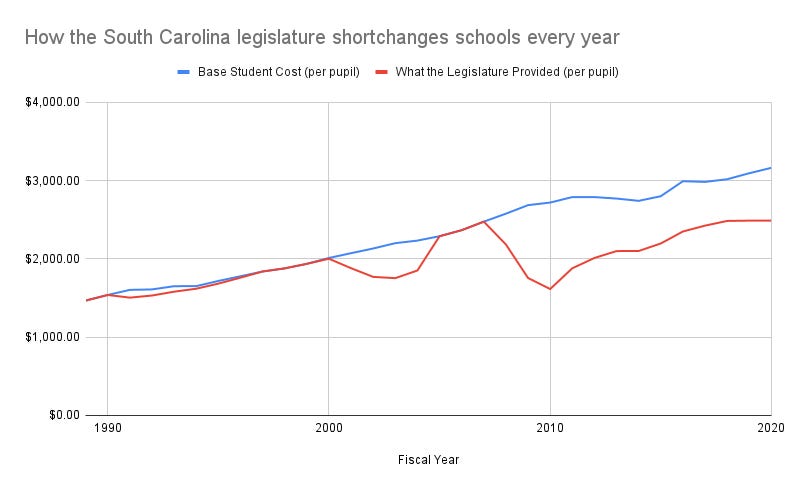
Data compiled by Steve Nuzum, via S.C. Revenue and Fiscal Affairs Office

As a matter of policy, you and your colleagues in the General Assembly have been steadily defunding public education since the start of the Great Recession. You have broken your own promises as outlined in the Education Finance Act and are currently under-funding the Base Student Cost by about a half-billion dollars per year. The results have been disastrous: Our teachers are underpaid and quitting by the thousands, classroom sizes have ballooned, our rural schools are in physical shambles, and a system of separate and unequal education along racial and economic lines has returned with a vengeance.

It is difficult to predict how much money public schools would lose as a result of Education Savings Accounts, which would allow public funds to “follow” individual students to private schools. Our state’s Revenue and Fiscal Affairs Office has tried to guess, though. According to a fiscal impact summary published in December, the ESA program could divert as much as $35 million to private schools within the first year it takes effect, depending how many families participate in the program. By 2026, they estimated the program could cost the state as much as $2.9 billion. Compounded by the General Assembly’s ongoing policy of public disinvestment, this could constitute a death blow to public schools.

The bill is built on a few faulty premises, including the underlying assumption that private schools could or would serve South Carolina students better. The authors of the bill also seem to believe that our state’s private schools could handle a sudden influx of new enrollment while accommodating students’ learning, transportation, and health needs. These are dicey propositions at best.

S. 935 is a direct attack on the notion of education as a public good. Its authors would leave us all to fend for ourselves as atomized individuals, cut loose from mutual obligations that once tied us together. For a certain type of doctrinaire conservative, this may sound like a dream scenario. For the rest of us living in the real state of South Carolina, it is a nightmare come true.

Regards,

Paul Bowers

North Charleston, S.C.