A friend sent Gloria Steinem’s solution to gun safety:

“How about we treat every young man who wants to buy a gun like every woman who wants to get an abortion:

1. Mandatory 48-hour waiting period, parental permission, a note from his doctor proving he understands what he’s about to do, a video he has to watch about the effects of gun violence…

2. Close down all but one gun shop in every state and make him travel hundreds of miles, take time off work, stay overnight in a strange town to get a gun.

3. Make him walk through a gauntlet of people holding photos of loved ones who were shot to death, people who call him a murderer and beg him not to buy a gun.”

If we really cared about the right to life, this is what we would do.

The BBC compiled this statistical portrait of America’s gun culture five years ago and updated it a month ago, before the Buffalo and Uvalde massacres. The latest studies report that there are more than 400 million guns in the U.S.

It begins:

It was over 50 years ago when the administration of President Lyndon Baines Johnson declared that “firearms are a primary instrument of death in American crime” and that it was “primarily the result of our culture’s casual attitude towards firearms and its heritage of the armed, self-reliant citizen”.

At the time, about 90 million guns were circulating in the country.

Today, there are many more guns and many more deaths.

Firearms deaths have become even more of a fixture in American life, with the 1.5 million that took place between 1968 and 2017 higher than the number of soldiers killed in every US conflict since the American War for Independence in 1775.

In 2020 alone, more than 45,000 Americans died at the end of a barrel of a gun, whether by homicide or suicide, more than any other year on record. The figure represents a 25% increase from five years prior, and a 43% increase from 2010.

Heather Cox Richardson writes a valuable and informative history of the politics of guns in America. She makes clear that the current Republican interpretation of the Second Amendment is not rooted in American history.

Please open the link to see the footnotes.

She writes:

Today, a gunman murdered at least 19 children and 2 adults at Robb Elementary School in Uvalde, Texas. 

For years now, after one massacre or another, I have written some version of the same article, explaining that the nation’s current gun free-for-all is not traditional but, rather, is a symptom of the takeover of our nation by a radical extremist minority. The idea that massacres are “the price of freedom,” as right-wing personality Bill O’Reilly said in 2017 after the Mandalay Bay massacre in Las Vegas, in which a gunman killed 60 people and wounded 411 others, is new, and it is about politics, not our history.

The Second Amendment to the Constitution, on which modern-day arguments for widespread gun ownership rest, is one simple sentence: “A well regulated militia, being necessary for the security of a free state, the right of the people to keep and bear arms, shall not be infringed.” There’s not a lot to go on about what the Framers meant, although in their day, to “bear arms” meant to be part of an organized militia.

As the Tennessee Supreme Court wrote in 1840, “A man in the pursuit of deer, elk, and buffaloes might carry his rifle every day for forty years, and yet it would never be said of him that he had borne arms; much less could it be said that a private citizen bears arms because he has a dirk or pistol concealed under his clothes, or a spear in a cane.”

Today’s insistence that the Second Amendment gives individuals a broad right to own guns comes from two places.

One is the establishment of the National Rifle Association in New York in 1871, in part to improve the marksmanship skills of American citizens who might be called on to fight in another war, and in part to promote in America the British sport of elite shooting, complete with hefty cash prizes in newly organized tournaments. Just a decade after the Civil War, veterans jumped at the chance to hone their former skills. Rifle clubs sprang up across the nation.

By the 1920s, rifle shooting was a popular American sport. “Riflemen” competed in the Olympics, in colleges, and in local, state, and national tournaments organized by the NRA. Being a good marksman was a source of pride, mentioned in public biographies, like being a good golfer. In 1925, when the secretary of the NRA apparently took money from ammunition and arms manufacturers, the organization tossed him out and sued him.

NRA officers insisted on the right of citizens to own rifles and handguns but worked hard to distinguish between law-abiding citizens who should have access to guns for hunting and target shooting and protection, and criminals and mentally ill people, who should not. In 1931, amid fears of bootlegger gangs, the NRA backed federal legislation to limit concealed weapons; prevent possession by criminals, the mentally ill and children; to require all dealers to be licensed; and to require background checks before delivery. It backed the 1934 National Firearms Act, and parts of the 1968 Gun Control Act, designed to stop what seemed to be America’s hurtle toward violence in that turbulent decade.

But in the mid-1970s, a faction in the NRA forced the organization away from sports and toward opposing “gun control.” It formed a political action committee (PAC) in 1975, and two years later it elected an organization president who abandoned sporting culture and focused instead on “gun rights.”

This was the second thing that led us to where we are today: leaders of the NRA embraced the politics of Movement Conservatism, the political movement that rose to combat the business regulations and social welfare programs that both Democrats and Republicans embraced after World War II. Movement Conservatives embraced the myth of the American cowboy as a white man standing against the “socialism” of the federal government as it sought to level the economic playing field between Black Americans and their white neighbors. Leaders like Arizona Senator Barry Goldwater personified the American cowboy, with his cowboy hat and opposition to government regulation, while television Westerns showed good guys putting down bad guys without the interference of the government.

In 1972, the Republican platform had called for gun control to restrict the sale of “cheap handguns,” but in 1975, as he geared up to challenge President Gerald R. Ford for the 1976 presidential nomination, Movement Conservative hero Ronald Reagan took a stand against gun control. In 1980, the Republican platform opposed the federal registration of firearms, and the NRA endorsed a presidential candidate—Reagan—for the first time.

When President Reagan took office, a new American era, dominated by Movement Conservatives, began. And the power of the NRA over American politics grew.

In 1981 a gunman trying to kill Reagan shot and paralyzed his press secretary, James Brady, and wounded Secret Service agent Tim McCarthy and police officer Thomas Delahanty. After the shooting, then-representative Charles Schumer (D-NY) introduced legislation that became known as the Brady Handgun Violence Prevention Act, or the Brady Bill, to require background checks before gun purchases. Reagan, who was a member of the NRA, endorsed the bill, but the NRA spent millions of dollars to defeat it.

After the Brady Bill passed in 1993, the NRA paid for lawsuits in nine states to strike it down. Until 1959, every single legal article on the Second Amendment concluded that it was not intended to guarantee individuals the right to own a gun. But in the 1970s, legal scholars funded by the NRA had begun to argue that the Second Amendment did exactly that.

In 1997, when the Brady Bill cases came before the Supreme Court as Printz v. United States, the Supreme Court declared parts of the measure unconstitutional.

Now a player in national politics, the NRA was awash in money from gun and ammunition manufacturers. By 2000 it was one of the three most powerful lobbies in Washington. It spent more than $40 million on the 2008 election. In that year, the landmark Supreme Court decision of District of Columbia v. Heller struck down gun regulations and declared that the Second Amendment protects an individual’s right to keep and bear arms.

Increasingly, NRA money backed Republican candidates. In 2012 the NRA spent $9 million in the presidential election, and in 2014 it spent $13 million. Then, in 2016, it spent over $50 million on Republican candidates, including more than $30 million on Trump’s effort to win the White House. This money was vital to Trump, since many other Republican super PACs refused to back him. The NRA spent more money on Trump than any other outside group, including the leading Trump super PAC, which spent $20.3 million.

The unfettered right to own and carry weapons has come to symbolize the Republican Party’s ideology of individual liberty. Lawmakers and activists have not been able to overcome Republican insistence on gun rights despite the mass shootings that have risen since their new emphasis on guns. Even though 90% of Americans—including nearly 74% of NRA members—support background checks, Republicans have killed such legislation by filibustering it.  

The NRA will hold its 2022 annual meeting this Friday in Houston. Former president Trump will speak, along with Texas governor Greg Abbott, senator Ted Cruz, and representative Dan Crenshaw; North Carolina lieutenant governor Mark Robinson; and South Dakota governor Kristi Noem—all Republicans. NRA executive vice president and chief executive officer Wayne LaPierre expressed his enthusiasm for the lineup by saying: “President Trump delivered on his promises by appointing judges who respect and value the Constitution and the Bill of Rights and in doing so helped ensure the freedom of generations of Americans.”

Tonight, President Joe Biden spoke to the nation: “Why are we willing to live with this carnage? Why do we keep letting this happen?… It’s time to turn this pain into action. For every parent, for every citizen in this country, we have to make it clear to every elected official in this country, it’s time to act.” In the Senate, Chris Murphy (D-CT) said, “I am here on this floor, to beg, to literally get down on my hands and knees and beg my colleagues….find a way to pass laws that make this less likely.”

But it was Steve Kerr, the coach of the Golden State Warriors basketball team, whose father was murdered by gunmen in Beirut, Lebanon, in 1984, who best expressed the outrage of the nation. At a press conference tonight, shaking, he said, “I’m not going to talk about basketball…. Any basketball questions don’t matter…. Fourteen children were killed 400 miles from here, and a teacher, and in the last ten days we’ve had elderly Black people killed in a supermarket in Buffalo, we’ve had Asian churchgoers killed in Southern California, and now we have children murdered at school. WHEN ARE WE GONNA DO SOMETHING? I’m tired, I’m so tired of getting up here and offering condolences to the devastated families…. I’m tired of the moments of silence. Enough. There’s 50 senators…who refuse to vote on HR 8, which is a background check rule that the House passed a couple years ago…. [N]inety percent of Americans, regardless of political party, want…universal background checks…. We are being held hostage by 50 senators in Washington who refuse to even put it to a vote despite what we the American people want…because they want to hold onto their own power. It’s pathetic,” he said, walking out of the press conference. 

“I’ve had enough.”
Another mass murder of little children. More families robbed of their beloved child. More tears. More grief. More empty expressions of sympathy from politicians who send “thoughts and prayers.”

There is no point in trying to understand the young man who carried out this atrocity. His “reasons” or motive don’t matter. What matters is that he murdered innocent children and teachers.

President Biden sees this horrific tragedy as proof that gun control is necessary to protect the innocent from the evil, the insane, the impulsive killers. I agree.

But it’s perfectly obvious that Republicans will actively fight any effort to curb the means of mass murder. There could be a mass murder every day of the week for the rest of the year, and Republicans would still fight any attempt to screen or limit who has access to murder weapons.

As the tragic events in Uvalde, Buffalo, and hundreds of other places show, Republican Party today believes in the right to life for the unborn, but doesn’t care at all about the lives of the born.

None of us is safe. No place is safe. The U.S. has 400 million guns. No matter how many innocent children or adults die at the hands of a killer, the right to own a gun is more precious to the Republican Party than the right to life.

We have seen plenty of movies about life in a dictatorship, but this video shows you the real thing. A well-known Russian pianist, Alexei Lubimov, announced a concert a few months ago. He planned to play a work by a famous Ukrainian composer, Valentin Silvestrov, and another by Schubert.

As he was playing, with great brilliance, the police arrived to stop the concert. The pianist insisted on finishing the piece he was playing. As the two policemen stood there, the audience applauded vigorously. Then the police told him they had reports of a bomb on the premises, and they had to stop the performance until bomb-sniffing dogs arrived. The dogs arrived two hours later.

The concert was stopped.

At the Network for Public Education conference in Philadelphia on May 1, I moderated a panel to discuss attacks on public schools and the groups behind those attacks. Peter Greene identified a long list of groups that claim to be protecting “parents rights.” Peter described groups such as “Moms for America,” “Moms for Liberty,” “For Kids and Country,” “Parents Defending Education,” and the “National Parents Union,” which seem to be led by women with close ties to Trumpism and funded by the usual rightwing crowd. They asserted ”parent rights” to oppose teaching about race and sex. They insisted that parents have the right to control their children.

They say they are fighting for parental rights, yet they have said nothing about the legislation in several states that sever the rights of the parents of transgender youth.

Arkansas Governor Asa Hutchinson, a conservative Republican, vetoed a bill in his state that eliminates parental rights to seek medical care for their transgender children. The legislature overrode his veto.

“The Republican Party that I grew up with believed in a restrained government that did not jump in the middle of every issue.”

He said transgender health care of young people should be limited to the patient, parents and physicians. “And we ought to yield to that decision making unless there’s a compelling state reason.”

In an attempt to provide context for the trend by Republicans in passing anti-transgender legislation across the country, Hutchinson said there is an overwhelming sense among party members that “there’s undue influence” on young people to reconsider their gender.

But he said, “This was one step way too far and I couldn’t abide by it.”

The “parent rights” groups are silent. They have nothing to say to states that take away the rights of parents of transgender children.

Medical decisions involving children should be made by parents and doctors, not politicians.

Medical decisions affecting adult women should be made by them and their doctors, not by politicians.

Medical decisions affecting adult men should be made by them and their doctors, not politicians.

James Harvey recently retired as executive director of the National Superintendents’ Roundtable. He is a member of the board of the Network for Public Education. In this post, he describes how the benchmarks used by the National Assessment of Educational Progress are misused to attack American education. The “achievement levels” were created in 1990 when Chester Finn Jr., an enemy of public schools, was chair of the National Assessment Governing Board. They were designed to make American student achievement look worse than it was. The media and the public think that “proficient” means “grade level.” It does not. It is equivalent to a solid A. Yet how many hundreds or thousands of times (e.g. the charter propaganda film “Waiting for Superman”) have you been told that most American students score “below grade level”? It’s not true. To be blunt, it’s a lie.

James Harvey wrote on Valerie Strauss’s “Answer Sheet” blog at The Washington Post:

Every couple of years, public alarm spikes over reports that only one-third of American students are performing at grade level in reading and math. No matter the grade — fourth, eighth or 12th — these reports claim that tests designed by the federal government, the National Assessment of Educational Progress (NAEP), demonstrate that our kids can’t walk and chew gum at the same time. It’s nonsense.


In fact, digging into the data on NAEP’s website reveals, for example, that 81 percent of American fourth-graders are performing at grade level in mathematics. Reading? Sixty-six percent. How could this one-third distortion come to be so widely accepted? Through a phenomenon that Humpty Dumpty described best to Alice in “Through the Looking Glass”: “When I use a word it means just what I choose it to mean.”


Here, the part of Humpty Dumpty was played by Reagan-era political appointees to a policy board overseeing NAEP. The members of the National Assessment Governing Board, most with almost no grounding in statistics, chose to define the term “proficient” as a desirable goal in the face of expert opinion that such a goal was “indefensible.”

Here’s a typical account from the New York Times in 2019 reporting on something that is accurate as far as it goes: results from NAEP indicate that only about one-third of fourth- and eighth-graders are “proficient” in reading.


But that statement quickly turns into the misleading claim that only one-third of American students are on grade level. The 74, for example, obtained $4 million from the Walton and DeVos foundations in 2015 by insisting that “less than half of our students can read or do math at grade-level.”


The claim rests on a careless conflation of NAEP’s “proficient” benchmark with grade-level performance. The NAEP assessment sorts student scores into three achievement levels — basic, proficient, and advanced. The terms are mushy and imprecise. Still, there’s no doubt that the federal test makers who designed NAEP see “proficient” as the desirable standard, what they like to describe as “aspirational.”


However, as Peggy Carr from the National Center for Education Statistics, which funds NAEP, has said repeatedly, if people want to know how many students are performing at grade level, they should be looking at the “basic” benchmark. By that logic, students at grade level would be all those at the basic level or above, which is to say that grade-level performance in reading and mathematics in grades 4, 8 and 12, is almost never below 60 percent and reaches as high as 81 percent.
And the damage doesn’t stop with NAEP. State assessments linked to NAEP’s benchmarks amplify this absurd claim annually, state by state.

While there’s plenty to be concerned about in the NAEP results, anxiety about the findings should focus on the inequities they reveal, not the proportion of students who are “proficient.”
Considering the expenditure of more than a billion dollars on NAEP over 50-odd years, one would expect that NAEP could defend its benchmarks by pointing to rock-solid studies of their validity and the science behind them. It cannot.


Instead, the department has spent the better part of 30 years fending off a scientific consensus that the benchmarks are absurd. Indeed, the science behind these benchmarks is so weak that Congress insists that every NAEP report include the following disclaimer: “[The Department of Education] has determined that NAEP achievement levels should continue to be used on a trial basis and should be interpreted with caution” (emphasis added).


Criticisms of the NAEP achievement levels
What is striking in reviewing the history of NAEP is how easily its policy board has shrugged off criticisms about the standards-setting process. The critics constitute a roll call of the statistical establishment’s heavyweights. Criticisms from the likes of the National Academy of Education, the Government Accounting Office, the National Academy of Sciences, and the Brookings Institution have issued scorching complaints that the benchmark-setting processes were “fundamentally flawed,” “indefensible,” and “of doubtful validity,” while producing “results that are not believable.”
How unbelievable? Fully half the 17-year-olds maligned as being just basic by NAEP obtained four-year college degrees. About one-third of Advanced Placement Calculus students, the crème de la crème of American high school students, failed to meet the NAEP proficiency benchmark. While only one-third of American fourth-graders are said to be proficient in reading by NAEP, international assessments of fourth-grade reading judged American students to rank as high as No. 2 in the world.

For the most part, such pointed criticism from assessment experts has been greeted with silence from NAEP’s policy board.


Proficient doesn’t mean proficient


Oddly, NAEP’s definition of proficiency has little or nothing to do with proficiency as most people understand the term. NAEP experts think of NAEP’s standard as “aspirational.” In 2001, two experts associated with NAGB made it clear that:
“[T]he proficient achievement level does not refer to “at grade” performance. Nor is performance at the Proficient level synonymous with ‘proficiency’ in the subject. That is, students who may be considered proficient in a subject, given the common usage of the term, might not satisfy the requirements for performance at the NAEP achievement level.”

Lewis Carroll’s insight into Humpty Dumpty’s hubris leads ineluctably to George Orwell’s observation that “[T]he slovenliness of our language makes it easier for us to have foolish thoughts.”

NAEP and international assessments


NAEP’s proficiency benchmark might be more convincing if most students abroad could handily meet it. That case cannot be made. Sophisticated analyses between 2007 and 2019 demonstrate that not a single nation can demonstrate that even 50 percent of its students can clear the proficiency benchmark in fourth-grade reading, while only three could do so in eighth-grade math and one in eighth-grade science. NAEP’s “aspirational” benchmark is pie-in-the-sky on a truly global scale.
What to do?

NAEP is widely understood to be the “gold standard” in large-scale assessments. That appellation applies to the technical qualities of the assessment (sampling, questionnaire development, quality control and the like) not to the benchmarks. It is important to say that the problem with NAEP doesn’t lie in the assessments themselves, the students, or the schools. The fault lies in the peculiar definition of proficiency applied after the fact to the results.

Here are three simple things that could help fix the problem:


• The Department of Education should simply rename the NAEP benchmarks as low, intermediate, high, and advanced.

• The department should insist that the congressional demand that these benchmarks are to be used on a trial basis and interpreted with caution should figure prominently, not obscurely, in NAEP publications and on its website.

• States should revisit the decision to tie their “college readiness” standards to NAEP’s proficiency or advanced benchmarks. (They should also stop pretending they can identify whether fourth-graders are “on track” to be “college ready.”)

The truth is that NAEP governing board lets down the American people by laying the foundation for this confusion. In doing so, board members help undermine faith in our government, already under attack for promoting “fake news.” The “fake news” here is that only one-third of American kids are performing at grade level.

It’s time the Department of Education made a serious effort to stamp out that falsehood.

The state of Massachusetts appears ready to take control of the Boston Public Schools at its meeting tomorrow, despite the fact that state takeovers have failed everywhere. The state does not have a special reservoir of knowledge that is lacking at the local level, and if they did, they could provide it without taking control of the school district and ending local control.

This morning, as a seeming prelude to takeover, the state released a “blistering” report about the condition of BPS.

Boston Public Schools is largely stuck in “entrenched dysfunction” and its failure to achieve systemwide change on a number of fronts is causing thousands of students to languish in their classrooms, even as school district leaders have taken initial steps to help remedy some of the problems, according to a blistering state review released Monday.

”The district has failed to effectively serve its most vulnerable students, carry out basic operational functions, and address systemic barriers to providing an equitable, quality education,” the review states. “The problems facing BPS are abundantly clear.”

And the report makes the case that state Commissioner Jeffrey Riley and the state Board of Elementary and Education will take action, although the report doesn’t state what specific steps will be taken. The state education board is scheduled to discuss the report’s findings at its monthly meeting Tuesday...

The new review paints a devastating portrait of the state of BPS, but gives outgoing Superintendent Brenda Cassellius and the school system credit for launching several new district-wide initiatives that show promising signs for boosting student achievement.

Among them: Raising high school graduation standards to align with entry requirements to the state’s public universities, adopting a new literacy curriculum and higher-quality instructional materials, and expanding the diversity of its teaching staff. But full implementation has not been realized yet, and the report raised concerns that the efforts could be thwarted by the district’s lack of a strategic approach to training staff and setting clear expectations and deadlines for schools to embrace the changes.

Despite these improvements, takeover is on the horizon.

The Boston Teachers Union plans a rally tomorrow to protest the state takeover:

As announced last week– we are attending the Board of Elementary and Secondary Education (BESE) meeting tomorrow to say NO to receivership! 

BESE just announced a location change for this meeting. The meeting will now be at 1 Ashburton Pl, Boston, MA 02108 (NOT Wellesley HS). We will meet in front of the State House at 8am and walk over to the meeting together.

You can drive and meet us there but parking is limited and expensive in that area. You can also take the T to Park Street. Or we’ll still have two buses leaving at 7:30am:

  • Boston Teachers Union in Dorchester (180 Mt. Vernon St. 02125. Be sure you go to the address in Dorchester, not downtown). Lots of free parking.
  • St. Stephen’s Youth Programs in the South End (419 Shawmut Ave, 02119). Limited parking.

If you haven’t already, RSVP here if you can join us.

If you can’t join in person, you can watch the livestream of the meeting at https://livestream.com/accounts/22459134 and take action here. Follow the conversation on Twitter by following the hashtag #OurCityOurSchools. 

Tomorrow BESE will hear from students, parents, and educators united against state takeover! 

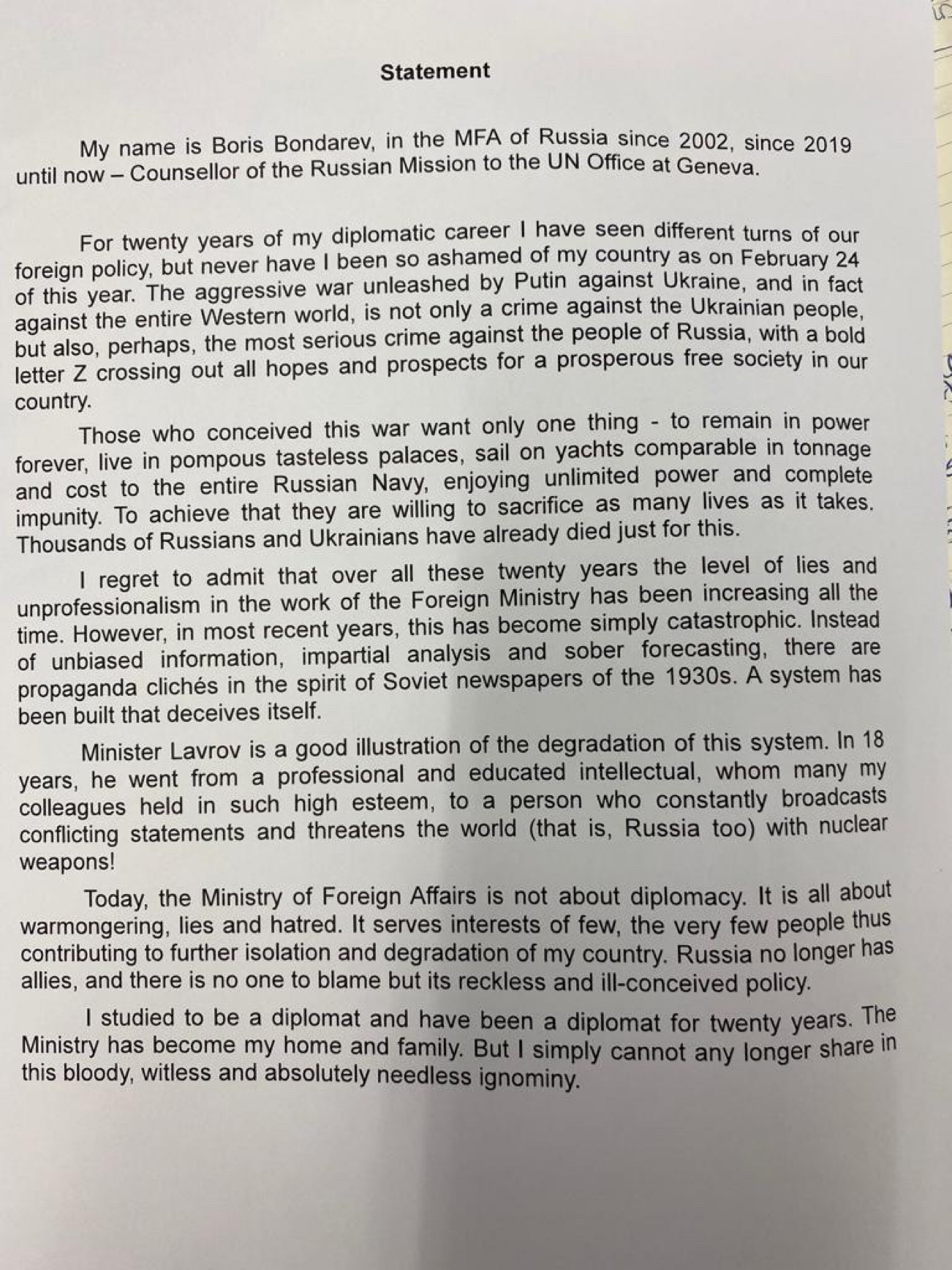
Russia’s Counselor to the United Nations in Geneva resigned. I hope that those few readers of this blog who have been stridently defending Putin and making excuses (“clear out the Nazis,” “it’s NATO’s fault,” etc.) for his brutal, unprovoked invasion of Ukraine will read this.

The New York Times authenticated the letter.

Thank goodness for independent media! Oklahoma Watch published an investigative report that detailed a secret slush fund that supplements the salary of the state Secretary of Education.

(This story was produced in partnership with the Oklahoma nonprofit newsroom The Frontier.)

Gov. Kevin Stitt vetoed legislation that would have required cabinet members to file public reports to disclose their finances.

If Stitt had signed the bill last month, Oklahomans would learn that Secretary of Education Ryan Walters makes at least $120,000 a year as executive director of a nonprofit organization that keeps its donors secret. Walters is also paid about $40,000 a year by the state, according to state payroll data.

The nonprofit, Every Kid Counts Oklahoma, has refused to disclose its largest donors.

But a joint investigation by The Frontier and Oklahoma Watch has found that much of the organization’s funds come from national school privatization and charter school expansion advocates, including the Walton Family Foundation and an education group founded by billionaire industrialist Charles Koch.

As Secretary of Education, Walters serves as Stitt’s top advisor on public education policy and is the governor’s liaison for dozens of state boards and programs.

Walters’ outside employment with a nonprofit funded by advocacy groups could be a conflict of interest, said Delaney Marsco, senior attorney for ethics at the Campaign Legal Center, a nonprofit group that focuses on government transparency and accountability.

“If you are responsible for making decisions in a certain area of the government and you are being paid by an outside organization that has an interest in that, that absolutely can be a conflict of interest,” Marsco said. “If you are a public servant, your duty is to the public, and anything that kind of calls that into question, even raises the appearance of a conflict of interest, is a problem.”

Under Walters’ leadership, Every Kid Counts Oklahoma was the public face of Stitt’s program that distributed $1,500 grants to families in 2020 funded with $8 million in federal coronavirus relief money. The money was intended to buy tutoring and educational supplies. But a lack of safeguards allowed parents to use some of the funds to buy TVs, gaming consoles and home appliances, an investigation by Oklahoma Watch and The Frontier found. Emails and other recordsshow that Walters helped secure the no-bid contract with a Florida company to distribute the money. The U.S. Department of Education’s Office of Inspector General has opened an audit into how the state used those funds.

Walters, who declined multiple interview requests, is now running for state superintendent, an elected position overseeing the state Department of Education and a budget of over $3 billion. Unlike in federal elections, candidates for state office in Oklahoma are not required to fill out financial disclosures until after they are elected.

Please open the link and read on.