Trump’s military attack on Venezuela was unauthorized by Congress. It was lawless. His actions deserve condemnation by the UN and world leaders.
He mocks the very idea of a rules-based international order. He mocks the idea that Congress is a co-equal branch of the federal government.
But he achieved three goals by his audacious actions.
He completely changed the national discussion away from the Epstein files.
He showed Congress that they are irrelevant.
He played the one card that might lift his very low poll ratings: military action. The public usually rallies round the flag. Going to war–especially when no American life is risked–typically raises the President’s popularity. Will it work this time in the absence of a casus belli? (Reason for war?)
The great irony in the current situation was that he recently pardoned Juan Orlando Hernandez, the ex-President of Honduras, who had been sentenced to 45 years in federal prison for sending some 400 tons of cocaine into the U.S.
Maduro should have had a better lobbyist or helped underwrite the Trump ballroom and he would be a free man.
Meanwhile, the U.S. has returned to the days of gunboat diplomacy, where it ruled the hemisphere by force.
Perhaps he has made a deal with Putin and Xi. Trump gets his hemisphere. Putin gets Europe. Xi gets Asia.
The 9th Circuit Court of Appeals was long known as one of the most liberal courts in the nation. No more. In a 2-1 decision, the Court overturned California’s ban on open carry of guns. Two of the three judges were appointed by Trump. Expect more gun deaths. Expect to see people in restaurants and grocery stores packing a gun. Stay away from people with a hot temper.
The Los Angeles Times reported:
California’s ban on the open carry of firearms in most parts of the state is unconstitutional, a San Francisco-based federal appeals court ruled Friday.
The 9th U.S. Circuit Court of Appeals determined that the ban, which applied to counties with populations greater than 200,000, violates residents’ 2nd Amendment right to keep and bear arms. Under those regulations, 95% of the state’s population was subject to the ban.
The 2-1 opinion was supported by two appointees of President Trump, U.S. Circuit Judges Lawrence VanDyke and Kenneth Kiyul Lee. U.S. Circuit Judge N. Randy Smith, an appointee of former President George W. Bush, dissented.
VanDyke, writing for the majority, stated that California’s urban ban on open-carry permits does not stand under the Supreme Court’s landmark gun rights ruling New York State Rifle & Pistol Assn. vs. Bruen. That 2022 decision made it much easier to carry a gun in public by striking down laws that required people to show a special need for self-defense…
VanDyke wrote in his opinion that California’s open-carry ban fails this test.
“The historical record makes unmistakably plain that open carry is part of this Nation’s history and tradition,” he wrote. “It was clearly protected at the time of the Founding and at the time of the adoption of the Fourteenth Amendment.”
Parents enrolled their children in a new charter school in North Carolina that offered great promise. But the charter school was deeply entangled with for-profit entities whose first priority was profit, not students. The school never opened. Parents had to scramble to find another school.
Last spring, Dulce Garcia heard about a soon-to-open school that would offer students immersion in both Spanish and Chinese. There was no other in High Point like it, and it didn’t charge tuition. It seemed like a way for Garcia, a restaurant worker, to give her children a long-term advantage.
She decided to enroll her 6-year-old daughter, Aracely, in Triad International Studies Academy (TISA). In its first year, the school would serve preschool through second grade. She planned to enroll her 9-year-old son, Joel, when the school expanded to higher grades.
Aracely flourished at TISA. Garcia marveled that her daughter was soon counting in both Spanish and Chinese, and credited her swift academic progress and close friendships to TISA’s small class sizes. Aracely’s first-grade class had only 12 students; the entire school had only 45. “I think she does better in that type of environment,” Garcia said.
While the school’s modest enrollment seemed like a benefit to Garcia, it set off alarm bells in Raleigh. Charter schools like TISA—privately run, but publicly funded—must have 80 or more students under North Carolina law.
Most state funding is awarded on a per-pupil basis, and real estate costs—not covered by a state allocation—can be hefty, making it difficult for even charter schools with more students to remain solvent.
TISA seemed at risk of buckling under the financial pressure, facing an acute version of the challenges that have begun to slow growth in the once-booming charter school sector. At the same time, its management was pushing the bounds on conflicts of interest.
After learning about TISA’s low enrollment, the state Charter School Review Board summoned school leaders to their October 6 meeting. The board has the responsibility to shut down schools that fail to meet the state minimum, but broad leeway to set terms and make exceptions.
TISA’s board chair, Chaowei Zhu, fielded the state board members’ questions. He largely blamed construction delays.
The plan to renovate a former church and install modular classrooms on the property had hit one obstacle after another, said Zhu, who is assistant dean for global initiatives at Wake Forest University’s Graduate School of Arts and Sciences. By mid-August, school leaders were on Plan C: putting all the kids in the auditorium until the renovations were finished. Two days before the start of the school year, parents arrived at an open house and found the parking lot a muddy mess. Zhu said that while he was directing traffic that rainy evening, he overheard parents saying that the school wasn’t ready.
Zhu’s wife, Junlan Li, a veteran educator and TISA’s principal, also told the board that an incident inside the school during the open house did perhaps even more damage. A child with autism hit several other students, she said. The child’s parents had not disclosed the child’s needs, so the school was unprepared.
TISA had projected 144 students in its first year. Roughly 90 attended the open house, but only about half that showed up on the first day.
Zhu and Li tried several arguments to persuade the Charter School Review Board to let their school stay open. They pointed out that state law allows the board to grant exemptions from the minimum enrollment if there is a “compelling reason.” In this case, TISA’s leaders said, the reason was the school’s “unique student population”—almost a third of students had a disability or other need for specialized education.
Zhu described aggressive marketing plans and a commitment from the school’s landlord to defer rent, which would allow them to break even with just 50 students. He requested that the board delay closing the school until next summer even if a waiver was ruled out. “If there’s any way you think we can continue, we’d love to give it a try,” Zhu said.
Bruce Friend, the charter board’s chair, said he was skeptical that TISA could boost enrollment substantially so far into the school year. “I’m just gonna be honest with you,” said Friend, who is head of school at Pine Springs Preparatory Academy, one of North Carolina’s largest charter schools. “Your track record doesn’t suggest that that’s going to happen.”
Friend moved to revoke the school’s charter, effective at the end of December. The board, made up largely of people with experience founding or operating charter schools, voted unanimously in support.
Garcia hadn’t considered TISA’s financial viability when she was selecting a school. She chose it for its programming and schedule. Seeing Aracely so happy, she imagined the school a staple of her family’s life for years to come. She didn’t expect to have to find another one just weeks into the school year.
Charting a New Course
North Carolina was among the first states to permit privately run, publicly funded charter schools. In its 1996 authorizing law, the General Assembly laid out its aims: to provide more choice for parents, more educational opportunities for gifted and at-risk students in particular, and new professional opportunities for educators.
The proposition was more freedom to experiment in exchange for more accountability. Rules on how money could be spent and what lessons could be taught were looser. But if the schools failed to meet student performance standards, they could be shut down. Some level of instability was built into the system.
At first, no more than 100 charter schools were allowed across the state. Legislators removed the cap in 2011 after Republicans gained majorities in both chambers. The number of charter schools doubled over the next decade. Then growth began to slow down. After hitting a peak of 211 in 2023, the number of charter schools fell for the first time ever. But the climb resumed this year. There are now 221 charter schools across the state, including virtual academies.
Even during the height of the boom, schools were regularly closing. Most years, there was at least one; some years, as many as 10. Regulators forced 38 charter schools to close between 1998 and 2024 for reasons that included insufficient enrollment, untenable finances, and poor academic performance. Over the same period, 32 other schools chose to voluntarily give up their charters—three in their first operating year. Another two dozen approved charters never materialized as schools.
While established schools continue to expand, pushing overall charter school enrollment ever higher, new schools are struggling. Every one of the seven that opened in North Carolina this school year came up short of their enrollment projections. Liberty Charter Academy, also in High Point, projected 500 students, but had only 172 enrolled as of the beginning of October. Three other new schools reported October 1 enrollment under 100.
Ashley Logue has noticed new schools facing ever-greater headwinds over the eight years she has worked in the state Office of Charter Schools. In that time, three first-year schools had their charters revoked for failing to meet the state’s minimum enrollment requirement; two were in the past two years….
She also saw other signs of escalating distress: More boards with approved charters were delaying their school’s opening by a year or more or deciding to give up their charter before the school ever opened. New schools were, on average, missing their targets by higher percentages.
National trends have been following a similar trajectory, according to a report published this summer by the National Center for Charter School Accountability that asked, “Has the charter movement reached its saturation point?”
Logue, who is now the director of the Office of Charter Schools, said the pandemic shifted how many parents thought about school, and in subsequent years alternatives to traditional public schools multiplied. “Post COVID, parents are much more understanding of the options and also more willing to say, ‘OK, this option that my child had—whether it was a district school or something else—is not working. What are my other options?’”
The alternatives include abundant variants of homeschooling, magnet schools run by public school districts, and private schools ranging from tiny church-run operations to opulent college preparatory academies. Since 2023, the General Assembly has made a massive investment in subsidizing private school tuition—families of any income now qualify for Opportunity Scholarships, though not all private schools accept the vouchers.
Meanwhile, birth rates in many parts of the state are declining, and high housing prices have changed where families with children live. The combined effects have been hard for schools of all stripes to predict.
The problem is perhaps most acute for novice independent charter school operators, who are, almost by definition, optimistic. By the time their school is about to open, they have been working toward that goal for years, sometimes racking up significant debt in the process. TISA said in its application that it planned to take out a $210,000 loan with a five-year term and a 7% interest rate to fund its planning year.
Real-estate and financial constraints can have a strong influence on the enrollment projections that operators submit to Logue’s office and the Charter School Review Board. Friend, now the board’s chair, said that was his personal experience when he was preparing his application back in 2015.
He was trying to project enrollment two years out in one of the state’s fastest-growing communities, Holly Springs. “The truth of the matter is my projections were largely based on what the size of my facility was going to be, and the size of my facility was going to be largely based on how much money I could secure,” Friend said.
The board of every school that Logue has warned about low enrollment has come before the oversight board promising that they will make their numbers. “I call it unrealistic optimism,” she said. “There’s a lot of things that we’ve seen over the last couple of years that you wouldn’t want to happen to your school.”
In response, the North Carolina Association for Public Charter Schools has begun organizing new training for schools in the year-long, state-mandated planning period that follows a charter award. First-year schools will also be allowed to participate. “Having names on a list and people telling you they’re going to send their kid—that doesn’t mean much these days,” the association’s Executive Director Rhonda Dillingham said. “We’ve got to make sure that the new schools that are opening understand that and do everything in their power to market the school.”
Dillingham’s group also recently received a $53 million federal grant to help charter schools build out career development; science, technology, engineering, and math; artificial intelligence; and career and technical education programming. Some of that funding will go to new schools.
Logue has proposed several changes to the state’s oversight of charter schools to try to prevent closures that leave families scrambling for a new school for their child in the middle of the school year.
“TISA,” she said, “was a worst-case scenario.”
High Hopes
Pressed for first-year numbers, Zhu said they had almost 100 students registered, but it was hard to know how many would show up. He estimated no-shows at 30 to 40 percent.
TISA’s plans were exuberantly bullish from the start.
Its application for a charter describes dual-language immersion programs in four different languages by the school’s fifth year in operation.
The school would start by serving kindergarten through second grade and add one grade per year until it was a full K-8 school. More than 900 students were expected at full enrollment.
The application named three model schools—East Point Academy in Columbia, South Carolina, and East Voyager Academy and Elbert Edwin Waddell High School, which are both in Charlotte. But only the latter offers multiple languages, and it is a magnet school within the public school district, rather than an independent charter.
Above: In mid-November, a for-sale sign stood on the property that housed TISA. Right: Parent Dulce Garcia was sad to see the school close. (Carolyn de Berry for The Assembly)
Mike Lally, the head of school at East Point, said in an interview that the prospect of running a school offering multiple languages was “scary.” “It’s difficult enough with HR and personnel to do Mandarin immersion,” he said. “I couldn’t imagine trying to manage that with multiple languages.”
The candidate pool for language-immersion teachers is small and would be smaller still if fluency in multiple languages was required, Lally said. On top of that, there is often extra administrative work related to immigration for those teachers.
Renee Mathews, the CEO and principal of East Voyager, was the founding principal of East Point and said the two schools had very different growth trajectories. The South Carolina school grew quickly, she said, because there was little competition at the time. The Charlotte charter school, facing more competition, has grown steadily, but much more slowly. It offers Spanish in addition to Mandarin, but only introductory classes that are limited to middle schoolers.
Li worked at both East Point and East Voyager, but consulted neither Matthews nor Lally as she prepared to open TISA, they said. Neither did Zhu, who was on the committee that helped to open East Voyager. One member of East Voyager’s board of directors was on TISA’s board for a time, but he declined an interview through Mathews.
In their charter application, TISA leaders cited the success of the charter school movement in the state as one reason to think their enrollment projection was sound. “While some may view this as a concern for too much competition, TISA’s case is different,” the application said. “If approved to open, TISA will be the only public school in Greensboro offering multilanguage immersion programs in Chinese, Japanese, French, German, and/or Spanish under the same roof. … TISA’s program is unique, innovative, and difficult to replicate. Therefore, competition should not be a concern in TISA’s case.” They indicated their break-even number was 138.
After school leaders couldn’t find acceptable property in Greensboro, they shifted their sights to High Point. The former church they settled on required a special use permit, which meant school leaders had to plead their case before the city council.
What city leaders most wanted to know during the March hearing was how many students TISA was expecting.
“We just want to build a very small school,” Zhu told them. “Because that’s always my dream. At a small school, teachers get to know everybody, give them individualized care, and particularly help them to learn the language.”
High Point’s planning staff recommended that the special use permit restrict the school’s enrollment to 250. TISA was arguing for up to 390 students, with a plan to have students arrive on a staggered basis each day to minimize traffic.
Minutes from a TISA board meeting three days earlier indicate the school had sent out acceptance notices to 76 families. Enrollment wasn’t meeting expectations, Li told the board. She noted that another new charter school, Liberty Charter, was also opening in High Point.
‘Came Out of Nowhere’
The families with children enrolled at TISA learned about the Charter School Review Board’s vote to revoke the school’s charter the following evening, on October 7.
“Please know that our staff and leadership team are fully committed to ensuring a smooth, supportive transition for every student and family in the coming months,” Li, the principal, wrote in the email, which said the school would close at the end of December.
Garcia was shocked. To her, the information “came out of nowhere.”
She had no idea that board members were discussing a shortfall of $58 million in September or that state charter school regulators had advised against TISA’s management structure.
A deeper look at public records tied to the school might have prompted additional questions about ethics and finances. TISA Board Chair Zhu is also a partner in LinguaVista, the for-profit company that owns the school’s property and holds its management contract. Additionally, he is president of TISA Child Care Center, a for-profit company with a contract to run the on-site preschool.
TISA said in its 2023 charter application that it “does not foresee any existing relationships that could pose actual or perceived conflicts if the application is approved.” Zhu was identified as the board chair, and Li was identified as the likely principal candidate. It made no mention of the fact that they are married.
North Carolina law allows charter schools to hire relatives of board members as long as the conflict is disclosed, and TISA’s board meeting minutes indicate that Li and Zhu left the room for certain discussions due to a conflict of interest.
But theminutes and a financial journal shared with some board members in February also show Zhu had deep involvement in managing the school’s finances—including scheduling $40,000 in payments to Jun-Chao Consulting, a company registered to his wife, for “supporting in planning year” and “writing charter.”
The board had also experienced high turnover. The only members named in the application that were still involved by late 2024 were Zhu and Hua Qin, who is described in the application as a certified public accountant. Records from the CPA oversight boards in North Carolina and South Carolina list no one by that name. (The Assembly tried to reach a Forsyth County resident by that name, but did not receive a reply.)
It’s not clear from the minutes how seriously the board considered contracting with companies unconnected to Zhu. Neither Li nor Zhu provided copies of full board packets and contracts in response to multiple requests from The Assembly. Li declined an interview; in response to detailed questions, Zhu provided a written statement that said TISA complied with all state disclosure requirements and followed the conflict-of-interest policy its board approved. Other board members either declined to speak with The Assembly or did not respond.
“Without subpoena powers, it is very difficult to figure out what is going on financially” at a charter school, particularly one with a for-profit management company, said Tom Kelley, a law professor at the University of North Carolina at Chapel Hill who has written about charter schools and nonprofit law. While there are federal and state legal doctrines intended to prevent self-dealing, investigations are rare, he said.
The second email Garcia received about TISA’s closure really shocked her. That email, sent about 24 hours after the first, retracted many of Li’s previous assurances that school would continue as normal through the end of the year.
“Effective immediately,” there would be no more breakfast or lunch service, no transportation, and no before- or after-school care.
Garcia attended an emergency board meeting the following evening. Parents gathered in the school cafeteria to encourage the board to appeal.
Lisa Noda, an attorney who drove her children from Davidson County to attend TISA, went first. She told the board that her second-grade daughter, who has dyslexia, now loves to go to school and wants to read. Her younger daughter, who is in the preschool program and advanced academically, is also happy at TISA, Noda said. “Please consider appealing and allow students to finish.”October 15 was students’ last day at TISA. (Carolyn de Berry for The Assembly)
Breanne Kraft said the teachers were so patient as her daughter, who has autism, processed her father leaving the family. “She does not want to leave. It hurts her and it hurts me,” Kraft said. “We both cried.”
Cailey Oates said, “To us, TISA is more than a school, it is a community.”
When it was her turn to speak, Garcia suggested things she could personally do to try to boost enrollment. She could hand out flyers and spread the word among Spanish speakers.
But Zhu told the parents that he did not see much of a chance to reverse the Charter School Review Board’s decision. “We told them everything, but it did not change their mind,” he said. “I am the saddest person. I sold my house to build the school.” (County records indicate the house listed on the school’s charter application is still owned by Zhu and Li.)
After a half-hour closed session, the board voted unanimously not to appeal.
The following week, the board held another meeting, voting unanimously to relinquish the charter. TISA would not keep operating through December as state regulators allowed; instead, October 15 would be students’ last day.
Left in the Lurch
Amanda Cook, a former public school teacher who served on the High Point City Council, immediately started to coordinate a meeting to help the families left in the lurch.
“I felt like with the number of kindergarteners that they had, there were a lot of families that had never been part of the school system before, so they hadn’t been through the process,” said Cook, who has since been appointed to the state House to replace Rep. Cecil Brockman.
On the day TISA closed, Guilford County Schools held an event at one of the district’s two Spanish-immersion schools, Kirkman Park Elementary School, to introduce parents to other local options.
Teachers and other staff were available to translate, Cook said. The district also brought people to answer questions about transportation, enrollment, exceptional children’s services, and English language support. As of mid-November, 18 former TISA students have enrolled in district schools, a spokesperson for Guilford County Schools said.
Garcia learned at the open house that she could send Aracely to Northwood Elementary School, where a weekly Chinese class was offered. There was also a spot for her son and room for both children in the afterschool program. She enrolled them the next day, but Garcia was still out of work for the better part of a week.
Aracely Lopez Garcia flourished at TISA, her mother said. She credited her swift academic progress and close friendships to TISA’s small class sizes. (Carolyn de Berry for The Assembly)
Noda lost much more work time getting her daughters resettled. She felt that Davidson County schools did not have the resources to do right by her daughter with autism and dyslexia, so she looked into private options.
“My older child was out of school for a month where we were trying to find something, and she did trials at different schools that did not accept her because of the needs that she has,” Noda said.
She ultimately enrolled her older daughter at another school in High Point, The Piedmont School, which serves children with attention deficit disorder and dyslexia, and received some state funds toward the private school’s tuition. Her younger daughter now attends a private pre-K program.
Zhu and Li received a bill from the state the same day the board voted to relinquish the charter. TISA had received state funding based on its projected enrollment; charter schools that end up enrolling fewer students have to give a proportional amount of money back. TISA now owes the state $112,789.
LinguaVista, the for-profit company that owns the school property, is facing legal action for another apparently unpaid bill. In late November, Dobbins Electric Company Inc. filed a claim of lien against the school property, asserting that it’s owed $68,351.86.
In mid-December, after repeatedly reminding Li that the school is obliged to disclose public records, The Assembly received an email from the address tisabankruptcyperiod@tisanc.org. The email, signed “TISA Board of Trustees,” said the board was “in transition and in the process of retaining bankruptcy counsel.” No public records requests would be fulfilled in the meantime.
Carli Brosseau is a K-12 education reporter for The Assembly. She previously worked at The News & Observer, where she was an investigative reporter and a ProPublicaLocal Reporting Network fellow.
Jason Garcia, a veteran investigative reporter in Florida, reports on the ongoing scandals in the Sunshine State. In this post, he describes a new law that would offer generous bounties to anyone who helped to prevent an abortion arranged in other states. The law hasn’t passed yet, but its purpose is to stop women from accessing abortion drugs via telehealth.
He wrote:
Florida’s Republican-controlled Legislature may turn husbands, fathers and brothers into bounty hunters who can block women from ending unwanted pregnancies.
A new bill filed in the Florida House of Representatives would dangle $100,000 prizes in front of private citizens who are willing to sue in order to stop a pregnant family member from obtaining abortion pills through the mail.
More specifically, House Bill 663 would allow a pregnant woman’s spouse, parents or siblings to sue anyone who tries to send her abortion medication — including doctors who prescribe the pills, drug companies that make them, shipping companies that transport them, even friends or other family members who help arrange delivery.
A successful lawsuit would come with a $100,000 payout — plus extra cash to pay lawyers and legal fees.
The Florida legislation is similar to a first-of-its-kind state law that just took effect in Texas. Right-wing groups have billed the Texas measure as a model for other anti-abortion states — like Florida, which bans most after just six weeks of pregnancy — that now want to stop women from accessing abortion services remotely from states where it is still permitted through telehealth and in-home medication.
Many abortion-supportive states around the country have in recent years enacted what are known as“shield laws.” These are laws that protect patients, doctors and others involved in reproductive healthcare from criminal prosecutions and civil lawsuits brought under laws passed in anti-abortion states — just like the kind envisioned in House Bill 663.
But the new Florida bill tries to weaken other states’ shield laws, too.
Shield laws often contain “clawback” provisions that enable someone who provides legal abortion care in their home state — but is then criminally charged or held civilly liable under the laws of another state — to sue in order to recover damages and recoup any costs they incurred in their legal defense.
House Bill 663 would forbid state courts from recognizing or enforcing any judgement issued under another state’s clawback law. What’s more, it would enable someone in Florida who is sued under an out-of-state clawback provision to then countersue in this state.
House Bill 663 wouldn’t enable a father to sue his daughter or a brother to sue his sister; the legislation specifically prohibits lawsuits against a woman trying to obtain abortion medication for herself.
But women are still the true target here. The ultimate goal of legislation like this is to scare providers out of sending abortion pills to women who want them.
As the executive director of the Texas Alliance for Life — one of the anti-abortion groups that supported the new bounty hunter law in Texas — wrote in a recent column, “The ‘chilling effect’ is precisely the point.”
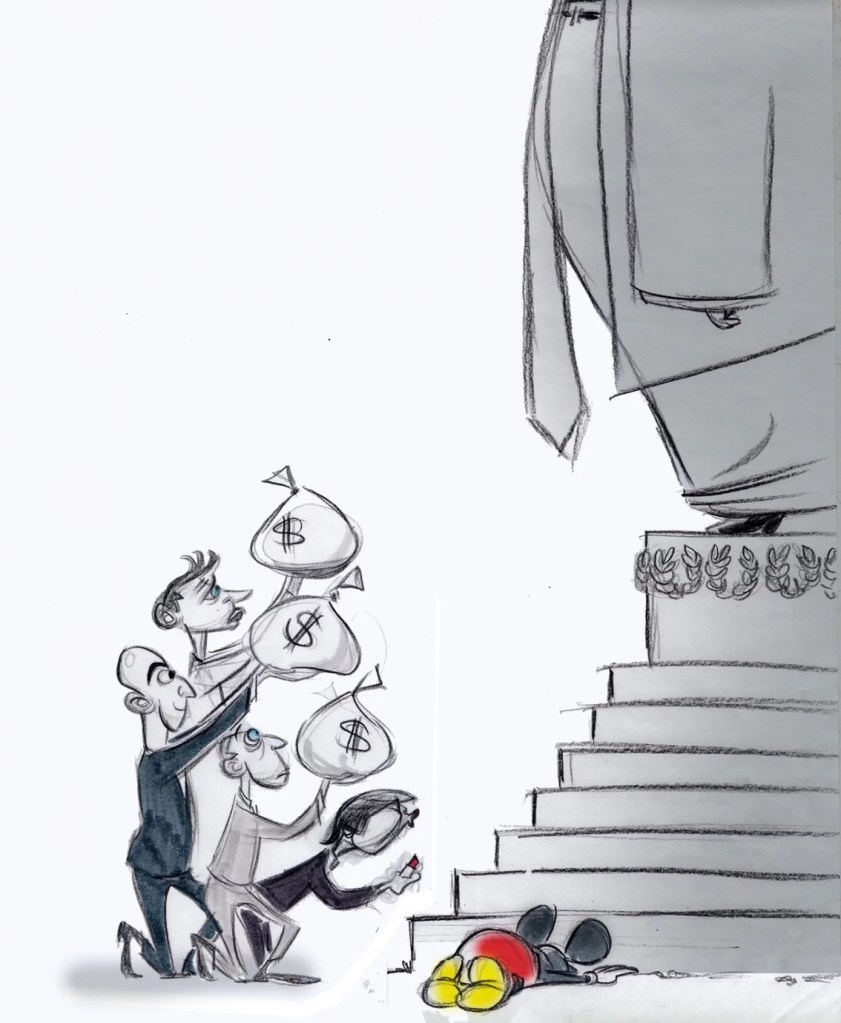
Her editor refused to print a cartoon she had drawn showing tech billionaires bowing at Trump’s feet. One of them was Jeff Bezos, the owner of the newspaper. Her editor said that the topic duplicated stories. Ann didn’t agree. She quit, not knowing where she would go next.
Like many other suddenly homeless writes, she started a blog at Substack, where she has a large following and no editor to shut her down.
Ann Telnaes’ gave up her job at The Washington Post when this cartoon was spiked.
She wrote about the past year:
On January 3, 2025 I published “Why I’m quitting the Washington Post” on Substack. When I made my decision to leave, I knew this would be the end of my thirty year career as an editorial cartoonist – but that’s not what happened. For whatever reason the news went viral, not just in the United States but in many countries throughout the world. Because of you and your incredible support, I continue to draw cartoons and try to shine a light on the criminal behavior of this administration and the ongoing threats to our democracy. Thank you.
Throughout this year I received many invitations to speak about the free press and editorial cartooning, here in the US and internationally. As I’ve mentioned before, public speaking isn’t in my comfort zone but I tried to accept as many as I could because of Trump’s escalating attacks on the free press and also to talk about my profession and hopefully make people more aware of the importance of editorial cartooning.
Then a few more trips nationally for presentations and panels in DC, University of Kentucky, Ohio State University, University of Minnesota, San Jose State University, ending my year with a speech in Landau, Germany to accept the Thomas Nast Prize.
The people I talked to while overseas are mystified at what is happening to a country which seems to be willingly letting its democratic principles be hijacked by an immoral conman and his corrupt enablers. After my speech in Landau, I met several expats in the audience who are shocked at how their country has fallen so fast and so far. I share their feelings.
(from my Landau speech)
Every American editorial cartoonist is familiar with Thomas Nast and how he exposed the corrupt 19th century New York politician Boss Tweed through his cartoons. We all have seen the drawing of Tweed and his accomplices depicted as vultures, sitting on a ledge with bones and skulls scattered around them… and also the iconic image of Tweed’s unmistakable portly figure with a large bag of money representing his head. One can only imagine the cartoons Nast would be doing right now about President Donald Trump and his grifting family and cronies. Nast also created the political symbol of the elephant to represent the Republican Party, although I’d like to think that he would have chosen something more reptilian to represent the current spineless GOP.
And I’m sure Thomas Nast would have been outraged at what is happening in his adopted homeland. I too have German roots on my late mother’s side. My late father was Norwegian and I became a naturalized U.S. citizen as a young teenager. Although I am proud of my heritage, I have always considered myself an American. A proud American. So it pains me to see what has happened this past year, with democracy under attack and the principles and ideals which the country was founded on being threatened- including a Free Press, which is an essential part of a democracy.
Thank you again for all your support and comments. Yes, I read all of them and truly appreciate your insights, humor, and our Substack community. Wishing each of you a happy and healthy New Year.
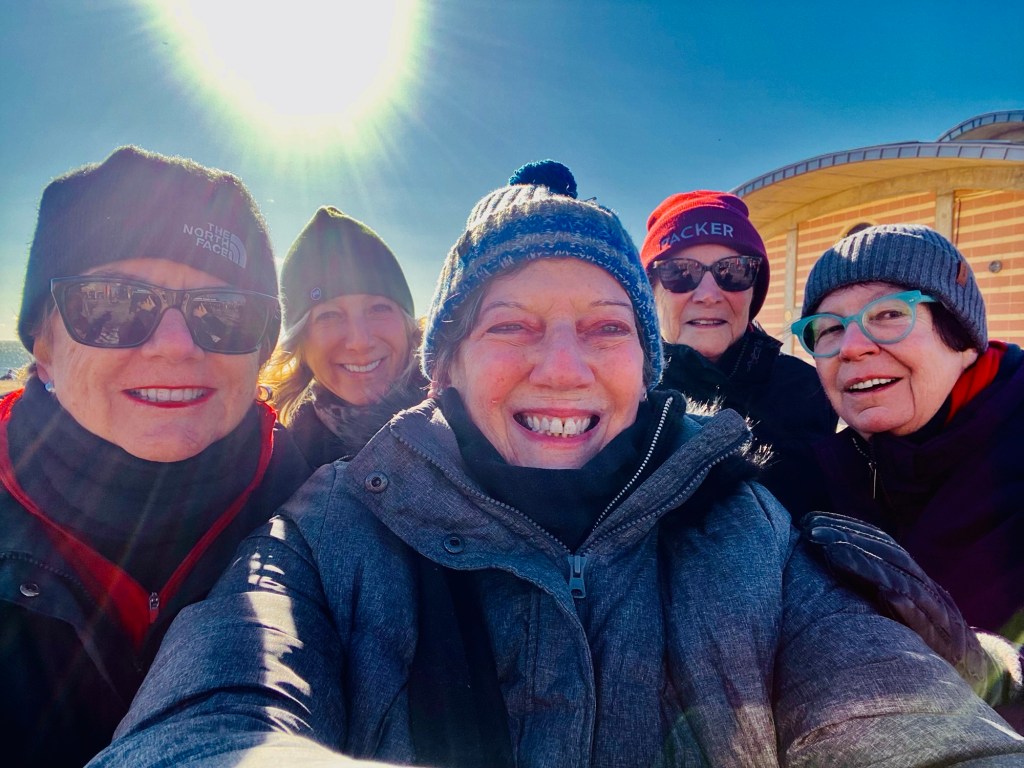
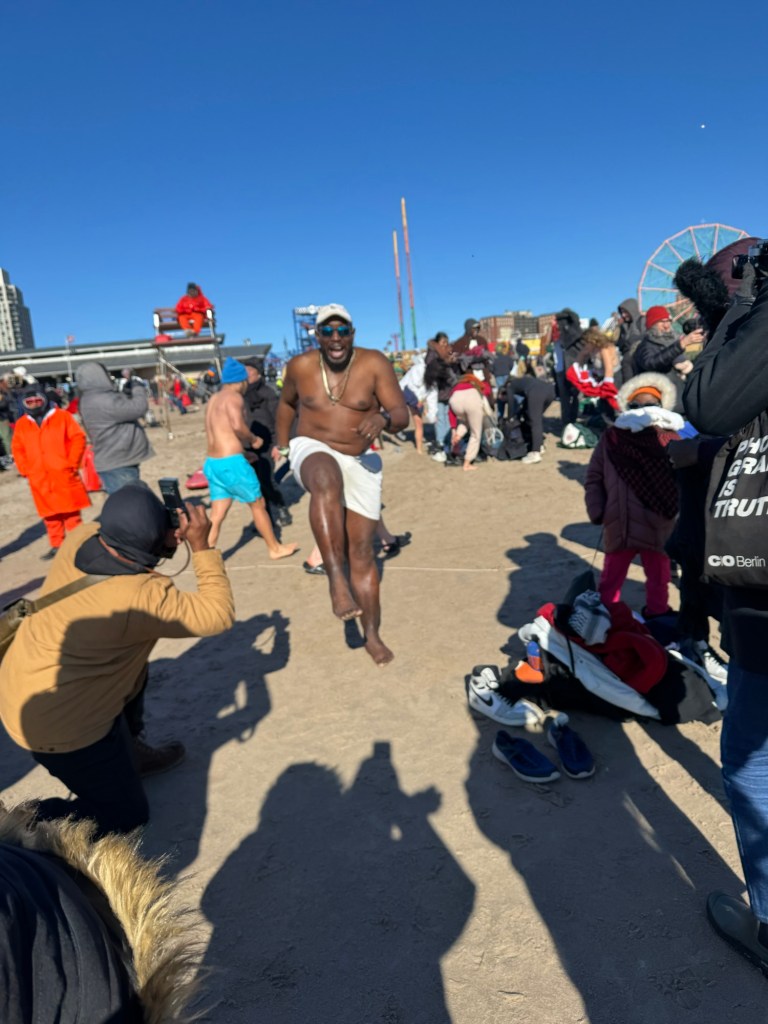
This morning I went with four friends to Coney Island in Brooklyn for the Annual Polar Bear Plunge. Hundreds of people (or more) showed up to take a dip in the ocean on a frigid day.
The sun was shining brightly, but the air temperature was in the high 20s, and the “real feel” due to gusty winds, was only 6 degrees.
The atmosphere was festive. Swimmers came with friends to cheer them on and offer them towels and blankets when they emerged from the water.
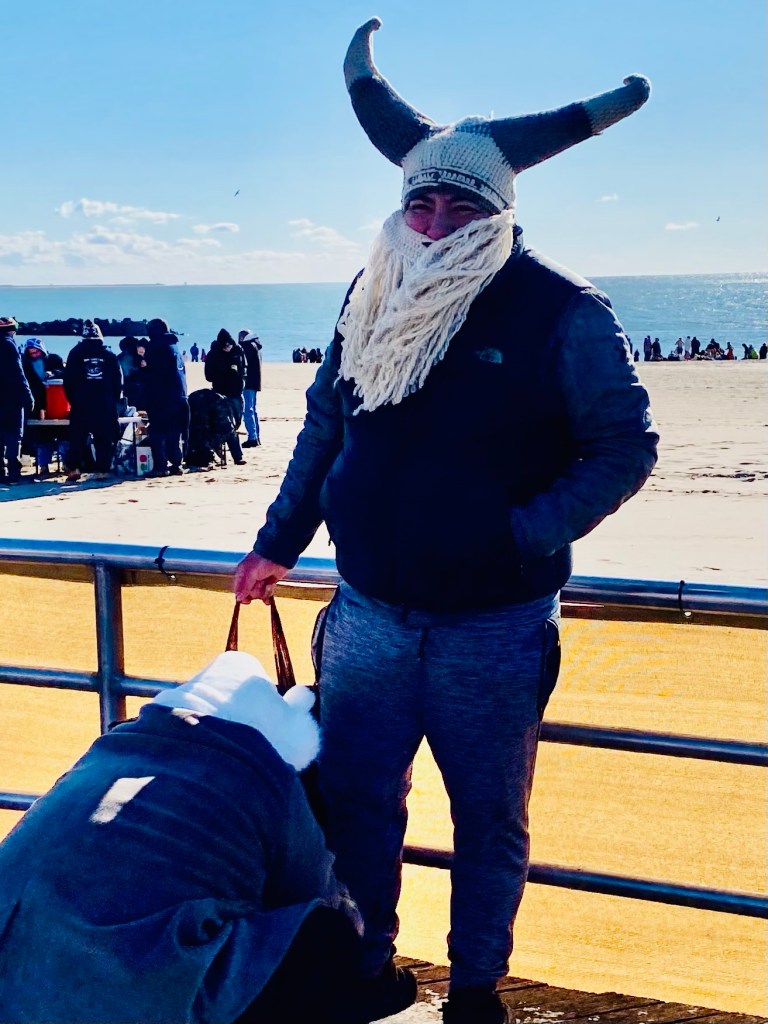
Some were in silly costumes. Some wore funny head pieces. None carried a mock Statue of Liberty into the water. Women and girls were in bikinis. They stripped off their warm clothes and their shoes and ran into the Atlantic Ocean.
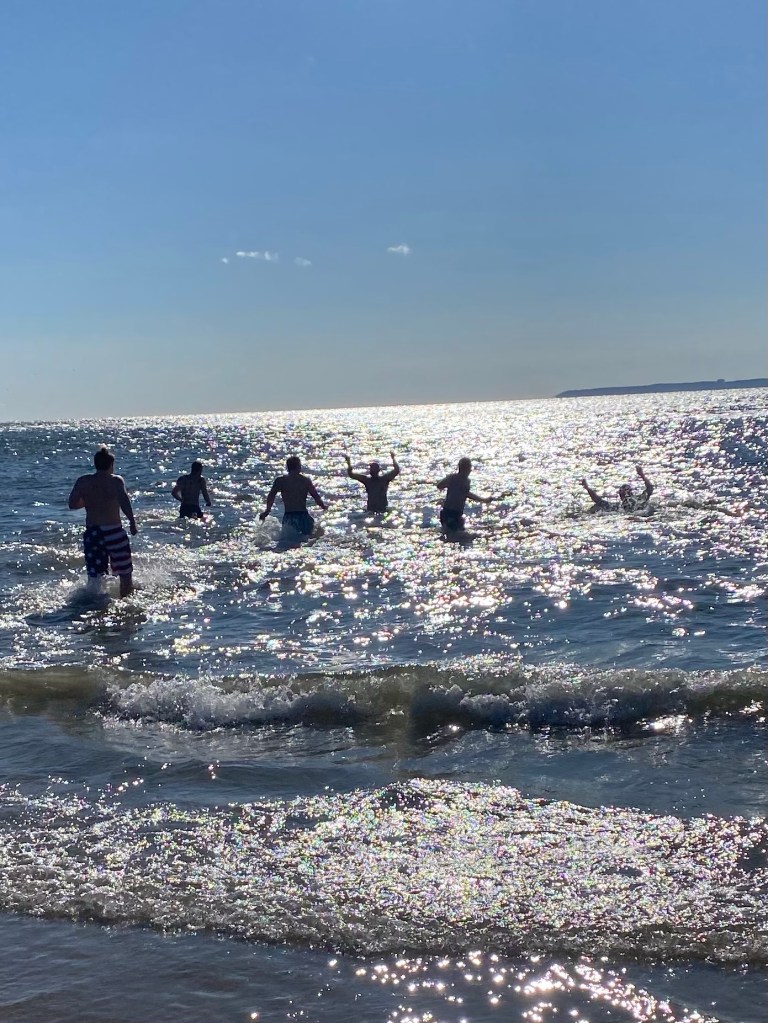
There was a mood of hilarity about the madness of the event. Everyone was smiling or laughing or both. People run into the water. Some run out as soon as they have gotten wet. Others actually swim. Some splash around.
A lifeguard keeps watch, and a police boat is anchored about 100 yards beyond the swimmers.
The Coney Island Polar Bear Club sponsors the event every year to raise money for local charities. Their members swim all year round; the huge crowd of swimmers shows up only on January 1, to welcome in the New Year.
For two hours, politics, heated partisan issues, and acrimony were cast aside as a diverse crowd of Americans frolicked in the ocean.
I asked one young woman in a tiny bikini how it felt to jump in. She said “Exhilarating! The water was warmer than the air.”
Another young woman peeled off her clothes and stripped to her bathing suit, accompanied by three friends. She said it was her first Polar Bear Plunge. I asked why she was doing it. She said, “If I can do this, I can do anything.”
A handsome African-American man gathered a crowd as he danced around in his bathing suit, getting psyched to jump in. He told the crowd that it was his first time. He jumped up and down, kicked his legs in the air, yelled “Here I go!” And he ran straight into the ocean.
I wanted to wait until he emerged, because we were leaving, but he was cavorting in the water, having a great time. We left, bound for a hot and filling Chinese meal, at a tiny restaurant on Fort Hamilton Parkway in Brooklyn.
This is a joyful event. Join us next year if you can. I won’t swim with you but I will be glad to cheer you on.
Audrey, Hope, Maureen, me, Mary. Getting ready to suit up and take the plungeIt was really, really cold.Her first plunge on New Year’s DayDressed as a polar bear, ready to take the plungeThe swimmers had a great time!Psyching himself up for his first January 1 swimDoing his pre-swim high kicks, and off he goes!Like most swimmers, they ran into the ocean as fast as they could With the Ferris wheel in the background, a nylon igloo stated the obvious.
Now, in case you want to reduce the amount of pet hair in your home, I recommend a pet vacuum called Oneisall. For tips on how to vacuum your cat, I give a demonstration in this clip.
Senator Bernie Sanders of Vermont shared his year-end thoughts along with his hopes for the future. As the first year of Trump’s second term winds down, it’s hard to believe that the dreams he describes can come true. Every day brings a new blow to the environment, to our health care, to our schools, to our children, to the rule of law, to our allies, to our national sense of purpose.
Yet we will persist. We have no other choice.
Sisters and Brothers –
As we come to the end of a very difficult year, I want to wish everyone a very happy holiday season, a wonderful new year and thank you all for the support you have given our progressive movement.
Let me take this opportunity to share some end-of-the-year thoughts with you.
As I reflect on the moment in which we’re living, what is most disturbing to me is not just that a handful of multi-billionaires control our economic life, our political life, and our media. That’s bad, and extremely dangerous. But, what is even worse is the degree to which these Oligarchs, through their wealth and power, have created an environment that limits our imaginations and our expectations as to what we deserve as human beings.
It really is quite amazing.
We live in the wealthiest country in the history of the world and, yet, we are asked to accept as “normal” the reality that tens of millions of Americans struggle every day to afford the basic necessities of life – food, housing, health care or education.
We live in a “democracy,” but we are told that it is legal and proper for one man, the wealthiest person on earth, to spend $270 million in campaign contributions to help elect a president who then provides huge tax breaks and other benefits to the very rich.
We live in a nation whose Declaration of Independence in 1776 boldly proclaimed “that all men are created equal” while, today, the gap between the rich and poor is wider than ever and the top 1% owns more wealth than the bottom 93%.
We live under a criminal justice system which punishes people for being poor, but rewards fossil fuel tycoons whose carbon emissions are wreaking havoc on the lives of billions of people and posing an existential threat to the planet.
As we enter the new year, our job is clear. We don’t have to accept the Oligarchs’ determination as to what is possible and what is not. We must think big, not small. We must reject status quo politics and economics. We must imagine, and fight for, a world very different than the one in which we now live. We must demand and create a world of economic, social, racial and environmental justice.
Yes. We no longer have to be the only major country on earth that does not guarantee health care for all as a human right. The function of healthcare must not be to make the insurance companies and drug companies even richer. We CAN create a high quality cost-effective health care system that focuses on disease prevention, extends our life expectancy and is publicly funded. This is not a radical idea.
Yes. In a highly competitive global economy we CAN have the best public educational system in the world from child care to graduate school. As a nation, we must respect the importance of education and adequately compensate educators for the important work they do. We must strengthen and improve our primary and secondary educational systems and make child care and public colleges and universities tuition free. This is not a radical idea.
Yes. We CAN end the housing crisis and the reality that 800,000 Americans are homeless and millions spend half of their incomes to put a roof over their heads. We must build millions of units of low-income and affordable housing and, in the process, create many good paying union construction jobs. This is not a radical idea.
YES. With effective regulation we CAN utilize Artificial Intelligence (AI) and robotics to improve the lives of all, not just the billionaires who own that technology. As worker- productivity increases we can raise wages, improve working conditions and reduce the work week. Making sure that AI and robotics benefit all of society and not the wealthy few is not a radical idea.
YES. We CAN address the outrageous level of income and wealth inequality that we are now experiencing. While we can respect talented businesspeople and entrepreneurial skills, we do not have to accept the outrageous level of greed and vulgarity that the billionaire class too often exhibits. It is beyond absurd that we have a tax system in which the richest people in this country often pay an effective tax rate that is lower than truck drivers or nurses. Demanding that the 1% and large corporations start paying their fair share of taxes is not a radical idea.
At a time when we live in a dangerous and unprecedented moment in American history, and part of a rapidly changing world, it is absolutely imperative that we boldly respond to the crises that we face. This is not the time for timidity. Our agenda must be fearless and straightforward. Nothing less than the preservation of democracy, the well-being of the planet and the future of humanity is a stake.
As we enter the new year, let us go forward together.
In Solidarity.
Bernie
IN THAT SPIRIT, dear friends, Happy New Year!
Don’t stop believing in the power of conscience and collective action.
I couldn’t write about it then because it was too painful. Let me say from the outset that nothing I write here will be as beautiful as Peter Greene’s farewell to his beloved dog two years ago.
But I need to tell you about our wonderful girl.
Mary and I got Mitzi in 2013 when she was three months old. She was already 30 pounds and growing fast. She eventually reached 100 pounds.
She was born in 2012. She was a mutt. She came from a shelter in Hayward, California. When I asked the rescuer who found her what her breed was, she said: “Think of it this way. Her mother was a mutt. Her father was a mutt. They met once.” When we tested her DNA, we learned she was a mix of German Shepherd, Siberian Husky, Alaskan Malamute, and lots of others. We liked to say her eyelashes were Chihuahua.
A sweeter dog never lived. Little dogs often barked at her, and she ignored them. She was a gentle giant. She pulled me over a couple of times because she was frightened and took off like a bullet. The first time, I was walking her to the groomer, and when she saw his shop, she yanked me over trying to escape. The second time, we were taking a walk after dinner on July 3, and she heard a firecracker; she started running home and I fell over, determined not to lose control of her leash.
Her greatest fear was the sound of firecrackers and thunder. July 4 and New Year’s Eve were times of terror for this big girl. In her last years, I finally cracked the problem by taking Mitzi into a bathroom with no windows, closing the door, and playing loud music on my cellphone. It worked like a charm. She learned to appreciate Hank Williams.
Mitzi loved everyone and everyone loved Mitzi. Except for our cat, Dandelion, who was about the same age as Mitzi but weighed 15 pounds. Mitzi loved to chase Dandy but she never caught him. Never. He lived in constant fear, although once in a blue moon he would smack her, and she would back off.
Mitzi developed benign tumors in 2021 and 2022. They were surgically removed from her stomach. And one was cut off her eyelid.
Then in 2023, Mitzi developed a malignant tumor in one of her haunches. More surgery, followed by a referral to an oncologist. She took a pill every day, and a year later, in June 2024, the oncologist declared her cancer free.
One year without cancer, then it returned as a trigeminal nerve sheath tumor, a malignant, inoperable tumor in her head.
There was nothing we could do but wait. Kiss her and hug her a lot. Her favorite activity was sitting by the water and watching the boats, watching the water.
At 2 am on August 1, she woke us, as she was gasping for air. We took turns holding her, giving her ice chips. I called the vet when they opened at 8 and asked him to come to our place as soon as possible. She died at 9 am, in Mary’s arms. The vet arrived 15 minutes later.
We think of her very often. We miss her. Dogs are wonderful animals who give us unconditional love.
Here are some pictures of our girl:
Mitzi as a baby
This beautiful soul was an integral part of our lives for a dozen years. I can’t let this year end without paying tribute to her. I hope all of you experience a Mitzi in your lives.
The editorial boards of the Orlando Sentinel and the Sun-Sentinel wrote a joint editorial questioning the wisdom of setting aside a day to honor Charlie Kirk, who was assassinated earlier this year. They titled it “A Badly Misguided Honor for Charlie Kirk.”
Their editorial courage is a tribute to freedom of the press, which Charlie would have applauded.
In a society that treasures and protects free speech, it’s important to focus a spotlight on people who were hunted down because their ideas were too dangerous or offended too many people.
These names are threaded through the history of this nation, and of Florida as well. Teaching schoolchildren and reminding everyone of their importance is a worthy endeavor. But such efforts should be comprehensive. Unfortunately, Florida’s latest attempt at recognition is not.
A bill predictably likely to pass the Florida Legislature calls for every October 14, Charlie Kirk’s birthday, to be a statewide “Day of Remembrance” — forever. A Senate committee already passed it on a party-line 5 to 2 vote, with only Sen. LaVon Bracy Davis, D-Orlando (herself the daughter of civil-rights activists) and Tina Polsky, D-Boca Raton, voting no.
They meant no offense — nor do we — to the humanity of Kirk, who was shot during a speech to university students in Utah three months ago. And it’s important to note that, while most people associated with the concept of civil rights won that recognition for defending and uplifting freedom, many of Kirk’s positions called for the curtailment of rights and the erasure of personal liberty.
Kirk, the 31-year-old founder of Turning Point USA, inspired many people with his conservative activism, but he alienated many others with his pointed attacks.
He denounced the assassinated Rev. Dr. Martin Luther King Jr. as “awful,” and “not a good person.” He called the Civil Rights Act of 1964 a “huge mistake.” He said the pop star Taylor Swift should change her name if she marries her fiancé Travis Kelce, as a sign of submission to him. He said gun murders were an acceptable price to pay for the right to own them. And on and on.
Whatever his views, Kirk had every right to express them to anyone willing to listen. That’s the American way. But the Legislature should be mindful of how hurtful some of his views were.
It goes without saying that his murder was a crime to be deplored by everyone, not just his conservative admirers. But elevating him with an officially recognized annual commemoration while ignoring other heroes with legitimate ties to Florida makes no sense.
One obvious, and tragically overlooked, example comes from Central Florida. Harry T. Moore, a Florida civil rights pioneer, was murdered when a Ku Klux Klan bomb planted under his bedroom blew up his home in Mims on Christmas night 1951. His wife, Harriette, died of her injuries a few days later. As an NAACP field secretary, Moore campaigned successfully for Black teachers to be paid the same as whites and to register more Black voters in Florida than any other Southern state.
He initiated the long and ultimately successful movement to vindicate four Black men unjustly accused in the infamous 1949 Groveland rape case.
No one was ever convicted of the bombing, although a KKK member committed suicide after being questioned by the FBI. A federal indictment against others was dismissed for lack of jurisdiction.
The Moores are included in Florida social-studies curriculum, but too often go in unmentioned in the roll call of civil rights martyrs. They were left off the martyr’s memorial in Montgomery, Ala., because of an arbitrary definition of the Civil Rights Era as having begun with the Brown v. Board of Education decision in 1954. But they died for the cause just as certainly as anyone else did.
And if Florida wants to commemorate Kirk, who lacked significant ties to Florida, our nation’s history is replete with other examples of courage.
Andrew Goodman, James Earl Chaney and Michael Schwerner were the young civil rights volunteers kidnapped and murdered by the KKK in Mississippi in 1964 for trying to register Black voters. Eight men eventually got relatively light federal sentences for the killings. Forty-one years later, Mississippi convicted a chief perpetrator. He died in prison.
Medgar Evers was the Mississippi civil rights activist shot to death outside his home in 1963. It took until 1994 to convict his killer, who died in prison.
Harvey Milk, elected to San Francisco government on a platform that included human rights for same-sex couples, was assassinated on Nov. 27, 1978.
Those are only a few of many private citizens who paid with their lives for speaking out for what they believed.
Others include the abolitionist publisher Elijah Lovejoy and Joseph Smith, founder of the Church of Jesus Christ of Latter-Day Saints, who died at the hands of mobs in Illinois a century ago. To commemorate only one such victim, as Senate Bill 194 and HB 125 do, is not appropriate. But at least it’s less inappropriate than legislation that aims to rename streets for Kirk at every Florida state college and university.
A Day of Remembrance should honor not one martyr, but many, and right-wing political views should not be a prerequisite.
















 Diane Ravitch's blog