On Twitter (“X”), The Recount reports that the newly elected president of the Central Bucks County school board, Karen Smith, was sworn into office on a stack of banned books, not the Bible.

https://x.com/therecount/status/1732425364675203121?s=42&t=9ko2QEoKmRIlvHb1PdtjSw

The new board swept out a board of rightwing zealots.

This is a 2-minute video by Trae Crowder.

Or here on Facebook.

Please watch it and enjoy!

Last spring, a television station in Nashville reviewed state data and discovered that 80% of the state’s charter schools are “less successful” than the districts they allegedly serve. In other sectors, when a new idea is tried and fails, it is abandoned. But this is not likely in education, because someone is making money from failure. Among the state’s lowest performing charter schools were those in the “Achievement School District,” which was created with $100 million on Race to the Top funding, promising to taise the state’s lowest performing schools into the top 25% in the state.

NASHVILLE, Tenn. (WTVF) — About 80% of the taxpayer-financed, privately operated charter schools in Tennessee have a lower success rate than the districts where they are located, according to a NewsChannel 5 analysis of state data.

Out of 109 charter schools for which data was available for the 2021-2022 school year, 87 had success rates below the rates reported for other schools in the same geographic district — in many cases, much lower. More than a third of the charter schools, a total of 38, reported success rates of 10% or less; 10 of those had success rates below 5%.

Only 21 charter schools reported higher success rates, while comparisons were difficult for one school because of the way that the state reports the data.

The data also raises questions about how well the privately operated charter schools are meeting the needs of children with disabilities, with two-thirds reporting that they had so few students that they were not required to report success rates for those children.

Tennessee’s Department of Education calculates the one-year success rate based on the percentage of students in grades 3-5 whose scores on state assessments “met expectations or exceeded expectations” for math and English Language Arts.

Success rates are now at the center of Tennessee’s education policy under a new law set to require the retention of third graders who don’t meet ELA expectations.

In the larger debate, the data appears to run counter to some ideological arguments — mainly from the right, but sometimes from the left —that taxpayer-funded charter schools are a critical response to low-performing traditional public schools, with much of the focus often directed at the potential of charter schools to meet the needs of children of color.

Charter school advocates largely focus on metrics regarding “student growth,” a complex calculation used to argue that students in those schools statistically tend to learn more statistically than their peers in traditional public schools.

At the lower end of the scale, the LEAD Brick Church charter school had a success rate of just 5.7% for grades 5-8, compared to Metro Nashville Public Schools’ 26.2% for grades 3-5 and 22.5% for grades 6-8.

Brick Church is 70% economically disadvantaged, and more than 95% of students are children of color.

The traditional public school was taken over by the state and converted to a charter school under the Achievement School District in 2012 as part of an ambitious notion that the state could take schools in the bottom 5% and turn them into top performers within five years.

In fact, data shows that Tennessee’s Achievement School District has largely failed in that goal, producing some of the worst results of any district.

The ASD success rate was 10.6% for grades 3-5, compared to Metro Nashville’s 26.2% and Memphis-Shelby County’s 20.9%.

The relatively new Tennessee Public Charter School Commission District, by comparison, had a 37.4% success rate — a figure driven largely by just one school, KIPP Antioch College Prep Elementary. The commission’s Nashville Collegiate Prep reported a success rate of 23.4% for grades 3-5, compared to MNPS’ 26.2%.

On the other hand, the commission’s Bluff City High School in Memphis reported a success rate of just 6.7%, compared to Memphis-Shelby County’s 6.8% for grades 9-12.

Adam Friedman of Tennessee Outlook wrote about the flood of dark money pouring into Tennessee to defeat legislators who oppose school choice, both moderate Republicans and Democrats. The biggest money is coming from Charles Koch (Americans for Prosperity).

By now, you have heard about the allegations of sexual misconduct by Christian Ziegler, leader of Florida’s state Republican Party, and his wife, Bridget Ziegler, co-founder of Moms for Liberty, school board member in Sarasota, and DeSantis appointee to the Disney World governing board. An unnamed woman accused Christian Ziegler of raping her. In her statement to the police, she referred to a prior three-way sexual tryst that included Bridget Ziegler. She canceled her date with Christian because he didn’t bring Bridget. Then she claims he showed up and raped her.

If you want to see the full police affidavit, read Mercedes Schneider’s account of the ménage a trois.

If you want to see Peter Greene’s wise take, read here.

Moms for Liberty released the following statement via a public relations person:

From: Grace English <Grace@cavalrystrategies.com>
Sent: Tuesday, December 5, 2023 1:16 PM
Subject: Statement from Moms for Liberty Co-Founders re: Christian and Bridget Ziegler


Hello,


In response to numerous media inquiries about Christian and Bridget Ziegler, please see the following statement from Moms for Liberty Co-Founders Tiffany Justice and Tina Descovich:


Comment from Tina Descovich and Tiffany Justice: 


“We have been truly shaken to read of the serious, criminal allegations against Christian Ziegler. We believe any allegation of sexual assault should be taken seriously and fully investigated.

“Bridget Ziegler resigned from her role as co-founder with Moms for Liberty within a month of our launch in January of 2021, nearly three years ago. She has remained an avid warrior for parental rights across the country.

“To our opponents who have spewed hateful vitriol over the last several days: We reject your attacks. We will continue to empower ALL parents to build relationships that ensure the survival of our nation and a thriving education system. We are laser-focused on fundamental parental rights, and that mission is and always will be bigger than any one person.” – Tina Descovich and Tiffany Justice


— 

Grace English

Cavalry Strategies

(904) 923-1684

In Bucks County, Pennsylvania, voters elected a new school board pledged to reverse the policies of their Moms-for-Liberty style predecessors. That meant ending censorship of library books and ending the ban on gay-friendly displays, among other things. The old school board gave the retiring superintendent a $700,000 going-away gift; the new one is trying to recover the gift.

The Philadelphia Inquirer reported:

The new Democrat-controlled Central Bucks school board moved quickly Monday to roll back some of its GOP-led predecessors’ most controversial actions — from suspending policies restricting library books to authorizing potential legal action into the former superintendent’s $700,000 payout.

What shape the new board’s actions will ultimately take isn’t yet clear. The board’s new solicitor, for instance, said earlier Monday that he needed to learn more about the separation agreement reached between the prior board and now-resigned superintendent Abram Lucabaugh before pursuing a lawsuit.

But the crowd that lined up outside the Central Bucks administrative building to witness the swearing-in of new members Monday was ready to celebrate regardless — cheering new leadership after what numerous speakers described as two years of “chaos,” bookended by highly contentious, big-money elections.

Republicans who cemented their majority in 2021 enacted bans on teacher “advocacy” in classrooms — including the display of Pride flags — and “sexualized content” in library books, and faced a federal complaint alleging the district had discriminated against LGBTQ students.

But Democrats swept the Nov. 7 school board elections — as they did in a number of area districts where culture-war issues had dominated debate.

“Two years ago, I stood in this room a broken woman,” said Silvi Haldepur, a district parent. But “this community banded together and stood up against the hate.”

Keith Willard, a social studies teacher, told the board it was “incredibly difficult” to work for the district when the previous board had “actively marginalized people” and pushed the “belief that staff are indoctrinating kids.”

“What I ask of this board is that you help steer the ship… and return the stewardship to the people that do the real work every day” — teachers and staff, said Willard, who drew a standing ovation.

The room again broke into applause as the board voted to suspend the library and advocacy policies,as well as a policy banning transgender students from participating in sports aligned with their gender identities — a measure the former board passed at its final meeting in the wake of last month’s elections.

Has the U.S. Supreme Court stripped away all limits on the right to buy and carry arms? We are soon to find out, as the Court just heard a case challenging restrictions on domestic violence abusers. A federal appeals court decided that even violent people should have the right to bear arms, because that is what the Founders wanted. Some states allow open carry of weapons; some require no background checks for purchasers. We may soon be living in the “O.K. Corral,” where shootouts are a common occurrence.

Rachel Barkow of the website CAFE analyzes the case and the likely ruling of the High Court. Barkow is a professor at the New York University School of Law, specializing in criminal law.

She writes:

Since 2008, there has been no greater obstacle to confronting America’s epidemic of gun violence than the Supreme Court. That was the year five justices on the Court decided the Heller case, which held, for the first time in the country’s history, that the Second Amendment of the Constitution protected an individual’s right to bear arms and was not, in spite of its plain language, cabined to protecting the collective right of a militia to bear arms. The Court’s majority claimed its view was consistent with the original meaning of the clause, but legal historians have demolished that claim. The Court’s decision was instead the product of an orchestrated campaign by the National Rifle Association over decades to shift opinion on the Constitution’s meaning. Heller was the culmination of those efforts and the decision drastically curtailed the ability of voters to limit gun possession because it entrenched a constitutional right to possess firearms. The actual holding of Heller covered only the ability to possess a gun inside one’s home for self-defense, but it was just the first step in the Court’s takeover of gun policy.

Despite widespread criticism by legal scholars and historians of the Court’s interpretation of the Second Amendment, the Court (pardon the pun) stuck to its guns. Last Term in Bruen, the Court expanded the scope of the Second Amendment by striking down a New York law that required people to show “proper cause” to get a permit to carry guns for self-defense in public. That decision not only expanded the right to bear arms to include carrying a weapon in public, but it also changed the manner in which the Court would analyze Second Amendment claims to make it even harder for sensible gun regulations to survive the Court’s review.

The Court, in an opinion authored by Justice Thomas, rejected the argument that a regulation that covers guns outside the home can be upheld if it promotes an important interest. Instead, “The government must affirmatively prove that its firearms regulation is part of the historical tradition that delimits the outer bounds of the right to keep and bear arms.”

In other words, no matter how much the government might want to address the scourge of gun violence and mass shootings, its hands are tied by what the Court believes white men in the 18th century would have wanted. Moreover, this is an inquiry that the Court typically gets wrong because it is not a body composed of trained historians, but of lawyers doing back-of-the-envelope history (derisively and accurately referred to as “law office history”) that typically just so happens to yield the very result a majority of justices would like to see.

That is how we have arrived at the surreal moment at the Court on Tuesday in which the justices heard arguments about whether the government can remove guns from domestic violence abusers. That is the issue in United States v. Rahimi, a case out of the Fifth Circuit, a conservative federal intermediate appellate court that covers Louisiana, Mississippi, and Texas. The Fifth Circuit believed it correctly followed the framework from Bruen and struck down a federal law that prevents people subject to domestic violence restraining orders from possessing firearms. To obtain such a restraining order, a court must find, after notice and a hearing, that a person presents a credible threat to their intimate partner or child, and that the order is necessary to protect the partner or child from “domestic gun abuse.”

In a sane world, the question of whether someone should lose access to weapons would turn on the adequacy of the procedures for making that determination and the evidence that the person poses a threat. In the Supreme Court’s world, in contrast, whether someone is stripped of access to guns depends solely on whether the government of the 18th century disarmed similarly situated people. According to the Fifth Circuit, the government’s evidence from the 18th century about taking guns from “dangerous” people was not sufficiently similar, so the federal law could not pass muster.

Will five justices of the Supreme Court agree with the Fifth Circuit that the historical record is too thin to support the domestic violence law? The Court’s three liberal justices will almost certainly side with the government. Justices Kagan and Sotomayor have already expressed their disagreement with the Court’s flawed framework for deciding these issues by joining Justice Breyer’s dissent in Bruen. Justice Jackson was not on the Court in Bruen, but she expressed skepticism about the Bruen framework in her questioning at oral argument in Rahimi. She got to the heart of the insanity of the matter when she asked Rahimi’s lawyer if the Court’s task, in his view, was to look for “the regulation of white Protestant men related to domestic violence,” or if it was possible to take the level of generality up a notch.

The question is whether at least two of the six conservative justices will agree, and all signs from the oral argument are that the government has amassed enough evidence to get five votes to uphold this particular law. Justice Barrett wrote an opinion when she was on the Seventh Circuit that recognized firearms can be removed from dangerous people, and her questions at argument suggested she sees Rahimi as falling into that category. Indeed, she talked about domestic violence as being in the heartland of danger. Justice Gorsuch also gave indications that the facts of this case would survive Second Amendment scrutiny because he kept carving out issues for future cases. It is likely other justices will join this decision as well, given the clear finding of danger under the facts of the case. Even Rahimi’s counsel had a hard time arguing his client was not a danger when asked at oral argument.

It is less clear that there are enough votes to shift the framework for deciding these cases so that the government in 2023 and beyond is not hamstrung by what the government did in the 18th century. Part of the debate at oral argument was over how specific a historical analog has to be to allow a gun regulation today. If the Court does not make clear that governments today can identify threats and dangers – even if the Framing generation did not identify those same threats and dangers – as suitable for disarmament, the government in Rahimi will have won a battle, but not the war, on gun violence. Whether gun regulations survive will depend on what five lawyers on the Supreme Court think.

The Court’s track record in Second Amendment cases does not inspire confidence. The Court got the history of the Second Amendment’s scope wrong in Heller. It is not an individual right but a collective one in the service of militias. The Court then made matters far worse in Bruen by broadening the scope of that right and preventing the government from regulating firearms unless the Framers passed a similar regulation. Everything comes down to an interpretation of 18th century America’s approach to guns, despite the fact that almost nothing about firearms is the same as it was at the time of the framing.

Nor does the Court limit itself to history so rigidly in other contexts. That is what led legal scholar Khiara Bridges to declare “the right to bear arms the most protected of rights in the Constitution.”

The Court’s inconsistent approach to originalism is the reason people can more easily lose their liberty than their right to keep a firearm. Although we are supposed to have a presumption of innocence in America and that is a concept firmly rooted in the original meaning of due process, if you are merely charged with a crime – not convicted – you can be locked in jail, according to the Supreme Court, as long as a judge thinks you are dangerous. No originalist should permit this, as the Framing generation did not condone incarceration on the basis that someone was merely accused of a crime and then deemed dangerous by a judge before conviction. Yet we have hundreds of thousands of people incarcerated on just this basis because the Court has not taken the same strict originalist approach to pretrial detention. We can only ponder why we ended up with a regime that would allow liberty to be taken away so cavalierly, but that treats gun rights as inviolate without a sufficiently precise historical analog.

The Framers were not so foolish as to place greater protections on guns than freedom. But the Supreme Court does not seem to understand the relevant history. Whatever the Court decides in Rahimi, we are a long way from a sensible constitutional framework for thinking about these issues as long as the inquiry will depend on the Court’s faulty historical analysis. Tragically, this is an area where the Court’s law office history is literally killing us.

It’s worth subscribing to the Orlando Sentinel just to read Scott Maxwell. His commentary on Florida politics is priceless. This one asks: “Why not ban voting altogether?”

He writes:

A common trait among Florida legislators, especially those in positions of power, is that they think they’re really smart. Usually smarter than they are. And definitely smarter than you.

It’s not completely their fault. Many live inside bubbles filled with staffers and lobbyists who constantly tell them they’re brilliant. (And attractive. And hilarious joke-tellers.) Plus, they’re surrounded by a bunch of other politicians. So it’s a low bar.

I mention all this because Republican legislators are resuming one of their long-running crusades, trying to make it harder for you to set the policies and priorities you want in the state in which you live. And they do so because they think you’re too dumb to be trusted — at least when it comes to changing state laws.

See, if 50.1% of voters put a politician into office, that politician usually believes voters have demonstrated the wisdom of Solomon.

But if 60% of you vote for something they dislike — like medical marijuana or a higher minimum wage — then they’re convinced you don’t understand what you’re doing. You’re an idiot. So the politicians want to protect you from yourself.

Republican lawmakers began this crusade about two decades ago. Florida voters had already used the constitutional amendment process to demand things like smaller class sizes — and it really ticked off lawmakers.

So the politicians teamed up with deep-pocketed donors, like Publix and the Florida Association of Realtors, to fund a campaign to raise the threshold for future amendments from 50% to 60%. And it worked.

But the politicians and special interests had a problem: You people — the annoying voters — kept on voting for things they disliked by margins of 60% or more.

So now GOP lawmakers want to raise the bar to 66.7%.

You already live in a state where the minority rules. Now they want to make it the superminority.

This is why I think it would be simpler if these guys were just honest about what they really want — for you people not to vote at all.

Just let them run the show. They’re smarter. And they will protect you from your own bad ideas … like quality pre-K programs for all.

Voters should play as little of a role as possible in democracy. That’s the basic idea from Rep. Rick Roth, a Republican from Palm Beach, perhaps by way of Pyongyang or Havana.

Roth is the sponsor of the bill to raise the amendment threshold to 66.67%. And he has a lot of support within his party. Almost all of the Republicans in the State House supported Roth’s bill last year. It was the Senate that said no.

House Republicans called their 67% bill an effort to demand “broader support.” Yet would you like to guess who didn’t receive “broader support” at the polls? Most of the legislators who supported this bill.

Local reps Doug Bankson, Tom Leek, Rachel Plakon, Susan Plasencia, Tyler Sirois and David Smith were all among the House Republicans who voted for the supermajority requirement for issues but fell short of that in their own personal campaigns. They, of course, still felt quite comfortable taking office.

Give those guys a 51% victory, and they consider it a mandate. But a 63% vote for Fair Districts? Well, you dumb voters just didn’t understand what you were doing.

Many lawmakers also claim the amendment process should be tougher because the Florida Constitution is some sort of sacred document whose hallowed words should not be altered by mortal men — an argument that is a total crock. The Florida Constitution wasn’t handed down to Moses on a mountaintop thousands of years ago. It was last ratified in 1968 when the Beverly Hillbillies was still on TV.

And lawmakers themselves have tried to ram all sorts of half-baked ideas into the constitution in recent years,  including a non-binding rant against Obamacare they wanted to insert in 2012.

That they find worthy of inserting into our state’s supposedly sacred constitution. But not restoring civil rights to former felons.

The reason Roth’s push to make the amendment process tougher is getting extra attention this year is that GOP lawmakers are extra nervous about abortion. All over America, moderate Republicans are uniting with Democrats and independents to pass laws guaranteeing the right to abortion access.

Kansas particularly freaked these guys out. When they saw that nearly 60% of voters in that very conservative state supported abortion rights, they knew they needed to change the rules in Florida so that 60% would no longer be considered a victory.

If you can’t win the game on the field, move the goal posts.

But again, it seems like it’d be simpler for these politicians just to ban voting altogether.

Instead of moving the threshold of victory from 50% plus one — which it’s been since the beginning of time — to 60% and then 67% and then who-knows-what later on, just tell citizens they can’t vote anymore.

After all, the politicians are obviously smarter than the rest of us. Just look at the deft way they’ve handled property insurance and things like unemployment benefits.

Citizens, with their silly notions about democracy, fairness, civil rights and quality education, just tend to get in the way.

smaxwell@orlandosentinel.com
The Center for Budget and Policy Priorities in D.C. issues reports on high-profile issues. This one should be in the hands of every legislator, school board member, and policymaker. It succinctly explains why states should not authorize vouchers.

Iris Hinh and Whitney Tucker wrote this report, which was published in June 2023. One conclusion is clear: vouchers inflict damage on public schools, attended by the vast majority of children, while helping affluent families. After this report appeared, Hinh joined the staff of the Senate Health, Education, Labor and Pensions Committee as an education policy advisor.

Hinh and Tucker write:

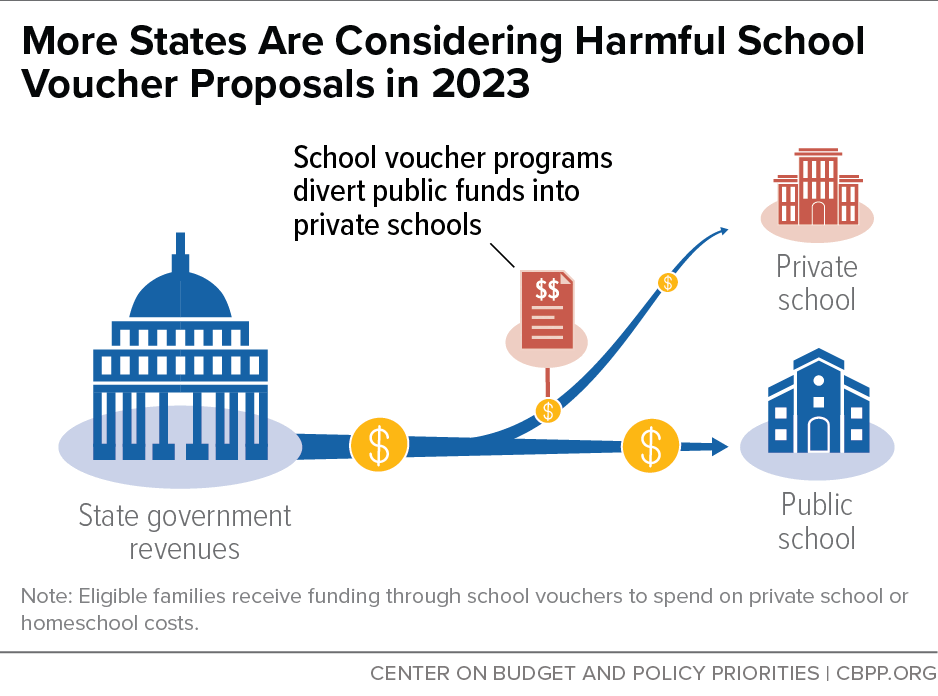
K-12 school vouchers are typically funded through state revenues and give families a set amount of money per eligible student to cover a portion of private school tuition. These vouchers divert money away from public schools, sometimes by directly re-routing education funding to private schools, and other times indirectly by making it harder to pay teachers, buy new textbooks, and provide quality after-school programming. The support for public schools is high: families overwhelmingly support their schools, and many teachers and other advocates for public education oppose vouchers.[1]

In the past few months, state lawmakers have expanded and created a record number of school voucher programs with little to no limits on eligibility. This will deplete available state revenues for public education and other critical services and do little to expand opportunity for students.

Regardless of whether school vouchers directly or indirectly divert funding from public schools to private education, state K-12 funding formulas depend on some metric of student count to allocate per-pupil funding. Some school districts can absorb some of the cuts with layoffs and reduced spending on textbooks and supplies. But fixed expenses such as air conditioning, school buses, and building maintenance can lead to funding shortfalls and layoffs.

In early 2023, these states created or expanded their school voucher policies:

  • Nebraska passed the state’s first voucher program, a K-12 tuition tax credit initially capped at $25 million annually, though the cap could rise to $100 million a year depending on demand for tax credits. Individuals and businesses can donate up to half of their taxes owed (with a maximum of $100,000); donations are funneled to scholarship granting organizations (SGOs), which pay private school tuition and other eligible expenses on behalf of students and their families. The tax credits reduce tax liability and thus, decrease the state revenues available for investments in public services, including public schools. Public school advocates are planning to challenge the bill on the 2024 ballot.
  • ArkansasLEARNS Act created, among other harmful policies for public education and teachers, an education savings account (ESA) program, which will phase in universal eligibility by the 2025-2026 school year and provide state-funded vouchers for families to use toward private school tuition and several other allowable expenses (like homeschooling, exam fees, and tutoring).
  • Florida broadened eligibility requirements to make its existing ESA program available to all students (rather than only students with disabilities or those from low-income families), with an estimated cost of $4 billion in the first year of implementation.
  • Iowa created an ESA that is initially targeted to families with lower incomes. But it will expand over time to include all students by the 2025-2026 school year and cost over $340 million per year when fully in effect.
  • South Carolina expanded the state ESA, lifting household income eligibility to 400 percent of the federal poverty level beginning in 2026-2027, but placing a 15,000-student cap on the program.
  • Utah created an ESA starting in the 2024-2025 school year that is available to all students but gives priority to students based on their household’s income.

Other states should not follow the paths of these states. For one, school vouchers primarily benefit wealthier students, families, and businesses. States with existing voucher programs — Arizona, Missouri, New Hampshire, and Wisconsin — have reported that most families who benefitted were already covering the costs of private schools and homeschooling prior to the voucher becoming available.

Wealthy people and companies also benefit when vouchers take the newer form of K-12 tuition tax credits. People and companies who donate to SGOs are allowed to opt out of paying tax to fund public needs and instead fund tuition scholarships at private K-12 schools. This tax incentive can provide state credits — up to 100 percent of the donation — to families with incomes over $200,000 and even allows businesses to profit from claiming federal expense deductions and avoiding capital gains tax.

Vouchers can also increase the likelihood that students experience discrimination and harm. Private schools are not required to offer the same federal civil rights protections for students as public schools. In fact, many voucher bills explicitly require families to waive students’ protections and rights under the federal Individuals with Disabilities Education Act for educational services that students with disabilities may need to learn.

Further, vouchers do not necessarily expand opportunities for students with the greatest needs. Students from families with low incomes often face barriers to navigating the voucher application and private school admission processes. Smaller, rural areas often rely on their local public schools as community hubs and primary sources of employment. Private schools can more easily push students out without recourse based on how they style their hair, what they wear, test scores, and subjective disciplinary action.

Voucher costs often grow beyond what is projected and thus, reduce overall revenues for other state spending. A recent study of school voucher programsin seven states shows how state voucher spending from 2008 to 2019 increased by hundreds of millions of dollars annually, while K-12 spending for public education declined despite public school enrollment increases. Arizona became the first state to implement a universal voucher program in 2022, and as of mid-March 2023, the ESA program is expected to cost the state at least $345 million more than initial projections for the first year. New Hampshire’s voucher program was estimated to cost $130,000 in 2021 and it now costs $14.7 million. And a few private schools in Iowa are already raising tuition only a few months after the new voucher program passed in January of this year.

Some state lawmakers understood the great cost at the expense of public services and stopped multiple school voucher bills this year. For example, 16 House Republicans broke with their party to defeat Georgia’s universal voucher proposal in the final hours of session. And Idaho Senate Republicans raised concerns about the long-term cost of a universal ESA bill, which also applied to subsequent voucher bills.

As some states continue to debate school vouchers during legislative sessions, state lawmakers should understand that their actions now and in the future will have large fiscal and harmful consequences for public education and student opportunities.

Another state that did NOT pass vouchers was Texas, even though Governor Greg Abbott called four special sessions of the legislature. Rural Republicans refused both bribes and threats and voted against vouchers because they wanted to protect their community schools.

More States Are Considering Harmful School Voucher Proposals in 2023

The graph above appeared in an earlier version of this report, published in March 2023.

The following post by Jess Piper was reposted by the Network for Public Education. Jess Piper is a fearless rural mom in Missouri who supports public schools.

New post on Network for Public Education.

Jess Piper: Poisoned Water in Missouri Public Schools? Let The Kids Eat Cake.

Jess Piper is a powerful defender of public education on TikTok and other social platforms. In this post, she talks about a recent run-in with Jean Evans, head of Betsy DeVos’s advocacy group in Missouri.

As a former public school teacher, with 16 years in the classroom, and an outspoken advocate for rural public schools, I have had more than my fair share of dealings with Jean. A few stand out in particular: one in which she said that “educational freedom” in rural Missouri is not a brick and mortar building staffed with certified teachers, but one in which rural kids could attend online schools and hire private tutors. That sure would free up some time for these kiddos to go to work, am I right?

Yes, she knows there is no school choice in rural Missouri, but our kids don’t deserve it anyway. I mean, we are just hayseeds out here and what do we expect?

That response is very indicative of the thought pattern for the grifters who want to privatize public schools…whose intentions are to siphon taxpayer money to private hands. But, what I loathe, yet enjoy, so much about Jean Evans is her ability — no, her insistence— on saying the quiet part out loud.

Yes, she works for a billionaire to defund Missouri schools. Yes, she is willing to say that defunding rural schools will displace children and close their schools.

But, what else is she willing to say publicly?

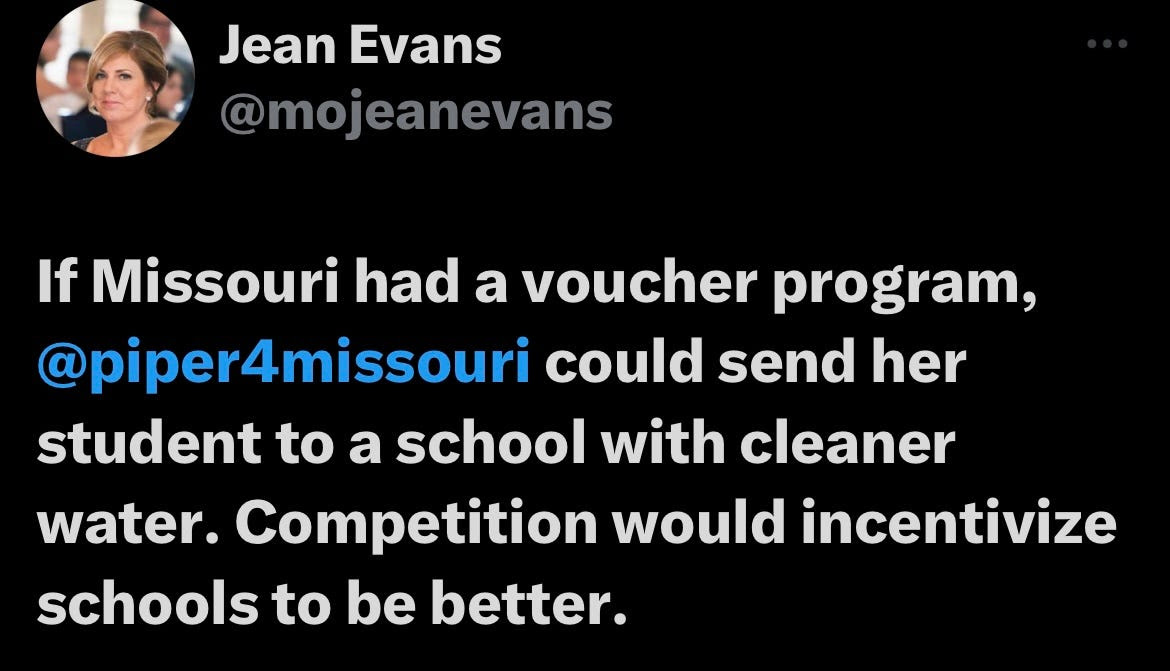
She was willing to tell me that the rural kids at my local public school would be deserving of clean drinking water if only Missouri would pass a voucher program. One may wonder if Jean herself snacked on too many lead paint chips as a child?

It all started with a letter from my local school reporting on the findings of lead in the water at the school. Most water sources were within EPA levels of lead in the water—not particularly great news, but I suspect most old schoolhouses reported much of the same. One faucet, in the nurse’s office, reported an elevated level more than four times the recommended limit. The school is addressing the water faucet and is attempting remediation. No children will drink this water.

I tweeted the findings and reminded my Twitter audience that over 80% of Missouri children test positive for lead in their blood. Jean responded by tweeting this:

Yes, if only we would expand Missouri’s current ESA scheme to defund schools and agree to a full-on voucher scheme, maybe the kids in my town wouldn’t be drinking poisoned water? If only rural folks would acquiesce to closing our schools and going along with the plan to keep our rural kids at home for online learning, and the occasional visit from a tutor, our kids wouldn’t be drinking lead.

Read the full post here.You can view the post at this link : https://networkforpubliceducation.org/blog-content/jess-piper-poisoned-water-in-missouri-public-schools-let-the-kids-eat-cake/