There have been stories in the press recently suggesting that the culture war issues are fading away. Such stories are premature.

Jason Garcia is an investigative reporter in Florida who keeps watch over the daily corruption in politics in his blog “Seeking Rents.” In this post, he tracks the bills that were passed. If you think the Republican majority is moderating its ideology, read this.

Garcia writes:

Two weeks into this year’s session of the Florida Legislature, one of the Big Business lobby’s top priorities seemed to be in trouble.

Republican leaders in the Florida House of Representatives were muscling a bill through their chamber that would, among other things, stop cities and counties across the state from enforcing local laws that require government contractors to pay higher wages or businesses with outdoor workers to follow heat-safety rules.

But the legislation — House Bill 433, which records show was written at least partly by lobbyists for the Florida Chamber of Commerce— faced a more difficult path forward in the Florida Senate.

To have any hope of passing, the Senate version of the bill first had to clear the chamber’s Commerce and Tourism Committee, where Republicans held a slim, 4-2 majority. And one of the Republican members was Sen. Ana Maria Rodriguez of Miami, where more than 28,000 workers were facing potential pay cuts under the bill. Rodriguez is also one of four Republican senators in Tallahassee elected to swing districts with help of spoiler-candidate schemesorchestrated by GOP political strategists using Big Business money.

Even if Senate Bill 1492 somehow survived that stop, it would then have to get through the Senate’s Community Affairs Committee. And the chairperson of that committee — the person who, at least ostensibly, decides which bills to put on the agenda and which to let die without a hearing — was Sen. Alexis Calatayud, another Republican from Miami sitting in a possible tossup seat.

So the Senate sponsor — Sen. Jay Trumbull (R-Panama City) — offered a compromise. He agreed to remove the part of his bill that would have wiped out living wage laws in places like Miami. The scaled-back version of the bill would only stop communities from establishing their own heat-protection rules, which wasn’t something that any city or county had done yet (though Miami has been considering one).

“I felt that for our purposes— in this committee, on this particular bill, today — that it would be better just to have us just talk about the heat issues in the bill,” Trumbull told the committee that day.

The compromise was enough to get SB 1492 through the Senate Commerce and Tourism Committee by a single vote.

The compromise was also enough to get the bill onto the agenda of the Senate Community Affairs Committee — where it once again survived by a single vote.

The compromise was also a fraud.

Because seven weeks later — on the final day of the Legislature’s 60-day session — Republican leaders in the Senate decided to take up the House version of the bill anyway. Just two hours before gaveling this year’s session to a close, the Florida Senate voted 24-15 to pass HB 433, which, though it had been tweaked, largely resembled the legislation that senators had seemingly abandoned before.

(The House bill is actually even worse for workers, because it would also prohibit local communities from passing “fair work week” laws that require businesses to give hourly workers advance notice of their weekly schedules.)

The bait-and-switch ultimately accomplished two goals for Senate Republican leaders.

It helped them sidestep a couple of tough committees in order to pass a priority bill for the Florida Chamber of Commerce, which records show gave more than $400,000 last year to a fund controlled by Senate GOP leadership. 

But it also helped them protect their potentially vulnerable incumbents. Because both Rodriguez and Calatayud were ultimately allowed to vote against the bill — but only after their votes no longer mattered. 

Garcia then lists the other bills that were passed by the Legislature before it recessed.

They included:

Loosening child labor laws (having banned undocumented immigrants, the Legislature had to make it easier for businesses to hire teenagers)

Permit school districts to hire religious chaplains to counsel students in school

Lower the standards for teachers in “classical schools,” the charter schools based on the Hillsdale College curriculum

Extend Florida’s “Stop Woke Act,” which limits teaching about racism or sexism, to education-preparation courses

Reduce regulations on natural gas pipelines, prohibit offshore wind energy, and erase most mentions of climate change from state law.”

Moderation? No.
Between January 2017 and January 2021, Trump stacked the federal courts with rightwing ideologues. Three were added to the U.S. Supreme Court. Many more were approved for federal District Courts and Appellate Courts. We are now seeing the results of putting extremists in charge of consequential decisions. Women’s reproductive rights, a 50-year-old precedent, were overruled and left to the states. Some have imposed bans that prevent abortions even in cases of rape, incest, and to protect the life of the mother.

In the current instance, the U.S. Supreme Court gave Texas approval to implement Senate Bill 4, a state law that takes precedence over federal law in regulating the international border with Mexico. For at least a century, federal courts have ruled that federal law governs international borders.

To complicate matters, the Fifth Circuit Court of Appeals has issued a stay on implementation of SB 4. Decades ago, the Fifth Circuit was one of the most liberal appeals courts, and it took the lead in enforcing desegregation. It is now one of the most conservative courts.

The Washington Post described the conflicting court decisions as “whiplash:

The law’s fate is yet another flash point in the nation’s polarized debate over immigration, which Republican candidate and former president Donald Trump has made a central theme of his campaign against Biden. Whatever the 5th Circuit decides, the status of the law is likely to end up back before the Supreme Court.
The high court’s order Tuesday afternoon set off a fast-moving round of legal maneuvering in the lower court that has kept the law’s status in limbo.

The Supreme Court urged the 5th Circuit to decide quickly whether the law would remain in effect while litigation continues, and hours later a three-judge panel said it would convene a hearing by Zoom on Wednesday morning.
Then, in a highly unusual move, just after 11 p.m. Tuesday, two of the judges on the 5th Circuit panel blocked enforcement of the law in advance of the Wednesday hearing.

The brief order did not explain the reasoning of the two judges — Priscilla Richman, a nominee of George W. Bush, and Irma Carrillo Ramirez, a Biden nominee. The dissenting judge — Andrew Oldham, a Trump nominee — said only that he would have allowed the law to remain in effect before Wednesday’s hearing.

“It’s Ping-Pong,” Efrén C. Olivares, director of strategic litigation and advocacy at the Southern Poverty Law Center, said in a phone interview, describing the back-and-forth rulings.

Olivares said it is unclear whether the three-judge panel will rule immediately, since a preliminary injunction from a lower court remains in place, and the state law is not in effect. Texas conceivably could ask the full circuit court to review the panel’s decision blocking the law temporarily, he said, but he noted that is uncommon.

The law makes it a state crime for migrants to illegally cross the border and gives Texas officials the ability to carry out their own deportations to Mexico.

How they will do so remains unclear. The Mexican government said Tuesday that it would not accept anyone sent back by Texas and condemned the law as “encouraging the separation of families, discrimination and racial profiling that violate the human rights of the migrant community.”

Mexico President Andres Manuel Lopez Obrador on Wednesday referred to the Texas law as Draconian.

“It disrespects human rights, it’s a completely dehumanizing law, it’s anti-Christian, unjust, it violates precepts and norms of human co-existence, Lopez Obrador said. “It doesn’t just violate international law but [the teachings of] the Bible. I say this because those who are applying these unjust, inhumane measures go to church, they forget that the Bible talks about treating the foreigner well, and of course, loving your neighbor.”

The Texas law was passed last year as part of Republican Gov. Greg Abbott’s push to expand the state’s role in immigration enforcement — historically the purview of the federal government and its jurisdiction over international borders.

The Supreme Court’s decision drew dissent from the three liberal justices, two of whom said the majority was inviting “further chaos and crisis in immigration enforcement.”

“This law will disrupt sensitive foreign relations, frustrate the protection of individuals fleeing persecution, hamper active federal enforcement efforts, undermine federal agencies’ ability to detect and monitor imminent security threats, and deter noncitizens from reporting abuse or trafficking,” wrote Justice Sonia Sotomayor, joined by Justice Ketanji Brown Jackson…

Luis Miranda, a spokesman for the Department of Homeland Security, said federal immigration agencies do not have the authority to assist Texas with the implementation of the state law. The only deportations that U.S. agents are allowed to conduct must involve federal orders, he said.


“Immigration is within the exclusive purview of the federal government,” Miranda said in a statement.


U.S. District Court judge David A. Ezra temporarily blocked the Texas law last month, saying it was probably unconstitutional and “could open the door to each state passing its own version of immigration laws.” Ezra said the law intruded into federal matters even more than an Arizona immigration law that the Supreme Court partially struck down in 2012.


But the 5th Circuit quickly froze Ezra’s decision without explanation and said the Texas law could be enforced, at least temporarily, unless the Supreme Court weighed in.

The Supreme Court did weigh in, allowing Texas to control the border. And a panel of 5th Circuit judges froze the law’s implementation.

Think about it. The U.S. Supreme Court recently decided that one state (Colorado) couldn’t disqualify an oath-breaking insurrectionist because each state would write its own rules. Now the SCOTUS allows one state to control its international border. This makes no sense.

Here is some additional background.

LoneStarLeft, a Texas blogger named Michelle Davis, was horrified by the SCOTUS approval of SB 4. She wrote yesterday:

Today, the Supreme Court ended the pause on SB 4’s implementation and allowed this blatantly unconstitutional law to be enforced while litigated in court. This ruling does not indicate that the law is constitutional; only Texas can implement it while it is being challenged. This is terrible news for many of Texas’ residents. 

SB4 would grant Texas Law Enforcement Officers the authority to deport undocumented immigrants independently, bypassing due process and federal oversight. This move by Texas Republicans aims for quick political gains. The bill would allow officers and state agencies to escort individuals to ports of entry to guarantee adherence. Should immigrants resist compliance with a directive to return, they could be accused of a second-degree felony, risking up to 20 years of incarceration.

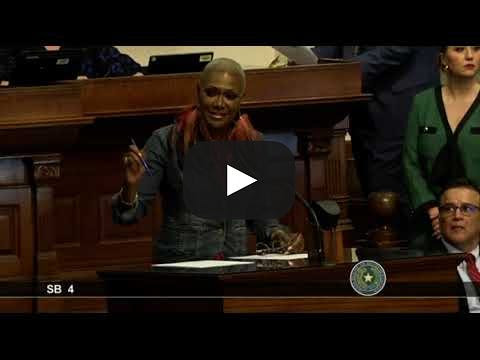
Watch Representative Jolanda Jone (D-Harris County) blast this SB4 as it went through the House: 

…Now, under Texas law, any Keystone Cop can decide to drive a person they deem undocumented to the international border and demand they go back into Mexico (even if they are not from Mexico). If the person doesn’t walk across the bridge, they are arrested and imprisoned for up to twenty years.

The Constitution of the United States of America states that the Federal Government’s job is to manage international treaties, our borders, and citizenship issues. SB4 crosses a major line.

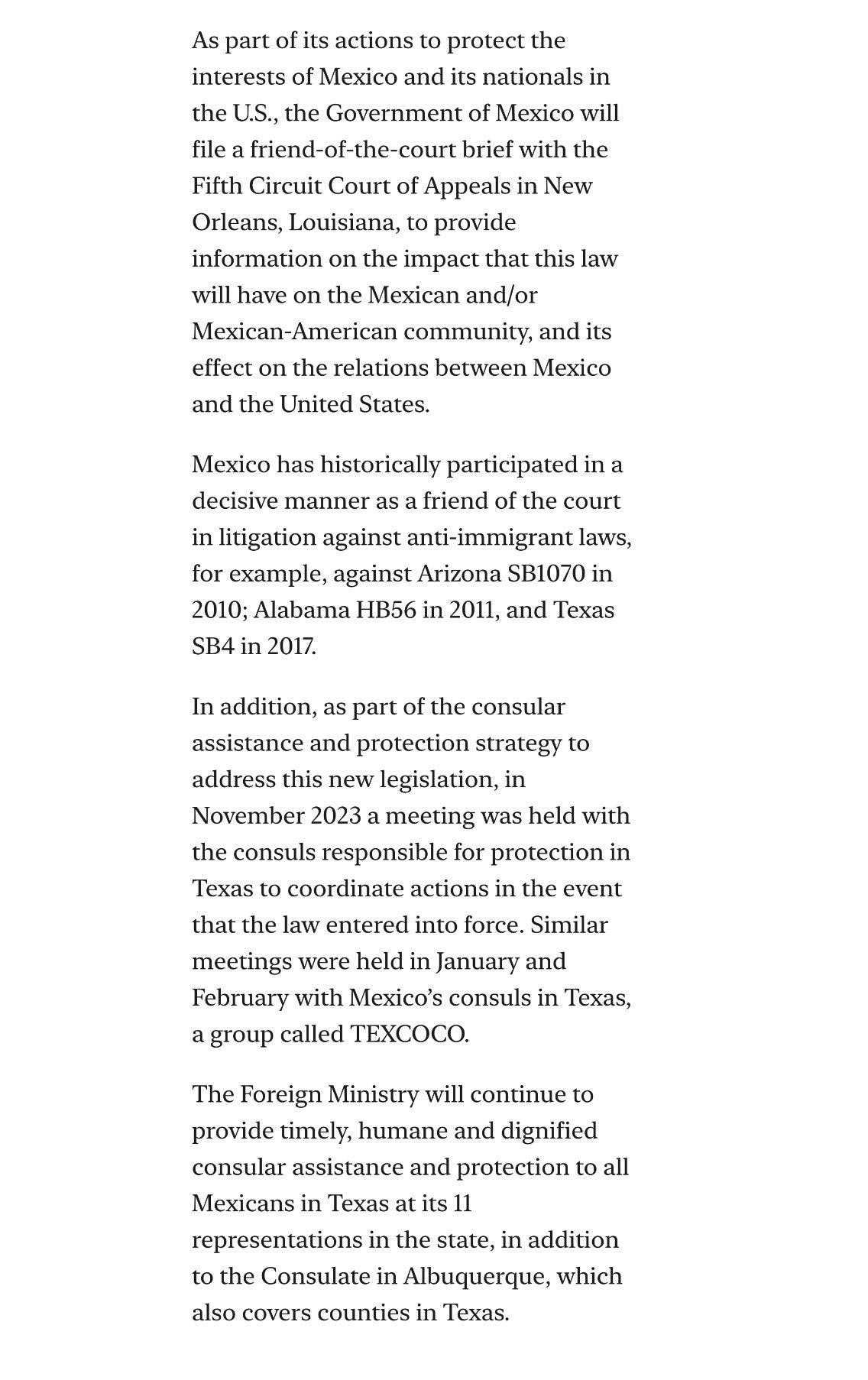
Here is a statement put out today by the Mexican Government: 

This bill will even remove people who have been here for decades, living lawfully and paying taxes.

Within SB4, the term “alien” is defined as an individual who is neither a citizen nor a lawful permanent resident. Thus, a person who was once denied a visa but presently holds a valid visa (for example, tourism or marriage) is STILL considered committing an offense, even though they are lawfully present in the country.

Cruelty is the point.

SB4 passed straight down party lines. Every single Republican voted for it, and every single Democrat voted against it. When they tell you who they are, you need to listen. A lot of non-voters need to become voters, the GOP’s authoritarian laws are on our door step…

ALL Latinos should be very concerned right now. 

This immigration law will allow any brown person to be rounded up for any possible violation. SB4 will allow any law enforcement agent in Texas (even school resource officers) the ability to demand a brown person prove they are a citizen (“Show Me Your Papers”). If that person can’t prove their citizenship, they risk deportation to Mexico, no matter their origin. 

The law’s implementation will lead to racial profiling, separate families, and harm Black and brown communities across the state, regardless of immigration status. 

That directly conflicts with the United States Constitution, which states that everyone, regardless of race or immigration status, has the freedom to move and thrive.

Republicans have already committed to opening up shuttered prisons to make room for 80,000 immigration prisoners. Under SB4, police will act as immigration agents and arrest people who “look” like they’re undocumented. Half of Texans are Latino and could “look” undocumented to a racist cop.

Two Brits have a website called Josh & Archie. Being audacious pranksters, they hatched a scheme to trick Tucker Carlson. One sent Carlson’s office an email claiming that he was the employee of the Royal family who doctored the photo of Kate Middleton and her three children. He said he was fired.

He soon heard from the booker for the Tucker Carlson show, who asked for the original photo and proof that he worked for the Royal family.

Josh and Archie created a document proving that he worked for the Royals. It had a fake Latin motto that happened to be the motto of a supermarket chain. And his employment contract included a clause saying that if his work was unsatisfactory, he agreed that one of his limbs would be amputated.

Apparently no one scrutinized his evidence with care, and he scored an interview with Tucker Carlson. Carlson was delighted with the interview.

But before it aired, Josh and Archie went public. They said they didn’t want to cause any further trouble for the Royals.

The editorial board of Cleveland.com and the Plain-Dealer were taken aback by the facts reported about vouchers by their reporter Laura Hancock (posted in previous time slot). The Ohio legislature expanded vouchers so almost every family is eligible, even if they never sent their child to public school. The editorial board believed that vouchers were supposed to help poor kids escape low-performing schools, and they urge the legislature to return to the original purpose.

What is disappointing about this editorial is that it fails to recognize that the original purpose of vouchers has already proven to be a disaster. In the only statewide evaluation of vouchers, sponsored by the choice-friendly Thomas B. Fordham Institute, poor children who took vouchers fell even farther behind their peers in the public schools they left. (See summary, on p. 7, concluding that students who left public schools for voucher schools performed worse than if they had remained in their public school).

This finding—that voucher students who leave public schools perform worse—has been replicated in every voucher program. Voucher students don’t go to elite private schools. Typically they go to voucher schools that do not have certified teachers and that are allowed to discriminate on any grounds.

Voucher scholar Josh Cowen of Michigan State University has assembled the powerful negative effects of vouchers on kids who transfer from public schools. The results in Ohio are the worst.

I wish the editorial board of Cleveland.com and the Plain-Dealer had seen these data before they wrote the following editorial. The facts are in: Vouchers don’t help poor kids who leave struggling public schools.

The editorialists wrote:

Last June, when the Ohio House passed Amended Substitute House Bill 33, the two-year state budget, sending it to Gov. Mike DeWine’s desk for his signature, House Majority leadership celebrated the “landmark” expansion of EdChoice school vouchers, loosening income caps to make voucher benefits available to all Ohio families.

“Along with funding public education, the budget makes a landmark investment in school choice with a universal voucher program,” the statement from House Republican leadership said. “This program is designed to safeguard lower-income families and offers options beyond traditional public schools. By expanding access to vouchers, Ohio ensures parents can make the best decisions for their children’s education.”

But data from implementation of this “landmark investment in school choice … designed to safeguard lower-income families” suggest it did very little to provide school choice or to help low-income families.

Instead, parents in affluent communities like Rocky River, Westlake and Bay Village with kids already in private and parochial schools appear to have taken immediate advantage of the new eligibility rules. Families of four up to 450% of poverty levels (that is, earning up to $135,000 a year) now qualify for full taxpayer-funded vouchers, and those making more money qualify for partial vouchers.

Ohio’s legislature, to be true to its stated school-choice motive, should rewrite the rules to guarantee that this money goes to children in underperforming schools, possibly relying on state report cards to set the standard.

Cleveland.com’s Laura Hancock looked at before-and-after numbers and found that students on EdChoice vouchers shot up from 16 to 309 in the Rocky River school district; 41 to 581 in Westlake; and 13 to 229 in Bay Village.

Hancock then compared public-school enrollment trends to judge if this was primarily a move out of public schools, or a subsidy for kids already in private and parochial schools.

The evidence points strongly to the latter. Rocky River public school enrollment dropped by only 22 students, not 309. Bay Village enrollment dropped by 30 students, not 229. Westlake schools recorded 19 fewer students this year compared with last academic year — not 581. Similar patterns were seen in other affluent school districts, from Strongsville and North Royalton to Brecksville-Broadview Heights.

By contrast, in the Cleveland public schools, where more than 8,000 students now get school vouchers through the much-older Cleveland school voucher program, which dates to 1996, those on EdChoice vouchers increased only slightly, from 9 to 28.

In even more impoverished East Cleveland, EdChoice recipients dropped from 12 last academic year to less than 10 this year.

And the money is now almost gone.

“The legislature budgeted $397.8 million for EdChoice-Expansion this year,” Hancock reports. “As of Feb. 26, the state had spent $387.5 million.”

Advocates of the universal voucher program suggested to Hancock that, as word gets out, more people will use the vouchers as intended next school year, to switch from low-performing public schools to a private or parochial option.

But it seems unlikely those now on the EdChoice expansion vouchers would be displaced to make room for lower-income students.

In other words, lacking conscious, targeted efforts to make sure low-income Ohioans in poor-performing schools primarily benefited, Ohio’s EdChoice expansion as implemented was not the school-choice program Statehouse leaders promised.

The data suggest instead it became just a big taxpayer subsidy for those students already in private schools.

That should outrage every Ohio taxpayer — and every parent of students in struggling districts who were supposed to benefit.

Also raising red flags were the absence of reciprocal obligations on the part of private and parochial schools taking these taxpayer-funded vouchers to show they are a higher-quality alternative to public schools.

The lack of transparency and data-reporting guardrails forces parents making “school choice” for academic reasons, rather than out of religious or other motivations, to blindly assume that a private or parochial school is the best choice, without actual data on educational performance.

This is particularly troubling given Ohio’s history of funding for-profit charter schools without such guardrails. That’s how the now-shuttered Electronic Classroom of Tomorrow managed to make off with $117 million in wrongly paid taxpayer funds, based on a 2022 state audit — mostly for falsely reporting students ECOT never had.

The General Assembly needs to revisit its universal vouchers program to ensure that this nearly $400 million in Ohio taxpayer money is buying true school choice as promised for students mired in poor-performing public schools who most need quality alternatives.

Laura Hancock wrote at Cleveland.com about the expansion of Ohio’s voucher program. The state now offers a voucher to everyone, but most vouchers are claimed by students who never attended public schools.

COLUMBUS, Ohio – The number of Cuyahoga County students receiving state-funded scholarships to attend private schools has skyrocketed this year after state lawmakers expanded a voucher program, but state data suggests that doesn’t necessarily mean more kids have opted out of public schools.

Across the county’s 31 districts, the number of students receiving tuition payments in the EdChoice-Expansion scholarship  one of five school voucher programs run by the state, and the one lawmakers expanded over the summer to give at least partial tuition payments to families of all income levels— has increased nearly four-fold, from about 2,500 students last year to nearly 9,200 this year.

Those districts, however, have not seen a corresponding loss in student population, indicating that most of the families newly benefitting from the vouchers were already enrolled in private schools, rather than fleeing a school district besieged by violence or bullying, mediocre test scores or other problems.

The data cut against arguments lawmakers and advocates have made over the years that vouchers are necessary to give families a chance to choose private schools over the public school district where they live.

In Rocky River, EdChoice-Expansion scholarships were nearly 20 times higher on Feb. 1 than last year. In Bay Village, they increased 17 times. Westlake’s increase is 14 times higher, according to an analysis of state data by The Plain Dealer / cleveland.com.

The number of students across Ohio who are attending private schools on state-funded scholarships spiked this year because the legislature — in the two-year budget bill signed by Gov. Mike DeWine — removed income eligibility caps for EdChoice-Expansion. Last year, the cap was 250% of the federal poverty level for a scholarship, or $75,000 for a family of four. Now, there are no income caps, although families only get partial scholarships when they earn above 450% of the poverty level, or above $135,000 for a family of four.

Full scholarship amounts are $6,167 for grades K-8 and $8,407 for grades K-12.

Enrollment losses in Cuyahoga County district classrooms, however, are more modest than the jump in private school vouchers. State data shows that families that live in the boundaries of suburban district schools— some of which are among the best performing in the state — but may have never set foot in a public school now are receiving vouchers.

Enrollment in Rocky River City School District fell by just 22 students between last year and this year, even though the number of kids receiving vouchers shot up from 16 to 309. In Bay Village City School District, there are 30 fewer students, despite a voucher jump from 13 to 229. Westlake City School District has 19 fewer students; vouchers in the district spiked from 41 to 581.

In the Cleveland Metropolitan School District, the number of kids receiving EdChoice Expansion vouchers increased from nine to 28 this year, a miniscule number compared against its student population of more than 32,000. But students in Cleveland also are eligible for the Cleveland Scholarship, which has no income caps, and is the oldest in the state, having been established in 1995. As of Feb. 26, there were 8,218 students in the Cleveland Scholarship program.

Open the link to finish the article.

Following a vigorous debate on the blog about the Supreme Court’s decision to reverse Colorado‘a disqualification of Trump from the ballot, our reader Democracy reviews the article in The Atlantic by Laurence Tribe and Michael Luttig. (It is available on The Atlantic website for a free trial.)

Democracy writes:

I don’t know who titled the piece by Luttig and Tribe in The Atlantic, but I thought it was both brilliant and accurate. The title:

“Supreme Betrayal”

These are some of the most compelling passages in the article:

“What ought to have been, as a matter of the Constitution’s design and purpose, the climax of the struggle for the survival of America’s democracy and the rule of law instead turned out to be its nadir, delivered by a Court unwilling to perform its duty to interpret the Constitution as written. Desperate to assuage the growing sense that it is but a political instrument, the Court instead cemented that image into history. It did so at what could be the most perilous constitutional and political moment in our country’s history, when the nation and the Constitution needed the Court most—to adjudicate not the politics of law, but the law of the politics that is poisoning the lifeblood of America.”

Bam!

“As the extraordinary array of amicus briefs filed in Trump v. Anderson made clear, the voluminous historical scholarship exploring the origins of the disqualification clause and its intended operation left no genuine doubt that the Colorado Supreme Court got it exactly right in its decision explaining why the former president was ineligible to ‘hold any office, civil or military, under the United States,’ certainly including the presidency.

The Colorado Supreme Court entered into some extensive fact-finding in declaring Trump an insurrectionist. None of those facts has been questioned, even at the Supreme Court, where the justices just tiptoed around the factual issues and pretended they didn’t exist. Oh, but they did:

https://www.usatoday.com/picture-gallery/news/nation/2021/01/07/front-pages-capture-chaos-riots-us-capitol/6577931002/

Back to Luttig and Tribe, and the three “liberal” justices:

“For Justices Sonia Sotomayor, Elena Kagan, and Ketanji Brown Jackson—who wrote a separate concurrence that in parts read more like a dissent—we can only surmise that any discomfort they felt was outweighed by the extra-constitutional allure of going along with the other justices on the decision’s bottom line and thus enabling the nation’s electorate to work its will, rather than the Constitution’s. Those three justices took the opportunity to distance themselves from at least part of what the Court’s majority did by criticizing its ‘attempts to insulate all alleged insurrectionists from future challenges to their holding federal office.’ Sotomayor, Kagan, and Jackson convincingly dispatched as ‘inadequately supported as they are gratuitous’ the majority’s unnecessary holdings that only Congress can enforce the disqualification clause and that Congress’s implementing legislation must satisfy the majority’s made-up insistence upon ‘congruence and proportionality.’ Those three justices left in tatters much that all the other justices, with the exception of Amy Coney Barrett, wrote about the operation of the disqualification clause against federal officeholders, making plain that the majority’s ‘musings’ simply cannot be reconciled with the Fourteenth Amendment’s language, structure, and history.”

Luttig and Tribe note clearly that there were two “majorities” in this case. There was the 9-0 majority, that some commenters here cling to, and there was the 5-4 majority that went w-a-y too far in insulating Trump from disqualification even though he IS an insurrectionist. And that 9-0 majority? Luttig and Tribe state that the step “that all nine justices took represents a constitutionally unforgivable departure from the fundamental truth of our republic that ‘no man is above the law.’ ”

And that Colorado decision?

“… the week-long trial by the Colorado state court, which had indisputable jurisdiction to consider the matter, undoubtedly more than satisfied the constitutional requirements for disqualifying the former president under Section 3. At that trial, he was afforded every opportunity to defend himself against the charge that he had personally ‘engaged’ in an ‘insurrection or rebellion’ against the Constitution. Not a single justice suggested that the process was less than what the former president was due. That trial ended in a finding by ‘clear and convincing evidence’ that he had not only engaged in that insurrection but had orchestrated the entire months-long effort to obstruct the joint session’s official proceeding, preventing the peaceful transfer of power for the first time in American history. Not a single justice suggested that a more stringent standard of proof was required or that the courts below applied an insufficiently rigorous definition of insurrection. No justice suggested that the First Amendment or anything else in the Constitution shielded the former president from the reach of Section 3.”

And yet they shielded him.

Luttig and Tribe conclude with this:

“Our highest court dramatically and dangerously betrayed its obligation to enforce what once was the Constitution’s safety net for America’s democracy. The Supreme Court has now rendered that safety net a dead letter, effectively rescinding it as if it had never been enacted.”

I’m curious. Is there anyone commenting on this blog who genuinely believes that Trump is NOT an insurrectionist?

MacKenzie Scott received billions of dollars in Amazon stock when she divorced Jeff Bezos. Every year, she gives large awards to mostly worthy groups. Up to now, she has not made a gift to a group that supports public schools. She just gave $2 million to a great organization in Austin, Texas.

I confess that I washed my hands of MacKenzie Scott and her advisors in 2022 when I read that she gave $25 million to Teach for America. TFA undermines the teaching profession by sending in amateurs to teach for two years. Worse, TFA has no financial need. It has way more than $300 million in assets and a long list of overpaid executives. With so many worthy and penniless groups struggling to survive, why enrich a bloated TFA?

But here is a good grant, though much smaller than what Scott gave TFA:

Austin Voices for Education and Youth Receives $2 Million Gift From the Yield Giving Open Call


For Immediate Release


Contact: Allen Weeks, Executive Director, Austin Voices


March 19, 2024

Today, MacKenzie Scott’s Yield Giving announced Austin Voices for Education and Youth as one of the Yield Giving Open Call’s awardees working with people and in places
experiencing the greatest need in the United States.

Austin Voices received $2 million.


Founded in 2003, Austin Voices for Education and Youth creates community collaboration to
strengthen families, support kids and improve schools. We believe our public schools can serve
as powerful hubs for bringing neighborhoods, families and students together to increase equity
and achieve positive change.

More information about Austin Voices, including our most recent Impact Report, can be found at http://www.austinvoices.org.


In March 2023, Yield Giving launched an Open Call for community-led, community-focused
organizations whose explicit purpose is to enable individuals and families to achieve substantive
improvement in their well-being through foundational resources.


“Receiving this generous gift from MacKenzie Scott and Yield Giving will allow us to serve more families in Austin, help more kids succeed in schools, and expand the next generation of student and parent leaders. In a time when schools are squeezed for resources, this gift is tremendously helpful,” says Allen Weeks, Executive Director of Austin Voices for Education and Youth.


The Open Call received 6,353 applications and initially planned for 250 awards of $1 million
each. In the Fall of 2023, organizations top-rated by their peers advanced to a second round of
review by an external Evaluation Panel recruited for experience relevant to this cause, and
underwent a final round of due diligence. In light of the incredible work of these organizations,
as judged by their peers and external panelists, the donor team decided to expand the awardee
pool and the award amount.

“We are excited that our partnership with Yield Giving has resonated with so many organizations,” said Cecilia Conrad, CEO of Lever for Change. “In a world teeming with potential and talent, the Open Call has given us an opportunity to identify, uplift, and empower transformative organizations that often remain unseen.”


More information on the Yield Giving Open Call and other initiatives can be found at


http://www.leverforchange.org.


Yield Giving


Established by MacKenzie Scott to share a financial fortune created through the effort of
countless people, Yield Giving is named after a belief in adding value by giving up control. To
date, Yield’s network of staff and advisors has yielded over $16,500,000,000 to 1,900+ non-
profit teams to use as they see fit for the benefit of others.

To learn more, visit
http://www.yieldgiving.com.


Lever for Change


Lever for Change connects donors with bold solutions to the world’s biggest problems—
including issues like racial inequity, gender inequality, lack of access to economic opportunity, and climate change. Using an inclusive, equitable model and due diligence process, Lever for Change creates customized challenges and other tailored funding opportunities. Top-ranked teams and challenge finalists become members of the Bold Solutions Network—a growing global network that helps secure additional funding, amplify YIELD GIVING OPEN CALL AWARDEE TOOLKIT members’ impact, and accelerate social change. Founded in 2019 as a nonprofit affiliate of the John D. and Catherine T. MacArthur Foundation, Lever for Change has influenced over $1.7 billion in grants to date and provided support to more than 145
organizations. To learn more, visit http://www.leverforchange.org.

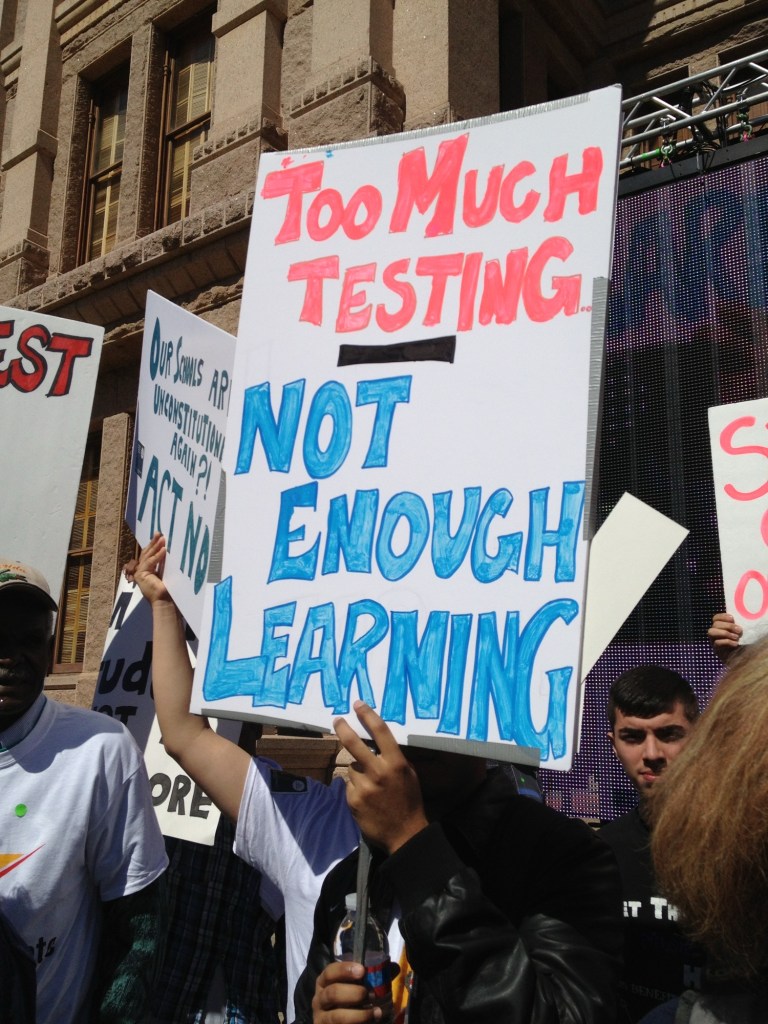
I spoke at Austin Voices for Education and Youth at a rally in front of the State Capitol in 2013
This is Allen Weeks

Mackenzie Scott should give $25 million to Austin Voices for Education and Youth and another $25 million to Community Coices for Education in ZHouston.

Garry Rayno writes about state politics for InDepthNH, a subject he has covered for the past three decades. Here he explains how the old adage that “all politics is local” has been reversed. Now, with the advent of big money, all local politics is influenced by national agendas. Read what he has to say about vouchers. As in every other state, most vouchers are claimed by students already enrolled in private and religious schools. There has been no mass exodus from public schools. In fact, there has been almost no decline in public school enrollment. Taxpayers are now subsidizing families who can afford private schools on their own.

Rayno writes:

CONCORD – You can expect partisan politics to play a larger role in the legislature during the second year of a two-year term.

It is an election year and both parties are hard at work appealing to their bases and defining the other party as the bad guy.

However, the ill-will appears to be growing over the last decade and there is a reason or two for what is occurring.

More and more state legislatures are put in the middle of national issues that once were the purview of the political professionals.

One of the major reasons for the national attention is the US Supreme Court’s Citizens United decision swinging open the doors of the Brinks Trucks to let millions of dollars of outside money pour into a small state like New Hampshire to sway the outcome of elections.

The $1.3 million of campaign funds spent in 2022 on the New Hampshire Legislature by groups affiliated with the Koch Foundation would have been unimaginable before the court’s decision giving corporations first amendment rights as if they were individuals.

The national parties are also reaping the rewards of the decision and in turn spend rigorously to elect their candidates.

All that money investment does not come free as the people contributing expect a hefty return on investment.

Consequently many national wedge issues find their way into the legislative agendas of both parties.

The last few sessions of the House this month reflect some of what there was little of in years past.

For example House Bill 1156, which targets the World Health Organization and the Centers for Disease Control over their guidance during the pandemic and its future guidance coming in a couple of months on pandemics to come.

The contention is that the two organizations put the state’s sovereignty at risk while revisiting the shutdown and masking debates from the pandemic’s greatest impact.

On its own, given the political philosophy of the majority of the Republican House members, it does not appear to be unusual.

But if you Google state sovereignty and WHO and CDC you will see that many other state legislatures have similar if not identical bills before them this year.

The national battle over electronic vote counting machines made it all the way down to town meeting votes this year, although the ban was not very successful, the push has been ongoing since the “Big Lie” over voter fraud in the 2020 election.

The National Republican Party had touted “voter integrity” which really means disenfranchising as many voters as possible before the 2024 election.

House Bill 1569 would do away with the affidavit exemption allowing a person to vote if a registered voter forgot a photo Id or the proper paperwork for same-day registration. That in itself will disenfranchise thousands of voters, and essentially does away with same-day registration, which New Hampshire adopted so it would not have to have motor-voter registration under the Help America Vote Act. 

This change is likely going to court if it passes the Senate and the governor signs it.

The bill also expands the challenged voter provision, which puts the onus on the challenged voter to go to superior court to prove otherwise which means thousands more will be disenfranchised.

Other bills approved by the House last week would shorten the time period for voter purges from the checklist.

On the other side, the House killed House Bill 1364 which would have resulted in criminal charges if someone intimidated an election official, exerted improper influence over the election process or tampered with electronic ballot counting devices.

While that has not been an issue in New Hampshire as it has in some other states, mostly in the south and southwest, you have to wonder why the House killed the bill unless some of what would be illegal is planned for the next election.

Democrats also pushed a bill to have the state join the Election Registration Information Center, which has not interested the state in the past, and was killed last week.

Democrats proposed a series of House resolutions, which indicate the wishes of the legislature, but do not have the weight of law that included universal health insurance, and differentiating between individual and corporate rights (sound familiar).

Perhaps the most costly example of New Hampshire following a national agenda is the Education Freedom Account program, which began three years ago following other nearly identical programs in places like Arizona, Florida, Wisconsin and Louisiana.

A recent study by the Cleveland Plain Dealer of the program in Ohio which greatly expanded its program last year, noted that despite the number of new students in the program, the enrollment in the public schools did not decline, meaning most of the students benefiting from the expansion were already in private schools meaning it’s ultimately a subsidy for parents who already could afford to pay the tuition. 

The study found that about 65 percent of the total grants were private school grants and most were to religious schools.

Those numbers also reflect what the New Hampshire program has seen, that most of the students enrolling in the program were already in private or religious schools, or homeschooling when the program began with 1,635 students in the 21-22 school year and growing to about 4,500 students for the 23-24 school year.

The year before the program began there were 164,918 students in public schools, according to data on the Department of Education’s website, and the first year of the program there were 164,950 students in public schools, the second year, 163,681 and this school year 165,082. [Emphasis added]

That too would indicate that most of the students receiving EFA grants are not leaving public schools to join the program.

The program’s income cap is expected to increase to 500 percent of the federal poverty level, next school year — the House has passed the bill, it is expected to pass the Senate and the governor has said he would sign it.

Parental rights are another issue that has been targeted nationwide by Republicans while Democrats continue to push for raising the minimum wage, which is a national issue since the state did away with its own minimum wage in the 2011-2012 term and moved to the federal rate.

And transgender issues have been before the legislature, particularly for minors, as they have been in many other states.

All the same issues surfacing at the same time would certainly indicate that some groups or organizations are behind the efforts.

And the political parties are also using state legislatures to continue what they hope will be the dividing lines in the upcoming election.

Oh for the days of clashes over education funding and shoreline protection.

But we are still fighting over education funding, but it’s at least our own fight.

Garry Rayno may be reached at garry.rayno@yahoo.com.

Laurence H. Tribe, the eminent professor of constitutional law at Harvard Law School (Democrat), and Judge Michael Luttig, a retired federal judge (Republican), co-authored a lengthy article in The Atlantic, condemning the U.S. Supreme Court’s decision to overrule the Colorado Supreme Court, which removed Trump from the 2024 ballot.

It seemed, after the Court’s decision, that Section 3 of the Fourteenth Amendnent had been excised from the Constitution. But just yesterday the Supreme Court rejected an appeal by a New Mexico man who was convicted for taking part in the January 6 insurrection.

Couy Griffin was convicted for his role as a member of the mob that stormed the U.S. Capitol. Because he previously served as a member of the Otero County board of commissioners, the courts in New Mexico said he was ineligible to hold office ever again. Griffin was a founder of Cowboys for Trump and an outspoken purveyor of lies about election fraud.

The Supreme Court concluded that states could disqualify persons from attempting to hold state offices, but Congress had to enact legislation to implement the disqualification of federal officials.

Since Congress is unlikely to muster a majority of both Houses—or 60 votes in the Senate to avoid a filibuster—oath-breaking insurrectionists will not be barred from seeking or holding federal offices.

One good thing: the Griffin decision implicitly agreed that the mob action of January 6 was an insurrection.

Last week, before the Griffin decision, Tribe and Littig wrote in The Atlantic:

The Supreme Court of the United States did a grave disservice to both the Constitution and the nation in Trump v. Anderson.

In a stunning disfigurement of the Fourteenth Amendment, the Court impressed upon it an ahistorical misinterpretation that defies both its plain text and its original meaning. Despite disagreement within the Court that led to a 5–4 split among the justices over momentous but tangential issues that it had no need to reach in order to resolve the controversy before it, the Court was disappointingly unanimous in permitting oath-breaking insurrectionists, including former President Donald Trump, to return to power. In doing so, all nine justices denied “We the People” the very power that those who wrote and ratified the Fourteenth Amendment presciently secured to us to save the republic from future insurrectionists—reflecting a lesson hard-learned from the devastation wrought by the Civil War.

For a century and a half before the Court’s decision, Section 3 of the Fourteenth Amendment was the Constitution’s safety net for America’s democracy, promising to automatically disqualify from public office all oath-breaking insurrectionists against the Constitution, deeming them too dangerous to entrust with power unless supermajorities of both houses of Congress formally remove their disability. This provision has been mistakenly described by some as “undemocratic” because it limits who may be elected to particular positions of power. But disqualification is not what is antidemocratic; rather, it is the insurrection that is antidemocratic, as the Constitution emphatically tells us.

In any event, all qualifications for office set by the Constitution limit who may be elected to particular positions of power. And no other of these disqualifications requires congressional legislation to become operative, as the Court now insists this one does. To be sure, the other qualifications—age, residence, natural-born citizenship—appear outside the Fourteenth Amendment, whose fifth section specifically makes congressional action to enforce its provisions available. But no such action is needed to enforce the rights secured to individuals by Section 1 of the same amendment, so deeming congressional action necessary to enforce Section 3 creates a constitutional anomaly in this case that the majority could not and did not explain. For that matter, no other provision of the other two Reconstruction amendments requires congressional enforcement either. As the concurring justices explained, the majority “simply [created] a special rule for the insurrection disability in Section 3.”

To read the rest of this brilliant article, open the link or subscribe to The Atlantic.

The Grand Canyon Institute is a nonpartisan nonprofit research organization in Arizona. Its latest report concludes that charter schools are more accountable than vouchers. Vouchers suck up nearly $1 billion a year in public money and are completely unaccountable. Oucher schools are subject to no financial audits, do not have to comply with the state curriculum, and are not audited for academic performance.

Step right up and get your free money, grifters! Courtesy of Arizona taxpayers and GOP legislators!

FOR IMMEDIATE RELEASE

Charters are Accountable, Independent Private Schools are Not Yet nearly a billion public dollars flow to unaccountable private schools

Phoenix —On Monday, the State Board for Charter Schools, a public body, voted unanimously to issue a notice of intent to revoke the charter contract for ARCHES Academy, currently located in Apache Junction.


The school appears to have both academic and financial problems and recently addressed an issue with a fire marshal. This action represents the kind of responsible oversight of charter schools that serves to protect the interests of students, parents and taxpayers.


In sharp contrast, independent private schools are required to have no such oversight, even though they currently receive nearly $1 billion in state public funding. That nearly matches the state general fund support for the state university system. Public funds that support private schools come from redirected general fund dollars through tax credit donations to Student Tuition Organizations and by funds from Empowerment Scholarship Accounts (ESA)/vouchers directly from the General Fund. Last year GCI estimates private school tax credits cost $285 million (the formal report is due by March 31) and ESA/vouchers cost $592 million, so, collectively, nearly $900 million in public support for unaccountable private schools (note: this figure includes an amount for ESA homeschooling). 

The table below uses the case of ARCHES Academy to  contrast charter schools (which are privately owned public schools) with private schools that operate independently with the level of oversight and accountability required.

Please open the link to see the table comparing Arches charter school and private schools receiving vouchers.

For more information, contact:

Dave Wells, Ph.D., Research Director

602.595.1025, Ext. 2, dwells@azgci.org