Jeff Bryant, veteran education journalist, writes here about the success of community schools in Chicago, in contrast to the failed ideas of “education reform.” The latter echoed the failed strategies of No Child Left Behind and Race to the Top: testing, competition, privatization, firing staff, closing schools, ranking and rating students, teachers, principals and schools based on test scores. So-called “education reform” created massive disruption and led to massive failure.

Bryant describes the evolution of community schools in Chicago, led by grassroots leaders like Jitu Brown, where parents are valued partners.

Bryant writes:

“Until now, we haven’t even tried to make big-city school districts work, especially for children of color,” Jhoanna Maldonado said when Our Schools asked her to describe what Chicago Mayor Brandon Johnson and his supporters have in mind for the public school system of the nation’s third-largest city.

Johnson scored a surprising win in the 2023 mayoral election against Paul Vallas, a former CEO of Chicago Public Schools (CPS), and education was a key issue in the race, according to multiplenewsoutlets. Maldonado is an organizer with the Chicago Teachers Union (CTU), which is reported to have “bankrolled” Johnson’s mayoral campaign along with other labor groups, and Johnson is a former middle school teacher and teachers union organizer. What Johnson and his supporters are doing “is transforming our education system,” Maldonado said. There’s evidence the transformation is sorely needed.

For the past two decades, Chicago’s schools experienced a cavalcade of negative stories, including recurring fiscal crisis, financial scandals and mismanagement, a long downward slide in student enrollment, persistent underfunding from the state, the “largest mass closing [of schools] in the nation’s history,” and a seemingly endless conflict between the CPS district administration and CTU.

Yet, there are signs the district may be poised for a rebound.

“The people of Chicago have had enormous patience as they’ve witnessed years of failed school improvement efforts,” Maldonado said. “And it has taken years for the community to realize that no one else—not charter school operators or so-called reformers—can do the transformation. We have to do it ourselves.”

“Doing it ourselves” seems to mean rejecting years of policy and governance ideas that have dominated the district, and is what Johnson and his transition committee call, “an era of school reform focused on accountability, high stakes testing, austere budgets, and zero tolerance policies,” in the report, “A Blueprint for Creating a More Just and Vibrant City for All.”

After experiencing more than 10 years of enrollment declines between 2012 and 2022, losing more than 81,000 students during this period, and dropping from its status as third-largest school district in the nation to fourth in 2022, CPS reported an enrollment increase for the 2023-2024 school year. Graduation rates hit an all-time high in 2022. The number of students being suspended or arrested on school grounds has also declined significantly. And student scores on reading tests, after a sharp decline during the COVID-19 pandemic, have improved faster than most school districts across the country. Math scores have also rebounded, but are more comparable to other improving districts, according to a 2024 Chalkbeat article.

Johnson and his supporters have been slowly changing the district’s basic policy and governance structures. They are attempting to redefine the daily functions of schools and their relationships with families and their surrounding communities by expanding the number of what they refer to as “sustainable community schools.” The CPS schools that have adopted the community schools idea stand at 20 campuses as of 2024, according to CTU. Johnson and his transition committee’s Blueprint report has called for growing the number of schools using the sustainable community schools approach to 50, with the long-term goal of expanding the number of schools to 200.

The call to have more CPS schools adopt the community schools approach aligns with a national trend where several school districts, including big-city districts such as Los Angeles and New York City, are embracing the idea.

Community schools look different in different places because the needs and interests of communities vary, but the basic idea is that schools should address the fundamental causes of academic problems, including student health and well-being. The approach also requires schools to involve students and their families more deeply in school policies and programs and to tap the assets and resources available in the surrounding community to enrich the school.

In Chicago—where most students are non-white, more than 70 percent are economically disadvantaged, and large percentages need support for English language learning and learning disabilities—addressing root causes for academic problems often means bringing specialized staff and programs into the school to provide more academic and non-academic student and family services, often called wraparound supports. The rationale for this is clear.

“If a student is taken care of and feels safe and heard and has caring adults, that student is much more ready to learn,” Jennifer VanderPloeg the project manager of CPS’s Sustainable Community Schools told Our Schools. “If [a student is] carrying around a load of trauma, having a lot of unmet needs, or other things [they’re] worrying about, then [they] don’t have the brain space freed up for algebra. That’s just science,” she said.

“Also important is for students to see themselves in the curriculum and have Black and brown staff members in the school,” said Autumn Berg, director of CPS’s Community Schools Initiative. “All of that matters in determining how a student perceives their surroundings.”

“Community schools are about creating a culture and climate that is healthy, safe, and loving,” said VanderPloeg. “Sure, it would be ideal if parents would be able to attend to all the unmet needs of our students, but that’s just not the system we live in. And community schools help families access these [unmet] needs too.”

Also, according to VanderPloeg, community schools give extra support to teachers by providing them with assistance in all of the things teachers don’t have time to attend to, like helping families find access to basic services and finding grants to support after-school and extracurricular programs.

But while some Chicago educators see the community schools idea as merely a mechanism to add new programs and services to a school’s agenda, others describe it with far more expansive and sweeping language.

“Community schools are an education model rooted in self-determination and equity for Black and brown people,” Jitu Brown told Our Schools. Brown is the national director of Journey for Justice Alliance, a coalition of Black and brown-led grassroots community, youth, and parent organizations in more than 30 cities.

“In the Black community, we have historically been denied the right to engage in creating what we want for our community,” Brown said.

In Chicago, according to Brown, most of the schools serving Black and brown families are struggling because they’ve been led by people who don’t understand the needs of those families. “Class plays a big role in this too,” he said. “The people in charge of our schools have generally been taught to believe they are smarter than the people in the schools they’re leading.”

But in community schools, Brown sees the opportunity to put different voices in charge of Chicago schools.

“The community schools strategy is not just about asking students, parents, and the community for their input,” he said. “It’s about asking for their guidance and leadership.”

It Started with Saving a Neighborhood

Chicago’s journey of embracing the community schools movement has been long in the making, and Brown gets a lot of credit for bringing the idea to the attention of public school advocates in the city.

He achieved much of this notoriety in 2015 by leading a hunger strike to reopen Walter H. Dyett High School in Chicago’s predominantly African American Bronzeville community. Among the demands of the strikers—Brandon Johnson was a participant in the protest when he was a CTU organizer—was for the school to be reopened as a “hub” of what they called “a sustainable community school village,” according to Democracy Now.

The strike received prominent attention in national news outlets, including the New York Times and the Washington Post.

But Brown’s engagement with the community schools approach started before the fight for Dyett, going back almost two decades when he was a resource coordinator at the South Shore High School of Entrepreneurship, a school created in 2001 when historic South Shore International College Preparatory High School was reorganized into three smaller campuses as part of an education reform effort known as small schools.

Brown was responsible for organizing educators and community members to pool resources and involve organizations in the community to strengthen the struggling school. He could see that the school was being “set up,” in his words, for either closure or takeover by charter school operators.

“School privatization in the form of charter schools was coming to our neighborhood,” he said, “and we needed a stronger offer to engage families in rallying to the school and the surrounding community.”

Brown pushed for the adoption of an approach for transforming schools that reflected a model supported by the National Education Association of full-service community schools.

That approach was based on five pillars that included a challenging and culturally relevant curriculum, wraparound services for addressing students’ health and well-being, high-quality teaching, student-centered school climate, and community and parent engagement. A sixth pillar, calling for shared leadership in school governance, was eventually added.

After engaging in “thousands” of conversations in the surrounding historic Kenwood neighborhood, where former President Barack Obama once lived, Brown said that he came to be persuaded that organizing a school around the grassroots desires of students, parents, teachers, and community members was a powerful alternative to school privatization and other top-down reform efforts that undermine teachers and disenfranchise families.

Brown and his collaborators recognized that the community schools idea was what would turn their vision of a school into a connected system of families, educators, and community working together.

Open the link to continue reading this important story.
John Thompson, retired teacher in Oklahoma, writes here about the environmental crisis in his state, propelled by greed.

He writes:

Oklahoma City is again in the national news. On one hand, it was ranked 16th in the nation in the U.S. News & World Report’s “Best Places to Live” in 2024-2025. On the other hand, The International Classification of Functioning, Disability and Health’s, (ICF) Climate Center just projected how Oklahoma City’s “temperature will change by mid-century under a moderate warming scenario.” 

From 1981 to 2010, the average annual days in Oklahoma City where heat put a strain on electric transformers was 10. This was due to “blistering daytime highs along with sultry nighttime lows, depriving electrical equipment of a chance to cool down.” By the midcentury (2036 to 2065) it is projected to reach 45 days. Also, Tulsa is expected to reach 44 days and Altus 65 days of heat waves. 

It also estimated that Phoenix, which is in the news for its current heat wave, “will endure an estimated 126 days each year with heat that reduces transformers’ performance, the analysis found. A power outage during a heat wave would kill thousands of people in the city, according to a peer-reviewed study published last year.”

Of course, the stress that heat waves dump on transformers is just an indicator of the predicted effects of a 350% increase in heat waves in Oklahoma City, and worse increases across the world. The distress imposed on infrastructure should be seen as a symptom of the devastation that humans, and other living beings will face.

The national press has also reported on possible ways that Oklahoma (and other places) could respond to global warming. In an editorial in the Tulsa WorldPhilip-Michael Weiner explained, “If we want to have a more stable climate in the future, we need to remove a lot of the carbon already in the air.” He adds, “Our elected representatives must not miss the chance to help Oklahoma become a global leader in carbon removal.”

Weiner explains that Oklahoma is “well-situated to become a global leader in carbon removal and reap meaningful economic benefits for our state.” He cites “Oklahoma’s geo-workers, technology, and resources, [and] vast geologic capacity, subsurface geology, needed for carbon storage.” And Weiner adds that, “Exxon Mobil Corp. estimates there will be a $4 trillion market by 2050 for capturing carbon dioxide and storing it underground.”

But that leads to another concern. Yes, given our failure to adequately tackle the proven threat of climate change, we must invest heavily in a range of efforts to decarbonize our atmosphere. And that will require major commitments from corporations, especially oil and gas companies, as well as government programs. But, we wouldn’t be facing such an existential threat if oil and gas companies, especially Exxon, had not hid their research which confirmed the findings of scientists who nearly convinced the H.W. Bush administration that carbon dioxide emissions needed to be quickly and massively cut. As the Guardian noted, their study:

Made clear that Exxon’s scientists were uncannily accurate in their projections from the 1970s onwards, predicting an upward curve of global temperatures and carbon dioxide emissions that is close to matching what actually occurred as the world heated up at a pace not seen in millions of years.

But they borrowed the tactics of the tobacco industry, which knowingly lied about the deadly dangers of their product. And then Exxon “continued its disinformation campaign for another half century.”

Yes, there has been reporting on Oklahomans seeking to apply technologies developed for fracking in order to cut greenhouses gases. But the bigger stories have focused on Oklahoma oil billionaire Harold Hamm, who pledges, “We’re going to be on oil and gas for the next hundred years,” It was Hamm who organized the “energy round table” at former President Trump’s private club where he promised “to eliminate Mr. Biden’s new climate rules intended to accelerate the nation’s transition to electric vehicles, and to push a ‘drill, baby, drill’ agenda aimed at opening up more public lands to oil and gas exploration.”

The New York Times reported that sources:

Asked not to be identified in order to discuss the private event.  Attendees included executives from ExxonMobil, EQT Corporation and the American Petroleum Institute, which lobbies for the oil industry.

One would think that the new predictions regarding global warming in Oklahoma City, and elsewhere, would convince the Chamber of Commerce and political leaders to immediately make de-carbonization a #1 priority. And it should be clear that the Hamm/Trump agenda – pushed by oil industry lobbyists – would devastate our planet. Somehow, we have to come together and hope businessmen will value stakeholders as well a shareholders, and place mankind over short-term corporate profits for a very few.  

By the way, as I was about to complete this post, United Nation’s World Meteorological Organization (WMO) said:

There is now an 80% chance that at least one of the next five years will mark the first calendar year with an average temperature that temporarily exceeds 1.5C above pre-industrial levels – up from a 66% chance last year.

As Reuters reports, “scientists warn of more extreme and irreversible impacts” if the 1.5C threshold is passed. So, “U.N. Secretary-General António Guterres called for urgent action to avert ‘climate hell.”” And I would add, Oklahomans and other Americans must double down on our abilities to fight global warming. But it is too late to make a difference in saving our planet if we don’t resist Exxon, Harold Hamm, Donald Trump, and others who are promoting the economics of destruction.

The school board of the Cypress-Fairbanks district (Cy-Fair) in Texas voted to delete chapters they didn’t like from textbooks in science. Science teachers in the district were taken aback.

Cy-Fair is located in the Houston suburbs and is one of the largest districts in the state.

Elizabeth Sander of The Houston Chronicle wrote:

The former science coordinator at Cypress-Fairbanks ISD was “appalled” as she watched the conservative stronghold on the school board vote to remove 13 chapters from science, health and education textbooks last month, scrapping in just minutes countless hours of work done by both state and local textbook review committees.

“Chapters are not independent entities. They’re put in an order purposefully, and they build off of prior knowledge, and they reference information in prior areas,” said Debra Hill, who has 40 years of experience in science education. “It’s like saying, ‘I’m going to take off the chapter on adding and subtracting, and we’ll just skip ahead to multiplication.’”

The material that was deleted will be covered by state tests.

One Cy Falls High School teacher, who served on the review committee for the earth systems course materials, has filed a grievance with the board that will be discussed at Thursday’s board workshop, according to information shared on social media by Trustee Julie Hinaman, the lone opposing vote on removing the chapters. Critics question whether students will get all the information the state intends — and will test for — in a last-minute effort to replace the materials. 

The earth science textbook had three entire chapters removed, titled, “Earth Systems and Cycles,” “Mineral and Energy Resources” and “Climate and Climate Change.”

Other content removed from the textbooks included chapters on cultural diversity, vaccines, COVID-19 and climate change. Courses impacted include education, health science, biology and environmental science.

Cy-Fair ISD’s Chief Academic Officer Linda Macias assured board members when they made the vote in May that it would be possible for their curriculum staff to make these changes, even as the staff has been slashed in budget cuts for the 2024-2025 school year. 

But Hill isn’t so sure it will actually be possible for Cy-Fair teachers to teach the required Texas Essential Knowledge and Skills next year, she said. 

Creating a new curriculum is hard enough, and the district must also provide students with materials that pertain to every single science TEK, she said. Cy-Fair’s curriculum staff and other educators may be responsible for creating their own textbook pages to replace the ones that were deleted, a process that could take countless hours outside of instruction that could drive teachers from the profession altogether, she said.

Plus, Hill hasn’t seen any clarity on who would approve the new instructional materials. The board could theoretically reject new chapters created by the district if it included too much of the type of climate change material that the deleted textbook chapters covered, Hill worried.

“If you want to drive teachers out of education, this is what you should do to them,” she said. “I am just very afraid that students are not going to get access to accurate, TEKS-aligned content.”

Last month, the school board voted to eliminate discussions of vaccines and other topics, while cutting the budget and eliminating 600 positions.

More than a dozen chapters including content on vaccines, cultural diversity, climate change, depopulation and other topics deemed controversial by conservative Cypress-Fairbanks ISD trustees will be removed from textbooks in the state’s third largest school system for the 2024-2025 school year.

Trustees voted 6-1 late Monday to omit the material, after an hourslong discussion about a $138 million budget deficit that is forcing the district to eliminate 600 positions, including 42 curriculum coaches, dozens of librarians and 278 teaching positions.

What were the school board members thinking? Did they think if you don’t teach about climate change, it doesn’t exist?

Who will remove the chapters? Will the publisher? Will teachers cut them out of the textbooks? Will they paste the pages together?

A big thank-you to Trustee Julie Hinaman, who believes in education, not censorship or indoctrination.

There’s a crucial election on June 25 in Colorado for an open seat on the state school board.

Carol Burris, executive director of the Network for Public Education, gives her personal endorsement to Kathy Gebhardt. She has worked with Kathy and knows that she has the experience to be an excellent member of the state school board. Her opponent has no qualifications for the seat other than having worked for the charter lobby. Less than 20% of the children in the state attend charter schools but the charter lobby wants to control education policy for the all students, especially so they can keep on expanding the charter sector and opposing accountability and transparency for charters (while insisting on accountability and transparency for public schools).

Burris writes:

The Colorado charter lobby is worried. It may be about to lose its rubber stamp through its majority on the state board. That is because Kathy Gebhardt is running for the Colorado State Board of Education. No one is more qualified to serve. Kathy is an education attorney with expertise in school finance, a long-time school board member, and has served on both state and national school board organizations. All five of her children attended public schools.


I met Kathy when we worked together on the National Education Policy Center’s Schools of Opportunity Project, which honored public high schools that did an outstanding job providing students with excellent and equitable opportunities. Kathy is a smart, serious professional with a kind heart who cares deeply about all children.


From her well of kindness and devotion to equity, she took a courageous stand. As a School Board member, she joined the majority decision to deny an Ascent Classical charter school connected with the Hillsdale College Barney Charter School initiative from opening in her district. The poorly prepared application from Ascent sought waivers from nearly all district requirements, including protections against discrimination based on LGBTQ status and disabilities. 


The charter school lobby, like the NRA, is known for its staunch opposition to reforms and regulations. It is not above using NRA tactics to put down challenges to protect its privilege. The lobby and its billionaire supporters view every reasonable denial of a charter school as an attack. This is why Kathy was perceived as a threat despite her track record of supporting high-quality, truly public charter schools that cater to unmet community needs.


In this Forbes article, Peter Greene explains how they put forth an unqualified candidate, a consultant who worked for the Waltons and whose clients include Jeb Bush’s Chiefs for Change, the National Alliance of Charter Schools, and PIE, a network of “reform” organizations.


When the unqualified Marisol Rodriguez jumped in the race at the last minute, dark money flooded the race. Negative ads against Kathy making ridiculous accusations started flooding mailboxes. 


Kathy needs your help. Voting has begun by mail and will continue until June 25. She also needs funds to help get her message out and reply to the barrage of dark money-funded deception. Please give here up to the personal legal limit of $450 if you can. And if you know anyone who lives in Congressional District 2 (Joe Neguse’s district), tell them to vote for Kathy Gebhardt for State School Board. 

Jon Valant and Nicolas Zerbino of the prestigious nonpartisan Brookings Institution examined the Arizona voucher program and were surprised to find that it was a giveaway to the richest families in the state.

Voucher advocates did not like their findings and tried to discredit their analysis.

They responded here.

In May, we released a short Brookings report showing which families are most likely to get voucher funding through Arizona’s now-universal Empowerment Scholarship Account (ESA) program. The analysis isn’t complicated, and the results couldn’t be much clearer. A highly disproportionate share of Arizona’s ESA recipients come from the state’s wealthiest and most educated areas. That’s an important finding, even beyond Arizona, since this program is at the forefront of a wave of universal voucher initiatives that’s currently sweeping across red states (and some purple states). What happens with Arizona’s program could foreshadow what’s to come in many parts of the country.  

These universal (or near-universal) programs are much more threatening to public education systems than the smaller, more targeted voucher programs that preceded them. They raise concerns about fundamental issues such as civil rights protections and the separation of church and state. Early research and reporting points to ballooning state budgetswasteful spending, and tuition increases from opportunistic private schools. Meanwhile, hardly anything in the academic literature suggests that universal ESA programs will improve student performance. And yet, the push to remake the U.S. education system in the form of universal school voucher programs continues.  

Having entered the fray with our own analysis of a universal ESA program, we’ve gotten a close look at the information environment surrounding these recent initiatives. Suffice to say, it isn’t healthy, at least if we hope for a functional policymaking process. A network of pro-voucher interest groups, think tanks, funders, and politicians are filling an information vacuum with misleading data, faulty or disingenuous arguments, and advocacy that masquerades as research.  

Here, we’ll respond to four critiques we’ve heard from that crowd. Part of our goal is to show why their specific critiques of our work are baseless, misleading, or just kind of odd. In doing so, we also hope to illuminate how dangerous the information environment surrounding universal ESAs has become now that many state leaders are dragging their education systems into uncharted territory based on little more than ideology, political calculation, and a fingers-crossed hope that the voucher advocates aren’t leading them astray.  

Here are the critiques: 

Critique 1: We got our analysis wrong because someone else found something different  

Our main results are probably best summarized by Figure 1, below, which appeared in our original post. 

FIGURE 1

The Arizona ZCTAs (ZIP codes, basically) with the lowest poverty rates have the highest share of school-age children who received an ESA. The ZCTAs with the highest poverty rates have the lowest rates of ESA take-up. It’s an extremely straightforward analysis, and we provide a detailed description of what we did in the piece

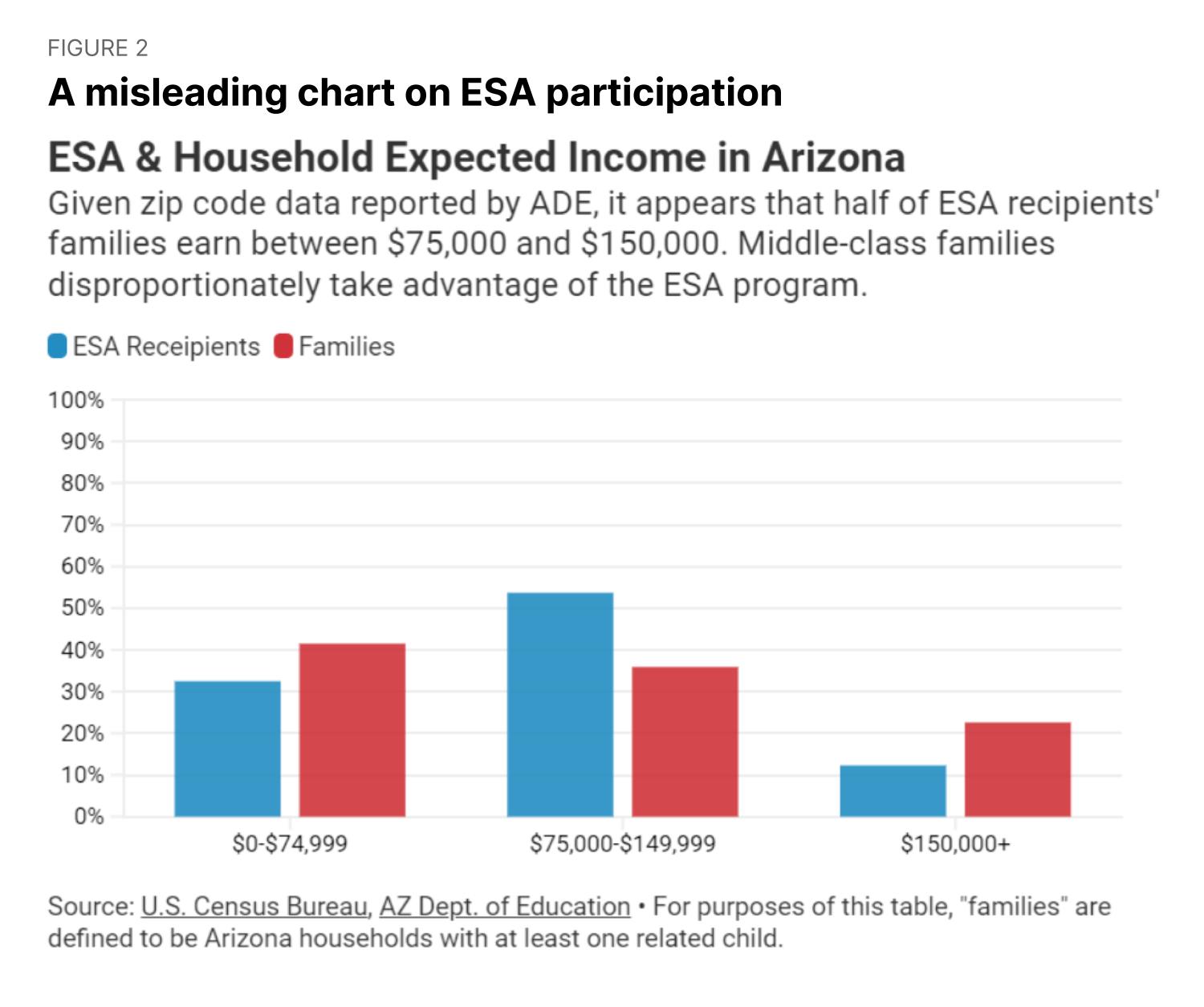
Before we published our post, an organization called the Common Sense Institute (CSI) of Arizona—a “non-partisan research organization” with several staff members from former governor Doug Ducey’s administration—looked into a similar question. CSI’s chart, below, tells a completely different story from our chart. 

A misleading chart on ESA particicpation

CSI makes it look like relatively few wealthy families in Arizona get ESAs. So, why the discrepancy?  

It’s because CSI presented an apples-to-oranges comparison that’s bound to tell that story. The data issue is subtle, but they present ZIP code-level data for ESA recipients (blue bars, on the left) and household-level data for families (red bars, on the right). Many households in Arizona make $150,000 or more, so the far-right, red bar is quite tall. However, few ZIP codes have enough households earning more than $150,000 that the median household income rises above that threshold. As a result, many ESA recipients who earn more than $150,000 aren’t included in the $150,000+ category in this chart. Instead, these households—which earn more than $150,000 themselves but live in ZIP codes where the median income is below $150,000—are included in one of the other blue bars.  

Maybe that’s an innocent mistake, but it’s certainly not an accurate representation of which Arizona residents are getting ESAs. 

Critique 2: We didn’t place Arizona’s ESA program in the proper context of its other school choice programs 

Education Next published an article from Jason Bedrick of the Heritage Foundation that accuses us of omitting key context that, if presented, would markedly change the takeaways from our analysis. Bedrick points out that Arizona’s universal ESA program exists alongside several tax-credit scholarship programs (true) and that families are prohibited from participating in the ESA and tax-credit scholarships simultaneously (also true). He then shares a few numbers, does some hand-waving, and concludes that our “fatally flawed” analysis is deeply misleading because of this omission. 

Curiously, Bedrick doesn’t show the relative size of the ESA and tax-credit scholarship programs in Arizona. Here’s the obvious chart to illustrate that comparison—one that EdNext maybe could have requested before publishing yet another round of Heritage Foundation talking points on ESAs:  

FIGURE 3

These tax-credit scholarship (TCS) programs are small relative to a large-and-growing universal ESA program that’s projected to exceed $900 million this year. On top of that, most TCS dollars are going to recipients above 185% of the federal poverty level—the threshold for reduced-price lunch eligibility. (One note: the most recent numbers available for the ESA program come from FY24, while the most recent numbers available for TCS programs come from FY23.)   

In other words, this critique—which really isn’t about the universal ESA program we analyzed in the first place—doesn’t even point to context that meaningfully changes the interpretation of our data.  

It’s important to emphasize, too, that our analysis was primarily about the high-income households that are obtaining a disproportionate share of Arizona’s ESAs. In that post, we tried to present data in the most straightforward, defensible way possible. If our goal had been to present the most damning data possible, there’s more we’d have said.  

Here’s a doozy of an example. According to U.S. Census Bureau data, Arizona has 300 ZCTAs with at least 250 children under age 18. (The other 60 ZCTAs are smaller, which makes them difficult to analyze.) Of those 300 ZCTAs, the one with the single-highest take-up rate for ESAs (236 of every 1,000 children) is the one with the single-highest median household income (about $173,000).  

Critique 3: Arizona’s ESA program is too new to assess who will participate 

Maybe the most peculiar response we’ve seen is from Mike McShane of EdChoice, who published an op-ed in Forbes.  

McShane appeals to Everett M. Rogers’ “diffusion of innovation” theory, which suggests that new technologies and ideas are adopted sequentially by different groups (from early adopters to laggards). McShane asserts that we should expect wealthier and more educated families to be the early adopters of a universal ESA program. He implores us to “think of the first people to own a personal computer, or a cell phone. They started with tech nerds and the wealthy, and eventually worked their way to everyone else.”  

Let’s play a game of “one of these things is not like the others” with personal computers, cell phones, and a universal ESA program. Yes, we’d expect wealthier families to be the first to buy computers and cell phones. Those things cost a lot of money. A universal ESA program gives you money. We might expect poorer families—with fewer resources and potentially worse public-school options—to jump first at that opportunity. Even the usual dynamic of uneven information diffusion is complicated in this context, as the ESA program was available to families with children in low-rated schools long before it became universal.  

Regardless, there’s reason for concern that vouchers will be more exclusively adopted by the wealthy over time. Jason Fontana and Jennifer Jennings studied the early implementation of a universal ESA account in Iowa. They found that private schools responded to ESA eligibility by increasing their tuition. If this response continues to play out, we might see desirable private schools becoming unaffordable to low-income families that cannot cover a growing gap between the value of their voucher and cost of enrollment. In the long term, this creates a risk of extreme stratification across the public and private sectors.  

Chile may provide a glimpse of that potential future. In a 2006 paper in the “Journal of Public Economics”, Chang-Tai Hsieh and Miguel Urquiola analyzed a universal voucher program in Chile. They found suggestive evidence that “the main effect of unrestricted school choice was an exodus of ‘middle-class’ students from the public sector… [which] had a major effect on academic outcomes in the public sector.” These patterns, along with widening achievement gaps between rich and poor, led Chile to drastically modify that program.   

Critique 4: We’re targeting ESA programs when the real villains are public schools 

A fourth set of critiques presents more conceptual arguments about education reform. Perhaps the most data-infused of these comes from The Goldwater Institute, which notes that Arizona spends a great deal of money to “subsidize public school instruction” for wealthy families. It accuses us (and/or others) of a double standard in how we object to using government funds to pay for wealthy students’ private schooling but not public schooling.  

We think this critique reveals just how far the rhetoric surrounding universal ESAs has drifted from Americans’ traditionally held views about education. Americans have long accepted—in fact, embraced—a double standard for public and private schools. Our public education system, with all its flaws, has been a foundational institution for supporting the country’s economic, social, and democratic well-being. Americans have found a rough consensus on how to approach K-12 education: provide free public schooling to everyone (including the wealthy!), allow families to pay for private education if they’d like to opt out of the public system, and maybe create a few opt-out opportunities via school choice policy for those unable to pay. 

We’ve entered a period in which conservative lawmakers are confronted with legacy-defining decisions about whether to abandon that long tradition and embrace universal vouchers at the risk of kneecapping their states’ public education systems. Worse, they’re doing it in a polluted information environment that has plenty of loud voices but hardly any credible research to guide or support their decision-making. Now that a few states—including Arizona—have taken that risky leap of faith, the least we can ask of other state leaders is to wait and see what happens

Three scholars at the nonpartisan Brookings Institution in Washington published a study of vouchers in Arizona. They began with no preconceptions. They studied who benefits from vouchers. Is the neediest segment of the student population benefitting? No. The answer: the most privileged sector of the population are the prime recipients of vouchers.

The authors are Jon Valant, Jamie Klinenberg, and Nicholas Zerbino, all Brookings scholars.

Please open the link to read the full report.

They write:

Amid a wave of legislation that created or expanded private-school choice programs across the country, Robert Enlow, the President/CEO of EdChoice, dubbed 2023 as “the year of universal choice.” Enlow wasn’t wrong. Universal eligibility is the defining trend in recent private school choice reforms. For decades, private-school choice programs (like vouchers) provided funds only to certain families—e.g., families with low household income or a child with a disability. Recently, however, Republican lawmakers have created or expanded private-school choice programs to allow nearly all students, regardless of their individual need, access to public funding to attend private schools.

Many of today’s programs take the form of education savings accounts (ESAs). Through an ESA program, families receive deposits of government funds in a restricted-use savings account, which they can spend on private school tuition, fees, and other qualifying expenses. ESA programs, though similar in many ways to voucher programs, are relatively new on the scene and haven’t been widely evaluated. Advocates argue that ESAs allow parents to customize their children’s education and create opportunities for families who otherwise might be unable to afford private schooling or other educational expenses. Critics contend that ESA programs lack protections for students and taxpayers. They also contend that ESAs have little track record of success and siphon off funds that would be better spent on public schools. While ESA programs remain young and confined to certain states, they are beginning to account for a sizable share of school funding in some places.

Here, we’ll examine who is getting public funds through Arizona’s Empowerment Scholarship Account, the oldest universal ESA program in the United States. We focus on whether the primary beneficiaries of these programs are families in need—a key question for judging whether universal ESA programs really are addressing inequities in school access.

The evolution of ESAs in Arizona

Arizona was an early adopter of both an education savings account program and, ultimately, a universal education savings account program. In 2011, Arizona launched the Empowerment Scholarship Account program, which allowed qualifying families to obtain the equivalent of 90% of per-pupil funding in an ESA. (Today, most scholarships provide $7,000 to $8,000 annually.) Initially, the program was restricted to students with disabilities and, through legislative action in 2013, capped at a small number of recipients. Over time, eligibility expanded slightly until, in 2022, Arizona lawmakers opened the program to all students, including those already attending private schools. EdChoice touts the current iteration of the program as the “first to offer full universal funded eligibility with broad-use flexibility for parents.”

The point about broad-use flexibility is important. The list of allowable expenses for Arizona’s ESA program is long. It includes everything from tuition and fees to backpacks, printers, and bookshelves. Overall, about 63% of state funds are being spent on tuition, textbooks, and fees at a qualifying school, with “curricula and supplementary materials” (12%) being the next largest expense.

Researchers, state officials, and advocacy groups have raised concerns about the program’s expansion. Some have pointed to wasteful spending from the lightly regulated program, while others have emphasized exploding costsand their potential impacts on public schools. An early report indicated that a disproportionate share of program beneficiaries appeared to be affluent.

A closer look at who is getting ESA funds in Arizona

We looked to publicly available data on Empowerment Scholarship Account recipients to get a clearer picture of who is receiving ESA funds. If, in fact, affluent families are securing the lion’s share of ESA funding, that would raise obvious questions about whether these programs are exacerbating rather than mitigating inequities in school access.

To begin, we took the most recent executive and legislative quarterly report for the program (the 2024 Q2 report). That report lists the number of students enrolled in the program by the recipients’ home ZIP code. We converted those ZIP codes to ZIP Code Tabulation Areas (ZCTAs), which allows us to describe the communities where ESA enrollees reside using U.S. Census Bureau data.1

In the analyses that follow, we compare ESA participation rates by the socioeconomic status (SES) of Arizona communities. We use three measures of SES: poverty rates, median household income, and educational attainment. This allows us to see, for example, whether wealthier or poorer neighborhoods (ZCTAs) tend to receive a disproportionate share of scholarships.

First, we examine ESA participation based on a measure of local poverty: the share of residents receiving public assistance income or SNAP/Food Stamps. For this chart (and others that follow), we divide the Arizona population into deciles, with each bar representing roughly 10% of the state population under the age of 18. In Figure 1, each bar shows the number of ESA recipients per 1,000 people under 18 years old. The leftmost bar represents the parts of the state with the lowest poverty rate (based on ZCTAs); the rightmost bar represents the decile with the highest poverty rate.

We see a clear trend on this measure. As poverty rates increase from left to right, the share of children receiving ESA funding decreases. The highest ESA participation rate—75 ESA recipients per 1,000 children under 18—is for the population decile with the lowest poverty rate. The lowest ESA participation rate—14 ESA recipients per 1,000 children—is for the population decile with the highest poverty rate. (Statewide, we find an average of 45 ESA recipients per 1,000 children.)

Next, we run a parallel analysis based on median household income. This allows us to examine the highest-income areas in ways that a chart based on poverty rates might obscure.

Here, too, the results are clear. As seen in Figure 2, the lowest decile in median income has the lowest rate of ESA participation (20 recipients per 1,000 children), while the highest decile in median income has the highest rate of ESA participation (74 participants per 1,000 children).

When we disaggregate by educational attainment, we see a similar story. Figure 3 shows rates of ESA participation disaggregated by the share of local residents who attended at least some college. ESA receipt is lowest where the fewest people have attended college (14 recipients per 1,000 children). It is highest where the most people have attended college (76 recipients per 1,000 children).

In other words, regardless of the SES measure used (poverty rate, median income, or educational attainment), we see similar patterns in who is obtaining ESA funding. More advantaged communities are securing a highly disproportionate share of these scholarships.

Please open the link to read this short report in full.

Several articles were published calling attention to TV ads run by Republican groups that are phony. The purpose of these ads is to make Biden appear feeble and incompetent.

This article in The Washington Post showed one example. Biden was watching a parachute drop alongside other world leaders at the recent G-7 meeting. The Daily Beast shows the edited video and points out that it got lots of coverage in Murdoch-owned media.

The video shows Biden wandering away from the other leaders, apparently dazed, talking to himself. The leader of Italy tapped his shoulder and he returned to the group.

The actual video showed Biden turning away from the other dignitaries to converse with a paratrooper who was disentangling from his parachute.

But the clipped video did not include the paratrooper, making it appear that he was aimlessly talking to himself.

He was engaged with another human being, asking questions, complimenting him, typical of Biden.

Peter Greene asks and answers a curious question: Why would anyone spend more half a million dollars to win a race for the State Board of Education in Colorado? The money is not coming from the candidate’s bank account. It is coming from unnamed people in the powerful charter school lobby. Right now, the state board has a 5-4 pro-charter majority. One of the five charter supporters is stepping down due to term limits. The charter industry can’t take the risk that someone they don’t control might flip the majority out of their hands.

More than 15% of students in Colorado attend charter schools, one of the highest ratios in the nation. For some reason, the lobbyists representing that small minority of students think they should control the state school board, not people who want to represent the interests of 100% of the state’s students.

As background, be aware that the charter industry fights any effort to require accountability and transparency. They say that any law that requires them to be more accountable or transparent is “an attack” on their right to exist. There used to be a saying that was universally accepted: with public money, there must be public accountability and transparency. But not for the charter industry.

In Colorado, the charter industry has the support of Democratic Governor Jared Polis. He is good on many issues, but not on charter schools. Many years ago, when charter schools presented themselves as “innovative” alternatives to stodgy public schools, Polis sponsored two charters himself and became a charter zealot. Even when it became clear that the charter idea was a Trojan Horse for vouchers and that its backers were right wingers like the Walton family and Betsy DeVos, Polis remained loyal to the original hoax.

Greene writes about the Colorado race in Forbes, where he is a regular columnist:

An ordinarily quiet primary in Colorado finds a Democrat challenged by a candidate with an extraordinary influx of money apparently from charter school backers.

Marisol Rodriguez is in many ways a conventional Democratic candidate. Her website expresses support for LGBTQIA+ students. She’s endorsed by Moms Demand Action For Gun Sense In America, and the Colorado Blueflower Fund, a fund that supports pro-choice women as candidates. Kathy Gebhardt, the other Democratic candidate, is also endorsed by the Blueflower Fund and Moms Demand Action, as well as the Colorado Education Association, Colorado Working Families, Boulder Progressives, and over 65 elected officials.

Rodriguez is running against Gebhardt for a seat on the state board of education, a race she entered at the last minute. The race will be decisive; the GOP candidate has disappeared from the race, so the Democratic primary winner will run unopposed in the general election.

Gebhardt has served on a local school board as well as the state and national association of school board directors, rising to leadership positions in each. She’s an education attorney (the lead education attorney on Colorado’s school finance litigation) whose five children all attended public schools. Asked for her relevant experience by Boulder Weekly, Rodriguez listed parent of two current students and education consultant.

Besides a major difference in experience, one other difference separates the two. Gebhardt was generally accepting of charter schools while she was a board member, but she drew a hard line against a proposed classical charter, linked to Hillsdale College’s charter program, that would not include non-discrimination protections for gender identity and expression. She told me “charters don’t play well with others.” While Rodriguez has stayed quiet on the subject of charter schools, her allegiance is not hard to discern.

Rodriguez’s consulting firm is Insignia Partners. She has previously worked for the Walton Family Foundation, a major booster of charter schools. Her clients include Chiefs for Change, a group created by former Presidential aspirant Jeb Bush to help promote his school choice policies; the National Alliance for Public Charter Schools, an advocacy group for charter schools and charter school policy; and the Public Innovators in Education (PIE) Network, a national network of education reform organizations.

Some of that consulting work appears to have been with the Colorado League of Charter Schools. A February meeting of that board shows her discussing some aspects of CLCS strategic planning.

There’s plenty for CLCS to deal with. Colorado spent the spring debating HB 1363, a bill that would have required more transparency and accountability from charter schools. Critics call it “a blatant attack on charter schools.” Heavy duty lobbying efforts have been unleashed to battle this bill, including work by the Betsy DeVos-backed American Federation for Children, as reported by Mike DeGuire for Colorado Newsline.

It is no surprise to find Republicans in Colorado supporting charter schools; this is, after all, the state where the GOP issued a “call to action” that “all Colorado parents should be aiming to remove their kids from public education.”

But Democratic Governor Jared Polis, a former member of the state board of education, has also been a vocal supporter of charter schools. And now he is also a vocal supporter of Rodriguez and features in many of her campaign images.

Support from CLCS is more than vocal. The Rodriguez campaign has received at least $569,594 from Progressives Supporting Teachers and Students. PSTS filed with the state as a non-profit on May 21, 2024; on May 23 CLCS donated $125,000 to the group according to Tracer (Colorado’s campaign finance tracker).

The registered and filing agents of PSTS are Kyle DeBeer and Noah Stout. DeBeer is VP of Civic Affairs for CLCS and head of CLCS Action, the CLCS partner 501(c)(4). Noah Stout is a member of the Montbello Organizing Committee, a group that receives money through various foundations that support charter schools, including the Gates Foundation and RootEd, and previously served as attorney for the DSST charter school network in Denver. The address for PSTS is the address for 178 other organizations.

It appears that CLCS created and funded Progressives Supporting Teachers and Students for this election.

The $569,594 are listed on Tracer as PSTS’s only expenditures as of the beginning of June. They consistent entirely of payments for Rodriguez-supporting consultant and professional services to 40 North Advocacy and The Tyson Organization (Tracer shows that CLCS has employed both before). The money has paid for video advertising, digital advertising, phone calling, newspaper advertising, and multiple direct mailings.

When he wrote the article, Greene could not discern who put up the money. No doubt, the usual anti-public school rightwingers with a few pseudo-liberals like Bill Gates or their front groups.

It is typical of the charter industry to name its lobbying group with a deceptive name, so of course they name themselves “Progressives Supporting Parents and Teachers,” when in reality they are “Highly Paid Consultants Advancing the Charter Industry.” Or, HPCACI.

There is nothing “progressive” about the charter industry. They are not more successful, on average, than public schools. They are a foot in the door for vouchers. They are beloved by rightwingers who see them as the first nail in the coffin for public schools. They claim to be “public schools,” but resist the accountability and transparency required of real public schools. Their lobbyists in Washington and in the states are funded by billionaires who want to privatize everything. They swamp state and local school board races with out-of-state dark money, making it hard for regular people to compete.

Will the charter lobby buy that crucial seat on the Colorado State board of Education? The Democratic primary for the State Board of Education is June 25.

For years, Pennsylvania has funded a large number of cybercharters. Hundreds of millions of taxpayer funding flows to cybercharters annually. For years, the state has known the very poor educational results of these online charter schools. Yet the state continues to fund them. Why?

PDE has released 2022-2023 school performance data
Here’s what those ubiquitous cyber charter ads (that your tax dollars pay for) don’t tell you:
Entries in red are 20 percentage points or more below statewide averages.

Michelle Davis writes a blog called Lone Star Left, where she opines on the struggle to reverse the hold of fascists on the state of Texas. She previously reported on the state convention of the Texas GOP, which cherishes the “right to life” for fetuses but wants to impose the death penalty on women who seek or obtain an abortion. Women who want an abortion apparently have NO right to life.

In this post, Davis reports on the Texas Democratic Party platform, which is the polar opposite of the GOP. She loves it!

She writes:

Okay, we’re finally to it. The Texas Democratic Party Platform and the proposed changes went through the Platform Committee. The Texas Democratic Party (TDP) platform is a critical document that outlines the party’s values, principles, and policy goals. It serves as a roadmap for Democratic candidates and elected officials, providing a clear vision for the future of Texas. The platform reflects the collective voice of party members and sets the agenda for the party’s legislative priorities.

The platform also plays a significant role in mobilizing voters. It provides a comprehensive guide to what the Democratic Party stands for, making it easier for voters to understand its positions on critical issues. (Or at least that’s how it’s supposed to work.)

If you missed the previous articles about the TDP’s updated rules and resolutions: 

Personally, I love the Texas Democratic Party Platform and have kept up with its evolution over the years. The previous platform is online, which you can see here: 

Loving a party platform? That’s weird. 

Earlier this week, I was mindlessly scrolling on TikTok, and I came across some dipshit from Los Angeles who has several hundred thousand followers; her video was all about how “both parties are the same,” and she was discouraging people from voting. The privileged position of living in a blue state, right?

People like this piss me off because NO Democrats and Republicans are not the same. 

While the Republican Party of Texas debated giving women who have abortions the death penalty, this week, the Texas Democratic Party added a platform plank that says, “Restore the right of all Texans to make personal and responsible decisions about reproductive health.”

Republicans want unfettered end-stage capitalism with no healthcare, no public education, no Social Security, no Medicaid, and vast wealth inequality. Democrats want universal healthcare, well-funded public education, robust social safety nets, and economic equality.

The Texas Democratic Party platform is a testament to our commitment to creating a fairer, more just society for all Texans. Seeing such misinformation spread online is frustrating, especially when it can lead to voter apathy. However, our platform represents a clear and progressive vision for the future.

It’s a comprehensive document outlining our priorities for a better Texas. We must continue to show these differences between the blue and the red to counteract the cynicism and misinformation that is prevalent today.

What are some of the positive highlights? 

Education:

The platform changes maintained the emphasis on protecting and improving Texas public education. They also retained strong language prohibiting school choice scams, such as using vouchers, including special education vouchers, and opposed these programs. The platform kept the requirement that every class have a teacher certified to teach that subject. It clarified that teachers should not be expected to provide financial support through classroom supplies and other essentials at their own expense.

Some of the planks I thought were good: 

  • Oppose discriminatory policies affecting special education funding. (It’s an ongoing problem in the Republican-led legislature.)
  • Offer dual credit and early college programs that draw at-risk students into vocational, technical, and collegiate careers.
  • Ensure all public school children are provided free school meals.

Higher education:

The TDP platform includes several favorable planks in higher education to make college more accessible and affordable. These include advocating for student loan debt relief, providing free college tuition for low-income qualified students, and offering paid internships and debt-free apprenticeship programs. Additionally, the platform supports eliminating standardized testing requirements like the SAT and ACT for college admissions.

Voting and elections:

The platform supports electronic voting systems that utilize paper backups and an auditable paper trail, ensuring election integrity. This particular plank led to some debate. While some supported it for ensuring election integrity, others were wary of potential vulnerabilities and preferred more traditional voting methods. Ultimately, it passed. 

Another fundamental plank supported the establishment of a limit on campaign donations in Texas elections to ensure fairness and transparency. We badly need campaign finance reform in Texas. Democrats see this need and are taking it seriously. 

They also supported establishing a code of judicial ethics for the Supreme Court of the United States and efforts to recalibrate the court by tying the number of justices to the number of federal circuit courts (13).

The Case For Expanding The Supreme Court

The Case For Expanding The Supreme Court

MICHELLE H. DAVIS

·FEB 14 Read full story

Healthcare:

If you missed my previous article, the Texas Democratic Party Resolution supports universal healthcare. This has also been part of their platform for several years. Unfortunately, we’re still fighting for basic healthcare access in Texas, so it’s a part of the Texas Democratic Party platform that doesn’t get enough attention. 

Here are some (not all) other interesting planks added this year: 

  • Protect doctors and hospitals from politically motivated attacks that hinder them from providing the best care possible.
  • Legalize and expand access to harm reduction supports such as fentanyl testing strips, Narcan, and safe syringe programs.
  • Support policies that reduce pollution and protect clean air and water.
  • Ensure that veterans have access to high-quality mental health services and support for substance use disorders.

Reproductive healthcare:

We all know what the GOP is doing. Besides restoring the right of Texans to make personal and responsible decisions about reproductive health, other new TDP platform planks include: 

  • Protect the right to access in vitro fertilization (IVF) treatment.
  • Uphold the right to travel to another state for legal medical services.
  • Offer comprehensive, age-appropriate sex education.
  • Hold medical providers accountable for withholding information about a pregnancy based on their presumption that the pregnancy would be terminated.
  • Safeguard reproductive health and gender-based care patient privacy, including protection from law enforcement.

The environment and climate. 

Sometimes, I wonder if we spend enough time talking about this issue. It’s terrible right now, and the next several months could bring devastating weather.

Issues regarding the environment and climate change are life-threatening, and with Texas being the number one producer of greenhouse emissions in America, it’s an issue that Texans should take very seriously. 

The new planks, which add to the TDP’s previous commitments to clean energy, address many of these concerns. Including supporting policies that develop clean energy resources, promoting alternative fuel vehicles, promoting more energy-efficient buildings and appliances, streamlining the permitting process for building new electric transmission lines, and adding charging stations for electric cars at all state highway rest stops.

Dawn Buckingham, the Texas Land Commissioner, and oil and gas shill has promised to fight the federal administration from connecting offshore windmills to Texas. However, the TDP platform supports federal legislation to share offshore wind lease and production revenues with Texas and other states, incentivizing state and local governments to facilitate successful siting processes and funding coastal infrastructure and flood resiliency projects.

They also emphasized creating and enforcing stringent state and federal regulations on oil and gas operations, including methane release monitoring and enforcement without exceptions.

All of these planks are fantastic, and maybe by the time the 2026 Convention rolls around, we’ll be ready to add support for legislation that holds fossil fuel companies responsible for climate change

Criminal justice reform.

The TDP platform includes significant changes in the criminal justice reform plank, stressing a more humane approach to law enforcement. The platform proposes raising the minimum age of criminal responsibility from 10 to 13 years, ending the prosecution of juveniles in adult courts, and closing the remaining youth prison facilities while investing in community infrastructure to support children. Additionally, it aims to enforce the constitutional mandate against imprisoning individuals for debt, promote alternatives to incarceration for non-threatening offenses, and eliminate mandatory minimum sentences to allow for judicial discretion—notably, the platform advocates for abolishing the death penalty and instituting a moratorium on executions.

There is more. Open the link to finish her post.

What happens in Texas doesn’t stay in Texas. It spreads to other GOP extremists. Stay informed.