Wisconsin Public Radio reported that State Superintendent Jill Underly has announced that the state will not comply with a letter from U.S. Secretary of Education Linda McMahon in which she directed states to agree with the Trump administration about stamping out diversity, equity, and inclusion. Trump wants to eliminate DEI, which would involve reversing compliance with existing civil rights law. In addition, although McMahon may not know it, she is violating federal law by attempting to influence curriculum and instruction in the schools.
Thank you, Superintendent Underly!
WPR reported:
Wisconsin school districts won’t comply with a directive from the Trump administration to eliminate diversity, equity and inclusion programs until districts have more information.
On Wednesday, state Superintendent Jill Underly asked the U.S. Department of Education for clarification on both the intent and legality of an April 3 directive that schools sign a letter acknowledging they’re following the government’s interpretation of civil rights laws.
This school year, Wisconsin received about $216 million in Title I funds. About $82 million of that money went to Milwaukee Public Schools.
Underly said the request from the Department of Education potentially violates required procedural steps, is unnecessarily redundant and appears designed to intimidate school districts by threatening to withhold critical education funding.
“We cannot stand by while the current administration threatens our schools with unnecessary and potentially unlawful mandates based on political beliefs,” Underly said in a statement. “Our responsibility is to ensure Wisconsin students receive the best education possible, and that means allowing schools to make local decisions based on what is best for their kids and their communities.”
On Feb. 14, the U.S. Department of Education sent a “Dear Colleague” letter giving educational institutions 14 days to eliminate diversity initiatives or risk losing federal funding.
At that time, the state DPI issued guidance to school districts encouraging a “measured and thoughtful approach, rather than immediate or reactionary responses to the federal government’s concerns.”
Secretary of Education Linda McMahon has not clearly defined what the administration considers a violation of civil rights law. The February letter said institutions must “cease using race preferences and stereotypes as a factor in their admissions, hiring, promotion, scholarship.”
In a related document addressing frequently asked questions about how the administration would interpret Title VI of the Civil Rights Act of 1964, the agency said: “Many schools have advanced discriminatory policies and practices under the banner of ‘DEI’ initiatives.”
The document went on to say that schools could engage in historical observances like Black History Month, “so long as they do not engage in racial exclusion or discrimination.”
Trump administration officials have described the men deported to El Salvador prisons last month as “the worst of the worst,” suggesting they were gang members involved in murder, rape and kidnapping.
The reality is that of 238 migrants — mostly Venezuelan — that officials accused of belonging to the Tren de Aragua gang and expelled to the Central American country in mid-March, just a small fraction had ever been charged with serious crimes in the US.
Hundreds of pages of US legal records and American government statements reviewed by Bloomberg News found five men charged with or convicted of felony assault or firearms violations. Three men were charged with misdemeanors including harassment and petty theft. Two others were charged with human smuggling.
For the rest of the men, there was no available information showing they committed any crime other than traffic or immigration violations in the US.
The findings raise questions about how the Trump administration determined that the migrants sent to El Salvador were violent criminals. The US maintains that all of the Venezuelans on the flights had committed a crime because they were in the country illegally, a senior official with the Department of Homeland Security said in an interview.
There is more to the story. When I read it, it was not behind a paywall. No guarantees.
Trump is following through on his frequent threats to punish anyone who crossed him in the past. He recently ordered his compliant Attorney General to investigate two men who were critical of him during his first term. Elie Honig, a former federal prosecutor, wrote about the tyrannical nature of this action and about Pam Bondi’s willingness to do whatever he wants.
Donald Trump’s presidential payback tour rages on, and now it’s personal. It’s one thing to target multi-billion dollar law firms, universities, and media outlets for organizational retribution; those efforts, aimed at stifling and punishing any criticism or dissent, are reprehensible in their own right. But now Trump is going after individual private citizens, using the might of the Executive Branch to potentially throw his detractors in prison.
In a pair of official proclamations – rendered no less unhinged by the use of official fonts and White House letterhead – Trump identifies two targets who worked in the federal government during his first tenure and dared to speak out publicly against him. First: Chris Krebs, who led the Cybersecurity and Infrastructure Security Agency from 2018 to 2020 and made headlines when he publicly contradicted Trump’s false claim that the 2020 presidential election was stolen. For this act of heretical truth-telling, Trump labels Krebs “a significant bad-faith actor” – whatever the hell that means – who poses grave “risks” to the American public.
And then there’s Miles Taylor, a former Department of Homeland Security official who publicly criticized the President in an anonymous book and various media appearances. Taylor, like Krebs, purportedly poses “risks” to the United States, is a “bad-faith actor” (though apparently not a significant one like Krebs) and “stoked dissension” with his public commentary.
Are you scared? Don’t you fear the “risks” posed by these two monsters?
True to the form he has displayed when going after disfavored law firms, Trump hits below the belt. The President orders security clearances stripped not only from Krebs and Taylor but also from everyone who works with them (Krebs at a private cybersecurity firm, Taylor at the University of Pennsylvania). He’s punishing his targets – plus their employers and colleagues, First Amendment freedom of association be darned.
It gets worse. In a separate set of orders, Trump directed the Attorney General to open criminal investigations of Krebs and Taylor. Notably absent from the orders is any plausible notion that either might have committed a federal crime. This hardly needs to be said, but it’s not a federal crime to be a “bad-faith actor,” to “stoke dissension,” or even to be a “wise guy,” as Trump called Krebs from the Oval Office.
The next move is Pam Bondi’s – and we know how this will go.
Any reasonable, ethical attorney general would follow the bedrock principle that a prosecutor must have “predication” – some kernel of fact on which to believe a crime might have been committed – to open a criminal investigation. The bar is low, but it serves the vital purpose of preventing precisely the baseless retributive inquests that Trump has now ordered up. In observance of this foundational precept, even Bill Barr – the subject of sharp criticism in my first book, Hatchet Man – generally ignored Trump’s public pleas for the arrests of Barack Obama, Joe Biden, and others. Like the exhausted parent of an unruly toddler, Barr would mostly sit back and let the tantrum pass.
Don’t count on Bondi taking the same course of passive resistance to the President. She has already shown her true colors, and they’re whatever shade Trump pleases. For example, despite the distinct possibility of criminality by top administration officials around the Signal scandal, the AG refused even to investigate. Instead, she decreed – after zero inquiry, with zero evidence – that information about military attack plans was somehow not classified, and that nobody had acted recklessly. Case closed, no inquiry needed.
Bondi no longer deserves the benefit of the doubt. She’s in the bag for Trump. The question now is whether she’ll cross the line that even Barr, her crooked predecessor, would not, and use the Justice Department’s staggering investigative power as an offensive weapon.
Even if DOJ investigates but concludes it cannot bring a criminal charge, the threat to Krebs and Taylor is real. Any criminal inquiry takes an enormous toll on its subject; subpoenas fly, friends and colleagues get pulled into the grand jury, phones get seized and searched, legal costs mount, professional reputations suffer, personal ties fray. Ask anyone who has been investigated by the Justice Department but not indicted. They’ll tell you it’s a nightmare.
If Bondi does somehow convince a grand jury to indict somebody for something, Trump has unwittingly handed both Krebs and Taylor a potent defense: selective prosecution, which applies where an individual has been singled out for improper purposes. Exhibit A (for the defense): Trump’s own grand proclamations, which openly confess to his personal and political motives for ordering a Justice Department inquiry. Selective prosecution defenses rarely succeed, often because prosecutors typically don’t commit their improper motives to paper. But this would be the rare case where the evidence is so plain – it’s on White House letterhead, signed by the President – that a judge could hardly overlook it.
Trump has long made a habit of threatening his opponents with criminal prosecution through social media posts and by spontaneous outbursts from the lectern. Until now, it was mostly bluster, a public form of scream therapy for the capricious commander-in-chief. But now it’s in writing, from the president to the attorney general, who typically jumps to attention to serve whatever suits the boss, prosecutorial standards be darned. Trump’s dark fantasies are coming to life.
Elie Honig served as an Assistant U.S. Attorney in the Southern District of New York for 8.5 years and as the Director of the Division of Criminal Justice at the Office of Attorney General for the State of New Jersey for 5.5 years. He is currently a legal Analyst for CNN and Executive Director at Rutgers Institute for Secure Communities
David Sanger wrote an article in the New York Times about Trump’s “Experiment in Recklessness.” His plan is no plan at all. His approach is no more than “burn-it-down-first,” figure what to do later. His article appeared on Wednesday, before Trump announced a 90-day pause in his incomprehensible plan to tax every nation–even uninhabited islands–but exempt Russia, Belarus, North Korea, and Cuba. Even desperately impoverished Lesotho–where the average pay is $5 a day–was subject to Trump’s tariffs.
Our government is run by a cabal of people who are either evil or stupid or both. Probably both. People will die and are dying now because of their actions. Government agencies are being ripped apart. A generation of scientists has been ousted from important jobs in the government and in universities, where their federal grants have been terminated. All federal efforts to address climate change have been cancelled.
Where Trump goes, chaos , destruction and death go with him.
Sanger writes:
As the breadth of the Trump revolution has spread across Washington in recent weeks, its most defining feature is a burn-it-down-first, figure-out-the-consequences-later recklessness. The costs of that approach are now becoming clear.
Administration officials knew the markets would dive and other nations would retaliate when President Trump announced his long-promised “reciprocal” tariffs. But when pressed, several senior officials conceded that they had spent only a few days considering how the economic earthquake might have second-order effects.
And officials have yet to describe the strategy for managing a global system of astounding complexity after the initial shock wears off, other than endless threats and negotiations between the leader of the world’s largest economy and everyone else.
Take the seemingly unmanaged escalation with China, the world’s second largest economy, and the only superpower capable of challenging the United States economically, technologically and militarily. By American and Chinese accounts, there was no substantive conversation between Mr. Trump and China’s top leader, Xi Jinping, or engagement among their senior aides, before the countries plunged toward a trade war.
Last Wednesday, Mr. Trump’s hastily devised formula for figuring out country-by-country tariffs came up with a 34 percent tax on all Chinese goods, everything from car parts to iPhones to much of what is on the shelves at Walmart and on Amazon’s app.
When Mr. Xi, predictably, matched that figure, Mr. Trump issued an ultimatum for him to reverse the decision in 24 hours — waving a red flag in front of a leader who would never want to appear to be backing down to Washington. On Wednesday, the tariff went to 104 percent, with no visible strategy for de-escalation.
If Mr. Trump does get into a trade war with China, he shouldn’t look for much help from America’s traditional allies — Japan, South Korea or the European Union — who together with the United States account for nearly half of the world economy. All of them were equally shocked, and while each is negotiating with Mr. Trump, they seem in no mood to help him manage China.
“Donald Trump has launched a global economic war without any allies,” the economist Josh Lipsky of the Atlantic Council wrote on Tuesday. “That is why — unlike previous economic crises in this century — there is no one coming to save the global economy if the situation starts to unravel.”
The global trading system is only one example of the Trump administration tearing something apart, only to reveal it has no plan for how to replace it.
State Department officials knew that eliminating the U.S. Agency for International Development, the nation’s premier aid agency, would inevitably cost lives. But when a devastating earthquake struck central Myanmar late last month and took down buildings as far away as Bangkok, officials scrambled to provide even a modicum of help — only to discover that the network of positioned aid, and the people and aircraft to distribute it, had been dismantled.
Having dismantled a system that had responded to major calamities before, they settled on sending a survey team of three employees to examine the wreckage and make recommendations. All three were terminated from their jobs even while they stood amid the ruins in the ancient city of Mandalay, Myanmar, trying to revive an American capability that the Department of Government Efficiency — really no department at all — had crippled.
Secretary of State Marco Rubio was unapologetic about the paltry American response when he talked to reporters on Friday: “There are a lot of other rich countries, they should also pitch in and help,” he said. “We’re going to continue to do our part, but it’s going to be balanced with all of the other interests we have as a country.”
Similarly, there was no plan for retrieving a Maryland man who was wrongfully deported to a notoriously dangerous Salvadoran prison, a move a judge called “wholly lawless” and an issue the Supreme Court is expected to take up in the next few days. A Justice Department lawyer in the case was placed on administrative leave, apparently for conceding that the man never should have been sent to the prison.
Mr. Trump has appeared mostly unmoved as the knock-on effects of his policies take shape. He has shrugged off the loss of $5 trillion in the value of the American markets in recent days. Aboard Air Force One on Sunday night, he said: “Sometimes you have to take medicine to fix something.”
To finish reading the article, click here. It should be a gift article.
Friends, we are in a whole lot of trouble. Trump is not a businessman. He played one on TV. He is a performer. He is in way over his head. He called Elon Musk a “genius.” Musk called Trump’s trade advisor Peter Navarro “a moron.” Trump allowed Musk to tear almost every federal agency apart, destroying vital programs and firing essential personnel.
We have to push back as hard as we can. Trump and his minions have retreated on some of their stupid actions (like purging Harriet Tubman and the Jnderground Railroad of its role in helping slaves escape). Little victories like this should encourage wider protests against the chaos that Trump has unleashed. Is he doing it for Putin’s benefit? Does he suffer from dementia?
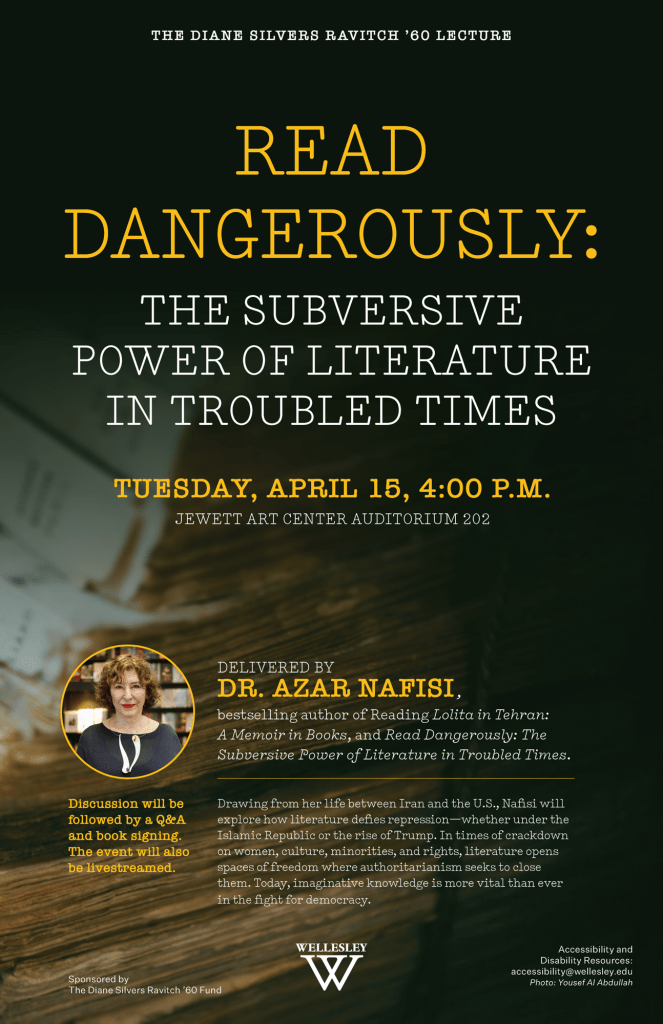
Only yesterday, I posted a notice about the planned lecture by Dr. Azar Nafisi at Wellesley College on April 15.
Overnight, we agreed that the lecture would be postponed because of a non-tenure track faculty strike on campus. I fervently hoped the strike would be finished before the lecture, but the two sides are currently not close to a settlement.
Non-tenure track faculty voted to unionize as the Wellesley Organized Academic Workers, or WOAW with the United Auto Workers. The strike began March 27.
Dr. Nafisi will not cross a picket line, and neither will I.
Dr. Azar Nafisi, author of the mega-bestseller Reading Lolita in Tehran, will speak at Wellesley College on April 15 at Wellesley College at 4 p.m. in the Jewett Arts Center. Admission is free.
Please mark the date on your calendar. She is speaking in a lecture series that I endowed several years ago. The lecture will be available eventually on the archive website of the College.
The book, which was a sensation upon its publication for its depiction of life under the mullahs, has recently been made into a film.
This review of the film was published by The Atlantic and written by Arash Azizi. At present, the film can be seen only at film festivals.
He wrote:
The past few years may well be remembered as the nadir of Iranian-Israeli relations, and the first occasion when the two countries attacked each other directly. But they were also a golden period for Iranian-Israeli collaboration in cinema. In 2023, Tatami was the first-ever film to be co-directed by an Israeli (Guy Nattiv) and an Iranian (Zar Amir). And in 2024 came Reading Lolita in Tehran, directed by Eran Riklis, who is Israeli, and adapted from a book by an Iranian author, with an almost entirely Iranian cast. The film premiered at the Rome Film Fest last year and is now starting to tour the United States.
Anyone old enough to remember cultural life at the beginning of this century will know the book. Azar Nafisi’s memoir came out in 2003, spent 36 weeks on the New York Times best-seller list, and quickly developed a cult following. A reviewer for The Nation confessed to missing a dental appointment, a business lunch, and a deadline just because she couldn’t put the book aside.
Literary scholars—Nafisi is an English professor—are not known for their page-turning thrillers. But Nafisi’s story and prose are captivating. She’d gone to Iran shortly after the 1979 revolution in the hope of putting her American education to use by teaching English at a university. Instead, she was hounded out of the classroom by authorities hostile to Western literature. She wound up holding clandestine seminars for young women in her living room, delving into the masterpieces that the Islamic Republic forbade: the Vladimir Nabokov novel that gives the memoir its name, alongside the works of Henry James and Jane Austen, as well as one of Nafisi’s favorites, F. Scott Fitzgerald’s The Great Gatsby. Nafisi brings these classics into dialogue with the real-life stories of young Iranians in the heady decades following the 1979 revolution. Her book isn’t just about reading and teaching literature under a repressive regime, but about how literature in and of itself could serve as an antidote to all that the regime stood for.
Despite its global fame and translation into 32 languages, Reading Lolita in Tehran was never turned into a film before now, mostly because Nafisi didn’t like the proposals she’d received. Then, seven years ago, Riklis came around, as he recounted to a New York audience on January 13, after a special screening of the film. The Israeli director managed to convince Nafisi of his vision—and then to secure the funding, assemble a suitable Iranian cast, and settle on Rome as the shooting location, given that Tehran was not an option.
When the book was initially released in 2003, the American zeitgeist, shaped by 9/11 and the Bush administration’s global War on Terror, was rife with debates about the representations of Muslim women and life in the Middle East. Nafisi’s was one of several popular memoirs by Iranian women published during this period, including Firoozeh Dumas’s Funny in Farsi (2003) and Marjane Satrapi’s Persepolis series (2000–03). And perhaps inevitably, given its success, Nafisi’s book became the subject of political scrutiny, much of it bearing little relation to the book’s content. Although Nafisi opposed the Iraq War, some critics lumped her in with neoconservatives because she portrayed the travails of Iranians under an anti-American regime. One scholar even proclaimed that he saw no difference between her and American soldiers convicted of abusing prisoners in Iraq.
More than 20 years later, Riklis’s loyal adaptation has opponents just as the book did, and even more so because of the nationality of its director. In Tehran, the regime media have denounced the film as furnishing a “pretext for attacking Iran” and called its Iranian actors “traitors working with Zionists.” One outlet claimed that the film peddled a “violent, anti-culture, anti-art, and anti-human view of Iran and Iranians.”
The idea that Reading Lolita in Tehran is anti-Iranian because of its portrayal of the Islamic Republic, and of the life of women under its rule, was always patently ridiculous. The claim bears up particularly poorly in 2024, two years after women-centered protests rocked Iran under the slogan “Women, Life, Freedom.” What Nafisi does best, and the reason her work has endured, is precisely to refuse cartoonish portrayals and basic morality plays.
In Riklis, known for his empathetic depiction of Israelis and Palestinians in films such as Lemon Tree and Dancing Arabs, her book finds an able interpreter who has stayed true to its ethos. The film isn’t neutral. It vividly tells the story of how puritanical Islamist goons attacked universities in the early years after 1979, imposed mandatory veiling on women, and banned books they didn’t like. But neither is it a simple story of scary Islamists versus heroic women resisters.
The film captures the atmosphere of Iran in the 1980s and ’90s remarkably well for having been shot in Italy and directed by an Israeli who has never set foot in the country. The dialogue is mostly in Persian, a language Riklis doesn’t speak; he was able to pull this off with the help of a carefully chosen cast of diasporic Iranians. Golshifteh Farahani, perhaps the best-known Iranian actor outside the country, is at her height as Nafisi, whom she plays as confident but humane, by turns brazen and vulnerable.
The young women of the clandestine class include Sanaz (Zar Amir), who has survived imprisonment and torture; Mahshid (Bahar Beihaghi, in one of the film’s most delightful performances), who, unlike most of her classmates, wore the Islamic veil even before the revolution and defends an ideal of modesty as virtue; and Azin (Lara Wolf), whose multiple divorces make her an object of fascination to the less experienced students, but who turns out to be suffering from domestic abuse.
In Nafisi’s apartment, the students are far from the prying eyes of the regime and also of men (even the professor’s husband is barred from their meetings). They construct for themselves, in that all-female room, a little literary republic that survives the years of war and revolution. In one memorable scene, Nafisi has the students practice a Jane Austen–era dance as part of their study of Pride and Prejudice, drawing parallels between the stifling rules of courtship in Victorian England and those of some contemporary families in Iran.
The film also ventures beyond that cloistered space. Bahri (Reza Diako), a devout 1979 revolutionary, is nevertheless an avid student in Nafisi’s class at the university before it is shut down. Despite their diametrically opposed politics, Nafisi and Bahri form a bond. Early in the story, she tells him his essay on Huckleberry Finn is the best she’s ever received from a student, even in America. The two reconnect when Bahri returns from the Iran-Iraq War of 1980–88, having lost an arm. He has used his family connections to the regime to obtain a surprise gift for his old professor: two tickets to The Sacrifice, by Andrei Tarkovsky, showing at the Tehran film festival. The connection between Nafisi and Bahri is presented with complexity and without sentimentality, neither papering over political differences nor caricaturing Bahri as a generic revolutionary.
In this way, both film and book avoid didacticism. And in doing so, they demonstrate exactly the point Nafisi explores with her students, which is the power of literature to stir empathy across seemingly unbridgeable divides. When the group discusses The Great Gatsby, Nafisi insists on understanding the forbidden love that Daisy Buchanan, the married socialite, has for Jay Gatsby as a true human feeling, not a symbol of Western perfidy, as some of her more revolutionary students claim it to be. The latter advocate banning the book. Nafisi organizes a mock trial for the novel in her class, with students divided into teams for and against.
Nafisi calls on students on both sides of the political divide to treat each other with humanity. When she catches some in her class expressing glee at the wartime deaths of pro-regime peers, she enjoins them not to become like their oppressors. And she is no dogmatic opponent of Islam, only of religiously inspired repressive government: At one point Nafisi tells Bahri, “My grandmother was the most devout Muslim I knew. She never missed a prayer. But she wore her scarf because she was devout, not because she was a symbol.” (I am not the only critic with a Muslim background who found this line powerful.)
The point here isn’t just to repeat the liberal platitude that “the problem isn’t with Islam but with its repressive enforcement.” Rather, Nafisi is rejecting the revolutionaries’ tendency to treat all that surrounds them as a field of symbols. People are worth more than that, she tells them and us, as though echoing the Kantian dictum to treat one another “as an end, never merely as a means.”
This message about the humane power of literature makes Reading Lolita in Tehran a work of art rather than an exercise in sloganeering. And the fact that now, more than two decades after the book’s release, and at a time of regional tension, an Israeli filmmaker has worked with Iranians to adapt Nafisi’s book to the screen gives the film a special power.
The audience at the screening I attended, at a Jewish community center on the Upper West Side, included American Jews, Israelis, and Iranians. What we had in common was the experience of being gripped by a story about the capacity of literature to reveal us to one another as ends rather than as means. The setup might sound mawkish. But I recommend avoiding the temptation of cynicism and embracing the film as truly one for these times.
Trump signed an executive order declaring all state laws that address climate change to be null and void. He claims that efforts to protect the environment are a hindrance to energy production. So ignoring climate change is important to national security because we need oil and gas more than we need clean air and water.
Remember when Trump said he was eliminating the Departnent of Education because states should manage their own schools and the federal government should get out of the way? Why can’t states make decisions about clean air, clean water, and auto efficiency?
Trump’s tariffs are getting blowback from some of his rightwing allies. Elon Musk called tariff-lover Peter Navarro “a moron.” Several Republican Senators expressed their opposition to tariffs at a Senate hearing. The National Review tore into Trump’s tariffs and his imperial behavior:
It wrote:
If it seems preposterous that a single person could enjoy this much power over the American economy — and, with it, the global economy — rest assured that it is. In Article I, the Constitution vests the “power To lay and collect Taxes, Duties, Imposts and Excises” in Congress, not in the president. As a result, the president has no power to impose tariffs that he has not been accorded by an act of the legislature. If it desires, Congress can choose to take back as much of that power as it sees fit. It ought to do so — and do so now.
That the Founders placed the power to tax, tariff, and legislate in the hands of the legislature, instead of the executive, was not an accident. On the contrary: This allocation sat at the very core of the system that they designed. Because legislatures play host to a diverse cast of characters — characters who have different views, are elected by different groups, and come from different regions — they are less prone to dogmatism, caprice, and flightiness than are monarchs, presidents, or emperors. Especially within the United States, where the Senate often checks the passions of the House, the procedural challenges that result from this tend to ensure that only those proposals that enjoy broad purchase among the citizenry’s representatives are able to become law. This arrangement has two chief benefits. First, it guarantees that the ideas under consideration will be subject to serious criticism and debate. Second, it makes it difficult to alter the status quo on a whim — which, in turn, makes it easier for the people to understand the laws under which they live.
This predictability is useful in all areas of civic life. But it is especially beneficial in the financial realm, where stability is imperative. Businesses, investors, workers, and families are all aided enormously by a reliable comprehension of what their tax rates, operating rules, regulatory liabilities, and tariff exposures are likely to be for the foreseeable future. When those variables are determined by Congress, the debates that inform them are transparent and the laws that result are built to endure. When those variables are determined by the president, the debates that inform them are opaque and the law is liable to change radically from day to day. In essence, the case for Congress fulfilling its responsibilities is the same as the case for written law per se: No free man wants to be at the mercy of a king.
In his vendetta against law firms who represented his opponents, universities whose high standards offend him, and anyone who dared to stand up to his lies, Trump has selected two former government employees for retribution. These actions are typical of dictators. Trump is wannabe dictator. He certainly aspires to be a full-fledged fascist. He has a compliant Departnent of Justice. Attorney General Pam Bondi thinks she works for Trump, not the people of the United States.
President Trump on Wednesday signed an executive ordering the Justice Department to investigate two prominent former senior Homeland Security officials, saying they could be guilty of “treason” because of their criticism of him.
Trump also stripped Miles Taylor and Chris Krebs of their security clearances, although it was not clear if they maintained any. The order “also suspends any active security clearance held by individuals at entities associated with Taylor, including the University of Pennsylvania,” where Taylor is an adjunct professor, “pending a review of whether such clearances are consistent with the national interest.”
Likewise, the order also suspends security clearances held by associates of Krebs at SentinelOne, a California-based cyber security firm, where he is currently employed as the company’s chief intelligence and public policy officer.
Taylor, who served as the chief of staff to Homeland Security Secretary John Kelly during the first Trump administration, drew Trump’s wrath for writing a blistering, New York Times Op-ed, titled, “I Am Part of the Resistance Inside the Trump Administration“, and later a book, A Warning, both under the pen name “Anonymous,” detailing his concerns about the president’s policies. The Op-ed unleashed a furious media campaign to identify him. After he surfaced in October 2020, he became a prominent TV critic of Trump
“You can’t have that happen,” Trump said as he signed the executive order, adding, “I think he’s guilty of treason if you want to know the truth, but we’ll find out.”
The executive order called Taylor “a bad-faith actor who weaponized and abused his government position, prioritizing his own ambition, personal notoriety, and monetary gain over fidelity to his constitutional oath.”
Taylor responded on X (formerly Twitter): “I said this would happen. Dissent isn’t unlawful. It certainly isn’t treasonous. America is headed down a dark path. Never has a man so inelegantly proved another man’s point.”…
It’s almost funny to see Trump criticize anyone for failure to be faithful to their “constitutional oath,” since he has violated his own constitutional oath on a daily basis.
With markets reeling and the odds of a recession shooting up, Trump made a Wednesday afternoon announcement that he would pause or lower the previously announced BIG, STRONG, NECESSARY reciprocal tariffs he had placed on all countries. China was the only nation that didn’t get the pause/lowering treatment.
It was an about-face of biblical proportions, given that a mere five days had passed since Trump posted on social media: “MY POLICIES WILL NEVER CHANGE.”
Trump decided to HANG TOUGH on tariffs for a few minutes, then fold
I guess Trump had enough medicine. I guess he decided not to HANG TOUGH.
Trump’s tariff reversal was head-spinning in its swiftness
But don’t you dare say that Trump panicked and took his tariff ball and ran home. Don’t you dare say that!
Trump is the toughest and most no-nonsense president in American history, and there’s no way world leaders will now look at him as a paper tiger who appears to have no clue what he’s doing.
Granted, The New York Times recently reported: “President Trump said on Sunday that he would not reverse tariffs on other nations unless the trade deficits that the United States runs with China, the European Union and other nations disappeared.
“His comments indicated that the steep import taxes that have panicked global businesses and investors would be in place for the long run.”
Turns out “the long run” was not particularly long.
He also said trade negotiations would not happen quickly: “They’ve been bad actors for a long time. And it’s not the kind of thing you can negotiate away in days or weeks.”
Gotcha. It appears Trump negotiated things away in approximately three days without getting anything except a nation with an economy plagued by uncertainty and a world that knows America’s president will fold in an instant.
A week ago, the White House made it sound like Trump would not bend
“These tariffs will remain in effect until such a time as President Trump determines that the threat posed by the trade deficit and underlying nonreciprocal treatment is satisfied, resolved, or mitigated.”
“President Trump refuses to let the United States be taken advantage of and believes that tariffs are necessary to ensure fair trade, protect American workers, and reduce the trade deficit ‒ this is an emergency.”
“Reciprocal tariffs are a big part of why Americans voted for President Trump ‒ it was a cornerstone of his campaign from the start. Everyone knew he’d push for them once he got back in office; it’s exactly what he promised, and it’s a key reason he won the election.”
The world now knows, for sure, that President Trump is a chicken
So, to sum it up: Trump’s tariff policies are what voters wanted and they will NEVER CHANGE and this is “an emergency” and the “tariffs will remain in effect” until the threat is resolved and America is in it for “the long run” and we need to “HANG TOUGH” and, oh, by the way, we’re putting a pause on all the harebrained tariffs we announced because we almost cratered the economy with this incalculably ignorant idea.
Don’t you dare say President Trump panicked. Don’t you dare say he chickened out.
That would be too kind, frankly. Because it would assume he had a clue about what he was doing in the first place.

 Diane Ravitch's blog