Archives for category: Vouchers

Bill Phillis of the Ohio Coalition for Equity and Adequacy of School Funding is a champion of public schools in a state with many charters and vouchers.

He writes:

A primary purpose for the creation of the common school system for all the children of all the people was to maintain a republican form of government. Knowledgeable people in unity with one another will ward off tyranny, in favor of liberty and equality. A virtuous government operating for the common good is the goal.

Common is a term of art that has universally-accepted meaning. As applied to school, it indicates a place or institution that serves all children free of charge, paid for by taxation. It relates to the community at large, in a symbiotic relationship.

Common means “belonging to all, used jointly, shared by all.” The “common” system is required by the Ohio constitution, and the “system” must be thorough and efficient.

Tax-supported vouchers and charters are foreign to the common school system required by the constitution. They are not only foreign to the system, but are parasitical in taking funds away from the common system. These schemes divide, rather than unite. They serve not all, but selected students. Their goal does not necessarily match the goal of the common system—to maintain the republican form of government. Their relationship to the community is often strained or non-existent, as opposed to symbiotic.

The No Child Left Behind Act Has Put The Nation At Risk

Vouchers Hurt Ohio

William L. Phillis | Ohio Coalition for Equity & Adequacy of School Funding | 614.228.6540 |ohioeanda@sbcglobal.net| http://ohiocoalition.org

Jan Resseger explains how the Ohio legislature, which is devoted to charters and vouchers, managed to cheat districts like hers while boasting about “fair student funding.”

In the new state budget, the Ohio Legislature supposedly fixed an inequitable scheme for funding the state’s extensive private school vouchers. But it was a bait-and-switch. Public schools were losers, especially in poor districts.

With the Ohio Legislature, Even When You Win, You Lose

In 2005, Ohio launched a new voucher program to “save poor kids from failing schools.” The voucher program served 3,000 students and cost $5 million.

Now the state’s voucher program serves 69,000 students and costs Ohio taxpayers $628 million annually. Voucher advocates want more.

The legislature continually rewrote the rules for eligibility to expand the number of students who can get a voucher.

At first, only students assigned to schools in “academic emergency” – the state’s lowest rating – for three consecutive years could apply for a voucher.

A year later it became schools in either academic emergency or academic watch for three years. Six months after that, the requirement dropped to two of the last three years.

In 2013, lawmakers created an income-based scholarship for all kids regardless of their home district. Then, they removed the requirement that kindergartners be enrolled in their local public school first and later expanded it all the way up to high school students.

Today, roughly half of Ohio’s families are eligible for an income-based voucher because the limit for a family of four $65,500 of annual household income.

Not many children are being “saved.” Most voucher schools perform worse than the public schools that the students left.

Most kids who use EdChoice scholarships perform worse on state standardized tests than their public school peers, a 2020 investigation by the Cincinnati Enquirer found. null

In 88% of Ohio cities where vouchers are used, the data showed better test results for the public schools. And when it came to Ohio’s eight largest cities, five of the districts (Akron, Canton, Cleveland, Toledo and Cincinnati) reported higher proficiency levels.

Akron City Schools had the biggest difference, scoring nearly 8 percentage points higher than the private schools in its area.

Public school advocates say that’s because many of the schools on the voucher list aren’t failing. The criteria for getting on the list is wrong, not the schools.

The goal of voucher advocates is not to “save poor children from failing schools,” but to transfer public funds for parents to use at private and religious schools, even though their public schools are better.

NPE ACTION’S NEW PROJECT TO BRING TALES FROM THE FRONTLINES OF PUBLIC SCHOOL ADVOCACY

Public schools remain incredibly popular among Americans across the political spectrum, even under the strains of a global pandemic and a divisive political culture being inflamed by opportunists seeking to push radical, unpopular agendas. Parents, students, volunteers, and communities who rely on and cherish their public schools deserve to be heard now more than ever. Public Voices for Public Schools, a community project of the Network for Public Education Action, launches today with tales from the frontlines of public school advocacy.

Unfortunately, public education in America has been under systematic attack for decades by an axis of right-wing political radicals, self-appointed reformers, opportunists, segregationists, and wealthy special interests, all working together to dismantle and privatize our treasured public schools. Their efforts have done lasting harm to students and their communities, and it is time those communities have a platform where their stories can be shared.

“After my two sons enrolled in a private school thanks to vouchers, I began to understand that school is about more than academics,” said Dountonia Batts, a former voucher parent. “As charter schools and vouchers expanded, the school system in Indianapolis was falling apart. All of the high schools in our neighborhood had been shut down, even as charter high schools were popping up. I realized I could no longer accept school vouchers for my children because it was unethical.”

People like Batts rarely get a chance to be heard, especially by policymakers who are often targeted for pressure by pro-privatization groups with access to campaign donations and full-time public relations machinery. That’s why Public Voices for Public Schools is so important, as it is a place to elevate the regular people in our community and help them have access to the tools to engage their elected representatives directly.

“Once I understood that our funders wanted us to help them burn down the entire public school system, I realized I had very different intentions than the school reform movement,” said Gloria Evans Nolan, a former Missouri education reformer. “I could see for myself the toll that education “reform” was having on my city. The result was that our sense of community was dropping away. We were also losing our history. Every school I attended is now closed.”

Public Voices for Public Schools will regularly bring you stories from parents like Batts and Nolan, students, academics researching the effects of privatization, along with many others. Visit us at pv4ps.org where you can join our shared community and always be kept up to date. You will learn what you can do to preserve a pillar of our democracy, our neighborhood public schools.
*************

Ethan DeWitt of the New Hampshire Bulletin and NPR reported on the partisan divide surrounding vouchers. Republicans budgeted for 28 students but expect between 1,000-5,000 to enroll. Democrats worry that the cost of vouchers will spin out of control.

Both should worry that the evidence base for the efficacy of vouchers shows high attrition rates and meager or negative academic results. Furthermore, the voucher advocates repeat the big lie that a state grant of $5,000 will give poor kids the same opportunities as rich kids, whose families pay far more for private schools.

During a two-hour event sponsored by the conservative advocacy organization Club for Growth, DeVos and Pompeo applauded New Hampshire’s initiative. And they framed the effort to allow public money to help students attend private schools as essential to closing the country’s achievement gap when compared to other developed countries.

Here is a link to Pompeo’s speech.

“The same chance”? Not so. Saying it doesn’t make it so.

Representative Mel Myers, Democrat and ranking member of the NH House Education Committee, sent me the following comment:

You have to remember that this voucher policy was slipped into the budget with no public hearing on this bill version. Our House Education Committee heard a similar bill which was tabled after a rigorous challenge on the part of the Democratic members of the committee. During the remote hearing, over 1000 signed up and over 800 were in opposition. Our Governor Chris Sununu and Commissioner of Education Frank Edelblut continue their agenda to dismantle NH education which has always ranked in the top five in the nation.


Rep. Mel Myler

Ranking Dem

House Education Committee

Jeanne Diestch, a former Democratic state senator in New Hampshire, recently wrote about the attention showered on the state’s new voucher program by Republican conservatives like Mike Pompeo, a likely Presidential candidate, and Betsy DeVos. Republicans took control of the New Hampshire legislature until 2020; its Governor, Chris Sununu, is a Republican, and he appointed the state’s commissioner of education, Frank Edelblut, who homeschooled his children. Republicans wasted no time in passing a sweeping voucher bill.

US Conservatives Eyeing NH Vouchers

Diestch wrote in her newsletter:


Why the GOP hates the world’s top education models

When a former Secretary of Education and a future Presidential candidate come to New Hampshire for the rollout of a new state educational policy, you know something important is afoot. The candidate, Mike Pompeo, stated at the event that US schools are falling behind because we have a “public-school monopoly”; adopting NH’s “Education Freedom Accounts” [EFAs] would allow the “free market” to correct this problem. This change is so important to conservatives that the Koch-founded Americans for Prosperity is handing out supportive pamphlets door-to-door in Bedford. So let’s look at three questions:

  1. Why do conservatives want the free market to control education rather than local public-school districts?
  2. Why are so many outside the state so interested in a change inside New Hampshire?
  3. How will all this impact us, the people of the state?

WHY DO CONSERVATIVES WANT FREE-MARKET EDUCATION?
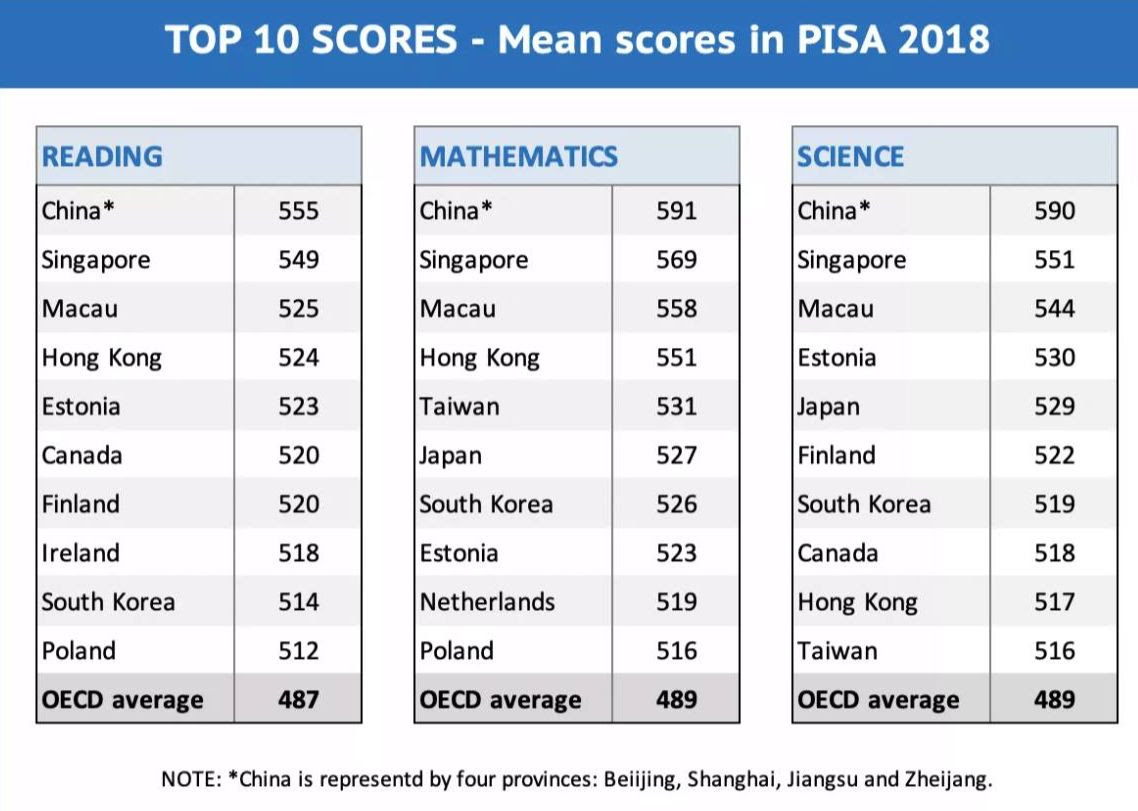
Nations with top education scores all rely on public schools. If the US followed their examples:

  • Teachers would be highly educated, well-paid and respected. In Finland, for example, acceptance for an education degree can be more competitive than medical school.
  • Schools would have shorter vacations, but also shorter school days. In China, elementary students take 90-minute lunch breaks. In Singapore, teachers use the additional time for planning lessons and collaborating on how to improve students’ performance.
  • After the regular school day, learning would continue at home or in tutoring sessions, especially for secondary students. Parents’ role in most successful nations is to ensure children do their three hours or so of assigned homework.

All these top-scoring countries rely on
public-education systems.

(Note that China is not really first; it only submits scores from 4 wealthy provinces.)Why don’t conservatives want to follow these successful models? More school days with highly qualified educators cost more. Companies want to sell high-margin educational software, supported by low-paid trainees, rather than pay education professionals’ salaries. New Hampshire’s EFAs potentially shift millions from public-school teachers and administrators to corporations seeking shareholder profits. In addition, church-based schools are seeking their share of EFAs. Then there is the fact that more-educated people tend to vote Democratic.

WHY SO MANY EYES ARE WATCHING NH EFAS
That is why so many outside New Hampshire are focused on EFAs here. National and international commercial and religious interests will be contributing to Mr. Pompeo and other conservative candidates. Donors hope that if a highly ranked state like New Hampshire can be convinced to hand their taxpayer dollars to unsupervised scholarship funds (see inset below), the rest of the nation will follow.EFAs hide spending detail from taxpayers

EFAs move millions in taxpayer funds from local school board oversight to an independent contractor. The contractor only has to report three things to the Department of Revenue
Administration: amount spent on administration, total number of scholarships, and average scholarship size. The state has no knowledge of who receives how much.
— NH RSA 77 G:5(g)HOW EFAS WILL CHANGE NH
EFAs impact far more than students. When EFAs substitute a $4600 payment for a year of public-school education, someone has to make up the difference. A religious school might charge only $2000 more per year in tuition, but how many low-income households can afford $2000 per child? The upshot is that poor neighborhoods will still need to rely on public schools, but those schools will have fewer per-student dollars to support them. Property taxpayers will have to make up the difference or close schools. The hit will be especially severe in Coos County, where thousands of educators comprise a significant segment of employees. When those schools are forced to close, most educators will move out, worsening Coos towns already dwindling populations and decreasing property values. Our most diverse populations in Manchester and Nashua are also more likely to suffer from the shift in funding caused by EFAs because they have lower incomes. In southern New Hampshire, the census showed that population did increase due to in-state migration. But what families will want to move into a state whose public schools are foundering? The answer is, those families for whom $4600 is enough to send their children to low-tuition religious schools, those families who can already afford expensive private school but would like taxpayers to subsidize them, and those families who want taxpayer funding for parent-guided home education programs. These differ from the workers attracted over the last decade to New Hampshire for its highly rated public schools. How will this affect companies struggling to find employees? No one knows, but the answer will certainly impact our economy.
EFAs will also impact New Hampshire society. Communities forced to close their schools will become less cohesive. Children educated only alongside others with similar backgrounds will have less understanding of the world and their place in it. They will be less able to succeed in the diverse demographics that will make up our nation’s future.
Perhaps conservatives have decided not to follow successful models for improving public education because they do not want the public to be educated. They would prefer people who let corporations and the wealthy take advantage of them, who have been taught to villainize a government that protects public interests.

Carol Burris, executive director of the Network for Public Education, reports the heartening news that support for school choice has declined in the latest poll by EdNext. EdNext is a pro-choice journal funded by the Hoover Institution and of there pro-choice organizations and individuals.

Support for Charters and Vouchers Has Dropped

Despite the myth that the pandemic resulted in an increased appetite for privatized alternatives to public schools, the opposite is true, according to a new poll just published by EdNext. Support for both charter schools and vouchers is down by substantial amounts. Only 33% of all Democrats now support charter schools–that’s an all-time low.  Less than half of all Americans (41%) now support them. Your constant advocacy for public schools and against privatized alternatives is paying off.

Democrats are beginning to see the pattern in the rug: Whatever is being pushed by Betsy DeVos, Charles Koch, the Walton family, and every rightwing foundation is not in the public interest.

Jeff Bryant is a journalist who specializes in education. In a recent issue of The Progressive, he details the many failures of what is falsely called “education reform.” The term for many has been a ruse for privatization via charter schools and vouchers. Instead of “reform,” it should be called disruption and destruction. Bryant leads the Progressive’s Public School Advocate project. This is a good-news story. Ed Reform has no successful strategies or ideas, but it’s billionaire funders and the U.S. Department of Education continue to fund its failed ideas.

He begins:

It was telling that few people noticed when Chicago’s Board of Education announced in late May that it was closing down its school turnaround program and folding the thirty-one campuses operated by a private management company back into the district.

The turnaround program had been a cornerstone of “Renaissance 2010,” the education reform policy led by former Chicago Public Schools Chief Executive Officer Arne Duncan, who became U.S. Secretary of Education during the Obama Administration. As the news outlet Catalyst Chicago reported, Duncan used the core principles of Renaissance 2010 as the basis for “Race to the Top,” his signature policy that he rolled out to the nation.

Race to the Top, a successor to former President George W. Bush’s “No Child Left Behind” program, included holding schools accountable for higher scores on standardized tests, inserting private management companies into district administration, and ramping up charter schools to compete with public schools.

Another news event affecting Chicago public schools that got very little national attention was the decision by the Illinois state legislature to rescind mayoral control of Chicago schools and bring back a democratically elected school board. The plan is backed by the state’s Democratic governor, J.B. Pritzker (and, predictably, opposed by Chicago mayor Lori Lightfoot). For years, prominent Democratic leaders—including New York Governor Andrew Cuomo and former Chicago mayor and previously Obama White House Chief of Staff Rahm Emanuel—touted mayoral control and a rejection of school board governance.

A third story from the Chicago education scene was that, in December, Noble Charter Network, the city’s largest charter school chain, disavowed its “no excuses” approach to educating Black and brown students because of the racist implications. Noble’s decision added to other reports of no-excuses charter chains dropping their harsh behavioral control and discipline policies during the past year.

These stories highlight the waning of three “school improvement” approaches: strict accountability with private management, mayoral control, and no-excuses charter schools. Each approach was among the pillars of “education reform” favored by previous presidential administrations and heartily endorsed by Washington, D.C., policy shops, such as the Center for American Progress.

Taken in unison, the three stories also contribute to the much larger narrative of how the once all-pervasive and generously funded policy movement known as education reform has ended—not with a bang, but a whimper.

Other policy directives of the reform movement that are also being relegated to the dustbin of history include state takeovers of low-performing schools, evaluating teachers based on student test scores, and flunking third-graders who score below a certain threshold on reading exams.

Please open the link and read on.

Some members of the Los Angeles school board are proposing a stealth voucher plan. Unsurprisingly, the United Teachers of Los Angeles opposes the plan.

DeVos-funded consultant pushes internal voucher scheme in LAUSD

This fall UTLA members will be building a vision for how to use the historic infusion of funding to transform education for our students. The privatizers have their own game plan to drive more public dollars to charter operators, and it involves an internal voucher-like scheme connected to Betsy DeVos. Under Trump, Devos’s office funded a grant for an outside consultant to push a competition-based system called Student-Centered Funding in LAUSD.

Basically, funding would move with each student instead of being allocated centrally for staff and programs. It sounds like a good idea when you first hear about it — but in cities like Chicago and Denver, these formulas have led to racially disparate negative consequences, including the loss of libraries and the arts, school closures, and the undermining of school stability, particularly in Black and Brown communities.

The funding scheme was sold in Chicago as a way to achieve greater equity for Black and Brown students, but it’s done the opposite.
Former student Styles Avant-Pinkston lived through a similar scheme — called student-based budgeting in Chicago — that led to under-resourced schools being starved of support and then often shut down. Avant-Pinkston was forced to travel across town to attend a school outside of his neighborhood.


“I shouldn’t have to take a 50-minute bus ride — I should just be able to walk to a good school,” Avant-Pinkston says. “These funding schemes are an attack on kids of color and minority communities. You never hear about schools in wealthy neighborhoods shutting down — they invest in those schools. Schools can be turned around if they see value in doing that — some people just don’t see the value in communities of color. The message is clear: Student-based funding schemes shut down neighborhood schools.”

The LAUSD School Board has yet to vote on the internal voucher scheme, but a decision could come as early as this month. With a highly paid consultant leading the way, the district has fast-tracked the plan, and families and educators have been left out of the discussions and development. Even some Board members have been given little information about this monumental shift in funding.

This internal voucher scheme has destabilized community schools wherever it’s been tried and has not proven to improve student outcomes. If implemented the negative effects would be:

Marketing Over Student Needs: Students would be turned into “backpacks full of cash” and schools forced to compete for market share. With every year a hustle to protect enrollment, school principals would have to prioritize marketing over student needs.

Downward Spiral: Schools that are already struggling with inadequate resources and that serve under-resourced communities would be hit hardest. Every time a student leaves, the school would have even fewer resources to support the students who remain, triggering cuts to staff and essential programs and pushing out other families.

School Closures: Drops in enrollment lead to the closure of neighborhood schools and the destabilization of communities, particularly in Black and Brown neighborhoods. LAUSD has already been targeting small schools like Trinity Elementary in South LA for permanent closure, citing dropping enrollment figures. Closed schools are then handed over to a chapter operator. That trend will accelerate under this internal voucher scheme

Veteran Educators Pushed Aside: The scheme creates incentives to hire lower-salary educators and other staff. That’s what happened in Chicago, where principals are prioritizing hiring less expensive inexperienced teachers over the overwhelmingly Black veteran teaching staff.

Privatization on steroids: LAUSD has told the Department of Education that they plan to allow dollars to follow students to independent charter operators, a further threat to neighborhood schools and the stability of the public school system. The operational funding shift also lays the groundwork for money to eventually follow students to private or religious schools. This is why market reformers from both political parties — from Arne Duncan and Betsy DeVos to ALEC — support the formula: It is an important step down the road to achieving their longtime goal of dismantling our nation’s historic commitment to public education and freeing those dollars for the private sector.
Readers of this blog have followed the advance of privatization of public school funding for nearly a decade. We know the big foundations and individuals that support privatization. We have followed their activities and watched as all of their strategies have failed to match their promises. The great puzzle, to me, is the indifference of the mainstream media. While they cover political scandals of every variety, they are just not interested in the sustained campaign to divert public money to schools there privately managed,to religious schools, to other private schools, and even to homeschooling. The media rightly criticized Betsy DeVos’s crusade for school choice, but as soon as she left office, they lost interest in the issue. Meanwhile, red states are rushing to open more charter schools and fund more vouchers.

Maurice Cunningham explored this issue in a recent post on the blog of the MassPoliticsProfs. He chastises the Boston Globe, but the same complaint could be directed to most mainstream media.

He begins:

Suppose WalMart swept into Boston and spent millions to acquire Market Basket. The town would go ballistic. It would be covered every day in every media outlet, front page of the Boston Globe. But the Walton Family Foundation of Arkansas—the exact same heartless* mercenaries—spends millions of dollars to take over public schools and it gets ignored. Why is that?

He discusses “Hidden Politics” and “the Politics of Pretending.” He has written frequently about astroturf groups and how they present themselves to a gullible media as authentic spokesmen for parents or for some other groups.

That’s the PR facade, he says. What really matters is: who is funding these groups? Why doesn’t the media care?

I always thought that if out-of-state billionaires could be proven to have entered the state using local fronts to change Massachusetts education policy that would be a great, great, great story. I’ve been proven wrong again, and again, and again. I still think it’s a great story, it’s just a great story that only gets told at a small political science blog. Why is that?

Why is that?