Archives for category: Virtual Charter Schools

The Auditor General of the state of Pennsylvania once declared that Pennsylvania has”the worst charter school law in the nation.”

Mark Miller shows how hard it is to fix that law. Operators of charter schools and cyber charters are reaping huge profits. One cyber charter founder was found guilty of tax evasion on his huge profits. A charter owner built a massive mansion in Palm Beach.

Yet the legislature can’t rein them in. Every dollar they collect means a dollar less for public schools.

http://www.markbmiller.com/2017/04/20/charter-deform-made-its-way-to-pa-house-floor-today/

Betsy DeVos and Randi Weingarten visited the public schools of rural Van Wert, Ohio. Randi wanted Betsy to see how important federal dollars are to a good public school. Betsy went along and got a promise from Randi to tour a school of choice with her.

Education Week says the “rifts” between them remain. Yeah, a rift the size of the Grand Canyon is not likely to close no matter how many schools they visit together or how often they meet.

Betsy’s spokesperson says she is not anti-public school. She just pours millions into campaigns of state and local candidates who support charters and vouchers, not public schools.

This effort to find common ground between polar opposites strikes me as pointless. It would be like bringing a devout Orthodox Jew to a Roman Catholic Church in hopes of changing his mind, or bringing a devout Roman Catholic to a synagogue and expecting to find common ground. Or hoping that a Bosox fan would be converted by a visit to the Yankees’ dugout. C’mon!

The New York Times’ account has this perceptive comment:

“Van Wert educators said they believed their biggest threat was school choice. An expanded voucher program would be “potentially catastrophic” for the district’s finances, said Mike Ruen, the district’s treasurer.
About 400 students now take advantage of a state open-enrollment policy, which Ms. DeVos endorsed during her visit. It allows students to attend an out-of-district school and take $6,000 in state per-pupil funding with them.
Most of them attend schools in a neighboring suburb. About 20 students are enrolled in an online charter school that has a 39 percent graduation rate. And a local vocational school takes 80 percent of the funding for each student who transfers there.

“Only one private school competes directly with Van Wert public schools: a small Catholic elementary school in town that the public school system provides special education services to, mostly at no charge. A Catholic high school 15 miles away is less of a draw, but could become one if parents receive vouchers. “I don’t think people are against choice,” Mr. Amstutz said. “But when you talk about expansion, taking money away from public schools, it gives people heartburn.”

Betsy DeVos will not change her mind about the importance of giving taxpayer dollars to every family to choose a charter school, a religious school, home schooling, a cyber charter, or whatever other option they want. They can even choose a public school. To the extent she is able, she will divert federal funds away from public schools to the other choices. She won’t resist Trump’s deep budget cuts. This visit will not transform her. It will not make her more attentive to the needs of the children in public schools. No doubt, she feels sorry for them because they are in public schools.

Randi will not stop being a union leader because of visiting a non-union charter or voucher school. She won’t stop believing in the importance or value of public schools. She won’t become a supporter of DeVos’s privatization agenda or Trump’s budget cuts.

Sorry, friends, but I don’t see the point of seeking “common ground.” There is none.

Despite the significant research demonstrating the failure of cyber charters, they continue to expand, according to a new study by the National Education Policy Center.

Secretary of Education Betsy DeVos was an investor in the worst of the cyber charter chains, the for-profit K12 Inc. started by Michael and Lowell Milken and listed on the New York Stock Exchange. It is not clear whether she divested. She has said she will encourage the growth of cybercharters, because any choice made by parents (she believes) is best for children.

Check out the NEPC report:

Find Documents:
Press Release: http://nepc.info/node/8564

NEPC Publication: http://nepc.colorado.edu/publication/virtual-schools-annual-2017

Contact:
NEPC: William J. Mathis: (802) 383-0058, wmathis@sover.net
Virtual School Performance: Gary Miron: (269) 599-7965, gary.miron@wmich.edu
Virtual School Research Base: Michael Barbour: (203) 997-6330, mkbarbour@gmail.com
Virtual School Policy: Luis Huerta: (212) 678-4199, huerta@tc.columbia.edu
Virtual School Policy: Jennifer King Rice: (301) 405-5580, jkr@umd.edu

More NEPC Resources on Virtual Education

BOULDER, CO (April 11, 2017) – Virtual Schools in the U.S. 2017, a three-part report released today by the National Education Policy Center, provides a detailed inventory of full-time virtual schools in the U.S. and their performance, an exhaustive review of the literature on virtual education and its implications for virtual school practices, and a detailed review and analysis of state-level policymaking related to virtual schools.

The growth of full-time virtual schools is fueled, in part, by policies that expand school choice and that provide market incentives attractive to for-profit companies. Indeed, large virtual schools operated by for-profit education management organizations (EMOs) now dominate this sector and are increasing their market share.

Although virtual schools benefit from the common but largely unsupported assumption that the approach is cost-effective and educationally superior to brick and mortar schools, there are numerous problems associated with virtual schools. School performance measures, for both full-time entirely virtual and full-time blended virtual schools, suggest that they are not as successful as traditional public schools.

The virtual education research base is not adequate to support many current virtual school practices. More than twenty years after the first virtual schools began, there continues to be a deficit of empirical, longitudinal research to guide the practice and policy of virtual schooling.

State policymaking in several key areas – such as accountability, teacher preparation, and school governance – continues to lag.

An analysis of state policies suggests that policymakers continue to struggle to reconcile traditional funding structures, governance and accountability systems, instructional quality, and staffing demands with the unique organizational models and instructional methods associated with virtual schooling. Accountability challenges linked to virtual schools include designing and implementing governance structures capable of accounting for expenditures and practices that directly benefit students.

The report’s policy recommendations include:

The specification and enforcement of sanctions for virtual schools and blended schools if they fail to improve student performance.
The creation of long-term programs to support independent research on and evaluation of virtual schooling, particularly full-time virtual schooling.
The development of new funding formulas based on the actual costs of operating virtual schools.

Find Virtual Schools Report 2017, Alex Molnar, Editor, on the web at:
http://nepc.colorado.edu/publication/virtual-schools-annual-2017

You will note that all of Betsy DeVos’s stories are about struggling students who were rescued from failing public schools by choosing to go to a charter school, a religious school, a home school, or a virtual charter school. Apparently she has never in her life seen a successful public school.

Her latest story is about a young man from India who attended the usual horrible public school. But his life was turned around because he had the good fortune to attend a virtual charter school in Washington State. DeVos was speaking to the National Association of State Boards of Education.

Mercedes Schneider decided it was time for fact-checking.

Betsy DeVos Pitches Virtual School with 4-Yr Cohort Grad Rate Below 32 Percent

The young man to whom DeVos referred attended a virtual charter with a four-year graduation rate of 19.1%. After five years, the graduation rate was up to 23.6%.

Surely, someone on her staff knew this. Yet she chose to conceal that the young man succeeded in a failing school.

Like Trump, DeVos must be constantly fact-checked. Her stories are misleading and inaccurate and have no point other than to smear public schools.

Angie Sullivan teaches first- and second-grade students in a Title 1 school in Carson County, Nevada. She sends her email reports to legislators and journalists. She is the conscience of Nevada.

She writes:


Attached is a report I put together in an attempt to review what data I could find on Nevada Connections Academy.

I did include some research on the parent corporation also for background which may or may not give you insight into the Nevada Connections Academy.

Opened in 2007 – Nevada Connections has never been successful.

Ten years later the Nevada Charter Authority is attempting to shut down this charter because of poor graduation rates.

Ten years.

I have been studying this information for months and have yet to see any accountability by Nevada Charters. Claims that they can be closed are not backed by real evidence. Nevada Charters close due to bankruptcy and fraud. They do not close due to severe and consistent academic under-performance.

As you review the data – you will notice that in most years and most grade levels half or more of the students are failing.

Graduation rates have been abysmal.

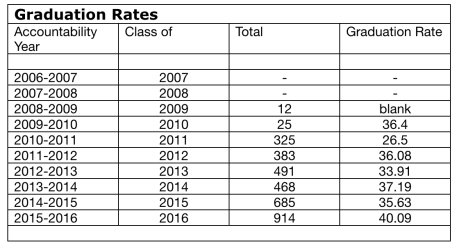
If I am reading the hard to understand reports correctly, in 2016 Nevada most likely paid $6,000 X 2400 = $14,400,000 to Nevada Connections Academy for High School Seniors and 40% or 914 graduated.

Total enrollment in Nevada Connections Academy was report at 2,851. Overall the Nevada Tax Payer spend $17,106,000 for less than half its students to be proficient.

The school also has a swinging door with half its students turning over. Due to lack of regulation and oversight – plus the “missing” students every year at testing time – I have to ask if the Nevada Tax Payer is paying for students not even in the program any longer.

nevada graph

Understandably parents and students do not want their charter school to close.

Parent and students do not want my public school to close either. Yet, I am held accountable. My school can be turned around or taken over by the Achievement School District. This failing charter has been doing poorly for 10 years and what has happened?

Nothing.

Parent and students base their “choice” of school on things other than standardized testing and numbers. I understand this very well. And they will protest if this school is closed. However, I am using this an example which is fairly similar to half of Nevada’s Charters which are on the lowest performing list.

Half of Nevada’s charters are on the lowest performing list. The worst graduation rates in the state are in the State Public Charter School System.

This charter is one of many in Nevada not doing well.

Half of Nevada’s charters are on the lowest performing list.

Parents need access to charter information at the same level public schools are required to give information to parents. In an annual report published on-line. Charters which spend on marketing to produce enrollment numbers need to be giving their data and graduation rate information to student prior to enrollment. No one should have to dig around in the Nevada Report Card for a month to try to determine if a school is academically achieving. If these charters are actually serving students not expected to graduate – if they are alternative schools – they should tell parents up-front the likelihood of graduating from these schools.

Charters need to be audited. Public schools have the SAGE Commission. Charters should have a similiar body which looks at return on investment and other financial measures.

I just attempted to watch an audit or something like an audit on-line from the charter authority.

https://manage.lifesizecloud.com/#/publicvideo/975a6334-1f01-4734-9678-cc6042d30f29?vcpubtoken=2021a45f-3957-40df-97a4-8cc8d9196bdb

Besides cheerleading for charters – I’m not sure the audit produced much information. It certainly did not expose anything I have discovered in the last few months. Watch the video for yourself and ask yourself if the Nevada Charter Authority is able to hold any of Nevada’s Charters accountable with the information presented.

Due process is the reason charters are not closing?

Perhaps there is simply zero political appetite to close a perpetually failing charter?

While charters may protest accountability in the name of freedom and choice. . . this needs to be balanced by accountability to the tax payer who pays the bills.

It is not fair to have a strict accountability system for public systems while charters are allowed to run amuck in the state of Nevada.

The unfairness of a legislated system that turns public schools into charters but does nothing about all the failing charters spending million in tax payer money in the state – is foul.

The Nevada Charter System is a failing school system in the state. That is clear according the data.

If Nevada Connections cannot be closed after 10 years of failure, which charter will ever be held accountable?

Angie

See the whole report here.

Our new Secretary of Education Betsy DeVos is very enthusiastic about virtual charter schools, even though the research shows that students don’t learn much while enrolled in them. Apparently, good works mean less than good profits.

In Arizona, a new online high school is returning remarkable profits. Jim Hall, retired educator, started an organization called Arizonans for Charter School Accountability, and he has a well-documented, horrifying story to tell about the defrauding of taxpayers.

News Release Contact Jim Hall

Arizonans for Charter School Accountability
arizcsa1000@gmail.com
602-343-3021
February 27, 2017
Phoenix, Arizona

The Consequences of Unregulated Charter Schools:

For-Profit American Virtual Academy Nets $10 Million Profit in 2016 After Siphoning $84 Million from Non-Profit Primavera Online. (Full report)

In its first year of operation as Primavera Online High School, for-profit charter holder American Virtual Academy (AVA) made an astounding $10 million profit in 2016. American Virtual Academy was given the charter for Primavera Online by non-profit Primavera Technical Learning Center (PTLC) in 2015 without compensation.

PTLC operated Primavera Online from 2002 to 2015 and had annual revenues of over $30 million a year with accumulated total cash assets of over $44 million with no debt. PTLC was the richest non-profit charter holder in Arizona in 2015.

On May 21, 2015 the PTLC Board suddenly decided to relinquish their charter to their software supplier, American Virtual Academy. There was no money exchanged in the transaction. PTLC is now out of the charter school business and is sitting on $44 million in assets.

Both PTLC and AVA were incorporated and directed by the same man, Damian Creamer. Creamer and his family members have received over $2 million in compensation as officers of PTLC. PTLC has employed Creamer’s software company, American Virtual Academy, since 2005 – paying AVA over $84 million from 2009 -2015 just to use software created by Creamer for Primavera Online.

In 2016 Primavera Online had a record year earning over $40 million. Creamer paid his new software company, FlipSwitch Inc., $13 million for software licenses and another $2.5 million for software support. Despite these huge expenditures, AVA cleared $10 million in profit that went to the company’s only stockholder, Damian Creamer.

Jim Hall, founder of Arizonans for Charter School Accountability commented, “This is worst case of a private citizen profiting from the actions of a non-profit organization imaginable. There is a charade going on in the charter school industry, both in Arizona and around the nation, that allows charter owners like Damian Creamer to control non-profit charter schools to enrich their for-profit subsidiaries – and themselves.”

The full report is at azcsa.org

Veteran education journalist Lindsay Wagner writes that anyone who wants to know what Betsy DeVos will do to schools need look no further than North Carolina. It has already happened there.

North Carolina was taken over by the Tea Party in 2010 and has gone on a rampage to privatize education and defund public schools. The legislature wiped out its very successful investment in teacher preparation–the North Carolina Teaching Fellows program–and replaced it with Teach for America. The Teaching Fellows made a five-year commitment and most became career teachers. TFA come and go within 2-3 years. Same cost, different results. One produces well-prepared career teachers, the other produces education tourists.

Charters, vouchers, cybercharters. North Carolina has it all.

Devos’ philanthropic efforts and her work running the American Federation for Children (AFC) have helped pave the way for North Carolina’s own school voucher program, which allows low-income families to use taxpayer-funded $4,200 vouchers each year for tuition at private, mostly religious schools that are not held to robust transparency and accountability standards and can discriminate against those who don’t pass a religious litmus test or identify as LGBTQ by barring them from enrolling.

In 2012, Democratic and Republican North Carolina lawmakers who were on board with the idea of school vouchers received more than $90,000 in campaign donations from AFC. The next year lawmakers enacted the school voucher program, which started out with an annual state commitment of just $10 million.

Then after winning a court case challenging the constitutionality of the program, lawmakers voted to significantly expand the school voucher program even though they had no data before them to indicate one way or another whether students leaving public schools using vouchers were actually doing better at private schools. The school voucher program is now scheduled to grow to $145 million annually by 2027. Between now and then, North Carolina will have spent nearly $1 billion on an unaccountable taxpayer-funded program.

The state’s top recipient of school vouchers, Trinity Christian School in Fayetteville, has received nearly $1 million in taxpayer funds since 2014. Last week it was reported that the state Department of Revenue arrested Trinity Christian’s athletic director following an investigation that turned up enough evidence to charge him with embezzling hundreds of thousands of employee tax withholdings over a seven year period.

It’s an unsurprising turn of events given that the state hasn’t enacted strong oversight measures for the school voucher program. Virtually anyone running a private school can receive publicly-funded school vouchers—most schools don’t have to routinely provide a look at how they balance their books or provide any robust evidence that their students are learning.

Now that DeVos is no longer just a private fundraiser pushing school vouchers at the state level but is now the federal education secretary, can she “voucherize” the entire public education system in the United States? No, not alone — besides, most of public education is financed at the state and local level. President Trump’s proposal to pour $20 billion into vouchers is contingent on state and local actors matching dollars and then some. As Vox’s Libby Nelson explains, DeVos could find some other creative ways to get federal dollars into voucher-like programs, but really the onus is on state legislatures to move the voucher agenda.

But if North Carolina’s steady march toward a school voucher program that continues to expand with very few accountability and transparency measures in place is any indication, DeVos has levers outside of her role as federal education secretary to try to keep the momentum going for state-born school voucher programs. And that is worth watching.

Charter schools

DeVos favors charter schools as well, although we’ve heard less about those from her as of late. Nonetheless, charter schools have been part of her philanthropic efforts over time and charter school advocates in North Carolina are enthusiastic about her confirmation as education secretary.

From 1997 until 2011, North Carolina experimented with charter schools, keeping a cap on how many can operate here at 100 schools. Charters are public schools too, but they are given more latitude in hiring and management practices and can do innovative things with their academic offerings—all in the name of improving education writ large.

But in 2011 something changed. Lawmakers did away with the cap on how many charter schools can operate here and since then, the charter school sector has grown at a fairly rapid rate—now at 167 schools. One effect of this expansion has been an an ever-increasing squeeze on public school budgets, which has in turn touched off a years-long fight at the legislature on how public dollars should flow to charter schools.
Meanwhile, resources and increased oversight have not grown concurrently with the charter school sector’s expansion, however; still a tiny group of people in Raleigh is charged with overseeing what is now approaching double the number of charters. And, according to the National Association of Charter School Authorizers (NACSA), recent legislation weakens charter school accountability and oversight and allows bad schools to stay open longer than they should be allowed.

A number of charter schools have suddenly closed in recent times, sometimes leaving students without an academic home in the middle of the school year. Poor governance and financial problems most commonly plague charters, and robust accountability and transparency measures still seem to be lacking as the industry experiences rapid growth. For-profit charter chain operators can run these schools and shield how they spend tax dollars behind a curtain—and lawmakers haven’t done much to force them to be more transparent.

The Tea Party leaders in North Carolina are thrilled with her selection as Secretary of Education. They have invited her to come and see how they have implemented all of her failed ideas. She has given generously to the political campaign’s of the state’s very rightwing senators.

As a result of DeVos efforts—along with those of other school privatization advocates—hundreds of millions of public dollars now flow to school vouchers, charter schools and virtual charter schools.

So when she does come to visit, it will be more like a welcome home party for DeVos. North Carolina has been her playground for years.

Teachers who teach children with multiple disabilities and children who are homeless may think that they have a tough job, but consider what a very hard time Betsy DeVos had in her first week as Secretary of Education, very likely the first paying job she has ever held. She visited a public middle school in D.C., where protestors harassed her and tried to keep her out. When she eventually entered the school, she said nice things to the staff, but after she left she insulted them as being in a “receive” mode. She gave a few interviews and said she hoped to launch more charter schools, more vouchers, more cybercharters, and presumably shrink the number of public schools as she opens up opportunities for students to go anywhere other than public schools.

In one interview, she told syndicated conservative columnist Cal Thomas that she did not think the protests against her were spontaneous. The implication was that those evil teachers’ unions had plotted against her. The other implication was that parents and teachers would welcome her noble presence in their public school, even though she was unimpressed with what she saw. Someone, she said, was trying to make her life “a living hell.” No matter what the plotters do, she pledged she would not be deterred from her mission of “helping kids in this country,” by enabling them to leave public schools for privatized alternatives.

She suggested to Thomas that it might be a good idea to bring tens of thousands of children to the Capitol to demonstrate for charters and vouchers. She said it had worked in Florida. Of course, this is now a standard part of the privatization script, using children as political pawns to demand more public funding for private choices, thus disabling public schools by diminishing their resources.

She pledged to support alternatives to public schools, without citing a scintilla of evidence that these choices would help kids and without acknowledging that the proliferation of choices harms the great majority of children who don’t choose to leave public schools. Her mindset is purely ideological. She did not offer any suggestions about how to help the vast majority of children who attend public schools. She has one idea, and she is sticking to it: choice. The absence of evidence for that one idea from her home state never comes up. Michigan has tumbled in national rankings as choice has expanded.

When Cal Thomas asked what could be done for children who had an “absent father,” she responded that this problem has to be addressed at the classroom level. “It’s not an easy or a single answer, but again it goes back to having the power to influence those things at the classroom level.” It is not clear what she meant or if she herself knew what she meant. How is the teacher in the classroom prepared to make up for an absent father? Is this what passes for profundity?

Then there was this very interesting exchange, in which Cal Thomas and Betsy DeVos exposed their deepest beliefs:

“Q. Throughout most of the public school system, which began in the late 19th century and flourished in the 20th, education included values, McGuffey Readers and even prayer and Bible reading, until the Supreme Court outlawed both in the ‘60s. Do you see a correlation between the loss of American values, a sense of morality, a concept of the transcendent, right and wrong, objective truth that have been banished in our relativistic age and lack of achievement in some places in our schools?

“A. I think it’s a significant factor. Many of the schools I’ve seen, especially the charters, have a focus on character development and again the whole child development. That’s one of the reasons parents are choosing alternatives like this.”

To begin with, public education got its start in the mid-nineteenth century, not the late nineteenth century.

I am one of the few living Americans who has actually read the entirety of the McGuffey readers. Children today would find them dull, simplistic, and obsolete.

The assumption that public schools lack values because they do not have Bible readings and prayers is nonsense. When I went to public schools in Houston in the 1940s and 1950s, we had daily Bible readings and prayers, but the schools were racially segregated. Few teachers had more than a bachelor’s degree. I would say without question that our public schools today have better quailed teachers today and a stronger value system than they did when we read the Bible and prayed every day. As a Jew in a Christian public school system, I ignored the implicit proselytizing, but from the perspective of the decades, I can say that our schools then did not practice what they preached. We never discussed current social or political issues. Too controversial. We were not well prepared for the real problems of our society.

The values of the dominant religion were imposed on me but I never had any wish to impose mine on anyone else.

Now, as we live in a religiously and culturally diverse society, Thomas and DeVos sound like two antiquarians. They want to turn the clock back 100 years, maybe two hundred years.

There is nothing innovative about DeVos’ ideas. She has lived in a billionaire bubble all her life, surrounded by her like-minded kith and kin of rich white Republican evangelicals. She has nothing to teach our teachers or students. She knows nothing about how to improve public schools. Her beloved charters, vouchers, and cybercharters have not proven to be better than public schools, and in many states, are demonstrably worse than traditional public schools with certified teachers.

We live in a big, ever-changing world, and it is far too late to go back to 1920 or 1820, no matter how devoutly DeVos would like to restore the suprenpmacy of whites and evangelical Christians. They too must learn to live and let live.

Here is the official transcript issued by the White House of Trump’s “listening tour.” Note how he gushes over every parent or teacher not in a public school and how quickly he breezes past a Teacher of special education in a public school. He seems to promise near the end to reduce the rate of autism. He says he visited an amazing charter school in Las Vegas but clearly doesn’t know that most of the charter schools in Nevada are failing schools.

The White House
Office of the Press Secretary
For Immediate ReleaseFebruary 14, 2017
Remarks by President Trump at Parent-Teacher Conference Listening Session

Roosevelt Room

10:50 A.M. EST

THE PRESIDENT: Well, I am delighted to welcome everybody to the White House. And Betsy DeVos, who has gone through — our new Education Secretary — she went through an interesting moment. And you’re going to do a fantastic job, and I know you would have done it again if you had to do it again, right? (Laughter.)

SECRETARY DEVOS: Probably.

THE PRESIDENT: She had no doubt that final night, waiting for the vote. So I just want to congratulate you. You showed toughness and genius.

As I said many times in my campaign, we want every child in America to have the opportunity to climb the ladder to success. I want every child also to have a safe community, and we’re going to do that very much. We’re going to be helping you a lot — a great school and some day to get a really well-paying job or better, or better; own their own company. And a lot of people are looking at that.

But it all begins with education, and that’s why we’re here this morning. And I’m here also to celebrate a little bit with Betsy because we started this journey a long time ago, having to do with change and so many other good things with education. And I’m so happy that that all worked out.

Right now, too many of our children don’t have the opportunity to get that education that we all talk about. Millions of poor, disadvantaged students are trapped in failing schools and this crisis — and it really is a crisis — of education and communities working together but not working out. And we’re going to change it around, especially for the African American communities. It’s been very, very tough and unfair. And I know that’s a priority and it’s a certainly a priority of mine.

That’s why I want every single disadvantaged child in America, no matter what their background or where they live, to have a choice about where they go to school. And it’s worked out so well in some communities where it’s been properly run and properly done. And it’s a terrific thing.

Charter schools, in particular, have demonstrated amazing gains and results. And you look at the results — we have cases in New York City that have been amazing in providing education to disadvantaged children and the success of so many different schools that I can name throughout the country that I got to see during the campaign. I went to one in Las Vegas; it was the most unbelievable thing you’ve ever seen. And they’ve done a fantastic job.

So there are many such schools and we want to do that on a large-scale basis. We can never lose sight of the connection between education and jobs. I’m bringing a lot of jobs back. We’re bringing a lot of big plants back into the country — everyone said it was impossible. And before I even took office, we started the process and tremendous numbers of plants are coming back into this country — car plants and other plants. And I have meetings next week with four or five different companies, big ones that are going to bring massive numbers of jobs back.

So we’re doing it from the jobs standpoint, but education only makes it better. Our goal is a clear and very safe community, great schools, and we want those jobs that are high-paying jobs — we’ve lost a lot of our best jobs to other countries and we’re going to bring them back.

So I’m going to do my job, and Betsy, at the education level, will do her job. And just to do it very, very formally, I want to congratulate you on having gone through a very tough trial and a very unfair trial, and you won. And there’s something very nice about that. And I’ll tell you the real winner will be the children — I guess a couple of adults (inaudible) — but will be the children of this country. And I just want to congratulate you.

SECRETARY DEVOS: Thank you, Mr. President.

THE PRESIDENT: Perhaps we’ll go around the room. And everybody knows our fantastic Vice President, Mike Pence. But if we went around the room, it would be very nice. So why don’t we start? Betsy, you might want to say a few words to us.

SECRETARY DEVOS: Well, Mr. President and Mr. Vice President, I am just very honored to have the opportunity to serve America’s students, and I’m really excited to be here today with parents and educators representing traditional public schools, charter public schools, homeschools, private schools, a range of choices. And we’re eager to listen and learn from you your ideas for how we can ensure that all of our kids have an equal opportunity for a high-quality, great education and therefore an opportunity for the future.

So again, I just wanted to have the opportunity to serve, and looking forward to fulfilling the mission that you set forward.

THE PRESIDENT: It’s our honor — believe me, Betsy.

Kenneth.

MR. SMITH: Ken Smith, educator helping at-risk kids get through school. Vice President, it actually has the largest application of jobs for America’s graduates in the country. And in a minute we’ll talk about that as a solution.

THE PRESIDENT: Great. Good.

Laura.

MS. PARRISH: Laura Parrish, I’m from Falls Church, Virginia. I homeschool my 10- and my 13-year-old.

THE PRESIDENT: Good. Very good.

Mary.

MS. RINER: My name is Mary. I’m a charter school parent here in D.C., and considered the best school in America.

THE PRESIDENT: You think, huh? (Laughter.)

MS. RINER: I know.

THE PRESIDENT: I like that.

MS. RINER: According to U.S. News & World Report.

THE PRESIDENT: Really? Is that right? Wow.

Jennifer.

MS. COLEMAN: I am Jennifer Coleman. I am from Prince William County, Virginia. I am the mother of six, and I homeschool my oldest four; they are grades kindergarten through seven. And before that I was a private school teacher.

THE PRESIDENT: Very good.

MR. CIRENZA: Bartholomew Cirenza. I’m a parent of seven, and my kids have gone through both private and public school, and I see differences, and —

THE PRESIDENT: Big difference.

MR. CIRENZA: Big difference.

THE PRESIDENT: Okay.

MS. BAUMANN: Good morning, I’m Julie. I teach special education at a public school in New Jersey.

THE PRESIDENT: Very good. Thank you.

MS. QUENNVILLE: Hi, I’m Jane Quennville, and I’m a principal of a special-ed center in Virginia serving children ages five through twenty-two with autism and physical and medically fragile conditions.

THE PRESIDENT: How is that going?

MS. QUENNVILLE: Well —

THE PRESIDENT: Have you seen an increase in the autism with the children?

MS. QUENNVILLE: Yes, yes. In fact, our school has shifted its population — saw more children with autism, definitely.

THE PRESIDENT: So what’s going on with autism? When you look at the tremendous increases, really, it’s such an incredible — it’s like really a horrible thing to watch, the tremendous amount of increase. Do you have any idea? And you’re seeing it in the school?

MS. QUENNVILLE: Yes, I think — I mean, I think the statistics, I believe, are 1 in 66, 1 in 68 children are diagnosed with autism.

THE PRESIDENT: And now it’s going to be even lower —

MS. QUENNVILLE: Probably.

THE PRESIDENT: — which is just amazing. Well, maybe we can do something.

MS. BONILLA: I am Carol Bonilla. I teach Spanish in a private elementary school in Arlington. I teach the students in fourth through eighth grade.

THE PRESIDENT: Very good. Thank you.

MS. VIANA: Good morning, Mr. Vice President, Mr. President. My name is Aimee Viana. I’m the parent of two children — fifth grade and second grade — and I live right outside of Raleigh, North Carolina in Cary, and I’m also a former educator in public and private schools.

THE PRESIDENT: Fantastic. Thank you. So thank you all very much. Let’s get going.

END
10:58 P.M. EST
Betsy DeVos is a huge fan of cybercharters. When responding in writing to questions from the Senate HELP Committee, she cited astonishing graduation rates for cybercharters.

She lied.

Benjamin Herold of Education Week did the fact-checking:

In her written response to questions from a key Democratic senator, Education Secretary-nominee Betsy DeVos defended full-time online charter schools using graduation rates significantly higher than those used for state and federal accountability purposes. The figures and language cited by DeVos directly mirror those used in a report from K12 Inc., the country’s largest for-profit operator of cyber charter schools, in which DeVos is a former investor.

According to the Ohio education department, for example, the Ohio Virtual Academy has a four-year graduation rate of 53 percent, good for an “F” on the state’s accountability system.

DeVos put the figure at 92 percent….

She was specific in her lies.

In written questions, Murray, who is the ranking member of the Senate Health, Education, Labor and Pensions committee, asked whether it is appropriate to advocate for the schools, despite their poor results.

DeVos responded:

“High quality virtual charter schools provide valuable options to families, particularly those who live in rural areas where brick-and-mortar schools might not have the capacity to provide the range of courses or other educational experiences for students. Because of this, we must be careful not to brand an entire category of schools as failing students.”

She then cited a number of schools and what she described as their graduation rates, which differ markedly from the figures used by each school’s state for accountability purposes:

The Idaho Virtual Academy has a 90 percent graduation rate, DeVos said. The school’s most recent publicly reported figure for state accountability purposes is 33 percent.

The Nevada Virtual Academy has a 100 percent graduation rate, DeVos said. The school’s most recent publicly reported figure for state accountability purposes is 67 percent.

The Ohio Virtual Academy has a 92 percent graduation rate, DeVos said. The school’s most recent publicly reported figure for state accountability purposes is 53 percent.

The Oklahoma Virtual Academy has a 91 percent graduation rate, DeVos said. The school’s most recent publicly reported figure for state accountability purposes is 40 percent.

The Utah Virtual Academy has a 96 percent graduation rate, DeVos said. The school’s most recent publicly reported figure for state accountability purposes is 42 percent.

The schools listed in DeVos’ written response, and the language she used to introduce them—”the following virtual academies have four-year cohort graduation rates at or above 90 percent”—is the same as the language used by K12 Inc. in its 2016 Academic Report.

Here is what she did not mention, but that the Senate HELP Committee–and the full Senate–should know.

The Tennessee Virtual Academy is the lowest-performing school in the state (Senator Alexander must know that). When then-State Commissioner of Education Kevin Huffman tried to close it, he was stymied by its friends in high places.

The New York Times reported that the Electronic Classroom of Tomorrow has the lowest graduation rate in the nation.

Even DFER founder Whitney Tilson inveighed against K12 Inc. because of its “dismal academic results” and “sky high” attrition rates.

Stephen Henderson, the editorial page editor of the Detroit Free Press, warned that Betsy DeVos has a long-standing habit of twisting data to promote her favorite causes (charters and vouchers), and that she is not to be trusted to tell the truth.

He wrote:

A true advocate for children would look at the statistics for charter versus traditional public schools in Michigan and suggest taking a pause, to see what’s working, what’s not, and how we might alter the course.

Instead, DeVos and her family have spent millions advocating for the state’s cap on charter schools to be lifted, so more operators can open and, if they choose, profit from more charters.

Someone focused on outcomes for Detroit students might have looked at the data and suggested better oversight and accountability.

But just this year, DeVos and her family heavily pressured lawmakers to dump a bipartisan-supported oversight commission for all schools in the city, and then showered the GOP majority who complied with more than $1 million dollars in campaign contributions.

The Department of Education needs a secretary who values data and research, and respects the relationship between outcomes and policy imperatives.

Nothing in Betsy DeVos’ history of lobbying to shield the charter industry from greater accountability suggests she understands that.

If she’s confirmed, it will be a dark day for the value of data and truth in education policy.