Jennifer Rubin was a solid conservative journalist and lawyer who was hired by the Washington Post to express the conservative view on politics in a column called “Right Turn.” After Trump’s election, she became increasingly critical of him and eventually reversed her ideology. She is today one of the most incisive critics of the MAGA movement. In this column, she chastises Prominent Republicans for remaining silent in this election.
She writes:
One of the most uplifting parts of last week’s Democratic convention was the presence of so many Republicans, such as former Illinois congressman Adam Kinzinger and former Georgia lieutenant governor Geoff Duncan. Both decided to put country over party and self.
“I know Kamala Harris shares my allegiance to the rule of law, the Constitution and democracy, and she is dedicated to upholding all three in service to our country,” Kinzinger said. “Whatever policies we disagree on pale in comparison with those fundamental matters of principle, of decency and of fidelity to this nation.” Likewise, Duncan said, “Let me be clear to my Republican friends at home watching: If you vote for Kamala Harris in 2024, you’re not a Democrat. You’re a patriot.”
The day after the convention, a dozen former lawyers from the three Republican administrations before Donald Trump’s published aletter endorsing Vice President Kamala Harris. They wrote, “Trump’s attempt to prevent the peaceful transfer of power after losing the election proved beyond any reasonable doubt his willingness to place his personal interests above the law and values of our constitutional democracy.” They argued that returning Trump to office “would threaten American democracy and undermine the rule of law in our country.” Then, a four-star general who served under President George W. Bush and hundreds of former Republican staffers endorsed Harris.
So, the question remains: Where are the rest of the Republicans who understand Trump is an existential threat to democracy? Most of the big names still refuse to follow Kinzinger and Duncan’s lead.
Former president George W. Bush must be in a witness protection program; he has virtually disappeared. Former Wyoming congresswoman Liz Cheney courageously stood up to Trump when he tried to stage a coup. But, sorry — if you pledge to do everything possible to prevent Trump’s return to power, you have an obligation to endorse Harris, the only person who can beat him.
Former New Jersey governor Chris Christie, who shredded Trump in the primaries, previously objected to endorsing President Joe Biden because of Biden’s age. (“President Biden, in my view, is past the sell-by date.”) What is his excuse now for refusing to endorse the new, 59-year-old Democratic nominee?
Paul Ryan, a Fox board member and former speaker of the House, was quoted in May as saying, “Character is too important for me. … [The presidency] is a job that requires the kind of character [Trump] doesn’t have.” But Ryan too lacks the nerve to support the only viable alternative. When he rationalizes his refusal to endorse a Democrat on the grounds that he differs on “policy,” he is telling us that preserving democracy is not a high policy priority for him.
The list goes on: H.R. McMaster (actually commending Trump’s foreign policy in the Atlantic!), Jim Mattis, Condoleezza Rice. Moral cowardice, or craving for access in future Republican administrations, seems to have silenced even those most vocal on America’s defense of Ukraine and other allies. History will not treat them kindly.
Certainly, getting some Republicans to refrain from voting for Trump is helpful. But if they are as devoted to democracy and as committed to the international world order as they say, there is no moral argument for refraining from going the rest of the way to endorse Harris, especially after such a robust affirmation of her foreign policy views.
Biden gave up the presidency for the sake of our democracy. Can’t these Republicans give Harris their votes?
Mary Trump, Donald’s estranged niece, asks an important question: Why did the U.S. Army decide not to bring charges against Donald Trump for law-breaking? He knew that it was illegal to bring cameras into Arlington National Cemetery; he knew it was illegal to stage a campaign event there. When the aide on duty reminded his crew not to break the law, they shoved her aside and ridiculed her. I assume the Department of the Army is acting out of self-interest. Those who made the decision know that if Trump is re-elected, he will wreak vengeance on them.
Donald Trump and his minions were warned against politicizing a visit to Arlington National Cemetery. They did it anyway, violating self-evident norms and the law: military cemeteries cannot be used to stage partisan political events. When it became clear that Donald’s staff was going to ignore this prohibition, an employee at the cemetery sought to restrict photography in accordance with federal regulations.
Arlington is “the final resting place of more than 400,000 U.S. troops, veterans and family members. Donald was there to mark the third anniversary of a suicide bombing that killed 13 U.S. troops during the evacuation of Afghanistan,” an anniversary he did not see fit to commemorate in 2023 or 2022.
Cemetery staff had made it clear ahead of time that official photography was not allowed in Section 60, where veterans of recent wars are buried. When the employee sought to reinforce the guidelines, she was, according to a report released by the Army, “abruptly pushed aside” by people in Donald’s entourage. The last part should surprise no one. Donald is a foppish, chubby overlord who relies on the unquestioning thuggery of the conscienceless jackals who comprise his inner circle and staff who exist to make him look tough. For him, “toughness” means being an unrepentant asshole; people in his orbit simply follow his lead.
Arlington National Cemetery is run by the Army. The woman who tried to make sure the guidelines, and the law, were followed by Donald’s team, is employed by the Army. After the altercation with members of Donald’s staff, she filed a report. It’s understandable that she does not want to press charges—after all, she remains unidentified because of concerns for her safety—but why won’t the Army? What exactly is gained by allowing this act of desecration to go unpunished? And, by the way, engaging in the kind of behavior Donald and his campaign staff engaged in isn’t simply indecent, it’s illegal. So why is the convicted felon allowed to commit more crimes with impunity?
But let’s summon the will to be shocked, shall we? Let’s be shocked that the former Commander-in Chief is such a despicable narcissist that every interaction he has with service members is simply a means simultaneously to steal their honor while denigrating them.
Is this the worst thing Donald’s ever done? Not by a long-shot. But the combination of selfishness, thuggery, menace, and his willingness to bring the entire weight of his power to bear on a private American citizen is a pretty good encapsulation of everything that is wrong with and disqualifying about him.
It’s time for corporate media to catch up and refuse to let this one go.
After Richard Nixon resigned the Presidency in 1974, his successor Gerald Ford pardoned him to unite the country and end “the nation’s long national nightmare.”
Just a few weeks ago, the question seemed almost preposterous: What should happen to the federal prosecutions of Donald Trump if he is defeated in November? Today, it might be premature to imagine a President Kamala Harris grappling with whether to allow the cases against Trump to go forward or whether, before or after any convictions, to grant him a pardon. But this is a discussion worth launching now, in part because, as the prospect of a Harris victory comes into focus, there could be a “long national nightmare” impulse to put all things Trump in the rearview mirror. Under more ordinary circumstances, in more ordinary times, my sympathies would tend toward such calls for national reconciliation, the sentiments that animated Gerald Ford, 50 years ago next month, to pardon Richard M. Nixon.
In pardoning Nixon, Ford invoked the continued suffering of Nixon and his family, along with Nixon’s years of public service, but said his decision was driven by the need for national healing.
In retrospect, that decision looks wise and selfless. But it’s not the right template for thinking about Trump. Harris should allow special counsel Jack Smith to proceed with his prosecutions against the former president, or what’s left of them after the Supreme Court’s ruling on presidential immunity. If Trump is convicted and the conviction is upheld, Harris should not use her power to pardon Trump or commute his sentence.
Why? What’s the difference between Ford and Nixon then and Harris and Trump in a not-so-theoretical future?
First is the matter of consequences for bad acts, something that Trump has magically managed to avoid for most of his 78 years. Short-circuiting his prosecutions or upending his convictions would be the maddening capstone to a life of evading responsibility for wrongdoing.
A sitting president can’t be prosecuted, under long-standing Justice Department policy, so the findings by special counsel Robert S. Mueller III that Trump might have committed 10 acts of obstruction of justice went nowhere. The House of Representatives voted twice to impeach Trump, but the Senate failed to convict — the second time largely because Republican senators (and Trump’s own lawyers) pointed to the prospect of criminal prosecution for efforts to interfere with the election results. Then the Supreme Court carved out a broad sphere of immunity for Trump, jeopardizing at least part of Smith’s prosecution.
When it comes to Trump, accountability is a can endlessly kicked down the road. That’s not in the interest of justice — and it sets a bad precedent for future presidents. We can hope that it doesn’t take the threat of criminal consequences to dissuade presidents from wrongdoing, but rules and laws without consequences are meaningless. And the charges against Trump — that he plotted to overturn election results and obstructed justice to improperly retain classified documents — involve serious misconduct that calls out for enforcement.
Second, Trump is no Nixon, and I don’t mean this in a good way. Nixon’s wrongdoing was egregious, and criminal. But he did not pose a threat to democracy on the same level as Trump, with his incessant claims of a system rigged against him, of elections stolen and politically motivated prosecutions. Nixon left office under political pressure, but, still, he left office.
Nixon cannot accurately be called repentant, but in accepting the pardon he acknowledged “my own mistakes and misjudgments,” adding, “No words can describe the depths of my regret and pain at the anguish my mistakes over Watergate have caused the nation and the presidency — a nation I so deeply love and an institution I so greatly respect.” It is impossible to imagine anything approaching this degree of contrition from Trump. Those who accept no responsibility deserve no mercy. Those who continually incite discord should not receive a pass in the name of calming the turmoil.
Third, about that turmoil: Times have changed since Ford pardoned Nixon. The country has grown angrier and more divided. Ford openly worried about this in his day, warning that if he allowed a criminal case to proceed, “ugly passions would again be aroused. And our people would again be polarized in their opinions. And the credibility of our free institutions of government would again be challenged at home and abroad.”
Back then, for all the fury generated by the pardon, it was a reasonable judgment that it would calm the waters overall. Today, I wonder whether that would happen. If Harris were to order the prosecutions dropped or grant a pardon, would that have the same salutary effect as Ford envisioned in 1974? Polarization has edged into antipathy, not mere disagreement but vehement disdain for the other side. Political tribalism reigns; it takes precedence over the national interest. It is hard to imagine an act by Harris toward Trump that would magically alter this ugly reality.
So, my advice for former prosecutor and possible president Harris is to let Smith do his job and the criminal justice system work its will. She can decide down the road about a pardon, but she should be wary of taking the lessons of a half-century ago as a road map for what is best for the nation today.
Historian Heather Cox Richardson weaves together the events of the past few days and demonstrates the submission of the Republican Party to one angry man. At the Republican National Convention, the party’s elders were notably absent. No Bush or Cheney; no Romney. Trump put his daughter-in-law, Lara, in charge of the Republican National Committee. It’s the Trump party now, and he controls all its levers of power. Note below that he hasn’t stopped hawking merchandise, even in the middle of his campaign. If you can open a tweet, this is an example of Trump turning his campaign into a money-maker for himself.
She writes:
…Trump began the day by posting an advertisement for the fourth “series of Trump digital trading cards,” or NFTs (which are unique digital tokens) featuring heroic images of Trump. People who buy 15 or more of them—at $99 apiece—get a physical trading card as well. Trump said that the physical card has a piece of the suit he wore at the presidential debate, and Trump promises to sign five of them, randomly. Up to 25 people who buy $25,750 worth of the cards with cryptocurrency will be invited to a gala next month at his Jupiter, Florida, golf club.
In the ad, Trump made it a point to emphasize his enthusiasm for cryptocurrency, an emphasis that dovetails with Trump’s recent promotion of an “official” cryptocurrency project. He linked to a Telegram channel run by his sons Don Jr. and Eric that, at the time, was called “The DeFiant Ones” but has been renamed “World Liberty Financial.” While there is little public information about the project, the channel has almost 50,000 subscribers.
Hawking merchandise was an odd move for a presidential candidate, and it suggested his focus is elsewhere than on the election. Also today, Trump announced that he plans to make former Democrats Robert Kennedy Jr. and Tulsi Gabbard, both of whom have endorsed him, honorary members of his transition team. Kennedy told right-wing personality Tucker Carlson that he would “help pick the people who will be running the government…”
And then, this evening, Quil Lawrence and Tom Bowman of NPR explained the story behind the surprising photos of Trump on Monday giving a thumbs-up over a grave in Arlington National Cemetery. The reporters wrote that “[t]wo members of Donald Trump’s campaign staff had a verbal and physical altercation Monday with an official” at the cemetery, where “[f]ederal law prohibits political campaign or election-related activities.” When a cemetery official tried to prevent Trump campaign staff from entering the section where the grave was located, “campaign staff verbally abused and pushed the official aside.” A Trump campaign spokesperson said the official who tried to prevent the staff from holding a political event in the cemetery was “clearly suffering from a mental health episode.”
The elephant in the room these days is that most Republicans, along with many pundits, are pretending that Trump is a normal presidential candidate. They are ignoring his mental lapses, calls for authoritarianism, grifting, lack of grasp on any sort of policy, and criminality, even as he has hollowed out the once grand Republican Party and threatens American democracy itself.
It’s hard to look away from the reality that the Republican senators could have stopped this catastrophe at many points in Trump’s term, at the very least by voting to convict Trump at his first impeachment trial. At the time, Senator Ted Cruz (R-TX) said, “Out of one hundred senators, you have zero who believe you that there was no quid pro quo. None. There’s not a single one.” Republican senators nonetheless stood behind Trump. “This is not about this president. It’s not about anything he’s been accused of doing,” then–majority leader Mitch McConnell (R-KY) told his colleagues. “It has always been about November 3, 2020. It’s about flipping the Senate.”
When the Framers wrote the Constitution, they did not foresee senators abandoning the principles of the country in order to support a president they thought would enhance their own careers. Assuming that lawmakers would jealously guard their own power, the Framers gave to the members of the House of Representatives the power to impeach a president. To the members of the Senate they gave the sole power to try impeachments. They assumed that lawmakers, who had just fought a war to break free of a monarch, would understand that their own interests would always require stopping the rise of an authoritarian leader.
But the Framers did not foresee the rise of political partisanship.
In the modern era, extreme partisanship has led to voter suppression to keep Republicans in power, the weaponization of the filibuster to stop Democratic legislation, and gerrymandering to enable Republicans to take far more legislative seats than they have earned. The demands of this extreme partisanship also mean that members of one of the nation’s major political parties have lined up behind a man whom, were he running this sort of a campaign even ten years ago, they would have dismissed with derision.
Finally, devastatingly, the partisanship that made senators keep Trump in office enabled him to name to the Supreme Court three justices. Those three justices were key to making up the majority that overturned the nation’s fundamental principle that all people must be equal before the law. In July 2024 they ruled that unlike anyone else, a president is above it.
In May 2016, South Carolina Republican senator Lindsey Graham famously observed: “If we nominate Trump, we will get destroyed…….and we will deserve it.”
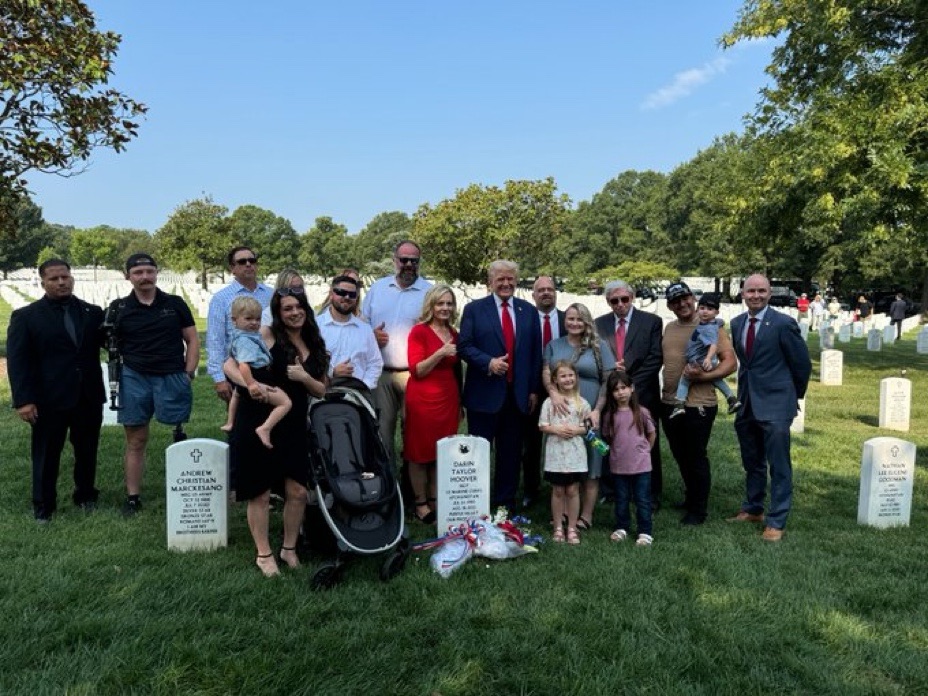
Much has been written about Trump’s controversial visit to the graves of American soldiers killed by a suicide bomber at the airport in Afghanistan as thousands of people were struggling to leave. The death of these brave soldiers was terrible and tragic. Trump decided to blame their deaths on Kamala Harris. He made common cause with some of the families and paid tribute to fallen soldiers at Arlington National Cemetery. That military cemetery has a special area, Section 60, where neither cameras nor campaign events are allowed. Both are strictly prohibited to show respect for the dead.
Trump arrived with his entourage. A young military woman, left to confront the visitors, informed them of the rules. She tried to stop them, and they pushed her aside. There was some sort of physical confrontation, and one of Trump’s group said later that the woman had “some kind of mental health episode.” Each side reported the other, and the military brass decided “case closed.” They knew that if Trump is re-elected, he would be vengeful. Trump went to the gravesites, where his photo was taken with family members. One bizarre photo showed him standing over a grave, grinning broadly and giving a thumbs-up sign, along with some family members.
Did he break the rules? Yes. He has always acted on the belief that the rules don’t apply to him. He is always immune from responsibility, accountability, or prosecution.
The fascist overtones from the Arlington National Cemetery incident are unmistakeable: a presidential campaign run like a gang, with enforcers shoving aside a public servant enforcing the rules and a mob of millions of supporters with a track record of doxxing, harassing, intimidating, and threatening anyone who gets in their candidate’s way, all the while being egged on by the candidate himself.
You can’t blame the cemetery official for declining to press charges rather than put herself in the line of fire for continued and unending abuse. She didn’t sign up for that. She’s already been baselessly accused by the Trump campaign of having a “mental health episode,” being “despicable” and a “disgrace,” and not deserving to have her job. That all happened within the first 48 hours of the apparent confrontation at the national shrine to fallen service members.
But what about the Army? It oversees Arlington National Cemetery and is a victim of Trump’s bullying, too, so I hesitate to blame it for its predicament. But some of the reporting suggests the staffer on the ground was effectively if inadvertently set up by higher-ups who themselves wanted to avoid a confrontation with Trump. According to the WaPo:
Pentagon officials were deeply concerned about the former president turning the visit into a campaign stop, but they also didn’t want to block him from coming, according to Defense Department officials and internal messages reviewed by The Washington Post.
Officials said they wanted to respect the wishes of grieving family members who wanted Trump there, but at the same time were wary of Trump’s record of politicizing the military. So they laid out ground rules they hoped would wall off politics from the final resting place of those who paid the ultimate sacrifice for their nation.
Rather than mount a full-throated defense and take any kind of remedial action, the Army has closed the matter after the cemetery official declined to press charges. But the fecklessness doesn’t end there. This paragraph in the NYT is an all-timer for weak-kneed kowtowing to a bully:
Several Army officials, speaking on the condition of anonymity to discuss confidential aspects of the matter, on Wednesday sought to keep the politically charged issue from escalating. But at the same time, they defended the cemetery official and pushed back on attacks from the Trump campaign, with one official saying that the woman at the cemetery was just trying to do her job.
Officials purporting to defend their person on the ground by offering some “push back” on the Trump campaign attack, but doing so anonymously while trying to keep it from “escalating.” Escalating into what? You’ve already been run over, so that leaves the only obvious conclusion: The Army itself is trying to avoid being the target of MAGA attacks. This is untenable acquiescence to bullying.
Is that really going to be the end of the story? No consequences, no new measures to enjoin Trump from doing the same thing again at Arlington or another military cemetery, no price to pay for his thuggery. It’s a familiar pattern.
The erosion of any kind of strong, unified, national, countervailing force to Trump’s public bullying and nastiness only enables and emboldens the thuggery that is central to his appeal and that he has already notoriously used on Jan. 6 to try to retain power.
If you don’t think a Trump win in November will unleash a reign of thuggery against anyone who stands in his way – not just political foes but innocent bystanders and regular folks just doing their jobs – then I don’t know what else to tell you. He’s doing it right now, he’s promised to do it if he wins, and his minions are poised and eager to follow through.
He’s not a schoolyard bully. He’s a public menace, and if he wins back the White House, he will be a public menace with vast official powers and Supreme Court-sanctioned immunity.
Donald Trump has shown the nation, once again, that he has no shame.
You knew that, of course. But hauling a camera crew to Arlington National Cemetery and exploiting the fresh graves of heroes — using them as props in his presidential campaign — was more than a violation of the cemetery’s rules; it was more, even, than a violation of federal law. It was a deeply dishonorable act by a shockingly dishonorable man.
Just because we are accustomed to this kind of behavior from Trump does not mean we should accept it. Just because he has no sense of honor or appreciation of sacrifice does not mean we have to pretend honor and sacrifice no longer exist. Just because “Trump is an awful person” is an old story does not mean we should yawn at this latest demonstration and quickly move on.
Section 60 at Arlington Cemetery is the resting place of the men and women who most recently gave what Abraham Lincoln called “the last full measure of devotion” to their country. Monday was the third anniversary of the suicide bombing that killed 13 U.S. troops during the chaotic withdrawal from Afghanistan. There is nothing wrong with a former president visiting those graves to commemorate that terrible day.
There is everything wrong, though, with that former president using the occasion to generate visual fodder for his bid to return to the White House. Trump brought along a photographer and videographer from his campaign to capture images of the visit — which his campaign team knew, and he surely knew, was forbidden.
And, of course, there is everything wrong with physically shoving aside a worker at the cemetery who was doing her job and trying to enforce the rules.
“Federal law prohibits political campaign or election-related activities within Army National Military Cemeteries, to include photographers, content creators or any other persons attending for purposes, or in direct support of a partisan political candidate’s campaign,” Arlington Cemetery officials said this week in a statement. This was made clear to Trump’s team as the visit was being planned, officials said — including the strict enforcement of the rule at Section 60, where grief and loss are still raw.
“What was abundantly clear-cut was: Section 60, no photos and no video,” a defense official told The Post.
Despite that warning, though, the Trump team brought its cameras into Section 60. When a cemetery employee tried to stop them, according to The Post, “a larger male campaign aide insisted the camera was allowed and pushed past the cemetery employee, leaving her shocked.”
No one can dismiss the incident as a misunderstanding by Trump and his aides, since their official position is that Trump is infallible. The campaign’s response, as usual, was a lie — a false and gratuitously cruel statement from spokesman Steven Cheung to NPR, which first reported the cemetery clash: “The fact is that a private photographer was permitted on the premises and for whatever reason an unnamed individual, clearly suffering from a mental health episode, decided to physically block members of President Trump’s team during a very solemn ceremony.”
The campaign promised to release footage to corroborate its version of the encounter. That turned out to be a TikTok post — a political ad — with video of Trump in Section 60. And the campaign released an image of Trump standing with family members of the fallen amid the still-fresh graves. He is shown flashing a broad smile and giving a thumbs-up.
Trump’s running mate, Sen. JD Vance (R-Ohio), tried to chime in MAGA-style by attacking Vice President Kamala Harris — the surging Democratic Party presidential nominee — for any role she might have played in the Afghanistan withdrawal. “She wants to yell at Donald Trump because he showed up?” Vance said at a campaign event in Pennsylvania. “She can go to hell.”
For the record, at that point Harris had not yelled, or said anything at all, about the cemetery incident.
Also for the record, it was Trump who negotiated the withdrawal of U.S. forces from Afghanistan and forced the Afghan government to release thousands of jailed Taliban fighters in a prisoner swap. Those decisions helped make possible the Taliban’s swift return to power.
And a point of personal privilege: The ashes of my father-in-law and mother-in-law, Edward Rhodes Collins and Annie Ruth Collins, are interred at Arlington. He was a Navy veteran who came under fire in the South Pacific during World War II and later in Korea.
Arlington National Cemetery is a place of honor. Donald Trump thinks honor is for suckers and losers — and values sacrifice only if it might help him win an election. Do not become numb to his nature.
For more about Trump’s disregard for our troops, read this.
The United States Army released a statement yesterday:
“Arlington National Cemetery routinely hosts public wreath laying ceremonies at the Tomb of the Unknown Soldier for individuals and groups who submit requests in advance. ANC conducts nearly 3,000 such public ceremonies a year without incident. Participants in the August 26th ceremony and the subsequent Section 60 visit were made aware of federal laws, Army regulations, and DoD policies, which clearly prohibit political activities on cemetery grounds. An ANC employee who attempted to ensure adherence to these rules was abruptly pushed aside. Consistent with the decorum expected at ANC, this employee acted with professionalism and avoided further disruption. The incident was reported to the JBM-HH police department, but the employee subsequently decided not to press charges. Therefore, the Army considers this matter closed. This incident was unfortunate, and it is also unfortunate that the ANC employee and her professionalism has been unfairly attacked. ANC is a national shrine to the honored dead of the Armed Forces, and its dedicated staff will continue to ensure public ceremonies are conducted with the dignity and respect the nation’s fallen deserve.”
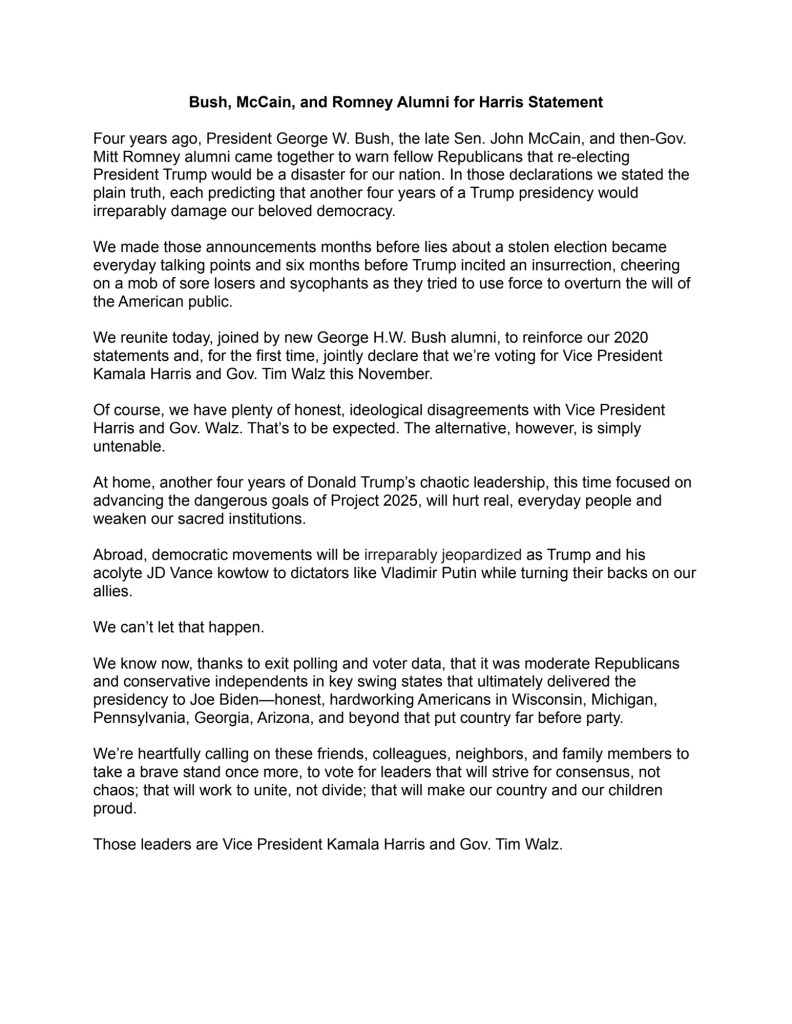
A long list of people who worked in the campaigns or government offices of George H. W. Bush, George W. Bush, Mitt Romney and John McCain issued a statement endorsing Kamala Harris yesterday. The full list appeared in USA Today. Many, but not all, of the group opposed Trump’s re-election in 2020. No comparable group of Obama-Biden alumni has endorsed Trump.
When Project 2025, the definitive guide to Trump’s second term, began to generate negative reactions, Trump claimed he was taken by surprise. All of a sudden, he played dumb about Project 2025: He said he didn’t know who was behind it and had barely heard about it.
Donald Trump and his campaign may have disavowed it, but don’t think for a moment that Project 2025 is going anywhere. A newly released hidden camera interview with one of the project’s authors, who also served in Trump’s Cabinet, reveals that the Republican nominee has “blessed it.”
First, a little background.
Project 2025, the MAGA blueprint to completely overhaul the federal government, is being spearheaded by the Heritage Foundation, the daddy of conservative think tanks, with input from more than 100 other right-wing organizations. “The Mandate for Leadership 2025: The Conservative Promise,” the official title, consists of four pillars:
A 900-page policy guide for a second Trump term
A playbook for the first 180 days, consisting of 350 executive orders and regulations that have already been written
A LinkedIn-style database of potential MAGA personnel
A “Presidential Administration Academy,” a training guide for political appointees to be ready on day one
On July 24, Russell Vought, Trump’s former director of the Office of Management and Budget, Project 2025 author and Republican National Convention policy director, met with two people he thought were potential donors to his conservative group, Center for Renewing America. They were actually working for a British nonprofit trying to expose information about Project 2025. The two secretly recorded the two-hour conversation.
In the video posted on CNN, Vought described the project as the “tip of the America First spear.” He said that after meeting with Trump in recent months, the former president “is very supportive of what we do.” The project would create “shadow agencies” that wouldn’t be subject to the same scrutiny as actual agencies of the federal government. Vought also told members of the British nonprofit that he was in charge of writing the second phase of Project 2025, consisting of the hundreds of executive orders ready to go on day one of a new administration.
When asked how the information would be disseminated, his deputy said it would be distributed old-school, on paper. “You don’t actually, like, send them to their work emails,” he said, to avoid discovery under the Freedom of Information Act.
Last week, ProPublica, an investigative journalism nonprofit, obtained more than 14 hours of training videos, which are part of Project 2025’s effort to recruit and train tens of thousands of right-wing appointees to replace a wide and deep swath of current federal civil servants.
“We need to flood the zone with conservatives,” said Paul Dans, who was in charge of Project 2025 until he was fired because it’s become such a headache for Trump. “This is a clarion call to come to Washington,” Dans said in 2023.
Project 2025 is not a new plan; it has been in the works for decades. The first version was published just after Ronald Reagan took office in 1981. In 2015 the Heritage Foundation gave the incoming Trump administration the seventh iteration. Should you think that Trump and his cronies know nothing about any of this, the Heritage Foundation boasted that Trump instituted 64% of the policy recommendations in that document, including leaving the Paris Climate Accords.
Trump has tried and largely failed to distance himself from Project 2025. Perhaps because two high-ranking members of his administration were directors of the project. On Truth Social, Trump posted, “I know nothing about Project 2025. I have no idea who is behind it….” As for those training videos, most of the speakers in them are former Trump administration officials.
Many of Project 2025’s recommendations are deeply unpopular with Americans. A survey conducted by YouGov found that almost 60% of respondents opposed several big tenets, including: eliminating the Department of Education, giving tax cuts to corporations, ending the Affordable Care Act (Obamacare), and changing the law to allow the president to fire civil servants.
It is difficult to convince voters that the project’s policy recommendations are real because they are so radical. Anat Shenker-Osorio, a political strategist, spoke about the challenges of discussing Project 2025 with focus groups on the podcast “The Wilderness.”
“When we actually cut and paste verbatim from the Heritage document, people are like, that’s a bunch of bull****. Like, why did you make that up? And what is wrong with you? And why are you lying to us?” she said.
To that end, here are just a few of the most democracy-threatening suggestions, verbatim:
On child labor: “With parental consent and proper training, certain young adults should be allowed to learn and work in more dangerous occupations.”
On education: “Federal education policy should be limited and, ultimately, the Federal Department of Education should be eliminated.“
On climate change: “Climate-change research should be disbanded … The National Oceanic and Atmospheric Administration (NOAA) should be broken up and downsized.”
On LGBTQ+ rights: “The next secretary should also reverse the Biden Administration’s focus on ‘LGBTQ+ equity,’ subsidizing single-motherhood, disincentivizing work, and penalizing marriage, replacing such policies with those encouraging marriage, work, motherhood, fatherhood, and nuclear families.”
On families: “Families comprised of a married mother, father, and their children are the foundation of a well-ordered nation and healthy society … The male-female dyad is essential to human nature and … every child has a right to a mother and father.”
Not to mention several highly publicized recommendations on abortion and women’s rights that are an effort to return to America of the 1950s.
The architects of and adherents to Project 2025 want a white, heterosexual Christian nation. The ideals of our 250-year-old form of government, in which majority rules, are anathema to them. They want to inflict their beliefs on everyone, representative democracy be damned.
I cannot state it strongly enough: Project 2025, with Donald Trump at the helm, is the greatest existential threat to American democracy in recent history. And make no mistake, should Trump win in November, he will usher in many if not most of the project’s recommendations.
Perhaps Project 2025 should be referred to as Project 1925. In Trump’s mind, that was the time that America was “great,” and they want to go back to that era of low taxes, no abortions, white Christian male domination, no civil rights laws, low taxes, and a very limited federal government.
Jill Lawrence is a veteran journalist who writes now for The Bulwark, a Never-Trumper site. She writes here about the ridiculous epithets hurled at Kamala Harris’s plan to punish price-gouging. After trying out various insulting names, he has settled on “Communist Kamala.” This is ridiculous, of course, but it stirs fear. Apparently anyone who believes that the federal government has a role to play in supporting the general welfare is a Commie. In Trump’ssworld, the purpose of the Feds is to cut taxes on the rich.
VICE PRESIDENT KAMALA HARRIS wants to punish companies for price gouging—but only food suppliers and grocery stores, and only if federal or state authorities investigate and determine that they have violated what her campaign calls “clear rules of the road.”
Reaction across the spectrum has run a mild to overheated gamut of negativity, with the proposal being called everything from counterproductive and “not sensible” to “Venezuelan-style” Nixonomics and “a heavy-handed socialist policy” that will fuel former President Donald Trump’s attacks on her as “Comrade Kamala” going “full Communist” by imposing “socialist price controls” that would cause rationing and hunger.
Give me a break, man, as President Joe Biden might say. Communist? Socialist? Nixonesque? Not even close.
“In our country both wholesale and retail prices are established by the government,” Soviet Finance Minister Vasily Garbuzov said in 1960. All of them. By fiat. And quite similar to what President Richard Nixon did eleven years later. “I am today ordering a freeze on all prices and wages throughout the United States,” he said on August 15, 1971.
None of this is remotely akin to the modest scope and due process of what Harris has in mind, per her campaign: writing national rules “to make clear that big corporations can’t unfairly exploit consumersto run up excessive profits on food and groceries,” and authorizing the Federal Trade Commission and state attorneys general to investigate and penalize companies that break those rules.
Many states—those vaunted laboratories of democracy—already have laws that ban price-gouging. At its core, it’s simply consumer protection. And while we don’t yet know the details of the Harris plan, let alone how it would evolve when enacted or what impact it would have, as a political calculation it’s never a mistake to empathize with consumers during inflationary times.
Nixon lifted his price and wage controls right after he was re-elected in 1972. Harris announced her plan last week—less than a month after her sudden rise to the top spot on the Democratic ticket in a contest against Trump, who is manifestly unfit to serve and a proven danger to democracy.
Speaker Emerita Nancy Pelosi helped engineer that candidate switchout, Harris slotted in for a flagging 81-year-old Biden, and it’s the Pelosi campaign mantra that comes to mind these days: Just win, baby. Plus, what’s wrong with politicians signaling in a visceral way that they feel people’s pain at the grocery store? Nothing.
Bill Clinton, the epitome of a feel-your-pain president, signaled both political moderation and emotional connection in two State of the Union speeches—1996 when he was running for re-election and 1997 after he had won a second term—by backing uniform requirements in public schools that wanted them. He argued they could help “break the hold of gangs and violence” and promote “discipline and order and learning” in classrooms.
By scale and historic import, Clinton’s school uniforms push didn’t rank among his administration’s most noteworthy achievements, yet it allowed him to relate to people on a personal, daily-life level, and that’s what Harris needs…
Joe Biden has not gotten the credit he deserves for his economic record. The U.S. economy on his watch has made a stellar recovery from the pandemic. Wages are up, unemployment is way down, the stock market is up, retail sales are up, inflation is down, and as of last week, small business applications were at a record high of 19 million since Biden and Harris took office.Join
Maybe the public hasn’t given Biden credit for all this because inflation has only just shown signs of subsiding. Or maybe it’s because of his age and general unhappiness about a Biden–Trump rematch. But part of it may be, as I have written, that Biden has been playing the long game—setting us up to fight climate change, compete with China, and bring manufacturing home to protect America against future global supply-chain disruptions.
And the investments have been targeted well: renewable energy, high-speed broadband, electric-vehicle battery plants and charging networks, a wave of future-forward manufacturing that studies show has gone largely to red and purple states and congressional districts. Biden will leave the whole country, not just the parts he likes or wins, more self-sufficient and better equipped to take care of the planet.
The concrete results in some cases won’t be apparent for years after Biden leaves office, but progress is happening now—high-speed internet proposals submitted and approved, new jobscoming online, semiconductor manufacturing projects advancing with federal and private-sector financing, and America on its way to producing 30 percent of the world’s semiconductor chips by 2032—up from zero.
Key parts of Biden’s Build Back Better plan largely fell by the wayside in 2022—most notably a care component that included free preschool, paid family and medical leave, child care subsidies, higher pay for home health care workers, an expanded child tax credit, and remedies for what even then was a crisis-level housing shortage. But Biden has not lost sight of any of this, and in fact he revived the family-relief provisions this past spring before exiting the 2024 race.
Harris, whose interest in such policies is longstanding, is now adapting and expanding on the care agenda in ways that mesh with today’s populist economics. She’s doing the same on housing and inflation, informed by her background as a prosecutor and attorney general who protected consumers and their interests, from privacy to home foreclosures.
This is the moment we’re in and Harris is seizing it. That’s the right thing to do in 2024, just as the right thing to do in 2020 was to defend democracy and fight for the soul of the nation. That’s how Biden defeated Trump four years ago and he’s been clear about his objective this year… “Win.”
To anyone who wonders if there is a difference between the two parties, here’s a big one: gun control. A Trump-appointed federal judge in Kansas struck down a ban on machine guns. He was following the advice of Justice Thomas, who made the wacky argument that if something was okay when the Constitution was written, then it’s okay now. The Founding Fathers did not ban machine guns: why should we?
Up next in the arms of school shooters: fully automatic machine guns. Trump appointee U.S. District Judge John Broomes (Kansas) ruled that the ban on owning fully-automatic machine guns that’s been part of American law since the 1930s is unconstitutional. Citing Clarence Thomas’ argument that if something wasn’t illegal at the time the Constitution was written it shouldn’t be illegal now, Broomes has set up a new case that’ll almost certainly end up before the six rightwing cranks on the US Supreme Court.
Jennifer Rubin, columnist for the Washington Post, was at the convention in Chicago with her colleagues. She made a sage observation. The Democrats have a strong bench of new and young faces. The Republicans do not.
She wrote:
It has become evident during convention week that Democrats are blessed with three groups of leaders. The wise first group — Hillary Clinton, the Obamas, former speaker Nancy Pelosi (Calif.) and now Biden — has guided the party for the past generation, nationally making strides and keeping the Democratic coalition together. The domestic accomplishments they have collectively made would stand up to any other generation’s output. The second group’s time has come: Harris, Gov. Tim Walz (Minn.), Transportation Secretary Pete Buttigieg, Sen. Raphael G. Warnock (Ga.), House Minority Leader Hakeem Jeffries (N.Y.), Gov. Josh Shapiro (Pa.). They are more media savvy than many in the older generation and better able to reach voters who are younger and more diverse. This second group’s challenge will be putting a stake through the MAGA movement and charting a path forward for a sustainable, center-left governing majority. The third, and most interesting, group includes the future stars, two of whom (Reps. Alexandria Ocasio-Cortez (N.Y.) and Jasmine Crockett (Tex.)) lit up the convention on Monday night. Other less flashy but equally compelling figures have the governing chops to win legislative battles and keep the party from straying too far left. These include Rep. Abigail Spanberger (Va.), who is running for governor; Rep. Elissa Slotkin (Mich.), who is running for Senate; Rep. Mikie Sherrill (N.J.); and Rep. Dan Goldman (N.Y.), who distinguished himself by going toe-to-toe with Republicans who ineptly and corruptly tried to investigate the Bidens.
Republicans have nothing comparable. Trump has hollowed out and disgraced the party. Any rebuilding, if Trump loses, will likely have to fall to a new generation. Trump, Senate Minority Leader Mitch McConnell (Ky.) and a flock of House and Senate extremists have dominated the GOP, turned off a great many voters and done immense damage to comity, the rule of law and good governance. One of the most attractive features of a possible Harris victory: Many prominent Republicans will be swept aside. We can only hope a better crop replaces them.
Note that Trump and his acolytes have driven the next generation of Republicans out of the party. Trump himself campaigned to defeat any member of Congress who voted to impeach him. Trump-aligned governors have “primaried” moderate Republicans. To be successful in today’s Republican Party, a candidate must pledge to defend The Big Lie. That hollows out good people like Adam Kinzinger and Liz Cheney.

 Diane Ravitch's blog