AP Physics students at the DeBakey High School for Health Professions had a new teacher Wednesday, after Houston ISD lifted a hiring freeze that had kept the position vacant since the start of the school year, forcing students to teach themselves college-level science.
The new teacher was hired on Friday, a day after Superintendent Mike Miles said the district was nearly finished with a staffing audit that led them to ask schools to limit hiring, according to an HISD spokesman. Students said they learned about the appointment Wednesday morning and had their first class with the teacher that same day.
“She seems super nice and (like) a very good teacher,” said senior Zain Kundi, who led a student petition to fill the vacancy, via text message. “She was able to teach us more in 40 minutes than the last eight weeks of us (teaching ourselves)…”
At DeBakey, students and parents were told the hiring freeze was the reason why the school couldn’t fill the AP Physics position, which was left vacant after administrators allegedly tried to foist the responsibility upon a standard physics teacher, who took an extended leave of absence in protest.
Students were left to teach themselves advanced physics for nearly two months, with some students being pulled out of other classes to teach their peers. The school’s Parent Teacher Organization eventually stepped in and enlisted qualified volunteers to provide virtual lessons and tutoring.
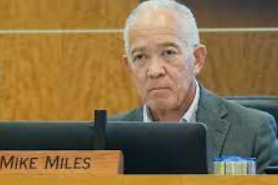
The incredible Mike Miles started the year boasting that he had no teaching vacancies. Nonetheless, teachers who dislike Miles’ lockstep “New Education System” are quitting. In one high-perfuming school, students in advanced physics lost their teacher and are now teaching other students.
Juniors and seniors at Houston ISD’s DeBakey High School for Health Professions walked into their AP Physics classes at the beginning of the school year and asked one question: “Where’s our teacher?”
About 150 students at the top-ranked high school signed up for the advanced science courses, many with the hope of earning college credit, but found themselves without a qualified teacher. Given the complex nature of the material, substitute teachers brought in were unable to do much more than supervise the classroom.
The teens spent the first seven weeks of the year trying to teach themselves sophisticated concepts, including electric circuitry and thermodynamics. In some cases, seniors in AP Physics II were pulled out of classes to teach juniors in AP Physics I. Students were told by administration that their hands were tied — a hiring freeze at Houston ISD had left them unable to fill the vacancy, they were told, which was created when a teacher went on leave to start the year.
“It’s just aggravating,” said senior Zain Kundi. “It’s money on the line, because these classes in college are thousands of dollars and if you get it out of the way now, you can save quite a bit of money. And if our grades start falling, colleges will see that early in the admissions process and be like ‘what the heck…’ Especially now with college applications, we have so much on our plates already.”
Kundi says the AP Physics position was left vacant because the school’s administration tried to saddle a standard physics teacher with the role just before the start of the school year, causing the teacher to use accumulated leave days in protest. The senior made it clear he does not blame the teacher nor HISD for the vacancy, arguing that DeBakey’s administration had a whole summer to find someone for the role. Now, student GPAs, AP scores and college prospects may be affected as a result, he says.
DeBakey Principal Jesus Herrera did not respond to multiple requests for comment. A district spokesman said last week that schools “have been asked to limit outside hiring” until staffing audits are complete in the 85 schools in or aligned with Miles’ New Education System, where enrollment was less than forecast to start the year.
“This will give existing HISD teachers whose positions are eliminated in NES and NES-A campuses the first opportunity to apply for other positions available in non-NES schools. Exceptions can and have been made for specialized instructors like AP teachers,” the district said in a statement.
Miles said Thursday evening that the audit was near completion and that the pause would be lifted quickly.
“We had some excess teachers, and we’re moving some teachers around, and that should be completed soon,” Miles said last week. Teachers who move from an NES or NES-A campus will keep their $10,000 stipends, but in the case of the former, will not retain the higher salaries they received for teaching in an NES school, he said.
Meanwhile, DeBakey students presented a petition with dozens of signatures to administrators at a PTO meeting in late September, demanding answers and a solution to the problem.
“Our current management of these courses is not working to benefit our students or our teachers, and it is time for answers,” the petition reads, noting that having senior students teach advanced physics to juniors is “extra work for the seniors and suboptimal instruction for the juniors…”
The situation is not just affecting DeBakey. Though Miles said he started the year with zero teaching vacancies, uncommon in a district like HISD, teachers and administrators at other schools say that they had to get creative to fulfill responsibilities of teachers who have left the district since the school year started.
One geography teacher at Sharpstown High School said he had to take over U.S. history classes after its teacher left over a month into the school year, and that the school has had to reshuffle classes and teachers to avoid hiring as more and more teachers leave. An administrator at one non-NES elementary school said that they were unable to hire a long-term substitute, as they normally would have in years past, after one teacher resigned a few weeks into the year because they were told by district officials that there was a hiring freeze for any positions beside special education and bilingual teachers…
At DeBakey, the PTO has attempted to address the issue on its own by pooling its money to pay stipends to two college professors and two former AP Physics teachers for virtual lessons and tutoring sessions. But not every school in HISD has the resources for such a response, which Ake acknowledged is a “Band-Aid solution until the school and the district can lift the freeze.”
For several years, vendors of Education technology have promoted the bizarre idea that learning on a computer is “personalized,” as compared to human interaction with a teacher. Tech leaders like Mark Zuckerberg and Bill Gates believed that technology would make it possible to accelerate learning and raise test scores by standardizing teaching.
Matt Barnum reports in Chalkbeat that Zuckerberg’s efforts failed. He and his wife Priscilla Chan via their CZI Initiative realize that their support of Summit Learning failed. However they are now betting on artificial intelligence.
What’s clear is that they do not trust teachers.
Barnum begins:
Several years ago, Mark Zuckerberg had grand designs for American schools.
The Facebook founder and his wife, pediatrician Priscilla Chan, poured well over $100 million into an online platform known as Summit Learning that initially aspired to be in half of the nation’s schools. In 2017, Zuckerberg suggested that technology-based “personalized learning” could vault the average student to the 98th percentile of performance.
Fast forward to this summer: The Chan Zuckerberg Initiative, the couple’s philanthropic arm, laid offdozens of staff on its education team and announced a shift in strategy. “Our understanding of what’s possible in the world of education — and in our world more generally — has changed,” Sandra Liu Huang, CZI’s head of education, wrote in an August blog post. “And so, at CZI, our education efforts must change too. Navigating these changes is humbling and challenging, but ultimately, necessary.”
It was an acknowledgement that the company’s prior education strategy had fallen short of its hopes. Through a spokesperson, Huang declined an interview request, but noted in her blog post that the company is continuing its work in education, albeit with a different strategy. “This moment demands not just investment but innovation — and that’s why we are building a team of experts and partners to identify opportunities where technology and grantmaking can drive coherence,” she wrote.
CZI’s shift in approach marks something of a coda to an era when various advocates and funders believed that computer-based “personalized learning” could dramatically improve education. Summit, CZI’s pet project, has not spread as far as once hoped, and there’s little evidence that it or similar efforts have led to the large learning gains that Zuckerberg envisioned. This gap between ambitions and results underscores the difficulty of using technology to dramatically improve America’s vast system of decentralized schools.
“People keep hoping that our technologies are the Swiss Army knives or steamrollers that they can do everything,” said Justin Reich, a professor at MIT and author of a book on the limits of technology in education. “Instead, our best technologies are very particularly shaped ratchet heads and the landscape of education is millions of bolts.”
Please open the link and read the rest of this fascinating article. CZI has not given up on technology. Imagine if they had spent those millions on health clinics in schools. Or anything else human-based.
Governor Greg Abbott really, really wants vouchers. The State Senate agrees with him. The House of Representatives is controlled by Republicans but it thus far has refused to pass them. Rural Republicans in the House have allied with urban Democrats because both know that vouchers will harm their community public schools.
But Abbott is pulling out all the stops. He even refused to raise teachers’ salaries or increase public school funding until he gets a voucher bill.
The Texas Observer comments:
Governor Greg Abbott has called lawmakers back to a special legislative session starting this coming Monday, October 9. His message to them: Pass school vouchers—or else.
“There’s an easy way to get it done, and there’s a hard way,” Abbott said during a September 19 tele-town hall. “If we do not win in that first special session, we will have another special special session and we’ll come back again. And then if we don’t win that time … We will have everything teed up in a way where we will be giving voters in a primary a choice.”
From bullying legislators to “co-opting” churches and religious services, Abbott “wants to force a voucher at all costs,” said Patty Quinzi, legislative director of the Texas American Federation of Teachers. Pulling the purse strings of Abbott’s voucher campaign are a handful of billionaires who have invested millions to weaponize far-right culture war propaganda to fund what the governor has branded as “school choice” for parents.
Meanwhile, many public school districts started this school year with a budget deficit after the Senate refused to use the state’s $33 billion budget surplus to increase school funding without the condition of passing universal vouchers.
During the regular session, the House twice rejected proposals for vouchers or “an educational savings account,” citing constituent concerns that voucher programs would siphon money from public schools. When the Senate attempted to force the House to accept universal vouchers in return for passing its school funding proposal, its author, Representative Ken King, pulled the bill.
“In the end, the Senate would not negotiate at all. It was a universal ESA or nothing,” King wrote in his public statement. “I am committed to protecting the 5.5 million school kids in Texas from being used as political hostages. What the Governor and the Senate [have] done is inexcusable, and I stand ready to set it right and continue to work for the best outcome for our students and schools.”
In early August, the House’s 15-member committee on Educational Opportunity and Enrichment issued its interim report, signaling some members’ willingness to compromise on school vouchers if they were limited to students with special needs and if the money to fund a voucher program came out of the state general revenue instead of the Permanent School Fund. Earlier this year, the Observer revealedhow limited voucher programs in other states served as a trojan horse for larger, universal voucher programs, leaving public schools with large deficits and a loss of federal civil rights protections for parents who took their children out of public schools.
“We are $40 billion below the national average for school funding, so we have no business talking about any kind of program that takes more money out of our public schools,” said Representative Gina Hinojosa, who serves on the committee but declined to endorse its recommendations.
Greg Abbott has vowed to keep calling special sessions until the Legislature passes a voucher bill.
Shani Robinson was one of the Atlanta teachers who was convicted during the Great Cheating Scandal of 2015. Almost ten years later, she and five others who refused to plead guilty are still free while appealing their convictions. Shani wrote a book about her ordeal called None of the Above, which I reviewed here. Shani’s book persuaded me that she had not cheated; she had no motivation to cheat since the scores of first-graders did not count for AYP (Adequate Yearly Progress) or for a bonus for her. She was outraged to be accused of cheating, and she resisted all plea deals that required her to plead guilty or to accuse others, even if the plea deal allowed her to walk free. She was determined to insist on her innocence rather than make a deal with prosecutors.
Now that Trump and others are accused using the RICO statute, I contacted Shani to ask her where her case stands today.
Shani wrote this account for the blog:
Most everyone I know is paying attention to the prosecution of former President Donald Trump and 18 of his allies related to an alleged conspiracy to overturn the 2020 election. Georgia’s Racketeer Influenced and Corrupt Organization (RICO) Act makes that possible. I view the proceedings with mixed feelings, as I was falsely accused and convicted under that same RICO Act during the Atlanta Public Schools (APS) Cheating Trial in 2015.
My name is Shani Robinson and I’m a former first grade teacher. I was falsely accused of cheating on my students’ standardized tests by a former co-worker, whose story changed every time she was interrogated by the Georgia Bureau of Investigation (GBI), but who was ultimately offered immunity in exchange for her testimony. Former Fulton County District Attorney Paul Howard Jr. claimed that cheating was the result of a criminal conspiracy. He used RICO—a law devised to take down the American Mafia—to throw the book at educators. I was offered a plea deal that would have whittled my potential 25-year prison sentence down to community service. But I wasn’t willing to admit guilt for something I hadn’t done and/or falsely accuse someone else. I also never received bonus money (the basis for the RICO charges) because my school didn’t reach the district targets, which were APS’s testing goals that prosecutors claimed were the main culprit behind the cheating. There was no motive for me to cheat because as a first-grade teacher, my test scores didn’t count toward the district targets.
The APS cheating case was rife with corruption from the beginning. Former Georgia Governor Sonny Perdue sent an unprecedented number of GBI agents into APS in 2010. Teachers were pulled out of their classrooms and told to speak with these agents, and in most cases, there were no attorneys present. Agents used intimidation to elicit confessions and accusations: Some educators complained that GBI interrogators threatened that they could lose custody of their children if they didn’t cooperate. Educators who maintained their innocence were asked to sign pre-written statements saying they didn’t cheat. Some of the teachers who signed the forms were still accused of cheating and were charged with making false statements and writings, a felony, because they had followed instructions and signed the statements the GBI provided. At the same time Perdue’s investigation was underway in APS, he turned around and used the same questionable test scores in an application for President Obama’s Race to the Top program and won a $400 million federal grant.
The trial was like a circus. The judge called out prosecutors on multiple occasions for improperly influencing the jury. But the judge himself was often out of line too: from telling the jury a story about a man he caught masturbating, to having a private conversation with former District Attorney Paul Howard Jr., to pressuring my co-defendants and me to take plea deals. While the prosecutorial and judicial misconduct that took place was bad enough, the mainstream media helped fuel the fire to justify the RICO charges. Their overall narrative was that educators cheated to get bonus money. This patently contradicted the GBI investigative report, which stated bonus money provided “little incentive” to cheat. One of the lead investigators on the case also stated this when he testified during the trial. Despite the flaws, the jury convicted all but one of us that was on trial.
The problem with RICO is that it criminalizes such a broad range of conduct, including acts by many people who have nothing to do with each other. RICO was originally written to attack organized crime; using such a statute against educators for cheating on standardized tests is unconscionable. Since the 2001 enactment of No Child Left Behind, a federal policy that mandated standardized testing and imposed sanctions on schools that failed to meet unrealistic goals, The National Center for Fair and Open testing documented cheating cases in nearly 40 states and Washington, DC. Only in Atlanta did educators face felony charges saddled with decades-long prison sentences.
This RICO indictment has hung over my head for the past 10 years, leading to a diagnosis of Post Traumatic Stress Disorder (PTSD). The impact of PTSD and the fallout from the trial has taken a significant toll on my family. I have 2 small children, sothe thought of going to prison and being separated from them is agonizing. There are 6 defendants, including me, still appealing convictions. We’ve all been able to remain out of prison thus far due to being on appeal bonds. But the case has been handled so poorly; the entire appeals process restarted this year with no end in sight. Millions of tax players dollars have already been spent on this trial.
Last year brought a ray of hope: Judge Jerry Baxter granted a new sentence for a principal who was convicted, enabling her to avoid prison and do community service instead. I’m hopeful that Fulton County District Attorney Fani Willis and Judge Jerry Baxter will come to the realization that RICO was misused in our case and find a peaceful resolution. Otherwise, the APS Cheating Trial could potentially be used as a playbook for other unjust prosecutions that clog up the legal system and waste public resources.
Mike Miles was imposed on the Houston Independent School District by State Commissioner Mike Morath. Neither Miles nor Morath was ever a teacher. HISD was graded a B district before the state takeover. The takeover was based on spite, on Governor Greg Abbott’s hatred for a district that opposes him.
Miles thinks he is an innovator, but none of his authoritarian mandates has ever succeeded anywhere else. They won’t succeed in Houston because he lacks the single most essential ingredient of leadership: Trust.
He rules by fiat. That may work in dictatorships but not in schools. Fear is not a good long-term motivator. If Miles know anything about research on motivation, he would know that the greatest motivators are intrinsic, such as a sense of mastery and autonomy.
The largest school district in Texas has been in the news a lot lately. You may know the district was issued a state takeover and its superintendent was replaced by Mike Miles, who, notably, has never taught.
You may know that as a part of his “wholescale, systemic reform” he identified 28 underperforming schools and identified them as NES Schools—which stands for New Education System.
You may know a few headlines—the most bizarre being that Miles starred in a musical skit for convocation that’s been scrubbed from the Internet.
Often, the real story isn’t as bad as newspaper headlines make them out to be. That’s not the case with what’s happening in H.I.S.D.
The experiences teachers are sharing are a different story entirely.
Here is what this reform looks like on a classroom level, from teachers currently in H.I.S.D.
Teachers read from a script the first two days of school.
Read right off the page. No get-to-know-yous, no surveys, no relationship-building, no games, nothing. Right into curriculum.
Teachers must keep classroom doors propped open.
However, teachers and parents argue this violates past safety mandates to leave classroom doors shut and locked.
Teachers cannot dim lights.
Even if they leave the windows open, have lamps, etc., the lights must be at full power.
Teachers have constant interruptions from administrators and district “minders.”
APs have to submit a minimum of five teacher observations per day, so this means near-constant interruption.
Administrators evaluate teachers on a checklist that has very little to do with pedagogy.
Teachers don’t know how school leaders will use these observations. This is the actual form (big thanks to Janice Stokes).
[Open the link to see the form.]
My first three reactions:
If teachers are reading from a script created by the district, why are we evaluating them on their instruction being relevant and engaging? Isn’t that on your people, Mike?
MRS stands for Multiple Response Strategies. Pair and share, whip around, etc. These are acceptable checks for understanding, but every four minutes is formulaic and prevents any kind of extended focus or stamina.
I haven’t heard “DOL” since 1992.
Classroom monitors can coach teachers on instruction at any time.
Even with students present. Not insulting at all!
No “weak readers” can read aloud because it models disfluency.
A district employee I spoke to insists it is a “flex space that can have other uses besides discipline.” I said, “Oh, like a library?” She did not respond.
Students may not free-write.
Also, they may not work independently for more than four minutes.
Every four minutes, teachers are required to hold an all-class response to check for understanding. Which is great, until you actually have to read a book, take a standardized test, or focus for more than four minutes.
Every classroom activity must tie directly to instruction.
No classroom celebrations, relationship-building activities, brain breaks, or routines/procedures instruction are permitted.
Teachers received extremely limited training on this model.
The location chosen for training left people sitting on floors and stuck in parking lots for over 45 minutes.
There is no information tying any of these strategies to best practice or research on what’s best for kids.
This authoritarian approach to education is taking a huge toll on school climate and morale. A friend of mine said teachers at her school are breaking down on a daily basis. Even the strongest, most experienced educators—department chairs and leaders with stellar records—feel demoralized and unnerved (and that’s saying a lot after the past few years).
And no, the answer isn’t to “just move,” or switch districts, or quit teaching altogether. First, that response is lazy and reductive, but more importantly doesn’t account for the hundreds of thousands of kids in H.I.S.D. schools forced to learn in environments counterproductive to their wellness and development.
Public school teachers in Texas have known for years that it’s in the best interest of the state to destroy public education and reallocate funding to religious and private schools. Years of slashing budgets, demonizing teachers, lowering standards, letting chaplains offer mental health counseling—don’t tell me that’s a state that holds any kind of value for public education. That’s a state that wants to “prove” public education doesn’t work so it can privatize.
It’s just wild to me that they’re not even hiding it anymore.
School started in the Houston Independent School District, and many teachers were stunned by the extent to which their actions were constrained by a script. The new superintendent Mike Miles has be never been a teacher but he thinks he knows everything about teaching. He laid down strict rules, and teachers must comply without hesitation. Miles is the kind of leader who, if put in charge of a hospital, would tell surgeons how to conduct surgeries. This story appeared in the Houston Chronicle and was written by staff writer Anna Bauman.
As she prepared for the start of a new school year in Houston ISD, a fifth-grade reading teacher stripped much of the colorful personality from her classroom, including motivational posters, student art projects, several bins of books and a social-emotional learning nook with comfy furniture.
She wiped away tears and, earlier this week, started teaching at a school under the New Education System, a wholesale reform model introduced by Superintendent Mike Miles, who was appointed in June by the Texas Education Agency to run the largest school system in Texas.
While parents and students may have noticed few of the changes, educators from a wide swath of schools in HISD say they feel micromanaged and stressed in their first week under new district leaders, who are reportedly enforcing strict guidelines and conducting frequent classroom observations that have sparked frustration, fear and low morale among teachers at both NES and non-NES schools.
“I feel like they are not allowing me to do what’s in the best interest of the children,” said the reading teacher. “Every day I go to work, I’m crying. Every day I leave from work, I’m crying.”
The superintendent, meanwhile, said he has been pleased with what he has seen while collecting a “baseline” at NES schools in the first week.
“I was very impressed with their progress, even in one day, but also their preparation for the beginning of the school year,” Miles said. “Teachers were teaching well, they were following the instructional model, and it was pretty good. It shows that the schools and the teachers have been preparing hard for the first day, second day of school.”
The district is laying the groundwork for a pay-for-performance evaluation system geared toward measuring the quality of a teacher’s instruction, although a Harris County judge has temporarily blocked HISD from implementing the system.
“The high-quality instruction, there’s a clear rubric for that, there’s a clear spot observation form, because we have to train teachers,” Miles said. “We can’t just do what we’ve always done, which is go into a classroom every three weeks or three months and think we’re going to see something that is effective teaching, and just rely on, ‘Oh, I’ll know it when I see it.’”
This year, all principals will be evaluated under a new system that requires them to give instructional feedback and spend significant time coaching teachers in classrooms. Principals will be graded in part based on the quality of instruction at their school. Meanwhile, teachers will also be measured with a new evaluation system this year, although those who do not work in the schools targeted for reform may ask for a waiver.
District leaders trained teachers in recent weeks on the evaluation system and new classroom expectations. For example, one slideshow presented during teacher training listed some “common practices that we want to generally avoid,” including stream of consciousness writing, rooms with dim lighting and worksheets that are not purposeful. The training materials also discouraged teachers from showing entire films, letting kids “earn” free time and allowing “poor readers” to read aloud during class.
The slideshow instructed teachers to post a “lesson objective” on the board before the start of each class, avoid wasting time on transitions between activities, teach “bell to bell,” teach grade-level content to “every student every day” and use a timer to guide pacing of the lesson. Teachers should use a “multiple response strategy,” an activity that engages and checks the understanding of all students, every four minutes, according to a sample spot observation form.
On the first day, teachers said they were expected to skip introductions and get-to-know-you games, instead jumping right away into instructional material.
“I don’t even know who my kids are because we haven’t been able to get to know them,” said the fifth-grade reading teacher. “They still call me ‘teacher’ because they can’t remember my name.”
She has struggled to stay on pace with the timed lessons and was scolded for bringing in additional materials to help students, many of whom are Spanish speakers who cannot read on grade level. When she raised concerns about the fast pace, a district official told a campus administrator that the teacher was “moving too slow.”
“We’re not allowed to give them work on a level they understand. Most of the time, they sit there confused,” the teacher said. “I’ve had students crying since day two, saying they’re overwhelmed.”
Meanwhile, Jessica Waligorski, a special education support teacher at Isaacs Elementary School, said she appreciates the rigor, high expectations and organization of the NES model. Administrators are supportive and easily accessible at her NES campus, she said. Teachers lift each other up when doubts creep in and students have taken to the new model “like sponges,” she said.
“Everyone is holding each other to a standard and we’re not wavering,” she said. “We have set the tone, we have set expectations, we have set goals … and our kids have been engaged, learning. They don’t have a minute to misbehave because there’s so many things they’re learning.”
Miles has said there is no directive from the district mandating that teachers at non-NES schools teach with a specific curriculum or follow a certain instructional model. In reality, however, many of the new rules and expectations seem forced on campuses across the district, including high-performing schools that do not fall under NES.
Some of the rules seem to have been taken to an extreme. One teacher said she asked for an accommodation to use lamps instead of florescent lights in her classroom due to a serious medical condition. District officials denied her request and suggested another option: Wear sunglasses.
The teacher has already started getting headaches from the bright lights.
“I have all my lights on,” she said. “I’m trying to get through the day.”
In addition to turning on lights, the teacher, who works at a non-NES middle school, has made several other changes this year, including removing bean bag chairs from her classroom, keeping the classroom door open and following the new instructional techniques outlined on the evaluation rubric.
District staff have been observing classrooms almost every day this week, she said. The teacher said she was nervous to sit down while taking attendance or interrupt a lesson to tell a funny story during class.
“We all feel afraid to step out of line,” she said.
One teacher at a non-NES campus said she was observed by appraisers three times on Monday, creating a climate of fear and nerves even at a top-ranked campus. She loves having visitors in her classroom — “I’m a really good teacher and I’m proud of what I do” — but it feels different when “someone’s sitting there, ticking boxes,” especially on the first day of class.
“People are having trouble sleeping because they’re on edge,” she said. “It’s the constant anxiety that we’re going to be caught and that we’re going to be dinged. … I think you’re going to see a mass exodus of teachers at the end of this year, if this continues.”
One teacher at a different non-NES campus said he and other educators were chastised for spending the first day on introductions, logistics and relationship building with students rather than teaching content.
The teacher stayed three hours late that night to adjust his lesson plans for the second day, and his principal checked in first thing the next morning to make sure that he was prepared to teach a full-blown lesson, as expected by the appraiser in his classroom.
The new expectations and frequent classroom observations from district administrators this week has created a sense of frustration and anxiety on campus, according to the teacher, who said he was ready to quit even though he feels “called” to the profession.
“There’s no grace, there’s no empathy, there’s no treating people as people,” he said. “We are not encouraged to move forward — we’re pushed off the cliff and told to fly. And if you don’t fly, you fail.”
Many of the teachers at his top-rated campus have decades of experience, he said.
“I work at a really special school. … We should not be the target,” he said. “We were hoping that we’d be so far under the radar that we’d be left alone, but that’s not the case.”
Under unrelenting pressure from major corporations, unions have experienced a precipitous decline in their numbers in recent decades. Only about 11.3% of workers belong to a union, and most work for government. Among the nation’s largest unions are the National Education Association and the American Federation of Teachers. Rightwing provocateurs have gone to the Supreme Court repeatedly to strip these unions of their power to defend the rights of their members.
Just in the last few days, unions won an important victory before the National Labor Relations Board. This victory was possible because Biden was elected in 2020, not Trump. Trump would have appointed people to squash unions like pesky bugs.
Harold Meyerson wrote about the ramifications of the latest NLRB decision:
Hot Labor Summer just became a scorcher.
Last Friday, the National Labor Relations Board released its most important ruling in many decades. In a party-line decision in Cemex Construction Materials Pacific, LLC, the Board ruled that when a majority of a company’s employees file union affiliation cards, the employer can either voluntarily recognize their union or, if not, ask the Board to run a union recognition election. If, in the run-up to or during that election, the employer commits an unfair labor practice, such as illegally firing pro-union workers (which has become routine in nearly every such election over the past 40 years, as the penalties have been negligible), the Board will order the employer to recognize the union and enter forthwith into bargaining.
The Cemex decision was preceded by another, one day earlier, in which the Board, also along party lines, set out rules for representation elections which required them to be held promptly after the Board had been asked to conduct them, curtailing employers’ ability to delay them, often indefinitely.
Taken together, this one-two punch effectively makes union organizing possible again, after decades in which unpunished employer illegality was the most decisive factor in reducing the nation’s rate of private-sector unionization from roughly 35 percent to the bare 6 percent at which it stands today.
In the Board’s press release outlining its 121-page decision in Cemex, it explained:
“… the revised framework represents an effort to better effectuate employees’ right to bargain through their chosen representative, while acknowledging that employers have the option to invoke the statutory provision allowing them to pursue a Board election. When employers pursue this option, the new standard will promote a fair election environment by more effectively disincentivizing employers from committing unfair labor practices.”
“This is a sea change, a home run for workers,” said Brian Petruska, an attorney for the Laborers Union who authored a 2017 law review article on how to effectively restore to workers their right to collective bargaining enshrined in the 1935 National Labor Relations Act, which was all but nullified by the act’s weakening over the past half-century. Taken together, Petruska added, last week’s decisions recreate “a system with no tolerance for employers’ coercion of their employees” when their employees seek their legal right to collective bargaining.
Petruska’s 2017 article explained how an attorney’s misstatement in a 1969 case before the Supreme Court (NLRB v. Gissel Packing Co.) led to the abandonment of a previous Board ruling in the case of Joy Silk Mills, which had required employers to recognize their workers’ union and enter into bargaining if they’d refused to recognize the union after a majority of workers had voted for affiliation. The article didn’t draw wide notice; at least, until President Biden’s appointee as the NLRB’s general counsel, Jennifer Abruzzo, sent out her initial memo to the 500 NLRB attorneys across the country whom she supervised. In the memo, Abruzzo laid out the kind of cases those attorneys could pursue, and suggested that they consider cases based on the long-forgotten Joy Silk standard, which she viewed as erroneously discarded, with demonstrably catastrophic consequences for workers’ right to unionize and bargain.
How catastrophic? In the profile I wrote of Abruzzo in the April 2022 print issue of the Prospect, I cited numbers from Petruska’s article that showed “in the five years before Joy Silk was struck down, charges of employer intimidation totaled about 1,000 cases a year. Once the softball remedies of Gissel became the standard, charges exploded to a peak of 6,493 in 1981, after which they fell along with unionization efforts generally.” As the new post–Joy Silk tolerance for employer coercion became the norm, interest in organizing withered.
By the time Abruzzo became general counsel, “even labor lawyers had forgotten about Joy Silk,” which had then been a dead letter for 52 years, UC Berkeley law professor Catherine Fisk told me for my Abruzzo profile. Abruzzo, however, had had a long career as an NLRB attorney and had also served as a special counsel for the Communications Workers of America (CWA), a consistently militant union. Even within the community of pro-labor attorneys, she was known for her exceptional dedication to worker rights and her knowledge of how the laws that once afforded them their rights could be revived and renewed. The brief she presented to the Board in the Cemex case promoted a ruling that differs in some respects from the standards promulgated in Joy Silk, but its effect is essentially comparable.
The Cemex decision secures Abruzzo’s place as the most important public official to secure American workers’ rights since New York Sen. Robert Wagner, who authored the NLRA in 1935 (the same year he authored the Social Security Act).
Since the days of Lyndon Johnson, every time that the Democrats have controlled the White House and both houses of Congress, they’ve tried to put some teeth back into the steadily more toothless NLRA. But they’ve never managed to muster the 60 votes needed to get those measures through the Senate. The Cemex ruling actually goes beyond much of what was proposed in those never-enacted bills.
Still, there’s one crucial element to restoring workers’ rights that has yet to be accomplished: Companies can still indefinitely refuse to agree on a contract. Some of the failed labor law reform bills included provisions mandating that an arbitrator impose a contract if no agreement has been reached after a specified period of time (say, 90 or 180 days). Absent such a provision, workers’ rights can still be thwarted, which we’re seeing happen in real time with the inability to complete a first contract at hundreds of Starbucks shops and Amazon’s warehouse in Staten Island.
Nonetheless, Cemex should open the door to more organizing campaigns than American labor has seen for decades, at least among those unions (SEIU, CWA, the Teamsters, National Nurses United, the private-sector wings of AFSCME, and the American Federation of Teachers, to name just some) that still have robust organizing departments. It could help the Steelworkers, the newly led United Auto Workers, and the Machinists to organize the federal incentive–driven factories springing up in the historically anti-union South.
One reason that these two landmark decisions came down last week was that the term of one of the three Biden appointees to the Board, Gwynne Wilcox, is about to run out. Board terms normally last for five years, but Wilcox was appointed for just two years to fill out the balance of the term of a member who had retired early. Once she’s off the Board, there will be just three members, since one of the Board’s Republican seats has now been vacant for nearly a year. (By mutual consent, the Board is composed of three members from the president’s party and two from the opposition.) And when it has only three members, the Board is forbidden from making decisions that change its rules.
The normal procedure for filling seats on the Board (like with many multimember commissions) is that an appointee from one party comes before the Senate for confirmation in tandem with an appointee from the other party. However, hoping to thwart the now Biden-dominated Board from making decisions like those of last week, the Republicans, backed by the U.S. Chamber of Commerce, have declined to put forth a nominee to fill the vacant Republican seat, plainly hoping that Democrats would adhere to the custom of not bringing up an unaccompanied Biden appointee for a vote. More precisely, they’ve wagered that the anti-worker duo of Sens. Manchin and Sinema would deny that nominee the 51st vote required for confirmation, using the fig leaf of the absence of a Republican nominee to justify their opposition.
The White House renominated Wilcox for a five-year term some time ago, and Bernie Sanders’s Senate Labor Committee has sent her nomination to the floor, with all the committee Democrats plus Alaska Republican Lisa Murkowski voting to do so. For whatever reason, however, both the Biden administration and Democratic Senate Majority Leader Chuck Schumer have put the floor vote on hold, perhaps in the vain hope that Senate Republicans will put forth their nominee, which Republicans have made obvious that they have no intention of doing. As a result, the Board is about to go down to three members, and become effectively inert.
Hence, the timing of last week’s one-two punch on the eve of Wilcox’s departure, even if just temporary. It will require the vote of any one of Manchin, Sinema, or Murkowski to restore the Board to its rulemaking authority.
Despite that drama, last week’s punch was historic. “Congress passed the NLRA to give workers the right to deal with their work issues immediately, not to have them delayed and denied by employers who feel free to violate the law,” says Jules Bernstein, the doyen of the D.C. union-side bar. “A ruling that restores that right—and that’s what the Cemex ruling does—is terrific, and long overdue.”
Mercedes Schneider summarizes the checkered career of Mike Miles, who was put in charge of the Houston Independent School District by State Commissioner Mike Morath, who was appointed by hard-right Republican Governor Greg Abbott. Abbott wants to punish Houston for not voting for him. What better punishment than to install Mike Miles as superintendent?
On June 01, 2023, the Texas Education Agency (TEA) appointed Mike Miles as the new HISD superintendent.
Miles is the golden-child product of market-based, ed-reform leadership. As reported in his LinkedIn bio, Miles holds no college degrees in teaching (engineering; slavic languages and literature; international affairs and policy). He has never been a classroom teacher, never a site-based administrator, yet he was a district superintendent in Colorado for six years (2006-11) and superintendent of Dallas ISD for three.
Though he does not mention it in his LinkedIn bio, Miles was a member of the Class of 2011 at the Broad Superintendents Academy A 2011 EdWeek article on Broad superintendents includes the criticism that they “use corporate-management techniques to consolidate power, weaken teachers’ job protections, cut parents out of decisionmaking, and introduce unproven reform measures.”
Indeed.
In 2015, Miles abruptly resigned from Dallas ISD amid being, as WFAA.com states, “at the center of controversy since he took the position nearly three years ago,” which apparently included questions about misdirecting funding intended for at-risk students and the subsequent exit of the Dallas ISD budget director. (Also calling Miles “a lightening rod for controversy,” WFAA.com offers this timeline of Miles’ unsettling tenure in Dallas.)
Following his Dallas ISD exit, in 2016, he founded a charter school chain, Third Future Schools, which has locations in Colorado, Texas, and Louisiana. For two years (2017-19), Miles was a senior associate in an education consulting firm, FourPoint Education Partners.
Linda Darling-Hammond is a prominent professor at Stanford and president of The Learning Policy Institute. She has been a public school teacher, a researcher, and president of the California State Board of Education. In this essay, she explains why the community school model may be the best path forward for school reform.
She writes:
“Kasserian ingera”—the traditional greeting of Masai warriors—asks: “And how are the children?” It is still a greeting among the Masai, acknowledging the high value they place on their children’s well-being. The traditional answer, “All the children are well,” means that the safety and welfare of the young are protected by their communities.
Unfortunately, in the United States, we know that all of our children are not well. Indeed, by any measure, children and youth in the United States are struggling. The aftermath of the pandemic has brought with it an epidemic of mental health issues, from anxiety and depression to suicidal ideation. A Centers for Disease Control and Prevention report from 2022 found that 44% of adolescents said they felt sad or hopeless most of the time during the spring of 2021, and 20% seriously considered suicide. During that time, 29% had an adult in their household lose a job and 24% went hungry; 55% said they were exposed to harsh verbal or physical treatment at home.
Many report continuing to feel disconnected from school. Among high school students from 95 districts surveyed by Youth Truth in 2021–22, a minority (40%) reported feeling like part of their school community or enjoying coming to school, and just 39% reported having an adult at school they could talk with when they feel “upset, stressed, or having problems.” (See figure below.) These proportions are even lower for students of color, LGBTQ+ students, and students in large schools.
It is in this context that a diverse and growing chorus of educators, students, families, and policymakers are calling for a reimagining of our schools. They are highlighting the need to center relationships, belonging, and community; to create structures and practices to support relevant and engaging learning; and to organize resources, supports, and opportunities in ways that mitigate the pernicious effects of structural racism and decades of disinvestment in low-income communities of color.
As Learning Policy Institute Senior Fellow in Residence Jeannie Oakes noted recently, “We need to have schools really change the way they operate to compensate for deficiencies, not in the kids, but in our social safety net.”
Responding to the uniquely challenging moment we’re in, many districts and states are making big bets on community schools—both to address the tattered social safety net Oakes refers to, as well as to provide a catalyst for the deeper cultural and practice changes needed to better serve students and adults alike.
These initiatives are underway in large urban districts like Albuquerque, Baltimore, Chicago, Los Angeles, New York City, and Oakland, as well as in smaller rural communities in California, Kentucky, New Mexico, New York, and Vermont. A number of states have also established funding and supports for community schools. Maryland established the Concentration of Poverty grant program to provide annual community school personnel grants to eligible schools, along with additional per-pupil grant funding for each eligible student. New York created a community schools set-aside in its school funding formula for high-need districts and funded three regional technical assistance centers for community schools. California, for its part, has leveraged multiyear budget surpluses in 2021 and 2022 to make a historic $4.1 billion investment in planning, implementation, and coordination grants—as well as technical assistance—for the state-funded California Community Schools Partnership Program. This investment is intended to provide sufficient resources for every high-poverty school in California to become a community school within the next 5 to 7 years.
Community schools are a place-based strategy deeply rooted in their local context—the needs, assets, hopes, and dreams of students, families, educators, and community partners. They leverage a complex web of partnerships and relationships, like those at Mendez High School in East Los Angeles, to support and engage students and families. By integrating access to services—from medical care to housing and other supports—and making them available to students and families on school campuses, community schools provide a much-needed alternative to the fragmented and bureaucratic social services gauntlet that families in need are typically required to navigate. As we have seen time and again during the COVID-19 pandemic, these services and supports—provided in the context of trusting and caring relationships—can be life changing and can mean the difference between academic success and struggling students and families.
At Mendez, because of the infrastructure created through its community schools approach, the school and its partners were able to provide vital services to students and families as soon as schools shut down in 2020. A mobile clinic that already served the school began COVID-19 testing for the community; mental health providers already in place conducted regular mental health check-ins with students via devices or at a safe physical distance. Other partners created care packages with food, toilet paper, electronic benefit transfer cards, and other essentials, and teachers organized to provide Wi-Fi hot spots to families before the district had the capacity to do so.
But to achieve the transformation our students need and the times demand, community schools must be about much more than providing an efficient structure for integrated student supports (or wraparound services, as they are sometimes called). Transformation requires that we also address the structural barriers to student well-being and academic success that are encompassed by the other foundational elements of community schools: a culture of belonging, safety, and care; community-connected classroom instruction; expanded and enriched learning opportunities; empowered student and family engagement; and collaborative leadership. Foundational to all of this is a grounding in whole childeducation.
When implemented well, community schools are guided by principles for equitable whole child practices that are grounded in the science of learning and development. This whole child framework is at the center of the community schools initiative in California, where the State Board of Education has thus far approved $1.5 billion in planning and implementation grants from a larger initiative that is intended to reach one third of the state’s schools in high-need communities.
The key elements of a whole child framework should be foundational to our vision of transformational community schools:
Structures and practices to foster positive developmental relationships and ensure that students are known and supported. Examples include looping in the elementary grades, where a teacher stays with the class for more than one year, and utilizing advisory systems in middle and high school, which create small family units that offer personal attention, space for sharing needs and feelings, and family connections that support each student.
Rich learning experiences that support inquiry, motivation, competence, self-efficacy, and self-directed learning.
Integrated student supports that remove academic and non-academic barriers to learning by providing health and social services as needed, tutoring and other academic supports, and a focus on children’s individual talents and needs.
Move at the “Speed of Trust”
Just as we need to rethink how students are engaged and supported in schools, we also need to reimagine adult interactions—among families and educators, as well as among school staff. That means treating families as trusted partners in their students’ well-being and academic success and intentionally supporting their capacity building and leadership development.
As importantly, it also means investing in educators and school staff, so they have the necessary tools, agency, and support—including support for their mental health and emotional well-being—to shift practices in ways that expand the capacities of students and adults alike. This includes enabling new teachers’ success with strong induction and mentoring, while providing leadership opportunities for more experienced teachers. It means providing the collaboration time essential to advancing meaningful and engaging instruction and supporting teacher-led professional development. And, just as with students and families, it means nurturing trust and collaborative leadership among staff and with school and district leaders.
Open the link to read the rest of this article and to see the graphs.


 Diane Ravitch's blog