John Thompson, retired teacher and historian in Oklahoma, noticed that the mainstream media loves bad news about public schools. Even when the news is good, the media somehow twist it into an indictment of public schools, teachers, and/or kids today. This drumbeat of negative coverage feeds into the narrative of the privatizers like DeVos and Koch. The latest example, he notes, are the recently reported scores from an international test.
He writes:
I recently wrote about the two tales of the Oklahoma school Report Card – the alt facts used by State Superintendent Ryan Walters to disparage public education, and the more nuanced view of a serious journalist. This is about the more subtle, but more important, two tales of the OECD’s PISA test scores.
I have become more worried that the newspapers I most respect are paying more attention to winners and losers of edu-political horse races, as opposed to the complexities of public schooling. Then, it was called to my attention by The Grade that “big international wire services tended to emphasize the dismal overall results (Reuters, A.P.). Mainstream national outlets tended to highlight the poor showing from U.S. kids, especially when it comes to math (New York Times, Washington Post, Axios).”So, I followed its links.
I also worry that this might be part of a larger pattern where the press is paying relatively more attention to polling data and attention-grabbing bad news for the Biden administration, such as inflation, immigration, and populist anger, and under-reporting the often more upsetting, complex, problems in other affluent nations.
Starting with the A.P. coverage, it began with “the average international math score [which] fell by the equivalent of three-quarters of a year of learning. Reading scores fell by the equivalent of half a year.” Granted, there are flaws in the way that those numbers are reached, but these “setbacks spanned nations rich and poor, big and small, with few making progress.” And the A.P. quickly noted that Germany, Iceland and the Netherlands “saw drops of 25 points or more in math scores.”
Then, it reported, “In the U.S., which historically has lagged in math, the average math score fell by 13 points.” But its reading and science “stayed mostly even, in contrast to an international drop of 10 points.” The A.P. then explained that the U.S. “improved to No. 26 in math, up three spots from 2018. It ranked No. 6 in reading and 10th in science, up two and one spots, respectively.”
Moreover, the A.P. addressed the endless headlines about learning loss during Covid, which are continually used as weapons against educators; School closures “didn’t always lead to lower scores.” There was “no clear difference” in performance trends between countries that had limited closures, including Iceland and Sweden, and those with longer closures, including Brazil and Ireland, according to the report.” And the A.P. quoted the OECD, “Many other factors impacted learning during this period, such as the quality of remote teaching and levels of support granted to struggling students.”
Similarly, Reuters quoted OECD director of education Andreas Schleicher who said, “Covid probably played some role but I would not overrate it.” Moreover, “Poorer results tended to be more associated with higher rates of mobile phone use for leisure and where schools reported teacher shortages.”
The New York Times began with, “The math performance of U.S. teenagers has sharply declined since 2018, with scores lower than 20 years ago, and with American students continuing to trail global competitors.” Two paragraphs later, it reported, “The bleak math results were offset by a stronger performance in reading and science, where the United States scored above average internationally.” But for the next 5 paragraphs, the Times focused on the bad news for U.S. schools, as well as saying “Countries that kept schools closed longer generally saw bigger declines.”(In fairness, however, the Times also reported, “In a surprising result, the PISA test did not find a growing gap in math and reading between the highest and lowest U.S. performers during the pandemic.”)
The article briefly reported:
The United States lost less ground than some European countries that prioritized opening schools more quickly. And the United States held steady in reading and science.
The United States even moved up in world rankings — largely because of the declines of other nations.
However, the next 15 paragraphs focused on math declines, which admittedly are extremely upsetting, while often implicitly criticizing schools. It wasn’t until the last paragraph that this context was added:
On other measures, the United States stood out for having more children living with food insecurity (13 percent, compared with an average of 8 percent in other O.E.C.D. countries), more students who are lonely at school (22 percent, versus 16 percent) and more students who do not feel safe at school (13 percent, versus 10 percent).
I also agree with criticism of Axios’ coverage, but I’d push back on the complaint about the Washington Post, at least for now. The Post’s headline, justifiably, was alarming, “Math scores for U.S, students hit all-time low on International exam,” but its subtitle was, “Even so, U.S. students performed better relative to their peers than in past years.” Its article was shorter, not leaving room for details about European declines, but it quoted Peggy Carr, commissioner of the National Center for Education Statistics on the math declines, “Only now can we see that it is a global concern.”
The most balanced report was published in Chalkbeat, which gave equal space to how “The U.S. ranked sixth in reading and 10th in science among the 81 school systems that gave the PISA last year. In 2018, the U.S. ranked eighth in reading and 11th in science.” Moreover:
The steady reading results among U.S. high schoolers run counter to the significant reading declines observed last year for younger students on the National Assessment of Educational Progress, or NAEP. Academic recovery in reading has also been uneven. Carr said that could indicate that the NAEP has a higher difficulty level than the PISA.
Chalkbeat also quoted U.S. Secretary of Education Miguel Cardona who:
Pointed to the results as an indicator of the impact of the federal investments made in schools during the pandemic, much of which was spent on academic recovery initiatives, such as tutoring and mental health support for students.
That spending “kept the United States in the game,” Cardona said. Without it, he said, the U.S. would be “in the same boat” as other countries that didn’t spend as much and saw steeper declines. .
And that brings me back to my wider worry that the press, in a time when the presidential race could determine whether our democracy survives, is headlining American problems, without revealing that affluent European nations are doing worse in many areas where President Biden is being blamed for not solving long term challenges, ranging from inflation to anti-immigrant-driven populism.
The news media keep a set of stock headlines at the ready whenever national or international test scores are posted: SCORES DECLINE! U.S. STUDENTS FAILING! A SPUTNIK MOMENT! OUR SCHOOLS ARE FAILING!
All these cries of “failure” feed the phony narrative of the privatization movement. Organizations funded by rightwing billionaires promote the idea that students will get higher scores in charters or voucher schools (we now know that this claim is not true, that charter schools are no better (and often worse) than public schools, and that vouchers subsidize wealthy families and do not save poor kids.
It is a fact that U.S. students have never performed well on international tests, as I explained in my book REIGN OF ERROR. Since the 1960s, when the first international tests were administered, our scores on these tests were mediocre to awful. Nonetheless, our economy has outperformed nations whose students got higher scores decades ago.
Now for the good news.
The latest international test scores were released a few days ago, and scores went down everywhere due to the pandemic. David Wallace-Wells, an opinion writer for The New York Times, reported that even with dropping scores, U.S. students outperformed the rest of the world!
He writes:
By now, you’ve probably registered the alarm that pandemic learning loss has produced a “lost generation” of American students.
This self-lacerating story has formed the heart of an indictment of American school policies during the pandemic, increasingly cited by critics of the country’s mitigation policies as the clearest example of pandemic overreach.
But we keep getting more data about American student performance over the last few years, and the top lines suggest a pretty modestsetback, even compared to how well the country’s students performed, in recent years, in the absence of any pandemic disruption.
Now, for the first time, we have good international data and can compare American students’ performance with students’ in peer countries that, in many cases, made different choices about whether and when to close schools and whether and when to open them.
This data comes from the Program for International Student Assessment, coordinated by the Organization for Economic Cooperation and Development in almost 80 countries typically every three years — a long-running, unimpeachable, nearly global standardized test measure of student achievement among the world’s 15-year-olds in math, reading and science.
And what it shows is quite eye-opening. American students improved their standing among their international peers in all three areas during the pandemic, the data says. Some countries did better than the United States, and the American results do show some areas of concern. But U.S. school policies do not seem to have pushed American kids into their own academic black hole. In fact, Americans did better in relation to their peers in the aftermath of school closures than they did before the pandemic.
The performance looks even stronger once you get into the weeds a bit. In reading, the average U.S. score dropped just one point from 505 in 2018 to just 504 in 2022. Across the rest of the O.E.C.D., the average loss was 11 times as large. In Germany, which looked early in the pandemic to have mounted an enviable good-government response, the average reading score fell 18 points; in Britain, the country most often compared with the United States, it fell 10 points. In Iceland, which had, by many metrics, the best pandemic performance in Europe, it fell 38 points. In Sweden, the darling of mitigation skeptics, it fell 19 points.
In science, the United States lost three points, about the same decline as the O.E.C.D. average and still above the level Americans reached in 2016 and 2013. On the same test, German students lost 11 points, and British and Swedish students dropped five; performance by students in Iceland fell by 28 points.
In math, the United States had a more significant and worrying drop: 13 points. But across the other nations of the O.E.C.D., the average decline from 2018 to 2022 was still larger: 16 points. And in historical context, even the 13-point American drop is not that remarkable — just two points larger than the drop the country experienced between the 2012 and 2015 math tests, suggesting that longer-term trajectories in math may be more concerning than the short-term pandemic setback. Break the scores out to see the trajectories for higher-performing and lower-performing subgroups, and you can hardly see the impact of the pandemic at all.
Of course, the Program for International Student Assessment is just one test, with all the limitations of any standardized measure. It is not good news, in general, if the world is struggling academically. And none of this is an argument for American educational excellence or never-ending remote learning or a claim there was no impact from closures on American kids or a suggestion that the country’s schools should have stayed closed as long as they did.
It is simply a call to assess the legacy of those closures in the proper context: a pandemic that killed 25 million people globally and more than a million in the United States and brought more than a billion children around the world home from school in 2020. In the 18 months that followed, American schools were not choosing between universal closures and an experience entirely undisturbed by Covid-19. They were choosing different ways of navigating the pandemic landscape, as was every other school system in the world. A good first test of whether the country bungled school closures is probably whether peer countries, in general, did better. The test scores imply that they didn’t.
So why do we keep telling ourselves the self-lacerating story of our pandemic educational failure?
One reason could be that while some state-level testing data shows no correlation between school closures and learning loss, some analysis of district-level data has shown a closer correlation. But this suggests that learning loss is not a national problem but a narrower one, requiring a narrower response.
Another is that testing is blind to other markers of well-being. Chronic absenteeism, for instance, is up significantly since before the pandemic and may prove a far more lasting and concerning legacy of school closure than learning loss. And the American Academy of Pediatrics declared a national mental health emergency — language that has been echoed by the American Medical Association.
But while American teenagers have reported higher levels of emotional distress in several high-profile surveys, here, too, the details yield a subtler picture. In the first year of the pandemic, according to a study supported by the National Institute of Mental Health, 17 percent fewer American teens made mental-health visits to emergency rooms than in the year before; in the second year, they made nearly 7 percent more. According to the Centers for Disease Control and Prevention, the proportion of teenage girls reporting persistent feelings of hopelessness and sadness rose from 47 percent in 2019 to 57 percent in 2021 — a concerning rise, though only slightly larger than the six-point increase from 2017 to 2019. The number of male teens reporting the same barely grew, from 27 percent to 29 percent, having risen much faster from 2017 to 2019.
Each of these data points should probably be understood in the context of mental health surveys of older Americans, such as the General Social Survey, which found that the percentage of American adults describing themselves as “very happy” fell from 31 percent in 2018 to 19 percent in 2021 and those describing themselves as “not too happy” nearly doubled to 24 percent. It is hard to disentangle the effects of school closure here from the experience of simply living through an anxious and disruptive time. To judge by the bleakest standard, youth suicide declined during the period of school closure and returned to prepandemic levels only after schools reopened.
Overall, American adults lost some confidence in the country’s school system in those years, with national approval dropping from 50 percent to 42 percent. But the drop is not from current parents of kids in school, whose approval rose throughout the pandemic, according to Gallup, from 72 percent in 2020 to 73 percent in 2021 to 80 percent in 2022. (Other recent surveys, including ones from Pew and The Times, have found similar postpandemic parental approval, between 77 percent and 90 percent.) Instead, as Matt Barnum suggested on ChalkBeat, the decline has been driven by the perspective of people without kids in those schools today — by childless adults and those who’ve opted out of the public school system for a variety of personal and ideological reasons. [Ed.: bold added]
Could we have done better? Surely. We might have done more to open all American schools in the fall of 2020 and to make doing so safe enough — through frequent pooled and rapid testing, more outdoor learning and better indoor ventilation, among other measures — to reassure parents, 71 percent of whom said that summer that in-person school was a large or moderate risk to their children and a majority of whom said that schools should remain closed until there was no Covid risk at all. We could have provided more educational and emotional support through the darkest troughs of the pandemic and probably been clearer, throughout the pandemic, that the risk of serious illness to individual kids was relatively low.
But we could do better now, too, by sidestepping pandemic blame games that require us both to exaggerate the effect of school closures on educational achievement and the degree to which policymakers, rather than the pandemic, were responsible.
No wonder Jeb Bush wrote an opinion article defending his so-called reforms, especially high-stakes standardized testing.
The Republican-controlled Legislature is moving to dismantle the structure that Bush created when he was governor. Some legislators wanted to cancel recess but the outcry from parents made them drop that idea.
The Florida Senate backed away Tuesday from plans to end the state’s recess requirement after objections from “recess moms” but moved ahead with proposals to scrap key, and controversial, parts of the Republican education agenda.
The Senate’s fiscal policy committee agreed by an 18-0 vote to end policies ushered in by former Gov. Jeb Bush more than 20 years ago. Those include requirements that high school students pass two exams to graduate and that third graders pass a reading test to move on to fourth grade.
Under the bill approved by the GOP-dominated committee, students would no longer have to pass an Algebra 1 and a language arts exam to earn high school diplomas. But the 10th-grade language arts exam would count as 30% of a student’s final grade in 10th-grade English classes, just as the algebra exam already counts as 30% of the final grade in Algebra 1 classes.
The bill also would allow third graders who failed the state reading test to be promoted to fourth grade, if that is what their parents thought was best.
Jeb Bush’s allies objected to the changes and said they would water down standards. It’s not yet clear whether DeSantis will go along. Moms for Liberty also objected.
But Republicans in the Senate have pushed and supported the measures, and two committees have now approved them.
Senate President Senate President Kathleen Passidomo introduced the proposals in a memo she sent to senators last month that was titled “Learn Local – Cutting Red Tape, Supporting Neighborhood Public Schools.”
The idea, she said, was that after the Legislature expanded school choice (HB 1) earlier this year, making many more children eligible for private school scholarships, it should look in its 2024 session to remove regulations on public schools, which serve the bulk of the state’s students.
In the memo, she called the ideas “bold,” “controversial” and, she conceded, ones that might “not make it across the finish line.”
Many of the Senate’s suggestions have broad support from school superintendents, administrators, teachers and parents.
Representatives from the Broward, Orange and Seminole county school districts all showed their support Tuesday, for example.
Simon noted that Florida’s new standardized test, FAST, is a “progress-monitoring” exam given several times a year starting in pre-Kindergarten. “We’re able to find those students much earlier on in the process,” he said, making the current third-grade rule unnecessary.
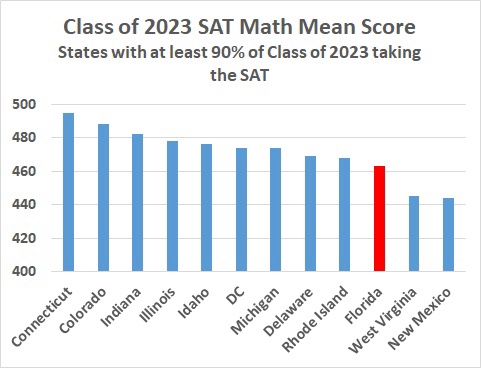
When you hear Jeb Bush or Ron DeSantis boast about the success of education in Florida, don’t believe it. Laugh out loud. Fourth grade reading scores are high, but could it be because low-scoring third graders are retained? Eighth grade reading scores are at the national average on NAEP—nothing to brag about. Florida’s SAT scores are embarrassingly low for a state that brags about test scores. Apparently those impressive reading scores in fourth grade ebb away as each year passes.
New rankings show Florida students are posting some of the lowest SAT scores in America.
We’re talking 46th place. Down another 17 points overall to 966, according to the combined reading and math scores shared by the College Board.
Florida trails other Southern states like South Carolina and Georgia. We trail states where more students take the test, like Illinois and Indiana.
We somehow now even slightly trail Washington, D.C. — a district long maligned as one of the supposedly worst in America, where all students take the test.
This should be an all-hands-on-deck crisis. Yet what are Florida education officials obsessing over?
Pronouns. And censoring books.
While other states focus on algebra and reading comprehension, Florida’s top education officials are waging wars with teachers about what kind of pronouns they can use and defending policies that have led to books by Ernest Hemingway and Zora Neale Hurston being removed from library shelves. We are reaping what they sow.
But perhaps the most disturbing thing about Florida’s current crop of top education officials isn’t just the misguided policies they’re pushing, it’s the way they behave. Like it’s all a joke. Like Twitter trolls.
They’re calling names, mocking those trying to have serious conversations about education and generally reveling in owning the libs.
A few months ago, Orlando Sentinel education reporter Leslie Postal spent weeks trying to get public records about a newly hired state education employee. Postal just wanted to explain to taxpayers how their money was being spent. But state officials refused to answer questions.
So Postal wrote up the piece, and Florida Education Commissioner Manny Diaz shared the piece on Twitter (now X) with a two-word comment: “Cry more!”
For those of you who don’t speak troll, “Cry more” is a response used by some social-media users — usually those juvenile in age or intellect — to mock someone who is unhappy. The folks at Urban Dictionary, who revel in all things trolly, define “Cry More” as a “phrase used in online games when someone is getting owned, and they b*tch about it.”
The game in question here, mind you, was the Sentinel’s two-month quest to get answers about how the state was spending tax dollars. And the response from the state’s top education official was: “Cry more!” What a role model for students.
That’s just one example. Last week, after I wrote a column about rampant book-censorship in the state — with one district shelving 300 titles — State Board of Education Member Ryan Petty responded (at quarter ’til 1 in the morning): “Just dumb. This passes as journalism.” Followed by a clown emoji.
OK, for argument’s sake, let’s say I’m the dumbest clod to ever set foot in the Sunshine State. Petty still wouldn’t answer any of the direct questions posed in both the column and on Twitter. Specifically, if the goal isn’t widespread book-banning, why won’t his education department provide a definitive list of what books it believes students shouldn’t have access to in school?
Petty opted for emojis over answers, because that’s what trolls do.
The responses on Twitter to Diaz and Petty — both appointees of Gov. Ron DeSantis — were about what you’d expect. One user told Petty: “My ninth grader could have crafted a more articulate response.” Several users responded similarly to Diaz’s “Cry More!” post, questioning his ability to maturely discuss policy and referring back to a Miami Herald investigation into student claims of “inappropriate behavior” by Diaz back when he was a teacher; claims Diaz said were bogus smears.
None of this did a thing to address this state’s education issues. Yet that’s where we are in Florida these days, mired in culture wars and trolling each other.
We also saw something similar last week when Diaz refused to directly answer questions from Orange County Public Schools about whether teachers were allowed to honor the requests of transgender students who wanted to be addressed with different pronouns — if the teachers wanted to and if those students also had their parents’ written permission. (Think about how bizarre it is that schools must even ask that question … in the so-called “parental rights” state.)
In his response to the district, Diaz offered a theatrical and condescending response that referred to “false” pronouns but which school officials concluded didn’t actually answer the question in a straightforward manner. Just more troll games … involving a population of teens more prone to self-harm and suicide, no less.
As far as the SAT goes, the test certainly has its share of legitimate critics. But it’s still one of the best apples-to-apples metrics we have for student learning.
Yet hardly any Florida media organizations even covered the October release of the new SAT scores that showed Florida’s poor showing. Why? Because we’ve been trained to follow the bouncing-ball, culture-war debate of the day.
So we see plenty of coverage about Florida supposedly ranking No. 1 in “educational freedom” by partisan political groups and scant addition to real education issues.
Call me old-fashioned, but I like hard numbers more than political posturing or magazine rankings. So do others who actually care about and study education.
Paul Cottle, a physics professor who authors a blog that focuses on STEM education, noted Florida’s increasingly cruddy SAT scores back in October when they were released — when everyone else was focused on the debate-of-the-day.
Cottle noted that Florida’s math scores for 4th graders were solid but that the SAT scores for graduating seniors were so bad, they suggested something was going awry for students before Florida schools sent them into the real world.
Cottle called the showing “a sad state of affairs.”
He’s right. Yet we’re getting precisely the educational environment and results that our culture-warring politicians are cultivating — an environment where trolls thrive, even if students don’t.
This is the most bizarre story I have read in many a day. The Boston Globe reported on a study showing a “serious literacy crisis” among the state’s youngest children. This is strange because Massachusetts regularly performs at the top of NAEP reading assessments.
The study was conducted by WestEd, a research group based in California. Apparently the researchers assessed the literacy skills of children in kindergarten, first and second grades. It is not surprising that most children in K and 1 and even 2 can’t read. They are only beginning to read.
The story starts:
A new state-commissioned study of young elementary students found that more than half showed early signs of reading difficulties — more evidence that the state has a serious literacy crisis, despite its reputation for educational excellence.
The report, released Friday, provides a first-of-its kind look at the reading skills of the state’s youngest children, whose reading prowess is not assessed by the state until the first MCAS exam in third grade.
The results are troubling: Nearly 30 percent of students in grades K-3 were at high risk of reading failure, and as many as 20 percent showed signs of having dyslexia, a language processing disorder that must be addressed with specialized reading instruction. Low-income students, those learning English or receiving special education services, Latino students, and Black students were most likely to experience reading struggles, according to researchers with WestEd, a San Francisco-based nonprofit that conducted the analysis.
The report suggests schools are not helping most struggling readers catch up: 60 percent of students who began the school year at risk of reading difficulties ended the school year in the same concerning position. But it found that younger students are much more likely to improve with extra help than older students are, a powerful argument for early intervention…
The extent of the state’s early literacy struggles have been laid bare annually in MCAS results, which, as the Globe’s Great Divide team previously reported, regularly show tens of thousands of students advancing from grade to grade without the reading skills they need to be successful.
The Globe investigation found nearly half of the state’s school districts last school year were using a reading curriculum the state considered “low quality.” A national nonprofit ranked Massachusetts this year in the bottom half of the nation in preparing educators to teach reading.
Massachusetts has not, as other states have, required evidence-based methods of reading instruction.
The “national nonprofit” that gave low scores to teacher education programs in the state is the National Council on Teacher Quality, a conservative group created by the Thomas B. Fordham Foundation and the George W. Bush administration. Its goal is to promote phonics. When NCTQ ranks Ed schools, it doesn’t visit them; it reads their catalogues.
If Massachusetts has a “serious literacy crisis,” the rest of the nation is a dumpster fire.
The only jurisdiction with higher scores in fourth grade was the Department of Defense schools. Five states had scores that were not significantly different from Massachusetts. Those six states outperformed 45 states and jurisdictions in fourth grade.
The point of the WestEd study seems to be that the state must push through a greater emphasis on phonics in teacher education programs, and that MCAS testing in grade 3 should start sooner.
The children who need extra help are low-income, limited-English, or in need of special services, etc. This is not news.
The “serious literacy crisis” looks and smells like a manufactured crisis. This report looks like a hit job on the state’s teachers and colleges of education. If the rest of the nation’s children matched the performance of those in Massachusetts, that would be cause for a national celebration.
Jeb Bush, a founding father of the corporate reform movement, was governor of Florida from 1999 to 2007. He implemented a regime of high-stakes standardized testing, third grade retention, school report cards, and choice. He vigorously championed charter schools and tried to change the state constitution to allow vouchers for religious schools. Now he is concerned that the legislature might undermine high-stakes testing, so he penned this opinion piece for the Orlando Sentinel bragging about the success of his test-and-punish regime.
Yes, Florida’s fourth-grade NAEP scores are high. But he does not acknowledge that the scores are high because Florida “retains” third-graders who don’t pass the reading test. Holding these kids back artificially inflated the fourth-grade scores. By eighth grade, Florida’s scores are at the national average. Nothing to boast about there. The moral of the story: retention raises test scores by removing from the testing pool the kids who were retained (flunked).
The other curious omission in this article is voucher schools. Jeb is a huge fan of vouchers but voucher schools don’t take any state tests. How does he explain this? He doesn’t.
He wrote:
For more than two decades, Florida has remained committed to educational excellence by ensuring that transparency, accountability and opportunity define our K-12 system. We’ve consistently pushed the envelope, transforming Florida into a national leader. This has not happened by accident.
When I took office, nearly half of Florida’s fourth graders had significant reading deficiencies. Similarly, half of Florida’s fourth graders were significantly below grade level in math. Only half of high school students graduated on time.
In partnership with state lawmakers, we championed the A+ Plan in 1999 based on core principles of high expectations, standardized measurement, a clear and achievable system of accountability, rewards and consequences for performance, effective teaching in the classroom and more choices for families to customize an education for each student.
Today, Florida’s fourth graders rank third in the nation for reading achievement and fourth in the nation for math achievement. Our high school graduation rate is approaching 90%.
This is why it’s concerning that some lawmakers now seem eager to throw out or water down key components of the policies that led our students from the back of the pack to top in the nation.
I understand the goal of the Florida Senate’s recently unveiled deregulation package (Senate bills 7000, 7002and 7004). Cutting red tape and removing outdated regulations is a worthwhile effort.
But this cannot come at the cost of our state and students taking a step backward.
Lawmakers have proposed watering down our third grade literacy policy, removing the backstop of retention and paving the way to reinstate social promotion. Requiring that students objectively demonstrate they are reading successfully before being promoted to fourth grade has been a core part of Florida’s comprehensive early literacy policy — one that research has consistently supported.
This is why it’s concerning that some lawmakers now seem eager to throw out or water down key components of the policies that led our students from the back of the pack to top in the nation.
I understand the goal of the Florida Senate’s recently unveiled deregulation package (Senate bills 7000, 7002and 7004). Cutting red tape and removing outdated regulations is a worthwhile effort.
But this cannot come at the cost of our state and students taking a step backward.
Lawmakers have proposed watering down our third grade literacy policy, removing the backstop of retention and paving the way to reinstate social promotion. Requiring that students objectively demonstrate they are reading successfully before being promoted to fourth grade has been a core part of Florida’s comprehensive early literacy policy — one that research has consistently supported.
Most parents believe their children are reading on grade level even when they are not. Florida’s retention policy raises expectations. We know there are grave later-life outcomes for struggling readers. Lowering expectations by watering down the retention requirement will not help students in third grade or beyond.
Moreover, abandoning the requirement that Florida students pass the tenth grade English Language Arts and Algebra I end-of-course assessments further reduces expectations and hampers Florida’s workforce development efforts. Removing this requirement may aid Florida’s graduation rates, but it will reduce the diploma to nothing more than a participation certificate.
If we expect less, we will get less. This cannot be the future we want for Florida.
Finally, part of the package would turn back recent gains for charter schools to be treated equitably alongside their traditional public school peers. The bill’s proposed changes would make it harder for charter schools to access vacant public school buildings and reduce the share of Title I funds made available to students attending charter schools. This is a step backward.
Maintaining Florida’s system of high expectations, clear accountability and robust choice is as important to our future as anything. We’ve spent two decades establishing, maintaining and building upon these ideals.
Now is not the time for lawmakers to get weak-kneed on policies that have played key roles in contributing to two decades of educational progress.
Jeb Bush was governor of Florida from 1999 to 2007. He is the founder and chair of ExcelinEd, ExcelinEd in Action and the Foundation for Florida’s Future.
John Thompson, historian and retired history teacher, analyzes the use and misuse of Oklahoma’s school report cards.
He writes:
As usual, the 2023 Oklahoma school Report Card prompted headlines about “struggling” students. But counter-intuitively, State Superintendent Ryan Walters stressed the declines during his time in office!?!?
Two tales of the Report Card are being told. As the Tulsa World reports, Walters “claimed that the data was from ‘previous years,’ even though all of the academic achievement indicators are from state tests administered just seven months ago.” Yes, taking office as State Superintendent in January 2023, Walters hasn’t had time to achieve many gains in learning, even if he’d really tried to. But the chaos during 2023, combined with the disruption he’d spread since 2020 as head of the Education Department, provided plenty of time for disruption.
As the Oklahoman reports, Walters cited the greatest decline under his watch, 8th grade reading proficiency which saw “a 5.7 percent decrease,” although “No other grade had more than a 0.4 percent decrease in reading scores, and some others “saw a very small uptick in reading scores.” Walters then promised “we are taking a Back to Basics approach,” which is the opposite of what it takes to increase proficiency.
The wisest narrative, illustrated by the Education Watch’s Jennifer Palmer, places the 2023 Report Card within the context of the massive decline of scores due to Covid, and the 2022 report. The 2023 report saw “no big swings in proficiency rates in any of the three tested subjects content,” while noting the overlooked fact that “a score of basic means a student demonstrated foundational knowledge and skills.”
Then Palmer tweeted background information on the differences between what basic means, as opposed to the widely misunderstood grade of proficiency which, I must add, has been misrepresented since the Reagan administration in order to denigrate public education. Oklahoma’s 8th grade reading proficiency grade requires that “students demonstrate mastery over even the most challenging grade-level content and are ready for the next grade, course or level of education.” It requires mastery of grade level skills that include interpretation, evaluation, analysis across multiple texts, and critical thinking. Mastery in requires use of evidence, argumentative response and synthesis of to create “written works for multiple purposes.”
As Palmer tweeted, we need a more nuanced” understanding of “reading.” And “the 8th graders who didn’t score proficient, but are in the ‘basic’ category, can still do all this” and then she linked to the challenging goals that are required for that grade, which include: partial mastery of interpretation, evaluation, analysis across multiple texts, critical thinking, use of evidence, argumentative response and synthesis.
Granted, these definitions are not necessarily the same as the more reliable NAEP scores. But as Jan Resseger explains, the nation’s NAEP proficiency grade “represents A level work, at worst an A-” and, basically, the same applies to Oklahoma’s tests. She asks, “Would you be upset to learn that “only” 40% of 8th graders are at an A level in math and “only” 1/3rd scored an A in reading?”
Ressenger also cites the huge body of research explaining why School Report Cards aren’t a reliable tool for measuring school effectiveness. We need a better understanding why the proficiency has been weaponized against schools, but we also need to master the huge body of research which explains why Report Cards aren’t a fair, reliable, and valid measure of how well schools are performing.
I’ll just cite one of the scholars that Ressenger draws upon. Stanford’s Sean Reardon’s 2022 research explained why “test score gaps may result from unequal opportunities either in or out of school; [but] they are not necessarily the result of differences in school quality, resources, or experience.” Reardon documented:
The socioeconomic profile of a district is a powerful predictor of the average test score performance of students in that district. The most and least socioeconomically advantaged districts have average performance levels more than four grade levels apart. … Achievement gaps are larger in districts where black and Hispanic students attend higher poverty schools than their white peers… and where large racial/ethnic gaps exist in parents’ educational attainment. The size of the gaps has little or no association with average class size, a district’s per capita student spending or charter school enrollment.
And that brings us to chronic absenteeism. As the New York Times reports, across the nation, “nearly 70 percent of the highest poverty schools experienced widespread, chronic absenteeism in the 2021-22 school year,” and “in these schools, about a third or more of the student body was considered chronically absent.” Of course, the Times notes, “Students cannot learn if they are not in school, and they cannot benefit from interventions, such as tutoring, that are supposed to help them make up pandemic losses.”
And Palmer reports:
Across the state, 20% of students were chronically absent last year, a half a percent increase over 2022. Some student groups were even higher: 24% of Hispanic students, 25% of economically disadvantaged and 31% of Black students were chronically absent …” Moreover, excessive absences are more prevalent now than before the pandemic. In 2019, 14% of Oklahoma students were chronically absent.
Tulsa World had previously reported that “About half of the Tulsa high school students are chronically absent” and explained why this complex and serious problem is “showing no signs of improvement.” The World cited the work of Georgetown’s Phyllis Jordan who explained the need to reconnect “what’s going on in the school and what’s going on outside the school.”
On one hand, that is why Patrick Forsyth, a University of Oklahoma professor who had analyzed the state’s A-F report card system, said “using attendance to measure school effectiveness is like using rates of tobacco use to measure hospital effectiveness.” On the other hand, as the Oklahoman reported, the Attendance Works’ Hedy Chang said, chronic absenteeism is an “all-hands-on-deck moment.” She also called on schools to “learn the specific barriers to attendance that their students experience before crafting a response to those unique challenges.”
That gets us back to the tragedy of two tales about what the Report Card means. Sadly, Ryan Walters uses it as one more weapon for disrupting public education. The other side must use these flawed metrics not to punish but for diagnostic purposes.
I have been critical of the focus on international tests because real life teaches us that the test scores of 15-year-old students do not predict future economic success for nations. I find it bizarre that people say that America is a great country but its schools are no good. That doesn’t make sense.
Adam Grant, a contributing opinion writer for the New York Times, injects a dose of common sense into that newspaper’s education coverage:
He writes:
Which country has the best education system? Since 2000, every three years, 15-year-olds in dozens of countries have taken the Program for International Student Assessment — a standardized test of math, reading and science skills. On the inaugural test, which focused on reading, the top country came as a big surprise: tiny Finland. Finnish students claimed victory again in 2003 (when the focus was on math) and 2006 (when it was on science), all while spending about the same time on homework per week as the typical teenager in Shanghai does in a single day.
Just over a decade later, Europe had a new champion. Here, too, it wasn’t one of the usual suspects — not a big, wealthy country like Germany or Britain but the small underdog nation of Estonia. Since that time, experts have been searching for the secrets behind these countries’ educational excellence. They recently found one right here in the United States.
In North Carolina, economists examined data on several million elementary school students. They discovered a common pattern across about 7,000 classrooms that achieved significant gains in math and reading performance.
Those students didn’t have better teachers. They just happened to have the same teacher at least twice in different grades. A separate team of economists replicated the study with nearly a million elementary and middle schoolers in Indiana — and found the same results.
Every child has hidden potential. It’s easy to spot the ones who are already sparkling, but many students are uncut gems. When teachers stay with their students longer, they can see beyond the surface and recognize the brilliance beneath.
Instead of teaching a new cohort of students each year, teachers who practice “looping” move up a grade or more with their students. It can be a powerful tool. And unlike many other educational reforms, looping doesn’t cost a dime.
With more time to get to know each student personally, teachers gain a deeper grasp of the kids’ strengths and challenges. The teachers have more opportunities to tailor their instructional and emotional support to help all the students in the class reach their potential. They’re able to identify growth not only in peaks reached, but also in obstacles overcome. The nuanced knowledge they acquire about each student isn’t lost in the handoff to the next year’s teacher.
Finland and Estonia go even further. In both countries, it’s common for elementary schoolers to have the same teacher not just two years in a row but sometimes for up to six straight years. Instead of specializing just in their subjects, teachers also get to specialize in their students. Their role evolves from instructor to coach and mentor.
It didn’t occur to me until I read the research, but I was lucky to benefit from looping. My middle school piloted a program to keep students with the same two core teachers for all three years. When I struggled with spatial visualization in math, Mrs. Bohland didn’t question my aptitude. Having seen me ace a year of algebra, she knew I was an abstract thinker and taught me to use equations to identify the dimensions of shapes before drawing them in 3D. And after a few years of observing what fired me up in social studies and the humanities, Mrs. Minninger knew my interests well. She saw a common theme in my passions for analyzing character development in Greek mythology and anticipating counterarguments in mock trial — and suggested doing my year-end project on psychology. Thank you, Mama Minnie.
Most parents see the benefit of keeping their kids with the same coaches in sports and music for more than a year. Yet the American education system fails to do this with teachers, the most important coaches of all. Critics have long worried that following their students through a range of grades will prevent teachers from developing specialized skills appropriate to specific grade levels. Parents fret about rolling the dice on the same teacher more than once. What if my kid gets stuck with Mr. Snape or Miss Viola Swamp? But in the data, looping actually had the greatest upsides for less effective teachers — and lower-achieving students. Building an extended relationship gave them the opportunity to grow together.
The Finnish and Estonian education systems are far from perfect, and Finland’s PISA scores have dipped a bit in recent years. But both countries have done more than just achieve high rates of high performers — they’ve achieved some of the world’s lowest rates of low performers, with remarkably small performance gapsbetween schools and between richer and poorer students. Being disadvantaged is less of a disadvantage in Finland and Estonia than almost anywhere else.
Looping isn’t the only practice that makes a difference. Both Finland and Estonia have professionalized education systems — they often require master’s degrees for teachers, training them in evidence-based education practices and methods for interpreting ongoing research in the field. And teachers are entrusted with a great deal of autonomy. Whereas American kindergarten has become more like first grade, with more emphasis on spelling, writing and math, Finland and Estonia make learning fun with a play-based curriculum. Elementary schoolers typically get 15 minutes of recess for every 45 minutes of instruction. Teachers don’t have to waste time teaching to the test. And over the years, if students start to struggle, instead of labeling them as remedial or forcing them to repeat grades, schools in both countries offer earlyinterventions focused on individual tutoring and extra support. That helps students get up to speed without being pulled off track.
Over the years, American students have consistently lagged behind two to three dozen countries on the PISA. A major factor in our lackluster results is the huge gapbetween our highest- and lowest-performing students. The U.S. education system is built around a culture of winner take all. Students who win the wealth lottery get to attend the best schools with the best teachers. Those who win the intelligence lottery may get to enroll in gifted-and-talented programs.
Great education systems create cultures of opportunity for all. They don’t settle for no child left behind; they strive to help every child get ahead. As the education expert Pasi Sahlberg writes, success is when “all students perform beyond expectations.” Finnish and Estonian schools don’t invest just in students who show early signs of high ability — they invest in every student regardless of apparent ability. And there are few better ways to do that than to keep students with teachers who have the time to get to know their abilities.
Paul Thomas of Furman University is a clear-sighted analyst of education policy. He is fearless when it comes to calling out frauds. This post is a good example.
He writes:
“The administrations in charge,” write Gilles Deleuze in Postscript on the Societies of Control, “never cease announcing supposedly necessary reforms: to reform schools, to reform industries, hospitals, the armed forces, prisons” (p. 4).
Deleuze’s generalization about “supposedly necessary reforms” serves as an important entry point into the perpetual education crisis in the US. Since A Nation at Risk, public education has experienced several cycles of crisis that fuel ever-new and ever-different sets of standards and high-stakes testing.
Even more disturbing is that for at least a century, “the administrations in charge” have shouted that US children cannot read—with the current reading crisis also including the gobsmacking additional crisis that teachers of reading do not know how to teach reading.
The gasoline that is routinely tossed on the perpetual fire of education crisis is test scores—state accountability tests, NAEP, SAT, ACT, etc.
While all that test data itself may or may not be valuable information for both how well students are learning and how to better serve those students through reform, ultimately all that testing has almost nothing to do with either of those goals; in fact, test data in the US are primarily fuel for that perpetual state of crisis.
Here is the most recent example—2023 ACT scores:
I have noted that reactions and overreactions to NAEP in recent years follow a similar set of problems found in reactions/overreactions to the SAT for many decades; the lessons from those reactions include:
Lesson: Populations being tested impact data drawn from tests.
Lesson: Ranking by test data must account for population differences among students tested.
Lesson: Conclusions drawn from test data must acknowledge purpose of test being used (see Gerald Bracey).
The social media and traditional media responses to 2023 ACT data expose a few more concerns about media, public, and political misunderstanding of test data as well as how “the administrations in charge” depend on manipulating test data to insure the perpetual education crisis.
Many people have confronted the distorting ways in which the ACT data are being displayed; certainly the mainstream graph from Axios above suggests “crisis”; however, by simply modifying the X/Y axes, that same data appear at least less dramatic and possibly not even significant if the issues I list above are carefully considered….
This crisis-of-the-day about the ACT parallels the central problem with NAEP, a test that seems designed to mislead and not inform since NAEP’s “Proficient” feeds a false narrative that a majority of students are not on grade level as readers.
The ACT crisis graph being pushed by mainstream media is less a marker of declining educational quality in the US and more further proof that “the administrations in charge” want and need testing data to justify “supposedly necessary reforms,” testing as gas for the perpetual education crisis fire.
Please open the link to read this excellent analysis in full.
Mike Petrilli, head honcho of the right-tilted Fordham Institute thinky tank, made it into the New York Times today to do some chicken littling about Learning Loss and suggest a bold solution. Don’t have a NYT subscription? That’s okay– let me walk you through the highlights of this festival of Things We Can Stop Saying About Education Right Now, Please.
Let’s start by invoking general Learning Loss panic. Petrilli points out that students “lost significant ground” during covid, and now NWEA says that students continue “backsliding” and “falling further behind.” People, in Petrilli’s view, are not panicking enough about “America’s massive learning loss.”
First, let’s use some more precise language, please. In all discussions of learning loss, we are actually talking about scores on a Big Standardized Test of reading and math going down. We will never, ever know how much of the slippage in tests scores is the result of students going a year or two without practicing for the BS Test. But in the meantime, it would be great if we stopped talking about test scores as if they were infallible equivalents of learning and achievement.
Second, “learning loss” is a misnomer. I’m willing to bet that verrrrrrry tiny number of students in this country actually lost learning. I’m equally certain that the vast majority of students did not learn as much as they would have in a non-pandemic year, but that’s not the same.
Think of it this way. It’s budget time, and the Mugwumps’ proposed budget increases spending on widgets from $500 to $600. The Wombats say, “Let’s only increase widget spending to $550.” That gets us to the part where the Mugwump talking point is “The Wombats want to cut spending on widgets.” When in fact everybody wants widget spending to go up.
That’s where we are. During the pandemic, learning occurred–just not as much as might have been expected in a normal-ish year. And this looks most like a crisis if you think of test scores like stock prices and focus on data rather than individual human students. (Petrilli does not invoke the baloney about impact on future earnings, so we’ll not go there right now.)
And, it should also be pointed out, it is where we were for a decade before covid even hit.
Having sounded the alarm, Petrilli bemoans the surfeit of leaders willing to make alarmy noises.The country is in desperate need of leaders who will speak the truth about what’s happening in our K-12 schools, and are willing to make the hard choices to fix it. Simply put, we need to bring some tough love back to American education.
Tough love? Back? Petrilli doesn’t really explain how the pandemic led to a loss of tough love in education. But that’s the dog we’re going to try to hunt with.
He cites Michael Bloomberg, who is ceaselessly alarmed about anything going on in public schools. Bloomberg wants a plan from Washington, a joint session of Congress, a Presidential address.
Ah, says Petrilli–you know when politicians were on the same page about education, presumably flinging tough love around with wild abandon.
We’re talking, of course, about the golden days of No Child Left Behind.
Petrilli remembers it fondly, citing how we saw “significant progress” which of course means “test scores went up,” which they did, at first, for a few years. Anyone who was in a classroom, especially a math or reading classroom, can tell you why. Within a couple of years, schools figured out what test prep would be most effective. Then they targeted students who were teetering on the line between High Enough Scores and Not High Enough Scores, especially the ones in special subgroups, and test prepped the hell out of those kids. At which point scores started stagnating because schools had done all they could do.
The Average Yearly Progress requirements were set up as a bomb that would go off during the next administration. Again, if you were working in a school at the time, you remember that chart, showing a gentle upward glide for a bit before jutting upward to 2014, the magical year in which 100% of students were to score above average on the BS Test. Oh, Congress will fix that before it happens, we were told. They did not. By the early 20-teens, there were two types of school districts–those that were failing, and those that were cheating.
Petrilli claims maybe success probably, saying NCLB “likely contributed” to graduation rates (no, schools just learned how to game those), college attainment rates (eh, maybe, but correlation is not causation) and “possibly” future real-life outcomes (absolutely not a shred of evidence–even reformster Jay Greene said as much).”It’s true that No Child Left Behind was imperfect,” says Petrilli. No. It stunk. But Petrilli has quite the tale here.There were fierce debates over “teaching to the test” and “drill and kill” instruction; about closing low-performing schools versus trying to fix them; and about the link between student achievement and family poverty. But once the law’s shortcomings became apparent, policymakers responded by adopting common standards and improving standardized tests, so as to encourage higher-level teaching. They poured billions into school turnarounds, invested in stronger instructional materials and started grading schools on how much progress their kids made from year to year, rather than focusing on one snapshot in time — an approach that is markedly fairer to high-poverty campuses. Still, the bipartisan effort that was No Child Left Behind ultimately fell apart as our politics fractured.
That’s quite the load. There was no debate about teaching to the test or drill and kill, because nobody was in favor of it except shrugging administrators who were staring at 2014. Petrilli also forgets that “teach to the test” ended up meaning “cut out any other classes–or recess–that does not appear on the test.” Arts slashed. History and science cut (at least for those teetering students). Closing low-performing schools was, in fact, the quickest way for a district to free itself of the low scores; who knows how many districts were restructured to put predictably low 8th grade scores under the same roof as better scores from lower or higher grades. And yes, poverty affects scores, despite all the No Excusing in the world.
What came next did not address any of these issues, The Common Core was an amateur hour fiasco. Were standardized tests improved? Not really (as witnessed by the fact that states dumped the SBA and PARCC as quickly as they could)–but it made a lucrative contract for some test manufacturers. Including progress in scores is great–unless you’re teaching kids who are already scoring at the top. School turnarounds have consistently failed (e.g. Tennessee’s failed Achievement School District).
But he’s right that Trump’s election and appointment of Betsy DeVos hurt the reformster alliance (despite the fact that DeVos had long been part of the club). But then, so was the increasing split between the social justice wing of reform and the free marketeer AEI-Fordham wing.
But look– NCLB and the sequel, Race to the Top, were just bad. They started from bad premises: 1) US education is failing because 2) teachers either don’t care or don’t know what they’re doing. They rest on a foundation of using a mediocre BS Test as an unquestioned proxy for student learning and teacher effectiveness, creating a perfect stage on which to conduct a national field test of Campbell’s Law (when you make a measure a proxy for the real thing, you encourage people to mess with the measure instead of the real thing, and it gets worse if the measure isn’t very good). And none of the “policymakers” who championed this mess ever came up with a single solitary idea of how to Fix Things that actually worked on either a local or macro scale.
The pandemic did not help anything in education. But it did lead to some flaming prose, like Petrilli’s assertion that “here we are, with decades of academic progress washed away and achievement trends still moving in the wrong direction.” This kind of overheated rhetoric is nothing new from the folks who gave us The Pandemic Erased Two Decades of Progress in Math and Reading as a headline. But what does it even mean? Washed away to where? Did knowledge dribble out of students’ heads? Did the learning of the past several years retroactively vanish with former students waking up across America feeling a little bit dumber somehow? Did teachers forget everything they knew about how to teach students, so they have to start over? Or do we just mean “test scores are down”?
Petrilli breaks this down to some other issues. His first point starts out fine– there’s an attendance problem right now. But he tries to set that beside an alleged nationwide move to lower standards. I’m not sure what basis there is for that assertion. He points to the “no zeros” rule used in some schools, but that rule existed in many places (like my old district) for ages. Maybe it’s letting slackers slide through in other places, but my own experience with no zeros policy is that it merely kept students working who would otherwise have given up–kind of the opposite of encouraging slacking.
But then he’s slicing NCLB-style baloney again:Virtually all schools and districts have enjoyed a vacation from accountability. Almost nobody is worried about state officials shutting their campuses because of low performance, or forcing district schools to replace their principals or teachers.
You say that like it’s a bad thing, Mike.
Embedded here are many of the same bad assumptions that have driven ed reform for decades. Teachers and schools have no motivation to do their jobs unless they have some kind of threat of punishment hanging over their heads. This isn’t just bad education policy–it’s bad management. As management which W. Edwards Deming pointed out often, fear should be driven out of the workplace. But NCLB and RttT were always all stick, no carrot, always starting out with the worst possible assumptions about the people who had chosen education as their life’s work (assumptions made largely by people who had never actually worked in a school).
And even if you don’t dig Deming, there’s another thing to consider–none of the stuff Petrilli misses actually worked (which was Deming’s point). He points out that the kind of thing being done in Houston right now has become rare, to which I say “Good,” because Houston is a nightmare and it will end just like all the other similar attempts–no actual success, but lots of disruption and dismay and upheaval of children’s education.
Petrilli will now argue for NCLB 3.0. We need “action at scale,” but we can’t ignore “the support and assistance schools require.” Holding schools accountable wasn’t enough because– wait for it– if NCLB failed it was because schools lacked the expertise and know-how to do it right. And now Petrilli almost–but not quite–gets it.“Teaching to the test” and other problems with No Child Left Behind stemmed from schools resorting to misguided practices to meet requirements. Under pressure to boost scores, but without the training to know what to do, some educators engaged in endless practice testing, and stopped instruction in any subject that was unlikely to be on the state assessment. In a few places, educators even resorted to outright cheating. They likely felt they had no choice, because they hadn’t been given the tools to succeed.
Nope. Close but no cigar. No, the reason all those things happened was because, as NCLB 1.0 and 2.0 were designed, those things were the tools to “succeed.” Because “success” was defined as “get maximum number of kids to score well on a poorly-designed multiple-choice math and reading test.” Granted, when most of us think about “success” in education, we have a whole list of other things in mind–but none of those things were valued by NCLB or RttT.
But we’re rolling up to the finish now. But after a decade of building capacity, offering helping hands and adding funds, it’s time once again to couple skill-building with will-building.
That is a great line. But what capacity-building? More seats in unregulated charters and voucher-accepting schools? Which helping hands? And exactly whose will needs to be built? Parents? Children? Teachers? Policymakers? I’m seriously asking, because I think a hell of a lot of will was involved in slogging through the last couple of years.
Petrilli calls on schools to spend their “federal largesse” to “catch their kids up”–and I think the call to accelerate education is one of the most infuriating calls of the last few years. Sure– because all along teachers have known how to educate children faster but they just haven’t bothered to do it, but hey, now that we have certified lower test scores, teachers will all bust the super-secret Faster Learning plans out of their file cabinets.
Petrillii says we don’t actually need to bring back NCLB, though he seems to have been talking about nothing else– just let’s get out those big sticks and get back to (threats of) “tough interventions for persistent underperformance,” because that has totally worked in the past. No, wait. It hasn’t actually worked ever. Kids, too, should know that it’s time to hit the books again. We need to rethink our lax grading policies, make clear to parents that their children need to be at school and bring back high school graduation exams and the like to ensure that students buckle down.
Also, get those kids off our lawns. And while you’re making sure parents know their kids should be in school, maybe talk to all the reform crowd that has been working hard to build distrust of public schools and deepen disrespect of educators.
And the big finish:Education matters. Achievement matters. We need leaders who are willing to say so, and educators who are willing to act like these simple propositions are true.
This seems straightforward enough, though if you replace “achievement matters” with “standardized test scores matter,” which is what he really means, it doesn’t sound quite as compelling. And it’s insulting as hell to suggest that the ranks of educators are filled with people who are unwilling to act as if education matters.
Well, the piece is completely on brand for the New York Times, and it certainly echoes the refrain of that certain brand of reformster whose response to their own policy failures has been, “Well, get in there and fail harder.” No Child Left Behind failed, and it not only failed but left some of its worst policy ideas embedded in the new status quo, continuing to do damage to public education right through today.
The pandemic did many things, and one thing it did was panic the testing industry, which faced an existential threat that everyone might realize that school without the BS Test, or NWEA’s lovely test-prep tests, might actually be okay. It’s no wonder that they feel a special nostalgia for the days when the entire weight of the government reinforced their importance. So here we are, painting low reading and math tests scores as an educational crisis whose only solution is to get more fear, more threats, and especially more testing back into schools.
I’m sorry if this assessment of some reformsters, their policies, and their motives seems harsh, but, you know– tough love.


 Diane Ravitch's blog