Archives for category: South Carolina

For decades, the GOP has claimed to be the party of “family values.” From what we have read recently about Governor Noem of South Dakota, who allegedly was romantically entangled with a Trump aide, and Rep. Lauren Boebert, ousted from a musical performance in Denver because she and her date were groping and vaping, the “family values” bit doesn’t fit.

And here is another broken vow, as reported by Business Insider:

A tale as old as time is playing out yet again: A politician who promotes the importance of family has abandoned them.

This time, it appears to be US Rep. Jeff Duncan, a Republican in South Carolina. Duncan’s wife, Melody Duncan, filed for divorce last week, citing her husband’s multiple affairs.

Melody Duncan, his wife of more than 30 years and mother to his three sons, accused her husband of at least two affairs in the divorce filing, which was first obtained and published by the Index-Journal, a local newspaper in Greenwood.

Duncan has been in office for 13 years and has long advocated for conservative Christian values.

“As a life-long social conservative, I am a strong advocate for life and traditional family values,” Duncan writes on his website. Accompanying the post is a stock image of the Holy Bible, a book famous for its views on infidelity.

He then pledges himself to the anti-abortion cause: “The most basic component of our society is the family.”

The family, plus a few mistresses, it would seem.

The divorce filing described Melody Duncan as a “dutiful wife” who “wholeheartedly supported” Duncan in his career. It cites a political event last month where Duncan echoed his wife’s sentiment.

At a “Faith and Freedom BBQ” on August 28, Duncan described his wife as “supportive and loving” while portraying himself as a “dedicated, dutiful husband,” according to the divorce filing. Duncan then “left the next day and went directly” to the home of his mistress, it says.

The Republicans continue their war against abortion, even though the majority in every state want to keep it legal. Few if any women realize they are pregnant at the six-week mark.

The South Carolina Supreme Court on Wednesday upheld the state’s new near-total ban on abortion by a 4-1 vote, reversing a decision it had made in January that struck down a similar ban and declared that the State Constitution’s protections for privacy included a right to abortion.

The court’s decision was not unexpected, because the makeup of the bench had changed, and Republicans in the State Legislature had passed a new abortion law in the hopes that it would find a friendlier audience with the new court. The decision in January was written by the court’s only female justice; she retired and South Carolina now has the nation’s only all-male high court.

The decision repeated what the justices said in January about a right to privacy in the State Constitution, but said the Legislature had addressed the concerns in the first law and “balanced” the interests of pregnant women with those of the fetus.

“To be sure, the 2023 Act infringes on a woman’s right of privacy and bodily autonomy,” Justice John Kittredge wrote for the majority.

But, he added, “We think it is important to reiterate: we are constrained by the express language in the South Carolina Constitution that prohibits only ‘unreasonable invasions of privacy.’

“The legislature has made a policy determination that, at a certain point in the pregnancy, a woman’s interest in autonomy and privacy does not outweigh the interest of the unborn child to live…”

Until now, South Carolina had allowed abortion until 22 weeks, which had increasingly made the state a haven for women seeking abortions as other Southern states banned the procedure.

Republicans said their next step would be a total ban on abortions.

The likely result: Wealthy and middle-income women who want an abortion will go to a state where it is legal. Poor women won’t be able to afford to make the trip. There will be more children born to poor mothers. In South Carolina, there is fervor to support the unborn but not the born.

Paul Bowers, who covered education for the Charleston Post and Courier, writes on his blog Brutal South about deteriorating working conditions for the state’s teachers. Class sizes are rising, and the state has chosen to divert funding from the public schools.

Compared to 15 years ago, South Carolina public school teachers are doing more work, administering more tests with higher stakes, for wages that increasingly get eaten by inflation, under intensifying scrutiny from aggrieved political actors — and in many cases, they’re doing it with more students than ever.

The last time I looked into the growth of K-12 classroom sizes in my state was 2019, and the picture was bleak. While state regulations1 set strict limits on student-teacher ratios in most types of classrooms, the state legislature had started granting waivers to those caps during the Great Recession and had not resumed enforcement.

Predictably, median classroom size soared as the state stopped funding its obligations to school districts, teachers’ promised pay increases were frozen, and teachers quit the profession faster than the colleges of education could graduate new ones. When I wrote about the trend for The Post and Courier in 2019, classroom sizes had begun to shrink but were still significantly larger than they were in the 2007-08 academic year…

I’m a graduate of South Carolina public schools who sends his kids to South Carolina public schools, and despite the bad headlines and flagging test scores, I’ve seen firsthand how our education system can change people’s lives for the better. I’m certainly better for it, and my own kids are flourishing.

But after a decade-and-a-half of austerity and a century-and-a-half of backlash to the universal public good of education in South Carolina, I’m left wondering how many more hits the system can take….

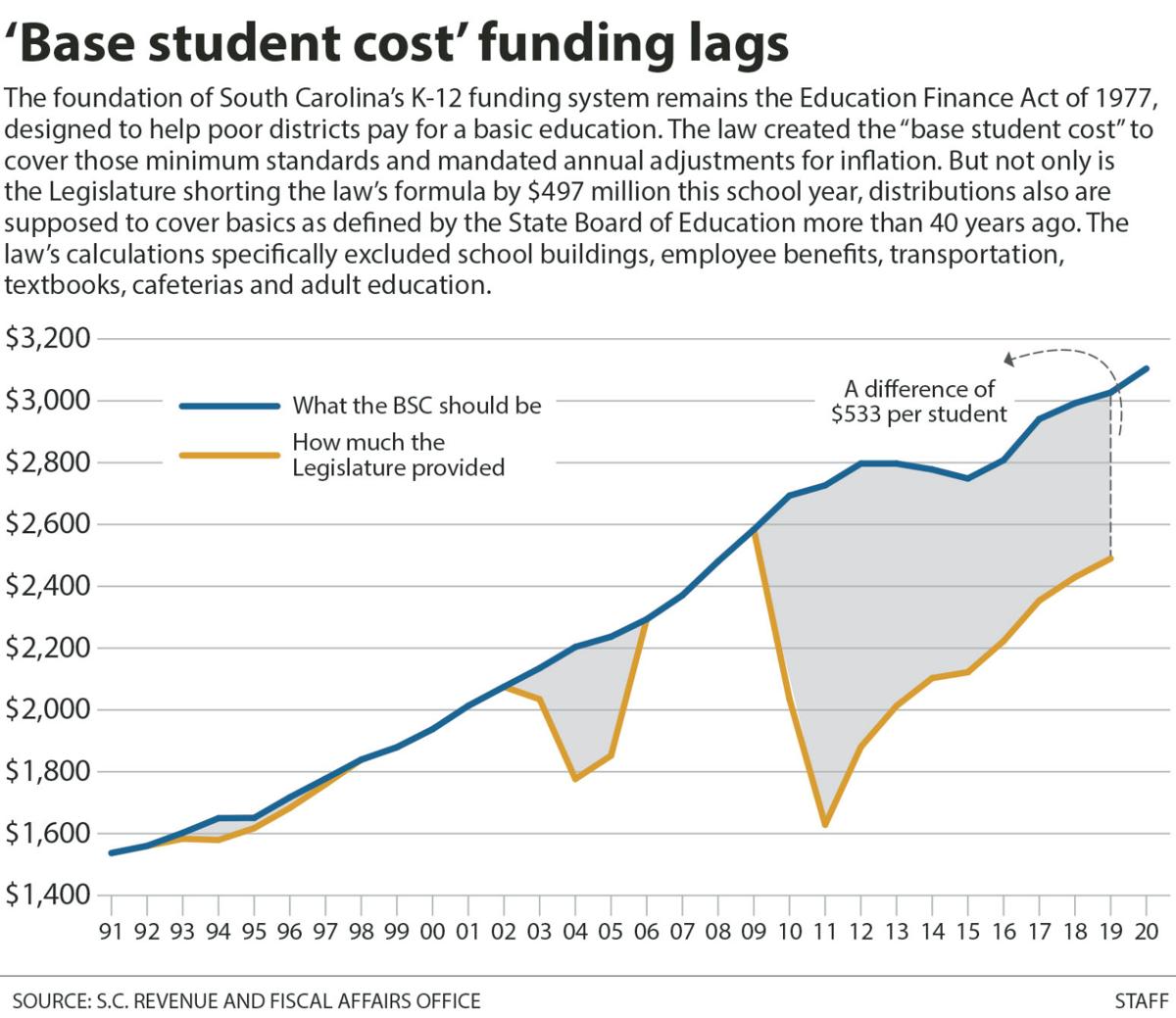
South Carolina Gov. Mark Sanford and the Republican-controlled legislature kneecapped school funding in 2006 with a tax handout to homeowners (Act 388) that routinely wrecks school revenues during economic downturns. As metropolitan school districts have grown thanks in part to an influx of workers for manufacturing concerns like Boeing, Volvo, and BMW, county governments have handed those employers massive tax incentives that cheated schools out of $2.2 billion in the last 5 years alone. And the legislature has not funded its own legally mandated Base Student Cost to districts since 2009, flagrantly violating the law every time it passes a budget — with outsize effects in our poorest rural districts.

Clearly, the leaders of the state don’t understand that their penuriousness towards the schools will hurt the next generation and the future of the state. They think in the moment. They forget about the future. They can attract corporations with a low-wage, non-union workforce, but they can’t build a thriving state unless they educate all the children.

Paul Bowers is an education journalist and blogger in South Carolina. He is a graduate of Siuth Carolina’s public schools and his children attend them. He writes here about what happened when the state banned books that made students uncomfortable, which are typically known as “divisive concepts laws.” Heaven forbid that students learn anything that would be considered controversial or divisive!

He wrote:

A most predictable outcome has arisen in South Carolina. After passing a gag order to stop the imaginary threat of “critical race theory” in schools, the state has purged a memoir about American racism from the syllabus in a high school classroom.

An outcome such as this was the obvious purpose of the teacher censorship provisos that Republican lawmakers slipped into the last two years’ state budgets, which forbid public school teachers from teaching that “an individual should feel discomfort, guilt, anguish, or any other form of psychological distress on account of his race or sex,” along with a long list of other vague speech prohibitions.1


Bristow Marchant, a reporter at The State newspaper, reported on Monday that in the spring of 2022, students in an Advanced Placement Language and Composition class at Chapin High School complained to the Lexington-Richland 5 School Board after being assigned Ta-Nehisi Coates’ 2015 bestseller Between the World and Me.
“I am pretty sure a teacher talking about systemic racism is illegal in South Carolina,” one student wrote.

To be clear, it is not illegal for teachers to talk about systemic racism in South Carolina. But in a season of unhinged school board rants by the Moms for Liberty network, vague condemnations of “critical race theory” by the state education superintendent, micromanagement of classroom materials by the governor himself, and frivolous lawsuits filed by the all-white South Carolina Freedom Caucus alleging anti-white bias in schools, the unofficial state policy is to intimidate teachers into silence regardless of what the law says.

In this case, a school principal caved to pressure and censored the book. The school board caved too. If recent history is any indicator, we can expect The College Board to cave, as they did in Florida when Gov. Ron DeSantis and his allies demanded a whitewashing of the AP African American Studies curriculum. (Coates’ writing was removed there, too.)

Here in South Carolina, the teacher was left standing up for herself, writing to her district superintendent with a spirited defense of the book’s inclusion in a unit on persuasive essays. Her courage is an inspiration. We can’t abandon her to the mob.

Book bans remain massively unpopular in the United States. In a poll conducted last year by the EveryLibrary Institute, just 18% of respondents said they supported banning books on issues of race and “critical race theory.” A small, entitled minority doesn’t get veto power over what the rest of our children learn. This is a message we can take to every school board, library board, and county council where the censors choose to wield their influence.

It can be daunting to stand up to the intimidation tactics of groups like Moms for Liberty, who got their start harassing and threatening their neighbors in Florida school districts. The piles of dark money behind these groups and others like the State Freedom Caucus Network can make them seem larger and more powerful than they really are. But never forget that we outnumber them.

$24.18 via Bookshop, a perfect gift for that special school board member in your life

Ta-Nehisi Coates is a literary giant who doesn’t need someone like me to defend his bona fides, but I’ll say this anyway: The politicians who seek to ban his work are revealing a lot about themselves.

Please open the link to read the rest of Bowers’ post.

Andy Brack is editor of Statehouse Report and the Charleston City Paper. This column is reprinted with the permission of the Charleston City Paper.

BRACK: McMaster needs to go to apology school

By Andy Brack |

S.C. Gov. Henry McMaster doesn’t need to go into comedy anytime soon. He’s just not that funny.

What he needs to do is to go to apology school.

The governor, who often sounds like Foghorn Leghorn these days, had this to say to fellow Republicans last week at a state convention: “I look forward to the day that Democrats are so rare, we have to hunt them with dogs.”

Umm. Not funny, governor. Really not funny. Even if you claim you’ve been saying it for years, it has never been funny.

Democrats responded with outrage about McMaster’s dog-whistle of a comment.

“Yesterday, Governor Henry McMaster threatened me, my family and thousands of other Anderson County residents who are Democrats when he said he looks forward to the day he can ‘hunt us with dogs,’” said Chris Salley, chairman of the Anderson County Democratic Party, in a statement.

Charleston County Democratic Party Chairman Sam Skardonwent further: “We cannot continue to normalize threats of political violence from the leadership of the Republican Party. If the governor does not retract and apologize, S.C. State Law Enforcement Division should investigate this threat.”

One man who lived through apartheid in South Africa recalled on Facebook how many people in that country were silent about its system of segregation: “Their silence spoke volumes. If you do not stand up against racism, if you remain silent, you are part of the problem.”

But maybe McMaster, a former attorney general who should know about keeping the peace more than inciting it, thought what he said was hilarious. The governor of any state should know better, particularly in an America today more polarized by race, fear and hate than in years.

What our governor said was mean, mean-spirited and filled with racial undertones of South Carolina’s ugly past in which white elites subjugated enslaved Africans and actually did hunt them when they escaped. Or hanged them, such as when Charlestonians executed Denmark Vesey and 34 others for what was purported to be a planned slave uprising. Or they just plain lynched them after the Civil War to reignite fear to fuel horrible decades of home-grown Jim Crow apartheid.

It’s not a history of which to be proud.

But predictably, the spin-doctors and fixers played McMaster’s comment off as a light-hearted joke. That’s what the embarrassment playbook says to do – just foist anything out on a lazy public that the person saying the trash didn’t really mean it.

Here’s how the Washington Post reported on the remark: “In a statement Monday, a spokesman for McMaster said the governor had been saying the line at GOP conventions for years, adding that ‘everyday South Carolinians understand that it’s a joke.’”

The joke might have worked in the 1950s, which is where McMaster and his buddies seem to want us to return. But rather than continuing to brush off the remark, the governor needs to realize he represents all South Carolinians, not just the ones who may look like him.

To drive this point home: Just imagine what would happen if a blue state governor started talking about crucifying pro-life activists. And then said it was just a joke. I bet McMaster, Fox News and most Republicans would squeal like stuck pigs. The vitriol surely would be intergalactic.

So governor, let’s lay off the bad jokes, the over-the-top rhetoric and the increasingly hostile politics that continue to pull people apart. There’s not going to be any Kumbaya moment in South Carolina anytime soon, but you can stop throwing gas on the fire.

Andy Brack, recognized in 2022 as the best columnist in South Carolina, is editor and publisher of Statehouse Report and the Charleston City Paper. Have a comment? Send to: feedback@charlestoncitypaper.com.

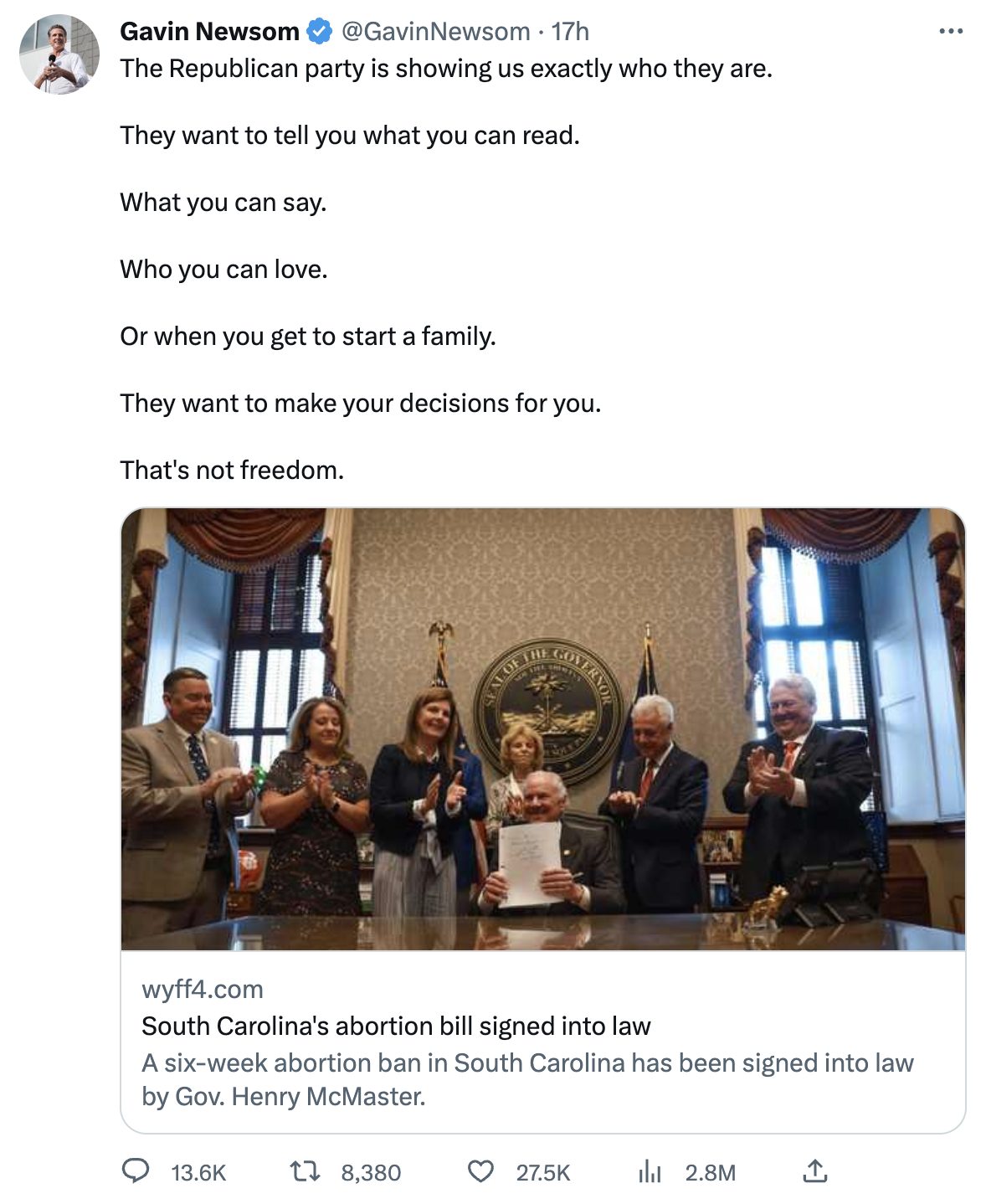
Gavin Newsom, Governor of California, regularly sends out emails pointing out the errors and hypocrisies of Republicans in other states. I enjoy them.

South Carolina, Diane…

Where the Republican governor just signed a six-week abortion ban, which he says will “begin saving lives.” All while that very same governor refuses to do anything about the fact South Carolina has one of the highest homicide rates in the country — more than 2x the rate of California.

Tweet from Gavin Newsom: 'The Republican party is showing us exactly who they are. They want to tell you what you can read. What you can say. Who you can love. Or when you get to start a family. They want to make your decisions for you. That's not freedom.'

You can’t make this up.

Today’s Republican party refuses to regulate assault weapons while gun violence is the leading cause of death of kids in America, but will champion the regulation of women’s bodies and take away reproductive freedom.

This is what Republicans want to do nationally.

And worse.

Be outraged.

Gavin

I remember when the idea of charter schools was first introduced. Charters would provide innovative schools whose basic purpose was “to save poor kids from failing public schools.” Vouchers had the same rationale.

Charters would provide better academics, more transparency, and more accountability. Charters would require less funding than public schools because they would be free of bureaucracy. Parents would hold them accountable by pulling their kids out. The competition with charters would improve public schools.

None of this turned out to be true.

Consider South Carolina. Entrepreneurs are using the charter law to create competition for private schools, at least on the sports field.

The moment was nearly nine years in the making.

A large crowd was on hand in January to see the Gray Collegiate Academy War Eagles basketball teams play in the school’s new on-campus gymnasium in West Columbia. No more bus rides downtown to Allen University, where Gray played most of its home games since opening in 2014.

“It brings everything that we have been working toward for nine years, full force,” Gray Collegiate athletic director and football coach Adam Holmes said. “There is nothing that we don’t have and can’t work toward to get.

“Our academics is second to none. Now, we have a turf football and soccer stadium, state-of-the-art gym, baseball, softball fields on campus. Hopefully, this will elevate us even more.” Less than two months later, Gray’s boys and girls basketball teams won state championships.

In the past 12 months, Gray also won state titles in softball and competitive cheer, and it won the 2021 football state title.

What once was a dream for Gray Collegiate was now reality. But for many of the high school teams that have had to play the War Eagles, the milestone of Gray adding new on-campus facilities might sound like more of a nightmare.

In their eyes, here is a burgeoning Goliath in athletics, a public charter school with advantages in attendance guidelines and whispers of recruiting tactics that result in all-star rosters that can dominate opponents. Gray and other charter schools — along with several private schools that compete in the public school league — are increasingly dominating small school athletics in South Carolina.

In the current school year, 13 of the 16 S.C. High School League fall and winter sports team championships in Class A and Class 2A were won by charter or private schools.

Administrators at traditional schools are starting to push back. One, the superintendent of Fairfield County schools, said he would not force teams in his district to play games against Gray if they didn’t want to.

The tension is pushing high school sports in South Carolina to a tipping point that could reshape not only their structure and oversight but force a fundamental reckoning on how the state deals with core issues such as fairness, sportsmanship and the boundaries of competition.

Read more at: https://www.thestate.com/sports/high-school/article271087367.html#storylink=cpy

Please open the link and keep reading. Is this why we needed charter schools? To create an athletic powerhouse that dominates the state?

Paul Bowers is an experienced journalist who writes a fascinating blog about South Carolina called “Brutal South.” In this post, he tells us who Nikki Haley, Republican Presidential candidate, is and whom she admires.

In his 2010 book of prophetic wisdom, Can America Survive? 10 Prophetic Signs That We Are the Terminal Generation, the Texas televangelist John Hagee recalls standing on a hill overlooking Megiddo in Israel, looking down into the valley, and envisioning a lake of blood 200 miles wide and as deep as a horse’s bridle.

In this and other bestselling books of prophecy, Pastor Hagee takes the book of Revelation literally and then prescribes a political program to bring about the end of human civilization as we know it. This is notable for a number of reasons, not least of which is that he has the ear of Republican presidential contender and former United Nations Ambassador Nikki Haley.

Like a lot of people, my ears perked up when Haley launched her campaign Feb. 15 in Charleston, South Carolina, and brought Pastor Hagee onstage to kick off the proceedings with a prayer. When Haley said, “To Pastor Hagee, I still say I want to be you when I grow up,” I nearly fell out of my chair. Like some kind of theological pervert, I went to the public library that week and borrowed every book by Hagee I could find.

I’ve been taking notes on these books and will probably write a more general synopsis at some point, but this week I want to linger on Can America Survive? It is an audacious book of geopolitical soothsaying, and it raises some questions that it would behoove political reporters to ask Haley on the campaign trail.

This book is, among other things, the most virulent Islamophobic text I have ever read. It repackages the “Eurabia” conspiracy theory for a U.S. audience, warning of an “Islamic population bomb” (p. 37) and favorably citing the British UKIP booster Melanie Phillips’ 2006 book Londonistan (p. 126). Hagee warns of secret Islamist sleeper cells throughout the heartland (p. 11) while advocating for spying on U.S. mosques and pre-emptive military strikes against Iran (p. 50). Hagee questions “radical Islam’s loyalty to America” after citing a random series of newspaper clippings about “honor killings” and claims, without evidence, that Adolf Hitler’s Mein Kampf is a No. 1 bestseller in unspecified Muslim countries (p. 26).

Please open the link and read on to understand Haley and other Christian nationalists.

Now, here is an example of the extremism and stupidity that has overtaken the Republican Party. A group of 21 Republican legislators in South Carolina want to impose the death penalty on any woman who gets an abortion. They assert that life begins at the instant of conception so any act that ends the life should require the murder of the woman who ended the pregnancy, even if the pregnancy was the result of rape or incest.

Let’s say that a 12-year-old girl is raped by a member of her family. She must carry the child of rape to term or be killed by the state. Meanwhile, her rapist walks free. Her life is worth nothing compared to that of the fetus.

It seems clear that the pro-life Freedom Caucus cares only about the lives of the unborn, not the lives of women who are pregnant. Why is one life more valuable than the other?

South Carolina Republican lawmakers are considering a bill that would make a person who has an abortion eligible for the death penalty.

The bill, titled the South Carolina Prenatal Equal Protection Act of 2023, would change the state’s criminal code and redefine “person” to include a fertilized egg at the point of conception.

According to the bill, the change would “ensure that an unborn child who is a victim of homicide is afforded equal protection under the homicide laws of the state.” Under South Carolina law, that includes the death penalty.

The bill provides exceptions for pregnant people who had an abortion if they were “compelled to do so by the threat of imminent death or great bodily injury” and also provides an exception if the abortion was done to save the life of the mother. There are no exceptions for rape or incest.

Rolling Stone wrote about this story as well.

Rep. Rob Harris, a sponsor of the bill, is a member of the Freedom Caucus. Asked if he saw any irony between being a member of the so-called “Freedom Caucus” while proposing such harsh restrictions on reproductive freedoms, Harris responded simply: “Murder of the pre-born is harsh.”

A friend in South Carolina sent me this public statement by a fearless district superintendent. He asked questions that most state legislators cannot answer. He knows that vouchers will subsidize the tuition of students already in private schools, and that private schools retain the right to refuse any student they don’t want.

J.R. Green, Ph.D, superintendent of the Fairfield County district sent out this letter:

Do the Advocates of “School choice” really believe in “School choice?”

Recently the South Carolina Senate passed S.39, a controversial voucher legislation that proposes to provide parents up to $6,000/year of state money to attend a private school. At full implementation by year three, the voucher program will cost approximately $90 million/year. Proponents of the legislation suggest that school vouchers empower parents to select the school that best fits the needs of their children. But does this legislation actually empower parents, or private schools that will ultimately benefit from the infusion of state revenue? The undisputed fact is that S.39 will provide private schools with state revenue, yet allow those same private schools to pick and choose the students they elect to serve. In essence, we are providing private schools with public money, without a commitment to serving the public student.

I respect any parent’s right to choose the educational option they see is best for their child. However, receiving public funding should obligate these institutions to serve all public school students, just as public schools are required to do. Private schools who receive this funding should not be allowed to deny students because they are Exceptional Education students, failed to meet qualifying scores on entrance exams, level of parent participation, etc. All students who request admission should be accepted. Amendments were offered during the debate of S.39 that would ban discrimination based on religion or disability. Those amendments were rejected and as a result would allow a private school receiving state revenue to deny a student because of an intellectual disability or physical handicap. This is the current reality for private schools in South Carolina, and I respect their right to restrict enrollment, as long as the school is being funded with private money. However, the acceptance of state money must require a different standard. During the senate subcommittee hearing debating the voucher legislation last year I shared the published admission criteria for a local private school. The school clearly outlined the following:

• Does not provide a program of study and support for students with learning disability, an IEP, or 504 plan.

• Married students, pregnant students, and or biological parents will not be allowed to attend.

• Reserves the right to reject any application for admission or employment and further reserves the right to terminate any association with students if it determines that such association is incompatible with the aims and purpose of the school

This clearly represents private school “choice” not parental “choice.”

Finally, since the Education Accountability Act of 1998, the general assembly has touted the benefits and necessity to administer yearly assessments to public school students. These assessments have been advertised as the key to improving education outcomes in South Carolina, and essential to ensuring the public can readily measure the return on the education investment. I’m perplexed as to why the private schools that would receive public funding would not participate in the same system of accountability? Why would these schools not be required to administer the same state assessments, and publish their data just as public schools are required to do? If this system of accountability is necessary and appropriate for public schools, it should be necessary and appropriate for private schools accepting public funding.

Although I think the legislation is unconstitutional, and represents little value to improving student outcomes, if the South Carolina General Assembly is committed to making school vouchers a reality, these schools must be accessible to all students, and accountable to the public just as public schools. Let participating schools open up their doors to all students, administer and publish the same assessments as public schools, and let the chips fall as they may.

J.R. Green, Ph.D.

Superintendent

Fairfield County Schools

Bravo, Dr. Green!