Archives for category: Resistance

Thom Hartmann continues to amaze me, with his steady production of powerful articles. This one is especially important for the readers of this blog, whose primary purpose is to strengthen and protect our public schools.

Thom Hartmann writes:

In 1776, British economist Adam Smith published The Wealth of Nations, a book that laid out the principles that modern economies have operated under for centuries (with the exception of the Reagan Revolution years of 1981-2021). In addition to arguing for a strong domestic manufacturing base and high taxes on the wealthy, Smith pointed out that one of the things that most directly constitutes the wealth of a nation is its educated workforce and well-informed populace (as a result of that education).

From Thomas Jefferson creating the first tuition-free American college (the University of Virginia), to Horace Mann’s advocacy of public schools in the late 19th century, right up until 1954, this was an uncontroversial position. It’s why every developed country on Earth has a vibrant public school system and — with the exception of the US since Reagan ended free college in California — most developed countries offer free or near-free college to their citizens.

But in 1954, the US Supreme Court upset the education apple cart by declaring in their Brown v Board case that “separate but equal” schools, segregated by race, were anything but “equal.” That decision fueled two movements that live on to this day.

The first was the rightwing anti-communist movement spearheaded by the John Birch Society, which was heavily funded back then by Fred Koch, the father of Charles and David Koch. They put up billboards across the country demanding that Americans rise up and “Impeach Earl Warren,” who was then the Chief Justice of the Supreme Court, for requiring “communist” racial integration of our schools.

The second was the private, all-white “academy” movement that has morphed over the years into charter schools and the “school choice” movement of today. It received a major boost when the white supremacist co-founder of neoliberalism, Milton Friedman, published a widely-read and influential article in 1955explicitly calling for what he called “education vouchers” to fund all-white private schools to “solve the national crisis” the Court had created.

In 1958 when the Virginia Supreme Court went along with the US Supreme Court’s Brown v Board decision and ordered that state’s schools desegregated, the governor shut downevery public school in the state. Prince Edward County’s schools were still closed in 1964, when they were finally ordered to open by the courts.

Hundreds of “segregation academies” opened across the South; in Mississippi, for example, 41,000 white students left public schools to attend these academies in just the one year of 1969. Parents had to pay the tuition themselves, but they were willing to do so to avoid their children having to interact with Black, Hispanic, or Asian kids.

The turning point for the Republican Party was 1964, when President Johnson and a Democratic Congress passed and signed into law the Civil Rights Act. Shortly thereafter, one Southern Democratic politician after another changed party affiliation to the GOP so they could continue to argue against “forced integration” of public schools.

The Republican war on public schools burst into the open with the Reagan Revolution, when Education Secretary Bill Bennett oversaw a 30 percent cut in federal aid to public schools following Reagan’s promise to abolish the Department altogether. Every Republican running for president since has made a similar promise or claimed the need to end the Education Department.

Bill Bennett wasn’t shy about explaining why it was necessary to gut public schools, after the Supreme Court had ordered they must be racially integrated. Bennett wanted to privatize public education — as did Trump’s former Education Secretary, billionaire Betsy DeVos — and is probably most famous for his statement that gives us a clue as to why this idea of ending public education is so persistent in the GOP:

“If you wanted to reduce crime,” Bennett said on the radio, “you could, if that were your sole purpose; you could abort every Black baby in this country, and your crime rate would go down.”

LISTEN NOW · 0:17

Could it be that it’s all about keeping white children away from Bennett’s Black babies? Is simple racism what’s animating the GOP’s antipathy toward public education?

One clue is that the idea of ending public education in America goes back even farther than Bennett or Reagan to a single moment and a single court decision. 

When I was born, in 1951, Republicans loved public schools. Republican President Dwight Eisenhower led the charge to build gleaming new public schools all across the United States: I attended one, as did perhaps a majority of my generation.

But then came the Supreme Court, with their Brown v Board decision.

In 1957, President Eisenhower ordered the Little Rock, Arkansas, public schools desegregated. The “Little Rock Nine” — nine Black children trying to desegregate Little Rock Central High School — became nationally famous when Governor Orval Faubus prevented them from entering the school that fall, provoking Eisenhower to call up federal troops to escort the children to class.

Faubus called a referendum — an election — and the good citizens of Little Rock voted 19,470 to 7,561 to shut down their entire school system rather than comply with Eisenhower’s order. That, in turn, led back to the Supreme Court, which, in the fall of 1958, ruled unanimously in Cooper v Aaron that the Brown v Board desegregation order was, in fact, now the law of the land for public education.

In response, whites-only private schools and “academies” began springing up across the nation, many run by all-white churches. (Jerry Falwell tried, in 1966, to open an all-white school; in 1980 he became Reagan’s main advisor on merging the white supremacist faction of evangelical Christians — also triggered by Brown v Board — into the GOP.)

Thus, in 1958 the governor of Virginia closed all the public schools in racially mixed Warren County, Norfolk, and Charlottesville; Prince Edward County’s public schools remained closed for a full five years.

While that’s the foundational history of what has become the GOP’s war on public education, for most of the past 40 years Republicans have merely claimed vague libertarian principles when they try to explain what they ironically call “school choice.”

It wasn’t until Donald Trump gave them permission — and showed them how politically potent it could be — to unleash their inner racists that the GOP went public with overt white supremacy as a core value for the party.

While Critical Race Theory (CRT) was a little-known 1993 analysis of structural racism pioneered by Kimberlé Crenshaw and Derrick Bell taught only in law school, rightwing influencer Christopher Rufo popularized the term with an appearance on Tucker Carlson’s Fox “News” show.

From there, it echoed around the GOP for a few months before catching fire across rightwing hate radio, podcasts, and Fox. Pretty soon white supremacist militia members were showing up at school board meetings threatening members that “we know where you live.”

Republicans anxious to stoke the fears of their white racist base began inveighing against teaching CRT in public schools — even though such a thing had never happened — and passing laws so loosely worded as to bar any meaningful teaching or classroom discussion of America’s racial history.

All-white private schools funded with taxpayer dollars have become the darlings of Republicans. In most cases these schools don’t need to flout the law by declaring their segregated status: Black, Asian, and Hispanic parents most often simply aren’t interested in enrolling their children in schools that proudly proclaim they will not allow a drop of “CRT,” true American history, or real science education in their classrooms.

The issue of privatizing public schools came up in Arizona in 2018 with a statewide ballot initiative that would extend free school vouchers to every student in the state: it was defeated by voters by a 2:1 ratio. Writing for The Arizona Republic, columnist Laurie Roberts was unambiguous in her description of the state’s voters’ horror at the ballot initiative:

“Actually, they didn’t just reject it. They stoned the thing, then they tossed it into the street and ran over it. Then they backed up and ran over it again.”

Republicans in the heavily gerrymandered state, though, didn’t much care about the will of the voters. Appealing exclusively to their white racist “Christian” base, they pushed what was essentially that same proposal through the GOP-controlled state legislature and it was signed into law last year by Republican then-Governor Doug Doocey.

In giving every student in the state the ability to opt out of public education with a taxpayer-funded voucher, Doocey established a new benchmark in the war against racially integrated public schools that was matched this year by Florida, Arkansas, Iowa, and Utah.

Legislation to gut public schools and replace them with vouchers for private schools have failed in six states so far (Georgia, Texas, IdahoVirginiaKentucky, and South Dakota), but Republicans are not letting go. This year voucher bills were introduced in at least 24 states.

The fact that most of the nation’s public school teachers are union members has given Republicans another good reason, in their minds, to do everything possible to destroy public schools. As Trump’s former Secretary of State Mike Pompeo claimedlast year, in the minds of Republicans the American Federation of Teachers’ President Randi Weingarten is “the most dangerous person in the world.”

Republicans also love the fact that voucher programs mostly subsidize upper-income families, while educationally ghettoizing the children of low-income parents. Vouchers almost never cover all the costs of attending a private school, so they primarily serve as a government handout to the mostly upper-middle-class white families who already wanted to send their kids to today’s version of the segregation academies.

Once the public schools are largely dead, Republicans will begin lobbying to “reduce spending” by cutting the amount allocated for the vouchers, locking the emerging two-tier status of publicly funded education into place.

For the moment, though, private schools are a booming industry as a result of the GOP’s embrace of Friedman’s vouchers. In Florida, for example, they have virtually no rules or standards for the over-one-billion-dollars the state shovels into its private schools: while public schools must disclose their graduation rates, how they spend their money, and let anybody examine their curriculum, private academies have no such rules in many Republican-controlled states, even though they’re receiving public monies.

Many private schools across the country operate with untrained and uncertified “teachers,” have no clear standards for graduation, and refuse to teach “controversial” subjects like evolution, climate science, and the racial history of America.

Which brings us to organized religion, the other recipient of big bucks because of the school voucher movement. Schools affiliated with churches are now raking in billions every month across the US, and Republicans — who continue to push for unconstitutional things like mandatory public school prayer — pander daily to fundamentalists who don’t want their kids exposed to science or history.

Six corrupt Republicans on the Supreme Court legalized this practice of shoveling taxpayer funds to churches and religious schools in their notorious Carson v Makin decision last year. As Justice Sonya Sotomayor wrote in her dissent:

[In just five short years this Court has] “shift[ed] from a rule that permits States to decline to fund religious organizations to one that requires States in many circumstances to subsidize religious indoctrination with taxpayer dollars.” This decison “continues to dismantle the wall of separation between church and state that the framers fought to build.”

Which is exactly what the GOP wants. As SenDem recently wrote for Daily Kos:

“Laura Ingraham claimed that ‘a lot of people are saying it’s time to defund government education or at least defund it by giving vouchers to parents.’ Fox’s Greg Gutfeld similarly declared that private school vouchers are needed because public schools are ‘a destructive system’ and described teachers as ‘KKK with summers off.’

“Sen. Marco Rubio of Florida has called public schools ‘a cesspool of Marxist indoctrination.’ Donald Trump declared, ‘public schools have been taken over by the radical left maniacs.’ And Rep. Marjorie Taylor Greene of Georgia called them taxpayer-funded indoctrination centers that need to end, which is a bit ironic since she is the poster child for the necessity of funding public education.”

Sweden has been flirting with libertarianism for a few decades and was the first developed country to offer American-style school vouchers to all kids so they could attend private, for-profit public schools. Just a month ago, their government proclaimed the experiment a disaster and is trying to figure out how to shut down the private schools and re-establish a public education system.

Public schools were the great social and economic leveler for the last century of American history; Republicans want to end that and instead advantage wealthy children over their lower-income peers, particularly those whose skin is darker than Trump’s spray tan.

Public schools (and free college) made it possible for America to produce an explosion of invention and innovation throughout the mid-20th century; now other countries are surpassing us, as the dumbing-down of our kids has become institutionalized in Red state after Red state.

And public schools gave many students their first experience of interacting with people who look different from them and grew up under different circumstances, awakening many young people to the discrimination and unfairness inherent in how America has historically treated minorities.

All of which explains why Republicans so badly want to put an end to public education in America.

This story appeared in Commonweal, a progressive Catholic magazine of distinction. The author, Luke Mayville, has organized thus-far successful resistance to vouchers.

He writes:

Ever since Milton Friedman’s 1955 essay “The Role of Government in Education,” economic libertarians have dreamed of privatizing America’s system of public schools. In place of a school system that is publicly funded, democratically governed, and accessible to all, policy entrepreneurs have sought to transform American education into a commodity—something to be bought and sold in a free market.

In the push to privatize education, the tip of the spear has always been school vouchers—policies that extract funds from public schools in order to subsidize private-school tuition. Milwaukee established the nation’s first voucher program in 1990. In the following twenty-five years, voucher experiments were rolled out in fits and starts, often meeting with stiff public resistance. Voucher advocates gained significant footholds in Ohio, Washington D.C., Indiana, and elsewhere, but lacked the power to fundamentally transform the nation’s public-school system.

The cause has gained unprecedented momentum during the past five years. In their book A Wolf at the School House Door (2020), Jennifer Berkshire and Jack Schneider sounded the alarm about “an increasingly potent network of conservative state and federal elected officials, advocacy groups, and think tanks…backed by deep-pocketed funders,” all of them committed to dismantling public education as an institution. The new assault on public education intensified in the pandemic era, as voucher advocates seized the opportunity of mass school closures to propose—and in many cases enact—sweeping privatization schemes. In states across the country, the voucher agenda went hand in hand with efforts to sow distrust in public education by claiming, usually without evidence, that schools had become centers for critical race theory, “gender ideology,” and other forms of “social-justice indoctrination.” Meanwhile, voucher proponents were energized by landmark decisions of the United States Supreme Court, most notably Espinoza v. Montana in 2020 and Carson v. Makin in 2022, both of which appeared to remove constitutional obstacles to the use of public dollars for private religious education.

The nationally coordinated push to privatize public education is one of the most corrosive developments in American life. While Catholics and members of other faith communities have rightly cherished private parochial education, they, too, have strong reasons to support America’s public schools even if their own children do not attend them. It is an essential feature of the mission of public education to affirm the dignity of every child and to prepare each child to be a full participant in civic and economic life. As Berkshire and Schneider put it, public education “is our collective effort to realize for all young people their full human potential, regardless of circumstance.”

Fortunately, the coordinated attack on public education has met strong resistance from educators, students, parents, and citizens in several states across the country. During the 2023 legislative session here in Idaho, legislators presented a long series of voucher bills. One proposal sought to enact universal “education savings accounts” (ESAs) that would be available to every Idaho family—including the affluent. Other bills proposed tax-credit schemes or more targeted approaches. Every single proposal failed. Remarkably, Idaho remains voucher-free even as the voucher movement has enacted sweeping legislation in Arizona, Florida, West Virginia, Iowa, Arkansas, and elsewhere.

Grassroots organizing has been indispensable in Idaho’s fight against vouchers. A strong coalition of educators, parents, and advocacy organizations—including Reclaim Idaho, an organization I cofounded—has proved to be an effective counterweight to the voucher movement’s deep-pocketed lobbying efforts.

A recent poll by the Idaho Statesman found that public opinion in Idaho is dead set against vouchers, with 63 percent opposed and just 23 percent in support. The mission of organizers has been to translate widespread public opposition into effective political action. To that end, we’ve organized in communities across this vast state and helped citizens become defenders of public schools and sharp critics of voucher schemes. We’ve helped local advocates understand and articulate the arguments against vouchers that resonate most with the public: that vouchers are fiscally reckless, costing far more than advertised; that voucher programs tend to diminish student achievement and discriminate against students with disabilities; and that voucher programs are especially harmful for rural communities where no private-school options exist.

In local efforts to resist vouchers, grassroots organizing can harness the power of personal stories. The voucher movement has attempted to tell their own personalized story by evoking images of poor, marginalized children who’ve been “trapped” in failing public schools. The promise of “school choice” is to give struggling parents the choice to move their children into private schools that better fit their needs. However, as more states adopt voucher programs, the vast majority of voucher funds are flowing not to students who’ve left public schools but to private-school students who were never in public schools to begin with. A total of 89 percent of voucher funds in New Hampshire, 80 percent in Arizona, and 75 percent in Wisconsin have gone to students already enrolled in private schools, and these students disproportionately belong to affluent families living in suburban and urban areas.

The “school choice” story is mostly a fiction, and grassroots organizing can refocus the conversation on personal stories that paint the full picture. When people get organized on the voucher issue, the question can suddenly shift from “Do families deserve more choice?” to “Why would we pull scarce funds from our public schools—especially in rural areas—in order to subsidize tuition for affluent suburban families?” During testimony before the Idaho Senate Education Committee on a bill to create universal ESAs, a public-school supporter named Sheri Hughes phoned in to testify remotely from Challis—a mountain town of 922 people located 190 miles from the state capital. “I know the power and strength of consolidated public money for education, especially in rural Idaho,” Hughes said. She told the committee that her grandfather had served on the Challis school board and helped build the town’s first high school, that her mother—also a school-board member—helped get the high school rebuilt after the 1983 Challis earthquake. “Based on Arizona’s ESA Voucher experience,” Hughes went on, “the money proposed to be removed off the top of Idaho’s education funding budget would take an estimated 17–20 percent of funding away from Challis schools—in an area with no private alternative choices, and where home-school students still access public-school resources for proctoring, band, sports, special ed, and other extracurricular activities.”

Grassroots organizing can also help advocates expose the creative attempts by voucher proponents to present their policy agenda as something less threatening. With the American public skeptical of school vouchers and school privatization more generally, the privatization movement has aggressively sought to rebrand vouchers by means of convoluted policy schemes. Proponents of ESAs claim that they are not proposing vouchers but merely offering families money that can be used for a wide range of education services—including, but not limited to, private-school tuition. Similarly, proponents of “tax-credit scholarships” claim their proposals are distinct from vouchers because they do not directly spend public dollars on private schools but instead award tax credits to individuals who choose to fund private-school scholarships.

Grassroots organizing can expose these policies for what they are: vouchers by another name. In Idaho, we’ve invested time and energy in community meetings across the state where the goal is to share information with local public-education supporters about the mechanics of ESAs, tax-credit scholarships, and other policy schemes. Such meetings have prepared local citizens to speak out forcefully against thinly veiled attempts to siphon funds out of their public schools. Local advocates have written to their legislators, published op-eds and letters to the editor, spoken with friends and neighbors, and—most importantly—many have shown up to testify before the legislature. With so many grassroots advocates raising their voices and telling the truth about these policies, it’s been very difficult for privatizers to maintain the public narrative that they are promoting something other than a repackaged voucher scheme.

Please open the link and finish reading the rest of this excellent article.

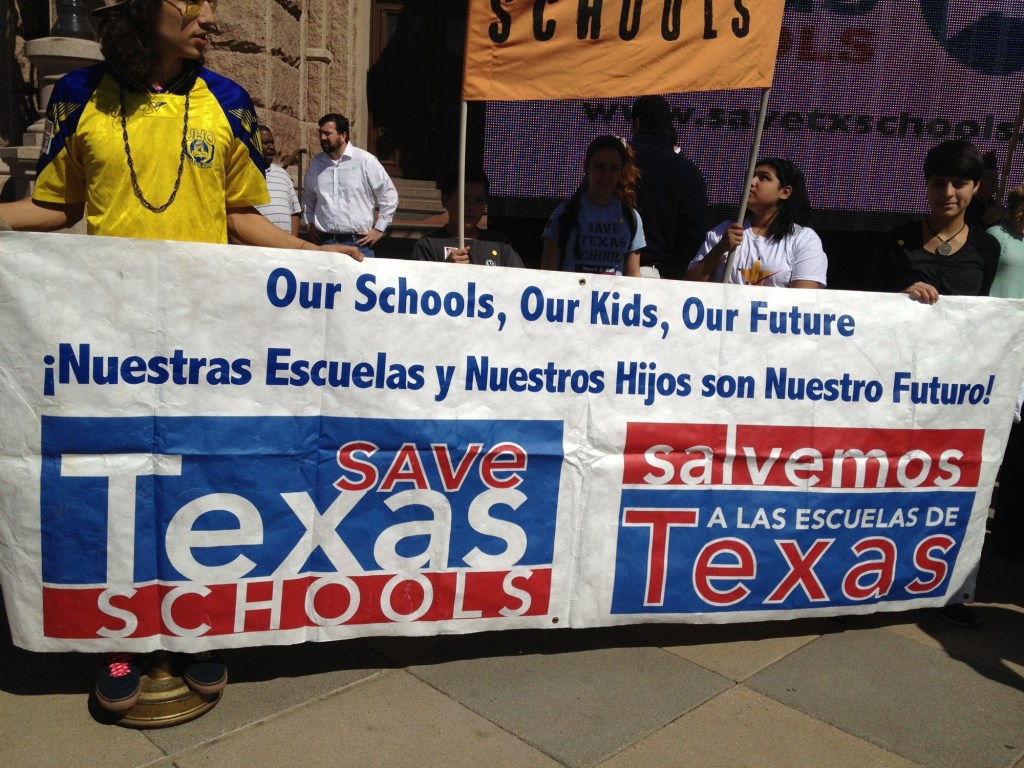
Mothers Against Greg Abbott is celebrating because Governor Gregg Abbott’s voucher proposal—his highest priority—was defeated for the fifth time this year. Once, in the regular legislative session, then again and again and again and again in four special sessions.

Abbott offered bribes: more funding for public schools, a pay raise for teachers—but the bribes didn’t persuade the rural Republicans who saw vouchers as a threat to their small community public schools.

Abbott threatened to primary Republicans who didn’t vote for vouchers. That didn’t work either. Now the Moms (MAGA!) have to go back to work to get their public schools funded.

This is their message, issued within hours after vouchers went down for the fifth time:

From Mothers Against Greg Abbott:

The Texas House has just voted down school vouchers.

This is a huge victory for Texas public schools… and for mothers, and others, like us. Today’s victory  wouldn’t have been possible without the help you provided over the last several months. We asked you to help us support public schools, and you stepped up time and again.

Our hard work paid off. 

I don’t want to spike the football to celebrate our success. Not least because our public schools might not have a football to spike if the voucher plan had succeeded. (Yes, I know that spiking the football in a high school game is a 15-yard penalty, but let’s go with the metaphor...)

The same people who tried to strip our public schools of funding, and to give that money to rich private schools instead, aren’t going away. They will be back. 

And so will we: We defended our public schools today, and we will defend them again.

At Mothers Against Greg Abbott, we believe in high quality, free public education for our children. We support our public school teachers and our public school children. And we won’t let a handful of anti-school activists steal our children’s futures from us.

We’re here in support of public education, and we aren’t going anywhere. The next time public education is on the legislative table, we’ll be there to defend it. 

We won’t spike the football then either. We’ll celebrate because our public schools will still be there — to educate our children, to help them become our future leaders, to create the civic engagement that we all need.

And, yes, to give our kids a football, a softball, a volleyball, a tennis ball, a baseball, a basketball, arts programs, orchestra, school plays, reading specialists, school counselors, beloved school librarians, and so much more. 

With love for our public schools and our public school educators,

Nancy Thompson, Founder
Mothers Against Greg Abbott

This week, our Mothers For Democracy Institute shares the mic with YOU this week on the newest episode of The Voucher Scam! 

Hosts Claire O’Neal and Nichole Abshire ask listeners this week to share their love of public schools and their worries about vouchers. With today’s VICTORY on school vouchers in the Texas House, there is no better time to start streaming. Tune in to the conversation, here ›››

And, if you like what you hear, shoot over a donation and help support our podcast series.

Mothers for Democracy Institute is a 501(c)(3) and
donations are Tax Deductible. We just launched our podcast series The Voucher Scam, but we more planned for 2024 to further support democracy and civics education. And we
would love your support.
https://bit.ly/voucherscam

Mothers For Democracy / Mothers Against Greg Abbott is the largest coalition dedicated to defeating the extremist MAGA movement in Texas. While we don’t agree on every topic, we all agree the Texas GOP isn’t Texas values.

Since 2021, we’ve been helping lead the Democratic resistance in Texas, we’ve organized thousands of local voters and our public issue campaigns have reached millions of Texans in key battleground areas. Now, we’re backed by thousands of Texas parents who are mobilizing in their own neighborhoods to ensure the Texas we hand over to the next generation is better than the one we’ve inherited. 

We’re sick and tired of being linked to a handful of extremist MAGA spokesmen—divisive politicians like Ken Paxton and Ted Cruz. We know it’s going to take all of us to defeat them this election cycle. The power of mothers and others like us means we know we can do it: It’s time for democracy to prevail. 

100% of our work is powered by individual donations and our average donation is just $23. We can’t stop until our children have the future they deserve. So this election cycle, we’re taking down Ted Cruz and dozens more of his Texas MAGA cronies. With you by our side, we’ll deliver the kind of leadership everyone living in Texas can be proud of. 

Support Our Work

The Texas House of Representatives met in special session for the fourth time, called together by Governor Greg Abbott specifically to pass voucher legislation. The House voted to strip vouchers out of HB1.

Rural Republicans sunk the voucher program, joined by every Democrat.

The vote to kill vouchers passed by 84-63.

Those opposed to vouchers included 21 Republicans, which was 25% of all Republicans in the House.

The vote for vouchers was 63 Republicans and 0 Democrats.

Will Governor Abbott understand? Vouchers will not pass. Rural Republicans support their public schools.

For the first time ever, a state voucher program was canceled. The Illinois Legislature failed to renew “Invest in Kids,” which puts an end to vouchers in that state. Retired teacher Fred Klonsky explains in this post why Illinois had a voucher program and who was behind it.

He wrote on his blog:

The veto session of the Illinois General Assembly ended yesterday and in spite of a full court press by the state’s Republicans, the right-wing Illinois Policy Institute and the Catholic Church, the state’s million dollar tax credit voucher program was allowed to die.

Good riddance.

The original idea emerged during the administration of Illinois’ last Republican governor, Bruce Rauner.

The law allowed up to $75 million in tax revenue to be diverted to private schools each year. More than 250 million oof state dollars have now been siphoned off to private schools in our state.

Invest in Kids was only supposed to last five years. It was extended an extra year and voucher supporters wanted to extend it again and make it permanent.

Democratic governor JP Pritzker said that if the General Assembly passed an extension he would sign it.

Instead, the General Assembly adjourned taking no action and so it is done.

In 2017, when Invest in Kids was being considered, the schools in the Archdiocese of Chicago was losing money as Catholic school enrollment was declining.

What to do?

Cupich met with Chicago’s mayor Rahm Emanuel and Illinois governor Bruce Rauner and asked for a life-line.

Of course, the U.S. Constitution’s separation clause prohibits direct government support for religious schools.

But Cardinal Cupich, Bruce Rauner and with behind the scenes support by then-mayor Rahm Emanuel, created the idea of Invest in Kids tax credit as a workaround to the Constitutional prohibition.

Forbes:

Illinois’s program funded a considerable amount of discrimination with taxpayer money. Illinois Families for Public School found at least 85 schools in the Invest in Kids program, nearly 1 in 5, have anti-LGBTQ+ policies.

Only 13% of private schools in the Invest in Kids program last year reported to the Illinois State Board of Education that they served any special education students. The majority of schools in the program are Catholic schools, and four of six Catholic dioceses in Illinois have policies that say schools may refuse to accommodate students with disabilities.

Policies that discriminate against pregnant and parenting students, students who have had an abortion, English-language learners, students with disabilities, undocumented students, and more are widespread in Illinois voucher schools as well.

More specific examples include Yeshivas Tiferes Tzvi Academy of Chicago, which reserves the right to expel any student whose family listens to secular music. Westlake Christian Academy of Greyslake will not admit students if they or their custodial parents maintain a “lifestyle” that violates biblical principles; this would include “promiscuity, homosexual behavior, or other violations of the unique God-give roles of male and female.” In fact, Westlake only accepts students from families in which one parent is “a born-again Christian.”

Defeating the attempt to extend Invest in Kids represents a major defeat for vouchers and school privatization.

**********

A letter to the blog by reader Martin Gartzman described the small number of unfunded activists who fought against the renewal of the Illinois voucher program. The Illinois Families for Public Schools never lost hope. A true David beats Goliath story.

Illinois Families for Public Schools is a small group. It basically is 3-5 people at any given time, spearheaded by political activist Cassie Cresswell and retired educator Diane Horowitz. They have very little funding. They have no full-time employees and perhaps a couple of part-timers. Cassie is not an educator; she got involved in this work as a parent-activist. But there is zero doubt that without their advocacy and incredible organizing, we’d still have a school voucher program in Illinois. This little group was the engine behind the effort to end Invest in Kids. They got over 60 organizations to support the sunset of the voucher program! They provided the mechanism for other education and political activists to get involved. And they organized the two main teachers unions to make the Invest in Kids sunset a priority (while supplying the unions with much of the data and other “ammunition”).

This isn’t the first time they made the improbable happen. About two years ago, an amazingly ill-conceived proposal for the State testing system was sailing through the Illinois State Board of Education. It was the pet project of the then State Superintendent of Schools and was being pushed hard by a major testing company that was likely to get the ten-year contract to develop and administer the test. The skids were greased for its passage until Illinois Families for Public Schools got involved. The “sure thing” boondoggle turned out to be derailed by relentless opposition that was organized by Illinois Families for Public Schools. Again, there is zero doubt that without those efforts, Illinois K-12 students would be languishing today under a disastrous state assessment system.

We owe a great debt of gratitude to this small group of activists.

Gentner Drummond, the Attorney General for Oklahoma, sued to block the authorization of a Catholic charter school. Drummond disagrees with Governor Kevin Stitt and State Superintendent of Education Ryan Walters. Even the lobbyists for the charter movement oppose the religious charter school, which is a back door voucher.

Sean Murphy of the AP reported:

Oklahoma’s Republican Attorney General Gentner Drummond on Friday sued to stop a state board from establishing and funding what would be the nation’s first religious public charter school after the board ignored Drummond’s warning that it would violate both the state and U.S. constitutions.

Drummond filed the lawsuit with the Oklahoma Supreme Court against the Oklahoma Statewide Virtual Charter School Board after three of the board’s members this week signed a contract for the St. Isidore of Seville Catholic Virtual Charter School, which is sponsored by the Archdiocese of Oklahoma City.

“Make no mistake, if the Catholic Church were permitted to have a public virtual charter school, a reckoning will follow in which this state will be faced with the unprecedented quandary of processing requests to directly fund all petitioning sectarian groups,” the lawsuit states.

The school board voted 3-2 in June to approve the Catholic Archdiocese’s application to establish the online public charter school, which would be open to students across the state in kindergarten through grade 12. In its application, the Archdiocese said its vision is that the school “participates in the evangelizing mission of the Church and is the privileged environment in which Christian education is carried out.”

The approval of a publicly funded religious school is the latest in a series of actions taken by conservative-led states that include efforts to teach the Bible in public schools, and to ban booksand lessons about race, sexual orientation and gender identity.

Oklahoma’s Constitution specifically prohibits the use of public money or property from being used, directly or indirectly, for the use or benefit of any church or system of religion. Nearly 60% of Oklahoma voters rejected a proposal in 2016 to remove that language from the Constitution…

Oklahoma’s Republican Gov. Kevin Stitt, who earlier this year signed a bill that would give parents public funds to send their children to private schools, including religious schools, criticized Drummond’s lawsuit as a “political stunt.”

“AG Drummond seems to lack any firm grasp on the constitutional principle of religious freedom and masks his disdain for the Catholics’ pursuit by obsessing over non-existent schools that don’t neatly align with his religious preference,” Stitt said in a statement.

Drummond defeated Stitt’s hand-picked attorney general in last year’s GOP primary and the two Republicans have clashed over Stitt’s hostile position toward many Native American tribes in the state.

The AG’s lawsuit also suggests that the board’s vote could put at risk more than $1 billion in federal education dollars that Oklahoma receives that require the state to comply with federal laws that prohibit a publicly funded religious school.

“Not only is this an irreparable violation of our individual religious liberty, but it is an unthinkable waste of our tax dollars,” Drummond said in a statement.

The National Alliance for Public Charter Schools, a nonprofit organization that supports the public charter school movement, released a statement Friday in support of Drummond’s challenge.

There are many wonderful groups fighting the extremists who control the state Republican Party, who regularly bow to Trump and try to surpass him in bigotry and hatred.

One of the groups I frequently donate to is called Mons Against Greg Abbott. You notice that their initials are M-A-G-A. I think of them as the “good MAGA.”

Here is their latest report:

Last week was a whirlwind of activity in the Republican-controlled Texas Senate — sadly, that’s not a positive.

Texas Senate Republicans proved once again how little they care for Texas families and demonstrated how willing they are to sacrifice their principles in support of an extremist MAGA agenda.

Here’s a quick roundup of some of the biggest votes that happened during the Texas Senate’s special session on education:

1. Their School Voucher Bill

As expected, last Thursday (Oct. 12) the Texas Senate passed a substantial voucher program (SB 1), creating an $8,000 / year Education Savings Account (ESA) for eligible students.

If adopted by the Texas House, the voucher program would allow families to access up to $8,000 of taxpayer money / student to pay for private school or homeschooling costs. $500 million of taxpayer money would be allocated initially to help fund the program.

SB 1 also included a provision that would require private schools to tell parents that they are not subject to federal and state laws regarding services to children with disabilities.

So… the takeaway here is that private schools, set to profit from our taxpayer monies will, in fact, NOT be subjected to either federal or state laws that help govern special needs education.

We’ll be closely monitoring the debate over school vouchers in the Texas House this week. So stay tuned, and keep fighting for our public schools!

2. Public School Funding

In addition to SB 1, the Texas Senate did pass a (smaller than desired) school funding bill (SB 2).

Under SB 2, $5.2 billion would be appropriated to public school funding — via an additional teacher retention bonus, increased funds for teacher salaries, an increase by $75 in the basic allotment, and adjustments to the basic allotment calculations.

To be blunt, no one is fooled by a $75 increase and SB 1 falls far short of what our public schools and our public teachers deserve.

In yet another example of poor leadership from the Texas Senate, on Friday, the Republican-controlled Texas Senate passed a sweeping ban on COVID-19 vaccine mandates (SB 7) for employees of private Texas businesses.

If passed, SB 7 would subject private Texas employers to state fines and other actions if they fire or punish employees or contractors who refuse vaccination.

3. Ban on COVID-19 Vaccines

The bill offers no exceptions for doctors’ offices, clinics or other health facilities.

What happened in the Texas Senate this special session is simply a failure of leadership. It is unacceptable that so many of our lawmakers voted against Texas families.

What happens now, in the Texas House, couldn’t be more important. Our legislative action team will be mobilized and doing everything we can to resist the type of draconian and destructive MAGA bills that came out of the Texas Senate last week.

And we are certain that more representatives will stand up and do the right thing. But making sure that happens will take all of us.

If you can support our movement with a contribution today, please know how much your support helps Mothers Against Greg Abbott continue the fight for Texas families.

The next annual conference of the Network for Education (NPE) will take place very soon: October 28-29 in Washington, D.C. There are a large number of wonderful speakers and panels about the issues in U.S. education today. There is still time to sign up and join us.

Tom Ultican vividly remembers the first NPE conference he attended. It was unforgettable!

I traveled from San Diego to Chicago’s famous Drake Hotel for the Network for Public Education (NPE) conference in 2015. Karen Lewis, President of the Chicago Teachers’ Union and her union hosted the event and leaders of the National teachers unions, Lily Eskelsen García from the National Education Association and Randi Weingarten of the American Federation of Teachers were present.

Scholar author, Yong Zhao, was the day-one keynote speaker.

At the hotel early Friday evening, Anthony Cody, co-founder of NPE, standing on the entry stairs, greeted new arrivals. This tall man had developed a reputation as a renowned champion for public education. Steve Singer from Pennsylvania and T.C. Weber from Tennessee arrived right after me and I knew it was going to be special.

Karen Lewis was fresh-off leading a stunning victory by the Chicago teachers’ union. She had been planning to run for Mayor of Chicago but unfortunately was diagnosed with brain cancer. With her amazingly big heart, for the next several years, we communicated by telephone. It was stunning how she always had time for me even when sick. I miss her.

Day One

Next morning at breakfast, I met Professor Larry Lawrence, a lifelong education professional and friend of public education who just happens to live 20-miles up old Highway 101 from me. We became quite close. I wrote about Larry in my post, Breakfast with Professor Lawrence, laying out some of his awesome contributions to public education.

The first session kicked off with addresses by Chicago’s Jitu Brown and Newark student union leader, Tanisha Brown.

Jitu heads Journey for Justice and would become nationally recognized when he led a 34-day hunger strike, saving Chicago’s Dyett High School from Mayor Rahm Emanuel’s chopping block. He shared that once, a man from Chicago, claiming to be a community organizer, dipped his toe in the ocean and when it was cold, moved on. It was Barak Obama.

Tanisha Brown was part of a student movement to save Newark’s schools from being privatized and from, the authoritarian control of a former TFA member, Cami Anderson.

These two speakers got the conference off to a rousing start.

During graduate school at UCSD in 2001, I spent a lot of time looking at various reforms. Then, it meant improving education, not privatization. The work of Deborah Meyer particularly stood out. Her small class-size and student-centered efforts in both New York City and Boston were inspirational. Getting to meet her at this conference in Chicago was a special treat. She and her niece talked with me for almost an hour. NPE is one of the few places this could happen.

On the way to lunch, I encountered Annie Tan, a special education teacher, then working in Chicago. The tables were round and could seat more than 10 people. We found a table right next to the stage. It turned out that four people at our table were going to be holding the lunch-time discussion: Jennifer Berkshire, Julian Vasquez Heilig, Peter Greene and Jose Vilson.

Today, almost everyone in the fight to save public education knows Jennifer Berkshire but up until 2015, she was hiding her identity under the pseudonym, Edu-Shyster. Julian Vasquez Heilig is now the head of education at the University of Kentucky; then, he was a department chief at Sacramento State University in California. Peter Greene was a teacher blogger from rural Pennsylvania and known to some of us as the author of Crumuducation. Jose Vilson was a teacher blogger from New York City, with a large following.

Also at the table was Adell Cothorne, the Noyes Elementary school principal, famous for exposing Michelle Rhee’s DC cheating scandal.

I will always appreciate Annie Tan, leading me up to that table. It was interesting that Peter Greene, his wife, Jose Vilson and I all play the trombone. Everyone knows that trombone players are the coolest members of the band.

The main event was a presentation by Professor Yong Zhao. Everybody was impressed and highly entertained. He had just published Who’s Afraid of the Big Bad Dragon?: Why China Has the Best (and Worst) Education System in the World. His book and presentation thoroughly discredit standards and standards-based testing.

Zhao is a funny guy. In 2015, readiness was a big education issue for the billionaire boys club … readiness for college, high school and even kindergarten, were written about in all big money education publications.

He said kindergarten readiness should mean “kindergartens are ready for children.” What he wanted for his children was “out of my basement readiness” and shared a personal experience of being in a Los Angeles elevator with Kim Kardashian, observing she had “out of my basement readiness”!

Union Leaders

In 2015, Bill Gates spent lavishly to control the direction of public education, giving large handouts to education journalists, education schools and teachers unions, in support of his proposal for the national Common Core State Standards. Activists at the Chicago meeting wanted the teachers unions not to accept Gates money, the underlying issue facing Lily Eskelsen García and Randi Weingarten as they took the stage in the main room for a Q & A session moderated by Diane Ravitch.

Both García and Weingarten were excellent presenters, consummate professionals, who did not disappoint. Most of the hour, Ravitch asked questions about topics, like teacher tenure and the scurrilous attack on classroom teachers. Answers from both union leaders received big positive responses.

The last question of the day was about the unions taking donations from Bill Gates. García and Weingarten both swore that their unions would no longer accept his gifts. This was not entirely true but did lead to that outcome eventually.

I personally got a chance to speak with García about diversity, saying in southern Idaho where I grew up, it might have a larger percentage of Mormons than Utah. She joked that in the Salt Lake school district, diversity meant there were some Presbyterians in the class. Lily was genuine and warm.

Some Thoughts on NPE

Be careful about your travel itinerary… had to leave before the conference ended to catch the flight home, not realizing how much time was needed to get to the airport … will not make that mistake again.

The next NPE conference will be my sixth. That first one in Chicago awakened me to the crucial efforts Diane Ravitch, Carol Burris and the NPE board are making.

NPE is our most important organization in America fighting to preserve public education, the foundation of democracy. When we meet in Washington DC October 28 and 29, some of America’s most brilliant educators and leaders will be sharing information and firming up plans for our country. I hope you can be there.

Remember, the way public education fares directly affects how American democracy fares.

Jim Hightower is an old-fashioned Democratic liberal in Texas. He blogs about conditions in his home state and nationally. In this post, he sizes up the New McCarthyism.

He writes:

Little Kevin McCarthy has again been cowed by his House Caucus of Rabid Hyenas, this time bowing to their squeals to investigate whether there’s anything to investigate in Joe Biden’s past. In turn, a Democratic lawmaker is shoving McCarthy’s wimpyness up his nose by demanding an investigation into Trump son-in-law Jared Kushner’s grossly corrupt money deals with the royal ruling thugs of Saudi Arabia.

Meanwhile, millions of low-income Americans are denied health care, the planet is exploding with climate change, inequality is raging as Congress pampers the super rich, the “Supreme Court” has become a very bad partisan parody of justice… and most Americans wonder whatever happened to Woody Guthrie’s upbeat, democratic ideal of “This Land Is Your Land.”

But don’t wring your hands.

Reach out and join hands in rebellion against the pathetic thieves of our hard-won values of economic fairness, social justice, and equal opportunity for all. Pogo famously said, “We have met the enemy, and it is us.” I say we have met the SOLUTION, and it is us. Organize, Strategize, Mobilize–that’s the only way we democrats have ever defeated the plutocrats, autocrats, theocrats, and kleptocrats. Onward!


Here are some groups we recommend getting involved with:

  • People’s Action has a roster of affiliated organizations who work in 29 different states to make grassroots change at the local level: https://peoplesaction.org/member-organizations/
  • Public Citizen has spent decades fighting the good fight, and Hightower is proud to serve on their board: https://www.citizen.org/
  • RuralOrganizing.org is working on a number of campaigns and policies to bring equity to rural America. We particularly love their daily rural press clips email! https://ruralorganizing.org/
  • What does it look like to have a home for popular education and organizing? Look no further than The Highlander Center in eastern Tennessee. You may know of it because of its historical role in many struggles, and the Center continues to train and educate activists of all ages (literally—they have youth programs!). https://highlandercenter.org/
  • We’re sure you know of Farm Aid’s concerts and events, but do you follow their movement-building and activism, too? Check out what they’re working on here: https://www.farmaid.org/take-action/

I have a few to add to that list:

1. The Network for Public Education. NPE opposes privatization of public funds and misuse of standardized testing. We fight for better schools for all. Join us in D.C. on October 28-29 for our 10th anniversary conference.

2. The States Project raises money to fund state legislative races, recognizing how important states are in today’s politics.

3. Indivisible organizes grassroots groups in every State and district.

There are many more groups organizing to protect our Constitution, our democracy, and our freedoms. Please feel free to add your suggestions.

Members of Support Our Schools Nebraska turned in over 117,000 signatures on their petition to put a new state voucher law on the state ballot in November 2024!

Supporters of the petition needed 60,000 signatures, which must now be verified by the Secretary of State. They collected far more than was necessary in case some were not valid. If they had collected 200,000 names, the law would have been suspended but that was an impossible goal.

Vouchers have never won a state referendum.

This is a wonderful challenge to privatization.

The governor vowed to keep fighting for private school funding no matter what happens in the referendum.

In a statement, Gov. Jim Pillen said the petition drive failed to suspend the law, and it will go into effect.

“We should not be fighting this fight. With the support of the Legislature, I provided the largest funding increase in the State’s history for public education. The signatures collected will now have to be certified by the Secretary of State. If this initiative makes it onto the 2024 ballot, I can promise you the fight will not be over. I have confidence in education, both public and private. I will continue to make sure each student in Nebraska has the educational freedom to choose where they want to attend school. We will never give up on our kids,” Pillen said in a statement.

Organizers took the podium Wednesday in Lincoln, discussing the results of their petition drive against LB 753, which commits public dollars into tax credits for scholarships to kids across Nebraska.

But these advocates said this law doesn’t help children at all.

They want public schools to be better funded, as Nebraska ranks 49th in the nation in state aid to public schools.

“The future of Nebraska is the future of our children. All children, not just some children, all children,” one organizer said.