Archives for category: Religion

The Texas Monthly describes the takeover of the state Republican Party by evangelical Christians. The party freely uses the language and symbols of evangelicals. Their passionate commitment to freedom and religious Liberty is self-referential.

A recent article begins:

Late last month, Senator Ted Cruz stood beside a pulpit at the Texas Faith, Family, and Freedom Forum, hosted by Texas Values, a conservative policy group based in Austin, and made the case that liberal insanity in Washington was worse than he’d ever seen it. He took Trump-style potshots at the appearance and scruples of his opponents—in this case a handful of congressional Democrats. “Five years ago in the Senate there was one open and avowed socialist,” Cruz said, referring to Bernie Sanders of Vermont. “Crazy uncle Bernie, white hair standing straight up. By the way, would it kill the guy to use a comb? I mean he’s a socialist, he can just take one from someone.”

Calling Democrats lunatics is standard practice for Texas’s junior senator. But mixed in with his jeremiads were other signals more fitting to the setting, a stage at Austin’s Great Hills Baptist Church with a large cross adorning the podium beside him. “A revival is coming,” said Cruz, the son of an evangelical Protestant minister. And while he added that politicians like him were ready to lead it, he also reminded those gathered that much of the public still needs to be won over. “We need to do a much better job as evangelists,” Cruz said. “Evangelists for Jesus, yes, but also in the public sphere as evangelists for liberty, for our values.”

Cruz blended explicit biblical language and patriotic imagery throughout what was, at its core, a speech to rally the political activism of the “joyful warriors” convened that evening by Texas Values, which itself makes little distinction between Republican, Christian, and American priorities. The group’s website explains its position that “government is an institution ordained by God, with the purpose of punishing evil and rewarding good” and adds that “those who serve in government are God’s ministers.” A cross-shaped graphic accompanying the term “Religious Liberty” on the homepage makes clear to which religion’s God the group is referring….

After the Texas Supreme Court sided with cheerleaders in East Texas in August 2018 and allowed them to display a verse from the New Testament on their football team’s run-through banner, state attorney general Ken Paxton tweeted in support. “God bless these young cheerleaders for their faith in God and their fight to protect their religious liberties. Just like their banners said, ‘I can do all things through Christ who strengthens me.’” The verse, taken from St. Paul’s letter to the Philippian church, references the apostle’s spiritual growth, which allows him to endure the unpredictability—including hunger and financial need—in his missionary work. The verse has become popular among athletes, politicians, and other competitors as a triumphalist blessing over their ambitions. It would be better applied as a way of saying “I’ll be fine, even if I lose, because God’s kingdom doesn’t depend on a football game or an election.” But that’s not the message Paxton is sending in the tweet. His public messaging and that of other top Texas politicians implies that the kingdom of God very much depends on who wins elections.
Jennifer Rubin is an excellent opinion writer at the Washington Post. In this column, she illustrates the fact that the Dobbs decision reflects the religious views of the majority of justices of the U.S. Supreme Court but violates the religious or non-religious views of others. Thomas Jefferson was wise indeed when he described “a separation of church and state.” The Founders did not want an Established Religion, whose views and values might be imposed on non-believers. There are literally hundreds of different religious groups in this country, as well as atheists. Why should their beliefs be dismissed?

Rubin wrote:

In July I wrote about a lawsuit in Florida challenging the state’s abortion ban on the grounds that it violates the religious beliefs of Jews — and members of other faiths — who do not believe in the Christian dogma that human life begins at conception. Now, three Jewish women from Kentucky have filed a similar suit.


One of the plaintiffs is undergoing in vitro fertilization. Another one is storing nine embryos. And another is “of advanced maternal age and faces many risk factors if she chooses to have a third child,” the complaint explains. It adds, “Individuals of Ashkenazi Jewish ancestry have a heightened risk of passing on genetic anomalies, like Tay-Sachs disease, for which there is no cure and the average life span of those with the condition is four years of age.”


Yet Kentucky’s abortion law, the complaint argues, would arguably make both an abortion after genetic counseling or the destruction of IVF embryos capital murder.

Contrary to the officiousness of the right-wing Supreme Court justices, who seem not to understand that they applied their own religious views in their ruling overturning abortion rights, the complaint explains:
Judaism has never defined life beginning at conception. Jewish views on the beginning of life originate in the Torah. … Millenia of commentary from Jewish scholars has reaffirmed Judaism’s commitment to reproductive rights.Under Jewish law, a fetus does not become a human being or child until birth. Under no circumstances has Jewish law defined a human being or child as the moment that a human spermatozoon fuses with a human ovum.The question of when life begins for a human being is a religious and philosophical question without universal beliefs across different religions.


The last sentence is key. The so-called state interest in preserving “fetal life” depends on the assumption that a fetus deserves the same protection as a toddler. But for Jews, “the necessity of protecting birth givers in the event a pregnancy endangers the woman’s life and causes the mother physical and mental harm” must control. Moreover, “the law forces Plaintiffs to spend exorbitant fees to keep their embryos frozen indefinitely or face potential felony charges.”


For that reason, the complaint alleges that the Kentucky abortion law violates the First Amendment and the state constitutional protection for religious freedom — as well as the state’s Religious Freedom Restoration Act. The latter part of the lawsuit may become moot should Kentucky voters pass a ballot measure that would declare the state constitution does not protect abortion access. But, in any case, forcing others to comply with the religious-based edicts of one sect flies in the face of the constitutional guarantee of free religious expression.


The complaint also alleges that the Kentucky law should be void for vagueness under the 5th and 14th Amendments. As with so many laws triggered by Dobbs v. Jackson Women’s Health Organization that predate modern medicine, it’s not clear whether the law requires preservation of the embryos. Moreover, the complaint argues, Kentucky’s abortion law “does not impose clear standards, rules, or regulations regarding the potential experiences of potential birth givers with regards to their access to reproductive technology.”


Regardless of whether the lawsuit succeeds, it raises three critical issues that apply in legal challenges to abortion bans. First, it pulls back the curtain to reveal that judges are acting on a religious, not scientific, view of personhood. The arrogance in assuming that everyone buys into a specific Christian sectarian viewpoint reveals the degree to which right-wing courts and legislatures ignore or disfavor Americans who are not Christian. It’s critical to force politicians, media, pundits, doctors, researchers and ordinary voters to recognize this.


Second, the lawsuit makes clear the negative impact on IVF, which was not in existence when many state abortion bans were passed in the 19th or early 20th century. The current crop of state lawmakers and Supreme Court justices seems willfully oblivious to the implications for such reproductive care. Do they really want to make a commonly used process for procreation effectively impossible?


Finally, it’s not just the Kentucky law that is vague to the point of unintelligibility. Many state statutes use vague, nonmedical terms to put doctors and patients in untenable positions. Should physicians render care to a pregnant woman experiencing a dangerous pregnancy, risking prosecution under the opaque language of a 19th-century law, or should they let the patient’s condition become so acute that she might fit within an exception for preservation of her life? The uncertainty these laws have imposed seems designed to chill the willingness of doctors to provide care, even if it turns out to be legal.

If the Kentucky lawsuit forces state legislators to wrestle with the real harm and chaos these laws have created, then it will be a success. Good thing that there is an election less than a month away.

For years, critics have claimed that the state’s Hasidic schools fail to comply with the state law that requires them to offer a basic secular education in addition to an Orthodox Jewish religious education. Investigations have gone nowhere because of the political power of the Hasidic community, which tends to vote as a bloc. Politicians seek their endorsement, as NYC Eric Adams did. (On election night, the new Mayor had representatives of the Hasidic community by his side.) in the Legislature, a representative of the Hasidic community had a decisive vote when the State Senate was equally divided between Democrats and Republicans.

Dr. Betty Rosa, State Commissioner of Education, broke the stalemate. Hasidic groups undoubtedly will sue to block her order. They will say that the law interferes with their freedom of religion. They will say that they should not be required to teach their children in English or science or mathematics or social studies.

Bravo for Commissioner Rosa!

Question: Will the Supreme Court rule with the Hasids? Does the state have the right to tell religious schools what to do? Should these schools collect hundreds of millions a year a year from the state while defying state law?

The New York Times reported:

In a profound challenge to New York’s private Hasidic Jewish schools, state education authorities have determined that a large boys’ school in Brooklyn is violating state law by failing to provide a basic education.

The ruling marks the first time that the state has taken action against a Hasidic boys’ school, one of scores of private academies that provide robust religious instruction in Yiddish but little instruction in English and math, and virtually none in science, history or social studies. It also served as a stern rebuke of the administration of Mayor Eric Adams, whose education department had recommended that the school be found in compliance with a law requiring private schools to offer an education comparable with what is offered in public schools.

The decision, which was issued last week by commissioner Betty Rosa and has not been previously reported, stemmed from a lawsuit brought by a parent against the school alleging a lack of secular education. The ruling requires city education officials to work with the school, Yeshiva Mesivta Arugath Habosem, in Williamsburg, Brooklyn, to come up with an improvement plan, something that many Hasidic schools have long fought to avoid. State officials will have final say over that improvement plan, putting additional pressure on city officials who have previously avoided intervening in the schools….

“The state did right,” said Beatrice Weber, a mother of 10 who brought the suit against her youngest child’s school and has since left the Hasidic community. “Hopefully now things will actually change.” Ms. Weber was recently named as the leader of Young Advocates for Fair Education, a group that has pushed for more secular education in Hasidic schools.

The decision will also provide the first test of a new set of state rules aimed at regulating private schools, including Jewish schools, known as yeshivas, which, like other religious schools, have largely been allowed to operate without government oversight for decades. Those regulations, which went into effect just two weeks ago, hold that schools that do not follow state law could lose their public funding.

Hasidic leaders waged fierce opposition to the new rules before they were approved by the State Board of Regents last month, casting them as an existential threat to the community. Earlier this week, a group of yeshivas and their supporters sued the state over the rules. Many of the plaintiffs were non-Hasidic schools that provide secular education and would likely not be affected by the regulations. The lawsuit has not been previously reported….

“Yeshivas are the central and irreplaceable pillar of the Orthodox Jewish life in New York,” reads the lawsuit, which seeks to have the regulations overturned.

On Wednesday, a spokesman for one of the groups that filed the lawsuit, the Parents for Educational and Religious Liberty in Schools, defended Yeshiva Mesivta Arugath Habosem.

“Educators from the city’s Department of Education visited the school several times and determined that it met the substantial equivalence standard,” said the spokesman, Richard Bamberger, referring to the state law. “It is disappointing that political appointees at the state education department won’t accept the city’s findings.”

Last month, The New York Times reported that more than 100 Hasidic boys’ schools in Brooklyn and the lower Hudson Valley have collected at least $1 billion in taxpayer dollars in the past four years, but many have denied their students a basic secular education.

For the past few weeks, Iran has been rocked by protests over the death in police custody of a twenty-two-year-old Kurdish woman, Mahsi Amini, who was arrested by the infamous Morality Police for wearing her hijab incorrectly. Apparently a few strands of hair were showing, and she was beaten to death for defying the strict law about head covering.

Since then, women and men have joined to protest the harsh “morality” laws that govern women’s dress and hair covering. Led by women, the protests have featured women tearing off their hijabs and throwing them in bonfires. And women cutting their hair. In some demonstrations, young people have ripped down posters of the Ayatollah Homeini, the leader of the revolution that overthrew the secular Shah and created the strictly religious Islamic Republic of Iran.

The New York Times posted dramatic videos of the protests. They are amazing. You will see young women taking off their hijabs, twirling them in the air, then throwing them into the flames, as hundreds of other young people cheer.

The Times wrote:

Protests erupted in more than 80 cities across Iran following the death of Mahsa Amini, known by her first Kurdish surname Jina, after her detention by the morality police under the so-called hijab law. Footage of the demonstrations posted to social media has become one of the primary windows into what is happening on the ground and revealed what is different about this latest show of resistance inside Iran.

The New York Times analyzed dozens of videos and spoke with experts who have followed the country’s protest movements to understand what insights the often blurry, pixelated footage contains about what is propelling the demonstrations.

Attacking Symbols of the State

Now in their third week, protests have continued even as dozens of people have been killed. Many of the videos appeared on social media during the first week of the protests, before Iran’s government began limiting internet access in an effort to silence dissent.

The Washington Post wrote:

Iran’s bold and bracing protests, stretching across an unsettled nation for more than two weeks, have been marked by defiant acts and daring slogans that challenge the country’s clerical leadership and its stifling restrictions on all aspects of social life.
Government security forces have responded with deadly, uncompromising force. At least 52 people have been killed, according to Amnesty International, including women and children.
The ongoing protests began in response to the death of Mahsa Amini, a 22-year-old woman who fell into a coma after being detained by the country’s hated “morality police.”


Iran’s supreme leader, Ayatollah Ali Khamenei, claimed Monday that the unrest had been instigated by foreign powers and blamed protesters for the violence: “The ones who attack the police are leaving Iranian citizens defenseless against thugs, robbers and extortionists,” he said.
Khamenei gave his full backing to the security forces, signaling a further wave of repression could be coming.


To understand the extent of the government’s crackdown against protesters, The Washington Post analyzed hundreds of videos and photographs of protests, spoke to human rights activists, interviewed protesters and reviewed data collected by internet monitoring groups. The Post geolocated videos of protests in at least 22 cities — from the Kurdistan region, where the protests began, to Bandar Abbas, a port city on the Persian Gulf, to Rasht on the Caspian coast.

In response to a post about the generous public funding of yeshivas that fail to teach English, science, mathematics, or history, our resident polymath Bob Shepherd compared these schools to Islamic madrassas.

Well, traditionally, in the Arab world, young men interested in following a religious vocation would go to one of the schools attached to a mosque, a madrassa, to study. These madrassas were Islamic seminaries. During the Russo-Afghan War, powerful, wealthy traditionalists in Saudi Arabia started funding madrassas throughout the Middle East and other parts of the Islamic war to inculcate a new generation of young people, mostly very poor young people, in an extremist version of Sunni Islam that is the de facto official religion in Saudi Arabia, Wahhābīsm. At the time, the U.S. was supporting the Afghan resistance, supplying training and weapons to resistance fighters like the young Osama bin Ladin, who made his name among the resistance fighters when he and others stopped a convoy of Russian tanks with American-supplied Stinger missiles. Well I remember Ronald Reagan speaking of those Afghan “freedom fighters” and saying that they were “Good, God-fearing people, just like us.” Those fighters were the Taliban. Yup. Same Taliban. Now, bin Laden and other young people in that movement were followers of an Egyptian named Sayyed Qutb, who had come to America to study, had been horrified by things like seeing women singing on television, and went back and started writing books about how decadent Western culture was going to inundate and overwhelm Islam and the only way to stop that was to fight back vigorously. To that end, he coopted a word that had referred to spiritual struggle toward enlightenment, jihad. So, the combination of the Saudi-funded fundamentalist madrassas and the work of Qutb helped create a powerful Islamicist movement, with consequences that included the events of 9/11.

Well, flash forward to today. The Extreme Court, formerly the Supreme Court of the United States, has been taken over by a supermajority of religious nutcase Republican appointees, including three appointed by the areligious Donald Trump (his worships only himself and Mammon). That Extreme Court is busily clearing the way for taxpayer funding of religious schools in order to create vehicles for indoctrination of a new generation of kids in fundamentalist, nationalist Christian ideology (see, for example, the Hillsdale 1775 curriculum), just as extremist traditionalists in Saudi Arabia funded the training of extremists in religious schools, madrassas, all over the Middle East and beyond. Why is the Extreme Court doing this? Because educated Republicans can see from polls and from the culture at large that the youth and the cultural avant-garde are against them ON EVERY ISSUE. So, they want to create a mechanism for turning that back, and religious schoolings is such a mechanism. Institutions for indoctrination.

It’s ironic, isn’t it? The Pugs HATE Islamic fundamentalist education, but fundamentalist education is precisely what they want the rest of us, here, to pay for.

Congresswoman Lauren Boebert of Colorado is known for her love of guns and God. The Denver Post spoke to several experts on Christian nationalism, and they agreed that she is an extreme voice for her religious beliefs. She won the Republican primary in her district and is near certain to win re-election for her extremist views. No matter what the Founding Fathers wrote, no matter what the Constitution says, Boebert foresees the reign of Christ in the days ahead. She is a proud religious zealot.

U.S. Rep. Lauren Boebert’s pattern of pushing for a religious takeover of America, spreading falsehoods about the 2020 presidential election and warning of an impending judgment day amounts to Christian nationalism, religious, political and social experts say.

Those ideals threaten the rights of non-Christian — and typically non-white — Americans but also endanger the foundation of the country’s democratic process, those experts say. The far-right Western Slope congresswoman represents a high-profile and incendiary voice in the movement, which is infiltrating virtually every level of American government and its judiciary.

Boebert leaned on those talking points Friday — in her official capacity as a member of Congress — at the Truth & Liberty Coalition’s From Vision to Victory Conference in Woodland Park.

“It’s time for us to position ourselves and rise up and take our place in Christ and influence this nation as we were called to do,” Boebert, of Silt, told the crowd, which responded with applause…

“We know that we are in the last of the last days,” Boebert later added. “This is a time to know that you were called to be part of these last days. You get to have a role in ushering in the second coming of Jesus.”

Boebert and her contemporaries, whether in Congress, state or local governments, can be expected to increase the volume and frequency of their Christian nationalist rhetoric as the November midterm elections approach and even beyond, Philip Gorski, a sociologist and co-director of Yale’s Center for Comparative Research, said.

“This is new and worrisome,” Gorski said. “There’s an increasing number of people saying ‘We’re in this battle for the soul of America. We’re on the side of good and maybe democracy is getting in the way. Maybe we need to take power and if that means minority rule in order to impose our vision on everybody else then that’s what we’re going to do.’”

Boebert’s comments Friday in Woodland Park serve as a dog whistle for violence, said Anthea Butler, chief of the University of Pennsylvania’s Department of Religious Studies. Especially in the context of the congresswoman’s penchant for firearms and her framing the issue around the November elections….

“I believe that there have been two nations that have been created to glorify God. Israel, whom we bless, and the United States of America,” Boebert said in June. “And this nation will glorify God.”

In the same address Boebert said she was “tired of this separation of church and state junk” and claimed that God “anointed” Donald Trump to the presidency….

She doesn’t explain why her God anointed a man to the Presidency who has no religious beliefs and is known for adultery, lying, and cheating his fellow citizens.

Boebert is perhaps best known for her gun-rights advocacy and said this summer that Jesus had been killed by Romans because he didn’t have enough assault rifles “to keep his government from killing him.

She blamed a school shooting in Uvalde, Texas, which left 19 students and two teachers dead, on “godlessness that is here overtaking America” and she frequently says drug use and violent crime are on the rise because of the Latin American people illegally immigrating through the southern border.

“It’s the idea that government power should be in the hands of ‘real Americans’ and those ‘real Americans’ are defined by an ethnoreligious category that usually entails white conservative Christians,” Kristin Kobes DuMez, a professor of history and gender studies at Calvin University, said. “This is not compatible with democracy.”

The end goal for certain sects of Christian nationalism, which subscribe to so-called Dominion theory, is to conquer what are called the “seven mountains” or seven areas of influence, Gorski said. They are family, religion, education, media, entertainment, business and government.

“Once they do, that will trigger the second coming of Christ,” Gorski said, citing their prophecy.

Boebert is moving in those circles, which also have ties to militia groups, Gorski added.

I wonder if there will be room in Boebert’s new world for people who don’t share her beliefs?

In a stunning turn of events, the charter schools affiliated with ultra-conservative Hillsdale College withdrew their applications in three counties. The counties rejected them, but the state charter commission had the power to override the local school boards. The charters stirred controversy in the rural counties, and the president of Hillsdale College made matters worse by insulting teachers.

American Classical Education — a group set up to create a network of charter schools affiliated with Hillsdale College across Tennessee — has withdrawn its applications to open schools in Madison, Montgomery and Rutherford counties.

This follows months of controversy since Gov. Bill Lee announced a “partnership” with the ultraconservative Michigan college during his State of the State Address in January.

ACE’s application had been rejected in all three counties, and they faced a contentious appeal next week before the Tennessee Public Charter School Commission, which could have overruled the local school boards.

“We made this decision because of the limited time to resolve the concerns raised by the commission staff and our concerns that the meeting structure and timing on Oct. 5 will not allow commissioners to hear directly from the community members whose interests lie at the heart of the commission’s work,” board chair Dolores Gresham wrote in a letter delivered Thursday to the commission….

Lee had praised Hillsdale’s “patriotic” approach to education and asked Hillsdale president Larry Arnn to open as many as 100 of the taxpayer-funded schools across the state.

But a NewsChannel 5 investigation had highlighted issues with Hillsdale’s curriculum, including a rewriting of the history of the civil rights movement.

Hidden-camera video also revealed Arnn making derogatory comments about public school teachers coming from “the dumbest parts of the dumbest colleges.”

More recently, NewsChannel 5 Investigateshad uncovered video of a Hillsdale College professor, who teaches part of an online course about the civil rights movement, questioning the achievements of famous Black Americans.

Early on, Governor Lee asked Hillsdale to open 100 charters in Tennessee, and Hillsdale College scaled the number back to 50. At the moment, Hillsdale has none. Governor Lee underestimated the close ties between rural communities and their public schools. The people of Tennessee were unwilling to toss aside the teachers they know and the schools that are the hub of their communities.

Please open the link to read the rest of the story. Hillsdale might try again.

C

Remember how voucher advocates claim that vouchers will “save” poor kids from “failing public schools”? T’aint so.

Stephen Dyer compared the progress of Ohio students in voucher schools to those in public schools. Guess what? The longer students are enrolled in voucher schools, the farther behind they fall.

He writes:

One thing you’d expect to hear a lot from voucher proponents is that students taking private school tuition subsidies do better the longer they’re in the private schools taxpayers are paying.

I mean, assuming these “choices” are so vastly superior to “failing” public schools, right?

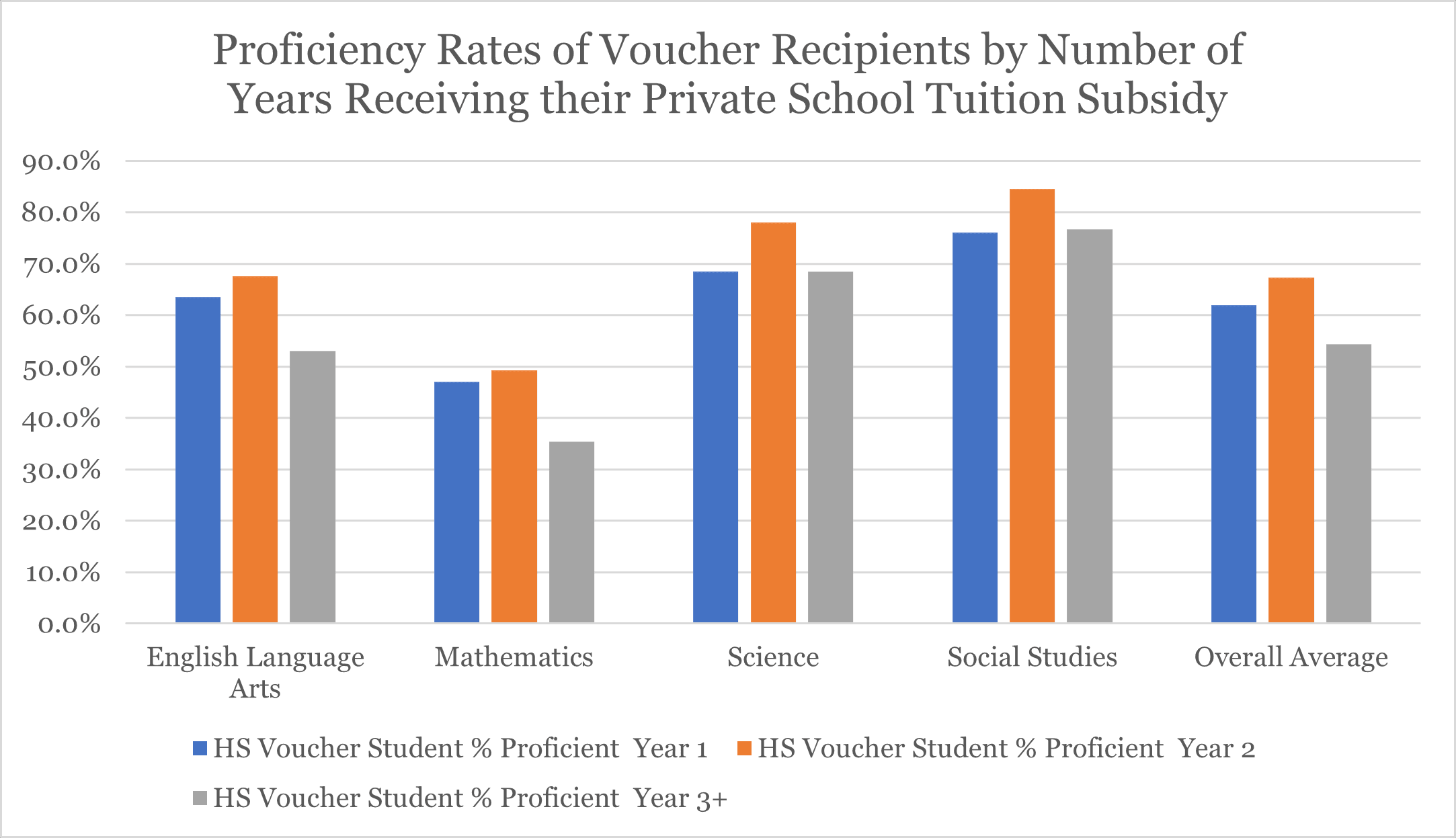
Yet you never hear that argument. Now I know why: according to state test data, the longer students take vouchers, the worse they do on state tests — in some cases a lotworse. Especially in high school.

Here is how students perform on state High School proficiency rates, depending on how long they’ve been taking vouchers. You can see pretty clearly that especially in English and Math, students do markedly worse if they’ve been taking vouchers for 3 plus years than they do if they’ve only been taking it for a year.

This provides some pretty compelling evidence that students taking vouchers are better prepared by public schools, but once they enter the private system, that success wanes. Only in Social Studies is there an increase, but it’s only a 0.9% increase. Math drops by nearly 1/4. Overall, there’s, on average, a 12.1% drop in proficiency rates the longer a high school student takes a voucher….

Let me put it simply:

  • Generally, Voucher students do worse on state tests the longer they take vouchers.
  • The Black-White achievement gap is much greater among voucher students than public school students.
  • Private Schools that accept Vouchers take a Whiter population of students than the districts from whence the students come.

I just have one simple question: How is it again that Vouchers provide “better” opportunities for students of color who are being “failed” by public schools, as voucher proponents continuously claim?

Because Ohio data sure suggest that students of color are best served by their local public schools, not the private schools who are more reluctant to take them, even with significant taxpayer-funded tuition subsidies.

Jerry Zahorchak, a former Secretary of the Pennsylvania Department of Education, explains why the Republicans’ voucher bill would harm students and public schools and deepen inequity.

He writes:

Imagine a school district with $4,000 less to spend per student than its wealthier neighbors with many students who lack supports to reach grade-level. How would you help?

Most people would guarantee that this school district had funds to hire enough teachers and aides to give students who are behind supports. Indeed, nearly two-thirds of Pennsylvania parents in a recent PSBA (Pennsylvania School Boards Association) poll agreed that struggling schools need more resources.

Legislative leaders are instead considering taking taxpayer money away from some of the state’s lowest funded schools and sending it private schools, no strings attached.

The bill, HB 2169, passed the State House in May and could be considered by the state Senate at any time this session. Under the bill, students who live in the attendance zone of public schools with test scores in the bottom 15% statewide would be eligible to receive the average per-student state funding for public schools – around $7,000 per year – as a voucher that can be used for any qualified educational expense, including private school tuition. Funding would come directly from their local school district, and would cost struggling school districts around $140 million annually (PSBA).

Rather than giving students in underfunded schools resources, they would use taxpayer money to fuel the private market. Families would be on their own, forgetting that we all have a stake in making sure that each child learns to cooperate with neighbors of every stripe and become self-supporting, knowledgeable citizens.

Proponents claim these “lifeline scholarships” will help families access quality education they wouldn’t otherwise be able to afford. The real story is not so simple.

Supporters never mention that districts with high academic performance are able to spend around $4,600 more per student on average than low-performing districts. These resource gaps – which will be worse with HB 2169 – closely track local wealth. When we adjust for the fact that poor school districts serve more students in poverty and other students who need more support, the gap between wealthy and poor school districts is more than $7,000 per student.

The fantasy that the private market will provide a better deal for students at a cheaper price falls apart under scrutiny.

Private schools often reject students that public schools rightfully must educate: students who are behind grade-level, have behavioral challenges, are learning English and more. There’s no guarantee to make private schools accommodate students with disabilities, unlike public schools where federal laws guarantee students with disabilities the right to a Free Appropriate Public Education (FAPE). Private schools can reject students simply because they don’t “fit the culture” or can’t pay the entire cost of tuition. Because many of these students need services that cost more, there is an incentive to say no.

Please open the link and read the rest of his article.

The voucher bill was narrowly passed by the Republican-led House and also the State Semate Education committee.

For some inexplicable reason, it was endorsed by Josh Shapiro, the Democratic candidate for Governor.

Peter Greene is a retired teacher in Pennsylvania; he stepped down after nearly 40 years in the classroom and has been a prolific writer ever since, stepped in the wisdom of practie.

He is disgusted with Democratic Gubernatorial candidate Josh Shapiro’s decision to support school vouchers.

Shapiro has joined forces with the GOP. How curious that Shapiro has thrown himself in the same boat with Greg Abbot, Ron DeSantis, Doug Ducy, and every other anti-public school governor.

Greene writes that Shapiro’s website touts his support for vouchers:

Josh favors adding choices for parents and educational opportunity for students and funding lifeline scholarships like those approved in other states and introduced in Pennsylvania.

The Lifeline Scholarship bill is a GOP education savings account bill–a super-voucher bill– currently sitting in the appropriations committee in the House; the Senate has passed their version. Not just charters. Not just traditional vouchers. But nice shiny, super vouchers. Take a bunch of money from public schools (based on state average cost-per-pupil, not local numbers, so that many districts will lose more money than they would have spent on the students). Handed as a pile of money/debit card which can be spent on any number of education-adjacent expenses.

The state will audit the families at least once every two years. The bill contains the usual non-interference clause, meaning that the money can be spent at a private discriminatory school, and no one will be checking to see if the school is actually educating the student. The bill is only old-school in that it uses the old foot-in-the-door technique of saying that this is just to rescue students from “failing” public schools (but includes no provisions to determine if the child has been moved to a failing private school).

Choicers are ecstatic…

You know a great way to make sure that zip code, ethnicity, and class don’t determine a child’s educational quality? It’s not to give some of them voucher money that may or may not get a few students to a better education.

It’s to fully fund and support all the schools in all the zip codes.

Boy, would I love to vote for a governor who supported that for a plan.

But no–we now have a choice of two guys who are barely different on education. Mastriano would gut spending completely while implementing vouchers, while Shapiro would just slice open a public education vein.

In fairness to Shapiro, his site says he’s going to fully fund education, too, which would be kind of like putting a hose in one side of your swimming pool while chopping a gaping hole in the base on the other side. It’s not a great plan. If he means it, which now, who’s to say.

Shapiro’s position is awful. It would align him with just about any GOP candidate in any other state, and the only reason it isn’t a disqualifier in this state is because insurrectionist Doug Mastriano is so spectacularly, so uniquely terrible, so ground-breakingly awful. Mastriano is still a terrible, terrible choice.

Voucher fans were sad because they could see their hopes and dreams going down in flames with Mastriano, but now they can rest assured that whoever wins, they will get a governor who supports an education program that any right wing Republican would love. For those of us who support public education, it is brutally disappointing.