Archives for category: Privatization

The Tennessee Court of Appeals upheld a lower court decision that Governor Bill Lee’s voucher plan is unconstitutional.

The voucher plan was supposed to be installed only in Memphis and Nashville, over the objections of their representatives. The deciding vote was cast by a legislator from Knoxville, after he was promised that the voucher program would not include his district.

A victory for friends of public schools and communities in Tennessee!

[intro]

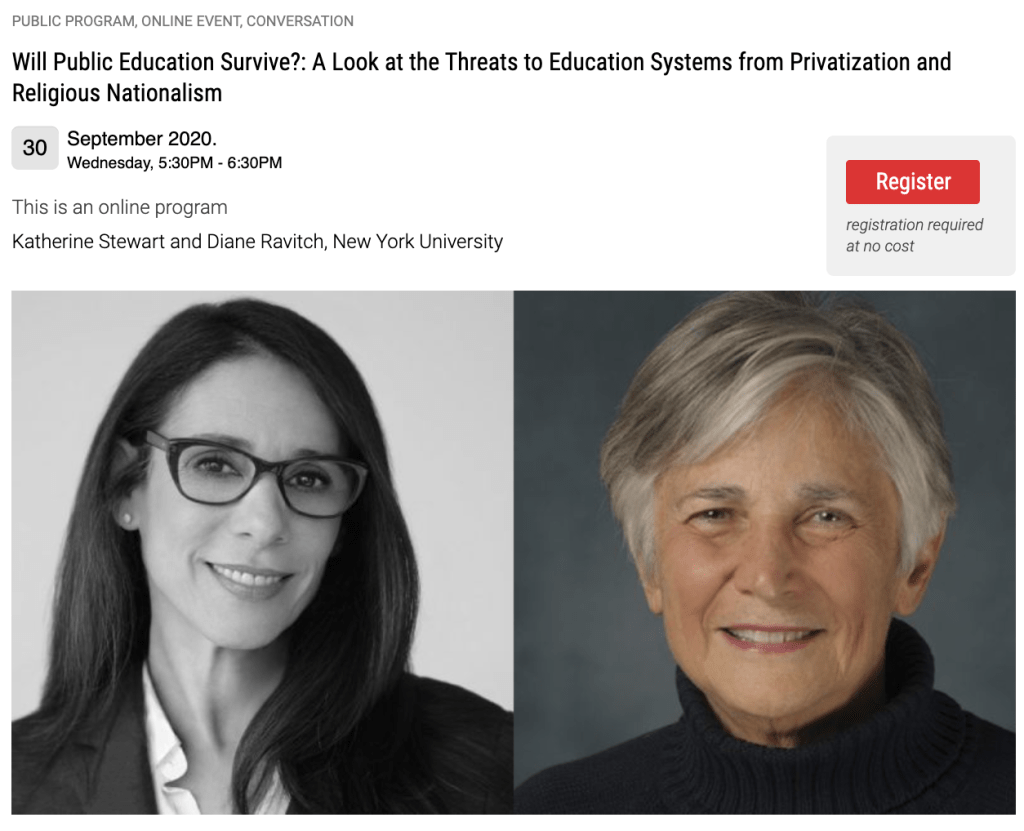
The rise of the Religious Right has coincided with the privatization movement in public schools. While some may feel that this is coincidental, there is reason to believe there is a directly causal relationship between these two factors. Two scholars, from different disciplines, will discuss how their work comes together to help explain the history and current state of efforts to diminish, if not dismantle, the American public education system. Katherine Stewart has written on the rise and increasing power of the Religious Right in her book The Power Worshipers. She will be joined by Diane Ravitch who has written extensively on education and, in her recent book Slaying Goliath, explores the history of the school privatization movement and the efforts to oppose it.

Please note, this is an online event held on the video conference platform, Zoom. Registrants will receive an email with links to join the program.

Link to register: https://18308a.blackbaudhosting.com/18308a/Will-Public-Education-Survive-A-Look-at-the-Threats-to-Education-Systems-from-Privatization–Reli

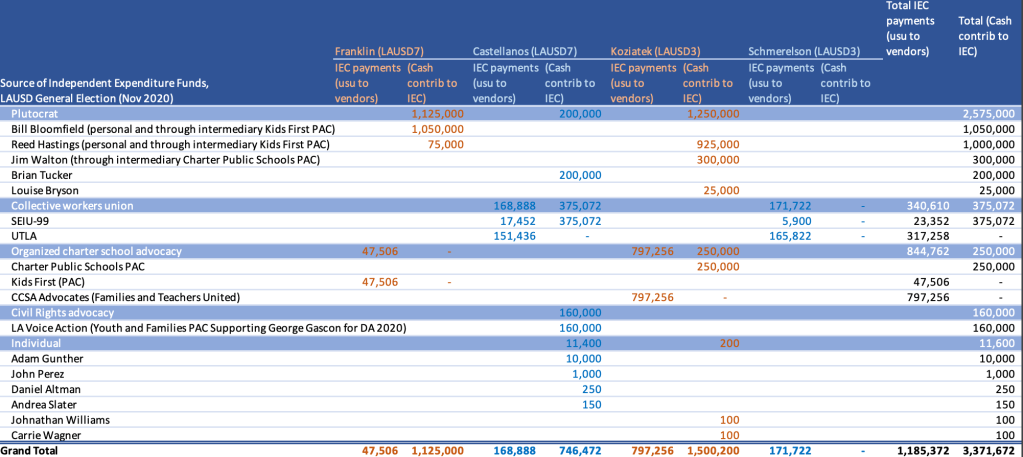
Once again, control of the Los Angeles Unified School Distict school board is up for grabs, and once again the billionaires hope to buy control so they can expand the number of charter schools. The latest financial disclosures show that Reed Hastings of Netflix has contributed $925,000 to try to defeat veteran educator Scott Schmerelson. Billionaire Jim Walton of the Walmart family added another $300,000. The charter lobby is flush with money to buy TV ads and flyers that smear Schmerelson and use vicious anti-Semitic tropes in their attack ads. The charter lobby is angry at Schmerelson for two reasons: 1. He fights fearlessly for the 80% of students in public schools. 2. He released the explosive fact that 80% of Los Angeles’ charter schools have vacancies, not waiting lists. His opponent Marilyn Koziatek has no experience in the public schools; she holds an administrative job in a charter school.

Download the .pdf here.

Note: Sara Roos of Los Angeles (blogger Red Queen in LA) prepared the graph of political expenditures based on public records.

Leonie Haimson reports that Success Academy is dropping plans to open three new high schools because it doesn’t have enough students.

Parent activist Brooke Parker wrote the report as a guest blogger.

No waiting lists. Not enough students.

Dr. Jennifer McCormick, state superintendent of education in Indiana, is a hero of public education. She has steadfastly sided with public schools and defied her own party’s embrace of charters and vouchers.

Blogger Steve Hinnefeld reports that Superintendent McCormick has endorsed Democratic candidates who support public schools instead of members of her own party aligned with the Mitch Daniels-Mike Pence privatization agenda.

Hinnefeld writes:

There was a time when Indiana Republicans supported public schools; at least, they supported their local public schools. The shift came in 2011, when Gov. Mitch Daniels got the GOP-controlled legislature to adopt school vouchers and expand charter schools. Today, many Hoosier Republicans have come very close to embracing the late economist Milton Friedman’s vision of a “universal” voucher program of unrestricted state support for private schools.

But McCormick, former superintendent of Indiana’s Yorktown school district, has been an outspoken advocate for public schools. Every time she spoke out for public school districts, you could see Republicans edging further away. When she announced in 2018 that she wouldn’t seek re-election, she implied that she was being elbowed aside. Legislators promptly changed the law so Indiana’s governor will appoint the state’s next chief education officer, starting in 2021.

Yes, support for public schools used to be bipartisan. Indiana has a long tradition of valuing public schools. But party leaders followed the Pied Piper, Milton Friedman, and determined to promote private school choice while defunding the public schools that enroll the vast majority of the state’s children.

Meanwhile, Hinnefeld writes, McCormick has endorsed Democrats because they, like her, believe in the importance of public schools.

I hereby add Jennifer McCormick to the Honor Roll of the blog, for her principled support of public schools and the common good and for her uncommon courage.

Betsy DeVos lost the biggest fight of her tenure as Secretary of Education. Federal judges consistently rejected her legally binding rule requiring states to give private schools a share of the $13 billion Congress allocated for public schools and for needy students in private schools. DeVos wanted private schools to get a share of the federal money without regard to the need of their students. The judges said no.

After fighting for her position, DeVos admitted defeat and decided not to appeal the court decisions.

Some states have already given federal funds to private schools, using DeVos’ formula, and it is not clear whether that money will be clawed back.

Charter schools also received a share of the $13 billion in CARES funds, which they qualified for as “public schools.” Many charter and private schools also applied for and received millions of dollars from the Paycheck Protection Program (public schools were not eligible for PPP). A study by Good Jobs Inc. determined that charter and private schools obtained SIX TIMES as much federal relief money as public schools.

I have posted many times about the corruption embedded in the for-profit virtual charter industry. The founder of Pennsylvania’s largest virtual charter school was sentenced to prison for misappropriating $8 million. The single biggest scam in U.S. history involved an online charter chain in California called A3, whose owners managed to make $50 million in state funding disappear. The Electronic Classroom of Tomorrow (ECOT) in Ohio collected $1 billion over its nearly two decades, its owner paid his companies for supplying services, he made generous gifts to elected officials, but ECOT declared bankruptcy in 2018 to avoid repaying the state for phantom students. The stories of corruption, embezzlement, and scamming go on and on.

Therefore I was delighted to find this excellent summary by journalist Florina Rodov, who gathers many of the scandals and research reports in one place to demonstrate the woeful failure of virtual charters. As she points out, the virtual charter industry has beefed up its already massive marketing budget to take advantage of the pandemic and try to gather market share.

One detail that I found fascinating was the link to executive compensation for K12 Inc., the for-profit virtual chain that has the largest enrollment in the nation. The top five executives receive a total of $28 million in compensation. Beats teaching!

She begins:

“Instead of going to school every morning, what if school could come to you?” an ad asks enticingly, promising students “online personalized learning” tailored to their specific needs. It’s one of hundreds of active Facebook ads run by K12 Inc., the largest for-profit virtual charter school provider in the United States. As public schools rose to the challenge of educating students online during the pandemic, corporations like K12 Inc., whose stock price has been climbing since mid-March, were licking their chops at the prospect of moving kids online permanently. Though virtual charter schools perform dismally academically and are plagued by scandal, the goal is for them to replace traditional brick-and-mortar public schools in an effort to privatize education. While this would harm students, it would most egregiously damage Black and Latino children, who’ve already been disproportionately impacted by the coronavirus, due to structural inequities such as lack of access to computers and internet service, as well as inconsistent health care and crowded housing.

The article has many important links and I urge you to read it in full. The virtual charter industry has the full-throated support of Betsy DeVos, who lied about their results at her confirmation hearings in 2017, claiming they had 100% graduation rates, when their graduation rates are abysmal.

Jan Resseger describes a grassroots effort to stave off the persistent assaults on public schools by the Republican-controlled legislature and state officials. Ohio has a large and low-performing charter sector, as well as a well-funded voucher sector that has produced no gains for students.

The privatization movement has harmed the public schools that most students attend without providing better schools. While the nation has struggled to survive the pandemic, Ohio’s legislators have remained focused on expanding their failed choice plans.

Resseger describes the work of the Northeast Ohio Friends of PublicEducation and their decision to create a website to educate the public.

Resseger writes:

In this leaderless situation with schools struggling everywhere, no matter their efforts to prepare, questions of policy have just sort of faded away—except that the privatizers are doggedly trying to co-opt the chaos in every way they can. In Ohio, the Legislature has taken advantage of the time while the public is distracted by COVID-19 to explode the number of EdChoice vouchers for private schools at the expense of public school district budgets, to neglect to address the injustices of our state’s punitive, autocratic state takeovers of the public schools in Youngstown, Lorain and East Cleveland, and to put off for over a year discussion of a proposed plan to fix a state school funding formula so broken that 503 of the state’s 610 school districts (80 percent) have fallen off a grossly under-funded old formula.

In recent years, most Ohio school districts have been getting exactly as much state funding as they got last year and the year before that and the year before that even if their overall enrollment has increased, the number poor children has risen, or the number of special education students has grown. And all this got even worse under the current two-year state budget, in which school funding was simply frozen for every school district at the amount allocated in fiscal year 2019. That is until this past June, when, due to the revenue shortage caused by the coronavirus pandemic, the Governor cut an additional $330 million from the money already budgeted for public schools in the fiscal year that ended June 30, thus forcing school districts to reduce their own budgets below what they had been promised. With much hoopla in the spring of 2019, the new Cupp-Patterson school funding plan was proposed. A year ago, however, research indicated (see here and here) that—partly thanks to the past decade of tax cuts in Ohio and partly due to problems in the new distribution formula itself—the new school funding proposal failed to help the state’s poorest schools districts. The analysis said that a lot of work would be required to make the plan equitable. New hearings are planned this fall, but nobody has yet reported on whether or how the Cupp-Patterson Plan has been readjusted.

In this context, discussions in the Northeast Ohio Friends of Public Education focused on our need to help ourselves and the citizens in our school districts find our way. What are the big issues? What information will help us explore and advocate effectively for policies that will ensure our schools are funded adequately and that funding is distributed equitably? In Ohio, how can we effectively push the Legislature to collect enough revenue to be able to fund the state’s 610 school districts without dumping the entire burden onto local school districts passing voted property tax levies? How can we help stop what feels like a privatization juggernaut in the Ohio Legislature? And how can federal policy be made to invest in and help the nation’s most vulnerable public schools?

The idea of a website emerged, with the idea of highlighting four core principles—with a cache of information in each section: Why Public Schools? Why More School Funding? Why Not Privatization? and Why Educational Equity? Although we have noticed that much public school advocacy these days emphasizes what public school supporters are against, we decided to frame our website instead about what we stand for as “friends of public education” even though our opposition to charter schools and private school tuition vouchers is evident in our website.

Educating the public is a crucial step in reclaiming the narrative from entrepreneurs, libertarians, and cultural vandals.
The Harvard Program on Education Policy and Governance is led by Professor Paul Peterson, an advocate for school choice. It would not be off the mark to say that PEPG exists to promote the DeVos agenda. Soon after she was confirmed, PEPG invited her to speak, and her speech was disrupted by Harvard students not affiliated with PEPG. Peterson has been the mentor for a generation of pro-school choice academics, including Jay Greene (University of Arkansas, Department of Education Reform), Patrick Wolf (same, also served as “independent evaluator” of Milwaukee and DC voucher prigrams), and Martin West (Harvard Graduate School of Education). Peterson recently appeared at the White House to support Trump’s call to reopen schools and co-wrote an oped with Dr. Scott Atlas (both are senior fellows at the rightwing Hoover Institution). Dr. Atlas supports Trump’s views that mask-wearing should not be mandatory, that children and adolescents don’t get the virus, th ast schools should reopen without delay, and that lockdowns are unnecessary. In many articles about Dr. Atlas, Peterson is his reliable defender.

The event today asks whether teachers unions can be part of the solution. Michelle Rhee and George Parker. Parker was head of the Washington Teachers Union when Rhee was chancellor. When he stepped down, he went to work for Rhee. He now works for a charter school lobbying group. More than 90% of charters are non-union.

Fall 2020 Colloquium Series: Can Teachers Unions Be Part of the Solution?

The PEPG Colloquium series continues Thursday, Sept. 24, with “Can Teachers Unions Be Part of the Solution?,” a talk by Michelle Rhee, Founder and CEO, StudentsFirst, former Chancellor for District of Columbia Public Schools, and George Parker, Senior Advisor, National Alliance for Public Charter Schools, former President, District of Columbia Teachers Union.

Thursday, Sept. 24
12-1:15 p.m.
Register to attend the Zoom webinar

Have you ever wondered what really goes on in the courtroom? Would you like to have a front-row seat as lawyers argue for and against vouchers before the South Carolina Supreme Court?

Here is your chance.

Tonight at 7:30 pm EST, I’m having a Zoom conversation with University of South Carolina professor Derek Black. He will talk about his new book, Schoolhouse Burning: Public Education and the Assault on American Democracy, and about the case discussed in this video.

Please sign up here and join us. It’s like a seat in a graduate seminar in vouchers and school choice, offered by a top-notch constitutional lawyer.