Archives for category: Privatization

Jan Resseger writes here about the charter schools in Ohio that received federal funding but never opened or closed soon after opening.

In Ohio, nearly $36 million was wasted, and that was only between 2006 and 2014. Throughout the 25-year life of the federal Charter Schools Program, the loss was far greater but has not yet been documented.

She writes:

I suppose the idea is that if you scatter hundreds of seeds across a state, they’ll grow and enrich the educational environment.  But as I examine Ohio’s list of failed or never-opened, CSP-funded charter schools, I can see that the seeds were scattered so widely that they weren’t particularly noticeable even when they came up. Unless there was a splashy scandal or a school was widely advertised on the side of city buses, nobody would have had any idea of the existence or failure of most of the seeds that did come up. And anyway a lot of them never sprouted at all.  Because the Charter Schools Program has lacked oversight from the U.S. Department of Education and because Ohio’s charter schools are poorly regulated by a large number of nonprofit agencies that serve as sponsors, the Ohio press has—until NPE’s Asleep at the Wheel report—not to my knowledge reported that the U.S. Department of Education is funding a lot of failed or never-opened schools. Until now, the failure of this program has been virtually invisible.

In the the list of failed or never-opened Ohio charter schools released last Friday by the Network for Public Education, NPE reports: “Two hundred ninety-three Ohio charter schools were awarded grants through the U.S. Department of Education’s (U.S. DOE) Charter Schools Program (CSP) from money that the U.S. Department of Education gave to the states between 2006-2014.  At this time, at least 117 (40%) of those (Ohio) charter schools were closed or never opened at all.” NPE explains that 20 of the Ohio charter schools on the list never opened; ninety-seven of the Ohio charter schools receiving CSP grants opened but subsequently shut down.

I suspect that like me, hardly anybody in Ohio has heard of most of the 20 schools that received CSP funding but never opened. Here are their names: Academy for Urban Solutions; Buckeye Academy; Central Ohio Early College Academy; Cleveland Arts and Literature Academy; Cleveland Lighthouse Charter Community School West; Columbus Entrepreneurial Academy; Cuyahoga Valley Academy; Medina City Schools Technology School; New Albany School for Performing Arts Middle School 6-8; Phoenix Village Academy Secondary 2; Rising Star Elementary School; School of Tomorrow; Summit Academy Community Schools in Alliance, Marion, Massillon, Columbus, and Cincinnati; Technology and Arts Academy of Cleveland; Vision into Action Academy-South Columbus; and WinWin Academy.  It is difficult to tell from the names of most of these schools even where it was intended that they would be located.

Ninety-seven CSP-funded schools in Ohio have shut down, but from the list, it is not possible to discern whether they were shut down by their sponsors for conflicts of interest or fraud, or whether their sponsors determined they were failing their students academically, or whether they just went broke. Most of the CSP grants awarded to closed or never-opened schools were in the six figure range—$150,000 or more.  Two of the schools that failed or were never opened had been awarded CSP grants over $700,000; three had been granted between $600,000 and $700,000; two had received between $500,000 and $600,000; and 25 had been awarded between $400,000 and $500,000.

The federal Charter Schools Program is neoliberal by design.  It awards public funding to private operators—individuals and companies—to run schools in competition with the traditional public schools. One primary problem with the CSP along with other schemes to privatize the public schools is that oversight is lacking to protect the rights of the students and to protect the stewardship of tax dollars.




Florida is a puzzle. Parents and taxpayers support their community public schools and regularly vote to tax themselves to pay for them. Yet in the general election, they elect legislators who have a financial stake in privatization and are riddled with conflicts of interest.  Some legislators are employed by charter schools and their related companies; some have family members who own and/or operate charter schools. Until the voters figure out that they are being hornswoggled, they will continue to have a Legislature that robs money from their public schools to pay for unaccountable, inefficient charter schools.


FEA: Legislature needs to heed voters and fund neighborhood public schools


TALLAHASSEE — Time and again, Florida’s electorate has demonstrated broad, bipartisan consensus on the need to increase funding for our students and neighborhood public schools.


The evidence of their support for investment in our schools can be found in the tens of thousands of petitions that the Florida Education Association (FEA) is delivering today, in the nearly 2 million Floridians who voted in 2018 to increase their local taxes in order to help schools, and consistently through public-opinion polls.


However, House leaders don’t appear to be listening.


“Stakeholders around this state have chosen to support their neighborhood public schools through local referendums, choosing to pay out of their own pockets to provide for students and keep qualified educators in classrooms,” said FEA President Fedrick Ingram. “The Florida House now wants to take that money in yet another attempt to defund our neighborhood public schools.”


Under House Bill (HB) 7123, money collected locally to support neighborhood public schools would be sent to charter schools and for-profit, out-of-state charter operators. The FEA calls on the House to leave the locally generated dollars alone and to instead follow the Senate’s lead in funding a substantial increase in the state budget’s per-student base allocation for our schools.


While financed by taxpayer dollars, charter schools are privately run. They differ markedly in several ways from the neighborhood public schools that educate the great majority of our students:

  • Public schools’ budgets are transparent — in order to get public support for local referendums, school districts had to prove the need for additional money. There is no such financial transparency for charter schools.
  • What little we do know about how charter schools spend their money paints a very troubling picture. Charter schools spend a much lower percentage of their revenue on instruction than public schools.
  • Instead of spending money on students, many charter schools spend in excess of $1 million a year of taxpayer money in fees to for-profit management companies.
  • Academic Solutions Academy in Fort Lauderdale, for instance, spends about 25 percent of all the taxpayer dollars it receives on instructional services, according to a school audit.
  • While HB 7123 does include language that says charter schools must use local levies for voter-authorized purposes, there appears to be no enforcement mechanism for that provision. How can voters be sure that charter schools are using the money the way voters intended, and how will charter schools be held accountable if they don’t?


The diversion of locally generated funds would represent one more sad chapter in the story of Florida’s failure to adequately support high quality neighborhood public schools.


Florida now ranks among the bottom 10 states nationally in funding for our students, and education spending remains below pre-recession levels. The average teacher salary in Florida has dropped to 46th in the nation, while many school staff earn a wage below the federal poverty line. We face a growing teacher shortage. More than 4,000 classrooms were without a qualified teacher at the start of this school year, and there may soon be more than 10,000 teacher vacancies according to Florida Department of Education projections.


The public and educators want change. More than 23,000 Floridians have spoken by petition to call for a major reinvestment in our neighborhood public schools. The printed petitions were delivered to the office of the speaker of the Florida House on Tuesday, April 23, following an FEA news conference at the Capitol. News conference speakers included FEA President Ingram; Justin Katz, president of the Palm Beach County Classroom Teachers Association; and Karla Hernandez-Mats, president of United Teachers of Dade.


We must fund our future. Find the FEA petition at https://actionnetwork.org/petitions/time-to-step-up-for-neighborhood-public-schools.


Spurred on by Governor Ron DeSantis, Jeb Bush, and Betsy DeVos, the Florida Senate endorsed a fifth private voucher program. 

“The bill would create a new Family Empowerment Scholarship — the state’s fifth voucher program — that could help up to 18,000 students pay private school tuition with state-backed scholarships. The program would target youngsters from low-income families but could be open to more middle class ones, too, with an income limit of nearly $80,000 for a family of four….

“Every parent knows what’s best for their individual child, and at no point should we turn over that responsibility to the government,” said Sen. Manny Diaz, R-Hialeah, one of the bill’s sponsors.”

The new program would be funded with money taken from the state education budget, up to $130 million. Other vouchers programs are “tax credits” given to corporations or individuals. Because this money comes right out of the state budget, it might be subject to legal challenge since it directly violates the state constitution’s prohibition on public money for religious schools.

Republicans are betting that the state courts will ignore the state constitution and the 2012 referendum that went against Jeb Bush’s effort to change that provision of the state constitution.

More than 80% of students using vouchers attend religious schools. Voucher schools “do not have to give students state tests nor meet state standards when it comes to academics, teacher credentials or facilities.”

Florida Republicans continue their  assault on public schools.

Florida is no model for the nation.

On the NAEP, Florida ranks at the national average in 8th grade reading and math. It has large achievement gaps between black and white students. Ignore Florida’s fourth grade scores; they are tainted by the state policy of retaining third grade students who don’t pass the state reading test.

I don’t know whether voucher students are included in NAEP’s sample. The State makes sure they are not included on state tests.


Remember when Laurene Powell Jobs announced that she was running a competition for ideas to reinvent the high school? She was offering $10 million to each winning proposal, which she called “Super Schools.”

Nearly 700 proposals were entered, but only 10 were chosen.

One of the winners was in Oakland, California, a district that has been subject to nonstop disruption, charters, and and constant meddling by the Eli Broad foundation. For years, the district has been led by Broadies, who have run it into a ditch and failed to revive its fortunes.

The Oakland winner planned to open a Super School that incorporated Mark Zuckerberg’s Summit Learning online platform.

But things went poorly after Oakland’s Broadie superintendent Antwan Wilson was lured to the District of Columbia to be its chancellor (where he was soon ousted after it was revealed that he pulled strings to get his daughter into one of the best public schools, a practice that Wilson had forbidden for others. Wilson is now running an education consulting business.)

Two years ago, the Oakland Super School was abandoned before it opened. 

The turmoil in the district, which has been a near constant for years, made it impossible to open.

Summit Public Schools, which operates a chain of charter schools, with support from the Oakland school district and Mayor Libby Schaaf’s office, submitted a winning proposal for a charter school focusing on personal learning and real-world experiences. The goal was to open the new school at the California College of the Arts on Broadway in Rockridge in fall 2018.

But the effort started to fall apart over the last several months and was ultimately abandoned in recent weeks, The Chronicle has learned. Now, Summit leaders will use the money for one of their existing charter schools in Daly City.

“There are just better ways for us to help kids in the Bay Area,” said Jason Solomon, senior director of advocacy and engagement at Summit Public Schools, which operates eight charter schools in the Bay Area and three in Washington state.

Solomon noted that the team’s entry to build the new school included the support of former Oakland Superintendent Antwan Wilson, who resigned this year to lead the Washington, D.C., schools. On top of the turnover in leadership, the district is grappling with the need to close or consolidate schools given declining enrollment while juggling a $30 million budget shortfall over the next year.

Community groups were unhappy that the proposed charter would be sited very close to an existing Oakland public school that had not yet been disrupted and destroyed.

With Antwan Wilson gone, Summit charters was not sure they would have a champion so they shifted the funding to one of their schools in Daly City.

Summit substitutes computer-based instruction for real teachers, and it has driven out in places as distant as Connecticut and Kansas, by parents and students.


School Bus
Toledo Board of Education member: HB 70 is “possibly one of the most undemocratic, mean-spirited, cynical pieces of legislation ever passed in the state of Ohio”
Several state legislators are attempting to repeal or at least put a moratorium on HB 70. Other state officials, including the State Superintendent and Governor, want to repair it.
HB 70, enacted by the 131stGeneral Assembly in a 24-hour period with no public involvement, was a colossal mistake. It merely punishes school districts that serve a high concentration of poverty students.
Ohioans must call for a complete repeal of HB 70. A repair job on HB 70 would be like using chewing gum to repair a leak in the Hoover Dam. HB 70 must be replaced by legislation that provides services to poverty students.
Governance is not the issue. Poverty is.
William L. Phillis | Ohio Coalition for Equity & Adequacy of School Funding | 614.228.6540ohioeanda@sbcglobal.net| www.ohiocoalition.org
STAY CONNECTED:
School Bus


As Leonie Haimson explains in this post, it has been a busy few weeks for Eva Moskowitz, founder and CEO of NYC’s controversial Success Academy charter chain.

Once again, her chain has been accused of violating the rights of students; Betsy DeVos awarded $9.8 million to her schools, added to the $43.4 million  Eva previously received from the federal Charter Schools Program; she will receive an honorary degree from Tufts University; and the President of Harvard University is giving the commencement speech to her graduating class.

How does it happen that the president of the nation’s most prestigious university is speaking to what may be a graduating class of a few dozen students at a charter school? .

“The former president of Tufts, Lawrence Bacow, who is the current president of Harvard is scheduled to speak at the Success high school’s graduation, which last year only graduated 16 out of the 73 students who entered the school in Kindergarten  or first grade.  No doubt both occurrences were influenced by the fact that the head of the Success board, hedge funder Steve Galbreath, is also on the Tufts board of trustees and heads its investment committee.”

Follow the money.

Don’t be surprised if next year Moskowitz land DeVos herself, America’s leading charter school champion.


Chalkbeat reports the likelihood of a legal challenge to any voucher bill in Tennessee if State Senate passes one as House did yesterday in a contentious proceeding.

Read the details here.

When the Waltons and Gates and Bloomberg read this, they will be very disappointed. Chagrined. The point of charters is to bust unions, they thought.

NEWS RELEASE:
For Immediate Release
| ctulocal1.org

CONTACT: Chris Geovanis, 312-329-6250, 312-446-4939 (m), ChrisGeovanis@ctulocal1.org

CTU charter members to announce strike date against operators

Teachers, support staff will walk out if demands for living wages, adequate student supports, pension rights, protections for immigrant and diverse learners are not met.

CHICAGO—Chicago could be on the cusp of a third strike against charter operators in the current school year, as negotiations drag on with operators of five schools, and four additional schools consider striking this spring. This would be the first multi-employer charter strike in U.S. history.

CTU educators will join City Colleges clerks and technical workers in AFT/IFT Local 1708 at 4:30 PM on Thursday, April 25 at the Arturo Velazquez Westside Technical Institute at 2800 S. Western Ave., where both groups will announce strike dates. Then workers will head two blocks north to Instituto Progresso del Latino’s IHSCA charter campus at 2520 S. Western Ave. to rally.

CTU charter members at two schools run by Instituto Progresso del Latino share a common target with City College clerks. City Colleges chancellor Juan Salgado ran Instituto before he was appointed as top brass at City Colleges. Under his leadership, workers at both shops have gotten the shaft, charge teachers. City Colleges clerks have been without a contract for almost three years, while Instituto under both Salgado and his heirs has steered public dollars away from classroom needs into a bloated bureaucracy and non-educational spending.

The five schools considering striking employ 134 CTU members who educate almost 1,800 students. All five schools voted overwhelmingly to strike earlier this month, with 94 percent of union members voting, and 97 percent voting to strike if there is no progress at the bargaining table.

CTU members are demanding protections built into the contract to provide special education students with the services they both need and are entitled to under federal law. They’re demanding more support for English language learners and immigrant students—including sanctuary protections enshrined in contract language. And union members are demanding adequate staffing and resources for schools that confront serious shortages of both, along with equal pay for equal work with their colleagues in CPS, who teach the same student population for better wages and working conditions.

At ChiArts, which was cofounded by wealthy investment banker Jim Mabie, teachers are also fighting to force the operator to contribute to their pension fund—a move opposed by the board at the same time that Mabie is trying to gut the pensions of striking Chicago Symphony Orchestra musicians. Mabie sits on both boards.

High turnover is a chronic issue at the schools, driven by systemic under-resourcing and poor wages and working conditions. Staff churn, which can be upwards of 20% per year or more at some schools, undermines students’ learning conditions and the stability of school communities.

Union charter workers want to reform these practices with these operators as part of an effort to reform the entire charter industry, which chronically undercuts investment in academic programs and student supports while expanding bloated bureaucracies, inflating executive salaries and shunting education dollars into high management fees.

While this number could grow, the schools announcing a strike date include:

  • IHSCA, the Instituto Health Sciences Career Academy, which serves more than 700 high school students. City Colleges chancellor Juan Salgado had oversight of IHSCA and Instituto’s other school programs and civic projects, yet failed to ensure that public dollars went into classrooms instead of Instituto’s management expansion and fee structure for ‘managing’ its school portfolio.
  • IHSCA is bargaining a joint contract with another small Instituto-controlled school, IJLA, the Instituto Justice Leadership Academy. The school serves just under 100 students aged 17-21 who previously left school and are seeking a high school diploma.  Both schools are ovewhelmingly low-income and Latinx, with high percentages of limited English-speaking students.
  • ChiArts, where more than 40 teachers are fighting for more classroom resources, and contributions to their pension fund. Management at the publicly funded selective enrollment school of 600 students has refused. Wealthy investment banker and ChiArts’ co-founder Jim Mabie is also treasurer of the Chicago Symphony Orchestra’s board, where he and his fellow board members are fighting to cancel the pensions of the orchestra’s striking world class musicians, even though moving musicians into a ‘defined contributions’ style plan would be more expensive than the current pension plan.
  • Latino Youth High School, or LYHS, run by CMO—charter management organization—Pilsen Wellness Center (PWC), which has demanded a longer school day and school year plus reductions in contractual benefits, while rejecting the union’s demand for equal pay for equal work. The school’s 220 students, who suffer from high rates of trauma, are almost 90% Latinx and 10% Black.
  • YCLA—Youth Connection Leadership Academy—where CTU members are bargaining with charter operator YCCS, which, like many operators, has inflated executives positions while shortchanging spending on students’ academic needs. YCLA’s CEO earns almost $180,000 per year and the top deputy makes almost $160,000 per year, while some educators make barely a fifth of that. Management has drawn complaints that range from body-shaming to shortchanging special education students at the overwhelmingly Black, low-income school on Chicago’s South Side.

###

The Chicago Teachers Union represents nearly 25,000 teachers and educational support personnel working in schools funded by City of Chicago School District 299, and by extension, the nearly 400,000 students and families they serve. The CTU is an affiliate of the American Federation of Teachers and the Illinois Federation of Teachers and is the third-largest teachers local in the United States. For more information please visit the CTU website at www.ctulocal1.org.

Sent via ActionNetwork.org. To update your email address, change your name or address, or to stop receiving emails from CTU Press, please click here.

Betsy DeVos held a “roundtable” with Kentucky Governor Matt Bevin at a public community college in Lexington, Kentucky.

When student journalists at Paul Laurence Dunbar High School heard that they were meeting, they went to the event, presented their press credentials, and were barred from covering it.

The only student invited to speak at the roundtable attends a religious school. The other participants represented Kentucky organizations that support privatization of public funds. That is, supporters of Betsy DeVos’s anti-public school agenda.

The students were on deadline, and they were on a mission.

They piled into a car last Wednesday and pulled away from Paul Laurence Dunbar High School, their public school in Lexington, Ky. With permission, they drove across town to a community college where their Republican governor, Matt Bevin, was hosting a roundtable discussion on education featuring Education Secretary Betsy DeVos.

The high schoolers — writers and editors for their school paper, the PLD Lamplighter — believed they were following the advice offered by DeVos last fall when she counseled, “It is easy to be nasty hiding behind screens and Twitter handles. It’s not so easy face to face.”

So the student journalists turned away from their screens and social media apps. They went in pursuit, they would later say, of “that face-to-face opportunity.”

But DeVos had no intention of admitting anyone who did not agree with her “freedom” agenda. In her view, “freedom” means her freedom only to hear what she already believes and freedom from anyone who disagrees with her. She was there to promote her agenda of defunding public schools, the schools that 90% of children in Kentucky attend. Why would she want students to hear her explain why she wants to force budget cuts on their schools?

The students discovered that the open roundtable was only open to those who were invited, and they were not invited.

So they wrote this editorial.

“No Seat at the Roundtable.”

The students were trapped in a Catch 22. They couldn’t attend the event because they were not invited. They presented their press credentials but they were still denied entry to what was billed as a public discussion.

We presented our school identification badges and showed him our press credentials. He nodded as if that would be enough, but then asked us if we had an invitation. We looked at each other, eyes wide with surprise. Invitation? For a roundtable discussion on education?

“Yes, this event is invitation only,” he said and then waved us away.

Carson Sweeney
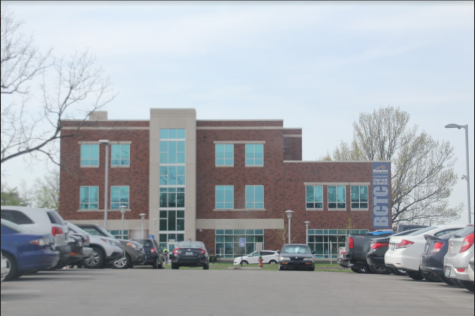
Unable to even leave our car, we settled for a picture of the campus taken through the window.

At that point, we pulled over and contacted our adviser, Mrs. Wendy Turner. She instructed us to try again and to explain that we were there as press to cover the event for our school newspaper. We at least needed to understand why we were not allowed in, and why it was never publicized as “invitation only.”

We watched as the same man waved other drivers through without stopping them, but he stopped us again. Instead of listening to our questions, he just repeated “Sorry. It’s invitation only.”

Disappointed, we called Mrs. Turner again and explained the situation. We were missing school for this event which had been reported as a “public” event on a public college campus. Unable to ask questions, we settled for a picture from our car.

It was then that our story turned from news coverage to editorial.

After leaving campus, we started looking through social media, seeking information from other journalists’ accounts, and trying to find a live stream.

We scrambled to get ourselves together because we were caught off guard, and we were in a hurry to produce anything we could to cover the event and to meet our deadline. We called our newsroom to get assistance from our other editors. Since we were out on location, we had little to work with.

After more research, we found mentioned on the government website that the meeting needed an RSVP, but there was no mention of an invitation. How do you RSVP when there is no invitation?

On the web site, it also stated that the roundtable was an “open press event.” Doesn’t open press imply open to ALL press including students?

We are student journalists who wanted to cover an event in our community featuring the Secretary of Education, but ironically, we couldn’t get in without an invitation.

The students checked and discovered that: Of the 173 school districts in Kentucky that deal directly with students, none were represented at the table. Zero. This is interesting because the supposed intention of the event was to include stakeholders–educators, students, and parents.

They didn’t understand that DeVos does not care about the educators, students or parents at public schools. She cares only about her radical agenda of charters and vouchers.

When the meeting was over, Governor Bevin said, with no hint of irony, that the discussion was all about “the children.”

But the children were not invited nor were they allowed to watch the event or even to cover it as journalists.

What hypocrites those leaders are!

How heroic the students are!

I am putting them on the blog’s honor roll, which is reserved for heroes of public education.


Governor Gina Raimondo, formerly a hedge fund manager, is unhappy with the public schools of Providence. Their test scores are low. They are definitely lower than the schools of Massachusetts.

She is thinking of a state takeover.

Whatever might she have in mind?

One assumes privatization by charter schools.

Hedge funders have a bad habit of believing that privatization fixes low test scores.

All they lack is evidence.

If they ran their hedge funds like they try to run schools, they would be bankrupt.