Archives for category: Privatization

In no particular order.

These are books I enjoyed and learned from.

Anand Giridharadas, Winners Take All: The Elite Charade of Changing the World

Rucker Johnson, Children of the Dream: Why Integration Works

Noliwe Rooks, Cutting School:  Privatization,  Segregation, and the End of Public Education
Richard Rothstein, The Color of Law: A Forgotten History of How Our Government Segregated America 
Gordon Lafer, The One Percent Solution: How Corporations Are Remaking America One State at a Time
Nancy McLean, Democracy in Chains: The Deep History of the Radical Right’s Stealth Plan for America
Daniel Koretz, The Testing Charade: Pretending to Make Schools Better
Yong Zhao, What Works May Hurt—Side Effects in Education
Pasi Sahlberg and William Doyle, Let the Children Play: How More Play Will Save Our Schools and Help Children Thrive
Eve Ewing, Ghosts in the Schoolyard: Racism and School Closings on Chicago’s South Side
Sent from my iPad


In my new book, Slaying Goliath, I focus on heroes of the Resistance. One of them is Professor Maurice Cunningham of the University of Massachusetts. He is a professor of politics and a blogger who believes in “follow the money.” His relentless pursuit of Dark Money in the Massachusetts charter referendum of 2016 (where voters overwhelmingly rejected charter expansion) led to the demise of the billionaire-funded front group called “Families for Excellent Schools.” It so happened that the “families” were billionaires who never set foot in a public school and never will.

In this post, Cunningham describes his fruitless effort to get a media outlet to acknowledge that the “parent group” it featured was Walton-funded.

Back on June 10 Masslive.com ran an editorial titled Meet the Newest Education Union: Parents which turned out not to be about education or unions at all but about the WalMart-heir front Massachusetts Parents United of Arkansas.  Helpful as always I sent an op-ed to Masslive setting the record straight but they paid no attention. Oh well. You can read the op-ed below.

It surprises me how little most media care about writing the basic facts about corporate “education reform” groups like MPU of AK, which would be non-existent without the millions of dollars poured in by the Waltons. The editorial board can take any position on issues they wish but it doesn’t excuse them from not informing their readers about who is funding and thus controlling the privatization fronts. Are they just not curious? I can’t imagine the motto “We don’t ask too many questions” would look good on the masthead. Is “follow the money” an elective in journalism school that got axed due to budget cuts?  Is it not news that state education policy is being hijacked by family of billionaires? Is it still not news that the billionaires are from Arkansas?

If you’re from western Massachusetts, ask Masslive yourself, and feel free to pass along my Letter to Massachusetts Education Reporters which has six reasons why reporters should report on who is behind front groups with tantalizing names like Massachusetts Parents United, Educators for Excellence, and Democrats for Education Reform.

Cunningham says “Dark Money never sleeps.”

Any Group funded by the Waltons or other billionaires is by definition “inauthentic.”

Cunningham hates hypocrisy.

So do I.


Checker Finn and I used to be best buddies back in the days when I was on the other side (the wrong side) of big education issues. We became friends in the early 1980s. We created something called the Educational Excellence Network, which circulated a monthly newsletter on events and issues back in the pre-Internet days. I was a member of the board of the Thomas B. Fordham Foundation, which was created and chaired by his father and led by Checker. Checker had worked for Lamar Alexander when Lamar was Governor of Tennessee, and he recommended me to Lamar when Lamar became George H.W. Bush’s Secretary of Education. I accepted the job of Assistant Secretary of Education for Research and Counselor to the Secretary, the same job Checker had held during the Reagan administration, when Bill Bennett was Secretary of Education. We both served as members of the Koret Task Force at the Hoover Institution. As a member of Checker’s board, I opposed accepting funding from the Gates Foundation, since I thought that as a think tank, we should protect our independence and we had plenty of money. I opposed TBF becoming an authorizer of charters in Ohio, where TBF was theoretically based even though its main office was in DC. I was outvoted on both issues. As a member of the Koret Task Force, I was in regular conversation and discussion with the best conservative thinkers. Over time, however, I lost the conservative faith. I changed my mind, as I described in my book, The Death and Life of the Great American School System: How Testing and Choice Are Undermining Education. 

I became and remain a deeply skeptical critic of all the grand plans to reinvent American education, especially those that emanate from billionaires and from people who are hostile to the very concept of public education.

To my surprise, I read an article recently by Checker that captured my skepticism about the Big Ideas imposed on schools and teachers. This one was called the New American Schools Development Corporation. It was spun off during the brief time that Lamar Alexander was Secretary. It was David Kearns’ pet project. David was a former CEO of Xerox who agreed to serve as Lamar’s Deputy Secretary. He was a wonderful man and I enjoyed getting to know him. He thought like a CEO and he thought that the best way to spur innovation was to hold a contest with a big prize. (Race to the Top did the same thing and flopped.)

Checker relies on the work of a wonderful scholar named Jeff Mirel of the University of Michigan. Jeff, a dear friend of mine, died earlier this year, far too young. He was a strong supporter of public schools and a first-rate historian. I miss him.

As Checker show, the NewAmerican Schools project failed. But the $50 Million that Kearns raised from private sources was eagerly snapped up.

My reaction to Checker’s article was this: Twenty or thirty years from now, someone will write a similar article about charter schools and ask, “How could people have been so dumb as to believe that you could ‘reform’ American education by letting anyone get public money to open any kind of school? Why did they think it was a good idea to let entrepreneurs and for-profit entities open schools? Why did they allow corporate chains to take over community public schools? Why did they allow religious zealots to get public money intended for public schools? They must have lost all common sense or any sense of history!”


Back in March 2019, Carol Burris and Jeff Bryant released a study of the federal Charter Schools Program on behalf of the Network for Public Education.. That study, “Asleep at the Wheel,” found that about a third of the charters that received federal grants in the $440 million program either never opened or closed soon after opening. The amount of money wasted was about $1 billion over several years. The Department of Education failed to monitor wherevthe Money was going and how it was spent.

Burris has been analyzing states that received federal charter money and has concluded that the initial estimates were understated. In the states she has reviewed, 40% of the charters were failures. Some had no name. Some were not even charters.

The extent of waste, fraud, and abuse in the federal CSP is appalling, as is the ED department’s failure to pay attention to where the money goes.

The initial impulse for the CSP, created during the Clinton administration, was to jumpstart innovation. Now, it is a slush fund for Friends of Betsy and a ready supplier of millions to big corporate charter chains like KIPP (which recently got a federal check for $86 million) and IDEA (which has collected $225 million in two years). Neither of these corporate behemoths are start-ups. Neither is needy.

Congress should eliminate the federal Charter Schools Program. It feels no need, other than greed.

Next time you meet a candidate at a town hall, ask him or her if they will pledge to eliminate this wasteful slush fund.


Louis Freedberg of EdSource explains here why California charter schools are largely unsupervised, leading to a drumbeat of scandals like the recent indictment of 11 people charged with a theft of $80 million.

He writes:

As charter school conflicts intensify in California, increasing attention is being focused not only on the schools themselves but on the school boards and other entities that grant them permission to operate in the first place.

They’re called charter authorizers, and unlike many states, California has hundreds of them: 294 local school districts, 41 county offices of education, along with the State Board of Education.

In fact, California, with over 1300 charters schools, has more authorizers than any other state. That’s not only because of California’s size but also because it has an extremely decentralized approach to charter school authorization.

Someone wishing to start a charter school, or to renew a charter, must apply to a local school district to get the green light to do so. If a petition is turned down by the district, applicants can appeal to county boards of education, and if they are denied there, they can go to the State Board of Education as a last resort.

An emerging question is whether California’s authorizers have the skills, capacity and guidance to adequately oversee the charter schools under their jurisdiction.

Under the state’s extremely lax law, a tiny rural district may authorize a charter to open for business in an urban district hundreds of miles away. The rural district collects a commission, the charter has no supervision.

A win-win for the charter and the authorizer, a lose-lose for taxpayers and students.

The California problem is not that authorizers need training, but that any district can authorize charters in other districts.

The law should be changed so that districts control whether charters open inside their boundaries. The current law encourages scavengers to prey on other districts. This must stop. Give districts control and responsibility for the schools inside their geographic area. Stop the charter vandals whose only goal is profiteering without oversight.
Beth Lewis wrote this report about the great news from Arizona, where SOS Arizona is staying strong, united, dedicated, and powerful.

SOS Arizona won NPE’s first annual Phyllis Bush Award for Grassroots Leadership, presented at the NPE conference last October in Indianapolis.

Beth Lewis writes:

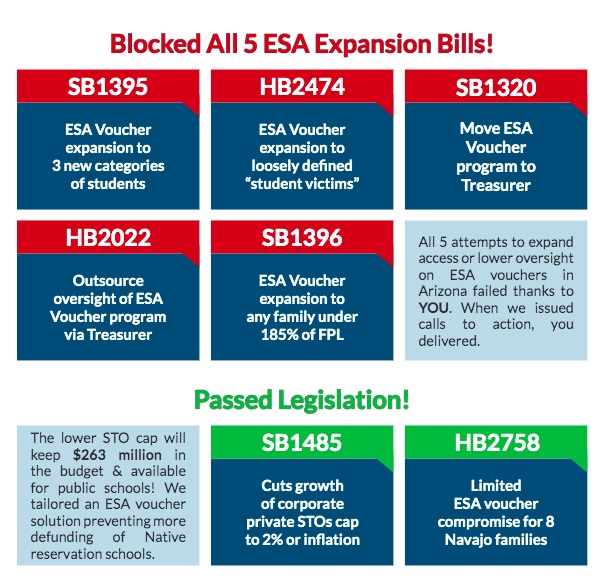
We have good news from Arizona! Coming off of their huge victory in defeating Proposition 305, which would have been the nation’s largest voucher expansion, Save Our Schools Arizona took their fight to the statehouse and won several critical battles.

The grassroots powerhouse stymied all five legislative attempts to either expand access to “Empowerment Scholarship Account” (ESA) vouchers or lower oversight of the existing program.

This marks three years in a row that the national voucher lobby has been defeated by volunteer parents, teachers and retirees in AZ. It’s thanks to mounting pressure to respect voters and fund Arizona schools, as well as wide reaching efforts to educate voters about the harms of privatization. Thousands of everyday citizens called, emailed, and met with lawmakers to make their opposition clear. In the end, the voice of the people prevailed over the various local and national special interest groups trying to push these bills. Arizona, the one-time school choice proving ground, is now demonstrating to the nation how to fight and prevail against privatizers. And that’s exactly why SOSAZ needs our support – to continue prevailing and protecting public schools. Please support their incredible work by donating at sosarizona.org/donate – they are nowhere near done fighting and need massive support to continue their work!

I receive regular updates from “In the Public Interest” and find them to be very valuable. I learn about privatization of schools, prisons, libraries, and virtually everything else that is usually considered to be public. I urge you to sign up and receive updates. Unlike my blog, their emails are typically once a week or once every two weeks, aggregating many stories from across the nation.

In the Public Interest is a national think tank that studies public goods and services and sends out a few emails that are helpful for people tracking privatization and trying to protect the common good.

  • Weekly privatization report: A scan of privatization-related news clips organized by sector (Education, Criminal Justice/Immigration, Infrastructure, etc.) sent out every Monday morning. Sign up here.
  • Our weekly newsletter: Analysis of privatization issues (like private prisons, public-private partnerships, charter schools, etc.) and stories that lift up the value and importance of the common good. You’ll learn something every time. Sign up here.
  • Cashing in on Kids: A twice-a-month scan of news clips and analysis tracking the movement to privatize public education. Sign up here.

Bill Phillis writes about Ohio’s connection to the biggest charter school heist in history (so far):


School Bus
More about the STEAM charters that have connections with the individuals indicted in California for an $80 million charter fraud
Five STEAM charters were “licensed” to operate in Ohio. Two of them, sponsored by Ohio Council of Community Schools, closed after a short period (2 years for one and 4 years for the other.)
Three STEAM charters are still in business as follows:
·       STEAM Academy of Warrensville Heights sponsored by Ohio Council of Community Schools
·       STEAM Academy of Akron sponsored by the Buckeye Community Hope Foundation
·       STEAM Academy of Warren sponsored by the Ohio Department of Education
Three of 11 individuals indicted in California for an $80 million charter fraud case have direct connections to the STEAM charter business enterprise in Ohio.
Other Ohio charter operations have been connected to charter operators indicted in other states. Several months ago some charter operators indicted for charter fraud in Florida had Ohio charter connections. The deregulated charter environment attracts people that relish the possibility of a quick buck.
The Ohio Department of Education and the two other sponsors should initiate an investigation into the operation of STEAM charters in Ohio.
William L. Phillis | Ohio Coalition for Equity & Adequacy of School Funding | 614.228.6540ohioeanda@sbcglobal.net| www.ohiocoalition.org
STAY CONNECTED:
School Bus

Haha, the charter industry keeps intoning over and over that charter schools are not public schools, but of course they are not. They are private schools that receive public funding and want more of it every year.

David Osborne, one of the loudest cheerleaders for charters, wrote in the Washington Post that charter schools are indeed private schools, and that is what makes them so fabulous.

It seems that the public sector mucks up everything, and the private sector really knows how to make things go well.

Kind of like those brilliant guys in California who figured out how to work the funding stream so they could siphon off $80 million for themselves and their allies.

And like the entrepreneurs who have figured out how to milk government funds by buying the real estate, then leasing it to their charter at exorbitant rates.

And like the legislators in Florida who direct public funding to the for-profit charters owned by their family.

It is refreshing to see a charter advocate admitting what everyone knows: charter schools are private, deregulated schools. Numerous studies have shown that they don’t get better results than public schools unless they cherrypick their students.

Now if someone can explain the rationale for government funding two sets of schools at the same time–one free to choose its students and set its own admissions rules, the other required to accept all students, including those kicked out by the private charters–then we might make sense of this mess.


One of the most valuable sites online is KnowYourCharter in Ohio.

This post lays out the waste of taxpayer dollars gobbled up by charters.

Time to close the spigot of money going down the drain in Ohio, leeched away from public schools to fatten charter operators.

Ohio has long been a hotbed of for-profit charter schools.

While Ohio requires that all charter schools be technically non-profit, Ohio law permits these schools to hire for-profit management companies that come in and, in essence, run the schooland take control of the school’s taxpayer funding.

For-profit charter school operators have been at the forefront of Ohio’s array of charter school scandals. From White Hat Management’s long history of dodging scrutiny while maintainingpolitical influencei, to Imagine Schools’ boondoggle on school rent agreementsii to the collapse ofWhite Hat’s political successor, Altair Learning Management, that ran the Electronic Classroom of Tomorrow – the epic collapse of which was widely reported last year and continues to generate headlines even today. It was recently reported that not one of the more than 4,666 students enrolled in ECOT’s final year actually attended the schooliii. Yet Ohio taxpayers paid ECOT to educate those kids for half a year.

But long overdue change is in the wind. Ohio House Speaker Larry Householder told assembledmedia shortly after he took the gavel that “I know they are technically nonprofit, but that secondtier, those management entities, I believe should be nonprofit.”1

The Know Your Charter website has updated the state data found on the website so parents, students, officials and media can compare the performance of charter schools and local public schools and districts. As part of that new data release, the Ohio Charter School Accountability Project examined how the 178 Ohio Charter Schools run by for-profit management firms2perform and spend money compared with the costs incurred by local public school districts.

The results are eye-opening.

  • Schools run by for-profit operators spend a hefty $1,167 more per pupil than school districts on non-instructional administrative costs3.
  • That’s 73 percent more money per pupil being spent by for-profit operators outside the classroom than the typical Ohio school district4.