Archives for category: Privatization

Will Pinkston, who served on the elected school board of the Metro Nashville school district, writes here that school districts should not outsource their charter application process to the charter industry’s lobbyists.

The timing is right because the Koch Network has targeted four states for unlimited charter school proliferation: Florida, Tennessee, Texas, and West Virginia.

Up until now, many school districts are using the guidelines and standards developed by the National Association of Charter School Authorizers, which wants minimal oversight of charter schools.

But NACSA, Pinkston notes, is not a neutral arbiter, but an organization dedicated to the growth and expansion of the charter industry.

Asking NACSA for advice about how to grant charters is akin to asking the Tobacco Industry Association whether cigarettes are good or bad for your health.

Many districts, Pinkston notes, are having budget problems because of the expansion of charters.

He advises:

Strengthening public school districts’ charter application reviews is a logical first step toward disrupting the school privatization movement…

Charter application review practices vary greatly between states and local school districts — and charter operators over the years have capitalized on this confusion in the field to push into existence scores of unneeded and unwanted charters.

Many districts have fallen into the trap of letting the charter sector exert undue influence on their review process. The most egregious example: For more than a decade, an innocuously named Chicago-based nonprofit organization — the National Association of Charter School Authorizers (NACSA) — has led the national charter sector’s campaign to set ground rules for how K-12 public school districts should review charter applications…

In fact, NACSA is a thinly veiled charter advocacy group largely funded by the Walton Family Foundation and the Bill & Melinda Gates Foundation — the two biggest pro-charter philanthropies in the U.S. Moreover, NACSA’s board and staff is exclusively populated with charter school advocates. According to an Internal Revenue Service filing, NACSA’s mission is simple: “Promote establishment” of charter schools.

With a multi-million-dollar annual budget, NACSA carries out its mission through a range of activities, including: Hosting conferences and workshops to train public school district employees on implementing pro-charter review standards; awarding grants to sway districts’ opinions on charters; and lobbying state policymakers to advance a pro-charter agenda in legislatures and statehouses…

The carefully branded name of NACSA’s standards assumes that charter school “authorizing” will happen. But districts’ default position should be that authorizing may happen — or not.

NACSA describes its standards as “a rich base of knowledge built on deep experience, study, deliberation, and refinement that reflects collective insights on best practices among authorizers of all types and portfolio sizes across the country.” But a closer examination reveals that NACSA’s standards are just a finely manicured PR product devised by the charter sector, for the charter sector.

Pinkston urges districts to take control of the charter authorizing process and consider such factors as:

Audits (they should be conducted by independent auditors, not self-audits);

Class size (NACSA is silent on this but district authorizers should not be);

Facilities and transportation (Districts should require charter applicants to submit detailed transportation plans that mirror best practices among districts. Moreover, districts should require charter applicants to submit robust facility plans — including the address of the proposed charter location, development or redevelopment plans, letters of commitment by funders or financial institutions, and other documentation that would be expected before any district opens a new school);

Licensed teachers (NACSA is silent, but districts should not be);

Salaries and benefits (NACSA is silent, but districts should not be).

As Pinkston says, it is up to districts to decide whether to award charters and to set conditions. They should not ask the charter lobbyists how to do it.

 

When Jan Resseger writes, she does so with authority and clarity.

In this essay, she explains why she will not vote for Michael Bloomberg, based on his record of disrespecting educators in New York City when he was mayor. Bloomberg as mayor employed all the same principles as No Child Left Behind: testing, accountability, school closings, charter schools, school choice, all based on “the business model.”

She writes:

Michael Bloomberg does have a long education record. Bloomberg served as New York City’s mayor from January of 2002 until December of 2013. In 2002, to accommodate his education agenda, Bloomberg got the state legislature to create mayoral governance of NYC’s public schools. In this role, Michael Bloomberg and his appointed schools chancellor, Joel Klein were among the fathers of what has become a national wave of corporate, accountability-based school reform. Bloomberg is a businessman, and Joel Klein was a very successful attorney. Neither had any experience as an educator. They took aggressive steps to run the NYC school district, with 1.1 million students, like a business. Their innovations included district-wide school choice, rapid expansion of charter schools, co-location of a bunch of small charter and traditional schools into what used to be comprehensive high schools, the phase out and closure of low-scoring schools, evaluation of schools by high stakes standardized test scores, the assignment of letter grades to schools based on their test scores, and a sort of merit pay bonus plan for teachers.

In her 2018 book, After the Education Wars, Andrea Gabor, the New York business journalist and journalism professor, comments on Bloomberg’s educational experiment: “The Bloomberg administration embraced the full panoply of education-reform remedies. It worshiped at the altar of standardized tests and all manner of quantitative analysis. The Bloomberg administration also had a penchant for reorganizations that seemed to create more disruption than continuous improvement among its 1.1 million students and 1,800 schools.” ( After the Education Wars, p. 75)

Gabor describes Bloomberg’s expansion of charter schools: “Harlem, in particular, has become the center of an unintentional educational experiment—one that has been replicated in neighborhoods and cities around the country.  During the Bloomberg years, when close to a quarter of students in the area were enrolled in charter schools, segregation increased, as did sizable across-the-board demographic disparities among the students who attended each type of school. An analysis of Bloomberg-era education department data revealed that public open-enrollment elementary and middle schools have double—and several have triple—the proportion of special needs kids of nearby charter schools. The children in New York’s traditional public schools are much poorer than their counterparts in charter schools. And public schools have far higher numbers of English language learners… In backing charter schools Bloomberg and other advocates pointed to one clear benefit: charters, it was widely accepted, would increase standardized test scores. However, years of studies showed little difference between the test-score performance of students in charter schools and those in public schools.” After the Education Wars, p. 95)

And there is more. Open the link and read it to understand why the “business model” did not work.

Jeff Bryant reports here about the recent strike in Oakland. Teachers won concessions from the school board but they were fighting for much more than higher pay. Like their peers in Chicago and other districts, they were striking to fend off the Modern Disruption/Corporate Reform Narrative of failing schools, closing schools, and privatization.

Even after the strike ends, the struggle continues.

He writes:

Teachers and public school advocates in Oakland and elsewhere are showing that strikes don’t end systemic forces undermining public education as much as they signal the next phase in the struggle.

When their recent strike concluded, Oakland teachers had won a salary increase and bonus, more school support staff, a pause on school closures and consolidations, and a resolution from the board president to call on the state to stop the growth of charter schools in the city.

While those were significant accomplishments, the core problem remaining is that policy leaders in the city continue to take actions that “hurt students,” Oakland Education Association president Keith Brown told me in a phone conversation.

“Students continue to experience pain and trauma in our schools due to lack of resources, over-policing, and continuing threats of school closures,” Brown said.

Despite gains from the recent strike, teachers and public education advocates have continued to show up at school board meetings to press their cause.

The coalition recently formed the group Oakland Is Not for Sale, which seeks to extend the moratorium on school closures and consolidations to summer 2022, institute financial transparency in the district, end the district’s policy of expanding charter schools, and redirect money for school police and planned construction of a probation camp for juveniles to pay for a rollout of restorative discipline practices in schools.

The board’s recent announcement to close higher-performing Kaiser Elementary and merge the students and teachers into an under-enrolled and struggling Sankofa Academy raised yet more agitation in the community, especially when news emerged that students from Kaiser would receive an “opportunity ticket” giving them priority to attend schools ahead of neighborhood students not already enrolled in those schools. In other words, the district’s rationale for merging the two campuses for the sake of fiscal efficiency was being undermined by its own proposal to make transferring to Sankofa optional and, thus—as Zach Norris, a parent leader of Kaiser parents resisting the move, told California-based news outlet EdSource—keep Sankofa under-enrolled and thereby also an eventual target for closure.


Maurice Cunningham, a political science professor at the University of Massachusetts, is a specialist in “follow the money.”

He writes in his latest post that the Waltons are targeting Elizabeth Warren not so much because of her stance on charter schools but because of her proposed wealth tax.

He writes:

If the Waltons hate anything so much as unions, it would be taxes. The family and WalMart are huge into tax dodging. And guess who has a plan for that? Elizabeth Warren. So yes the Waltons are big into charter schools but they are bigger into their own wealth. Disrupting Warren on any grounds is a good thing to them. Remember, dark money is never what it seems.

Here in Massachusetts the Waltons have their own political operation as I showed in The Walton Family’s Massachusetts Political Team, 2019.

And the beauty of these political operations the Walton Family Foundation backs in Massachusetts and around the country? They are mostly tax deductible at the top rate of thirty-seven percent. The Waltons pick up about sixty-three percent of this and you, the grateful taxpayer, pick up thirty-seven percent.

When the Waltons push charter schools, what they really mean is lower state and local taxes on Wal-Mart. When the Waltons try to shout down Elizabeth Warren, it’s about the wealth tax. The Waltons do all this with tax deductible political fronts. Taxes, taxes, taxes.

What happened in Georgia is that a taxpayer subsidized unit of the political front of one of America’s richest families attempted to shut down a political candidate. Expect more of this.

Money never sleeps. Follow the money.

At this very moment, Walmart is suing various states (even Arkansas) to lower their property taxes! That means less money available to support public schools and other public services! This is a family whose collective wealth is more than $160 billion, and they think their property taxes are too high!

Maurice Cunningham played an important role in the referendum about charter school expansion in Massachusetts in 2016 by revealing Dark Money and its sources; I write about him in my forthcoming book SLAYING GOLIATH. And the first page of the book quotes his memorable line: “Money never sleeps. Follow the money.”


Twitter lit up this morning with news of a disruption of an Elizabeth Warren rally by charter school “parents” in matching T-shirts. Hovering in the background was Howard Fuller, whose Black Alliance for Educational Options (BAEO) received millions during its lifetime of advocating for vouchers from billionaire foundations such as Bradley, Walton, and Gates.

Peter Greene has gathered the story of the funders of the “parent” disruption of the Warren rally. 

The usual billionaire-funded suspects. The disrupters came from Walton-funded organizations, representatives of DFER, and other pro-charter groups, whose purpose was to embarrass Warren for having the audacity to propose a massive increase in funding for poor kids and kids with disabilities and a cutoff of Betsy DeVos’s slush fund for corporate charters known as the federal Charter Schools Program (which currently spends $440 million annually).

He writes:

As [Ryan] Grim [of The Intercept] tweeted, “A group funded by some of the richest people in the world, the Waltons, just disrupted an @ewarren speech on the 1881 Atlanta washerwoman strike. Can’t make this stuff up.” It’s not a new game; charter advocates have often loaded up parents and students, made them some t-shirts, and deployed them as citizen lobbyists.

There’s a lot of money and power behind the charter school movement. Expect more of these shenanigans if Warren continues to lead the Democratic pack. The charter industry is not gong to let her go without a fight.


The original idea behind charter schools was that they would help the neediest, most disadvantaged students, including those who were disengaged or failing in their public schools. Some charters have been criticized for selecting the most compliant students.

One charter chain stands out for ignoring the neediest, the poorest, the most disadvantaged: Great Hearts. This charter chain was repeatedly rebuffed by the Metro Nashville school board because it insisted on locating in a neighborhood where the population was white and middle class, with no transportation for kids from out of area.

Great Hearts is proud to reach out to the advantaged students and use government money to do so. 

Unlike other charters that try to prove they are serving needy children, Great Hearts enrolls a relatively high-end demographic. In their case, cherry-picking is a feature, not a bug.

The Mind Trust is funded by billionaires to advocate for privatization of public funds and public schools.

Now it is going after parents.

Of course, the best person to make the case to parents is an education entrepreneur.

Dear Friends,

I deeply believe that those most impacted by systemic injustice are also the people who are best positioned to lead the fight to create a more just and equitable society. This is one of the many reasons why we are so excited about the work our Education Entrepreneur Fellow Ashley Virden is leading to empower Indianapolis parents to create the changes they deem necessary to dramatically improve our education system.

Read on for more about a recent event that Ashley hosted and how you can support her. You will also find information on our most recent Education Tour and a call for applications for our fourth cohort of Relay National Principals Academy Fellowships.

With gratitude,

Brandon Brown

CEO

Education Entrepreneur Fellow Ashley Virden leads parent organizing meeting

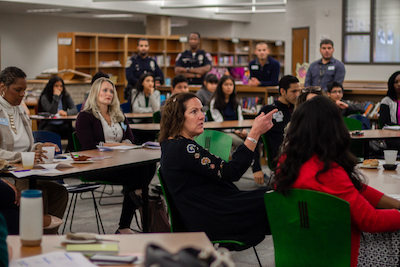
On November 7, our Education Entrepreneur Fellow Ashley Virden led a community meeting for parents looking to become more involved in their children’s education. She is developing an independent parent advocacy nonprofit that will empower parents to create necessary change for children and communities across Indianapolis.

Virden is specifically searching for a group of parents who are interested in receiving training in leadership, community organizing, and advocacy. If you or someone you know might be interested in supporting the work she is doing to uplift the voices of Indianapolis parents, please reach out to her at avirden@themindtrust.org.

“Parents deserve to have a voice in our city’s education system and in the schools our kids attend. I am excited to start building a community of empowered parents who want to be advocates for all students in Indianapolis.”

Ashley Virden, Education Entrepreneur Fellow

Education Tour series visits IPS Newcomer Program

On October 22, The Mind Trust hosted an Education Tour, formerly called Education Bus Tours, featuring IPS’ Newcomer Program. The Newcomer Program serves nearly 400 students in grades 3-9 who are new to the United States within the last year. Their students learn English alongside receiving core content instruction to prepare them for a successful transition to the school of their choice. In 2018-2019, the school served students from 33 countries, who spoke 22 different languages.

Now accepting applications for Relay’s National Principals Academy Fellowship

The Mind Trust is accepting applications for the fourth cohort of Indianapolis school leaders to participate in Relay Graduate School of Education’s National Principals Academy Fellowship, a nationally-recognized fellowship that provides school and school systems leaders with powerful instructional and cultural professional development. We are grateful to the Richard M. Fairbanks Foundation for a grant of $990,000 to help sponsor the next three cohorts fellows.

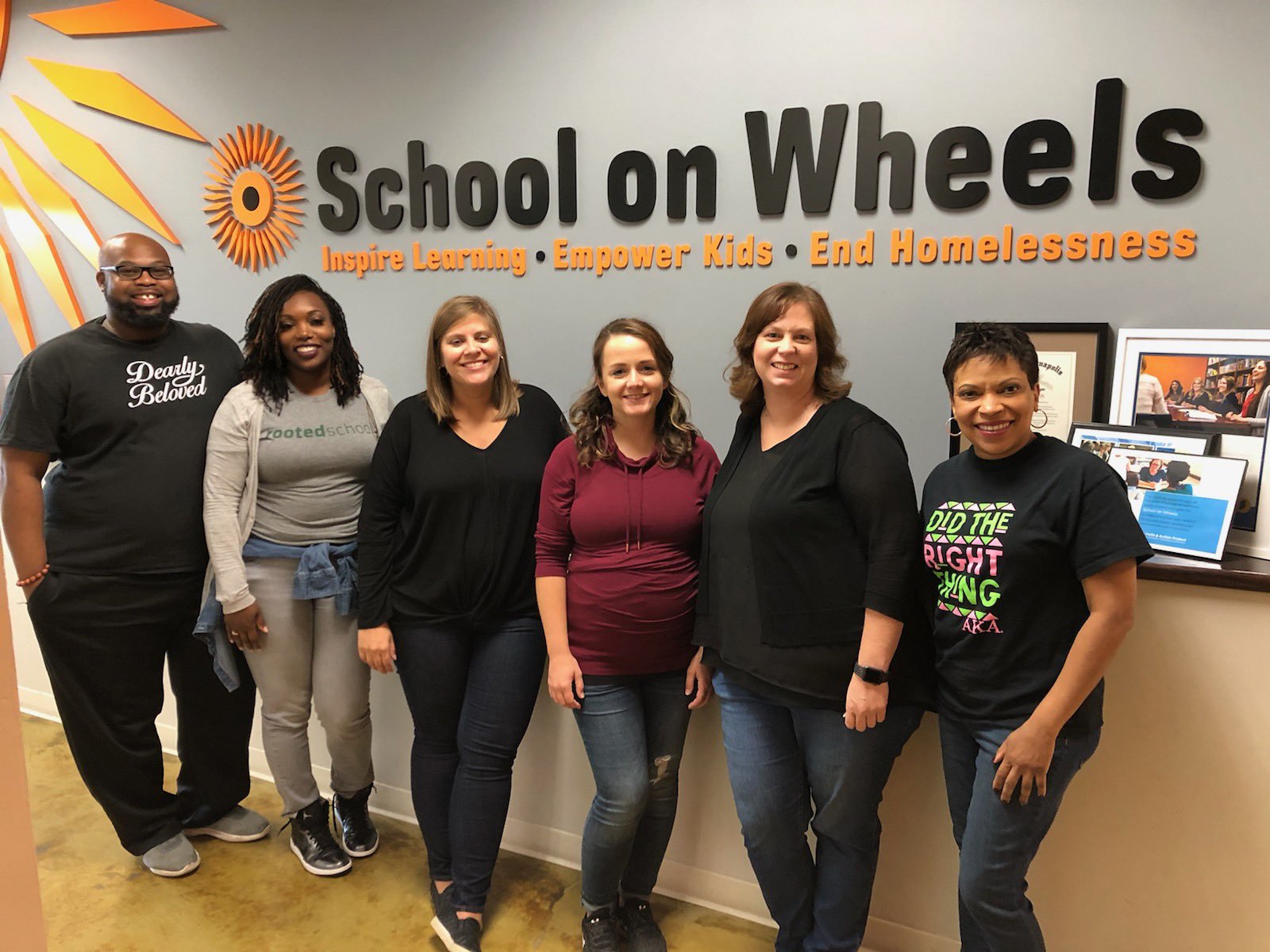
A few of our staff and Fellows volunteered at School on Wheels, filling backpacks with school supplies for students who utilize their programming. School on Wheels provides tutoring and wraparound academic support for hundreds of Indy children and families impacted by homelessness.
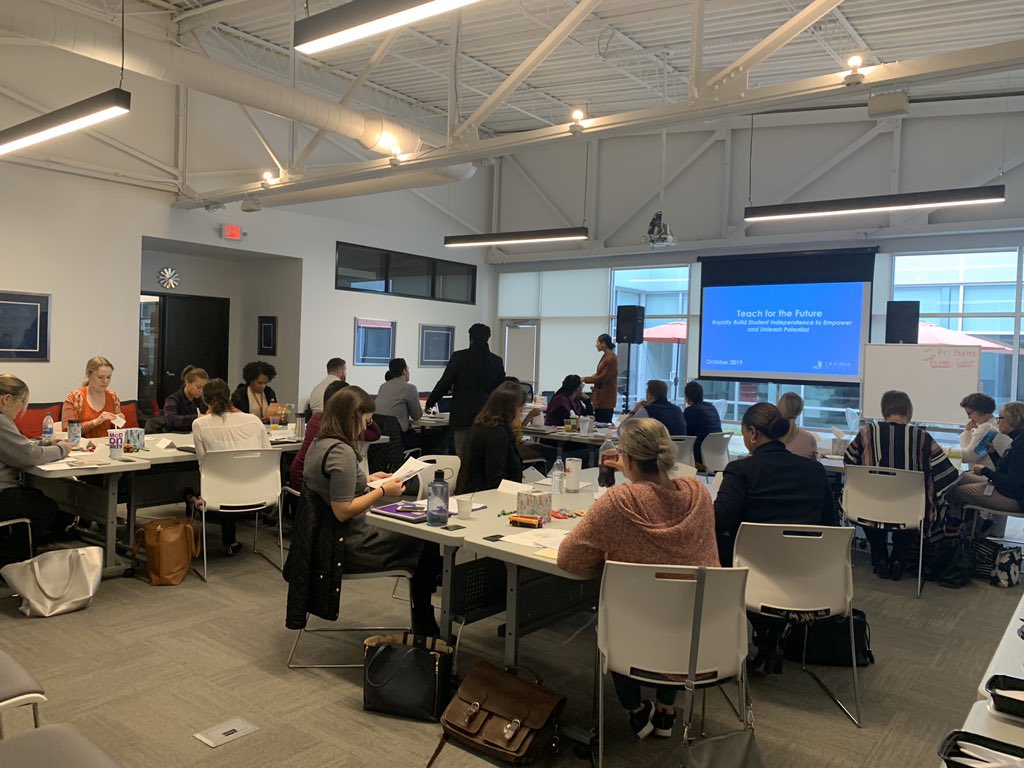
Our School Supports team partnered with the Lavinia Group to bring a literacy focused professional development to our Fellows and other Indianapolis school leaders. The training focused on building independence in reading to unleash student potential.

The Mind Trust In the News

10 new schools are seeking innovation partnership with IPS via Chalkbeat

Mind Trust Adds Lewis to Board via Inside Indiana Business

IPS Study Abroad Program To Relaunch As High School At Arlington via WFYI

New teacher residency program launches in Indy: ‘It will lead to a better retention’ via Fox 59

Church’s money management lessons lead to transformation in impoverished neighborhoodvia Faith & Leadership, Duke University

Schools were quick to downplay ILEARN results, but experts stand by the test. Here’s why.via Chalkbeat

The Mind Trust
1630 N. Meridian St., Suite 450  | Indianapolis, Indiana 46202
(317) 822-8102 | info@themindtrust.org

Follow Us on Social Media

Bill Phillis asks a reasonable question: Why should public schools in Ohio be required to take money from their budget to pay the transportation costs of charters and vouchers?


School district transportation costs increase with the expansion of vouchers and charter schools: North Olmsted Board of Education addressed the matter in a resolution
The North Olmsted Board of Education adopted a resolution on October 16 requesting the state to restrict a school district’s transportation obligation of charter and voucher students to school sites within the district.
The Ohio charter industry has successfully lobbied for increased tax funds to expand charters. The Ohio voucher lobby has gained multiplied millions for voucher expansion. Both charters and vouchers take funds, thus educational opportunities from school district students. Beyond the financial drain based on the number of students going to charter and voucher schools, districts are required to allocate more funds to transport charter and voucher students.
As state officials enact policies that extract school district funds to accommodate choice programs, they should adopt policies that compensate districts for those losses.
Educational programming in school districts should not be diminished by policies that force districts to operate costly, inefficient transportation systems.
William L. Phillis | Ohio Coalition for Equity & Adequacy of School Funding | 614.228.6540 | ohioeanda@sbcglobal.net| www.ohiocoalition.org


In this post, Jan Resseger challenges Cory Booker’s newly rediscovered support for privately managed charter schools. She says “that school choice privileges the few at the expense of the many.” That’s not quite right. If the charter school is staffed with inexperienced, under qualified teachers, if the charter is operated by grifters intent on profit, if the charter exercises harsh disciplines and has high suspension and dropout rates, if the charter lacks the financial stability to keep its doors open, then the children who enroll in them are by no means “privileged.” Instead they are marks, dupes, collateral damage.

She writes:

The essential point to remember about school choice—whether it is a system of private school tuition vouchers or privately operated but publicly funded charter schools—is that school choice privileges the few at the expense of the many.

The scale of the provision of K-12 education across our nation can best be achieved by the systemic, public provision of education. Rewarding social entrepreneurship in the startup of one charter school at a time cannot possibly serve the needs of the mass of our children and adolescents. In a new, September 2019 enrollment summary, the National Center for Education Statistics reports: “Between around 2000 and 2016, traditional public school… enrollment increased to 47.3 million (1 percent increase), charter school enrollment grew to 3.0 million students (from 0.4 million), and the number of homeschooled students nearly doubled to 1.7 million. Private school enrollment fell 4 percent, to 5.8 million students.”

Booker argues for well-regulated and high-performing charter schools. The problem he fails to acknowledge is that charter schools were established beginning in the mid-1990s by state legislatures smitten with the idea of innovation and experimentation. None of these legislatures, to my knowledge, provided adequate oversight of the academic quality of the schools, and none imposed protections to guarantee the stewardship of public tax dollars.  Malfeasance, corruption, and poor performance plague charter schools across the states. Charter schools have now been established by state law across 45 states where stories of outrageous fiscal and academic scandals fill local newspapers. The Network for Public Education tracks the myriad examples of outrageous fraud and mismanagement by charter schools. Because advocates for school privatization and the entrepreneurs in the for-profit charter management companies regularly donate generously to the political coffers of state legislators—the very people responsible for passing laws to regulate this out-of-control sector—adequate oversight has proven impossible.


In her latest post, Nancy Bailey draws a contrast between a summit of fake education leaders and the summit that actual teachers reach when they teach their students and fight for their students and their schools.

Bailey describes the pseudo summit taking place in San Diego, where people who have never taught discuss how to reinvent education for fun and profit.

Read her list at the end of her post. It is a who’s who of the Disruption Industry, assembled in one place to celebrate themselves and the damage they have done to schools, students, and teachers across the nation.


Bailey writes:

Today’s National Summit On Education Reform meeting is a nightmare for teachers and parents. It involves those who want to replace democratic public schools with technology, ending schools and teaching as we know it. They will have children sitting in front of screens for instruction in warehouse charters, or at home all day.

Most of these self-acclaimed experts have not struggled to teach in gritty, overcrowded classes. They have not wiped runny noses or dealt with the trauma that some children bring to school. They never had to work towards unproven curriculum standards through Common Core. Nor have they had to face the reforms that, ironically, they and their ilk created.

They blame teachers for what goes wrong in schools due to their own back ass policies, but they’ll step up and take credit for anything that goes right!

You won’t find them on the streets of their cities fighting for the needs of children and a profession that nurtures those children. These individuals are above all that.

Florida Governor Jeb Bush leads the summit. As an American citizen Bush has every right to speak out about schools, but he doesn’t have the right to own them. Bush, whose educational background is in real estate and Latin studies, has leveled accusations against schools without doing due diligence to help students. His 3rd grade retention plan is a failed idea, but no one seems to have the power to end it, so children still are hurt by it.

Bush has been against schools and teachers every step of the way. When he had the chance to improve class sizes in the 90s, he hated the idea so much he was caught saying he had a “devious plan to end it.” Think what it would have meant if he’d studied the issue and been supportive of teachers, even negotiated.

What if he’d said, we can’t afford to lower all classes, so let’s lower class size in K-3rd grade when children are learning to read. But Bush didn’t want that. Look at life in Florida and the country now, a mix of underfunded public schools and unproven charters, and vouchers to questionable schools.

Please open the link and read it to the end.