Archives for category: Privatization

Amy Goodman, host of “Democracy Now,” interviews Carol Burris, Keron Blair, and Jitu Brown about the Public Education Forum and the fight for equity and justice.

We are educating the public about the importance of changing the status quo.

Ahead of the last Democratic presidential debate of the year this Thursday, seven candidates appeared Saturday at the historic Democratic Presidential Forum on Public Education in Pittsburgh, an event organized by public education organizations, unions, civil rights organizations and community groups. We play highlights from the forum and get response from Keron Blair, director of the Alliance to Reclaim Our Schools in Atlanta; Jitu Brown, national director of the Journey for Justice Alliance; and Carol Burris, executive director of the Network for Public Education Action. She recently authored a report titled “Still Asleep at the Wheel: How the Federal Charter Schools Program Results in a Pileup of Fraud and Waste.”

Peter Greene writes here about the budget approved by Congress for the Department of Education.

There is good news and bad news. Peter Greene thinks it’s mostly good news. I’d say there is both.

Congress did not appropriate a penny for Betsy DeVos’s top priority, her $5 billion request for vouchers (aka “education freedom scholarships”). Sorry, Betsy, nada. Even Republican Congressmen and Senators represent public school parents.

But Congress appropriated $440 million for Betsy’s charter school slush fund, otherwise known as the federal Charter Schools Program. The CSP is a swamp of fraud, waste, and abuse, as the Network for Public Education demonstrated in its “Asleep at the Wheel” and “Still Asleep at the Wheel” reports, which showed that more than $1 billion in federal funds were wasted on charters that either never opened or closed not long after opening. The House (controlled by Democrats) wanted to cut CSP to $400 million (which is $400 million too much), but the Senate (controlled by Republicans) negotiated it back to level funding. The CSP was created by the Clinton administration in 1994 to help start-ups, mom-and-pop or teacher-led charters that needed some extra funding. Betsy has turned it into a big fat plum for corporate charter chains like KIPP and IDEA, which are not start-ups and which are already richly endowed with funding from billionaires, most of them right-wingers. At present, the federal government is the single biggest funded of charter schools in the nation, even in states that don’t want them or need them, like New Hampshire, where Betsy gave the state $46 million to double the number of charters, but the state legislative fiscal commission rejected the money. Congress showed its lack of concern for accountability; that’s for the little people.

Peter Greene writes:

Trump asked for a 10% cut to the department and the elimination of twenty-nine programs. That didn’t happen (though it’s worth noting that many Trump appointees like DeVos have figured out that you can cut spending in your department by simply letting positions stand empty).

There is more money for Title I. It’s about a 3% increase, while Democratic candidates are calling for increases of 200% to 300%.

The Charter Schools Program– the fund that has wasted a billion dollars on charter school waste and fraud– will stay art current levels, with neither the boost the GOP wanted nor the cut that Democrats called for.

And special ed funding will once again not be increased to its full, required level. This makes forever years for Congress to stiff the states on the granddaddy of all unfunded mandates. Thanks a lot, Congress.

Thomas Ultican, the chronicler of the Destroy Public Education movement, writes here about the calculated destruction of the Oakland Public School District, which has suffered at the hands and by the wallets of billionaires.

In 2003, the district had a deficit of $37 million.

The state forced the district to take out a loan of $100 million.

In return, the state took control of the district.

After six years of state control, the district’s deficit increased from $37 million to $89 million.

Unfortunately for Oakland, the billionaire Eli Broad decided to turn the district into his petri dish.

Oakland Mayor Jerry Brown welcomed the state takeover.

The Broadies romped.

A California central coast politician named Jack O’Connell was elected California’s Superintendent of Public Instruction in 2002. He selected Randolph Ward, a Broad Academy graduate, to be Oakland’s state administrator. When O’Connell ran for state superintendent, his largest campaign donors had been Netflix CEO Reed Hastings ($250,000), venture capitalist John Doerr ($205,000), and Eli Broad ($100,000). Brown described the state takeover as a “total win” for Oakland.

The Broadies of Oakland

2003-2017 Broad Academy Graduates and Superintendents of OUSD

Broad Academy graduates are often disparagingly called Broadies.

The OUSD information officer in 2003 was Ken Epstein. He recounts a little of what it was like when Ward became the administrator:

“I remember a school board meeting where Ward and the board were on stage. Each item on the agenda was read aloud, and Ward would say, “passed.” Then the next item was read. In less than an hour, the agenda was completed. At that point, Ward said, “Meeting adjourned” and walked out of the board room and turned out the lights, leaving board members sitting in the dark.”

When Ward arrived in Oakland, the district was in the midst of implementing the Bill Gates sponsored small school initiative which is still causing problems. The recently closed Roots that caused so much discontent in January was one of the Gates small schools. Ward opened 24 of them (250-500 students) which in practice meant taking an existing facility and dividing it into two to five schools. He closed fourteen regularly sized schools.

When Ward arrived in Oakland there were 15 charter schools and when he left for San Diego three years later there were 28 charter schools…

Kimberly Statham, who was a classmate of Ward’s at the Broad Academy, took his place in 2006. The following year a third Broad Graduate, Vincent Mathews took her place.

After a short period of no Broadie in the superintendent’s seat, Antwan Wilson was hired in 2014. Shortly after that, the New York Times reported that the Broad Foundation had granted the district $6 million for staff development and other programs over the last decade. The Broad Center also subsidized the salaries of at least 10 ex-business managers who moved into administrative jobs at the district office.

Kyla Johnson-Trammell, an Oakland resident who and educator with OUSD, was named to replace Antwan Wilson in 2017. When he left to lead the Washington DC’s schools, he left a mess in Oakland. Mother Jones magazine says Wilson saddled the district with a $30 million deficit. They continue, “A state financial risk report from August 2017 concluded that Oakland Unified, under Wilson, had ‘lost control of its spending, allowing school sites and departments to ignore and override board policies by spending beyond their budgets.”’

The preponderance of the problems in OUSD are related to the state takeover, FCMAT and the leadership provided by Broad Academy graduates.

The usual billionaires have selected several of the OUSD board members and showered them with donations from out-of-district and out-of-state.

The fundamental problem is Oakland has a dual education system with 37,000 students in public schools and 15,000 in charter schools. It costs more to operate two systems. Every school district in California that has more than 10% of their students in charter schools has severe financial problems. Oakland has the largest percentage of charter school students in the state with 29% so financial issues are the expectation.

This is an education crisis that was manufactured by the super wealthy and implemented by neoliberal politicians.


The New York Times reports that the Sackler family, one of the nation’s wealthiest families, busily transferred assets to themselves as the opioid crisis worsened

The Sacklers derived most of their billions from Purdue Pharma, prominent manufacturer and marketer of Oxycontin.

Jonathan Sackler is a major supporter of charter schools. He underwrote charter schools in Connecticut, created ConnCAN, then 50CAN, and the many state affiliates of that group. At this very moment, GeorgiaCAN is pushing charters on the receptive Atlanta school board (whose president is ex-TFA).

The Times reports:

As scrutiny of Purdue Pharma’s role in the opioid epidemic intensified during the past dozen years, its owners, members of the Sackler family, withdrew more than $10 billion from the company, distributing it among trusts and overseas holding companies, according to a new audit commissioned by Purdue.

The amount is more than eight times what the family took out of the company in the 13 years after OxyContin, its signature product, was approved in 1995. The audit is likely to renew questions about how much the Sacklers should pay to resolve more than 2,800 lawsuits that seek to hold Purdue accountable for the opioid crisis.

The family has offered to contribute at least $3 billion in cash as part of a settlement to resolve thousands of lawsuits brought by state and local governments against Purdue. But 24 states, led by Massachusetts and New York, have refused to sign onto the agreement, arguing that the Sacklers should pay more.

The new report, a 350-page forensic accounting prepared by Alix Partners, a consulting firm that Purdue has hired to help guide the company through Chapter 11 restructuring, was filed in bankruptcy court in White Plains, N.Y., Monday evening.

Sarah Darer Littman wrote about Jonathan Sackler’s long involvement in the charter school movement.

She says he brought his knowledge of marketing opioids to the charter school industry.

He is on the Board of Directors of the Achievement First charter school network. Until recently, Sackler served on the board of the New Schools Venture Fund, which invests in charter schools and advocates for their expansion. He was also on the board of the pro-charter advocacy group Students for Education Reform.

Through his personal charity, the Bouncer Foundation, Sackler donates to the abovementioned organizations, and an ecosystem of other charter school promoting entities, such as Families for Excellent Schools ($1,083,333 in 2014, $300,000 in 2015according to the Foundation’s Form 990s) Northeast Charter School Network ($150,000 per year in 2013, 2014 and 2015) and $275,000 to Education Reform Now (2015) and $200,000 (2015) to the Partnership for Educational Justice, the group founded by Campbell Brown which uses “impact litigation” to go after teacher tenure laws. Earlier this year, the Partnership for Educational Justice joined 50CAN, which Sackler also funds ($300,000 in 2014 and 2015), giving him a leadership role in the controversial—and so far failing cause—of weakening worker protections for teachers via the courts.

Just as Arthur Sackler founded the weekly Medical Tribune, to promote Purdue products to the medical professional who would prescribe them, Jon Sackler helps to fund the74million.org, the “nonpartisan” education news website founded by Campbell Brown. The site, which received startup funding from Betsy DeVos, decries the fact that “the education debate is dominated by misinformation and political spin,” yet is uniformly upbeat about charter schools while remarkably devoid of anything positive to say about district schools or teachers unions.

Charter chains are known for their lavish rallies, paid organizers, and “swag.”

These are techniques learned from the Sacklers and Purdue, writes Littman.

The description of “lavish swag” will sound familiar to anyone who has witnessed one of the no-expenses-spared charter school rallies that are a specialty of Sackler-funded organizations like Families for Excellent schools. Then there is the dizzying array of astroturf front groups all created for the purpose of demanding more charter schools. Just in Connecticut, we’ve had the Coalition for Every Child, A Better Connecticut, Fight for Fairness CT, Excel Bridgeport, and the Real Reform Now Network. All of these groups ostensibly claim to be fighting for better public schools for all children. In reality, they have been lobbying to promote charter schools, often running afoul of ethics laws in the process.

Take Families for Excellent Schools, a “grassroots” group that claims to be about parent engagement, yet was founded by major Wall Street players. In Connecticut, the group failed to register its Coalition for Every Child as a lobbying entity and report a multimillion-dollar ad buy expenditure and the costs of a rally in New Haven. 

In Massachusetts, Families for Excellent Schools-Advocacy (FESA) recently had to cough up more than $425,000 to the Massachusetts general fund as part of a legal settlement with the Office of Campaign and Political Finance, the largest civil forfeiture in the agency’s 44-year history. Massachusetts officials concluded that FESA violated the campaign finance law by receiving contributions from individuals and then contributing those funds to the Great Schools Massachusetts Ballot Question Committee, which sought to lift the cap on the number of charter schools in the state, in a manner intended to disguise the true source of the money. As part of the settlement, the group was ordered to reveal the names of its secret donors. Jonathan Sackler was one of them.

In addition, Purdue heiress Madeleine Sackler directed the pro-charter film “The Lottery” about Eva Moskowitz and her Success Academy charter chain.

The Sacklers have used their vast wealth, derived from the opioid crisis, to burnish their family reputation and to destroy public schools.

As the Times reports, they are doing their best to get their money out of the company before it is bankrupted by lawsuits.



Indiana is a swamp of school choice corruption.

If you read this post, your hair might catch on fire if  you are sensitive to things like ethics, honesty, and responsible stewardship of public money.

Seven years ago, the state superintendent of Indiana was a school choice firebrand named Tony Bennett. There was nothing he wouldn’t do to transfer public money from public schools to charter operators or religious schools. He was briefly riding high–the Thomas B. Fordham Institute named him the “reformiest of all reformers.” But then he came a cropper. An AP reporter unearthed the fact that he raised the grade of a charter school owned by one of his campaign donors. That was too much, even for the corrupt swamp overseen by Indiana Republicans. Bennett was defeated when he ran for re-election.  Bennett promptly became State Commissioner of Florida. That gig lasted only weeks, and he had to resign because of the ethics problem he left behind in Indiana.

One of his decisions during his tenure in Indiana was to hand over three low-performing schools in Indianapolis to the for-profit chain called Charter Schools USA, which is owned by a pal of Jeb Bush. The chain was supposed to “turn” those schools around.

As Indiana blogger Steve Hinnefeld writes, the schools continued to struggle. An extraordinary number of their students decided to homeschool, which boosted the graduation rate of the schools.

Lewis Ferebee, then the superintendent of Indianapolis, now the superintendent in D.C., was happy to work with Charter Schools USA.

Hinnefeld writes:

Charter Schools USA is a for-profit Florida company that operates over 80 schools in six states, according to its website. Its founder and long-time CEO, Jonathan Hage, has played influential roles in Florida Republican politics, including serving on Gov. Ron DeSantis’ education transition team.

Sherry Hage, who is married to Jonathan Hage, is founder and CEO of Noble Education Initiative, the nonprofit that would operate the three Indianapolis schools under a charter issued to ReThink Forward Indiana. There’s also ReThink Forward, a CSUSA arm that’s active in Tennessee; its vice chair is Tony Bennett, the former Indiana superintendent of public instruction.

Noble Education Initiative’s director of educational development and partnerships, Byron Ernest, is on the Indiana State Board of Education. Ernest worked for CSUSA as principal of Emmerich Manual for two years after the state took it over. (He has recused himself from state board decisions about CSUSA).

‘Turnaround academies’

Schools taken over by the state and turned over to managers like CSUSA are called turnaround academies. But they haven’t turned around quickly. T.C. Howe earned six more consecutive F’s under Indiana’s grading system after being taken over. Emma Donnan earned five F’s, then a C.

That’s despite approximately $22.3 million in federal School Improvement Grants that the State Board of Education has awarded to CSUSA for the schools. In recent years, the board has rejected recommendations from the Indiana Department of Education and its leader, Superintendent of Public Instruction Jennifer McCormick, to give a bigger share to district-run public schools that were struggling.

Charter Schools USA asked the Indiana charter board to turn the three Indianapolis schools into charters that it could add to its chain.

Shockingly, the charter board voted 4-3 NOT to give the schools to Charter Schools USA. 

As Chalkbeat reports,

Indiana Charter School Board denied charters Friday for three Indianapolis turnaround schools — a stunning move that could spell the end to the Florida-based Charter Schools USA’s operations in Indianapolis.

As a result, the three Indianapolis schools — Howe High School, Manual High School, and Emma Donnan Middle School — face the prospect of another rocky transition to new management, or even possible closure.

But the board’s 4-3 votes against the charters, which elicited gasps from the audience, marked a major victory for Indianapolis Public Schools, which could win back the three schools that have been under state takeover since 2011. (Two members of the charter board were not present for the vote.)

IPS could reclaim the three schools or close them.

But Charter Schools USA, despite its money and political influence, lost three juicy plums.

(Hint: the state schools’ chief Jennifer McCormick is secretly a friend to genuine public schools. Don’t tell the governor or the legislature.)


Every blogger who has written about MSNBC’s Public Education Forum expressed gratitude that a big cable network paid attention to our most important democratic institution.

Nancy Bailey is angry about the issues that were ignored, the ones that threaten the future of students, teachers, and public education.

She is also streamed that the program was not on live TV. Public education not important enough for live TV? 50 million children are in public schools. They have parents. Quite an audience to overlook.

Good work, Nancy!

She writes (in part, read it all):

Candidates talked about making the wealthy pay their fair share of taxes to help schools, but no one mentioned Bill Gates, the Waltons, Eli Broad, Mark Zuckerberg or any of the corporate reformers who are taking control of public schools.

They didn’t mention Common Core or the failure of the initiatives funded by the Gates Foundation and taxpayers. Nor did they speak about portfolio schools, the latest corporate endeavor to push choice and charters.

No one mentioned using Social Impact Bonds or Pay for Success to profit off of public schools. See: “Wall Street’s new way of making money from public education — and why it’s a problem” by Valerie Strauss.

CEO Tom Steyer mentioned corporate influence towards the end, but it was brief, and no moderator attempted to explore what he said.

Ed-Tech

No one mentioned what might be the biggest threat to public education, the replacement of teachers and brick-and-mortar schools with technology.

Disruption was initially described by Clayton Christensen and Michael Horn in their book Disrupting Class: How Disruptive Innovation Will Change the Way the World Learns. This is seen as the revolution by those in business and the tech industry and is being played out in online charter schools like Summit and Rocketship. Summit also has an online virtual school.

Many students across the country get school vouchers to be used for substandard online instruction like K12 and Connections Academy.Preschoolers are subjected to unproven Waterford UPSTART.

The candidates might want to review Tultican’s “Ed Tech About Profits NOT Education.”

Wrench in the Gears is another blog good at describing the threat of technology.

Teach for America

Teach for America corps members with little training have taken over classrooms, and they run state departments of education!

Do Democratic candidates have Teach for America corps members as consultants on their campaigns? It’s troubling if they do. They should not be wooing teachers with professional degrees and experience while relying on TFA behind the scenes.

Other insidious reform groups are also about replacing education professionals. Relay Graduate School, The New Teacher Project, New Leaders are a few.

This needs to be addressed, sooner, not later.

Betsy DeVos et al.

I don’t know anyone who doesn’t enjoy hearing Democratic candidates say they’re going to boot Education Secretary Betsy DeVos out.

But President Obama had individuals from the Bill & Melinda Gates Foundation, and other corporate reform groups, working in the U.S. Department of Education. Arne Duncan was no friend to teachers or public schools.

So, while applause against DeVos are justifiable, now’s the time to address the role Democrats have played (and continue to play) in corporate school reform.

The fact is, many groups and individuals are working to end public education, who wear Democratic name tags. It’s imperative that Democratic candidates address this.


Jan Resseger shares her reactions to the Public Education Forum. She was heartened by what she saw and heard, as candidates recognized the need to increase investment in education. 

She invites you to watch the video if you missed the event.

IT WON’T BE OFFICIALLY PUBLISHED UNTIL JANUARY 21, BUT YOU CAN PRE-ORDER YOUR COPY FROM YOUR BOOKSELLER OR AN ONLINE BOOK DEALER (PLEASE PATRONIZE INDEPENDENT BOOKSTORES, IF YOU STILL HAVE ONE NEAR YOU!).

I PROMISE YOU WON’T BE DISAPPOINTED!

IF YOU COME TO THE ANNUAL MEETING OF THE NETWORK FOR PUBLIC EDUCATION IN PHILADELPHIA MARCH 28-29, I WILL PERSONALLY INSCRIBE YOUR COPY OF THE BOOK!


EDUCATION

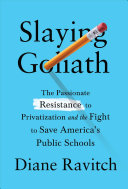
Slaying Goliath: The Passionate Resistance to Privatization and the Fight To Save America’s Public Schools

Knopf. Jan. 2020. 352p. ISBN 9780525655374. $27.95. ED
COPY ISBN

In this incisive, meticulously researched book, Ravitch (education, New York Univ.; The Death and Life of the Great American School) argues persuasively that the U.S. school privatization movement has resulted in poor test scores, the closure of public schools, and attacks on the teaching profession. Ravitch blames the so-called school reformers, whom she renames the disruptors, such as Bill Gates, Alice Walton, Michelle Rhee, Mark Zuckerberg, and Eli Broad, who spend millions to replace public schools with charter schools and private institutions that are run like businesses. Though disruptors view themselves as opposing the status quo, Ravitch contends that they are doing everything they can to maintain it. She devotes most of her book to the resisters, or the teachers, parents, and union leaders who have taken on the disruptors and are working to keep their local public schools open. Through this lens, Ravitch discusses the Common Core teaching standards, standardized testing, the Obama administration’s Race to the Top grant program, and Teach for America.

VERDICT This extensive analysis is required reading for anyone concerned about American education. [See Prepub Alert, 7/8/19.]

Charter enrollment declined in Utah for the first time in at least a decade, and no new charters opened.

Enrollment at Utah’s charter schools — which have seen explosive growth in the past as they’ve attempted to be “education’s disruptors” — declined this year for the first time in at least a decade.

The dip is largely unexpected but follows a particularly chaotic year for charters in the state. One was forced to close with millions in debts owed to overseas investors. Another filed for bankruptcy. A third was ordered to shut down after less than two years in operation…

In addition to some schools closing, no new charters opened this fall — which is also a first in the state for at least a decade, Peterson added, and likely contributed to the enrollment decline. Two or three were slated to enroll students in August but pushed back their starting dates over lease, land and building issues.

Royce Van Tassell, executive director of the Utah Association of Public Charter Schools, said the price of land has gone up in Utah and has put new charters in a challenging spot…

Van Tassell also pointed to the closure of the American International School of Utah, or AISU, for the dip. The Murray charter shut its doors in August in the face of mounting debts. The school owed the state and federal government nearly half a million dollars in misspent funds, according to an audit of its books.It also still faces potentially millions of dollars in other unspecified debt, according to its former spokesman, most of which was spent overseas. It’s likely that will never be repaid.

I was glad to see the reporter refer to charters as”disrupters,” which they are, and not as “reform,” which they are not.

Peter Greene writes here about Erica Green’s excellent coverage of Betsy DeVos’s testimony to Congress about student debt. 

He says you have to pay close attention to her words to understand that she is not greedy, she is not dumb;  she knows exactly what she is doing.

He writes:

“Here’s an absolutely DeVosian quote from the proceedings:

“I understand that some of you here just want to have blanket forgiveness for anyone who raises their hand and files a claim, but that simply is not right.

Ah yes– the smirk.

“This is DeVos– she knows what’s right, and she’s going to stand up for it. And’s what is right is that Those People shouldn’t be able to get away with not paying their debts. Those People should not be allowed to stiff their Betters. Because you know that Those People are probably lying about how badly they were hurt, anyway, because Those People are always trying to get things they don’t deserve. This “anyone who raises their hand and files a claim” characterization that DeVos has been using is such a flip way to dismiss the damage done by for-profit collges, an d here it matters what DeVos doesn’t say– she doesn’t say that there are people out there who played by the rules, tried to bootstrap themselves to a better life through education, and got fleeced, and we should provide those people some real relief. She has never seriously acknowledged that harm.

“But that takes us to the other DeVosian value that’s on display here.

“Ms. DeVos maintained that it was “probably the case” that Corinthian Colleges deceived students, but she also said she believed that the “prior administration basically forced schools like Corinthian out of business” with onerous financial restrictions. She rebuffed questions about an investigation by career staff, unveiled in January 2017 memos published by NPR on Wednesday, that concluded that Corinthian students deserved full loan forgiveness because they received no educational benefit.

“Businesses fleecing customers is not outrageous. What’s outrageous is government interfering with the operations and practices of businesses. There is an extra layer of irony here– the Obama administration actually was pretty damn slow to take any useful action against Corinthian, and even helped bail them out for a time, and any good Obama-bashing Trumpian might hammer that point home, but DeVos can’t see that because for her there is no greater sin than interfering with the operation of a business.

”She’s made variations of that point again and again, all the way back to the confirmation hearing when she couldn’t imagine any misbehavior that would prompt her, as a government official, to step in and say “Stop!” Businesses matter more than people.”