Archives for category: Poverty

Nancy E. Bailey writes here about the corporate reformers’ love for the term “Dropout Factories” to refer to public schools, especially those in impoverished communities.

She says the term is used to disparage public schools and their teachers. It received wide recognition when it was featured in the abominable pro-privatization film “Waiting for Superman.”

Bailey offers a list of research-based strategies for improving struggling schools, which are almost invariably schools with high proportions of students who live in poverty.

She notes that the originator of the term Robert Balfanz of Johns Hopkins has close ties to the reformer industry.

A valuable and informative post.

P.S. Nancy Bailey and I are updating the Edspeak glossary and thank readers for their many wonderful suggestions. “Dropout Factories” will definitely be an addition!

This article was written by An Garagiola-Bernier and published in the Washington Post.

She had a difficult life, growing up in a low-income home, dropping out of high school to help pay expenses, then suffering a debilitating disease that made it impossible to work and required multiple surgeries. She relied on charity to get by, but eventually enrolled in a community college. She made it to Hamline University, where she has a scholarship awarded by the John Kent Cooke Foundation. But she could not have made it to where she is today without the help of multiple federal assistance programs for low-income students like her. Those programs are now jeopardized by the proposed budget cuts.

She writes:

President Trump and Education Secretary Betsy DeVos never had to worry about the cost of a college education for themselves or their children. They never had to skip meals because they couldn’t afford to buy food. They never feared becoming homeless because they couldn’t afford a place to live.

Unfortunately, I — like millions of other low-income people — have had these worries. Not because we are lazy, ignored our school work or are not very bright. We simply didn’t have the good fortune of Trump and DeVos to be born into wealthy families. Many of us have had other bad breaks as well.

In my own case, I dropped out of high school to work at a low-wage job to help my mother pay mounting bills. Later, I was stricken with a disease called Ehlers-Danlos Syndrome that made it impossible for me to work for seven years and required me to undergo 12 surgeries, leaving me and my husband struggling to get by with our three children. I turned to a charity to pay my enormous medical bills. Disabled, with little education, my employment opportunities were dismal.

Fortunately, I found my way to community college and then transferred to Hamline University in St. Paul, Minn., where I am now a student. My life was transformed when I received a Jack Kent Cooke Foundation Undergraduate Transfer Scholarship that provides me with up to $40,000 a year for my education at Hamline. But most low-income students aren’t as lucky.

I resumed my education after many years out of school because, like the vast majority of low-income students, I want to make something of myself, get a good job and leave poverty behind. I am told the best way to do this is to get an education beyond high school.

But instead of helping us to further our educations, President Trump recently proposed his “America First” budget that calls for a 13 percent cut in the Education Department budget, amounting to $9 billion.

In higher education, Trump has proposed taking $3.9 billion in surplus funds from Pell Grants for low-income students to use for other parts of government; $200 million in cuts to other programs that help low-income students pay for and succeed in college; cuts to the Federal Work-Study program that pays students to hold part-time jobs; and elimination of the Supplemental Education Opportunity Grants for low-income students.

Two particularly effective programs that prepare low-income students for college and help them graduate would be hit hard — one called GEAR-UP (the acronym stands for Gaining Early Awareness and Readiness for Undergraduate Programs) would be eliminated, and a group of programs called TRIO would be cut. TRIO got its name from three initiatives that date to the 1960s.

How can Trump “make America great again” by denying access to higher education to those students who are low-income?

How is he “putting America first” if he closes the doors of opportunity to those who were not born rich like him?

Jeff Bryant spells out the Big Lie embedded in Trump’s budget proposal for education. He plans to cut programs that directly aid poor kids while bolstering charters and vouchers, pretending they are equivalent. They are not. Yet much of the mainstream media has fallen for the Trump-DeVos bait-and-switch.

“Public school supporters are angry at President Trump’s budget proposal, which plans to cut funding to the Department of Education by 13 percent – taking that department’s outlay down to the level it was ten years ago. But the target for their anger should not be just the extent of the cuts but also how the cuts are being pitched to the public.

“Trump’s education budget cuts are aimed principally at federal programs that serve poor kids, especially their access to afterschool programs and high-quality teachers.

“At the same time, Trump’s spending blueprint calls for pouring $1.4 billion into school choice policies including a $168 million increase for charter schools, $250 million for a new school choice program focused on private schools, and a $1 billion increase for parents to send their kids to private schools at taxpayer expense.

“The way the Trump administration is spinning this combination of funding cuts and increases – and the way nearly every news outlet is reporting them – is that there is some sort of strategically important balance between funding programs for poor kids versus “school choice” schemes, as if the two are equivalents and just different means to the same ends. Nothing could be further from the truth….

“The message being spun out of Trump’s education budget is that it takes money away from those awful “adult interests” – like, you know, teachers to actually teach the students and buildings so students have somewhere to go after school to play sports, get tutored, or engage in music and art projects – in order to steer money to “the kids” who will get a meager sum of money to search for learning opportunities in an education system that is increasingly bereft of teachers and buildings.

“Even competent education reporters are falling for this spin, writing that education policy is experiencing a “sea change in focus from fixing the failing schools to helping the students in the failing schools.”

“However, there’s evidence that federally funded efforts like afterschool programs and class size reduction tend to lead to better academic results for low-income children, while the case for using school choice programs to address the education needs of poor kids is pretty weak.

“The Weak Case For Choice

“School voucher programs, like the ones Trump and DeVos seem intent on funding, are particularly ineffective ways to address the education problems of poor kids. Indeed, these programs seem to not serve the interests of poor kids at all.

“Studies of voucher programs In Wisconsin, Indiana, Arizona, and Nevada have found that most of the money from the programs goes to parents wealthy enough to already have their children enrolled in private schools.

“Voucher programs rarely provide enough money to enable poor minority children to get access to the best private schools. And a new comprehensive study of vouchers finds evidence that vouchers don’t significantly improve student achievement. What they do pose is greater likelihood that students who are the most costly and difficult to educate – low-income kids and children with special needs – will be turned away or pushed out by private schools that are not obligated to serve all students.

“Charter schools, another program the Trump budget wants to ramp up funding for, also don’t have a great track record for improving the education attainment of low-income students.

“Perhaps the best case made for using charter schools to target the needs of low-income students comes from a study on the impact of charters in urban school systems conducted by research outfit CREDO in 2015. The study indeed found evidence of some positive impact of charters in these communities. But as my colleague at The Progressive Julian Vasquez Heilig points out, the measures of improvement, in standard deviations, are .008 for Latino students and .05 for African American students in charter schools.

“These numbers are larger than zero,” Heilig writes on his personal blog, “but you need a magnifying glass to see them. Contrast that outcome with policies such as pre-K and class size reduction which are far more unequivocal measures of success than charter schools. They have 400 percent to 1000 percent more statistical impact than charters.”

“Indeed, choice programs in all their forms, at least in how they are being promoted by the Trump administration and its supporters, seem more interested in diverting money away from public schools than they are intent on delivering some sort of education relief to the struggles of poor families.”

School choice will actually harm children by diverting money from public schools that now enroll 90% of America’s students to provide choices for a few children. Most of those choices will be for schools with uncertified teachers and a Bible-based curriculum.

This may satisfy billionaire Betsy DeVos but it won’t be good for children.

Just when you thought we were done with discussing, debating, and dissecting grit, the New York Times publishes an article about those “character strengths” that affluent children seem to have more of. Thomas Edsall writes about the subject here.

While there are substantial numbers of low-income children who have strength of character, the measures used continue to show that income and whatever is measured are correlated.

Attempts to develop educational strategies to promote the development of noncognitive skills are still in the beginning stages. Many experiments are being conducted in high-poverty, high-crime neighborhoods where the challenges in developing noncognitive skills have been most acute.

He goes on to cite James Heckman, Angela Duckworth, Paul Tough, and others who have written about the non cognitive skills that lead to success. Citing a researcher, he says that “noncognitive skill levels rose significantly not only as family income grew but also as the mother’s education level rose. In addition, children in continuously married two-parent families did better than children with single parents.”

What precisely is being measured?

Edsall sees a political angle to these issues, namely, Trump’s claim that Democrats and liberal policy is responsible for not teaching grit, perseverance, and character:

What is to be made of all these findings?

First, the spectrum of noncognitive skills and character strengths are a major factor in American class stratification. Whether these factors are more or less important than extrinsic forces like globalization, automation and declining unionization remains unclear, but changing family structures are evidently leaving millions of men and women ill-equipped to ascend the socioeconomic ladder.

Second, neither religious leaders nor practicing politicians nor government employees have found the levers that actually make disadvantaged families more durable or functional. As a corollary, the failure of government efforts to affect or slow down negative developments has left an opening for conservatives to argue that government interventions make things worse.

For liberals and the Democratic Party, the continued failure of government initiatives to achieve measurable gains in the acquisition of valuable noncognitive skills by disadvantaged youngsters constitutes a major liability.

This liability played a role in the outcome of the 2016 election. Throughout the campaign, President Trump repeated comments like this one:

The Democratic Party has run nearly every inner city for 50 years, 60 years, 70 years, and even more than 100 years they have produced only poverty, failing schools, and broken homes.

This and related charges will continue to dog Democratic candidates in 2018 and 2020 unless progressive policy advocates can find ways to more effectively highlight and capitalize on the ample supply of character strengths evident everywhere among America’s poor. This is extraordinarily important.

Advocates for the disadvantaged must also highlight and capitalize on the many demonstrably effective antipoverty solutions already well known to the academic, research and nonprofit communities. Without better funded and better crafted organization and advocacy on behalf of the poor, the propaganda and accusations now emanating from the right will ineluctably reshape the law of the land — and once institutionalized, such “remedies” could prove staggeringly difficult to reverse.

In my book Reign of Error, I responded to these claims, one by one. First, pointing out that test scores and graduation rates are at an all-time high, and dropout rates are at an all-time low. Then by explaining patiently that poverty takes a toll on children and families. They often lack decent health care, decent housing, and safe neighborhoods, which affects school performance and motivation.

Trump plans to take a wrecking ball to America’s public schools. He has no ideas, and his Secretary of Education Betsy DeVos has only one idea: to promote alternatives to public schools. Did people like them succeed because they have grit? No, they were born rich. Trump was born on third base; DeVos at home plate.

I have often criticized economist Raj Chetty for his study claiming that teachers in elementary school who “produce” test score gains affect the lifetime earnings of their students. This study, which he conducted with two other economists, supported Arne Duncan’s obsession with measuring teacher effectiveness by test scores of their student, a practice that was repeatedly debunked by scholarly organizations and caused the unjust firing of thousands of teachers and principals.

But he has a new study that makes sense, as

John Kuhn was the superintendent of the small Perrin-Whitt school district in Texas and was recently named superintendent of schools in Mineral Wells, Texas. He is also one of the best informed, most eloquent critics of corporate reform in the nation. He was a lead speaker at the 2011 Save Our Schools March on Washington, where he electrified the crowd. He has recently published two books: Fear and Learning in America and Test and Punish: How the Texas Education Model Gave America Accountability Without Equity. Kuhn says that the Texas A-F school grading system sets up schools that enroll poor kids to fail; A stands for “Affluent.”


Kuhn writes:


Texas Education Agency Releases A-F Grades for School Districts the Same Day It Dismisses Its Own A-F Grade on the National “Quality Counts” Report Card


On January 5, the Austin American-Statesman published the Texas Education Agency’s A-F grades for Texas school districts and campuses. The law establishing this system called for official A-F grades to come out in 2018, so these are “what if” grades, intended to provide to legislators a preview of what the “real” grading system will look like when grades come out officially. In a statement, TEA commissioner Mike Morath cautioned that no “inferences about official district or campus performance in the 2015– 16 school year should be drawn from these ratings.” That didn’t keep public school critics from immediately proclaiming that the A-F grades “transparently and comprehensively represent the performance of districts and campuses statewide.” No surprise there; A-F is seen by many as a tool designed specifically to give anti-public education forces ammunition to aim at the public school system.


In releasing the “work-in-progress” A-F grades to the public (as they were obligated to do), TEA officials ensured that these unofficial scores will become the de facto rating system for Texas schools for the remainder of the year, even though an actual rating system is already in place. This is despite commissioner Morath stating clearly and repeatedly that the grade report “is very much a work-in progress,” that the bases and assumptions behind the grades may change, and that the TEA didn’t take into account local community ratings of districts (statute requires that this local stakeholder input be included as 10% of schools’ final A-F grades). We now have a confusing situation in which the TEA homepage notes in a headline article that 94% of Texas school districts “Met Standard” while public school critics giddily point to another article on the same homepage announcing the release of A-F grades that often label formerly successful schools as sudden failures. In fact, several high-performing schools around the state received D’s and F’s. The Dallas Morning News listed 11 local school districts that received F’s but that were only recently considered as having “Met Standard.” “That’s amazing
when you consider that they all met the standard two weeks ago and the scores, the data, haven’t changed,” Mesquite Superintendent David Vroonland said.


School district officials have called the new A-F system “a big mistake,” “NOT an accurate reflection of quality education,” and “an unfair game,” and have noted that a similar A-F system was rescinded in Virginia after failing spectacularly, and that, since an A-F rollout in Oklahoma, student performance has declined significantly–despite the fact that A-F systems are sold to legislators as a means to improve student performance by holding districts accountable. It is difficult not to conclude that this system is for the most part arbitrary and capricious. In one respect it is very reliable, as it actually very consistently punishes those Texas schools that serve the most economically- and socially-challenged families and students. District A-F grades appear to align exceptionally closely with the percentage of economically-disadvantaged students on school district rosters, a factor that is obviously outside the ability of schools to affect.


As a means of assessing the impact of non-school factors on districts’ A-F grades, I sorted every school district in the state by the percentage of their student bodies made up of economically disadvantaged students, and then I listed their A-F grades out to the side. I took the ten districts with the lowest percentage of economically disadvantaged students that received grades in all four categories and compared them to the ten districts with the highest percentage of economically disadvantaged students. Here are the results:


The 10 Schools Serving the Lowest Proportions of Poor Kids in Texas

A – 20

B – 7

C – 9

D – 2

F – 2

Overall average – B

On the other hand:


The 10 Schools Serving the Greatest Proportions of Poor Kids in Texas:

A – 6

B – 8

C – 11

D – 6

F – 9

Overall average – D+


As you can see, there is a strong and verifiable correlation between districts’ A-F grades and the prevalence of poverty among their students. Meanwhile, there is no verifiable correlation between districts’ A-F grades and the quality of their teachers, which is supposed to be the purpose behind A-F grades even existing. They are supposed communicate to the public which schools are better, not which schools are poorer. We don’t need a measure that communicates which schools have the greatest concentrations of poor kids—we already have that measure (the economically disadvantaged numbers). The A-F system exists to differentiate good schools from bad, not poor schools from rich, and it can’t do it! Major fail.


That latter assertion—that A-F can tell us which schools are better and which schools are worse—was never really anything more than a blind assumption built on ideology and political posturing, rather than on science. This A-F system, despite what the anti-public education lobby will say, is not in the least transparent, not in the least fair, not in the least accurate, and does not serve the need of Texas parents and taxpayers to be informed about the quality of teachers and schools. In fact, if anything, it misinforms them. It amounts to fake news. These are fake grades, non-representative of what they purport to reflect. If your passing school in Texas is suddenly failing today, it’s probably because it educates the wrong kinds of kids: poor ones. The A-F system is carefully-crafted disinformation likely to adversely effect on public support for public education.


If I had time, I would do a similar bit of sorting of districts by residential home values, ratios of students served in special education, ratios of students with limited English, ratios of at-risk students, average teacher salary levels, and school finance revenue levels (because, in case you don’t know, Texas schools are funded at wildly different levels). I predict that each of those exercises would result in a strong correlation with these A-F grades (that, again, purportedly reflect teaching quality and supposedly do NOT merely reflect non-school factors outside the control of the educators being smeared by these grades). I challenge any statisticians worth their salt to examine this system in an independent review and let Texas education stakeholders know what these grades really show.


Commissioner Morath had to release these grades by law, so I don’t blame him for releasing it. However, he badly let down local teachers and administrators by over-promising transparency in the lead-up to A-F and under-delivering with its rollout. In a meeting of school leaders from the Dallas-Fort Worth area in December, Mr. Morath confidently assured school leaders that, out of a sense of fairness, since schools in Texas are funded so inequitably, he would ensure that anywhere the TEA published A-F ratings for schools, the Agency would also publish information related to each school’s relative funding level—so that users of the information would have the full picture, as it is unfair to expect schools with fewer resources to outperform schools that are funded more generously. Having promised that, however, Mr. Morath somehow failed to ensure that the information published by the Austin newspaper included the funding-levels context. As of this writing, I haven’t seen the promised relative funding levels information published anywhere by TEA. As many of us feared, the assurance that appropriate context would be included alongside the published results of the A-F accountability system appears to have been little more than a bait-and-switch. As with every school accountability system in the history of the state of Texas, this system purports to communicate to Texas parents that it represents a fair ranking of schools that are competing on an even playing field. In reality once again, by funding some schools at double and triple the level of others and keeping hush-hush about which schools are flush and which are kept on a shoestring budget, Texas is picking winners and losers and concealing the fact in school accountability system after school accountability system. This A-F system, like all the others, occludes more than it reveals.


In the end, A-F appears to exist primarily as a political tool, designed not to inform but to misinform parents and taxpayers across Texas. The A-F rating system has not been independently assessed for validity. No third party has done an in-depth analysis to establish whether A-F grades for schools tend to significantly correlate with factors outside of schools’ control, such as poverty levels of students, discrepant funding levels, and the like. Until it is established that the system accurately reflects educational quality more than it reflects social realities that schools operate within and cannot control, the system should be considered incapable of serving its stated purpose. No educational quality conclusions should be drawn absent this independent validation.


One last sidebar:


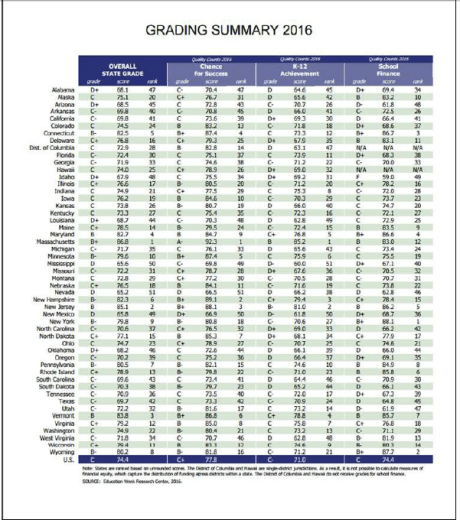
Ironically, on the same day that the TEA released grades for local campuses, it received its own A-F grade from Education Week’s “Quality Counts” report on the education systems in all 50 states and the District of Columbia. The Texas Education Agency received an overall grade of C- on the national report and wasn’t happy. TEA immediately dismissed the validity of the report, stating that it is “difficult to effectively evaluate the state’s performance from a national report where no state made the highest grade, no state made the lowest grade, and the majority of states were all lumped into the same grade category.”


On the chart below (from www.edweek.org/media/qualitycounts2016_release.pdf), you will see that on the “Quality Counts” ranking, Texas ranked 45th in the nation in school finance. In other words, Texas schools are low-funded compared to other states. However, on the achievement of students, Texas was ranked 24th. To this educator, that means Texas teachers are picking up the slack that lawmakers are leaving. Additionally, on a third measure called “Chance of Success”—which includes circumstances faced by students including family income, parent education, parent employment, steady employment, etc.—Texas ranked 42nd. So, despite long odds and little meaningful help from policymakers, Texas teachers are doing an outstanding job overcoming obstacles placed in front of them and helping our students to learn.
screen-shot-2017-01-08-at-9-45-25-am

Despite the systemic obstacles like inadequate school funding and insufficient outside-of-school supports available to Texas children, the TEA nonetheless released this grading report labeling 30% or so of Texas schools—as demanded by the bell curve they built the system on—as “D” and “F” schools. Perhaps most incredible of all is the fact that these grades are based almost exclusively on STAAR standardized test results, an exam fraught with problems, about which the Texas Lieutenant Governor Dan Patrick once said “we don’t trust this test.”


Despite misgivings about the quality and ability of the test to reflect student learning, and despite the TEA’s own tepid reaction to its A-F grade from Education Week, and despite the prior existence of a school accountability system proclaiming 94% of Texas schools to be satisfactory performers, and despite the fact that the A-F system reflects poverty better than it reflects teaching quality, ultimately, when it comes to A-F grades, the Texas Education Agency apparently believes it is better to give than to receive.


Note:  Spreadsheets with the Texas data can be found here and here.


There were reports of a billboard in Mumbai showing Trump in his usual gold-encrusted lifestyle, looming over a scene of desperate poverty in Mumbai, India. The billboard said, “There is only one way to live. The Trump way.” Snopes said it was fake news. But it was not fake news and Snipes changed its designation to TRUE.


If you live in Northeast Wisconsin, I urge you to support Tom Nelson for Congress.

He has never accepted money from DFER or any other privatizers.

He has fought Scott Walker over Walker’s full-blown efforts to privatize public funding for public schools.

He has served in the state legislature and as a county executive.

Elect a friend of public education to Congress!

Before the second debate tonight, the Journey for Justice asks the candidates to respond to these questions:


NEWS RELEASE MEDIA CONTACT: Jaribu Lee
FOR IMMEDIATE RELEASE

(773) 548-7500
October 8, 2016
info@j4jalliance.com

Education activists release statement ahead of second presidential debate: “Will the next president be tone deaf…”
​

CHICAGO – Today, Jitu Brown, national director of the Journey for Justice Alliance (J4JA) released the following statement ahead of the second presidential debate in St. Louis on Sunday, September 9th. Thousands of African American and Latino parents, students and activists have challenged both Hillary Clinton and Donald Trump (and third-party candidates) to release their K-through-12 public education platforms, as well as identify how, if elected, they will work to end federal education policies that have destabilized communities and hurt students of color:

“As parents, students and residents of communities impacted by corporate education interventions in 24 cities across this nation, we are dismayed by the omission of public education as an issue during this presidential election season. Public education repeatedly polls as a top tier issue, but has been largely ignored by both major and third party candidates,” said Brown.

“Will the next president be tone deaf to the tremors from the ground? As a national network of grassroots community organizations across America, we have seen first-hand a determined resistance to failed, top-down corporate education interventions that cannot be ignored; Title VI civil rights complaints filed in 12 cities, thousands of people in determined protest against school closings, sit-ins and traffic blockades, students occupying the superintendent’s office in Newark, a 34-day hunger strike to save a neighborhood’s last open-enrollment high school in Chicago, the rejection of punitive standardized test across the nation and from those who wish to be the leader of the free world; silence.

“The next president must base their advocacy in relationship with people’s lived reality, not corporate relationships. When a mother cries in Detroit because her child’s school is being closed, or students walk-out by the thousands in Boston, Chicago, Detroit, Camden and Newark, Baltimore and Philadelphia; it matters. The next president must understand that the United States ranks 19th in the world in public education among OECD countries but when you remove poverty we are number 2. The next president must have the courage to stare down inequity in public education with a commitment to hear the voices of the people directly impacted. The next president must understand that we do not have failing schools in America, as a public we have been failed,” he continued.

“We are asking the next president to meet with the Journey for Justice Alliance and adopt our education platform. Include J4J on your education transition team so that public policy can be rooted in our lived experiences, not someone’s opinion of our communities. We were disappointed that the vice-presidential candidates said nothing about public education in their October 4th debate. We want to hear from both candidates on October 9th about their education agenda. Will they be honest about the harm inflicted on our communities by school closings and the unwarranted expansion of charter schools? Will they acknowledge that the “illusion of choice” must be erased by the reality of strong, high quality neighborhood schools within safe walking distance of our homes? We will be watching.”

​###

The Journey for Justice Alliance (J4J) (www.j4jalliance.org) is a national network of inter-generational, grassroots community organizations led primarily by Black and Brown people in 24 U.S. cities. With more than 40,000 active members, we assert that the lack of equity is one of the major failures of the American education system. Current U.S. education policies have led to states’ policies that lead to school privatization through school closings and charter school expansion which has energized school segregation, the school-to-prison pipeline; and has subjected children to mediocre education interventions that over the past 15 years have not resulted in sustained, improved education outcomes in urban communities.

Journey For Justice Alliance
4242 S. Cottage Grove
Chicago, IL 60653
773-548-7500

This link will take you to the opening pages of the revised “Death and Life of the Great American Dchool System: How Testing and Choice Are Undermining Education.” The book was originally published in 2010. It became a surprise national bestseller.

The publisher at Basic Books, Lara Heimert, invited me to lunch a year ago and made an unusual offer. She said that I could revise the book any way I wanted. This was an extraordinary offer. Publishers usually warn you not to add or subtract unless you keep the line count exactly the same. They want to avoid the expense of resetting the entire book. But I was offered the opportunity to change, add, delete as I wished. It was an offer I could not refuse.

The two big changes I made were these:

I removed my long-standing support for national standards and tests in light of the Common Core debacle.

Second, I revised my estimation of the 1983 report, “A Nation at Risk,” which gave rise to the myth that American education was broken.

I hope you will take the time to read this new edition. It reflects much of what I have learned from YOU on this blog over the past four years.

Diane