Archives for category: Play

Joel Westheimer has advice for parents who are at home organizing their children’s days.


FORGET THE WORKSHEETS AND TRYING TO REPLICATE SCHOOL

I am really struck by the variety of media inquiries I’ve been getting about the impacts of Covid-19 on education, what parents should be doing at home, and so on. The interest doesn’t surprise me (I am an education columnist on public radio), but the preoccupation with whether kids will “fall behind” or with how they will “catch up” has. I see hundreds of stories, websites, and YouTube videos that aim to help parents create miniature classrooms at home. Maybe some parents have folding chairs they can bring up from the basement and put in rows. Where’s that big blackboard we used to have? Is there a run on chalk at Costco?

Stop worrying about the vague and evidence-less idea of children “falling behind” or “catching up.” This is a world-wide pause in life-as-usual. We’ve spent the last 25 years over-scheduling kids, over-testing kids, putting undue pressure on them to achieve more and more and play less and less. The result? Several generations of children and young adults who are stressed-out, medicated, alienated, and depressed.

This is not a time for worksheets. This is an opportunity (for those of us lucky enough to be at home and not in hospitals or driving buses or keeping our grocery store shelves stocked) to spend meaningful time with our children to the extent it is possible in any given family. Parents shouldn’t be thinking about how to keep their kids caught up with the curriculum or about how they can recreate school at home or how many worksheets they should have their children complete. They should bake a cake together. Make soup. Grow something in the garden. Take up family music playing. And neither school personnel nor parents should be focusing on how quickly or slowly children will return to school because none of us know We should be focusing on ensuring that teachers are afforded the conditions they need to best support their students — now when school is out and later when school is back in.

Remember that ditty about the two Chinese brush-strokes that comprise the word ‘crisis’? One is the character for ‘danger’ and the other the character for ‘opportunity.’ We are more and more aware of the danger. But we’re missing out on the opportunity: to spend time as families (in whatever form that family takes in your household).

This brings me back to the questions I keep getting. What are my recommendations for what to do with your children at home when they are missing so much school? Stop the homework (unless you and your children are enjoying it).Stop the worksheets. Stop trying to turn your kitchen into Jaime Escalante’s A.P. math class. But do help your children structure their day. Help them process what is going on around them. Help them engage in activities that do not take place on a screen. Help them maintain physical activities whether that means running around the block, running up and down the stairs, or running around the kitchen.Help them be creative. Give them — to the extent possible in your household — the gift of time and attention.

And when brick-and-mortar school (hopefully) returns next Fall, let’s give teachers a great deal of latitude in what, how, and when to teach any particular subject matter. Their primary job should be to restore a sense of safety, nurture a sense of possibility, and rebuild the community lost through extended social isolation.

_________
Joel Westheimer is University Research Chair in Democracy and Education at the University of Ottawa and an education columnist for CBC’s Ottawa Morning and Ontario Today shows. His most recent book is “What Kind of Citizen: Educating Our Children for the Common Good.” You can follow him on Twitter: @joelwestheimer.

Nancy Bailey writes here about the idea–promoted by NCLB, Race to the Top, and Common Core– that kindergarten children should know how to read. She says this is wrong.

Young children should be encouraged to speak and listen, she writes, which is something they do while playing and interacting with other children.

She writes:

With No Child Left Behind, Race to the Top, and Common Core State Standards, some adults have been led to believe that four- and five-year-old children should read by the end of kindergarten. Preschoolers are pushed to be ready for formal reading instruction by the time they enter kindergarten.

This is a dangerous idea rooted in corporate school reform. Children who struggle to read might inaccurately believe they have a problem, or reading could become a chore they hate.

Pushing children to focus on reading means they miss listening and speaking skills, precursors to reading. These skills are developed through play, which leads to interest in words and a reason to want to read.

Some children might learn to read in kindergarten, and others might show up to kindergarten already reading, but many children are not ready to read when they are four or five years old. And just because a child knows how to read in kindergarten, doesn’t mean they won’t have other difficulties with speech and listening.

When children come to schools from poor home environments, much of what they’ve missed involves a variety of language skills like speech and learning how to listen. When children have disabilities, speaking and listening skills are critical.

Forcing children to focus on reading early denies children opportunities to work on those other missing skills.

Also, there’s no research, no evidence that a child’s brain has evolved to indicate children can and should read earlier. Our culture has changed, but children have not. Even if new reading methods are developed that assist children to be better readers, there’s no reason to push children to read before they are ready.

In the drive for higher test scores, play has been minimized or eliminated. This is a crime against children.

This is a good time to recommend some reading: Pasi Sahlberg and William Doyle, Let the Children Play: How More Play Will Save Our Schools and Help Children Thrive. 


Michael Moore visited Finland with a camera crew to learn about its education system.

How could a nation post high test scores on international tests when its schools emphasize creativity, play, physical activity, and the arts and ignores standardized testing?

Watch his video and see what you think.


Reader Jack Covey, a teacher in Los Angeles, sent the following comment to me:


First, watch this clip from Michael Moore about
schools in Finland:
https://www.youtube.com/watch?v=4-DcjwzF9yc
Now, read Education Next on the same topic, in
the context of a book review by Cherker Finn.
https://www.educationnext.org/more-play-will-save-our-schools-book-claims-review-let-the-children-play-sahlberg-doyle/
Here’s the ending of Chester Finn’s “Stick with GERM” 
review of Past Sahsberg’s new book, and his
argument that “play” hurts poor kids, but it’s fine
for middle class kids (and presumably upper class
kids as well).  
He says we’re “bizarrely and cruelly” damaging 
those poor kids when U.S. schools “model themselves 
on a charming small country in northern Europe 
(it’s Finn vs. Finns, I guess)
CHESTER FINN:


Nancy Bailey describes here the determined effort by policymakers to stamp out play and childhood, all in the name of teaching reading long before children are ready to learn to read.

Because kindergarten has become more advanced, preschool is seen as the time children must have prereading skills for kindergarten. If they don’t, it’s seen as a red flag. This makes teachers and parents push children to learn to read early.

Children are expected to know letters and numbers, even basic sight words. They’re supposed to be able to sit and focus on tasks for longer periods. But preschool wasn’t always about teaching prereading skills, and we should question if children that young are being pushed to read too soon.

In 2002, Newsweek published an article entitled “The Right Way to Read.” The title was conjecture. Reporters visited the Roseville Cooperative Preschool in northern California. Children there were called “masters of the universe” because they oversaw play. Children played most of the time. The school based everything on play.

Children played at a science table. They used magnifying glasses to explore flowers, cacti, and shells. They donned smocks to do art, lots of art. They were able to climb and stay active. They had access to books and a dollhouse.

There were no letters or numbers on the wall.

Director and founder Bev Bos told teachers, “Forget about kindergarten, first grade, second grade. We should be focusing on where children are right now.”

But Newsweek didn’t praise the preschool. They were there to show the controversy surrounding it.

The Bush administration had claimed research indicated that 50,000 Head Start teachers were going to have to learn how to provide explicit instruction on how to teach the alphabet, letter sounds, and writing to young children.

Not only that. Preschool teachers were to use a detailed literacy-screening test. Forty-five million was being earmarked for preschool-reading research.

Children were no longer masters of their world. Adults were in control.

Yes, the adults were in control but they made horrible decision that stole childhood and play from children.

For all the hundreds of millions and billions poured into the Great Crusade to Teach Preschoolers to Read, there has been minimal change in NAEP scores for reading, in fourth or eighth grades. Despite the pressure to raise test scores in reading, scores remained stagnant, and no academic progress was made at all for the lowest performing students since the implementation of NCLB almost two decades ago.

Citizens for Public Schools needs you now to stand up for public schools in Massachusetts.

mail

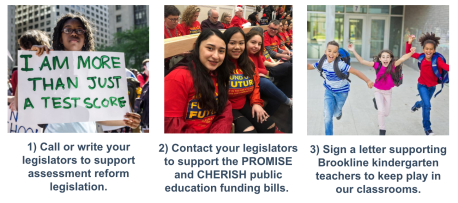
Three ways you can stand up and speak out for public education today!

Screen Shot 2019-06-14 at 6.53.46 AM

Take a few minutes today to raise your voice about these three important issues for our schools.

1) Less Testing, More Learning
Citizens for Public Schools members will testify at a public hearing before the Joint Education Committee Monday in favor of a moratorium on the high-stakes uses of standardized testing and other crucial reforms to improve assessment in the Commonwealth.
You can make a difference by asking your legislators to support five bills to reform and improve state assessment practices. Collectively, they would: stop the high stakes uses of standardized test results, establish a grant program to develop alternatives to high-stakes standardized testing, inform parents about their rights vis a vis state testing, allow local districts to determine graduation requirements, and make other improvements.
Read more about CPS’s priority education legislation here.
ACT TODAY! #StandUpForPublicEducation and ask your legislators to testify in support of these bills at Monday’s Joint Education Committee hearing, 10am, Room A-1. And then, spread the word. Thank you. (Email us if you would like to testify or submit written testimony to the committee.)
2) Fund Our Future
Thanks to all of you, our message about the urgent need to update the state school funding formula is getting through and resonating! A recent poll found 60% of voters believe our schools are not adequately funded, and nearly 60% are willing to pay more in taxes to fix funding disparities.
And today, parents are filing a lawsuit naming four state education officials for “violating the civil rights of low-income, black, and Latino students by failing to provide them with the same quality of education as their mostly white affluent peers.” (CPS is a member of the Council for Fair School Finance, backing the lawsuit.)
Now’s the time to keep up the pressure on legislators to pass urgently needed education funding legislation!
Contact your state senator and representative to support the PROMISE and CHERISH public education funding bills. Click below to find out if your legislators support the bills, then call to thank them or urge them to take a stand. Urge them to contact the appropriate committee chairs and express their support of these two crucial bills!
3) Keep Play in our Kindergarten Classrooms
A courageous group of Brookline kindergarten teachers are speaking out about program and curriculum practices, implemented without meaningful educator input, causing “everlasting negative impact” on their young students’ social-emotional well-being. In their letter, they say kids need play-based learning, not only stressful academic blocks that aren’t developmentally appropriate, create anxiety and hamper the joy of learning. Watch a video of their public comment here. Click the button below to sign a letter from a group of Brookline parents supporting the kindergarten teachers, and don’t forget to mention that you’re a CPS member in the comments! (You don’t have to be from Brookline to sign.)


David Gamberg is superintendent of two adjacent small school districts on Long Island in New York: Southold and Greenport. Gamberg is devoted to a philosophy of whole-child learning, in which play and a healthy body are as important as academics. He is constantly coming up with new ways to engage children’s imagination and creativity. His schools are alive with music, art, gardening, play, and, now, chess.

The Southold elementary school recently conducted a chess tournament with life-size chess pieces and a chess board. 

According to David Gamberg, superintendent of both the Southold and Greenport school districts, the idea for bringing chess to students was born after the “simple, kind gesture offered to the students at Greenport Schools.”

With no strings attached, Wesley Wang, a 9th grade student at Jericho High School affiliated with CHESSanity, an organization devoted to promote the playing of chess among school-aged children, reached out to Gamberg at Greenport Schools, the superintendent said.

After an exchange of emails, a donation of 24 chess sets and some guidebooks were sent to both Greenport and Southold Elementary Schools.

Since then, two chess clubs were formed, one in each school, and over the past few months, second and third graders in both districts have met for an hour each week to learn the game and hone their skills.

“The skills and dispositions learned by playing this game are invaluable as children start to think strategically and carefully,” Gamberg said.

Wang, of CHESSanity, said the goal was to provide the games to students at no cost to introduce chess to young minds, and to maintain the supply regularly. The organization has donated
chess sets to 20 schools in four school districts in Long Island so far.

“I hope that our little help can have some positive impact upon these children, improve their academic performance, and build their self-esteem,” he said.

Wang said since he and his brother, a college freshman, kicked of the non-profit organization CHESSanity, they have raised more than $35,000 by conducting chess classes every Friday night during the school years and organizing monthly competitive tournaments.

The funds raised have allowed them to give away the free chess sets to districts including Wyandanch, Roosevelt, and Hempstead, benefiting thousands of students.

There are many ways to inspire a love of learning and a desire to achieve one’s personal best. Chess is one of them.

I am reminded of I.S. 318, the New York City public school that has a championship chess team. It was featured in a wonderful film called Brooklyn Castle. You can find it and rent it online. Watch it if you can. It is an inspiring movie about the power of chess to change lives.


As the tentacles of Ed Reform reachdown into the earliest years, forcing standardized tests on young children, Defending the Early Years is there to block the monster from strangling the children’s loveof learning.

In this short video, early childhood educator Kisha Reid explains what young children need most to thrive.

Play. When children play together, they collaborate. They solve problems. No one fails. They work and play together, as equals. Good practice for the real world.

In this short video, veteran kindergarten teacher Jim St. Clair explains why play-based learning is important for young children and illustrates with examples from exemplary practice.

The video was produced by DEY (Defending the Early Years), a consortium of early childhood education practitioners and academics.

Michael Hynes, the progressive superintendent of the Patchogue-Medford school district on Long Island in New York, and William Doyle, an author who has lived in Finland, recently returned from a trip to that nation’s schools and wrote this article.

They offer a twelve-step program for American schools, based on what they learned in Finland.

Here are three of the steps they recommend. To learn about the other nine, open the link.

They write:

We were stunned by what we observed: A society that selects and respects teachers like elite professionals; a world-class network of vocational and technical schools; a school system that reveres and protects childhood and encourages children to experience joy in learning — where teachers shower children with warmth and attention; where children are given numerous free-play breaks; where special-education students are supported; and where children thrive.

In Finland, we heard none of the clichés common in U.S. education reform circles, like “rigor,” “standards-based accountability,” “data-driven instruction,” “teacher evaluation through value-added measurement” or getting children “college- and career-ready” starting in kindergarten.

Instead, Finnish educators and officials constantly stressed to us their missions of helping every child reach his or her full potential and supporting all children’s well-being. “School should be a child’s favorite place,” said Heikki Happonen, an education professor at the University of Eastern Finland and an authority on creating warm, child-centered learning environments. His colleague Janne Pietarinen explained, “Well-being and learning are intertwined. You can’t have one without the other.”

In short, we glimpsed an inspiring vision of an alternative future for American education, a future that we believe that all of our children deserve right now.

How can the United States improve its schools? We can start by piloting and implementing these 12 global education best practices, many of which are working extremely well for Finland:

1) Emphasize well-being. Make child and teacher well-being a top priority in all schools, as engines of learning and system efficiency.

2) Upgrade testing and other assessments. Explaining why he doesn’t need standardized tests to evaluate his students, one Finnish teacher said: “I am assessing my students every second.” Stop the standardized testing of children in grades 3-8, and “opt-up” to higher-quality assessments by classroom teachers. Eliminate the ranking and sorting of children based on standardized testing. Train students in self-assessment, and require only one comprehensive testing period to graduate from high school.

3) Invest resources fairly. Fund schools equitably on the basis of need. Provide small class sizes.