Archives for category: Parents

Ruth Conniff, editor-in-chief of The Wisconsin Examiner, brilliantly summarizes the war against public education in Wisconsin, which reflects what is happening in many other states. Parents and teachers have mobilized to defend their public schools, while the governor and legislature agree on expanding vouchers and an austerity budget for public schools. She points out that the rightwing angst about CRT and gender is a giant smokescreen to distract public attention from the diversion of public funds to private schools. The attacks are funded, of course, by rightwing billionaires.

Conniff writes:

It’s an understatement to say that public school advocates are not happy with the state budget Gov. Tony Evers signed.

“We’re not here to cheer for crumbs,” Heather DuBois Bourenane, executive director of the Wisconsin Public Education Network, declared at the group’s annual Summer Summit last week. “This budget did not deliver and will not adequately meet the needs of kids.”

It’s a “weird moment” for public school advocates, DuBois Bourenane added, noting the conspicuous absence of Evers, a longtime ally, from the annual gathering of public education organizers. Evers has signed a budget DuBois Bourenane described as “disgusting,” leaving 40% of school districts with less funding this year than they had under last year’s zero-increase budget.

School superintendents who attended the summer summit reeled off program cuts and school closings around the state as districts are forced to tighten their belts even though the state is sitting on more than $6 billion in surplus funds. Wisconsin is entering its 16th year of school funding that doesn’t keep pace with inflation. The toll is visible in districts that have had to close buildings and cancel programs.

“It’s a difficult line, I suppose, to walk,” an unsmiling State Superintendent of Public Instruction Jill Underly told me, standing in the hallway outside the auditorium at South Milwaukee High School after delivering the welcoming speech at the summit. Her theme was growth and change and how no one is perfect, drawing on a poem about caterpillars and butterflies.

“I feel like the governor is caught in a bad spot,” Underly added. Evers had to negotiate a deal with Republicans who were threatening to withhold shared revenue funds from Milwaukee, potentially plunging the state’s largest urban area into bankruptcy.

“It’s all part of politics and negotiation,” Underly said. “I do feel bad for the schools, because we got little, on top of no increase in the past.”

Although the budget deal does allow most school districts to levy an additional $325 per pupil from local property tax payers, that just “puts the burden back on the local districts to make up for that revenue rather than the state,” Underly said. And the state’s failure to meet public school demands that it cover at least 60% of the cost of special education — an expense that is devouring school district budgets, leading to program cuts in other areas — was a “missed opportunity,” Underly said, given the huge budget surplus. “I do feel strongly that our public schools lost out again.”

As for the big increase in taxpayer money going to finance private schools through the voucher expansion Evers signed as part of his deal with Republicans, “It’s hard to swallow,” Underly said, “because, really, we can’t afford two school systems.”

In just two years, all the enrollment caps will come off the school voucher program in 2026 and the problem of supporting two school systems, one public and one private, from the same limited pool of education funds, is going to get even worse.

“I think there’s going to be a reckoning,” Underly said. “I think the people in this state are going to have to do some soul-searching and really answer the question: What future do they want for public schools and kids and communities? Do they want a system that serves everybody? Or do they want to have two systems where the one that serves everybody keeps shrinking?”

That pretty much sums up not just the battle over the future of public schools in Wisconsin this year, but all of the struggles over the future of democracy in our state and around the country that suddenly seem to be coming to a head this year.

Are we going to have a society where we come together around shared values and common interests, or are we going to continue to break into increasingly isolated, hostile camps, tearing down our shared institutions, and leaving individuals and families on their own to grab what they can for themselves?

The Wisconsin Public Education Networks’ slogan, “Public Schools Unite Us” captures the more optimistic of those two roads.

“I don’t know anyone who disagrees with that slogan,” podcaster Todd Albaugh, a former Republican who spent 30 years in government and politics, said during the summit. He talked about the state champion high school baseball team in the little town of Ithaca, Wisconsin, and how everyone rallied around them. “Wisconsin public schools, they are the identity of our communities,” he said.

The Wisconsin Public Education Network has done an admirable job of reinforcing that identity, and defying the “politics of resentment” by bringing people together from urban and rural parts of the state. Together, rural and urban districts hammered out a shared set of priorities and pushed for them in the Capitol. Although they didn’t get what they wanted in the budget, they showed unity of purpose in pushing for a big raise in the state reimbursement for ballooning special education costs and a $1,510 per pupil increase to make up for 15 years of budgets that haven’t kept pace with inflation.

The vision of schools as cradles of a healthy, diverse, civic society was on display at South Milwaukee High, which hosted the summit Aug. 10, with representatives from mostly white rural districts mixing with students of color and teachers and administrators from urban, majority-minority schools.

There was a lot of talk about school funding and not so much on the hot buttons pushed by the right: “critical race theory,” gender pronouns and “parents rights.”

Politicians and school-privatization lobbyists have put a lot of money and energy into stirring up anger and distrust based on those culture war topics, in an effort to distract voters and undermine public schools. But the real aim of rightwing attacks on public schools is not just to teach conservative family values or racist rewrites of history. School privatization advocates have been working for decades to get their hands on the public funds that flow to public schools. As Rupert Murdoch put it, discussing News Corp’s foray into the business of education: “When it comes to K through 12 education, we see a $500 billion sector in the US alone that is waiting desperately to be transformed.” In Wisconsin, that transformation is well underway.

Rod Gramer, president and CEO of Idaho Business for Education, a group of 250 Idaho business leaders who helped beat back publicly funded private school vouchers in their state, urged Wisconsin public school advocates gathered in South Milwaukee last week to keep the focus on the bigger picture.

“People don’t understand this is not a state problem,” Gramer said. “They don’t understand there’s a large group of billionaires who want to abolish public education.

“Billionaires who’ve never set foot in your state are spending billions to elect friendly legislators,” Gramer correctly pointed out. “I think people would be outraged if they know these elite billionaires are trying to undermine education in your state…”

We can do better. Voters, whether they are rural Republicans or urban Democrats, really can get together on defending a shared vision of a decent society. A cornerstone of that society is a free, high-quality public education system with beloved teachers, music programs, sports teams, and the whole sense of community that builds. Public schools do unite us. And as Evers said, before he got his arm twisted and signed the current budget, we should always do what’s best for kids.

Please open the link and read this important article to its conclusion.

Steffen E. Polko is a retired professor of education at TCU in Texas. He wrote the following commentary for the Fort Worth Star-Telegram. Vouchers, he says, will doom community rituals, like Friday night football. Dividing students up by religion and other grounds will divide our communities and our country even more than at present.

He writes:

There appears to be some confusion regarding rural Texans’ opposition to school choice and vouchers. I think I may know why.

Gov. Greg Abbott’s espoused principal reason for promoting vouchers is to protect Texas children from the “woke” propaganda being disseminated by public school teachers. Let me assure the governor that teachers in upstanding, God-fearing communities such as Mineral Wells and Hico are not subjecting their students to “woke” ideology. In these communities, “woke” still means not asleep. This is not something that’s broken in small-town Texas, so it doesn’t need fixing.

Now, onto the most important reason. Vouchers pose a threat to high school football and could turn out Friday Night Lights. An education savings account program will reduce funding levels for public schools as students leave. The first thing to be hit will be athletic budgets.

Proponents note that there are few private school options in rural Texas. So, where will these students go? There are no options yet, but this will change with vouchers. Many churches face declining attendance and financial difficulty. If $8,000 per year vouchers are available a minister with 20 or more school-age children in the congregation will find it rational and financially prudent to start a school.

Let’s say I have 40 such children. If the state sends me $320,000 per year and I can keep expenses at $160,000, I will net $160,000 for my church. How do I keep my expenses so low? The key is technology. High-quality learning systems produced by nationally recognized educational providers such as Pearson are readily available over the Internet. The cost of learning management systems currently averages around $5 per student per month.

The state will require me to have two “teachers” for 40 students. No problem; this can be anyone in my congregation with a college degree and some time on their hands. Getting alternative certification from the state is relatively easy. My teachers need not be education experts because the learning management system does the heavy lifting. It provides instruction and creates and grades the homework and tests. The latest systems even use artificial intelligence to answer student questions.

The only job for the “teachers” would be to manage classroom behavior and help students use the software. A student leaving the public schools will probably get a fairly good Christian education. The public school will lose funding for athletic programs and perhaps a potential star quarterback. Ouch! For-profit schools will emerge employing a similar model. Using a hybrid instructional model and current costs, I calculate that a 200-student high school would bring cashflow of about $800,000 a year. Start 10 of

those and you have a nice chain of businesses. Could this be the real driving force behind vouchers? To recruit students, such schools could promise to teach artificial intelligence and the Python programming language to prepare students for a promising future in technology — or use some other clever hook. Texas has about 8,000 schools. The Texas Education Agency employs 1,000 people and spends around $2 billion per year to monitor the schools and hold them accountable.

I predict that vouchers will increase the number of schools in Texas four-fold. Will the Legislature increase funding by a factor of four to monitor this many schools? I think not. It will be a long time before state officials figure out if for-profit schools are delivering on their promise, and the owners will be very rich before they do. Good luck getting them and their money back from Barbados. Not only would church and for-profit schools poach rural athletes, but specialized voucher- and donor-funded sports academies could emerge. Let’s say someone starts a Dallas Football Academy. It could use an entrance exam similar to the NFL combine to assure it got the best athletes. The best coaches, fitness trainers, and other staff would be recruited.

These schools would have a direct connection to universities to give their athletes the best shot at a top-level scholarship. Such schools would dominate small-town teams and end the reign of, for example, the Aledo Bearcats. The state championship game would probably feature the Dallas and Houston football academies.

Rural Texas is our best bet to keep the state from making a huge mistake that is little more than a political stunt to get votes. Small communities have nothing to gain from vouchers and a lot to potentially lose, as does the rest of the state.

Steffen E. Palko is a retired associate professor of education at TCU. He lives in Fort Worth.

Read more at: https://www.star-telegram.com/opinion/opn-columns-blogs/other-voices/article277689198.html#storylink=cpy

Linda Darling-Hammond is a prominent professor at Stanford and president of The Learning Policy Institute. She has been a public school teacher, a researcher, and president of the California State Board of Education. In this essay, she explains why the community school model may be the best path forward for school reform.

She writes:

“Kasserian ingera”—the traditional greeting of Masai warriors—asks: “And how are the children?” It is still a greeting among the Masai, acknowledging the high value they place on their children’s well-being. The traditional answer, “All the children are well,” means that the safety and welfare of the young are protected by their communities.

Unfortunately, in the United States, we know that all of our children are not well. Indeed, by any measure, children and youth in the United States are struggling. The aftermath of the pandemic has brought with it an epidemic of mental health issues, from anxiety and depression to suicidal ideation. A Centers for Disease Control and Prevention report from 2022 found that 44% of adolescents said they felt sad or hopeless most of the time during the spring of 2021, and 20% seriously considered suicide. During that time, 29% had an adult in their household lose a job and 24% went hungry; 55% said they were exposed to harsh verbal or physical treatment at home.

Many report continuing to feel disconnected from school. Among high school students from 95 districts surveyed by Youth Truth in 2021–22, a minority (40%) reported feeling like part of their school community or enjoying coming to school, and just 39% reported having an adult at school they could talk with when they feel “upset, stressed, or having problems.” (See figure below.) These proportions are even lower for students of color, LGBTQ+ students, and students in large schools.

It is in this context that a diverse and growing chorus of educators, students, families, and policymakers are calling for a reimagining of our schools. They are highlighting the need to center relationships, belonging, and community; to create structures and practices to support relevant and engaging learning; and to organize resources, supports, and opportunities in ways that mitigate the pernicious effects of structural racism and decades of disinvestment in low-income communities of color.

As Learning Policy Institute Senior Fellow in Residence Jeannie Oakes noted recently, “We need to have schools really change the way they operate to compensate for deficiencies, not in the kids, but in our social safety net.”

Responding to the uniquely challenging moment we’re in, many districts and states are making big bets on community schools—both to address the tattered social safety net Oakes refers to, as well as to provide a catalyst for the deeper cultural and practice changes needed to better serve students and adults alike.

These initiatives are underway in large urban districts like Albuquerque, Baltimore, Chicago, Los Angeles, New York City, and Oakland, as well as in smaller rural communities in California, Kentucky, New Mexico, New York, and Vermont. A number of states have also established funding and supports for community schools. Maryland established the Concentration of Poverty grant program to provide annual community school personnel grants to eligible schools, along with additional per-pupil grant funding for each eligible student. New York created a community schools set-aside in its school funding formula for high-need districts and funded three regional technical assistance centers for community schools. California, for its part, has leveraged multiyear budget surpluses in 2021 and 2022 to make a historic $4.1 billion investment in planning, implementation, and coordination grants—as well as technical assistance—for the state-funded California Community Schools Partnership Program. This investment is intended to provide sufficient resources for every high-poverty school in California to become a community school within the next 5 to 7 years.

Community schools are a place-based strategy deeply rooted in their local context—the needs, assets, hopes, and dreams of students, families, educators, and community partners. They leverage a complex web of partnerships and relationships, like those at Mendez High School in East Los Angeles, to support and engage students and families. By integrating access to services—from medical care to housing and other supports—and making them available to students and families on school campuses, community schools provide a much-needed alternative to the fragmented and bureaucratic social services gauntlet that families in need are typically required to navigate. As we have seen time and again during the COVID-19 pandemic, these services and supports—provided in the context of trusting and caring relationships—can be life changing and can mean the difference between academic success and struggling students and families.

At Mendez, because of the infrastructure created through its community schools approach, the school and its partners were able to provide vital services to students and families as soon as schools shut down in 2020. A mobile clinic that already served the school began COVID-19 testing for the community; mental health providers already in place conducted regular mental health check-ins with students via devices or at a safe physical distance. Other partners created care packages with food, toilet paper, electronic benefit transfer cards, and other essentials, and teachers organized to provide Wi-Fi hot spots to families before the district had the capacity to do so.

But to achieve the transformation our students need and the times demand, community schools must be about much more than providing an efficient structure for integrated student supports (or wraparound services, as they are sometimes called). Transformation requires that we also address the structural barriers to student well-being and academic success that are encompassed by the other foundational elements of community schools: a culture of belonging, safety, and care; community-connected classroom instruction; expanded and enriched learning opportunities; empowered student and family engagement; and collaborative leadership. Foundational to all of this is a grounding in whole childeducation.

When implemented well, community schools are guided by principles for equitable whole child practices that are grounded in the science of learning and development. This whole child framework is at the center of the community schools initiative in California, where the State Board of Education has thus far approved $1.5 billion in planning and implementation grants from a larger initiative that is intended to reach one third of the state’s schools in high-need communities.

The key elements of a whole child framework should be foundational to our vision of transformational community schools:

  • Structures and practices to foster positive developmental relationships and ensure that students are known and supported. Examples include looping in the elementary grades, where a teacher stays with the class for more than one year, and utilizing advisory systems in middle and high school, which create small family units that offer personal attention, space for sharing needs and feelings, and family connections that support each student.
  • Supportive and caring school communities where students feel a strong sense of belonging and are safe to bring their full selves, without fear of being bullied by peers or stereotyped or negatively judged by students or adults at school.
  • Culturally affirming social and emotional learning that is infused throughout the school day and includes skill-building, as well as educative and restorative approaches to classroom management and discipline, so that children and young people learn responsibility for themselves and their community.
  • Rich learning experiences that support inquiry, motivation, competence, self-efficacy, and self-directed learning.
  • Integrated student supports that remove academic and non-academic barriers to learning by providing health and social services as needed, tutoring and other academic supports, and a focus on children’s individual talents and needs.

Move at the “Speed of Trust”

Just as we need to rethink how students are engaged and supported in schools, we also need to reimagine adult interactions—among families and educators, as well as among school staff. That means treating families as trusted partners in their students’ well-being and academic success and intentionally supporting their capacity building and leadership development.

As importantly, it also means investing in educators and school staff, so they have the necessary tools, agency, and support—including support for their mental health and emotional well-being—to shift practices in ways that expand the capacities of students and adults alike. This includes enabling new teachers’ success with strong induction and mentoring, while providing leadership opportunities for more experienced teachers. It means providing the collaboration time essential to advancing meaningful and engaging instruction and supporting teacher-led professional development. And, just as with students and families, it means nurturing trust and collaborative leadership among staff and with school and district leaders.

Open the link to read the rest of this article and to see the graphs.

Gary Rubinstein has been a teacher since 1991. Four of those years were spent teaching in Houston. Gary has been watching what’s happening since Mike Miles arrived and was taken aback when Miles imposed sweeping changes on the district without spending time getting to know it. Miles’ “reforms,” Gary predicts, are heading for trouble. Those reforms come out of the “corporate reform” playbook. Maybe Miles took a page or two from the Broad Academy guidelines, applicable in all situations.

Gary writes:

With around 200,000 students, Houston Independent School District (HISD) is the 8th largest school district in the United States. For years there was talk about the state possibly taking over the district and this finally happened on June 1, 2023. The board was fired and replaced by Texas Education Agency (TEA) appointees. Mike Miles, who founded a charter school network called Third Future Schools and was previously the head of Dallas Schools for three years, was hired as the new HISD superintendent. While most people new to a job like this would take some time to get the ‘lay of the land,’ Miles instantly proposed some radical, and in my estimation, terrible, reforms which I will outline in this post.

He identified the three lowest performing high schools in HISD: Wheatley, Kashmere, and North Forest. Those three schools together with the 26 middle and elementary schools that feed into those high schools were to become part of a new ‘New Education System’ known as NES. This NES is the latest ‘turnaround’ district. Over the past 20 years there have been several of these, the most prominent are the Recovery School District (RSD) in New Orleans, set up after Hurricane Katrina in 2003 and the Achievement School District (ASD) in Tennessee, created in 2011 with Race To The Top money. There was also Michigan’s Education Achievement Authority (EAA) in 2011 as well as a few more that have popped up around the country. To my knowledge, there has never been a successful takeover of this sort in the history of this country. The EAA has been shut down, the RSD has been merged back into the New Orleans school system and the ASD has floundered, never having any success at all in improving the test scores of the schools it took over. It is funny/sad to see this hopeful panel discussion by the leaders of these districtsbefore it was known how badly they would fail. (I’ve written a lot about the ASD, but here is something I wrote summarizing the history of these turnaround efforts.)

These turnaround efforts sometimes have school closures or staffs at schools having to reapply for their jobs and often have the schools converted into charters. For the HISD NES model, the schools are not getting taken over by charters but teachers do have to reapply for their jobs. Teachers at these schools will get raises and opportunities for bonuses with test score based merit pay. Other changes that will happen at these 29 schools are a restructuring of the teacher role where the teacher is like a ‘surgeon’ doing the most important part of the job while other tasks like grading, lesson planning, and discipline are done by others. Also, you may have read about elsewhere, libraries at these schools are converted into discipline centers where students are sent to watch a live streamed version of the lesson on a computer screen.

The reason that no turnaround effort like this has ever worked is that it is based on faulty assumptions about what the cause of the low test scores are at those schools so any solution based on those assumptions is doomed to fail. It is like trying to treat a broken leg by giving a patient a complete blood transfusion.

As someone who has been teaching since 1991 – and my first four years were in HISD actually, looking at the list of changes makes me shudder. Anyone who ever taught can see how most of these changes will make the schools worse but I want to summarize some of them here.

All teachers have to reapply for their jobs – When students come back and learn that many of their favorite teachers were not hired back, this can be very traumatic. There is no guarantee that the teachers who replace those who weren’t hired back, even if those teachers have been successful at a different school, will necessarily be a good fit at this school. This uncertain improvement coupled with guaranteed disruption is a pretty big risk. Why not first see how the current staff does with these new supports?

Please open the link to finish this important article.

Gary reviews the other major elements of Miles’s prepackaged plan and explains why they are unlikely to make a difference. They haven’t worked before, why will they work now? As Gary writes, takeovers typically fail because they are based on fake assumptions and prepackaged cures.

Truth to power!

If you are on Twitter (X), please watch this mother take the state-appointed superintendent to the woodshed.

Love to see community leaders speaking truth to power. We need more leaders like this in ⁦‪@TeamHISD‬⁩ 👏👏👏 pic.twitter.com/OZ0D2DtK5Y

https://twitter.com/HISD_Outreach/status/1687570880732221440?s=20

Teachers College Press released this description of recent research on school choice.

Does School Choice Mean Parents or Schools Do the Choosing?

Dr. Barbara Ferguson
Research on Reforms, Inc.


In their book on school choice, the authors ponder the question: “Does School Choice Mean Parents or Schools Do the Choosing?”

The book is published by Teachers College Press at Columbia University* and its authors, Wagma Mommandi and Kevin Welner, begin by citing the driving force behind school choice, which is to remove the “government monopoly on schools and let families choose the school for their children.”

But, through their decades of research, the authors conclude that “charter schools often play an outsize role in shaping enrollment.” They cite an assortment of practices that charter schools have implemented to deter the enrollment of certain groups of students. And they conclude, “even when parents are able to enroll their child in their preferred school of choice, academic requirements and disciplinary policies may prevent enrollment in subsequent years.”

These same conclusions were reached by Dr. Barbara Ferguson and published in her book: “Outcomes of the State Takeover of the New Orleans Schools” (2018). Dr. Ferguson uses the term “selective admission” for charter schools with enrollment practices that deter the enrollment of certain groups of students. The term “selective retention” is used for charter schools that have policies that prevent continued enrollment.

Charter schools are public schools, and they are supposed to be distinguished from the traditional public schools only by the governance structure. Charter schools are governed by private boards and traditional schools are governed by public boards. Yet, in New Orleans, the charter schools are allowed to enact admission and retention rules like those enacted by private schools..

“Selective Admission” allows charter schools to select the best and the brightest, and the wealthiest. Lycée Français charter school, in 2011-12, had a paid preschool program with a tuition of $4,570 and those preschool students gained automatic entry into the elementary charter school. They bypassed the lottery, which is required by federal law to be used when there are more applicants than spaces available in the school.

Benjamin Franklin, Lusher and Warren Easton were three successful magnet high schools that became charter schools and were allowed to keep their selective criteria for admission.“Selective Retention” allows charter schools to selectively remove underachieving and disruptive students:
• To continue their enrollment at Franklin and Lusher, students had to earn an overall 2.0 grade point average, and at Warren Easton an overall 1.5.

• At Hynes charter school: “Students with chronic attendance/tardy issues or with three or more suspensions will be ineligible to re-register.”

• At Mays charter school: “A student who misses ten or more consecutive days of school without notifying Mays Prep …is subject to being unenrolled at Mays Prep.”

• At Priestley charter school: “Students must maintain a 2.5 grade point average during the school year. Failure to do so will result in academic probation…and/or an invitation not to return the following year.”


• At Lake Forest Elementary charter school: “Failure to complete volunteer hours or participate in the mandatory fund raisers may result in loss of placement for your child.”This list can go on and on. The above information is taken from each school’s handbook and cited in Dr. Ferguson’s book.Perhaps the most egregious “Selective Retention” charter school scheme is expelling students for offenses for which they previously could not be expelled. Charter schools are allowed to develop their own rules for expulsion.


• At Miller-McCoy charter school, students can be expelled for “not attending tutoring, homework center…, misbehaving on the school bus, disrupting class….”


• At Arise Academy charter school, students can be expelled for “offenses, such as, disrespect, out of uniform, chewing gum…”


• At New Orleans College Prep charter school, students can be expelled “for repeated and fundamental disregard of school policies and procedures.”


• At Lafayette Academy charter school, students can be expelled for “unexcused or excessive absenteeism; cheating; failure to report to detention.”The list can go on and on. The above information is taken from each school’s handbook and cited in Dr. Ferguson’s book.

Charter schools not only developed their own rules for expulsion, but they could expel directly from the site level. Thus, a more tragic outcome was the aftermath of the expulsion. Previously, schools had to make a recommendation for expulsion to the district level. If the district office expelled the student, the district was then required to reassign the expelled student to another school. But charter schools were allowed to expel directly from the site level with no obligation to ensure that the student was re-enrolled in another school. Thus, the parents of the expelled student had to find another school which was almost impossible since charter schools can cap enrollment.

Constitutionally, each state has an obligation to educate all students to a given age which is established by the state. But that obligation is circumvented when no entity has the responsibility to ensure that a student expelled from a charter school is re-enrolled into another school. When the New Orleans School Board regained some control of the charter schools, they reversed the charter school site-level expulsion mandate, now requiring charter schools to recommend students for expulsion to the district office. If expelled, the district office then places the student into another school. However, two New Orleans high schools still retain language in their handbooks which state that they expel from the site level.

“Does school choice mean parents or schools do the choosing?” The Louisiana charter school law was intended for parents, especially parents of “at-risk” children and youth, to remove their students from “failing” schools and to choose a school with a higher rating. But the written law has not become the implemented law. New Orleans “at-risk” children and youth remain in the poorest performing schools.


________________________________Endnote:


*School’s Choice: How Charter Schools Control Access and Shape Their Enrollment (Teachers College Press, 2021) Authors: Wagma Mommandi and Kevin Welner.

Comments to bferguson@researchonreforms.orgResearch On Reforms Website

“This story was originally published by Chalkbeat. Sign up for their newsletters at ckbe.at/newsletters”.

Matt Barnum of Chalkbeat summarized recent polls about public schools and noticed a sharp contrast between parents of public school students and non-parents.

Parents who have children in public schools are satisfied with them, based on their experience. But the general public swallows the negative narrative spewed by the mainstream media and rightwing politicians and thus has a sour view of public schools. This gap in perception has persisted for many years but seems to be increasing as Republican politicians like Texas’s Greg Abbott and Florida’s Ron DeSantis amp up their attacks on public schools.

Since it is not newsworthy to report that most parents are satisfied with their children’s public schools, the media loves to publish stories about crises and failure. Eventually, it becomes the conventional wisdom.

We have heard scare stories about the public schools with great intensity since the publication of the ominous “A Nation at Risk” report in 1983. That report, we now know, was purposely distorted to make public schools look bad. The commission that released that hand-wringing report had cooked the books to generate a sense of crisis. And they succeeded. The Reagan administration was alarmed, the nation’s governors were alarmed, the media stoked their fears. And for 40 years, the nation bought the lie.

But one group did not buy the lie: public school parents.

Barnum wrote:

The polling company Gallup has been asking American parents the same question since 1999: Are you satisfied with your oldest child’s education? Every year though January 2020, between two-thirds and 80% said yes.

The pandemic upended many things about American schooling, but not this long-standing trend. In Gallup’s most recent poll, conducted late last year, 80% of parents said they were somewhat or completely satisfied with their child’s school, which in most cases was a public school. This was actually a bit higher than in most years before the pandemic. A string of other polls, conducted throughout the pandemic, have shown similar results.

“Contrary to elite or policy wonk opinion, which often is critical of schools, there have been years and years worth of data saying that families in general like their local public schools,” said Andy Smarick, a senior fellow at the Manhattan Institute, a conservative think tank.

Steve Nelson is a retired educator. In this post, he contrasts the demands of the fake “parental rights” folk with a genuine agenda for the rights of parents and children:

As is true in many aspects of current American politics, the right wing conservatives dominate the discourse on education. As is also true in other aspects of current American politics, it seems not to matter that they are wrong – terribly wrong – and are gradually unraveling the critically important institution of public education.

The assault is on two broad fronts:

*The persistent efforts to privatize education through charter and voucher schemes, accompanied by defunding traditional public schools and diverting support to all manner of incompetent opportunists.

*An overlapping campaign to bring more Christianity into publicly-funded education and remove any and all references to race, gender, sexuality and normal functions of the human body.

In service of these goals they have successfully captured the PR realm, with groups like the attractively named Moms for Liberty. Who wouldn’t love moms or liberty?

The most damage is being done with legislation at the local and state level. Right-wingers have taken control of school boards and many gerrymandered state legislatures. Once again, these zealots have seized the PR reins by using the inarguably appealing mantra of “parental rights.” What parents want their rights taken away? So, the significant body of laws and policies that already protect the rights of parents is being absurdly enhanced with laws and policies that give parents the “right” to dictate what books children can read, what bathrooms children can use, and what public health measures can be exercised. They also claim the right to micromanage curricula, thereby ensuring that a white, Eurocentric, Christian, heteronormative experience is enjoyed by all. Ozzie and Harriet are applauding from the grave.

We liberals and progressives have done a piss poor job of responding in kind. Lots of folks (like me!) opine passionately to minuscule effect, given that our readers are in the hundreds or, rarely, thousands. There are politicians and pundits who argue against the nefarious work of this loud, conservative minority, but we are seldom, if ever, on the offensive.

We too need slogans and initiatives with catchy names that capture the imagination.

Perhaps:

*Moms for Keeping Crazy Moms Out of Our Schools and Libraries.

*Parents for the Rights of Teachers to Teach Without Nut-bag Interference

*Citizens for Keeping God Safe in Our Churches and Out of Our Politics

*Parents of Black and LGBTQ Students Who Won’t Take This Shit Anymore

Nelson then lists an educational bill of rights that the overwhelming majority of parents and teachers would likely endorse:

Then, if and when we can get the crazies under control, the parents in the majority can address the actual needs of children. What might happen if a grassroots effort gathered momentum and demanded that schools and school systems adopt this Bill of Rights?

Bill of Educational Rights

The undersigned insist that our school(s) and all teachers:

Open the link to read Steve Nelson’s Bill of Educational Rights.

Would you endorse these principles?

I kept seeing references in the news toa documentary called “Shiny Happy People,” so I turned on Amazon Prime and watched four episodes at one sitting. It’s a fascinating look inside the world of Christian fundamentalism. The documentary focuses on the Duggar family, which achieved fame and fortune because they had 19 children. They live in Arkansas.

The Duggar family had its own TV program on TLC. Television cameras recorded every event in the family. They were the perfect, wholesome American family. Until they weren’t.

This is a good summary of the four episodes. You can see that the family was very attractive. Beautiful girls. Handsome boys. All the children did their chores. And all were home-schooled.

The Duggars belonged to a fundamentalist organization (a cult) called the Institute in Basic Life Principles. It was run by an evangelical preacher who taught a strict and patriarchal way of life. God reigns over man. Man rules over his wife. The parents rule over the children. Good parents administer corporal punishment.

The leader of IBLP knew how every family should act, but he was unmarried.

The father of the Duggar family was elected to the legislature.

It was the perfect family until word got out that the oldest son had molested some of his sisters. Eventually, you learn that the leader of the IBLP was accused of sexually assaulting a number of the attractive young women he chose as his assistants.

There are many interviews with thoughtful people, including some of the adult Duggar children, who reflect on being brainwashed.

We need to know who these Christian nationalists are because they are taking a major role in reshaping our nation and its politics. Nothing is said about national politics but it’s clear that the fundamentalists are a rock-solid part of the Republican Party.

To the extent they gain power, this will be a less tolerant, less open-minded society, indifferent to knowledge and hostile to science.

I hope you watch it.

Military man Mike Miles has launched his overhaul of Houston’s public schools, and parents and teachers are alarmed. Miles previously failed in Dallas, but that has not dimmed his authoritarian style. Trained for school leadership by the Broad Academy, which admires authoritarian style, Miles was imposed on Houston as part of a state takeover.

The state education department is led by non-educator Mike Morath but controlled by Governor Greg Abbott. Abbott hates Houston, because its a Democratic city. The takeover was triggered by the “failure” of one high school, Wheatley, which enrolls higher proportions of students with disabilities than other high schools. Miles, however, has far exceeded his mandate by firing the staff at 29 schools—not just Wheatley—and telling staff to re-apply for their jobs. Miles now sees himself as an education expert and has declared his grandiose ambition to create a “New Education System” (NES), to show the nation how it’s done.

Parents, teachers, and students at the schools that Miles is disrupting are outraged.

The Houston Chronicle reports:

Elmore Elementary School was never perfect, but Kourtney Revels felt prospects were improving for the northeast Houston campus. A new principal, Tanya Webb, had taken the helm in December, and while Revels didn’t approve of every move she made, she admired the newcomer’s initiative.

Revels and other parents had long been frustrated, for example, that the school bus would often arrive late in the afternoon because kids would act up on board. So the principal took matters into her own hands — she, or another staff member, began riding the bus home with students, to make sure their behavior stayed in line. Now, Revels’ third grader, Judith, arrives home faster from school.

“Going that one extra mile took a burden off of parents who were waiting an hour, two hours, three hours for their kid to come from down the street,” Revels said.

It remains to be seen if Elmore parents can count on the practice to continue. Webb, along with the majority of staff members at 28 other schools in northeast Houston, has to reapply for her job as part of a major shakeupannounced by new Superintendent Mike Miles on his first day in office. 

“I do see a little bit of turnaround since she came in this year but she’s only been here since December,” Revels said. “And now she has to reapply for her job.”

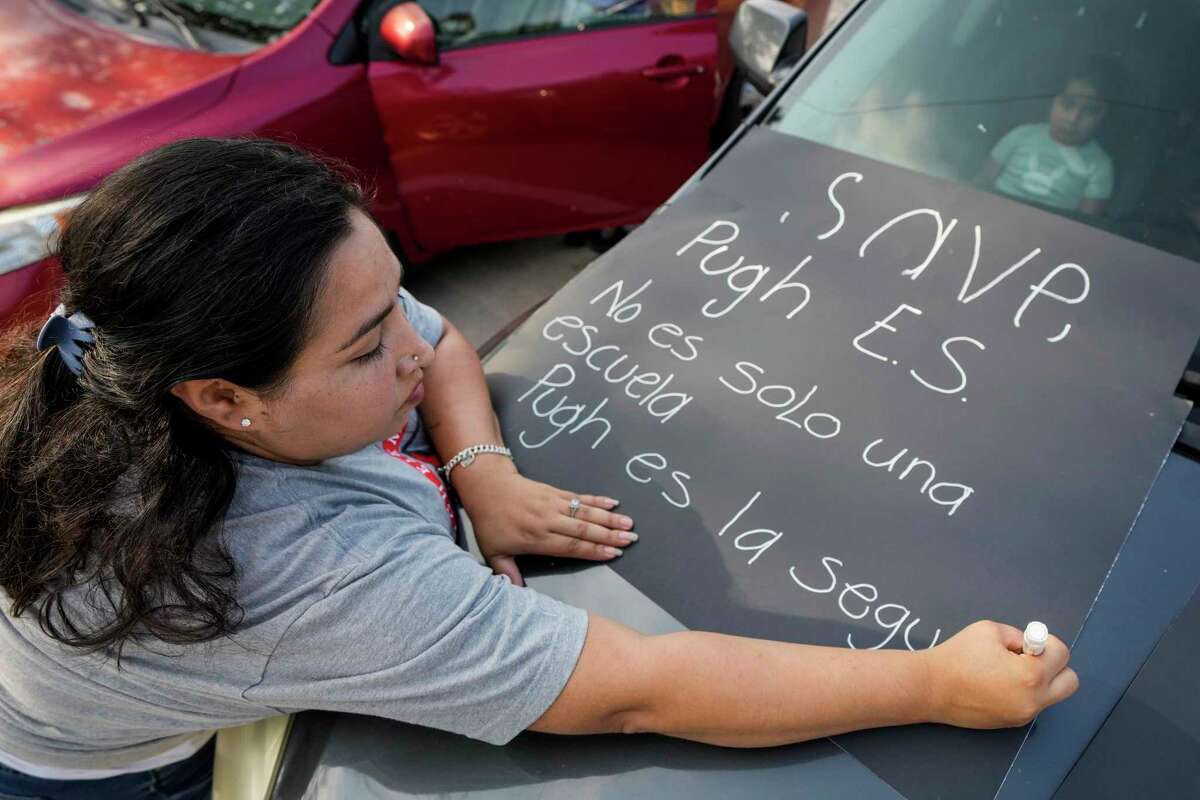
Parents, students and community activists gather near Pugh Elementary School to protest the potential replacement of their children’s teachers by HISD on Thursday, June 15, 2023 in Houston.
Nallely Garza make a sign as she joins parents, students and community activists near Pugh Elementary School to protest the potential replacement of their children’s teachers by HISD on Thursday, June 15, 2023 in Houston.

Radical changes

The 29 schools in the New Education System program that Miles announced on June 1 will likely look radically different when doors open to students on Aug. 28. For starters, kids might be greeted by an entirely new roster of teachers, administrators and support staff; all employees besides custodians, cafeteria workers, bus drivers and nurses have to reapply for their jobs.

Miles has already said that librarians will likely be removed from NES schools, though he promised that they, along with all other teachers, principals, assistant principals and counselors who are already under contract, will be guaranteed similar jobs with the same salary at other schools if they are not brought back. Other staff members have received no such guarantees.

Teachers who do return will make over $90,000 after factoring in various stipends offered for teaching at high-need schools, and be supported by teaching apprentices and learning coaches who will handle much of the supplementary work such as grading and classroom preparation.

The application process is already underway for principals and teachers. NES principals will be selected by June 23, and teachers by July 3.

But staffing changes are just part of the transformation coming to NES schools. Curriculum will be standardized across campuses and lesson plans prepared for teachers in advance. Classes will be recorded via webcam, and students who are pulled from class for disruptive behavior will be sent to another room to watch the streamed class. Magnet offerings such as STEM and dual language programs “will be evaluated on a case-by-case basis” and may be cut.

Emails shared with the Houston Chronicle from principals to their staff suggest school leaders will be observing teachers every day, and that schools will be open from 6:30 a.m. to 5 p.m. each day for free childcare before and after school, with teachers serving four supervisory shifts per month. Miles is also bringing the Dyad program that he had introduced at his charter school network, Third Future Schools, to the NES schools, in which community members will teach students in extra-curriculars, such as sports or arts twice a week, according to emails shared with the Chronicle.

Miles says the changes put students’ most fundamental needs at the forefront by allowing teachers to focus purely on instruction.

“We will be aligning our resources—especially our most effective teachers and principals—to better serve students in underserved communities,” Miles said. “For students who need to catch up and in schools that have failed for years, we will be offering more instructional time.”

Miles has repeatedly stated that he understands the concerns emanating from many in the HISD community, but that he hopes improvements at the schools will eventually win their trust.

“Change brings some anxiety, and there will be some anxiety most of the summer, probably, but we will keep putting information out there so that we can turn that anxiety into hope,” Miles said during his first week in office.

‘Pugh es nuestra familia’

Several parents at Pugh, Martinez and other northeast Houston elementary schools gathered Thursday morning with their children at the Denver Harbor Multi-Service Center to protest the potential removal of teachers from their A-rated schools, before traveling to HISD headquarters to bring their complaints to the district. Children held signs with their teachers’ names — Ms. Rodriguez, Ms. Arguelles, Mr. Infante — and pleas to keep them in place. “Pugh es nuestra familia,” one sign read.

“Every morning, everyone from the principal to the office staff, custodians and cafeteria workers, they greet our children with a smile. I think the kids forget the problems they have at home when they go to school. We don’t want new teachers, we want the same teachers because they’ve been our second family at Pugh,” said Nancy Coronado, a parent volunteer at Pugh for 13 years, in Spanish.

Her son, Ricardo Delgado, graduated from fifth grade at Pugh this year. He discussed his favorite teacher, Ms. Lopez, and how she was a warm, familiar presence to him even before he’d ever taken her class. Now set to start at the Baylor College of Medicine Academy at Ryan Middle School in the fall, Delgado credits Ms. Lopez with teaching him the reading skills he’ll need in middle school.

“If other teachers come, it wouldn’t be the same because she’s been there since I was 6 years old,” Delgado said.

The plan to have teachers reapply for their job has left other Houston parents with mixed feelings. Karmell Johnson, a Fifth Ward mother of three students at NES schools, said there are “pros and cons” to the situation. She welcomes the opportunity to remove under-performing teachers, but worries that some effective teachers, who understand the community they’re serving in and may have formed bonds with students, may be caught up in the mix.

“It’s an emotional roller coaster. Once a bond is established and they rip that out, the kids have to get used to their teachers, the teachers have to get used to the schools, and it’s going to take some time. It’s going to be uncomfortable for everybody,” Johnson said.

Uncertain future for teachers, staff

At many NES schools, however, teacher and principal turnover has already become a fact of life. It was only 10 years ago that North Forest High School was completely reconstituted when the Texas Education Agency ordered North Forest ISD to be absorbed into Houston ISD, and after a brief upswing, it has failed 80 percent of its TEA evaluations since (it passed this year with a C). Wheatley High School replaced a significant portion of their teachers just last year.

Ainhoa Donat, a bilingual fourth grade teacher at Paige Elementary, said she worked with a different fourth-grade colleague in each of her six years at the Eastex/Jensen school.

Donat said she was told by her principal that the school would no longer offer a bilingual program, and that she was welcome to apply for a standard teaching position at the school (the district, in a statement, said that NES schools “will now have a dedicated English Language Arts block for English language development,” which “includes bilingual support for emerging English speakers based on their proficiency level”).

With 16 years of experience at HISD under her belt, the extra money being offered wasn’t enough for Donat to overcome the indignity of being blamed for the school’s low performance. She’s currently in the process of applying for a bilingual job at another HISD campus.

“I have a lot of experience and I work super hard, so when I went to that meeting and the superintendent (basically) said ‘you didn’t do your job,’ I felt really humiliated,” Donat said.

One longtime teacher at Martinez Elementary School, who asked to remain anonymous out of fear of retribution, said she worries that the financial incentives may “entice the wrong people.”

“I would give it back to stay at Martinez,” she said. “There are some teachers who are all about the money… but not at our school.”

The fear is even more acute for support staff, who aren’t guaranteed positions.

One administrative assistant, who has worked for over 20 years at an NES elementary school and also asked to remain anonymous, said she may be forced to retire early if she isn’t rehired. The assistant has spent almost her entire career with HISD and doesn’t know what else she could do.

She wonders who will manage the payroll, procure supplies for teachers, plan field trips and do all the other unseen tasks that keep a school running if support staff are eliminated.

“All I’ve ever known is HISD, getting up and going to work at these schools. We’re not here for the money, we’re here for the children,” she said. “You talk about the children but what are you doing for them? You’re taking their teachers away, and its very upsetting.”Parents, students and community activists gather near Pugh Elementary to protest the potential replacement of their children’s teachers by HISD on Thursday, June 15, 2023 in Houston.Brett Coomer/Houston Chronicle

Photo of Sam González Kelly

Written By 

Sam González Kelly is a reporter for the Houston Chronicle.

You can reach Sam at sam.kelly@chron.comVIEW COMMENTS