Archives for category: Lies

Tomorrow is “No Kings” Day. Join a group and protest Trump’s attempt to make himself our king, our permanent dictator.

Timothy Snyder, noted historian, analyzed Trump’s speech to the troops at Fort Bragg and determined that it was not only self-aggrandizing but also an appeal to disunity, division, and hatred. He honored traitors and oath-breakers, like those who participated in an actual insurrection on January 6, 2021, and leaders of the Confederacy.

Please read and take action to oppose Trump’s tyranny:

Earlier this week Donald Trump called for a second civil war at a US military base. This scenario can be resisted and prevented, if we have the courage to listen, interpret, and act. And this Saturday we will have the occasion to act.

The listening is important. The speech was given at the base now known again as Ft. Bragg. The fort was named for a confederate general. It was renamed Ft. Liberty. Under this administration, it was renamed Fort Bragg, now ostensibly to honor another American serviceman, not the confederate general. It is a dishonest pretense that dishonors everyone. The fort is now named again after a confederate general, as Trump made clear. The tradition that is now in fact being honored, that of oathbreakers and traitors.

In Trump’s speech, the existence of the United States is placed in doubt. We are not a country but a divided society in which some of us deserve punishment by others. He made no mention of the world today, nor of any common American interest that might necessitate national defense. There was no concern about threats from China or Russia. Middle Eastern dictatorships, the only countries that Trump singled out, garnered great praise because their leaders gave Trump money. There was no mention of any wars that are actually underway, such as the Russian invasion of Ukraine.

Trump invoked battlefields across the decades to create a sense of individual heroism, in which of course the history the the US Army is very rich. But that individual heroism is usually cited by commanders in chief as evidence of a nation that is worthy of defense. No such America figured in Trump’s speech. America did not exist Trump’s speech, except as a cult to him personally.

In the actual history of the United States, one war is central: the Civil War. Trump, who has never seen the point of the Union Army defending the republic, now seems now to have moved on to the position that the Confederacy should have won. He promised to rename Fort Gregg-Adams, the first base named for African-Americans, to Fort Robert E. Lee. The base in question hasn’t been known by the full name of the confederate commander since 1950. Lee was a traitor, an oathbreaker, a defender of slavery and the commander of a force whose mission was to break up the United States of America.

In his speech, Trump claimed that seizing undocumented migrants in 2025 shows the same courage as fighting in the Revolutionary War, or the First World War, or the Second World War, or Korea or Vietnam. It would have been news to the soldiers at the time that charging a trench or jumping from a plane is no different than ganging up on a graduate student or bullying a middle-aged seamstress.

But here we see the magic of Trump’s rhetoric: he seeks to transform the courage of the past into the cowardice of the future. He is preparing American soldiers to see themselves as heroes when they undertake operations inside the United States against unarmed people, including their fellow citizens.

All of this, of course, trivializes actual US military achievements. The actual battles of our history just become a “show,” to use one of Trump’s keywords. They are deeds performed for the pleasure of a Leader who then invokes them to justify his own permanent power. Denuded of all context, military glory becomes a spectacle into which any meaning can be injected. And he who injects the meaning is he who rules. That is the fascist principle that Trump understands. There is no politics except struggle, and he who can define the enemy in the struggle can stay in power. But whereas historical fascists had an enemy without and an enemy within, Trump only has an enemy within. The world is too much for him. The army is just for dominating Americans.

Abraham Lincoln statue

In his speech, Trump was trying to transform a legacy of battlefield victory around the world into a future willingness to take illegal orders regarding his own policy on the territory of the United States. The defiance of the law was clear. Trump cannot, for example, legally just rename those bases. The forts were named by an act of Congress. And he cannot legally deploy the Marines to Los Angeles. He has no authority to do so. The president is expressly forbidden by law from using the armed forces to implement domestic policies.

Trump defined himself not as a president but as a permanent Leader. In repeatedly mocking his predecessor, he was summoning soldiers to defy the fundamental idea that their service is to the Constitution and not to a given person. “You think this crowd would have showed up for Biden?” Whether or not it is unprecedented, as I believe it is, such mockery certainly dangerous. It suggests that something besides an election, something like individual charisma, some personal right to rule, is what matters. That soldiers should follow Trump because he is Trump, and not for any other reason.

In general, we imagine that the US Army is here to defend us, not to attack us. But summoning soldiers to heckle their fellow Americans is a sign of something quite different. Trump seized the occasion to summon soldiers to join him in mocking the press. Reporters, of course, as the Founders understood, are a critical check on tyranny. They, like protestors, are protected by the First Amendment of the Constitution. Trump was teaching soldiers that society does not matter, and that law does not matter. He “loves” soldiers. He is personally responsible for the pay raises: “I gave you so much money for four years it was crazy.” “We’re giving you an across-the-board raise” This is the way a dictator speaks to a palace guard, or a fascist to a paramilitary.

Trump is putting himself above the army and the army above the country: “we only have a country because we first had an army, the army was first.” That ridiculous: the Continental Army was formed in 1775 from the people, for the very specific and time-limited purpose of ending colonial oppression. Trump wants the armed force to be the end in itself, and freedom to be its enemy. Generally, presidents who speak to soldiers of military glory have had in mind the defense of American freedoms, such as the freedom of expression, including the freedom of the press and the freedom to assemble. Trump said nothing about freedom, except as a “flame” or a “shield.” He said nothing about rights. There was not a word about democracy.

We are witnessing an attempt at regime change, rife in perversities. It has a historical component: we are to celebrate the oathbreakers and the traitors. It has a fascist component: we are to embrace the present moment as an exception, in which all things are permitted to the Leader. And of course it has an institutional component: soldiers are meant to be the avant-garde of the end of democracy. Instead of treating the army as defenders or freedom, Trump presented soldiers as his personal armed servants, whose job it was to oppress his chosen enemies — inside the United States. Trump was trying to instruct soldiers that their mission was to crush fellow Americans who dared to exercise their rights, such as the right to protest.

Referring to migration as an “invasion,” as Trump did during the speech, is meant to blur the distinction between his immigration policy and a foreign war. But it is also meant to transform the mission of the US Army. The meaningful border here is that between reality and fantasy. If soldiers and others are willing to accept that migration is an “invasion,” then they enter into an alternative reality. Inside that alternative reality, they will see those who do not accept the invasion fantasy as enemies. And this is exactly what Trump called for when he portrayed elected officials in California as collaborators in “an occupation of the city by criminal invaders.”

The US Army, like other American institutions, includes people of various backgrounds. It depends heavily on African-Americans and non-citizens. One can try to transform the army into a cult of the Confederacy and a tool to persecute migrants, but this will cause, at a minimum, great friction. Beyond this, using the Army to enforce domestic policy risks ruining its reputation. Deploying the armed forces in cities risks US soldiers killing US civilians. It also risks that provocateurs, including foreign ones, including allies of Trump, will try to kill an American soldier to provoke a disaster. (Trump’s birthday parade seems practically designed for such an incident, by the way.) 

Trump will welcome and exploit such situations, of course. He doesn’t have the courage to say things clearly or start conflict directly, but instead sets up others for situations in which they suffer and he profits. The question is whether civil war is the future Army officers and soldiers want. When Trump promises to celebrate Robert E. Lee, he is telling the Army that oath-breakers and traitors will be celebrated in the future. This is not in his gift. Officers who bring the US armed forces to battle American civilians will be remembered by the heirs of a broken republic and as the people who started a second American civil war.

It is clear what Trump is trying to do. He wants to turn everything around. He wants an army that is not a legal institution but a personal paramilitary. He wants it not to defend Americans but to oppress them. He wishes the shame of our national history to become our pride. He wants to transform a republic into a fascist regime by transforming a history of courage into a future of cowardice.

This can only succeed if it goes unchallenged. All of us can think about his words and their implications. Officers and soldiers can remember that not all orders are legal orders. Those in the media can interpret Trump’s speeches clearly rather than just repeating them or seeing them as one side in a partisan dispute. Our courts can name the limits of his authority. And even a Republican Congress can recognize when its powers are being usurped in a way that risks the end of our country.

Though he did not mention the Civil War, Trump did refer to “the sacred soil of Gettysburg.” It is worth recalling Lincoln’s very different sense of the sacrifice of American soldiers in his Gettysburg Address:

The brave men, living and dead, who struggled here, have consecrated it, far above our poor power to add or detract. The world will little note, nor long remember what we say here, but it can never forget what they did here. It is for us the living, rather, to be dedicated here to the unfinished work which they who fought here have thus far so nobly advanced. It is rather for us to be here dedicated to the great task remaining before us — that from these honored dead we take increased devotion to that cause for which they gave the last full measure of devotion — that we here highly resolve that these dead shall not have died in vain — that this nation, under God, shall have a new birth of freedom — and that government of the people, by the people, for the people, shall not perish from the earth.

In the end, and in the beginning, and at all moments of strife, a government of the people, by the people, for the people depends upon the awareness and the actions of all of us. A democracy only exists if a people exist, and a people only exists in individuals’ awareness of one another of itself and of their need to act together. This weekend Trump plans a celebration of American military power as a celebration of himself on his birthday — military dictatorship nonsense. This is a further step towards a different kind of regime. It can be called out, and it can be overwhelmed.

Thousands of Americans across the land, many veterans among them, have worked hard to organize protests this Saturday — against tyranny, for freedom, for government of the people, by the people, for the people. Join them if you can. No Kings Day is June 14th.

Members of the military are supposed to be nonpartisan; they serve the nation, not the President or his party. Yet Trump gave an invective-filled speech to the troops at Fort Bragg, denouncing his political enemies, while a pop-up shop sold Trump campaign merchandise to the troops.

All completely inappropriate. But Trump respects no norms. The Supreme Court gave him “absolute immunity” as president. He will use that license to do and say whatever he wants, no matter how inappropriate.

Military.com reported on the politicization of the military and how it violates Pentagon policy.

It was supposed to be a routine appearance, a visit from the commander in chief to rally the troops, boost morale and celebrate the Army‘s 250th-birthday week, which culminates with a Washington, D.C., parade slated for Saturday.

Instead, what unfolded Tuesday at Fort Bragg, North Carolina, bore little resemblance to the customary visit from a president and defense secretary. There, President Donald Trump unleashed a speech laced with partisan invective, goading jeers from a crowd of soldiers positioned behind his podium — blurring the long-standing and sacrosanct line between the military and partisan politics.

As Trump viciously attacked his perceived political foes, he whipped up boos from the gathered troops directed at California leaders, including Gov. Gavin Newsom — amid the president’s controversial move to deploy the National Guard and Marines against protesters in Los Angeles — as well as former President Joe Biden and the press. The soldiers roared with laughter and applauded Trump’s diatribe in a shocking and rare public display of troops taking part in naked political partisanship.

For this story, Military.com reached out to Defense Secretary Pete Hegseth’s office as well as the Army and the 82nd Airborne Division directly with a series of questions that ranged from the optics of the event to social media posts showing the sale of Trump campaign merchandise on the base, to the apparent violation of Pentagon policies on political activity in uniform.

Internal 82nd Airborne Division communications reviewed by Military.com reveal a tightly orchestrated effort to curate the optics of Trump’s recent visit, including handpicking soldiers for the audience based on political leanings and physical appearance. The troops ultimately selected to be behind Trump and visible to the cameras were almost exclusively male.

One unit-level message bluntly said “no fat soldiers.”

Open the link from Military.com to continue reading.

Trump speech at Fort Bragg.

Secretary of Health and Human Services Robert F. Kennedy Jr. fired the Center for Disease Control’s expert advisory panel on vaccines. This clears the way for him to appoint people who share his wacko views about vaccines. When asked why he fired them, he lied and said they had conflicts of interest. This was not true.

Apoorva Mandavilli of The New York Times reported:

The health secretary, Robert F. Kennedy Jr., on Monday retired all 17 members of an advisory committee on immunization to the Centers for Disease Control and Prevention, arguing that the move would restore the public’s trust in vaccines.

He made the announcement on Monday in an opinion column for The Wall Street Journal.

The C.D.C.’s vaccine advisers wield enormous influence. They carefully review data on vaccines, debate the evidence and vote on who should get the shots and when. Insurance companies are required to cover the vaccines recommended by the panel.

This is the latest in a series of moves Mr. Kennedy, a vaccine skeptic, has made to drastically reshape policy on immunizations. A vaccine panel more closely aligned with Mr. Kennedy’s views has the potential to significantly alter the immunizations recommended to Americans, including childhood vaccinations.

Mr. Kennedy said the panel, called the Advisory Committee on Immunization Practices, “has been plagued with persistent conflicts of interest….”

In fact, ACIP members are carefully screened for major conflicts of interest, and they cannot hold stocks or serve on advisory boards or speaker bureaus affiliated with vaccine manufacturers.

On the rare occasion that members have indirect conflicts of interest — for example, if an institution at which they work receives money from a drug manufacturer — they disclose the conflict and recuse themselves from related votes.

Paul Offit, director of the Vaccine Education Center at Children’s Hospital of Philadelphia and former member of the panel, expressed concern that Kennedy wants to replace members of the panel with people who share his antagonism towards vaccines.

How many Americans will die because of this extremist who has strong opinions but limited knowledge of science or medicine?

In his epic battle to punish the nation’s most prestigious university, Trump claimed that Harvard is teaching remedial math. That was his way of saying that its standards of admission are very low because Harvard wants to recruit unqualified nonwhite students.

Trump has refused to release his own academic record but his public statements indicate that he is in no position to tell Harvard whom to admit or what to teach.

Only 3.6% of the students who applied to Harvard last year were admitted.

The Boston Globe took a close look at the course that Trump–the stable genius–calls “remedial.”

A star student at her small Alabama high school, Kyra Richardson graduated confident in her academic prowess in all but one subject: math.

By the time she arrived at Harvard in the fall of 2024, it had been more than 12 months since Richardson‘s last math class. Even though she passed a college-level AP calculus course as a high school junior, Richardson said it felt more like she was memorizing formulas than truly understanding the concepts behind calculus.

So when it came time for her to begin fulfilling the math requirement associated with Harvard’s pre-medical track, the university recommended (and Richardson agreed) she should take an intro-level calculus course called Math MA.

Even with her previous calculus experience, she said, the Harvard course was far from an easy A. “I’m glad that I took a class that pushed me,” Richardson said.

In recent months, amid the White House’s ongoing battle with Harvard, the Trump administration has used that class to questionthe university’s academic rigor. In what has become a familiar refrain, Education Secretary Linda McMahonJosh Gruenbaum, a top US General Services Administration official, and President Trump himself have all labeled a modified version of the calculus course Richardson completed — known as MA5 — “remedial math.” 

“I want Harvard to be great again,” Trump said in the Oval Office last month. “Harvard announced two weeks ago that they’re going to teach remedial mathematics. Remedial, meaning they’re going to teach low grade mathematics like two plus two is four. How did these people get into Harvard if they can’t do basic mathematics?”

Richardson said she laughed when she heard the remedial math comment because “MA5 is the exact same class [as MA]. It just meets five times a week” as opposed to four. 

According to an online course description of MA5, the extra day of instruction time “will target foundational skills in algebra, geometry, and quantitative reasoning that will help you unlock success in Math MA.” The homework, exams, and grading structure of MA5 are the same as MA, a course Harvard has offered for decades. Even MA5’s format is not entirely new. Five days of instruction was previously required for all students taking Math MA in 2018.

“If you look at academic support and a college trying to help their students, and you think that’s unnecessary or it’s embarrassing that they have to provide that kind of support, then it’s coming from a place of ignorance,” said Richardson. “You have no understanding of how, not just college, but how learning works. You can’t learn without help.”

All Harvard freshmen take a placement exam in mathematics prior to their arrival on campus. Based on how they score, the university suggests which course they should be placed into. Math MA5, MA, and its companion course, MB, make up Harvard’s most basic introductory calculus courses known as the M series. MA5 was introduced last year by Harvard to combat pandemic learning losses, which saw students show up to campus with gaps in their math knowledge, especially in early high school courses like algebra, as a result of virtual learning. 

“When this first came out about us teaching remedial math, I was like, ‘Well, this is news to me and I wouldn’t even know how to do it,’” said Harvard’s director of introductory math Brendan Kelly. “Thinking about how to explain addition to somebody is an expertise that your elementary school teachers and middle school teachers have. … We focus on much more advanced mathematics.”

Only 20 students took MA5 this past academic year according to Kelly. The course was taught across two sections, each with 10 students, Kelly said, all of whom have declared majors like economics or biology that necessitate a strong foundation in calculus…

Remedial math courses in higher education are typically defined as “non credit bearing courses that cover middle school and high school content below that of college algebra,” said Chris Rasmussen, a professor of mathematics at San Diego State University. “So we’re talking fractions or some basic algebraic manipulation.” Rasmussen — who was part of a team of outside professors that recently conducted a full review of Harvard’s math department — said “in no way is MA5 a remedial math course. It’s a rigorous calculus course.”

The article includes a PDF with the course syllabus. How many members of Congress could pass it? Not many. Certainly not Trump or Secretary McMahon.

Trump got very angry at the AP, an international press agency, because it insisted on calling the Gulf of Mexico by its rightful name. It refused to follow Trump’s renaming it as “the Gulf of America.”

So Trump punished the AP by excluding it from the press pool on Air Force 1 and in other gatherings.

A three-judge panel voted 2-1 to allow Trump to continue choosing which press gets access to him. Two of the judges were appointed by Trump.

Peter Baker, a national correspondent for The New York Times wrote on Twitter:

Appeals court rules that the president can punish a news outlet based on the content of its coverage by denying it access that it has had for generations. If the decision stands, it represents a major blow to press freedom. @ZJMontague @minhokimdh

The consequences of this go beyond Trump barring the @AP from the White House press pool. By this logic, a future Democratic president will be able to bar conservative media outlets that want to ask about, say, his advancing age or his son’s business activities.

Replies to his comments criticized the media for not boycotting Trump events in solidarity with AP.

The New York Times reported:

A federal appeals court on Friday paused a lower court’s ruling that had required the White House to allow journalists from The Associated Press to participate in covering President Trump’s daily events and travel alongside their peers from other major news outlets.

By a 2-to-1 vote, a three-judge panel of the U.S. Court of Appeals for the District of Columbia Circuit found that many of the spaces in the White House complex or on Air Force One where members of the press have followed the president for decades are essentially invite-only, and not covered by First Amendment protections.

“The White House therefore retains discretion to determine, including on the basis of viewpoint, which journalists will be admitted,” wrote Judge Neomi Rao, a Trump appointee. She was joined by Judge Gregory G. Katsas, who was also appointed by Mr. Trump.

The ruling temporarily lifted the requirement that the White House give A.P. journalists the same access as other news media professionals while the appeal continues. But it was clouded by the fact that the situation facing The Associated Press has shifted considerably since the legal standoff began in February.

Heather Cox Richardson warns about the Republicans’ “One Big, Beautiful Bill,” which cuts Medicaid and other vital services while increasing the deficit. Republicans cover up the cruel cuts to vital services by lying about them.

She writes:

The Republicans’ giant budget reconciliation bill has focused attention on the drastic cuts the Trump administration is making to the American government. On Friday, when a constituent at a town hall shouted that the Republicans’ proposed cuts to Medicaid, the federal healthcare program for low-income Americans, meant that “people will die,” Senator Joni Ernst (R-IA) replied, “Well, we are all going to die.”

The next day, Ernst released a video purporting to be an apology. It made things worse. “I made an incorrect assumption that everyone in the auditorium understood that, yes, we are all going to perish from this Earth. So, I apologize. And I’m really, really glad that I did not have to bring up the subject of the tooth fairy as well. But for those that would like to see eternal and everlasting life, I encourage you to embrace my lord and savior, Jesus Christ,” she said.

Ernst blamed the “hysteria that’s out there coming from the left” for the outcry over her comments. Like other Republicans, she claims that the proposed cuts of more than $700 billion in Medicaid funding over the next ten years is designed only to get rid of the waste and fraud in the program. Thus, they say, they are actually strengthening Medicaid for those who need it.

But, as Linda Qiu noted in the New York Timestoday, most of the bill’s provisions have little to do with the “waste, fraud, and abuse” Republicans talk about. They target Medicaid expansion, cut the ability of states to finance Medicaid, force states to drop coverage, and limit access to care. And the nonpartisan Congressional Budget Office (CBO) says the cuts mean more than 10.3 million Americans will lose health care coverage.

House speaker Mike Johnson has claimed that those losing coverage will be 1.4 million unauthorized immigrants, but this is false. As Qiu notes, although 14 states use their own funds to provide health insurance for undocumented immigrant children, and seven of those states provide some coverage for undocumented pregnant women, in fact, “unauthorized immigrants are not eligible for federally funded Medicaid, except in emergency situations.” Instead, the bill pressures those fourteen states to drop undocumented coverage by reducing their federal Medicaid funding.

MAGA Republicans claim their “One Big, Beautiful Bill”—that’s its official name—dramatically reduces the deficit, but that, too, is a lie.

On Thursday, May 29, White House press secretary Karoline Leavitt claimed the measure would carry out “the largest deficit reduction in nearly 30 years with $1.6 trillion in mandatory savings.” She echoed forty years of Republican claims that the economic growth unleashed by the measure would lead to higher tax revenues, a claim that hasn’t been true since Ronald Reagan made it in the 1980s.

In fact, the CBO estimates that the tax cuts and additional spending in the measure mean “[a]n increase in the federal deficit of $3.8 trillion.” As G. Elliott Morris of Strength in Numbers notes, the CBO has been historically very reliable, but Leavitt and House speaker Mike Johnson (R-LA) tried to discount its scoring by claiming, as Johnson said: “They are historically totally unreliable. It’s run by Democrats.”

The director of the CBO, economist Philip Swagel, worked as chief of staff and senior economist at the Council of Economic Advisors during the George W. Bush administration. He was appointed in 2019 with the support of Senate Budget Committee chair Michael Enzi (R-WY) and House Budget Committee chair John Yarmuth (D-KY). He was reappointed in 2023 with bipartisan support.

Republican cuts to government programs are a dramatic reworking of America’s traditional evidence-based government that works to improve the lives of a majority of Americans. They are replacing that government with an ideologically driven system that concentrates wealth and power in a few hands and denies that the government has a role to play in protecting Americans.

And yet, those who get their news by watching the Fox News Channel are likely unaware of the Republicans’ planned changes to Medicaid. As Aaron Rupar noted, on this morning’s Fox and Friends, the hosts mentioned Medicaid just once. They mentioned former president Joe Biden 39 times.

That change shows dramatically in cuts to the National Oceanic and Atmospheric Administration (NOAA). NOAA is an agency in the Commerce Department, established under Republican president Richard Nixon in 1970, that monitors weather conditions, storms, and ocean currents. The National Weather Service (NWS), which provides weather, wind, and ocean forecasts, is part of NOAA.

NWS forecasts annually provide the U.S. with an estimated $31.5 billion in benefits as they enable farmers, fishermen, businesspeople, schools, and individuals to plan around weather events.

As soon as he took office, Trump imposed an across-the-board hiring freeze, and billionaire Elon Musk’s “Department of Government Efficiency” fired probationary employees and impounded funds Congress had appropriated. Now, as hurricane season begins, experts in storms and disasters are worried that the NOAA will be unable to function adequately.

Cuts to the NWS have already meant fewer weather balloons and thus less data, leaving gaps in information for a March ice storm in Northern Michigan and for storms and floods in Oklahoma in April. Oliver Milman of The Guardianreported today that 15 NWS offices on the Gulf of Mexico, a region vulnerable to hurricanes, are understaffed after losing more than 600 employees. Miami’s National Hurricane Center is short five specialists. Thirty of the 122 NWS stations no longer have a meteorologist in charge, and as of June 1, seven of those 122 stations will not have enough staff to operate around the clock.

On May 5, the five living former NWS leaders, who served under both Democratic and Republican presidents, wrote a letter to the American people warning that the cuts threaten to bring “needless loss of life.” They urged Americans to “raise your voice” against the cuts.

Trump’s proposed 2026 budget calls for “terminating a variety of climate-dominated research, data, and grant programs” and cutting about 25% more out of NOAA’s funding.

The Federal Emergency Management Agency (FEMA) has also suffered dramatic cuts as Trump has said he intends to push disaster recovery to the states. The lack of expertise is taking a toll there, too. Today staff members there said they were baffled after David Richardson, the head of the agency, said he did not know the United States has a hurricane season. (It does, and it stretches from June 1 to the end of November.) Richardson had no experience with disaster response before taking charge of FEMA.

Trump’s proposed cuts to the National Institutes of Health (NIH) are even more draconian. On Friday, in a more detailed budget than the administration published in early May, the administration called for cuts of 43% to the NIH, about $20 billion a year. That includes cuts of nearly 40% to the National Cancer Institute. At the same time, the administration is threatening to end virtually all biomedical research at universities.

On Friday, May 23, the White House issued an executive order called “Restoring Gold Standard Science.” The order cites the COVID-19 guidance about school reopenings from the Centers for Disease Control and Prevention to claim that the federal government under President Joe Biden “used or promoted scientific information in a highly misleading manner.” (Schools closed in March 2020 under Trump.) The document orders that “[e]mployees shall not engage in scientific misconduct” and, scientists Colette Delawalla, Victor Ambros, Carl Bergstrom, Carol Greider, Michael Mann, and Brian Nosek explain in The Guardian, gives political appointees the power to silence any research they oppose “based on their own ‘judgment.’” They also have the power to punish those scientists whose work they find objectionable.

The Guardian authors note that science is “the most important long-term investment for humanity.” They recall the story of Soviet biologist Trofim Lysenko, who is a prime example of the terrible danger of replacing fact-based reality with ideology.

As Sam Kean of The Atlantic noted in 2017, Lysenko opposed science-based agriculture in the mid-20th century in favor of the pseudo-scientific idea that the environment alone shapes plants and animals. This idea reflected communist political thought, and Lysenko gained the favor of Soviet leader Joseph Stalin. Lysenko claimed that his own agricultural techniques, which included transforming one species into another, would dramatically increase crop yields. Government leaders declared that Lysenko’s ideas were the only correct ones, and anyone who disagreed with him was denounced. About 3,000 biologists whose work contradicted his were fired or sent to jail. Some were executed. Scientific research was effectively banned.

In the 1930s, Soviet leaders set out to “modernize” Soviet agriculture, and when their new state-run farming collectives failed, they turned to Lysenko to fix the problem with his new techniques. Almost everything planted according to his demands died or rotted. In the USSR and in China, which adopted his methods in the 1950s, at least 30 million people died of starvation.

“[W]hen the doctrines of science and the doctrines of communism clashed, he always chose the latter—confident that biology would conform to ideology in the end,” Kean said of Lysenko. He concludes: “It never did.”

Jamelle Bouie writes an opinion column for The New York Times, and he is my favorite on that site. His insights are clear and sharp. In this column, he reminds us that Republicans have a long history of promises about tax cuts for the middle class that have ended up enriching the wealthiest and increasing inequality.

He writes:

It’s 1981. A Republican president and his allies in Congress are promising large, broad tax cuts that will benefit the middle class and strengthen the economy.

It’s 2001. A Republican president is promising broad tax cuts that will benefit the middle class and strengthen the economy.

It’s 2003. That same president is promising another round of broad tax cuts that will benefit the middle class and strengthen the economy.

It’s 2017. Yet another Republican president is promising broad tax cuts that will benefit the middle class and strengthen the economy.

With each new Republican administration, it is the same promise. With each round of tax cuts, it is the same result: vast benefits for the wealthiest Americans and a pittance for everyone else. There is little growth but widening inequality and an even starker gap between the haves and have-nots.

President Ronald Reagan’s 1981 tax cuts, which inaugurated the pattern, slashed the top tax rate on investment income to 50 percent from 70 percent and the capital gains rate to 20 percent from 28 percent. “New tax benefits for business were so generous,” Michael J. Graetz writes in “The Power to Destroy: How the Antitax Movement Hijacked America,” “that corporate tax receipts declined from about 15 percent to less than 9 percent of federal revenues.” The law, he continues, “substantially cut taxes on income generated from wealth, increased opportunities for tax-free savings by upper-income Americans and greatly expanded tax-shelter opportunities for high-income individuals and corporations.” It also “reduced taxes on transfers of wealth from the richest Americans to their descendants by exempting all but a small fraction of the wealthiest 1 percent” from the estate tax.

Over the next decade, Reagan and his successor George H.W. Bush were forced to raise taxes as a result of this profligacy. Reagan signed deficit-reducing tax increases in 1982, 1983, 1984 and 1987. Bush signed a significant tax increase in 1990, breaking his “Read my lips” election-year promise not to raise taxes.

George W. Bush rejected his father’s fiscal heterodoxy in favor of the unrepentant supply-side orthodoxy of Reagan’s first year. Sold as middle-class tax relief, the $1.7 trillion George W. Bush tax cuts — passed in 2001 and 2003 — were by and large a handout to the wealthiest Americans. As Graetz notes, they “reduced federal revenues from 20 percent of G.D.P. in 2000 to 15.6 percent in 2004,” and when all the changes were phased in, “they raised the after-tax incomes of people in the top 1 percent by nearly 6.5 percent — $54,000 on average — compared to about 1 percent, or an average of $207, for the bottom 40 percent.” In a 2017 analysis of the legacy of the George W. Bush tax cuts, the Center on Budget and Policy Priorities found that the top 1 percent of households received an average tax cut of over $570,000 from 2004 to 2012. Not surprisingly, it also found that these cuts “did not improve economic growth or pay for themselves, but instead ballooned deficits and debt and contributed to a rise in income inequality.”

We can basically copy and paste this dynamic from Reagan and George W. Bush to Donald Trump, who sold his 2017 tax cuts as — you guessed it — middle-class relief. “Our focus is on helping the folks who work in the mailrooms and the machine shops of America,” he told supporters in the fall of 2017. “The plumbers, the carpenters, the cops, the teachers, the truck drivers, the pipe fitters, the people that like me best.”

Except — surprise! — a vast majority of the benefits of the $1.9 trillion Tax Cuts and Jobs Act went to the highest earners — millionaire chief executives and billionaire owners of large companies. Americans in the middle received an average tax cut of $910. Americans in the top 1 percent received an average cut of $61,090. The 2017 law also cut estate taxes and gave new advantages to real estate investors, direct benefits for Trump and his family.

We are now looking at another round of Republican tax cuts. Yet again the claim is that this will benefit most Americans. “The next phase of our plan to deliver the greatest economy in history is for this Congress to pass tax cuts for everybody,” Trump said in his March 4 address to Congress. But as Paul Krugman points out in his Substack newsletter, this latest package is both a shameless giveaway to the rich and a ruinous cut to safety net programs for lower-income and working Americans.

The tax and benefit cuts are, in fact, two sides of the same coin. To pay for the more than $1.1 trillion in tax cuts for people with incomes above $500,000, the House Republican framework would cut $300 billion from the Supplemental Nutrition Assistance Program — snatching food assistance away from millions of low-income families — and $800 billion from Medicaid and the Affordable Care Act, leaving an estimated 10 million or more Americans without health insurance, according to the Congressional Budget Office. The top 0.1 percent of earners would see their income grow; the bottom 20 percent would see it plummet.

It remains to be seen whether Republicans can pass their bill in the form they want. They have had some trouble moving it out of the House of Representatives and into the Senate. But if they can, it’s hard to imagine that there will be much appetite to kill the president’s “big, beautiful bill.”

Which is all to say that it’s 2025, and a Republican president has promised a broad tax cut that will help the middle class and strengthen the economy. I think we know what is going to come next.

Peter Greene nails one of the many flaws of school choice. The choice movement hurtles forward despite its record of failure to fulfill any of its promises but one: It provides choice. Not necessarily good choice or better choice. Just choice.

Greene writes:

When researcher Josh Cowen is talking about the negative effects of school vouchers on education, he often points at “subprime” private schools— schools opened in strip malls or church basements or some other piece of cheap real estate and operated by people who are either fraudsters or incompetents or both.

This is a feature, not a bug. Because as much as choice advocates tout the awesomeness of competition, the taxpayer-funded free market choice system that we’ve been saddled with has built in perverse incentives that guarantee competition will be focused on the wrong things.

The free market does not foster superior quality; the free market fosters superior marketing. Now, the marketing can be based on superior quality, but sometimes it’s just easier to go another way.

The thing about voucher schools is that quality is not what makes them money. What makes them money is signing people up.

That’s it. Voucher school operators don’t have to run a good school; they just have to sell the seats. Once the student is signed up and their voucher dollars are in the bank, the important part of the transaction is over. There is no incentive for the school to spend a pile of money on doing a good job; all the incentive is for the school to come up with a good marketing plan.

Betsy DeVos liked to compare the free market for schools with a row of food trucks, which was wrong for a host of reasons, but one was the market speed. Buy lunch at a food truck, and you become part of the marketing very quickly. Within minutes, you are either a satisfied customer telling your friends to eat there, or warning everyone to stay away. Reputations are built quickly.

But for schools, the creation of a reputation for quality takes a long time, time measured in years. The most stable part of the voucher school market is schools that already have their reputation in place from years of operation. But if you are a start-up, you need to get that money for those seats right now. If you are a struggling crappy private school with a not-so-great reputation, you don’t have time to turn that around; you’ve got to up your marketing game right now.

So the focus (and investment) goes toward marketing and enrollment.

Won’t your poor performance catch up with you? Maybe, but the market turns over yearly, as students age out and age in to school. And you don’t have to capture much of it. If you are in an urban center with 100,000 students and your school just needs to fill 100 seats, disgruntled former families won’t hurt you much– just get out there and pitch to the other 99,900 students. And if you do go under, well, you made a nice chunk of money for a few years, and now you can move on to your next grift.

This is also why the “better” private schools remain unavailable to most families holding a voucher. If a reputation for quality is your main selling point, you can’t afford to let in students who might hurt that record of success.

Meanwhile, talk to teachers at some of the less-glowing private and charter schools about the amount of pressure they get to make the student numbers look good.

Because of the way incentives are structured, the business of a voucher school is not education. The business of the voucher school is to sell seats, and the education side of the business exists only to help sell seats. Our version of a free market system guarantees that the schools will operate backwards, an enrollment sales business with classrooms set up with a primary purpose of supporting the sales department, instead of vice versa.

Charter schools? The same problem, but add one other source of revenue– government grants. Under Trump, the feds will offer up a half a billion dollars to anyone who wants to get into the charter biz, and we already know that historically one dollar out of every four will go to fraud or waste, including charter businesses that will collect a ton of taxpayer money and never even open.

“Yeah, well,” say the haters. “Isn’t that also true for public schools”

No, it is not. Here’s why. Public schools are not businesses. They are service providers, not commodity vendors. Like the post office, like health care in civilized countries, like snow plows, like (once upon a time) journalism, their job is to provide a necessary service to the citizens of this country. Their job should be not to compete, but to serve, for the reasons laid out here.

And this week-ass excuse for accountability– if you do a bad enough job, maybe it will make it harder for your marketing department– has been sold as the only accountability that school choice needs.

School choice, because its perverse incentives favor selling seats over educating students, is ripe for enshittification, Cory Doctorow’s name for the process by which operators make products deliberately worse in order to make them more profitable. The “product” doesn’t have to be good– just good enough not to mess up the sales. And with no meaningful oversight to determine where the “good enough” line should be drawn, subprime voucher and charter schools are free to see just how close to the bottom they can get. It is far too easy to transform into a backwards business, which is why it should not be a business at all.

If your foundational belief is that nobody ever does anything unless they can profit from it (and therefor everything must be run “like a business”) then we are in “I don’t know how to explain that you should care about other people” territory, and I’m not sure what to tell you. What is the incentive to work in a public education system? That’s a whole other post, but I would point to Daniel Pink’s theory of motivation– autonomy, mastery and purpose. Particular a purpose that is one centered on making life better for young human beings and a country better for being filled with educated humans. I am sure there are people following that motivation in the school choice world, but they are trapped in a model that is inhospitable to such thinking.

Jennifer Berkshire has both good news and bad news about vouchers. The idea of public funding for religious and private schools had some big wins this year, especially in Texas. But most vouchers are subsidizing kids who never attended public schools; that’s a feature, not a bug as it creates strong support for the giveaway among the highest-income people. But, lo! The real cost of have the state pay for everyone’s tuition is beginning to get the attention of taxpayers. And that could cause a backlash against welfare for the wealthy. Florida is already paying $4 billion a year for vouchers. Will taxpayers object?

She writes:

Champagne corks, storm clouds—I’m mixing my metaphors here. But as we survey the steaming wreckage of the 2025 state legislative sessions, both are present in spades. Let’s start with the popping corks: the school voucher movement really did notch some big wins this year, adding Tennessee, South Carolina, Idaho and the biggest prize of all, Texas, to the list of states with “education freedom.” Now add in the sneaky move to slip a voucher program that is really a tax shelter for the wealthy into the tax code and it’s easy to feel despondent, and not just about the future of public education. 

Listen in on the debates that played out in these states, though, and you’ll come away with a very different view. As the economy sours and the tide of red ink rises, alarm bells are sounding and a backlash is brewing.

Let’s start with a quick trip to my neighboring state, New Hampshire, where a familiar series of events has transpired. Now, in the Granite State, vouchers are known as Education Freedom Accounts, and they were sold to notoriously thrifty Yankees as a way to save money as students abandoned “government schools” for less expensive private religious schools, home schools, microschools. But nothing of the sort happened, leaving taxpayers to foot the bill for thousands of students who’d never attended public schools. Meanwhile, New Hampshire’s revenue situation has been deteriorating rapidly thanks to yet another round of slashing taxes on businesses. 

All of which adds up to some pretty bleak math as the state must now figure out how to pay for an expensive—and expanding—school voucher program even as New Hampshire’s budget pie keeps shrinking. Which is how GOP lawmakers seem to have landed on the worst of both worlds: an austerity budget that slashes funding for the state’s public higher education budget in order to pay for the cost of further undermining the state’s public education system. (If you’re wondering why this recipe sounds familiar, you’re thinking of Indiana, star of a recent episode of Have You Heard, and a cautionary tale about what happens when a state expands school choice while simultaneously cutting school funding and divesting from public higher education.)

Different state, same story

While the libertarian paradise known as New Hampshire may be unique, the dynamic playing out here is the same as in virtually every state that has now adopted school vouchers. 1) Ever-shifting goal posts regarding the purpose of these programs? Check. 2) Ballooning voucher costs as states now pick up the tab for students already attending private schools? Check. 3) Deep tax cuts on the wealthy and corporations, meaning less revenue to spend on public education and other social programs? Check. 

Consider Louisiana, which last year enacted the so-called LA GATOR program—short for Giving All True Opportunity to Rise. Now if you know anything about the recent history of school vouchers in Lousiana (spoiler: not good!), this is the time for a chuckle of the bitterest variety. What IS rising rapidly is the program’s cost—nearly $100 million in its second year, estimated to reach as much as $520 million as the program scales up. But when Governor Jeff Landry tried to collect the cash from lawmakers, something interesting happened. They said no, or at least, not so much. 

“I was not remotely expecting that,” [Senate President Cameron] Henry said about Landry seeking an extra $50 million for the program. “Somehow there was a misunderstanding, which we will rectify.” Despite Landry’s request, Henry said he will hold firm to spending roughly the same amount as vouchers cost this school year: $43.5 million “It will be no more” than that, he said, “because that was the original agreement.”

And it wasn’t just Louisiana. Over in Missouri, lawmakers axed their governor’s request for $50 million to scale up the voucher program known as MoScholars. The GOP senator behind the move offered a simple explanation. “I want to make sure that we’re fully funding our obligation to public schools before we start spending 10s of millions of general revenue dollars on private schools.”

If you’re wondering what’s going on, the answer is fairly simple. As voucher programs have ballooned in size and cost, they’ve become a bigger target, especially in states where they’re now hoovering up state funding at the expense of the public schools—which are still attended by most children in every state. And years of tax slashing in these same states is exacerbating what we might call the ‘pie’ problem. Factor in the worsening national economic forecast and things look even more dire. Texas, which is now on the hook for $1 billion a year to pay for vouchers, plummeting oil prices due to Trump’s tariffs is likely to lead to a recession as soon as this summer. 

Theory of change

As regular readers of this newsletter know, I’m an avid reader of conservative treatises. As I type, I’m surrounded by anti-public-education screeds by Pete Hegseth, Kevin Roberts, Betsy DeVos, and Corey DeAngelis. It’s the last one, Parent Revolution: Rescuing Your Kids from the Radicals Ruining Our Schools, that has proven to be a particularly useful guide to our times. How, for example, did school choice for the very wealthy become the civil rights cause of our times? Dr. DeAngelis explains:

“Allowing politically advantaged groups to benefit from the program is also a smart way to keep the policy protected for years to come.”

You see, there’s a theory here: that as monies grow scarce and one state after another devolves into a pitched battle over what’s left, the richest and most connected will fight the hardest to keep what’s theirs. For a preview of what this looks like, I recommend a pitstop in West Virginia, where lawmakers just wrapped up another session by shoveling money at tax cuts for the wealthy and school vouchers, while cutting programs that help people get clean water, find work after struggling with addiction and get child care. Oh well…

But for the theory of change to work, people have to want to live in a West Virginia-like reality, and I’m not at all convinced that that’s the case. Don’t believe me? Let’s head to Florida, which school choice proponents like to point to as a model for the rest of our states, and which now spends $4 billion a year on vouchers. Since the state made the program available to even the wealthiest Floridians, surprise, surprise, they’ve leaped at the opportunity to have tax payers pay their children’s private school tuition:

More than 122,000 new students started using vouchers for the first time in the 2023-24 school year, and nearly 70 percent were already in private school, many in some of Florida’s priciest institutions.

But Florida is also an example of the bad math, and shoddy assumptions, that drive the push for school privatization. As public education advocate and blogger extraordinaire Sue Woltanski has been tirelessly documenting, vouchers are indeed succeeding in defunding Florida’s public schools:

This isn’t because the money follows public school students fleeing to private options, but because, when families, whose children are ALREADY in private schools, are offered a tax-funded discount for their private school tuition, they flock to apply, and private schools encourage it.

As Sue keeps pointing out, the big flaw in the school choice lobby’s theory is that Florida’s public schools aren’t going away. A state that used to brag about how little it spent on its students is now funding two parallel education systems: “one for the nearly 3 million students still enrolled in public schools, and another for the hundreds of thousands already in private or home education, all out of the same funding formula.”

So what gives? The GOP’s solution is to slash funding for popular programs in public schools: AP, IB, CTE. When I asked a reader in Florida what he thought was motivating the lawmakers, he saw a longer-term conspiracy at work. Get rid of programs that parents care about and eventually they’ll abandon their local public schools. But that assumes that these parents are powerless and that lawmakers can eviscerate programs and institutions that matter to them without paying a price. I’m not so sure. 

A few weeks ago I had the pleasure of visiting Sarasota to speak to a group called Support Our Schools. SOS is a phenomenal advocacy group, and in partnership with a youth-led group that’s “organizing school boards to fight fascism, protect democracy, and build power from the ground up,” they’re having a real impact in a community that’s been ground zero for the right-wing takeover of public education. I headed south anticipating that my hosts would be despondent over the state of Florida and the nation, but what I found was the opposite. These local activists were energized, convinced that their cause—defending and strengthening public education—is finally breaking through. In their words, the situation for Florida public schools is now so dire that it’s impossible to ignore. 

Throughout my visit, one theme echoed repeatedly. A backlash is coming. It can’t come soon enough.

During Biden’s term in office, Republicans continually complained that Biden was “weaponizing” the Justice Department because it prosecuted Trump for inciting the insurrection of January 6, 2021, and for taking classified documents to his Mar-A-Lago estate.

Days ago, the Trump administration announced that it had reached a settlement with the family of Ashli Babbitt, who was shot and killed by a police officer as she attempted to be first to break into the House of Representatives’ chamber, where members of Congress were fleeing. The family is suing for $30 million. The police officer who shot her was defending the lives of our elected representatives, both Democrats and Republicans. It’s hard to imagine any other administration, whatever the party in power, paying off the family of a woman leading a mob into the House chambers to stop the electoral vote count.

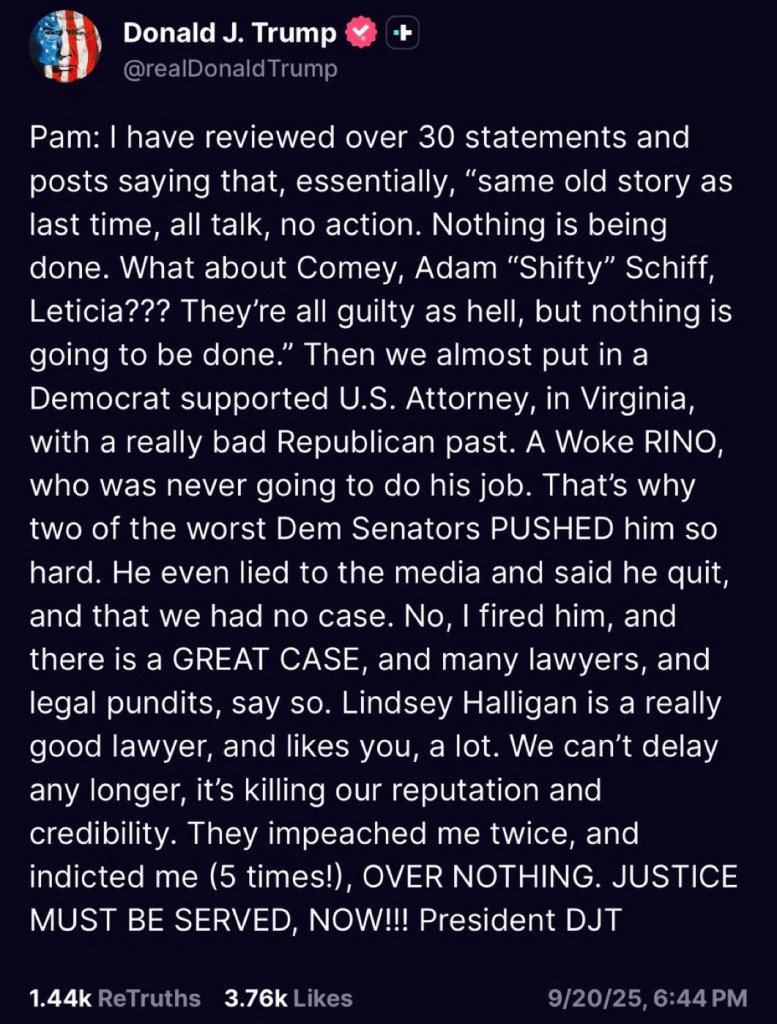
Now that Trump is president again, he has turned the Departnent of Justice into his personal law office and assigned it the mission of prosecuting anyone whoever dared to cross Trump.

Trump is gleefully using his powers to weaponize the Department of Justice and to punish his political enemies. Not a peep from the Republicans, who unjustly accused Biden of doing what Trump is literally doing.

Trump has issued executive orders targeting law firms who had the nerve to represent Democrats or other Trump critics. His orders barred lawyers from those firms from federal buildings and directed the heads of all federal agencies to terminate contracts with the firms he designated. Several major law firms, fearful of being blocked from any federal cases, immediately capitulated. Trump exacted a price for releasing them from his attack: they had to agree to perform pro bono work on behalf of causes chosen by Trump. He currently has close a billion dollars of legal time pledged to him by those law firms that feared his wrath.

Individuals targeted by Trump must either find a lawyer who will represent them pro bono or face personal bankruptcy, that is, if they can find a lawyer willing to take on the Trump administration.

A few law firms have resisted Trump’s tyranny, and one of them–Perkins Coie–won a permanent injunction to block the enforcement of Trump’s ban. Perkins Coie represented Hillary Clinton in 2016, as well as George Soros. U.S. District Judge Beryl Howell said that Trump’s attacks on specific law firms, based on the clients they represented, were unprecedented and unconstitutional.

Judge Howell cited the example of John Adams, who represented the British soldiers accused of killing five colonists in the Boston Massacre of 1770. In two separate trials, Adams prevailed. He believed that everyone deserved a good lawyer and that they had been provoked into firing. Adams was a patriot and a man who defended the law. He was not stigmatized for defending the British soldiers.

An issue that Judge Howell raised but set aside for another time was whether Trump’s orders, which single out specific groups or individuals for punishment without trial are bills of attainder, which the Constitution forbids. They surely look like it, and this issue will come up again in the future.

As law professor James Huffman wrote in The Wall Street journal about Trump’s targeting of law firms:

A presidential bill of attainder places the powers of all three governmental branches in the hands of one man. As James Madison wrote in Federalist No. 47: “The accumulation of all powers, legislative, executive, and judiciary, in the same hands . . . may justly be pronounced the very definition of tyranny.”

Paul Rosenzweig, who worked in the George W. Bush administration, wrote in The Atlantic about Trump’s destruction of the rule of law, which he has twisted into an instrument of retribution for his personal grudges.

He writes:

When Thomas Paine asked what made America different from England, he had a ready answer: “In America, the law is king.” America has not always upheld that ideal, but, taking the long view, it has made great progress toward that principle. In recent decades, the Department of Justice has become an institutional embodiment of these aspirations—the locus in the federal government for professional, apolitical enforcement of the law, which is in itself a rejection of the kingly prerogative. That is why Donald Trump’s debasement of the DOJ is far more than the mere degradation of a governmental agency; it is an assault on the rule of law.

His attack on the institution is threefold: He is using the mechanisms of justice to go after political opponents; he is using those same mechanisms to reward allies; and he is eliminating internal opposition within the department. Each incident making up this pattern is appalling; together, they amount to the decimation of a crucial institution.

Investigations should be based on facts and the law, not politics. Yet Trump has made punishing political opposition the hallmark of his investigative efforts. The DOJ’s independence from political influence, long a symbol of its probity (remember how scandalous it was that Bill Clinton had a brief meeting with Attorney General Loretta Lynch?), is now nonexistent.

This development should frighten all citizens, no matter what their political persuasion. As Attorney General Robert Jackson warned in 1940, the ability of a prosecutor to pick “some person whom he dislikes and desires to embarrass, or selects some group of unpopular persons and then looks for an offense, [is where] the greatest danger of abuse of prosecuting power lies.” Choosing targets in this way flies in the face of the DOJ’s rules and traditions—to say nothing of the actual, grave harm it can inflict on people.

Far from eschewing the possibility of abuse, Trump and his allies at the Department of Justice positively revel in it. The most egregious example was Trump’s recent issuance of an executive order directing the government to investigate the activities of two of his own employees in the first administration, Chris Krebs and Miles Taylor, who later came to be political opponents of his. (Both men are friends and colleagues of mine.)

Their offense of perceived disloyalty is perhaps the gravest sin in Trump world, and as a result, they will now be individually targeted for investigation. The personal impact on each of them is no doubt immediate and severe. Krebs, who is a well-respected cybersecurity leader, has quit his job at SentinelOne and plans to focus on his defense. If Trump’s DOJ pursues this investigation to the limit, the two men could face imprisonment.

The cases of Krebs and Taylor do not stand in isolation. Recently, the U.S. attorney in New Jersey (Trump’s former personal attorney Alina Habba) launched an investigation into the state of New Jersey for its alleged “obstruction” of Trump’s deportation agenda. In other words, because New Jersey won’t let its own employees be drafted as servants of Trump’s policy, the state becomes a pariah in Trump’s mind, one that must be coerced into obedience.

Meanwhile, Attorney General Pam Bondi has announced that the U.S. government is suing Maine because of the state’s refusal to ban transgender athletes from playing on girls’ high-school sports teams. Not content with threatening Maine, Bondi has also announced an investigation of the Los Angeles Sheriff’s Office because of its alleged opposition to the Second Amendment and its “lengthy” process for approval of gun permits. And she recently announced that she would target leakers of classified information by going after journalists, rescinding a policy that protected journalists from being subpoenaed to assist government-leak investigations.

But the most aggressive abuser of the criminal-justice system has to be the interim U.S. attorney for the District of Columbia, Ed Martin. Martin has asked the FBI to investigate several of President Joe Biden’s EPA grantees for alleged fraud—a claim so weak that one of Martin’s senior subordinates resigned rather than have to advance it in court. He has also begun to investigate, or threatened investigations of, Georgetown UniversitySenator Charles Schumer, and Representatives Eugene Vindman and Robert Garcia, among others. More recently, in mid-April, Martin sent a series of inquiry letters to at least three medical and scientific journals, asking them how they ensured “competing viewpoints,” with the evident intention of suggesting that the failure to include certain minority opinions was, in some way, content discrimination.

A less-well-known example of Martin’s excess is his use of threats of criminal prosecution to empower DOGE. When DOGE was first denied entry into the U.S. Institute of Peace, one of the lawyers for USIP got a call from the head of the U.S. attorney’s criminal division, threatening criminal investigation if they didn’t allow DOGE into the building. Magnifying that power of criminal law, Martin sent D.C. police officers to the agency, telling the police that there was “an ongoing incident at the United States Institute of Peace” and that there was “at least one person who was refusing to leave the property at the direction of the acting USIP president, who was lawfully in charge of the facility,” according to the journalist Steve Chapman.

A final example of DOJ overreach is, perhaps, the most chilling of all. In a recently issued presidential memorandum, Trump directed the attorney general to “investigate and take appropriate action concerning allegations regarding the use of online fundraising platforms to make ‘straw’ or ‘dummy’ contributions and to make foreign contributions to U.S. political candidates and committees, all of which break the law.” Were the investigation neutral in nature, this might be understandable. But it isn’t.

In fact, there are two major fundraising platforms in use—WinRed (the Republican platform) and ActBlue (the Democratic one). Even though WinRed has been the subject of seven times as many FTC complaints as ActBlue, the Trump memorandum involves only the latter. By targeting his opponents’ fundraising, Trump is overtly marshaling the powers of federal law enforcement in his effort to shut down political opposition.

In essence, Trump is using the department to try to ensure future Republican electoral victories. One can hardly imagine a more horrifying variation on Lavrentiy Beria’s infamous boast: “Show me the man and I’ll show you the crime.”

There is more to the article. I encourage you to read it in full.