Archives for category: Lies

Bill Phillis is a retired state deputy commissioner of education who is dedicated to the preservation and improvement of public schools in Ohio. He has dedicated his retirement years to publicizing the harm that vouchers and charters do to public schools. He founded the Ohio Coalition for Equity and Adequacy. The Ohio State Constitution guarantees a uniform system of public schools, a commitment that the Republicans who control the state have repeatedly violated with impunity.

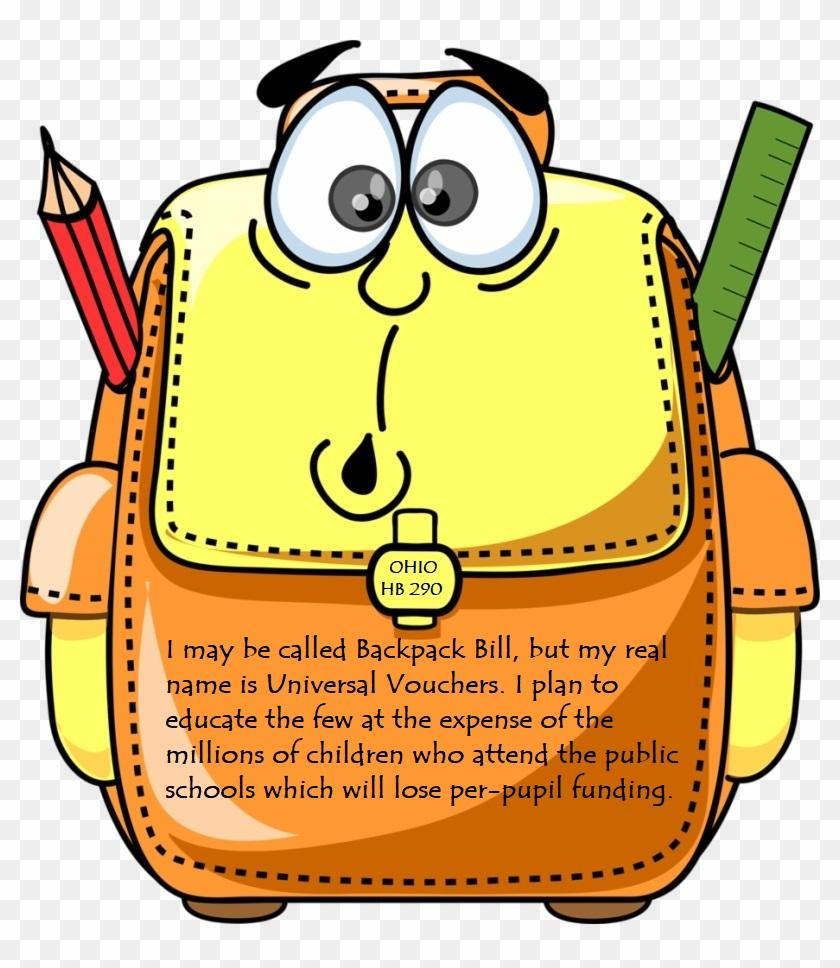
The latest gambit from the Republican privatizers called “the backpack bill,” symbolizing the idea that each child has a “backpack full of cash” to spend in any way their family chooses. They really need to see the wonderful documentary “Backpack Full of Cash.” You can rent the documentary and show it in your community.

Phillis writes:

THE OHIO UNIVERSAL VOUCHER CAMPAIGNERS USE CRITICAL RACE THEORY TO ENTICE FOLKS TO SUPPORT HB290 (UNIVERSAL VOUCHERS) IN A SLICK MAILER


The HB290 crusaders have produced and sent a fundraising mailer signed by one Aaron Baer to an undisclosed list of folks. The seven-page letter warns recipients that public schools are indoctrinating our children into radical anti-Christian ideology, “Critical Race Theory, and trans advocacy”. “They are being trained to hate America”, the letter says. They evidently combed through the classrooms of Ohio and found 4 students whose teachers were doing something that hinted at support for CRT or other controversial issues. They didn’t mention the 100,000 plus public school educators that are working selflessly to grow upstanding citizens.
The author of the letter makes such revealing statements as:

  • “…many of Ohio’s public schools have been failing our students for more than a generation.”
  • “…I initiated the Backpack Bill (HB290)…” (A couple legislators who sponsored the bill indicate they initiated the bill.)
  • “…The Backpack Bill ensures every Ohio student can have access to high quality education…”
  • The P.S. to the letter includes the statement, “Ohio students are trapped in failing public schools…”

The Backpack voucher campaigners are perpetuating the myth of the “failing public school monopoly” as a key plank in their campaign platform.

Public school advocates, who believe HB290 is too extreme to pass, need to wake up.

Follow the link to read the 8 Lies About Private School Vouchershttps://vouchershurtohio.com/8-lies-about-private-school-vouchers/

Like us on Facebook: https://www.facebook.com/OhioEandA


Photo Credit: Jeanne Melvin


The No Child Left Behind Act Has Put The Nation At RiskVouchers Hurt Ohio

William L. Phillis | Ohio Coalition for Equity & Adequacy of School Funding | 614.228.6540 |ohioeanda@sbcglobal.net| http://ohiocoalition.orgSign up for our newsletter!

Duke historian Nancy MacLean, author of the superb Democracy in Chains: The Deep History of the Radical Right’s Stealth Plan for America, wrote recently in The Washington Post about the sinister origins of school choice. Its true purpose was to protect segregation and abolish public schools. (For my view, see this article in The New York Review of Books.)

MacLean writes:

The year 2021 has proved a landmark for the “school choice” cause — a movement committed to the idea of providing public money for parents to use to pay for private schooling.

Republican control of a majority of state legislatures, combined with pandemic learning disruptions, set the stage for multiple victories. Seven states have created new school choice programs, and 11 others have expanded current programs through laws that offer taxpayer-funded vouchers for private schooling and authorize tax credits and educational savings accounts that incentivize parents moving their children out of public schools.

On its face, this new legislation may sound like a win for families seeking more school options. But the roots of the school choice movement are more sinister.

White Southerners first fought for “freedom of choice” in the mid-1950s as a means of defying the U.S. Supreme Court’s 1954 Brown v. Board of Education decision, which mandated the desegregation of public schools. Their goal was to create pathways for White families to remove their children from classrooms facing integration.

Prominent libertarians then took advantage of this idea, seeing it not only as a means of providing private options, but also as a tool in their crusade to dismantle public schools altogether. This history reveals that rather than giving families more school options, school choice became a tool intended to give most families far fewer in the end.

School choice had its roots in a crucial detail of the Brown decision: The ruling only applied to public schools. White Southerners viewed this as a loophole for evading desegregated schools.

In 1955 and 1956, conservative White leaders in Virginia devised a regionwide strategy of “massive resistance” to the high court’s desegregation mandate that hinged on state-funded school vouchers. The State Board of Education provided vouchers, then called tuition grants, of $250 ($2,514 in 2021 dollars) to parents who wanted to keep their children from attending integrated schools. The resistance leaders understood that most Southern White families could not afford private school tuition — and many who could afford it lacked the ideological commitment to segregation to justify the cost. The vouchers, combined with private donations to the new schools in counties facing desegregation mandates, would enable all but a handful of the poorest Whites to evade compliance.


Other Southern states soon adopted voucher programs like the one in Virginia to facilitate the creation of private schools called “segregation academies,” despite opposition from Black families and civil rights leaders. Oliver Hill, an NAACP attorney key to the Virginia case against “separate but equal” education that was folded into Brown, explained their position this way: “No one in a democratic society has a right to have his private prejudices financed at public expense.”


Despite such objections, key conservative and libertarian thinkers and foundations, including economists Milton Friedman and Friedrich Hayek, Human Events editor Felix Morley and publisher Henry Regnery, backed the White Southern cause. They recognized that White Southerners’ push for “freedom of choice” presented an opportunity to advance their goal of privatizing government services and resources, starting with primary and secondary education. They barely, if ever, addressed racism and segregation; instead, they spoke of freedom (implicitly, White freedom).


Friedman began promoting “educational freedom” in 1955, just as Southern states prepared to resist Brown. And he praised the Virginia voucher plan in his 1962 book, “Capitalism and Freedom,” holding it up as a model for school choice everywhere. “Whether the school is integrated or not,” he wrote, should have no bearing on eligibility for the vouchers. In other words, he knew the program was designed to fund segregation academies and saw it as no barrier to receiving state financing.


Friedman was far from alone. His fellow libertarians, including those on the staff of the William Volker Fund, a leading funder on the right, saw no problem with state governments providing tax subsidies to White families who chose segregation academies, even as these states disenfranchised Black voters, blocking them from having a say in these policies.


Libertarians understood that while abolishing the social safety net and other policies constructed during the Progressive era and the New Deal was wildly unpopular, even among White Southerners, school choice could win converts.


These conservative and libertarian thinkers offered up ostensibly race-neutral arguments in favor of the tax subsidies for private schooling sought by white supremacists. In doing so, they taught defenders of segregation a crucial new tactic — abandon overtly racist rationales and instead tout liberty, competition and market choice while embracing an anti-government stance. These race-neutral rationales for private school subsidies gave segregationists a justification that could survive court review — and did, for more than a decade before the Supreme Court ruled them unconstitutional.

When challenged, Friedman and his allies denied that they were motivated by racial bigotry. Yet, they had enough in common ideologically with the segregationists for the partnership to work. Both groups placed a premium on the liberty of those who had long profited from white-supremacist policies and sought to shield their freedom of action from the courts, liberal government policies and civil rights activists.

Crucially, freedom wasn’t the ultimate goal for either group of voucher supporters. White Southerners wielded colorblind language about freedom of choice to help preserve racial segregation and to keep Black children from schools with more resources.

Friedman, too, was interested in far more than school choice. He and his libertarian allies saw vouchers as a temporary first step on the path to school privatization. He didn’t intend for governments to subsidize private education forever. Rather, once the public schools were gone, Friedman envisioned parents eventually shouldering the full cost of private schooling without support from taxpayers. Only in some “charity” cases might governments still provide funding for tuition.

Friedman first articulated this outlook in his 1955 manifesto, but he clung to it for half a century, explaining in 2004, “In my ideal world, government would not be responsible for providing education any more than it is for providing food and clothing.” Four months before his death in 2006, when he spoke to a meeting of the conservative American Legislative Exchange Council (ALEC), he was especially frank. Addressing how to give parents control of their children’s education, Friedman said, “The ideal way would be to abolish the public school system and eliminate all the taxes that pay for it.”

Today, the ultrawealthy backers of school choice are cagey about this long-term goal, knowing that care is required to win the support of parents who want the best for their children. Indeed, in a sad irony, decades after helping to impede Brown’s implementation, school choice advocates on the right targeted families of color for what one libertarian legal strategist called “forging nontraditional alliances.” They won over some parents of color, who came to see vouchers and charter schools as a way to escape the racial and class inequalities that stemmed from White flight out of urban centers and the Supreme Court’s willingness to allow White Americans to avoid integrating schools.

But the history behind vouchers reveals that the rhetoric of “choice” and “freedom” stands in stark contrast to the real goals sought by conservative and libertarian advocates. The system they dream of would produce staggering inequalities, far more severe than the disparities that already exist today. Wealthy and upper-middle-class families would have their pick of schools, while those with far fewer resources — disproportionately families of color — might struggle to pay to educate their children, leaving them with far fewer options or dependent on private charity. Instead of offering an improvement over underfunded schools, school choice might lead to something far worse.

As Maya Angelou wisely counseled in another context, “When people show you who they are, believe them the first time.” If we fail to recognize the right’s true end game for public education, it could soon be too late to reverse course.
Sandy Hook parents won a defamation lawsuit against rightwing media figure Alex Jones. Their children were murdered on December 14, 2012, in a massacre at Sandy Hook Elementary School in Newtown, Connecticut. A total of 20 children between the ages of six and seven were killed, along with six staff members, including the principal.

For years, Alex Jones has asserted that the massacre was staged and that the film footage showed child actors. His repeated slanders were deeply hurtful to the families who lost children and adult relations.

The parents of two first-graders slain in the Sandy Hook massacre have won a defamation lawsuit in Texas against conspiracy extremist and Infowars host Alex Jones.

Scarlett Lewis, the mother of Jesse Lewis, and Lenny Pozner and Veronique De La Rosa, the parents of Noah Pozner, will have their cases heard by a jury to determine damages…

The parents, who each sued Jones for more than $1 million for claiming, among other things, that the 2012 slaying of 26 first-graders and educators at Sandy Hook Elementary School was “staged,” “synthetic,” “manufactured,” “a giant hoax” and “completely fake with actors,” had been battling with Jones in Travis County District Court for pretrial documents he had been ordered to turn over to them.

Chris Lubienski is a professor of education policy at Indiana University. He wrote recently with Amanda Potterton and Joe Malin about the deceptive rhetoric of school choice rhetoric. Thirty years ago, the school choice movement boasted that charters and vouchers would “save poor children from failing public schools.” They claimed that private schools outperform public schools. Now we know that school choice does not produce academic improvement for students; that many pick their students and discriminate against the children they don’t want. “Success” for school choice means expansion of charters and vouchers, not better education for students.

Last week, Forbes magazine published an article on how “School Choice Keeps Winning.” Interestingly, “winning” isn’t defined as helping kids learn. Indeed, the article avoids that issue because evidence indicates that school choice is actually failing on that front. Instead, Forbes uses the term to celebrate the expansion of choice programs in many GOP-led states.

The language used in the Forbes article reflects a rhetorical strategy that school choice advocates have adopted in recent years. We (Joe Malin, Amanda Potterton, and Chris Lubienski) analyzed how language favoring educational choice is increasingly shaping U.S. educational policy for a new article published in the journal, Kappa Delta Pi Record. Key features of some dominant narratives include shifting the focus away from academic results (where choice advocates had, for years, insisted there were great gains). Instead, in view of a slew of recent studies showing students in choice programs experience a relative decline in learning gains, choice advocates like Betsy DeVos and Donald Trump have been moving the goalposts to focus on personal narratives and claims of school choice as “liberty,” “freedom,” or a “civil right.” Public schooling is often framed as a “failing” enterprise, and thus a burden on the taxpayer and on poor families. This language often implies that education should be organized like a “business,” with families as “consumers” of the privatized benefits of schooling.

But we also note emergent, counter-narratives which support and envision a strong, broadly supported public education system. For example, in 2019 in Kentucky, superintendents joined together to oppose a bill that would create a scholarship tax-credit program for private schools. They engaged in urgent news press gatherings and via social media to highlight the importance of adequate funding for the state’s public schools. One superintendent said:

We’re all in this business to help students, we are in public education. And it’s a very simple fact that over the last ten years the percentage of funding from the state has continued to dwindle. The burden on local school districts has continued to increase. Teachers feel it the same that we feel it. Every one of our employees feels it. So, we feel very passionate and we’re all very united for this idea that we cannot continue to allow the state to siphon funds away from public education.

Another superintendent, illustrating real-time funding concerns they have, said:

You need to prepare and provide for all of our students, all of our learners, and 21st century learning is much more diverse than what it was 20 years ago. So to provide them specific needs at the expense of another funding mechanism or while we are losing specific funding streams has made it difficult. We are faced a choice: do we keep Read to Achieve or do we buy textbooks? Do we buy textbooks or do we offer in-house professional development? Those are difficult decisions, decisions that have been made, will continue to be made by myself and colleagues, to benefit our children. But it’s beginning to become very difficult, because you are getting to the meat of services to kids, and when that becomes a problem it inhibits their learning, it inhibits their opportunities, it disallows us to create additional avenues that they would be interested in pursuing, be it career choices or whatnot. So, it does become a very problematic scheme when you look at it in that way.

And this was all before the pandemic. So, now in 2021, we believe these concerns regarding public school funding are clearly still relevant.

The analysis finishes with talking about what lies ahead and why words matter in policy and practice amid continued, evolving efforts by some to further privatize public resources.

The recently published article is available here. If you can’t gain full access, a pre-print version is also available here — or, feel free to email Joe at malinjr@miamioh.edu

Citation

Malin, J. R., Potterton, A. U., & Lubienski, C. (2021). Language matters: K-12 choice-favoring and public-favoring stories. Kappa Delta Pi Record, 57(3), 104-109. https://doi.org/10.1080/00228958.2021.1935175

Justin Parmenter, NBCT teacher in North Carolina writes here about the resolution passed by a local school board that bans teaching anything that might cause students to feel stress, anxiety, or discomfort. Well, that pretty much eliminates teaching about world wars, genocide, racism, sexism, and everything bad that ever happened in history. It denies the uncomfortable facts of history, like the existence of racism, the denial of women’s rights, the internment of Japanese-Americans in camps during the Second World War, the brutality of the Holocaust, the forced relocation of Native Americans, and on and on. It also requires the suppression of many novels; only happy, pleasant stories may be read, in which no one dies, no one is betrayed, no one is cheated or harmed.

Obviously, it’s a back door attempt to ban teaching about racism, which is the crusade of the moment for the Republican Party..

Is it possible to prepare young people to live in this world if they are shielded from uncomfortable realities?

Parmenter writes:

At its Monday meeting, the Cabarrus Board of Education unanimously adopted a “Resolution to Ensure Dignity and Nondiscrimination in Schools.”

The resolution notes that the board “recognizes the importance of diversity of backgrounds, opinions, and expression as foundational to providing students with the opportunity to receive a sound basic education” before stating that student learning should not result in any “discomfort, guilt, anguish, or any other form of psychological distress.”

The board’s action comes after North Carolina’s State Board of Education adopted new, more inclusive social studies standards which teach history from more diverse perspectives. Some language in the standards documents has resulted in charges that the standards teach that the United States is a racist nation and that news could be distressing for some of our children…

As a teacher I feel it’s important to add that learning and growing as an individual involves discomfort. That’s an inherent part of the learning process.

This resolution isn’t really about ensuring that all students are treated with dignity in schools at all. It’s about ensuring that white students don’t learn that their country has a long history of systemic oppression towards people of color and a whole host of other traditionally marginalized groups.

Dana Milbank is a regular columnist for the Washington Post and one of my favorites.

Read his latest column: “Even the Squad Is More Pro-Police than These Republicans”

Republican leaders have developed a new strategy for ousting Democrats from their majority in Congress: Blue Lies Matter.


House Minority Leader Kevin McCarthy (Calif.) falsely tweeted Friday: “The ‘Defund the Police’ campaign — endorsed by Democrats — has decimated our law enforcement. … When Republicans are in the majority, we will FUND the police.”


Rep. Elise Stefanik (N.Y.), who with McCarthy’s help ousted Rep. Liz Cheney (Wyo.) as Republican Conference chair, falsely tweeted Monday: “Dems’ manta [sic] ‘Defund the Police’ was one of their top policy messaging points in 2020.… GOP has always supported increasing funding for police!”


The rank and file have followed their leaders down Mendacity Lane. Rep. Jim Banks (Ind.) said on “Fox News Sunday” that “Joe Biden is being held hostage in the White House by the Squad and the radicals in the Democrat [sic] Party who control their party, who have spent the last year stigmatizing one of the most honorable professions in America, in our law enforcement.”
By midday Tuesday, a dozen House Republicans had tweeted messages about Democrats defunding the police.


How, then, to explain the latest “legislative scorecard” from the National Association of Police Officers, a group claiming to represent a quarter-million officers who endorsed President Donald Trump’s reelection?


McCarthy, Stefanik and Banks all scored 57 percent, and some of the back-benchers piling on Tuesday — Reps. Ken Buck (Colo.), Jody Hice (Ga.), Mo Brooks (Ala.) — scored a paltry 43 percent on NAPO’s pro-police scorecard.


And the Squad? Democratic Reps. Ilhan Omar (Minn.), Rashida Tlaib (Mich.) and Ayanna Pressley (Mass.) all scored 86 percent. Rep. Alexandria Ocasio-Cortez (D-N.Y.) scored 71 percent. Where it really counts, all four members of the Squad are more pro-police than their Republican critics.


The pattern continues when looking at House Speaker Nancy Pelosi of California (80 percent) and Majority Leader Steny Hoyer of Maryland (86 percent), compared with Minority Whip Steve Scalise of Louisiana (50 percent). Rep. Thomas Massie (Ky.), one of 21 House Republicans to vote against giving medals to the police heroes of Jan. 6, scored 33 percent.


Things are a bit more even in the Senate, although Sen. Bernie Sanders of Vermont (80 percent) bests Republican Sens. Tim Scott of South Carolina and Ted Cruz of Texas (both 60 percent) and Rand Paul of Kentucky (a perfect zero).


The reason is simple. Democrats, at least at the federal level, have been the ones funding the police. The 2019-2021 scorecard is based on votes on health care, pensions, covid-19 relief, bulletproof vests, victim compensation and policing reform. There’s not yet a scorecard of votes in the new Congress, but police groups favored the American Rescue Plan covid-relief legislation, which Republicans uniformly opposed, and President Biden wants to pump $300 million more into the COPS community policing program, which Republicans have long opposed.


Few Democratic voters support defunding the police. Seventy-two percent of likely Democratic voters in New York City’s mayoral primary agreed that there should be more police officers on the street, an online poll last month by NY1 with Ipsos found. Only 20 percent disagreed.


Biden himself rejected “defund” calls during the presidential campaign. Arguing for the $350 billion in aid to states and municipalities contained in the covid relief legislation this year, he warned on at least three occasions that such funds were needed because police officers were at risk of losing their jobs.


Contrast that with McCarthy, who, well before opposing this year’s relief bill, voted against funding for the COPS program in 2015, 2014, 2012, 2011 (twice) and 2009.

Or contrast it with Banks, who was challenged on “Fox News Sunday” by host Chris Wallace: “You voted against that package, against that $350 billion, just like every other Republican in the House and Senate. So can’t you make the argument that it’s you and the Republicans who are defunding the police?” Banks tried to change the subject.


Or contrast it with Stefanik, who opposed the legislation that is now funding cops in her district. The Watertown (N.Y.) Daily Times reports that the city is using funds from the American Rescue Plan to reinstate four police positions that had been cut because of a budget squeeze.


Certainly, there has been a serious spike in violent crime over the past year. Undoubtedly, the justified demands from the left for policing reform, and the popular backlash since the murder of George Floyd, have taken a toll on police morale. But for every Tlaib rashly demanding “no more policing,” there’s a Rep. Andrew Clyde (R-Ga.) refusing to shake hands with the Jan. 6 police hero who was beaten unconscious and suffered a concussion and heart attack.


Democrats ought to be saying, as Biden aide Cedric Richmond did on “Fox News Sunday,” “Republicans are very good at staying on talking points of who says defund the police, but the truth is, they defunded the police.” Unlike GOP leadership, the numbers don’t lie.

Billy Townsend doesn’t pull any punches. In this post, he tears into the State Commissioner for thinking he can indoctrinate the students of Florida with lies.

He titles his piece:

Indoctrinate this, part 1: The voices of the Great Migration laugh at Richard Corcoran

A grifter who can’t make finalist in a university president search rigged for him is no match for the honest, competitive study of America — which is an unpoliceable classroom without walls.

I was already in the process of writing and documenting this piece about The Great Migration’s relevance to today’s economic and social moment when the comical ball of failure and grift that is Florida Education Commissioner Richard Corcoran did what he tends to do.

He helped me — by saying really dumb stuff.

Indeed, it’s hard to quantify all the usefully dumb stuff he said to an audience at Hillsdale College during his recent freestyle Facebook rant dressed up as a Q&A. I will try, bit by bit, in weeks to come.

But the passage that follows is most relevant to this article. It’s about the importance of indoctrinating your kids and mine with whatever nonsense Richard Corcoran claims to believe at any given time. I see no evidence he actually believes in anything but petty personal dominance, which means the “indoctrination” will morph from moment to moment if he thinks he can bully you with it. Indeed, note the part in bold at the end. I think it illustrates pretty well Corcoran’s embarrassing sense of himself as tiny dictator.

But you have to police it on a daily basis, it’s 185,000 teachers in a classroom with anywhere from 18-25 kids and it you’re not physically there in the classroom. I will tell you it’s working in the universities and it’s starting to work in… I’ve censored or fired or terminated numerous teachers for doing that. I’m getting sued right now in Duval County … because it was an entire classroom memorialized to Black Lives Matter… we made sure she was terminated and now we’re being sued by every one of the liberal left groups for “freedom of speech” issues and I say to them … “look let’s not even talk about whether it’s right or true or good …

That, of course, directly conflicts with this laughably vague, unenforceable, and undefinable rule Corcoran is now pushing though the Florida Department of Education as some kind of poor man’s performative “Cultural Revolution.”

Instruction on the required topics must be factual and objective and may not suppress or distort significant historical events, such as the Holocaust, and may not define American history as something other than the creation of a new nation based largely on universal principles stated in the Declaration of Independence.

Keep this Corcoran prologue in mind as you read the rest of this article, which is Part 1 of 2. And remember that I didn’t know any of what follows about Florida and American history, really, until about 12 years ago.

That’s because of the “indoctrination” of “traditional,” inaccurate, and woefully incomplete American History standards taught by my public schools in Florida and my elite private college in Massachusetts.

I had to teach myself — with help from microfilm, Google, and some great historians — through engaging the actual words and behaviors of people who lived the history as it happened.

Kids today are so far ahead of me at their age. They already know so so so so much more than I did. I’ve maybe helped a little with my books and countless vibrant discussions with young people inside classrooms and outside classrooms. I find them insatiably hungry to know who they are and how they came to fit into America in the way they do.

If that frightens Corcoran, perhaps he should come “police” me, if he can. But I’m not very important, obviously. And I’m not the reason Corcoran has already lost.

Every kid is their own teacher

HBO has put Tulsa on film twice in the last 18 months in two different series. “Drunk History” is more factual and more fun than Corcoran’s grifter drivel. YouTube blows up lies as often as it creates them. Knowledgable “amateurs” on Twitter embarrass grifter clowns and gatekeeping blowhards alike every single day. Of all subjects a teacher “teaches,” history and its adjacent social topics are the least like syringes of content to inject.

Whatever side you take, the ongoing battle for historical memory and its modern application isn’t occurring within walled classrooms. No one can police it; and no one can make a kid — or even an adult — swallow an obvious lie, even if it’s important to the brittle self-identity of the liars. You might test a lie and get a kid to bubble in the lie you want them to for the sake of a cheap grade; but that’s not indoctrination. Not even close.

Keep reading. There’s lots more about the Great Migration and the lies taught about it.

Fiorina Rodov wanted to teach, and, as she writes, she believed the glowing claims about charter schools as beacons of hope for the neediest students. She saw “Waiting for ‘Superman'” and cheered for the kids who wanted to get into a charter. She believed the movie’s hype about the magic of charters. So she got in 2016 a job teaching in a charter school in Los Angeles.

There she learned the truth about charter schools, or at least the one where she was teaching.

The school was non-union. Teacher turnover was high every year. Student attrition was high.

But the chasm between the hype and reality became evident to me immediately upon starting work. There were high attrition rates of students and teachers. Over the summer, more than half the faculty resigned and were replaced by new teachers. About three-quarters of the students hadn’t returned either, and though new kids had registered, the enrollment wasn’t anywhere near what was needed in order to be fiscally stable, because funding was tied to enrollment. There were legal violations: The special education teacher had 43 students, though the law capped class sizes at 28. The overage made him fall behind on students’ individualized education plans (IEPs), making the school noncompliant on special education requirements.

Rodov also learned about the big-money forces promoting the charter myth. She was in L.A. for the election campaign between charter skeptic Steve Zimmer (chair of the LAUSD school board and former TFA) and charter zealot Nick Melvoin. The charter leaders across the city strongly supported Melvoin, of course.

I learned that billionaires fund local school board elections across America in order to accelerate charter school growth. In District 4 in Los Angeles, Steve Zimmer was financed by teachers’ unions while Nick Melvoin was reportedly bankrolled by California billionaires Eli Broad, Netflix co-founder Reed Hastings, and Gap clothing company co-founder Doris Fisher, as well as out-of-towners like former New York City Mayor Mike Bloomberg, Walmart heirs and siblings Jim and Alice Walton, and others in an expensive race...

Furthermore, CCSA [California Charter Schools Association] Advocates donated to an organization called Speak UP, which was a “strong opponent” of Zimmer, according to the Los Angeles Times, and whose co-founder and CEO Katie Braude resides in the Pacific Palisades, where the median home price is about $3.4 million. Braude helped launch the Palisades Charter School Complex, which sought to serve “all students in an ethnically and economically diverse student body,” according to her bio on the Speak UP website. But at Palisades Charter High School, “[w]hite students are 2.8 times as likely to be enrolled in at least one AP class as Black students,” while “Black students are 7 times as likely to be suspended as [w]hite students,” according to ProPublica. In 2016 and 2017, Black students were victims of hate crimes at Palisades Charter High School, and in 2020, a Black teacher sued the school for racial discrimination, wrongful termination, harassment and “intentional infliction of emotional distress.” According to the Pacific Palisades Patch, Pamela Magee, the school’s executive director and principal, responded to the teacher’s allegations via email, “PCHS is an equal opportunity employer, and we take allegations of discrimination seriously…”

Melvoin’s list of individual donations, according to the Los Angeles City Ethics Commission, is filled with some of the same moguls who donated to CCSA Advocates, such as Eli Broad and Reed Hastings. It also includes then-co-chairman of Walt Disney Studios Alan F. Horn, president of the Emerson Collective Laurene Powell Jobs, and Martha L. Karsh and her husband Bruce Karsh, who at the time of the election was the chair of the Tribune Media Company, which then owned the Los Angeles Times. (Bruce Karsh stepped down from the Tribune in October 2017, five months after the school board election.)

The billionaires who fund school board races across the country also finance education reporting. The Eli and Edythe Broad Foundation, which was partly behind a $490 million plan reported in 2015 to enroll half of LAUSD’s students in charters by 2023, funded the Los Angeles Times’ reporting initiative Education Matters with the Baxter Family Foundation and the Wasserman Foundation, which also support charters. The Bill and Melinda Gates Foundation and Amazon (whose founder and former CEO—now executive chairman—Jeff Bezos also owns the Washington Post) fund the Seattle Times’ Education Lab. The Bezos Family Foundation, the Gates Foundation, Bloomberg Philanthropies and the Chan Zuckerberg Initiative, founded by Facebook’s Mark Zuckerberg and his wife Priscilla Chan, fund Chalkbeat. The Chan Zuckerberg Initiative, the Gates Foundation and the Walton Family Foundation fund Education Week and The 74, which owns the LA School Report. The Gates Foundation finances the Solutions Journalism Network (SJN), whose “Fixes” column in the New York Times covers education and other issues. And Powell Jobs’ Emerson Collective owns the Atlantic, which has a robust education section.

The infusion of billionaire cash and media ownership helps to explain why the mainstream media seldom reports on the failures of charter schools or expose their lies and propaganda.

Rodov goes on to explain that her school was finally closed, but no one in the mainstream media in Los Angeles bothered to interview teachers about “the climate of terror at the school.”

She ends with the hope that Biden’s election will mean an end to favoritism towards charter schools and a beginning of focus on public schools, which are a vital democratic institution.

Those of us who are sick of charter school lies and propaganda share her hope. We will know in time whether Biden will keep his promise to cut off federal funding of for-profit charters, whether he will eliminate the $440 million federal Charter Schools Program (which Betsy DeVos used as her private slush fund), and whether he will make the strengthening of public schools his top education priority. Six percent of America’s students attend charter schools, and they are the darling of billionaires like Bill Gates, Reed Hastings, Laurene Powell Jobs, Charles Koch, Michael Bloomberg, and many more (I wrote a chapter in my recent book Slaying Goliath naming the billionaires and corporations that pour money into charter schools). Let the billionaires pay for them.


Richard P. Phelps recounts his experiences as the director of assessment for Michelle Rhee, chancellor of the District of Columbia Public Schools. Phelps was expected to expand the notorious IMPACT testing program, meant to evaluate teachers. Phelps visited hundreds of administrators and teachers and asked their advice about how to make the program better. They gave him good ideas, and he passed them on to top staff as recommendations. The professionals’ advice was rejected by two top reformers.

Phelps’ article was posted on the blog of D.C. activist Valerie Jablow. She acknowledged its origin in this editor’s note:

[Ed. Note: In part 1 of this series, semi-retired educator Richard P. Phelps provided a first-hand account of what went down in DCPS as ed reformers in the early days of mayoral control pushed standardized tests; teacher evaluations based on those tests; and harsh school penalties. This second part looks at the cheating scandals that arose in the wake of such abusive practices. Such accounts are all the more important now that the DC auditor has just released a bombshell report of poor stewardship of DC’s education data. Both articles appeared in Nonpartisan Education Review in September 2020 and are reprinted here with permission. For this part, the author gratefully acknowledges the fact-checking assistance of retired DCPS teacher Erich Martel and DC school budget expert Mary Levy.]

Phelps came to realize that the “reformers” really didn’t care about improving education or helping children. They were padding their resumes, building their career prospects in the lavishly funded reform world.

Phelps writes:

Alas, much of the activity labelled “reform” was just for show, and for padding resumes. Numerous central office managers would later work for the Bill and Melinda Gates Foundation. Numerous others would work for entities supported by the Gates or aligned foundations, or in jurisdictions such as Louisiana, where ed reformers held political power. Most would be well paid.

Their genuine accomplishments, or lack thereof, while at DCPS seemed to matter little. What mattered was the appearance of accomplishment and, above all, loyalty to the group. That loyalty required going along to get along: complicity in maintaining the façade of success while withholding any public criticism of or disagreement with other in-group members.

Unfortunately, in the United States what is commonly showcased as education reform is neither a civic enterprise nor a popular movement. Neither parents, the public, nor school-level educators have any direct influence. Rather, at the national level, U.S. education reform is an elite, private club—a small group of tightly connected politicos and academics—a mutual admiration society dedicated to the career advancement, political influence, and financial benefit of its members, supported by a gaggle of wealthy foundations (e.g., Gates, Walton, Broad, Wallace, Hewlett, Smith-Richardson).

Despite their failures, the elites who led DCPS moved on to remunerative positions. The game goes on. And it’s not “for the children.”

Denisha Jones explains here what happened at a televised event in Pittsburgh when she asked candidate Joe Biden if he would eliminate standardized testing. Denisha is a highly accomplished woman and a champion for children.

Biden’s Broken Promise: Time to Opt Out! 

On December 14, 2019, I asked President Biden a question about standardized testing. Seeking the Democratic nomination, he had joined other presidential candidates at a Public Education Forum, the creation of a collective of organizations, including the Schott Foundation, Network for Public Education, and Journey for Justice, live-streamed and moderated by MSNBC.

I had all day to frame my question–Biden was last in the lineup. Given the widespread havoc that standardized testing has wreaked, I had to cover a lot of ground. I wanted to demonstrate the negative impact of standardized testing on teacher autonomyand early childhood education. I needed to emphasize the racist history of standardized testing to remind everyone how we got to this point.  

“If you are elected president, will you commit to ending the use of standardized tests in public schools?” I asked.   “Yes,” said Biden. He told me that I was preaching to the choir and assured me that he was well-informed about the over-reliance on standardized tests to evaluate teachers and students.  He agreed that we need to give teachers the power to determine the curriculum and build children’s confidence. 

“When testing is the measure of whether or not the student is successful…teaching to a standardized test makes no sense,” he said. The question went viral, with many educators hopeful that this dark cloud would finally evaporate under a Biden presidency.  At the time, I didn’t believe him, and though I voted for him, I had no faith that he would keep his promise to me and America’s teachers.

I knew that Democrats were too deeply aligned with neoliberal education reform policies to end standardized testing. Some thought otherwise, hoping for a positive influence from  Dr. Jill Biden, a teacher. Democratic presidents may publicly speak out against such assessments while filling their administration with people who support them.   I remembered that President Obama also had delivered a critique of testing and then ramped it up with his Race to the Top program.  Biden could have selected Dr. Leslie Fenwick, with a proven track record against standardized testing, as his Secretary of Education. Instead, he chose a moderate, unknown candidate, Miguel Cardona.  

I was right.

On February 22ndChalkbeat reported, “States must administer federally required standardized testing this year…” the administration announced. While schools will not be held accountable for scores and can administer the test online and shorten it, states will not receive an exemption through federal waivers. 

Of course, when Biden made his promise to me, we had no idea that COVID-19 would upend public education as we know it, plunging teachers, students, and families into the world of remote teaching and learning. Now would be the perfect time for Biden to make good on his promise. Last year’s tests were canceled. As the pandemic rages on and districts struggle to move from remote to hybrid and fully in-person, why should Biden insist on keeping the standardized tests he claimed made no sense in a pre-COVID world?

Everyone is asking me what we should do now. Fortunately, parents and students have an excellent tool at their disposal.They can opt out. 

I cannot imagine a more opportune time for parents to refuse to have their children participate in a standardized test.  The last thing our children need is the added pressure of a test that won’t count, but they are still required to take.  Our focus should be on helping children build the resilience they need, not just tosurvive the trauma from this pandemic but to thrive in this new education landscape.  Jesse Hagopian passionately reminds us,  

“While corporate education reformers prattle on about a need for more high-stakes testing to evaluate ‘learning loss,’ what students truly require is the redirection of the billions of dollars wasted on the testing-industrial complex toward supporting educators and students: to gain access to COVID-19 testing, contact tracing, and vaccinations, as well as psychologists, nurses, social workers, trauma counselors, after-school programs, restorative justice coordinators, and more.”

Opting out of standardized testing is a parent’s choice and right, despite administrators’ push back. Pre-COVID 19, some schools tried to force children to sit and stare for hours while their classmates took the exam. Now that testing has gone virtual, some parents had to give up their right to opt out when they signed up for online schooling. They can make you logon to the testing platform, but no one can force your child to answer the questions.  

I am not alone in my calls for widespread opt out. On Thursday, February 25th, the recently resigned Chancellor of New York City Schools, Richard Carranza, called for parents to refuse the tests. NYC Opt Out and Integrate NYC hosted a town hall to strategize opting out of spring testing.  You can sign the Integrate NYC petition here

Opting out will not hurt schools, but it will hurt the testing corporations, desperate to prove that these assessments can survive in virtual schooling and protect their bottom line. Two years in a row without standardized testing would clear the way to finally dismantle this racist practice–the likely rationale forhis broken promise. The time has come to banish this obsolete relic of a painful past.  

For more information on the opt out movement, visit http://www.unitedoptoutnational.org/

You can also read my blog, Five Myths About the Standardized Testing and the Opt Out Movement

Full Text of My Question

Good afternoon. My name is Denisha Jones, and I am the Director of the Art of Teaching Program at Sarah Lawrence College in New York. Today I’m here representing the Network for Public Education Action, Defending the Early Years, the Badass Teachers Association, and The Black Lives Matter at School Week of Action National Steering Committee. 

Teaching has changed drastically over the last 20 years. Instead of being allowed to use their expertise to develop creative,engaging, culturally relevant lessons, teachers are often forced to use a scripted curriculum and move students along even when they need more time. Many teachers feel more like a test prep tutor than a teacher of children and are concerned that both teachers and students are evaluated too heavily based on test scores. Beginning in kindergarten, young children are losing time for play and discovery and instead forced into developmentally inappropriate academic instruction in an effort to get them prepared for tests. Although formal testing does not begin until 3rd grade, younger students are bombarded with practice tests that narrow the curriculum and often leave many of them hating school.

Given that standardized testing is rooted in a history of eugenics and racism, if you are elected president, will you commit to ending the use of standardized tests in public schools? 

VIDEO: Watch Biden’s response here

BIO

Denisha Jones is the Director of the Art of Teaching Program at Sarah Lawrence College. She is a former kindergarten teacher and preschool director who spent the past 17 years in teacher education.  Denisha is an education justice advocate and activist. She serves as the Co-Director for Defending the Early Years, the Assistant Executive Director for the Badass Teachers Association, an administrator for United Opt Out National, and the Network for Public Education board. Since 2017, she has served on the national Black Lives Matter at School steering committee. In 2020 she joined the organizing committee for Unite to Save Our Schools. Her first co-edited book, Black Lives Matter at School: An Uprising for Educational Justice, was published in December 2020 by Haymarket Books. She is an attorney.