Archives for category: Justice

The Disney Corporation ended its silence on Governor DeSantis’ decision, with the legislature, to dissolve the special district the state created for the entertainment giant more than 50 years ago. Disney’s lawyers let the Governor know that taxpayers in nearby districts would have to pick up the costs of public services that Disney pays for, but also its bond debt of more than $1 billion.

DeSantis wanted to punish Disney for criticizing his moronic “Don’t Say Gay” bill. But Florida taxpayers will have to pay the price of the governor’s vengeance.

The Miami Herald reports the message from Disney’s lawyers.

As Florida legislators were rushing through passage of a bill to repeal the special district that governs Walt Disney World last week, they failed to notice an obscure provision in state law that says the state could not do what legislators were doing — unless the district’s bond debt was paid off.

Disney, however, noticed and quietly sent a note to its investors to show that it was confident the Legislature’s attempt to dissolve the special taxing district operating the 39-square mile parcel it owned in two counties violated the “pledge” the state made when it enacted the district in 1967, and therefore was not legal.

The result, Disney told its investors, is that it would continue to go about business as usual.

The statement, posted on the website of the Municipal Securities Rulemaking Board on April 21 by the Reedy Creek Improvement District, is the only public statement Disney has supplied since lawmakers unleashed their fury over the company’s vocal opposition to the “Parental Rights in Education” law, also known as the “don’t say gay” bill.

The statement, first reported by WESH 2, quotes the statute which says, in part, that the “State of Florida pledges…it will not limit or alter the rights of the District…until all such bonds together with interest thereon…are fully met and discharged…”

In essence, the state had a contractual obligation not to interfere with the district until the bond debt is paid off, said Jake Schumer, a municipal attorney in the Maitland law firm of Shepard, Smith, Kohlmyer & Hand, in an article for Bloomberg Tax posted on Tuesday and cited in a Law and Crime article.

The law passed by the Republican Legislature on a largely party-line vote, and signed into law by the Republican governor, either violates the contract clause of the Florida Constitution, or is incomplete, Schumer told the Herald/Times on Tuesday. If the Legislature wants to dismantle the Reedy Creek Improvement District, it has more work to do….

Schumer noted that the bill dissolving Reedy Creek doesn’t say what should happen to its debts, but another state law requires that by default the county assumes a district’s debt along with all of its assets when it is dissolved. “This means that theoretically, Orange and Osceola counties will inherit upward of $1 billion in bond debt,’’ he wrote in the Bloomberg Tax article….

When the state established the Reedy Creek Improvement District in 1967 as an independent taxing district controlled by Walt Disney World, it gave it the power to build roads, sewers and utilities as well as the authority to set its zoning laws, establish its police and fire departments, and regulate its construction. The district can borrow money by issuing bonds to pay for services and that infrastructure and, while Disney must also pay property taxes to Orange and Osceola counties, the state also allows the Reedy Creek Improvement District to tax itself. The current tax rate is three times higher than the maximum amount allowed by cities and counties, Schumer said….

The Orange County tax collector said:

“Orange County gets Reedy Creek’s assets, debts and obligations,’’ he said. But the cost of providing its services is $105 million a year and the cost of its debt services is $58 million a year and so if Reedy Creek is dissolved those assets and liabilities would be absorbed by Orange County’s $600 million budget, he said.

Taxpayers in Orange County won’t be thanking DeSantis for their new tax bills.

Read more at: https://www.miamiherald.com/news/politics-government/state-politics/article260783972.html#storylink=cpy

Have you lost faith in our elected officials? Let me introduce you to my personal hero. Rosa DeLauro. I have met with her several times, and she was always attentive and thoughtful. I love her values, and I love her too. It’s a very small tribute to this great woman, but I take this opportunity to add her to the blog’s honor roll for standing up forcefully to the bullying of the charter lobby.

Congresswoman Rosa DeLauro is one of the most powerful members of Congress. She is a Democrat from Connecticut. She is an outstanding liberal who fights for children and working people.

Please read her bio.

Rosa DeLauro is the Congresswoman from Connecticut’s Third Congressional District, which stretches from the Long Island Sound and New Haven, to the Naugatuck Valley and Waterbury. Rosa serves as the Chair of the House Appropriations Committee and sits on the Democratic Steering and Policy Committee, and she is the Chair of the Labor, Health and Human Services, and Education Appropriations Subcommittee, where she oversees our nation’s investments in education, health, and employment.

At the core of Rosa’s work is her fight for America’s working families. Rosa believes that we must raise the nation’s minimum wage, give all employees access to paid sick days, allow employees to take paid family and medical leave, and ensure equal pay for equal work. Every day, Rosa fights for legislation that would give all working families an opportunity to succeed.

Rosa believes that our first priority must be to strengthen the economy and create good middle class jobs. She supports tax cuts for working and middle class families, fought to expand the Child Tax Credit to provide tax relief to millions of families, and introduced the Young Child Tax Credit to give families with young children an economic lift.

Rosa has also fought to stop trade agreements that lower wages and ships jobs overseas, while also protecting the rights of employees and unions. She believes that we need to grow our economy by making smart innovative investments in our infrastructure, which is why she introduced legislation to create a National Infrastructure bank.

Rosa is a leader in fighting to improve and expand federal support for child nutrition and for modernizing our food safety system. She believes that the U.S. should have one agency assigned the responsibility for food safety, rather than the 15 different agencies that lay claim to different parts of our food system. Rosa fights against special interests, like tobacco and e-cigarettes, which seek to skirt our public health and safety rules.

As the Chair dealing with appropriations for Labor, Health, Human Services, and Education, Rosa is determined to increase support for education and make college more affordable for more American students and their families. She is also fighting to protect the Affordable Care Act so that all Americans have access to affordable care. Rosa strongly believes in the power of biomedical research and she is working to increase funding so that we can make lifesaving breakthroughs in science and medicine.

Rosa believes that we have a moral obligation to our nation’s veterans and their families, and her concern for these heroes extends to both their physical and mental well-being. Rosa supports a transformation in how the Department of Veterans Affairs is funded, including advanced appropriations for health services, to ensure its fiscal soundness; and she successfully championed legislation to guarantee that troops deploying to combat theaters get the mental health screening they need both before and after deployment, as well as championed legislation that now provides assistance to today’s Post-9/11 veterans choosing to pursue on-the-job training and apprenticeship programs.

Rosa belongs to 62 House caucus groups and is the co-chair of the Baby Caucus, the Long Island Sound Caucus, and the Food Safety Caucus.

Soon after earning degrees from Marymount College and Columbia University, Rosa followed her parents’ footsteps into public service, serving as the first Executive Director of EMILY’s List, a national organization dedicated to increasing the number of women in elected office; Executive Director of Countdown ’87, the national campaign that successfully stopped U.S. military aid to the Nicaraguan Contras; and as Chief of Staff to U.S. Senator Christopher Dodd. In 1990, Rosa was elected to the House of Representatives, and she has served as the Congresswoman from Connecticut’s Third Congressional District ever since.

Rosa is married to Stanley Greenberg. Their children—Anna, Kathryn, and Jonathan Greenberg—all are grown and pursuing careers. Rosa and Stan have six grandchildren, Rigby, Teo, Sadie, Jasper, Paola and Gus.

Download Congresswoman DeLauro’s Biography

Download Congresswoman DeLauro’s Official Photo

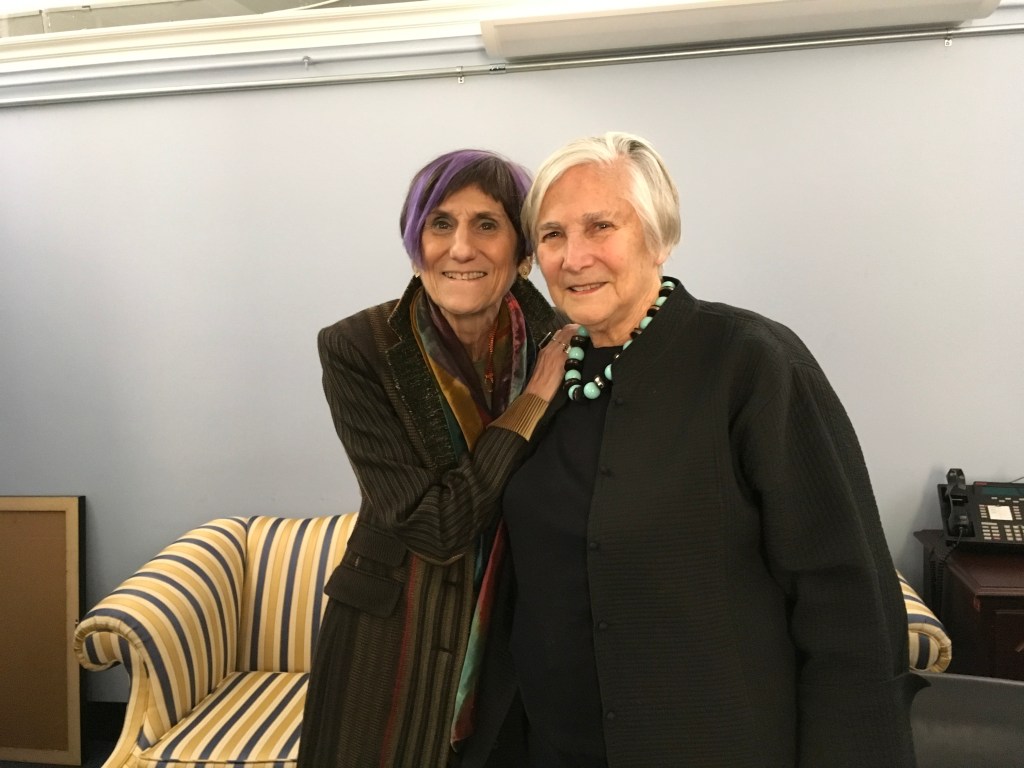
Congresswoman Rosa DeLauro and I in 2018: My hero.

Three major religious events converge this weekend: Easter, Passover, and Ramadan.

To readers who celebrate these holy days, I send good wishes.

To those who are non-religious, I also send good wishes.

To everyone, I send my personal hope that we can share a world without war, a world of kindness, a world of plenty, a world in which we can share the bounty of a healthy earth, and a world in which everyone is respected.

Above all, in this moment, I hope that Mr. V. Putin stops his war against Ukraine. Please end the killing and destruction.

Let us together seek Peace, Joy, Freedom, Democracy, and Justice. Not just for ourselves but for everyone.

With the support of three renegade Republicans (Romney of Utah, Collins of Maine, and Murkowski of Alaska), Judge Ketanji Brown Jackson was confirmed as a new Justice of the Supreme Court.

Her qualifications were beyond dispute. She is one of the most qualified members of the Court. she received the highest possible rating from the American Bar Association (Trump’s last appointee, Justice Barrett, did not).

She won’t change the 6-3 balance on the deeply divided Court, but she will bring a fresh perspective, a great intellect, a deep respect for the Constitution, and a judicial temperament that enabled four days of withering and unfair attacks by ambitious Republican Senators who we’re competing for the QAnon sector of the GOP base.

A great choice! Justice prevailed.

After four days of hostile grilling by Republicans, the nation had the chance to see a person who stood up to every insulting and demeaning question with a calm and collected demeanor. Judge KJB has a judicial temperament. She demonstrated grace under pressure.

She just received the highest rating from the American Bar Association, in recognition of her record, wisdom and intellect.

The senators running for the Republican nomination used the opportunity to appeal to their racist, Q Anon base, asserting that she was an advocate of critical race theory (false), soft on crime (false), and easy on child pornographers (false).

The judge has been endorsed by police organizations; several of her family members were law enforcement officers.

She opposes racism, but that does not make a CRT ideologue. The fact that her husband is white gives the lie to those like Senator Cruz who portray her as a racist who is hostile to white people.

The flap about child pornographers was an effort by GOP senators to placate the crazies in Q Anon who believe the government is filled with predators of children. Anyone who panders you them should be ashamed.

The judge was even questioned about whether she supports court-packing, a strange question coming from a party who refused to meet with President Obama’s choice “because it was an election year,” but rushed through Justice Barrett’s nomination on the eve of the 2020 election. The court now has 6 conservatives and only three liberals. Judge Brown would not change that uneven balance.

Judge Ketanji Brown Jackson is well qualified to serve on the High Court. She should be promptly confirmed. Republicans should demonstrate that they are not knee-jerk partisans by voting for her.

Tomorrow at 9 a.m., the Atlanta chapter of the NAACP, the Southern Center for Human Rights, and the Abolitionist Teaching Netwotk will host a press conference at the Fulton County Courthouse. They will be asking the judge and district attorney not to send nonviolent educators to prison during the middle of a pandemic.

Shani Robinson contacted me this morning to ask if I would be willing to send a statement of support. I read Shani’s book None of the Above: The Untold Story of the Atlanta Public Schools Cheating Scandal, Corporate Greed, and the Criminalization of Educators and was convinced that Shani was unjustly prosecuted and convicted. Investigators pressured her and others to confess or to name others. She maintained her innocence. As a first grade teacher, she was not eligible for a bonus based on student scores. She was convicted by a racist judge who had the temerity to claim that the cheating scandal was “the sickest thing that’s ever happened to this town.” Not slavery. Not murder. Not Jim Crow.

I wrote the following letter. If you read the book and are as outraged as I am by the prosecution and conviction of Shani Robinson, please send a letter of support for Shani today. You may also contact elected officials on her behalf.

Here is my letter:

A Letter to the Judge and the District Attorney:
Honorable Officers of the Court and the Law in Fulton County:

I am a recently retired Professor at New York University and a historian of American education.
I am writing to urge you not to imprison Shani Robinson and other nonviolent educators.

I have read Shani’s book, which persuaded me that the state wrongly used RICO statutes to prosecute educators accused of changing student answers on standardized tests. Cheating of this kind has been documented in many school districts, and no other district has invoked a federal racketeering statute to prosecute teachers. The usual punishment is termination.

Shani taught first grade, where the tests have no stakes for students or teachers. She had no motive or reason to cheat.

I believe she was unjustly prosecuted by overzealous investigators. She could have pleaded guilty or accused others to avoid prosecution but she insisted on her innocence.

I believe her.

I believe her prosecutors wrongly pursued her, using tactics that were intended to coerce false convictions. Her conviction was unfair and racist.

I urge you not to send her to prison in the midst of a pandemic. Not now, and not ever.

I urge you to reopen and review her case.

I believe in Shani Robinson’s innocence.


Diane Ravitch, Ph.D.

Kimberlé Williams Crenshaw is a professor of law at Columbia and UCLA and one of the leading figures in the field of critical race studies. She wrote the following article for the Los Angeles Times, where she demonstrates that the new laws banning the study of systemic racism simultaneously ban Dr. King’s views of America’s racial problems, which were not solved by passing civil rights laws. The furor over CRT shows that racism remains a powerful force today. Critics of CRT maintain illogically that teaching the history of racism is racist, that uncomfortable facts must not be taught at all, and that history must be scrubbed clean of divisive realities. As Crenshaw points out, King would have fought the current effort to cleanse U.S. history; his own words and works cannot be taught.

For the first time, we’re observing the Rev. Martin Luther King Jr. holiday under new laws in multiple states that ban the instruction of “divisive” interpretations of our racial past. The assaults have given new weapons to an enduring faction in American society that has long resisted the reckoning that his life’s work demanded.

In King’s day, this faction was known as the “Massive Resistance,” an effort to organize and frustrate the Supreme Court’s 1954 Brown vs. Board of Education ruling and efforts to build multiracial classrooms. Today, this faction is known as the “anti-CRT” effort, which seeks to proscribe race-related curricula, books or trainings that offer a discomforting view of our past and its current implications.

Teachers, public officials and students are in a particularly unsustainable bind. They’re charged with honoring King as a figure while disavowing the ideas that he lived and died to advance. They’re being asked not merely to defer King’s dream of racial equality but to decommission it altogether.

King would likely take bitter note of the all-too-familiar dynamics behind today’s backlash. After the 2020 global movement for racial justice in the United States and beyond in the wake of the savage police killing of George Floyd, legislatures in 32 states have relied on what is patently a lie — that antiracism is antiwhite — to fuel the antidemocratic crusade against what they call “critical race theory.”

For more than 30 years, scholars have employed critical race theory as an analytical tool. The right has rebranded it as the new racism, as wokeness run amok, as a threat to innocent schoolchildren and as a stalking-horse for the demise of “Western civilization” itself. The theory has become the target of coordinated efforts to stigmatize and erase generations of antiracist knowledge, advocacy and history. The objective is both to disappear antiracism’s history and to deny its contemporary salience.

King himself is a prime casualty in this effort. Apostles of the McCarthyite crackdown on critical race theory have exploited him as a mouthpiece for their cause, reducing him to a solitary, decontextualized line from the “I Have a Dream” speech about a future in which his four children were to be judged not “by the color of their skin, but by the content of their character.”

Some use King’s words to erase his deeds and those of millions more who rose up to “make good the promises” since Reconstruction. In Tennessee, for example, the Moms for Liberty sought to ban Frances E. Ruffin’s children’s book “Martin Luther King Jr. and the March on Washington” by framing its descriptions of segregation and the violence meted out against King and others as traumatizing and racist. The Moms argue that Ruffin’s portrayal of white racism against people of color “will sow the seeds of racial strife, neo-racism, neo-segregation, and is an affront” to King’s ideals. This reveals precisely what comes of a persistent and willful ignorance of King’s legacy.

The sheer power on display to turn King against himself — a process that has been underway since the first day this holiday was celebrated — is a grim reflection of the way opponents have long subjected antiracist thinking and activism to distortion, misappropriation and redefinition. The brazen casting of critical race theory as the contemporary villain following 2020’s racial reckoning is no surprise.

The King holiday and Black History Month are an excellent opportunity — perhaps the only opportunity — to course-correct, contest and redirect the misconceptions about King’s legacy and its interface with critical race theory. Recovering the real King begins by freeing his image from the clutches of those seeking to substitute truthful education with a saccharine narrative built on illusions, delusions and lies.

Dr. King was an “inconvenient truth teller.” His insistence on the urgency of racial justice put him at odds with moderate whites in the South, and his denunciation of imperialism put him at odds with allies more narrowly focused on the freedom struggle within U.S. borders.

For telling these truths, in life, King was often criticized rather than celebrated. At the time of his death, polls showed that most white people held an unfavorable view of him. The FBI, under J. Edgar Hoover, framed him as a national security threat. Some Black leaders were hardly convinced of his tactics — his civil disobedience was too radical for some, his nonviolence too accommodationist for others. But for King, the demands for racial justice were not to be won through a popularity contest or by painting a comforting picture of the U.S. social order. Nor was King’s an identity-obsessed demand for recognition. He offered a clear-eyed assessment of a would-be democracy in a state of disrepair. Confronting it at its source was the only way forward.

It’s no accident that the firestorm over critical race theory has singed King’s message: King was, in fact, a critical race theorist before there was a name for it. A core observation of the theory is the recognition that the promise of liberation extends beyond the elimination of formal segregation and individual-level prejudice. Critical race theory explores how racial inequality was historically structured into the fabric of the republic, reinforced by law, insulated by the founding Constitution and embedded into the infrastructure of American society. Similarly, King observed in 1967 that “the doctrine of white supremacy was embedded in every textbook and preached in practically every pulpit,” entrenched as “a structural part of the culture.”

Accordingly, King’s appeal in the March on Washington in 1963 was grounded in the assertion that the promise of a fully inclusive American democracy — one that lived up to its oft-stated ideals — required creative confrontation with a republic out of step with its promises. He rebuffed those who found fault in the tensions created by placing our norms and our realities in sharp relief.

King famously wrote a letter rejecting the counsel of white moderate allies who argued for a gradualist accommodation to the prioritized sensibilities of those who didn’t experience the sting of segregation. As a father, he conveyed the anguish of his own children, who couldn’t understand why they weren’t allowed into the Funtown amusement park, which barred Black visitors, while the joy of white children was privileged. He argued elsewhere that “justice for black people cannot be achieved without radical changes in the structure of our society.”

King centered the promise of equal access to the ballot — now under concerted assault — at the heart of his prophetic mission. He fought to win passage of both the Civil Rights Act and the Voting Rights Act, and he understood that the provisions of each law were part and parcel of the same struggle for true and lasting racial justice. While he hailed the landmark voting reform as “a great step forward in removing all of the remaining obstacles to the right to vote,” he also insisted that the vote be used to “rid the American body politic of racism.” King would instantly recognize the mutually reinforcing objectives of denying the ballot, an indispensable instrument of reform, while also silencing the substantive case for reform by whitewashing the country’s racial past.

Contrary to countless assertions from the right, King did not endorse colorblindness. It wasn’t the remedy for dismantling the ugly realities that white supremacy had produced. Like today’s critical race theorists, King understood that American racism was systemic and demanded systemic remedies. He was forthright in acknowledging that anti-Black racism “was not a consequence of superficial prejudice but was systemic.” Throughout his career, King set his sights on institutional-level change, calling for solutions built on the race-conscious analysis of inequalities across our society.

King invoked a “bank of justice” to be mobilized against the many structures of racial oppression to ultimately realize “the security of justice” for all Americans. This commitment explicitly extended to the mode of race-conscious practice that now goes by the name of affirmative action.

When questioned whether he would support such outlays, King bluntly replied, “I do indeed,” and went on to explain: “Can any fair-minded citizen deny that the Negro has been deprived? Few people reflect that for two centuries the Negro was enslaved and robbed of any wages — potential accrued wealth which would have been the legacy of his descendants. All of America’s wealth today could not adequately compensate its Negroes for his centuries of exploitation and humiliation.”

Much of King’s legacy may never be taught in public schools, if this manufactured panic that demands critical thinking about racism be expunged from curricula and libraries continues. In North Dakota, for example, King’s understanding of structural racism would contradict the state’s newly minted edict that racism cannot be taught as anything more than an individual’s prejudice and bias. His understanding of the historical debt created by centuries of uncompensated labor flies directly in the face of Oklahoma’s prohibition of material suggesting that current generations bear any responsibility for the actions of their ancestors.

Not only did King clearly recognize that antiracism must address built-in headwinds that unnecessarily disadvantage some groups over others, but so does, incidentally, the Supreme Court, as seen in its many rulings. Yet an instructor seeking to explain King’s expansive vision of justice or a professor highlighting legal cases about institutional discrimination will be in jeopardy if they teach these ideas in some states that have adopted such laws.

King’s ideas could also fall under efforts in states such as Oklahoma or Texas that forbid the use of classroom materials that might create guilt or discomfort in public school students. King’s description of a social order in need of repair would trigger complaints that current generations are made to feel responsible for the sins of our past. New Hampshire, meanwhile, has proposed legislation forbidding antiracist critiques of the nation’s founding and history.

Indeed, under most of these laws, King’s concrete work and documented analysis of racism’s enduring legacy in American society would be suspect. In his final speech, on the eve of his death, he said he might not get to the promised land with us. This prophecy would rest uneasily in curricula that sanction assumptions that we haven’t already become that society that King dreamed we would one day be.

This imposition of a fairy-tale account of America makes King’s sacrifice utterly illegible. It is a memory-holed vision of the past better suited to George Orwell’s dystopian reveries than to a nation seeking to redeem its promise of genuine, expansive and democratic self-rule.

Nationwide, lawmakers are legislating that our schools and workplaces turn away from King’s mandate to make good on the country’s broken promises, and wallow instead in the wages of this ignorance. It is an ignorance that grows out of an earlier effort to impose an approved orthodoxy about the American past. One of the enduring consequences of the United Daughters of the Confederacy’s textbook campaigns was the persistence of Confederate propaganda and Lost Cause mythology masquerading as the truth about the history of the Civil War and its aftermath. The United Daughters ensured that millions of children inherited a view of America’s past grossly warped by the whitewashing of slavery and the violent Redemption, when white Southerners called for a return to white supremacy, that followed Reconstruction. The democratic crisis we face today is an unrecognizable spasm from that past, illegible in part because our educational system and national myths have not overcome these past manipulations to embrace this history.

To truly honor King’s memory, then, we must defeat the faction that facilitated the U.S. Capitol riot, put democracy on life support, and continues to demand that critical interrogation of its past be censored by law. King implored that we put our bodies on the line to face the organized forces of white reaction in his day — and it’s clear that he’d be fighting in exactly the same way to preserve his prophetic legacy in our own day, when the right to equal education, to vote freely and to realize true cross-racial justice are once more under bitter attack.

Reclaiming his legacy is to realize that there is no daylight between a truly democratic society and a racially just one.
Jesse Hagopian is an activist teacher in the Seattle Public Schools, a leader in Black Lives Matter at School and editor of the book More Than a Score: The New Uprising Against High-Stakes Testing. This article appeared in the Seattle Times:

State Republican Rep. Jim Walsh recently introduced HB 1807 and Republican Rep. Brad Klippert introduced HB 1886 for this legislative session — two bills designed to mandate educators lie to Washington’s students about structural racism and sexism.

This copycat legislation is lifted from a growing number of bills around the country that seek to ban an honest account of history in K-12 education, including many of the long struggles against oppression. These bills especially target the teaching of critical race theory (CRT), the 1619 Project, the Zinn Education Project and Black Lives Matter at School.

It’s fitting that Rep. Klippert’s bill is numbered “1886,” as that was the year a mob of white people in Seattle rounded up more than 200 Chinese people, forced them into wagons, and hauled them to Seattle docks where they were placed on a ships and deported. Though 15 people were tried in court in relation to the riot — including Chief of Police William Murphywho helped the mob round up Chinese people illegally — not a single one was ever convicted of a crime.

It’s similarly appropriate that Rep. Walsh’s bill is numbered “1807” because this bill seeks to return us to the early 19th century — a time when the nation was accelerating the attack on Black people’s rights in the North and colonizing the land of Native Americans. In 1807, New Jersey took away the right to vote for Black people. On April 1, 1807, Ohio outlawedBlack people from testifying in cases with white people. For the next 40 years, white people could act with impunity in filing baseless lawsuits and commit crimes — even violent attacks — against Black people who could not testify to defend themselves or give any evidence against them…

HB 1886 states that educators would be banned from teaching that, “The United States is fundamentally or structurally racist or sexist.” But consider these facts: The average white family has 10 times the amount of wealth of the average Black family.

∙ A Black woman is three times more likely to die from pregnancy or childbirth-related causes than a white woman.

∙ Black students are more than three times more likely to be suspended from school than white students.

· The median household income for Native Americans was 60% of median white household income. And that was before the COVID-19 pandemic. Recent estimates reveal inequities have worsened, especially for Native American women.

· At least 44 transgender and gender nonconforming people were violently killed in 2020, with Black transgender women accounting for two-thirds of total recorded deaths since 2013.

· Anti-Asian hate crimes surged over 169% last year.

For teachers who believe in accurate history, there is no real choice here — we will always teach students about the reality of structural racism and other intersecting oppressions. Revealing these facts in the classroom is not about shaming white students — in fact, it is those who deny structural racism who end up leading white children to suspect that they are personally responsible for the racial disparities they see, rather than understanding the way systems can work to perpetuate inequities sometimes regardless of the intentions of the individuals who work in these systems.

Our friends, the Pastors for Texas Children, sent the following message today. There are Senators giving speeches today about the legacy of Dr. King, even as they intend to vote against federal protections for voting rights. They should walk their talk.

Walk Your Talk

     We have a faith filled with words.

     The Word of God inspires and empowers us to a relationship of love with God and our fellow human beings. Adherents of Abrahamic faiths—Judaism, Christianity, and Islam—claim to be “people of the Book.”

     The Book of Genesis reports to us that God spoke all of Creation into being; “and God said, let there be… and there was.” The Gospel of John opens with the immortal line, “In the beginning was the Word, and Word was with God, and the Word was God.”

     Indeed, the Gospel of Mark, the earliest gospel, tells us at the beginning that “Jesus came preaching,” and quotes Jesus at the end to “go into all the world and proclaim the good news to the whole creation.”

     Words are important.

     But, these same profound faith traditions also teach that words without subsequent action are useless.

     Word must become flesh in order for it to facilitate a new creation.

     Jesus challenges his disciples in closing his famous Sermon on the Mount that “everyone who hears these words and acts on them will be wise.”

     The Book of James: “Faith without works is dead,“ and “Be doers of the word and not merely hearers.”

     Today we celebrate the life and ministry of a great preacher, Rev. Martin Luther King, Jr. Every year, we commemorate his powerful life and legacy especially on this day.

     Leaders all over, particularly political leaders, will invoke Dr. King’s name, recite his sermons, quote his words, remember his life.

     But, many of them have no intention of putting any of Dr. King’s vision into action.

     If words aren’t followed up with action, they ring hollow. Word remaining word.

     Today, many political leaders give lip service to the teachings of Dr. King, but have no intention whatsoever to put those teachings into action.

     In fact, their policy positions often directly contradict the essential truths of those teachings.

     Even acts of individual charity and benevolence miss the mark of Dr. King’s purpose. We might do charitable acts of service on a day like today, which is right and good.

     But Dr. King did not champion mere charity; he preached justice.

     Instead of feeding the hungry, he fought to change the systems that resulted in hunger. He preached in a memorable sermon that it is one thing for the famous Samaritan to rescue the injured man in the ditch, but we must also address the conditions causing the attacks on the Jericho Road.

     PTC believes that educational equity for all children is essential to overcome systemic racism and injustice in our society. Not just good words. But, a structure that ensures those words become deeds.

     It is good to believe that “all people are created equal and endowed by their Creator with certain unalienable rights, that among these are Life, Liberty, and the pursuit of Happiness.”     

     It is better to put that belief into action that dismantles our systems of injustice. And replaces them with actions that ensure quality public education for ALL Texas schoolchildren.

Rev. Charles Foster Johnson, Executive Director

Pastors for Texas ChildrenPO Box 471155, Fort Worth, Texas, 76147

Steve Luxenberg, an editor at The Washington Post and the author of a 2019 book on racial separation and the Plessy case, Separate: The Story of Plessy v. Ferguson, and America’s Journey from Slavery to Segregation, wrote to correct important errors in my post about Homer Plessy.

Plessy, you may recall, was arrested in New Orleans for attempting to ride in an all-white train car, thus violating state law. His was a test case of a recently enacted segregation statute. When his case reached the U.S. Supreme Court, challenging the constitutionality of the racial segregation law, the Court issued a ruling in 1896 endorsing the law and the legality of “separate but equal.” This endorsement of de jure segregation remained intact until the Brown vs. Board of Education decision of 1954.

Now, here are the facts about Homer Plessy, as documented by Luxenberg. I am grateful to him for correcting my version (and errors in the article I quoted):

1. Plessy was not found guilty after his arrest (in 1892), and as a result, his lawyers did not appeal that conviction. The case went to the Supreme Court on entirely different grounds. Cutting to the chase for now: Judge Ferguson held off on a trial, instead issuing a ruling on the constitutionality of Louisiana’s Separate Car Act. That was a gift to Plessy’s legal team, because it meant that they could appeal Ferguson’s ruling (he said the Act was constitutional) rather than pursuing a habeas corpus strategy as planned. The Citizens Committee (the group that planned and arranged for Plessy’s arrest as a test case) did not want Plessy in jail while the appeal was wending its way through the courts.

2. Judge Ferguson never found Plessy guilty, and he wasn’t convicted in 1890. In January 1897, nearly eight months after the Supreme Court’s ruling, Plessy pleaded guilty, before a different judge, to close the case. The Citizens Committee paid his $25 fine.

That ruling—Plessy vs. Ferguson— okayed racial segregation statutes that locked millions of Black Americans into second-class status, since separate was never equal in a racist society. Separate but equal remained in place until it was overturned by the Supreme Court in 1954, a decision that was boldly resisted by the South for years.

Homer Plessy will be posthumously pardoned as a result of a sustained effort by his descendant Keith Plessy, and the descendant of Judge John Howard Ferguson.

Keith Plessy and Phoebe Ferguson created a foundation to honor Homer Plessy and to advance the cause of racial reconciliation. Plessy and Ferguson and their allies worked for the past 11 years to get a pardon for Homer Plessy, and they have just succeeded.

Keith Plessy and Phoebe Ferguson’s drive to right a terrible, devastating wrong came to full fruition last month, when they appeared before the Louisiana Pardon Board to ask the board to extend a pardon to Homer Plessy for his conviction in 1890 [this date is wrong]. The board swiftly agreed with the pair and voted unanimously on Nov. 12 to pardon Homer Plessy.

Keith Plessy said that his ancestor Homer was selected by a local group of activists to challenge the law.

Keith Plessy placed their crusade for justice in further historical context, pointing out that Homer Plessy was actually carefully selected by late-19th-century civil rights advocates to test the state’s segregation laws of that era.

The New Orleans organization called the Comite de Citoyens, or Committee of Citizens – a multi-ethnic group of activists dedicated to fighting the 1890 Separate Car Act – chose Plessy, a mixed-race Creole, to test the law by getting arrested and placing the matter in the courts.

Once in court, Plessy’s attorneys argued that the Separate Car Act, and as such Plessy’s arrest, violated his Constitutional rights under the 13th and 14th Amendments, an argument the court rejected with his conviction.

“I feel that working together, we have been trying to tell the whole story of the Citizens Committee and the Civil Rights Movement that continued after this case,” Keith Plessy said. “[The Plessy strategy] was the blueprint that was used over and over again [by Civil Rights advocates] in the 20th century.”

“New Orleans,” he added, “was the crucible of the Civil Rights Movement.”

Governor John Bel Edwards (a Democrat) declared that he would swiftly sign Plessy’s pardon.

I had the pleasure of meeting Phoebe Ferguson and Keith Plessy when I spoke at Dillard University, a historically Black university in New Orleans, in 2010. It was incredible to meet these two people who symbolized such an important and infamous event in American history. Thanks to these two persistent people for their fight to keep Homer Plessy’s legacy alive and to pursue Justice. We are still struggling to overcome the legacy of Jim Crow era legislation.