Archives for category: International

In 2014, Russia invaded Ukraine and took control of the Crimean Peninsula, which was then absorbed into Russia. Presently, Putin has stationed at least 100,000 troops on Ukrainian borders, and leaders in the West are fearful that he intends to invade and seize control of all Ukraine. Ukraine has a long and terrible history under Russian control. In the late 1920s and 1930s, Stalin collectivized Ukrainian agriculture and sent troops to export Ukrainian crops to Russia. Millions of Ukrainians were killed or starved to death in the ensuing famine. Historian Robert Conquest wrote a history of these events callled Harvest of Sorrow. It is a terrifying history. Today, it appears that Vladimir Putin wants to reassemble the Soviet Union. He once called its dissolution the worst geopolitical tragedy of the 20th century.

Here are the views of Britain’s Secretary of Defence.

Secretary of State for Defence Ben Wallace discusses NATO, Ukraine and Russia.
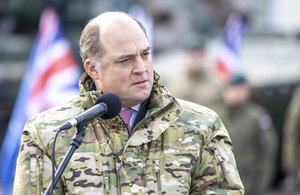
Defence Secretary in Olsztyn, Poland.

Defence Secretary in Olsztyn, Poland.

I have lost count of how many times recently I have to had to explain the meaning of the English term “straw man” to my European allies. That is because the best living, breathing “straw man” at the moment is the Kremlin’s claim to be under threat from NATO. In recent weeks the Russian Defence Minister’s comment that the US is “preparing a provocation with chemical components in eastern Ukraine” has made that “straw man” even bigger.

It is obviously the Kremlin’s desire that we all engage with this bogus allegation, instead of challenging the real agenda of the President of the Russian Federation. An examination of the facts rapidly puts a match to the allegations against NATO.

First, NATO is, to its core, defensive in nature. At the heart of the organisation is Article 5 that obliges all members to come to the aid of a fellow member if it is under attack. No ifs and no buts. Mutual self-defence is NATO’s cornerstone. This obligation protects us all. Allies from as far apart as Turkey and Norway; or as close as Latvia and Poland all benefit from the pact and are obliged to respond. It is a truly defensive alliance.

Second, former Soviet states have not been expanded ‘into’ by NATO, but joined at their own request. The Kremlin attempts to present NATO as a Western plot to encroach upon its territory, but in reality the growth in Alliance membership is the natural response of those states to its own malign activities and threats.

Third, the allegation that NATO is seeking to encircle the Russian Federation is without foundation. Only five of the thirty allies neighbour Russia, with just 1/16th of its borders abutted by NATO. If the definition of being surrounded is 6% of your perimeter being blocked then no doubt the brave men who fought at Arnhem or Leningrad in the Second World War would have something strong to say about it.

It is not the disposition of NATO forces but the appeal of its values that actually threatens the Kremlin. Just as we know that its actions are really about what President Putin’s interpretation of history is and his unfinished ambitions for Ukraine.

We know that because last summer he published, via the official Government website, his own article “On the Historical Unity of Russians and Ukrainians”. I urge you to read it, if you have time, because while it is comprehensive on his arguments it is short on accuracy and long on contradictions.

We should all worry because what flows from the pen of President Putin himself is a seven-thousand-word essay that puts ethnonationalism at the heart of his ambitions. Not the narrative now being peddled. Not the straw man of NATO encroachment. It provides the skewed and selective reasoning to justify, at best, the subjugation of Ukraine and at worse the forced unification of that sovereign country.

President Putin’s article completely ignores the wishes of the citizens of Ukraine, while evoking that same type of ethnonationalism which played out across Europe for centuries and still has the potential to awaken the same destructive forces of ancient hatred. Readers will not only be shocked at the tone of the article but they will also be surprised at how little NATO is mentioned. After all, is NATO ‘expansionism’ not the fountain of all the Kremlin’s concerns? In fact, just a single paragraph is devoted to NATO.

The essay makes in it three claims. One: that the West seeks to use division to “rule” Russia. Two: that anything other than a single nation of Great Russia, Little Russia and White Russia (Velikorussians, Malorussians, Belorussians) in the image advanced in the 17th Century is an artificial construct and defies the desires of a single people, with a single language and church. Third, that anyone who disagrees does so out of a hatred or phobia of Russia.

We can dispense with the first allegation. No one wants to rule Russia. It is stating the obvious that just like any other state it is for the citizens of a country to determine their own future. Russia’s own lessons from such conflicts as Chechnya must surely be that ethnic and sectarian conflicts cost thousands of innocent lives with the protagonists getting bogged down in decades of strife.

As for Ukraine, Russia itself recognised the sovereignty of it as an independent country and guaranteed its territorial integrity, not just by signing the Budapest Memorandum in 1994 but also its Friendship Treaty with Ukraine itself in 1997. Yet it is the Kremlin not the West that set about magnifying divisions in that country and several others in the Europe. It has been well documented the numerous efforts of the GRU and other Russian agencies to interfere in democratic elections and domestic disputes is well documented. The divide and rule cap sits prettiest on Moscow’s head not NATO’s.

Probably the most important and strongly believed claim that Ukraine is Russia and Russia is Ukraine is not quite as presented. Ukraine has been separate from Russia for far longer in its history than it was ever united. Secondly the charge that all peoples in Belarus, Russia and Ukraine are descendants of the ‘Ancient Rus’ and are therefore somehow all Russians. But in reality, according to historian Professor Andrew Wilson in his excellent essay for RUSI entitled “Russia and Ukraine: ‘One People’ as Putin Claims?” they are at best “kin but not the same people”. In the same way Britain around 900AD consisted of Mercia, Wessex, York, Strathclyde and other pre-modern kingdoms, but it was a civic nation of many peoples, origins and ethnicities that eventually formed the United Kingdom.

If you start and stop your view of Russian history between 1654 and 1917 then you can fabricate a case for a more expansive Russia, perhaps along the lines of the motto of the Russian Tsar before the Russian Empire “Sovereign of all of Rus: the Great, the Little, and the White” – Russia, Ukraine and Belarus respectively. And crucially you must also forget the before and after in history. You must ignore the existence of the Soviet Union, breaking of the Russian-Ukrainian Friendship Treaty, and the occupation of Crimea. Far more than footnotes in history, I am sure you will agree.

Ironically, President Putin himself admits in his essay that “things change: countries and communities are no exception. Of course, some part of a people in the process of its development, influenced by a number of reasons and historical circumstances, can become aware of itself as a separate nation at a certain moment. How should we treat that? There is only one answer: with respect!” However, he then goes on to discard some of those “historical circumstances” to fit his own claims.

Dubious to say the least, and not in anyway a perspective that justifies both the occupation of Crimea (in the same way Russia occupied Crimea in 1783 in defiance of the Russo-Turkish Treaty of Kuchuk-Kainarji in 1774) or any further invasion of modern Ukraine, as an independent sovereign country.

The last charge against the West by many in the Russian Government is that those who disagree with the Kremlin are somehow Russophobes. Leaving aside that GRU officers deployed nerve agents on British streets or that cyber hacking and targeted assassinations emanate from the Russian state, nothing could be further than the truth.

Russia and the UK share a deep and often mutually beneficial history. Our allegiances helped to finally defeat Napoleon and later Hitler. Outside of conflict, across the centuries we shared technology, medicine and culture. During the 18th Century Russia and Britain were deeply tied. Between 1704 to 1854, from age of Peter the Great through Catherine the Great and well into the 19th Century the British were to be found as admirals, generals, surgeons, and architects at the highest level of the Russian Court. The father of the Russian Navy – one Samuel Greig – was born in Inverkeithing in Fife.

That shared admiration is still true today. The British Government is not in dispute with Russia and the Russian people – far from it – but it does take issue with the malign activity of the Kremlin.

So, if one cold January or February night Russian Military forces once more cross into sovereign Ukraine, ignore the ‘straw man’ narratives and ‘false flag’ stories of NATO aggression and remember the President of Russia’s own words in that essay from last summer. Remember it and ask yourself what it means, not just for Ukraine, but for all of us in Europe. What it means the next time…
Italy has restricted the activities of the unvaccinated to protect the vast majority who are vaccinated and to curb the spread of COVID. The Washington Post reported on the constrained life of a musician.

OSIGO, Italy — After many rounds of rules targeting the unvaccinated, the chamber musician’s new life is unrecognizable from the old. Claudio Ronco once performed all over Europe, but now he can’t even board a plane. He can’t check into a hotel, eat at restaurant or get a coffee at a bar. Most important, he can’t use the water taxis needed to get around Venice, his home for 30 years — a loss of mobility that recently prompted him to gather up two of his prized cellos, lock up his Venetian apartment and retreat with his wife to a home owned by his in-laws one hour away in the hills.

“Isolation,” Ronco called it, on the fourth day in a row that he hadn’t left the house.

At this complicated stage of the pandemic, the lives of unvaccinated people are in major flux, at the mercy of decisions made everywhere from courts to workplaces. But their lives are changing most dramatically in a handful of countries in Western Europe, including Italy, where governments are systematically reducing their liberties, while beginning to return the rest of society to a state of normalcy. And while regular testing, until recently, was permitted as an alternative to vaccination, even that option has now been largely removed as countries harden their mandates. For people like Ronco, the choice is to get inoculated or face exclusion.

The people of Chile are expunging the last traces of the brutal dictator Augusto Pinochet. They elected Gabriel Boric, a 35-year-old member of the Chilean Congress and a former student activist, as President of Chile. The election was expected to be close but Boric won by a 56-44% margin.

Boric was engaged in national protests over the past decade against inequality. A decade ago, he led protests against Chile’s privatized education system. He will be the youngest person ever elected to the Presidency of Chile. His election is a decisive rejection of the policies of the dictator Pinochet. His rival defended Pinochet and ran on a law-and-order platform and a pledge to cut taxes and social spending.

An Army General, Pinochet seized control of the government by a coup d’etat. He imposed a reign of terror, and thousands of his opponents were murdered, imprisoned, tortured, or disappeared. Pinochet called on Milton Friedman and the libertarian “Chicago Boys” to rewrite Chile’s Constitution. They baked the primacy of the free market and neoliberalism into the new Constitution. Pinochet’s regime cut social benefits, privatized social security and many government functions, reduced benefits, and introduced vouchers and for-profit schools. The economy grew, but so did inequality. Pinochet ruled from 1973-1990.

Protests against the nation’s privatized and deeply unequal education system rocked the nation a decade ago. Many Chileans were barely subsisting because of cuts to social security. More protests broke out in 2019 against the country’s entrenched inequality and corruption. Boric was active in all those protests.

Last year, Chileans expressed their demand for change by voting for a rewrite of the national constitution, the one written by the “Chicago Boys” and implemented by Pinochet.

The BBC reported:

Once the most stable economy in Latin America, Chile has one of the world’s largest income gaps, with 1% of the population owning 25% of the country’s wealth, according to the United Nations.

Mr Boric has promised to address this inequality by expanding social rights and reforming Chile’s pension and healthcare systems, as well as reducing the work week from 45 to 40 hours, and boosting green investment.

“We know there continues to be justice for the rich, and justice for the poor, and we no longer will permit that the poor keep paying the price of Chile’s inequality,” he said.

The president-elect also promised to block a controversial proposed mining project which he said would destroy communities and the national environment.

Chile’s currency, the peso, plunged to a record low against the US dollar after Mr Boric’s victory. Stock markets fell by 10%, with mining stocks performing particularly badly.

Investors are worried stability and profits will suffer as a result of higher taxes and tighter government regulation of business.

In a profile of Gabriel Boric, the BBC described his message:

When Mr Boric won the candidacy of his leftist bloc to run for president, he made a bold pledge. “If Chile was the cradle of neoliberalism, it will also be its grave,” he said. “Do not be afraid of the youth changing this country.”

And so he ran on a platform promising radical reforms to the free-market economic model imposed by former dictator Gen Augusto Pinochet. One that, he says, is the root of the country’s deep inequality, imbalances that came to the surface during protests in 2019 that triggered an official redraft of the constitution.

After a polarising campaign, Mr Boric defeated far-right rival José Antonio Kast in the second round of the presidential election by a surprising large margin, ushering in a new chapter in the country’s political history.

“We are a generation that emerged in public life demanding our rights be respected as rights and not treated like consumer goods or a business,” Mr Boric said in his victory speech to thousands of supporters, most of them young people…

Mr Boric, who says he is an avid reader of poetry and history, describes himself as a moderate socialist. He has abandoned the long hair of his activist days, and jackets now often cover his tattoos on both arms.

He has also softened some of his views while keeping his promises to overhaul the pension system, expand social services including universal health insurance, increase taxes for big companies and wealthy individuals, and create a greener economy.

His resounding win in the run-off vote of the presidential election, after trailing Mr Kast in the first round, came after he secured support beyond his base in the capital, Santiago, and attracted voters in rural areas. A supporter of same-sex marriage and abortion rights, he was also backed by huge numbers of women.

In his victory speech, when he was joined by his girlfriend, he promised to be a “president for all Chileans”, saying: “Today hope trumped fear”.

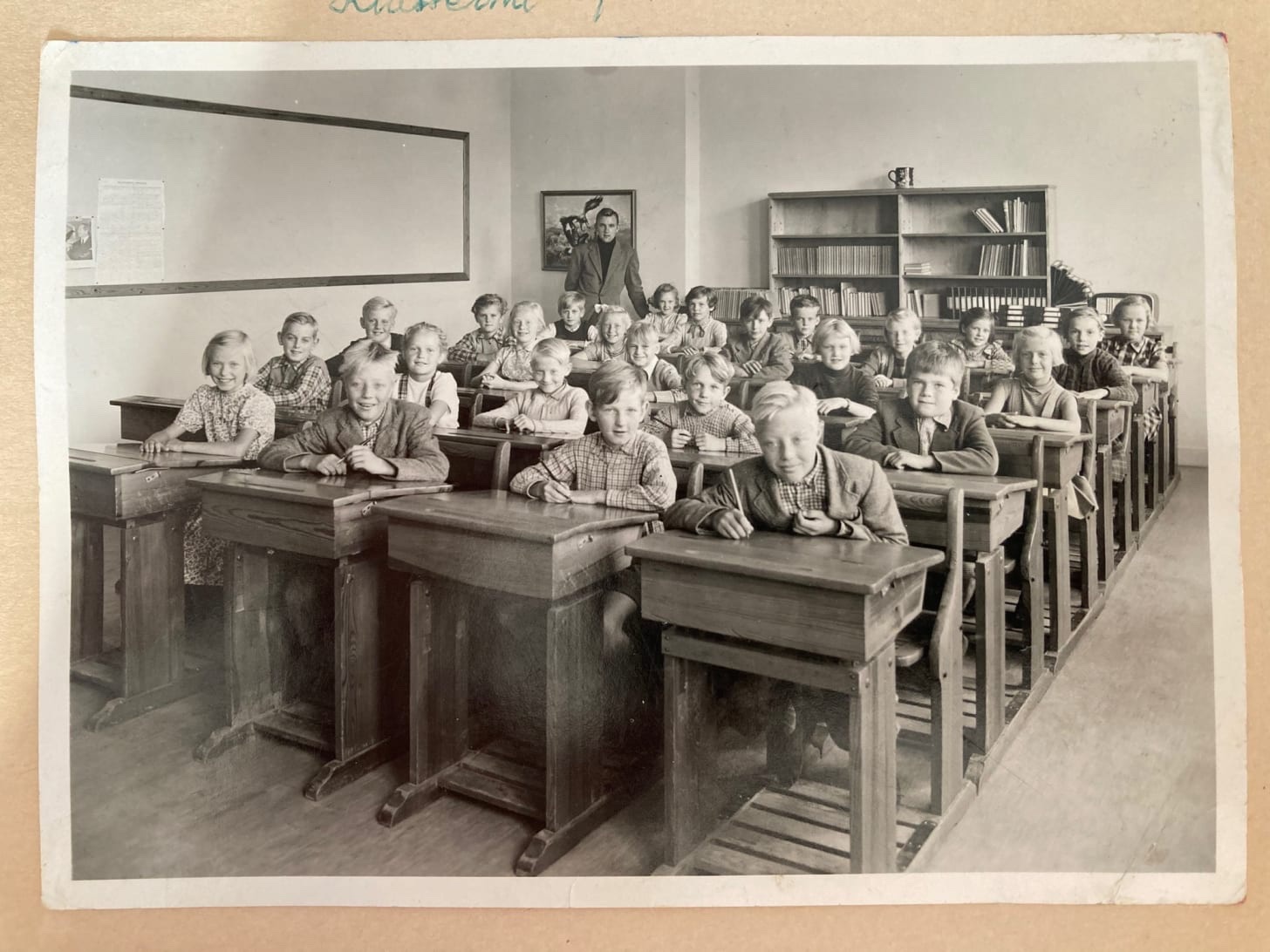
Mother’s first class, around 1950, at Skabersjöskolan, where I myself also went to school.

A friend in Sweden sent this article via Twitter. It was written by Jenny Maria Nilsson. I went to Google and asked for a translation from Swedish to English. Sweden is even farther down the road to privatization than we are. A conservative government in the early 1990s opened the way to public funding of independent schools, many of which operate for profit.

She writes:

The goal for primary school is not millions of different things but first and foremost education. If that goal is achieved, it certainly also provides other things: life opportunities, education and freedom, social interaction, a place for children to be and so on, but the school’s goal is teaching a basic curriculum.

In the book about the digitalisation of the Swedish school, which I have contributed to, I write: “What is the school’s task? To be a marketplace for all kinds of commerce, an arena for the edtech industry, a pseudo-market for welfare entrepreneurs and consultants, an advertising opportunity for municipalities, schools and individual teachers, a leisure center where children can thrive while parents are at work, an institution that organizes social support, a place where educators are responsible for identifying and developing great talent, an organization that will kick-start your child’s career, rank your child and let it make contacts with others in its social group, a place for admiration and curling of young people or vice versa a place where you put children in place and so on. ”

Tax-financed primary school is none of this but a “room” organized by us where previous generations through teachers and other school staff strive to convey the basic practical and theoretical knowledge that has been accumulated in various fields. The goal often seems to me to be distorted, the school system has increasingly been characterized by what I call the era of panic, where more people are looking for things that have nothing to do at school. The school has become a means for various special interests rather than a goal in itself.

To leave the era of panic, we need to navigate an era where school and school institutions and administration can maintain integrity. An era where the school is a cohesive unit that honors its knowledge and education mission – what I call the era of the monolith.

Robert Kuttner wrote the following for The American Prospect, which he co-founded and where he is co-editor. It is “the authoritative magazine of liberal ideas.” I urge you to subscribe.

As the EU provides rules for gig workers, young people foul up Kellogg’s strikebreaking plans.
The certification of one Starbucks out of the thousands in the U.S. is getting an appropriate amount of attention—the journey of a thousand miles begins with a single latte. My colleague Harold Meyerson has further thoughts on how to organize fed-up workers who haven’t been reached before. But that wasn’t the only interesting development in worker organizing this week.

After 1,400 striking workers at four Kellogg plants rejected the latest contract offer, the company made plans to hire replacement scabs. There was just one problem: organized discontent. A poster on the popular Reddit community r/antiwork, which has 1.3 million members, got members to surge fake applications to the online hiring portal. Then a young TikTok user created a codeto automatically fill out fake applications for the jobs perpetually. Kellogg may find it impossible to distinguish the real applications from the bogus ones. The kids are all right.

Meanwhile, in Brussels, the EU has proposed regulations that will give gig workers, an estimated four million in the 27-nation federation, most of the same rights as payroll workers. That would include minimum-wage protections, vacation pay, unemployment benefits, and protections against misclassification.

If it can happen there, it can happen here. Biden’s Labor Department has begun a major offensive against employers who try to classify regular workers as contractors to deny them benefits and the right to unionize. And if the platform model of exploiting workers can be shown to be vulnerable in Europe, that makes it easier to restore worker rights here.

Europe, incidentally, is not experiencing a Great Resignation, because workers there are treated better to begin with. Credit the pandemic or credit a shift in consciousness, but we are seeing definite gains to worker power on both sides of the Atlantic.


~ ROBERT KUTTNER

Samuel Abrams is the Director of the National Center for the Study of Privaization in Education. He writes here about his recent work on education issues in France. France has a long history of public schools, but it also subsidizes religious schools. A candidate for President proposed. That France should authorize charter schools. Her reasoning was similar to that of charter proponents in the U.S., that charter schools of the “no-excuses” type would improve the academic skills of the poorest children.

Abrams wrote the following introduction to an article he co-authored with a French political scientist, published in Le Monde.

Abrams wrote:

France is widely known as a country with a strong commitment to public education. Unlike the United States, which makes no mention of education in its Constitution, France has made education a centerpiece of each iteration of its five constitutions. In its Constitution of 1791, the nation’s first, the commitment was frank: “There will be established a system of uniform and free public education in subjects indispensable for all citizens, with the organization to take place gradually in concert with the division of the kingdom.”

Yet since 1959, France has funded education at private schools—which are primarily Catholic—through a system called sous contrat (“under contract”), whereby the government covers about 90 percent of tuition, and schools, in turn, must hire only state-certified teachers and follow the national curriculum. About 15 percent of France’s primary and secondary schools fall into this category.

During the current presidential campaign, one candidate, Valérie Pécresse, proposed vastly expanding the sous contrat system to include charter schools. Pécresse called specifically for charter schools of the “no-excuses” ilk to address underperformance in such marginalized regions as the banlieues surrounding major cities and declared that she would like 10 percent of the nation’s public schools to function in this manner by 2027.

In a lecture on educational privatization that I gave in October as a visiting scholar at the Institute of Advanced Studies at CY Cergy Paris University, I addressed Pécresse’s proposal and its implications. My host, a political scientist named Philippe Bongrand, afterward suggested we co-author an op-ed on this topic. Our op-ed appeared in Le Monde on November 30. Below is my English translation, followed by the original.

Samuel E. Abrams

Director, NCSPE

Abrams translated the article: into English:

Public Contract Schools Risk Exacerbating the Problem of Segregation

Samuel E. Abrams and Philippe Bongrand

English translation

Le Monde, November 30, 2021

In outlining the educational platform for her presidential candidacy in a speech in Venoy (Yonne) on October 12, Valérie Pécresse proposed transforming 10 percent of the nation’s public schools into “a new kind of public school under contract, inspired by ‘charter schools’ found in England and Sweden.” These schools, which would be primarily located in marginalized neighborhoods, would benefit, Pécresse declared, from the managerial autonomy currently exercised in France by private schools under contract, which account for 15 percent of the nation’s 60,000 primary and secondary schools. In these charter schools, “enrollment will depend on parents and students abiding by a charter of commitment.”

Mistakenly attributed to Sweden and England by Pécresse, charter schools, in fact, originated in the United States in 1992. Charter schools benefit from exemptions from conventional rules governing administration and curriculum in exchange for exhibiting a certain level of performance by their students on state-mandated tests. They now constitute 7 percent of American public schools. Sweden’s free schools (friskolor), also launched in 1992, and England’s academies, established a decade later, comport far more with the ideals of a free market in education than with the concept of posting specific results for their students on standardized tests.

In her speech, Pécresse echoed the typical arguments of charter school advocates, vowing to “combine the best of public and private teaching methods” to increase the effectiveness of teachers and to narrow the achievement gap for disadvantaged children. However, the research accumulated over the past thirty years calls for vigilance, to say the least.

First, rigid contracts at charter schools for parents and students have had perverse effects. Not all families have the necessary resources to commit to and abide by such contracts. The rigidity of these contracts alone discourages many parents from entering lotteries to enroll their children in such schools. For many of the students who do enroll, the steep academic and behavioral expectations prove to be too much, leading to high levels of attrition. Conventional neighborhood public schools then find themselves with even higher concentrations of struggling students, which, in turn, reinforces the desire of many parents to avoid them. Such charter schools in France would accordingly risk compounding the problem of segregation already present due to many selective pathways [including those created by the private schools under contract].

Second, the highly directive pedagogical methods that define such charter schools cultivate mechanical compliance rather than nurture the agency necessary for students to become independent learners. These charter schools, commonly referred to as “no-excuses” schools because of their quasi-military code of behavior, share a telling acronym, SLANT: Sit up; Listen; Ask and answer questions; Nod in acknowledgment of understanding a point or lesson; and Track the eyes of the speaker. In Scripting the Moves (Princeton University Press, 2021), the sociologist Joanne W. Golann documents how this strict approach to instruction undermines authentic learning.

Third, the arrangement whereby charter contracts hinge on student results on state-mandated tests can place untenable pressure on staff. Such pressure engenders relentless teaching to the test and leads administrators to quantify the “added value” of teachers. The leading network of “no-excuses” schools (named KIPP for Knowledge Is Power Program) loses a third of its teachers each year. Such turnover over time compromises pedagogical continuity and thus the quality of instruction.

Foreign policy borrowing should derive from substantial academic research. There are far better lessons to be learned from looking abroad. Academic progress in Finland, for example, has not been the result of rigid contracts with parents and students, nor, more generally, from the privatization of schooling. The Finnish model is based on better training and pay for teachers along with a more holistic approach to learning, involving many classes in music, art, carpentry, and cooking, all of which make school more enticing for students while implicitly teaching important lessons in math and science.

Skeptics reflexively reject the example of Finland because the country is small and homogeneous. Yet Finland’s Nordic neighbors—Denmark, Norway and Sweden—are similar in size and composition. For the seven administrations of the OECD’s Program for International Student Assessment (PISA), [administered every three years] from 2000 to 2018, the mean score for all OECD students in science was 497. [One year of learning corresponds to about 35 points.] The mean score for students in France was 499; in Denmark, 492; in Norway, 493; in Sweden, 499; and in Finland, 543.

Coming soon: Priyadarshani Joshi, “Perspectives from Principals in Nepal on What Motivates and Constrains Public Schools from Instituting Changes to Compete with Private Schools,” NCSPE Working Paper No. 246; Joanna Härmä, Low-fee Private Schooling and Poverty in Developing Countries (Bloomsbury, 2021), NCSPE Book Excerpt No. 4. Visit our Website

As we wade through the muck of a national effort to privatize public schools and replace them with “school choice,” via privately-run charters and vouchers, it’s important to recall why we have public schools. Education is not a consumer item. It is an integral part of a democratic society. Contrary to the propaganda from the right, our public schools do not indoctrinate children. They are tasked with transmitting the knowledge and skills to help young prople become productive citizens and to keep our democracy strong. At their best, they teach young people to question authority and to think for themselves. Thanks to Professor David Berliner for sharing this essay with me.

This article was written by a Canadian educator who was educated in the U.S.

Why public schools are public

Charles Ungerleider, Professor Emeritus, The University of British Columbia

Parents seeking programs that they believe are in the “best interests” of their own children sometimes act as if the education they seek is a private benefit. In seeking an education that is in a child’s or grandchild’s best interest it is easy for parents or grandparents to lose sight of why public schools are public.

If education were primarily a private benefit, it would not be something supported by governments; it would be left to families to determine the why, the what, and the how of educating the young. But in enrolling their children in public school they do not have that discretion.

Governments provide for schooling because it is a public good, something of benefit to everyone. Few people read the legislation establishing public schools but doing so is instructive. The purposes of education are often set out in a public schools or education act that is readily accessible.

The Public Schools Act in Manitoba, for example, proclaims that “a strong public school system is a fundamental element of a democratic society.”[i] Alberta’s act simply says, “Education is the foundation of a democratic and civil society.”[ii] Ontario’s act declares that “a strong public education system is the foundation of a prosperous, caring and civil society.”[iii] Despite differences in the way it is expressed, the contribution of schooling to a democratic, civil society is among public education’s paramount purposes.

Several acts speak specifically about the active connection between public schooling and the health, prosperity, and well-being of society. Manitoba says that “public schools should contribute to the development of a fair, compassionate, healthy and prosperous society.”[iv] Nova Scotia describes that the primary mandate of its publicly funded school system is “to provide education programs and services for students to enable them to develop their potential and acquire the knowledge, skills and attitudes needed to contribute to a healthy society and a prosperous and sustainable economy.”[v]

In the context of setting out the purposes of public schooling, the various statements of purpose refer to individual students. However, they make clear that the development of the individual is in service to the [re]creation of society. Some are quite explicit about the link between the student and the student’s social contribution. Alberta, for example, states “the role of education is to develop engaged thinkers who think critically and creatively and ethical citizens who demonstrate respect, teamwork and democratic ideals and who work with an entrepreneurial spirit to face challenges with resiliency, adaptability, risk-taking and bold decision-making.”[vi]

In addition to the general references to democracy and civil society, some statements of purpose are more specific. British Columbia’s School Act says that educational programs are “designed to enable learners to become literate, to develop their individual potential and to acquire the knowledge, skills and attitudes needed to contribute to a healthy, democratic and pluralistic society and a prosperous and sustainable economy.”[vii] BC complements its School Act with a ministerial order devoted to the mandate of the school system that provides the rationale for the emphasis on social and economic goals:

Continued progress toward our social and economic goals as a province depends upon well-educated people who have the ability to think clearly and critically, and to adapt to change. Progress toward these goals also depends on educated citizens who accept the tolerant and multi-faceted nature of Canadian society and who are motivated to participate actively in our democratic institutions.[viii]

The BC ministerial order makes clear that individuals have an obligation to contribute to the development of that society, and specifies that the educational program is designed to produce citizens who are:

  • thoughtful, able to learn and to think critically, and who can communicate information from a broad knowledge base;
  • creative, flexible, self-motivated and who have a positive self-image;
  • capable of making independent decisions;
  • skilled and who can contribute to society generally, including the world of work;
  • productive, who gain satisfaction through achievement and who strive for physical well being;
  • cooperative, principled and respectful of others regardless of differences;
  • aware of the rights and prepared to exercise the responsibilities of an individual within the family, the community, Canada, and the world.[ix]

The public schools and education acts and related policies make clear that education is instrumental in developing the knowledge, values, and behaviours that citizens need to maintain a socially cohesive and productive society. The territory of Nunavut is perhaps the most explicit about the importance of the education system in preserving Inuit values and traditional knowledge.

It is the responsibility of the Minister, the district education authorities and the education staff to ensure that Inuit societal values and the principles and concepts of Inuit Qaujimajatuqangit are incorporated throughout, and fostered by, the public education system.[x]

The principles and concepts of Inuit Qaujimajatuqangit define what it means to be a citizen in Nunavut:

  • Respecting others, relationships and caring for people (Inuuqatigiitsiarniq);
  • Fostering good spirit by being open, welcoming and inclusive (Tunnganarniq);
  • Serving and providing for family or community, or both (Pijitsirniq);
  • Decision making through discussion and consensus (Aajiiqatigiinniq);
  • Development of skills through practice, effort and action (Pilimmaksarniq or Pijariuqsarniq);
  • Working together for a common cause (Piliriqatigiinniq or Ikajuqtigiinniq);
  • Being innovative and resourceful (Qanuqtuurniq); and
  • Respect and care for the land, animals, and the environment (Avatittinnik Kamatsiarniq)

The curricula of the provinces and territories are intended to express what students must know and be able to do to prepare for adult citizenship. Public schooling benefits all of us by making sure that each student is prepared for adult citizenship. Public schooling is not about you or me, but about us.


[i] Manitoba, The Public Schools Act C.C.S.M. c. P250,

[ii] Alberta, Education Act, Statutes of Alberta, 2012  c. E-0.3

[iii] Ontario, Education Act, RSO 1990, c. E.2 

[iv] Manitoba, Ibid.

[v] Nova Scotia, Education Act,

[vi] Alberta, Ibid

[vii] British Columbia School Act, RSBC 1996

[viii] British Columbia, Statement of Education Policy Order, OIC 1280/89

[ix] Ibid.

[x] Nunavut, Education Act, S.Nu. 2008

oneducationcanada@gmail.com

Jim Sleeper is a journalist and alumnus of Yale, as well as a lecturer there. He published an enlightening article about the role of Yale University in forging the Grand Strategy, a strategy of American imperial power to safeguard the world (and American interests). For those of us who came of age in the 1950s, it seemed like the American Colossus was invincible and profoundly moral. But since the debacles in Vietnam and Afghanistan, the Grand Strategy no longer looks so grand, and America’s role as the “world’s policeman” appears to be a fruitless enterprise. To understand the Grand Strategy and Yale’s role in shaping it, read Sleeper’s article.

Sleeper urged me to post a larger portion of his excellent essay. Here it is.

When a new leader of the Grand Strategy program tied to change its focus, she was forced out.

Sleeper begins:

Yale history professor Beverly Gage has been praised widely for defending academic freedom from donors’ meddling by announcing her resignation (effective in December) from the directorship of Yale University’s Brady-Johnson Program in Grand Strategy, which she took over in 2017 from Cold War historian John Lewis Gaddis. But there are more politically urgent, and arguably profound, questions at issue here beyond professors’ right to design their courses free of outside interference.

Since the program’s inception more than two decades ago, Grand Strategy’s intensive seminars have engaged undergraduate as well as graduate students with close readings of classical works on strategy, stressful crisis decision-making simulations, and meetings with accomplished policymakers. In 2010, David Petraeus, at the time the four-star Army general commanding U.S. military operations in the Middle East (and later to become director of the CIA), visited the seminar, as did former U.S. Secretary of State Henry Kissinger, observers from the CIA, and U.S. Military Academy cadets.

That the program, prior to Gage’s arrival, nudged students toward embracing the U.S. military and national security state was hardly a secret. “A Yale Class Seeks to Change the World … Before Graduation,” read a headline on a Columbia News Service report in 2004, when Grand Strategy was directed by Gaddis. “We are looking for leaders,” the late Charles Hill, a program co-founder, career Foreign Service officer, and Yale’s diplomat-in-residence, told the reporter. “This course gives us a great opportunity to get our hooks into them early. We are not … looking for the kind of person who would be protesting the [World Trade Organization] at Davos,” the World Economic Forum.

But Gage wanted students to scrutinize foreign-policy elites, not elevate them. She welcomed social movement activists in civil rights, environmental, and other domestic causes, expanding Grand Strategy’s horizons to include people who challenge the dominant world arrangements that other visitors defend. Soon she was “second guessed and undermined,” as she put it, by the Yale administration’s failure to resist a demand for a conservative board of program overseers made by Grand Strategy’s benefactors: former Treasury Secretary Nicholas Brady, a former director of the Mitre Corporation and manager of federally funded research and development projects for the Defense Department; and Brady’s billionaire business associate Charles B. Johnson, an overseer of the conservative Hoover Institution on War, Revolution, and Peace. The two had endowed Grand Strategy with $17.5 million in 2006.

In an essay for the recently published anthology Rethinking American Grand Strategy, Gage writes that “as a citizen, I have, for better or worse, been as likely to be a protester as a policy maker,” and she urges anyone drawn to the latter “to pay more attention to voices bubbling up from below.” To Grand Strategy’s emphasis on foreign-policy decision-making, she added “the art of … channeling collective grievances into effective action.”

Gaddis, Hill, and other original faculty had sided generally with the powerful. “We hauled the entire Grand Strategy class down to New York to meet Henry Kissinger and hear about his sense of the great deficit that exists in grand-strategic thinking,” Gaddis told a large assembly of Yale alumni (including me) at a reunion in 2004. “A student was outraged by Christopher Hitchens’s book accusing Henry of war crimes. So I said, ‘Why not do a senior essay on Kissinger’s ethics?’ I saw a draft, called Henry, and he said ‘Bring him in.’ He hired him on the spot, … to fact check Christopher Hitchens.”

Many alumni swooned, not least over Gaddis’s exhibition of first-name familiarity with the famous and powerful. This was how things had been done at Yale in their time, and by God, Gaddis was bringing back the old elan! But nobody stopped to ask how that fits with a college education for undergrads, or whether intermingling national security professionalism with liberal education prematurely narrows their intellectual and moral development.

Yale College has often been a crucible of U.S. national statesmanship and espionage: Nathan Hale, class of 1773, was hanged for spying on British-colonial troop movements; the CIA was founded at Yale during World War II; and the State Department and its diplomatic corps have been instructed and advised by Yale professors for decades. Yale’s president from 1951 to 1963, A. Whitney Griswold, a descendant of colonial Connecticut governors and an “establishment” figure par excellence, abolished Yale’s Institute for International Studies, which had been funneling students into murky foreign missions with help from conservative alumni, but even then the university continued to serve as a recruitment grounds for the foreign-policy establishment.

Sweden is one of the few nations that allow for-profit schools to be funded by the government. The United States also funds for-profit schools with public money. The virtual charter chains like K12 Inc. operate for profit (the latter is listed on the New York Stock Exchange, and its top executives are each paid millions of dollars annually). in addition, more than 1,000 charter schools are operated by for-profit corporations, as are many allegedly ”nonprofit” charter schools. Read the Network for Public Education’s study of for-profit charters. Currently, the House of Representatives passed a budget that bars federal funding for for-profit schools, despite the fierce opposition of the charter lobby. The Senate must also approve this change, and charter lobbyists are fighting to protect federal funding for for-profits.

In this post, Swedish writer and educator Maria Jarlsdotter analyzes why Swedish politicians refuse to curb the for-profit sector. Her editor summarizes: “Many of the school’s current problems are rooted in the market system that was implemented and developed during the 1990s. Despite this, and despite the fact that there is popular support for limiting the school market, no party has dared to address this issue. It’s time now, says Maria Jarlsdotter.” (Ed.).

She writes:

Ok, I understand that this is not a scientifically proven result. Still, over 3100 people answered, apparently a question that engages. That is, the issue engages people in general, but not politicians. We know that Minister of Education Anna Ekström is hesitant about gains in school, but we also know that she has been gagged through the January agreement. This week, she was abruptly reminded of it on twitter by Annie Lööf.

Why is this a non-issue in politics? What is it that makes it forbidden to discuss? I really want to know. If it were the case that 85 percent are against profits in school, it can not be the popular opposition that makes politicians cling. Sometimes someone claims “But if schools close down, where should students go?” The answer is, of course, that the premises, staff and students remain, it’s just running the school for someone who is not only interested in making money from the business. I have also heard: “But that school is so good, shouldn’t the children be allowed to go there?” Absolutely, it can even get even better if all the money goes back to the school and the students instead of to the shareholders. The stupidest argument is probably still that there would be some kind of extreme socialism if we do not allow for-profit schools. We in Sweden are extreme, we have had this system since the 90s and NO other country has followed suit.

Only one country has had the same system, Chile, but they have now left. It is thus possible to do.

For some reason: Yes, I know that there are independent schools that do an excellent job as well as there are municipal ones where there is more to be desired. My point is that the differences between schools should be minimal. It should not matter where you live or what school you go to, you should get the same good education and learn just as much. It guarantees a stable future for Sweden.

Why then do we have a school market?

The simple answer is that the Bildt government in 1992 took a decision to transform the school into a market, privatization paid for with tax money (despite sharp warnings about the consequences from the OECD).

No trial period, it was full speed from the beginning.

In fact, I do not think that the Bildt government, in its wildest imagination, predicted the development that has taken place with large listed companies and profits that move abroad, I think that there was a certain degree of naivety. One idea was that by schools competing with each other, the quality would be raised. It has not really become so.

If you want to be kind, you can also say that many unfortunate interacting factors at about the same time have created today’s school. First the communalisation with many principals, then the privatization with even more, deregulation of teachers’ teaching time, New Public Management (goal management with constant demands for increased results, increased quality at a lower cost), a school law with very far-reaching demands on the school. It was also a time marked by many pedagogical trends that were not always favorable to the students, which was clearly seen in international measurements.

When things started to go awry with many principals and the state panicked, the Swedish Schools Inspectorate was set up with the task of checking and ensuring the quality. It has also gone that way. One thing is for sure, those who call for even more control are creating even greater administrative misery for the schools.

Questions politicians should ask themselves:

  • We do not get young people to choose the teaching profession to a sufficient extent. Why?
  • We do not get teachers to stay in the profession to a sufficient degree. Why?
  • Teachers are increasingly on long-term sick leave. Why?
  • Not all schools in Sweden are as good. Why?

These issues have been on the agenda for a long time and yet nothing happens politically or at least very little and far too late. What happens is not pervasive but more of a patch-and-law character. Why?

Getting answers to these questions must reasonably be the highest priority of all politicians. It is about Sweden’s future.

I have been a school leader since the 90’s and have seen the change that has happened and is happening and have, among other things, written about this. There are many interacting factors, some of which are about natural societal changes. The biggest single factor that matters most in Swedish schools, however, is the marketing of the school. The failure to make students and parents customers is costly to society. NOTE! I am not talking about “freedom of choice” here, it is possible to run schools as foundations and cooperatives on a “non-profit basis”. But the tax-financed school money, if that system is to remain at all, must go to the school and the students. Everything else is unreasonable.

We can not have for-profit schools, there is a reason why no other countries have followed suit. The tracks are scary.

This becomes especially clear when municipalities make cuts, in order to maintain the profit margin with shrinking resources, independent schools must become more innovative and cynical. What remains is to find ways to sort out the students who are most costly and retain the students who can handle larger groups of students and who do not need as much support. Segregation is increasing.

A confirmed suspicion is also that grade inflation will increase even more, grades are now a means of competition to get students and the exercise of authority is put out of play.

Another effect that we are already seeing is that independent schools are closing down their operations in “less profitable” municipalities. Let us hope that in that municipality there are schools that can take care of the abandoned students.

Back to the question of why far from enough people choose to train as teachers.

Well, this may not be such an enticing perspective:

“Welcome to a market where it is a lottery what working conditions and what working environment you get. You can also count on ever-shrinking resources. But you get a decent salary and your work is important to society ”. How does that sound? If you end up in the right school, the work can be fantastic. Good luck as well.

Why are politicians not allowed to talk about this? With each other, it is worth a Swedish school. It has been a long time since 1992, it is possible to change and do right across party lines. Fix it.

Maria Jarlsdotter

The post was previously published on her blog .

A new international organization has released five case studies of low- and middle-income nations, demonstrating that PUBLIC EDUCATION WORKS.

I received this mailing:

We are delighted to launch a new important piece of research on public education, titled Public education works: lessons from five case-studies in low- and middle- income countries”. The study shows that well-organised public education systems are possible and working everywhere, with political will and use of locally relevant practices.

It showcases positive examples of public education in different contexts and settings. The cases – from Bolivia to Namibia, including Vietnam – challenge the disseminated idea that public education needs privatisation for quality and point to a rights-aligned and socially committed definition of quality – including the aim for social inclusion and equity, the engagement of community and local actors, valuing teachers and respecting local culture.  It concludes that public education must be the way forward for building more equal, just and sustainable societies.

The research was produced collaboratively by 12 organizations and is part of GI-ESCR’s continuous efforts to reverse the adverse impact of the commercialisation of education in the context of the unprecedented expansion of private-sector involvement in education.

The launch of this study is a follow-up to the publication of a policy brief released ahead of the Global Partnership for Education summit in July 2021. Its release during the virtual session of the World Bank’s Civil Society Policy Forum adds to the call on the World Bank and other investors to prioritize their support for public education in their efforts to build back more resilient and equitable education systems for all.

The research is available in three formats: a Working paper, Research brief and Policy brief.

To support the publicity of this new, exciting research, please share widely.

#PublicEducationWorks

READ the Working paper or Research brief here

GI-ESCR is a non-governmental organisation that believes transformative change to end endemic problems of social and economic injustice is possible only through a human rights lens.