Archives for category: International

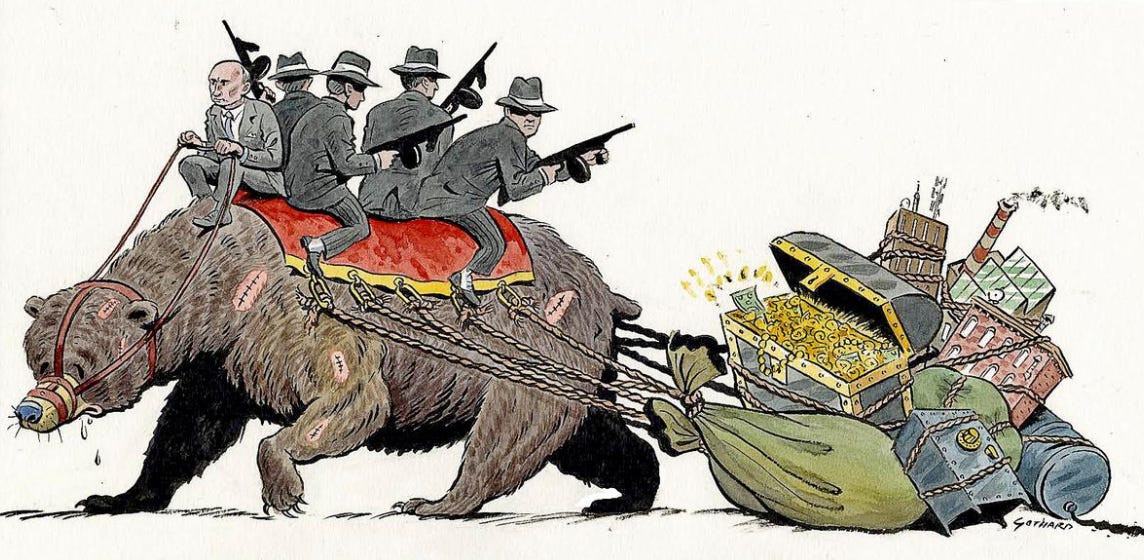
I discovered Diane Franscis’s blog while reading the latest Robert Hubbell. She writes here what many people suspected: Russia is controlled by a ruthless gang. In this country, we call them the mafia. In Russia, they are the government.

She writes:

The bizarre events in Russia over the weekend provide a glimpse into the reality that the country is not a nation, but an empire with warring factions that is run by a mafia. Vladimir Putin has reigned as the “Boss” for 23 years and remained in place by enriching Russia’s thugs, bridling them, and playing one off against another. Under his rule, they have built palaces, stolen the national wealth, become warlords, amassed staggering portfolios, and lived like Czars. But on February 24, 2022, Putin decided to escalate the grift by invading Ukraine to steal more of its resources. Now this war is failing, as is Russia’s economy and Putin’s grip on power. And on June 23, Putin’s inability to control a wartime feud between warlord Yevgeny Prigozhin and Russia’s military brass turned into a full-blown armed mutiny. Prigozhin pulled his mercenaries from the frontline in Ukraine and led a “march for justice” against Putin’s military inside Russia. Putin labeled Prigozhin a “traitor” on national television, ordered his arrest, then instructed his puppet in Belarus, Aleksandr Lukashenko, to make an offer to Prigozhin that he couldn’t refuse: Stand down, charges would be scrapped, and move to Minsk. The crisis ended quickly, but Putin, the Russian Federation, and the war in Ukraine, will never again be the same.

Putin and the gangsters. David Gothard. WSJ

Prigozhin grew up in St. Petersburg, where Putin did, and went to jail as a young man for fraud and theft. He has since become a billionaire oligarch as a result of his connections to Putin and business smarts. More recently, he has become a household word in Russia because of the success of his personal army, the Wagner Group mercenaries, as well as his diatribes on social media against Russia’s generals. He has accused them of poor strategies, corruption, and of using Russian soldiers as cannon fodder. His gutsy stances have made him a populist hero even though he is also a member of the elite. But Prigozhin is different. He’s gone “native” and dons fatigues, is on the frontlines with his mercenaries in the Ukrainian war zone, and excoriates Putin’s generals for drafting young Russians from poor families and regions then sending them to their deaths by the thousands without training or proper equipment.

“The children of the elite smear themselves with creams, showing it on the internet; ordinary people’s children come in zinc, torn to pieces,” said Prigozhin, a reference to metallic coffins. “Those killed in action had tens of thousands of relatives, and society always demands justice and, if there is no justice, then revolutionary sentiments arise.”

Prigozhin warns of revolution but is not a revolutionary. He became a successful chef, then caterer and started a mercenary army that has operated for years surreptitiously around the world on Putin’s behalf. For instance, Wagner helped Putin occupy Crimea and Donbas in 2014, it fought in Syria and various African countries for Moscow for years, and has been involved in the 2022 invasion, fighting alongside Russian regulars in Ukraine. But last year he began to aggressively criticize Russia’s Minister of Defense, Sergei Shoigu, and Chief of General Staff, Gen. Valery Gerasimov and Putin never intervened. This was because he was doing Putin’s dirty work again and blaming the generals for military failures. But Shoigu and Gerasimov struck back by sabotaging the Wagner Group on the battlefield. Prigozhin claimed they withheld ammunition and provided only sub-standard equipment. Then, last month, he alleged that the two actually shelled Wagner troops.

By June, Prigozhin’s success in the battlefield and growing social media presence across Russia and abroad was becoming a threat, so Putin sided with his generals. He ordered Wagner fighters to sign contracts with the Ministry of Defense by July 1. This represented a de facto expropriation which is why Prigozhin pulled his troops from the front line in Ukraine on June 23 and marched them into Russia. That night, Putin condemned Prigozhin on state television and ordered Lukashenko to deliver the deal. Putin has not surfaced since June 24, and unconfirmed reports are that he fled Moscow.

A coup or armed conflict was avoided, but damage was done. Putin’s climb-down and capitulation to a man he had just called a “traitor” destroyed his tough-guy image. It’s obvious that he is not the “Boss”, but merely a figurehead who sits atop a rotten system of squabbling and greedy oligarchs. Prigozhin’s stunt also unveiled Russia’s vulnerability. He was able to march two-thirds of the way toward Moscow in a few hours without resistance. His troops also reportedly shot down six Russian helicopters and an IL-22 airborne command-center plane, killing 13 airmen, along the way, without consequences.

Prigozhin backed down and agreed to self-exile, but he’s not going to disappear, except physically. The generals he demanded that Putin fire still remain in power so he will continue to broadcast his criticisms from afar and plot a comeback, either from a dacha somewhere around the world or on a yacht. He will rebuild Wagner and may attract allies inside and outside Russia who want to overthrow Putin and his generals. He may aspire to be President but that is unlikely. He would be thoroughly unsuitable as President, but, unless assassinated, his ongoing crusade will be a catalyst for change inside Russia and serve the interests of Ukraine and the West. Prigozhin has already undermined Russia’s leadership, damaged frontline morale, stirred up the public, and shredded Putin’s concocted narrative that the invasion was necessary because Ukraine and NATO were a threat to Russia’s existence.

There’s little likelihood that a grassroots movement against Moscow will sprout around Prigozhin because it is a reign of terror and because he’s another thug whose forces have killed many Ukrainians and others. But his popularity was rising in polls before his armed mutiny because his rants resonated with civil society, mostly younger people. He also attracted international recognition with his condemnation of the war itself in the days leading up to the confrontation: “The war wasn’t needed to return Russian citizens to our bosom, nor to demilitarize or denazify Ukraine,” he said. “The war was needed so that a bunch of animals could simply exult in glory.”

The weekend’s events may not have brought about regime change, but Prigozhin has already dealt Putin, and Russia as currently constituted, a fatal blow. As the war continues to backfire, Ukraine and its alliance will push harder and so will separatist movements inside Russia who want autonomy or secession. Putin’s weakness is now apparent, and his tenure uncertain, which will also convince neighboring nations and Russian allies to recalibrate their relationship or forge new ones. Most significantly, Putin’s cave-in and cowardice concerning Prigozhin also means that his many “red lines” in this war are meaningless which is why many have been crossed and more should be ignored in future.

It is ironic that Prigozhin has opened a Pandora’s Box about corruption and injustice in a country run by criminals like himself. His lightning attack also raises fears internationally as to how secure Russia’s nuclear arsenal is from seizure by disgruntled factions such as Wagner or others. Experts say the events haven’t altered the security status of Russia’s nuclear weapons, and the West carefully monitors their movement and storage facilities.

But the country is run by gangsters who have upended the world order. Only “100 beneficiaries and several thousand accomplices” own everything, said Mikhail Kodorovsky, an oligarch jailed by Putin in 2005 on trumped-up charges. “Most of these people began their careers in the criminal underworld of St. Petersburg. Despite having now taken control of the Presidency, the group retains every aspect of the criminal ilk from which they came.”

Putin’s Russia is a criminal organization that must be overthrown. And finally, one of its own has told the world, and Russian people, why it must disappear.

Last Saturday, we awoke to news that the mercenary Wagner Group was marching to Moscow. For a few hours, it seemed that there was a coup in the making. The Wagner troops did not encounter any resistance. They shot down several Russian helicopters. But suddenly the leader of the Wagner Group announced that he had struck a deal with the president of Belarus, and the advancing army turned back, only 120 miles from Moscow.

There are two articles that helped explain the odd series of events. One was written by Anne Applebaum in The Atlantic. When the Wagner Group rolled into Rostov-on-Don, there was no resistance. People brought them drinks and treats. She says that Putin had cultivated a sense of apathy among the Russian people. One man has been in office for 23 years and will remain in office for the next 13 years. Unless he wants to stay longer. Since the people have no say in how the nation is governed, why get involved? And so no one sprang to defend Putin.

Timothy Snyder is always worth reading. He is a professor of European history at Yale University. This post appeared on his blog.

He writes:

How to understand Yevgeny Prigozhin’s march on Moscow and its sudden end? Often there are plots without a coup; this seemed like a coup without a plot. Yet weird as the mercenary chief’s mutiny was, we can draw some conclusions from its course and from its conclusion.

1. Putin is not popular. All the opinion polling we have takes place in an environment where his power is seen as more or less inevitable and where answering the question the wrong way seems risky. But when Putin’s power was lifted, as when the city of Rostov-on-Don was seized by Wagner, no one seemed to mind. Reacting to Prigozhin’s mutiny, some Russians were euphoric, and most seemed apathetic. What was not to be seen was anyone in any Russian city spontaneously expressing their personal support for Putin, let alone anyone taking any sort of personal risk on behalf of his regime.

The euphoria suggests to me that some Russians are ready to be ruled by a different exploitative regime. The apathy indicates that most Russians at this point just take for granted that they will be ruled by the gangster with the most guns, and will just go on with their daily lives regardless of who that gangster happens to be.

2.  Prigozhin was a threat to Putin, because he does much the same things that Putin does, and leverages Putin’s own assets.  Both the Russian state itself and Prigozhin’s mercenary firm Wagner are extractive regimes with large public relations and military arms.  

The Putin regime exists, and the cities of Moscow and St. Petersburg are relatively wealthy, thanks to the colonial exploitation of hydrocarbon resources in Siberia.  The wealth is held by a very few people, and the Russian population is treated to a regular spectacle of otherwise pointless war — Ukraine, Syria, Ukraine again — to distract attention from this basic state of affairs, and to convince them that there is some kind of external enemy that justifies it (hint: there really isn’t).  

Wagner functioned as a kind of intensification of the Russian state, doing the dirtiest work beyond Russia, not only in Syria and Ukraine but also in Africa.  It was subsidized by the Russian state, but made its real money by extracting mineral resources on its own, especially in Africa.  Unlike most of its other ventures, Wagner’s war in Ukraine was a losing proposition.  Prigozhin leveraged the desperation of Russia’s propaganda for a victory by taking credit for victory at Bakhmut.  That minor city was completely destroyed and abandoned by the time Wagner took it, at the cost of tens of thousands of Russian lives.  

But because it was the only gain in Russia’s horrifyingly costly but strategically senseless 2023 offensive, Bakhmut had to be portrayed by Putin’s media as some kind of Stalingrad or Berlin.  Prigozhin took advantage of this. He was able to direct the false glory to himself even as he then withdrew Wagner from Ukraine.  Meanwhile he criticized the military commanders of the Russian Federation in increasingly vulgar terms, thereby preventing the Russian state (and Putin) from gaining much from the bloody spectacle of invaded Ukraine.  In sum: Wagner was able to make the Putin regime work for it.

3.  Prigozhin told the truth about the war.  This has to be treated as a kind of self-serving accident: Prigozhin is a flamboyant and skilled liar and propagandist.  But his pose in the days before his march on Moscow made the truth helpful to him.  He wanted to occupy this position in Russian public opinion: the man who fought loyally for Russia and won Russia’s only meaningful victory in 2023, in the teeth of the incompetence of the regime and the senselessness of the war itself.  

I’m not sure enough attention has been paid to what Prigozhin said about Putin’s motives for war: that it had nothing to do with NATO enlargement or Ukrainian aggression, and was simply a matter of wishing to dominate Ukraine, replace its regime with a Moscow-friendly politician (Viktor Medvedchuk), and then seize its resources and to satisfy the Russian elite.  Given the way the Russian political system actually works, that has the ring of plausibility.  Putin’s various rationales are dramatically inconsistent with the way the Russian political system actually works.

4.  Russia is far less secure than it was before invading Ukraine.  This is a rather obvious point that many people aside from myself have been making, going all the way back the first invasion of 2014.  There was never any reason to believe, from that point at the latest, that Putin cared about Russian national interests.  If he had, he would never have begun a conflict that forced Russia to become subordinate to China, which is the only real threat on its borders.  Any realist in Moscow concerned about the Russian state would seek to balance China and the West, rather than pursue a policy which had to alienate the West.  

Putin was concerned that Ukraine might serve as a model.  Unlike Russians, Ukrainians could vote and enjoyed freedom of speech and association.  That was no threat to Russia, but it was to Putin’s own power.  Putin certainly saw Ukraine as an opportunity to generate a spectacle that would distract from his own regime’s intense corruption, and to consolidate his own reputation as a leader who could gather in what he falsely portrayed as “Russian” lands.  But none of this has anything to do with the security of Russia as a state or the wellbeing of Russians as a people.  

The Putin of 2022 (much more than the Putin of 2014) seems to have believed his own propaganda, overestimating Russian power while dismissing the reality of the Ukrainian state and Ukrainian civil society — something no realist would do. That meant that the second invasion failed, and that meant (as I wrote back in February 2022) that it would give an opportunity to a rival warlord. Prigozhin was that warlord and he took that opportunity. This might have all seemed abstract until he led his forces on a march to Moscow, downing six Russian helicopters and one plane, and stopping without ever having met meaningful resistance. To be sure, Wagner had many advantages, such as being seen as Russian by locals and knowing how local infrastructure worked. Nevertheless, Prigozhin’s march shows that a small force would have little trouble reaching Moscow. That was not the case before most of the Russian armed forces were committed in Ukraine, where many of the best units essentially ceased to exist.

5.  When backed into a corner, Putin saves himself.  In the West, we worry about Putin’s feelings.  What might he do if he feels threatened?  Might he do something terrible to us?  Putin encourages this line of thinking with constant bluster about “escalation” and the like.  On Saturday Putin gave another speech full of threats, this time directed against Prigozhin and Wagner.  Then he got into a plane and flew away to another city.  And then he made a deal with Prigozhin.  And then all legal charges against Prigozhin were dropped.  And then Putin’s propagandists explained that all of this was perfectly normal.  

So long as Putin is in power, this is what he will do.  He will threaten and hope that those threats will change the behaviour of his enemies.  When that fails, he will change the story.  His regime rests on propaganda, and in the end the spectacle generated by the military is there to serve the propaganda.  Even when that spectacle is as humiliating as can be possibly be imagined, as it was on Saturday when Russian rebels marched on Moscow and Putin fled, his response will be to try to change the subject.  

It is worth emphasizing that on Saturday the threat to him personally and to his regime was real.  Both the risk and the humiliation were incomparably greater than anything that could happen in Ukraine.  Compared to power in Russia, land in Ukraine is unimportant.  After what we have just seen, no one should be arguing that Putin might be backed into a corner in Ukraine and take some terrible decision.  He cannot be backed into a corner in Ukraine.  He can only be backed into a corner in Russia.  And now we know what he does when that happens: record a speech and run away.

(And most likely write a check. A note of speculation. No one yet knows what the deal between Putin and Prigozhin was. There are rumblings in Russia that Sergei Shoigu, Prigozhin’s main target, will be forced to resign after accusations of some kind of corruption or another. There are reports that Prigozhin was given reason to be concerned about the lives of his own familymembers and those of other Wagner leaders. I imagine, personally, that one element was money. On 1 July, Wagner was going to cease to exist as a separate entity, at least formally speaking. It like all private armies was required to subordinate itself to the ministry of defense, which is to say to Shoigu. This helps to explain, I think, the timing of the mutiny. Were Wagner to cease to function as before, Prigozhin would have lost a lot of money. It is not unreasonable to suppose that he marched on Moscow at a moment when we still had the firepower to generate one last payout. Mafia metaphors can help here, not least because they are barely metaphors. You can think of the Russian state as a protection racket. No one is really safe, but everyone has to accept “protection” in the knowledge that this is less risky than rebellion. A protection racket is always vulnerable to another protection racket. In marching from Rostov-on-Don to Moscow, Prigozhin was breaking one protection racket and proposing another. On this logic, we can imagine Prigozhin’s proposal to Putin as follows: I am deploying the greater force, and I am now demanding protection money from you. If you want to continue your own protection racket, pay me off before I reach Moscow.)

6.  The top participants were fascists, and fascists can feud.  We don’t use the term “fascist” much, since the Russians (especially Russian fascists) use it for their enemies, which is confusing; and since it seems somehow politically incorrect to use it.  And for another reason: unlike the Italians, the Romanians, and the Germans of the 1930s, the Putin regime has had the use of tremendous profits from hydrocarbons, which it has used to influence western public opinion.  All the same, if Russia today is not a fascist regime, it is really difficult to know what regime would be fascist.  It is more clearly fascist than Mussolini’s Italy, which invented the term.  Russian fascists have been in the forefront of both invasions on Ukraine, both on the battlefield and in propaganda.  Putin himself has used fascist language at every turn, and has pursued the fascist goal of genocide in Ukraine.  

Prigozhin has been however the more effective fascist propagandist during this war, strategically using symbols of violence (a sledgehammer) and images of death (cemeteries, actual corpses) to solidify his position.  Wagner includes a very large number of openly fascist fighters.  Wagner’s conflict with Shoigu has racist overtones, undertones, and throughtones — on pro-Wagner Telegram channels he is referred to as “the Tuva degenerate” and similar.  

That said, the difference between fascists can seem very meaningful when that is all that is on offer, and it is absolutely clear that many Russians were deeply affected by the clash of the two fascist camps.  That said, it is important to specify a difference between Putin and Prigozhin’s fascism and that of the 1930s.  The two men are both very concerned with money, which the first generation of fascists in general were not.  They are oligarchical fascists — a breed worth watching here in the US as well.

7.  The division in Russia was real, and will likely endure.  Some Russians celebrated when Wagner shot down Russian helicopters, and others were astonished that they could do so.  Some Russians wanted action, others could not imagine change.  Most Russians probably do not care much, but those who do are not of the same opinion.  Putin’s regime will try to change the subject, as always, but now it lacks offensive power in Ukraine (without Wagner) and so the ability to create much of a spectacle. Russian propaganda has already turned against Wagner, who were of course yesterday’s heroes. The leading Russian propagandist, Vladimir Solovyov, recruited for Wagner. The son of Putin’s spokesman supposedly served in Wagner. Although this was almost certainly a lie, it reveals that Wagner was once the site of prestige. 

It might prove hard for Russian propagandists to find any heroes in the story, since for the most part no one resisted Wagner’s march on Moscow.  If Wagner was so horrible, why did everyone just let it go forward?  If the Russian ministry of defense is so effective, why did it do so little?  If Putin is in charge, why did he run away, and leave even the negotiating to Lukashenko of Belarus?  If Lukashenko is the hero of the story, what does that say about Putin?

It is also not clear what will happen now to Wagner.  The Kremlin claims that its men will be integrated into the Russian armed forces, but it is hard to see why they would accept that.  They are used to being treated with greater respect (and getting paid better).  If Wagner remains intact in some form, it is hard to see how it could be trusted, in Ukraine or anywhere else.  More broadly, Putin now faces a bad choice between toleration and purges.  If he tolerates the rebellion, he looks weak.  If he purges his regime, he risks another rebellion.

8.  One of Putin’s crimes against Russia is his treatment of the opposition.  This might seem to be a tangent: what does the imprisoned or exiled opposition have to do with Prigozhin’s mutiny?  The point is that their imprisonment and exile meant that they could do little to advance their own ideas for Russia’s future on what would otherwise have been an excellent occasion to do so.  The Putin regime is obviously worn out, but there is no one around to say so, and to propose something better than another aging fascist.  

I think of this by contrast to 1991.  During the coup attempt that August against Gorbachev, Russians rallied in Moscow.  They might or might not have been supporters of Gorbachev, but they could see the threat a military coup posed for their own futures.  The resistance to the coup gave Russia a chance for a new beginning, a chance that has now been wasted.  There was no resistance to this coup, in part because of the systematic political degeneration of the Putin regime, in part because the kinds of courageous Russians who went to the streets in 1991 are now behind bars or in exile.  This means that Russians in general have been denied a chance to think of political futures. 

9.  This was a preview of how the war in Ukraine ends.  When there is meaningful conflict in Russia, Russians will forget about Ukraine and pay attention to their own country.  That has no happened once, and it can happen again.  When such a conflict lasts longer than this one (just one day), Russian troops will be withdrawn from Ukraine.  In this case, Wagner withdrew itself from Ukraine, and then the troops of Ramzan Kadyrov (Akhmat) departed Ukraine to fight Wagner (which they predictably failed to do, which is another story).  In a more sustained conflict, regular soldiers would also depart.  It will be impossible to defend Moscow and its elites otherwise.  Moscow elites who think ahead should want those troops withdrawn now. On its present trajectory, Russia is likely to face an internal power struggle sooner rather than later.  That is how wars end: when the pressure is felt inside the political system.  Those who want this war to end should help Ukrainians exert that pressure.

10.  Events in Russia (like events in Ukraine) are in large measure determined by the choices of Russians (or Ukrainians).  In the US we have the imperialist habit of denying agency to both parties in this conflict.  Far too many people seem to think that Ukrainians are fighting because of the US or NATO, when in fact the situation is entirely the opposite: it was Ukrainian resistance that persuaded other nations to help.  Far too many people still think the US or NATO had something to do with Putin’s personal decision to invade Ukraine, when in fact the character of the Russian system (and Putin’s own words) provide us with more than enough explanation. 

Some of those people are now claiming that Prigozhin’s putsch was planned by the Americans, which is silly.  The Biden administration has quite consistently worked against Wagner.  Prigozhin’s main American connection was his hard work, as head of Russia’s Internet Research Agency, to get Trump elected in 2016.  Others are scrambling to explain Prigozhin’s march on Moscow and its end as some kind of complex political theater, in which the goal was to move Prigozhin and Wagner to Belarus to organize a strike on Ukraine from the north.  This is ludicrous.  If Prigozhin actually does go to Belarus, there is no telling what he might improvise there. But the idea of such a plan makes no sense. If Putin and Prigozhin were on cooperative terms, they could have simply agreed on such a move in a way that would not have damaged both of their reputations (and left Russia weaker).  

Putin choose to invade Ukraine for reasons that made sense to him inside the system he built.  Prigozhin resisted Putin for reasons that made sense to him as someone who had profited from that system from the inside.  The mutiny was a choice within Putin’s war of choice, and it exemplifies the disaster Putin has brought to his country.

(PS this has been corrected to repair an autocorrection mistake in a surname. Thanks for your patience. TS 26 June 2023).

Vladimir Kara-Murza is a Russian journalist, author, and dissident who was sentenced to 25 years in jail for speaking out against the war on Ukraine. This article appeared in the Washington Post.

Vladimir Kara-Murza has prepared the following remarks for an upcoming appearance before a Moscow appeals court. In April, he was sentenced to 25 years in prison on treason charges — an accusation based entirely on his public statements about Russia’s full-scale invasion of Ukraine.

“Throughout this process — first in the Moscow City Court, now here in the Court of Appeal — a very strange feeling has never left me. Judicial procedures, by their nature, must be somehow connected with the law. But everything that has happened to me has nothing to do with the law; if anything, what I have witnessed is precisely the opposite.

“The law — both Russian and international — prohibits the waging of aggressive war. But for more than 15 months, the man who calls himself the president of my country has been waging a brutal, unprovoked, aggressive war against a neighboring country: killing its citizens, bombing its cities, seizing its territories.

“The law — both Russian and international — prohibits attacks on civilians and civilian targets. But during the 15 months of Putin’s aggression in Ukraine, tens of thousands of civilians have been killed and wounded, and thousands of hospitals, schools and houses have been destroyed.
The law — both Russian and international — prohibits propaganda for war. But war propaganda is all I hear from morning to night on the television that plays in my prison cell.


“Today in our country, it is not those who are waging this criminal war but those who oppose it who face judgment: Journalists who tell the truth. Artists who put up antiwar stickers. Priests who invoke the commandment “Thou shalt not kill.” Teachers who call a spade a spade. Parents whose children draw antiwar pictures. Lawmakers who allow themselves to doubt the appropriateness of children’s competitions when children are being killed in a neighboring country.

“Or, as in my case, politicians who openly speak out against this war and against this regime. I received a sentence of 25 years for five public appearances. As the head of my guards in Moscow City Court sarcastically joked: “Impressive work.”

“All this has happened before in our country. In 1968, participants in a demonstration on Red Square against the invasion of Czechoslovakia were sentenced to camps and internal exile, and in 1980, [Andrei] Sakharov was exiled to the closed city of Gorky for speaking out against the war in Afghanistan.

“But it was only a few years later that a Russian president [Boris Yeltsin], on a visit to Prague, condemned that occupation and laid flowers at the memorial to its victims, and the highest legislative body of our country declared that the war in Afghanistan deserved moral and political condemnation. The same will happen with the current war in Ukraine, and it will happen much sooner than it may seem to those who unleashed it. That is because, in addition to legal laws, there are laws of history, and no one has yet been able to cancel them.

“And then the real criminals will be judged — including those whose arrest warrants have already been issued by the International Criminal Court. As you know, war crimes have no statute of limitations. I have some advice for all of those who organized my and other show trials against opponents of the war by trying to present opponents of the authorities as “traitors to the Motherland,” for all of those who are so nostalgic for the Soviet system: Remember how it ended. All systems based on lies and violence end the same way.”

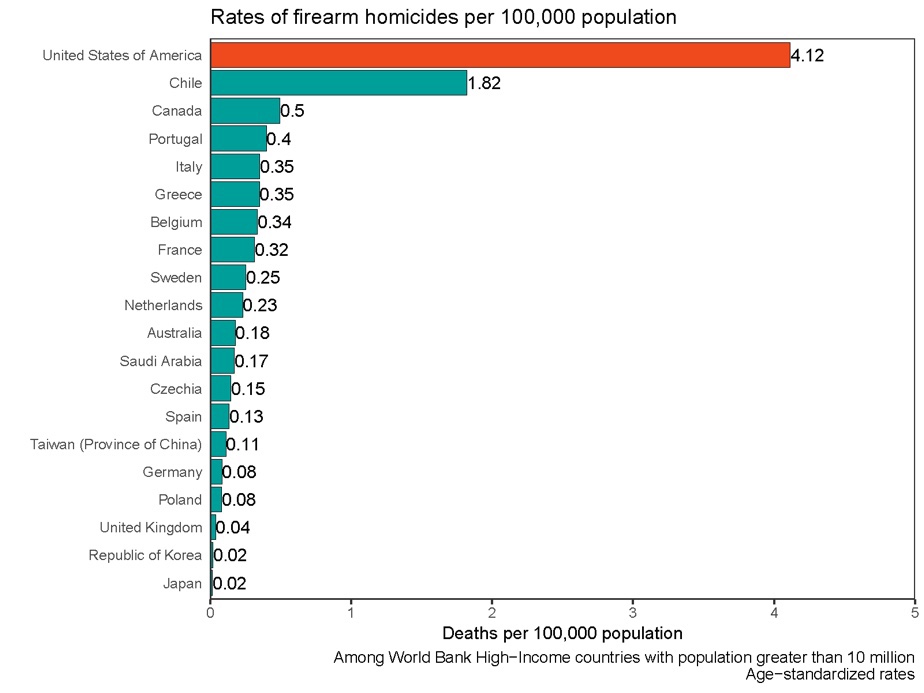
We lead the world in gun deaths. Yet GOP-dominated states like Florida, Texas, and Missouri are making it easier to get and carry a gun. The GOP fights any form of gun control.

Timothy Snyder is a historian at Yale Univerity who has written extensively on European history and threats to democracy. This essay is a fascinating history of Ukraine, which was published in The New Yorker.

He writes:

When Vladimir Putin denies the reality of the Ukrainian state, he is speaking the familiar language of empire. For five hundred years, European conquerors called the societies that they encountered “tribes,” treating them as incapable of governing themselves. As we see in the ruins of Ukrainian cities, and in the Russian practice of mass killing, rape, and deportation, the claim that a nation does not exist is the rhetorical preparation for destroying it.

Empire’s story divides subjects from objects. As the philosopher Frantz Fanon argued, colonizers see themselves as actors with purpose, and the colonized as instruments to realize the imperial vision. Putin took a pronounced colonial turn when returning to the Presidency a decade ago. In 2012, he described Russia as a “state-civilization,” which by its nature absorbed smaller cultures such as Ukraine’s. The next year, he claimed that Russians and Ukrainians were joined in “spiritual unity.” In a long essay on “historical unity,” published last July, he argued that Ukraine and Russia were a single country, bound by a shared origin. His vision is of a broken world that must be restored through violence. Russia becomes itself only by annihilating Ukraine.

As the objects of this rhetoric, and of the war of destruction that it sanctions, Ukrainians grasp all of this. Ukraine does have a history, of course, and Ukrainians do constitute a nation. But empire enforces objectification on the periphery and amnesia at the center. Thus modern Russian imperialism includes memory lawsthat forbid serious discussion of the Soviet past. It is illegal for Russians to apply the word “war” to the invasion of Ukraine. It is also illegal to say that Stalin began the Second World War as Hitler’s ally, and used much the same justification to attack Poland as Putin is using to attack Ukraine. When the invasion began, in February, Russian publishers were ordered to purge mentions of Ukraine from textbooks.

Faced with the Kremlin’s official mixture of fantasy and taboo, the temptation is to prove the opposite: that it is Ukraine rather than Russia that is eternal, that it is Ukrainians, not Russians, who are always right, and so on. Yet Ukrainian history gives us something more interesting than a mere counter-narrative to empire. We can find Ukrainian national feeling at a very early date. In contemporary Ukraine, though, the nation is not so much anti-colonial, a rejection of a particular imperial power, as post-colonial, the creation of something new.

Southern Ukraine, where Russian troops are now besieging cities and bombing hospitals, was well known to the ancients. In the founding myth of Athens, the goddess Athena gives the city the gift of the olive tree. In fact, the city could grow olives only because it imported grain from ports on the Black Sea coast. The Greeks knew the coast, but not the hinterland, where they imagined mythical creatures guarding fields of gold and ambrosia. Here already was a colonial view of Ukraine: a land of fantasy, where those who take have the right to dream.

The city of Kyiv did not exist in ancient times, but it is very old—about half a millennium older than Moscow. It was probably founded in the sixth or seventh century, north of any territory seen by Greeks or controlled by Romans. Islam was advancing, and Christianity was becoming European. The Western Roman Empire had fallen, leaving a form of Christianity subordinate to a pope. The Eastern (Byzantine) Empire remained, directing what we now call the Orthodox Church. As Rome and Constantinople competed for converts, peoples east of Kyiv converted to Islam. Kyivans spoke a Slavic language that had no writing system, and practiced a paganism without idols or temples.

Putin’s vision of “unity” relates to a baptism that took place in this setting. In the ninth century, a group of Vikings known as the Rus arrived in Kyiv. Seeking a southbound route for their slave trade, they found the Dnipro River, which runs through the city. Their chieftains then fought over a patchwork of territories in what is now Ukraine, Belarus, and the northeast of Russia—with Kyiv always as the prize. In the late tenth century, a Viking named Valdemar took the city, with the help of a Scandinavian army. He initially governed as a pagan. But, around 987, when the Byzantines faced an internal revolt, he sensed an opportunity. He came to the emperor’s aid, and received his sister’s hand in marriage. In the process, Valdemar converted to Christianity.

Putin claims that this messy sequence of events reveals the will of God to bind Russia and Ukraine forever. The will of God is easy to misunderstand; in any case, modern nations did not exist at the time, and the words “Russia” and “Ukraine” had no meaning. Valdemar was typical of the pagan Eastern European rulers of his day, considering multiple monotheistic options before choosing the one that made the most strategic sense. The word “Rus” no longer meant Viking slavers but a Christian polity. Its ruling family now intermarried with others, and the local people were treated as subjects to be taxed rather than as bodies to be sold.

Yet no rule defined who would take power after a Kyivan ruler’s death. Valdemar took a Byzantine princess as his wife, but he had a half a dozen others, not to mention a harem of hundreds of women. When he died in 1015, he had imprisoned one of his sons, Sviatopolk, and was making war upon another, Yaroslav. Sviatopolk was freed after his father’s death, and killed three of his brothers, but he was defeated on the battlefield by Yaroslav. Other sons entered the fray, and Yaroslav didn’t rule alone until 1036. The succession had taken twenty-one years. At least ten other sons of Valdemar had died in the meantime.

These events do not reveal a timeless empire, as Putin claims. But they do suggest the importance of a succession principle, a theme very important in Ukrainian-Russian relations today. The Ukrainian transliteration of “Valdemar” is “Volodymyr,” the name of Ukraine’s President. In Ukraine, power is transferred through democratic elections: when Volodymyr Zelensky won the 2019 Presidential election, the sitting President accepted defeat. The Russian transliteration of the same name is “Vladimir.” Russia is brittle: it has no succession principle, and it’s unclear what will happen when Vladimir Putin dies or is forced from power. The pressure of mortality confirms the imperial thinking. An aging tyrant, obsessed by his legacy, seizes upon a lofty illusion that seems to confer immortality: the “unity” of Russia and Ukraine.

In the Icelandic sagas, Yaroslav is remembered as the Lame; in Eastern Europe, he is the Wise, the giver of laws. Yet he did not solve the problem of succession. Following his reign, the lands around Kyiv fragmented again and again. In 1240, the city fell to the Mongols; later, most of old Rus was claimed by the Grand Duchy of Lithuania, then the largest state in Europe. Lithuania borrowed from Kyiv a grammar of politics, as well as a good deal of law. For a couple of centuries, its grand dukes also ruled Poland. But, in 1569, after the Lithuanian dynasty died out, a Polish-Lithuanian commonwealth was formalized, and the territories of Ukraine were placed under Polish jurisdiction.

This was a crucial change. After 1569, Kyiv was no longer a source of law but an object of it—the archetypal colonial situation. It was colonization that set off Ukraine from the former territories of Rus, and its manner generated qualities still visible today: suspicion of the central state, organization in crisis, and the notion of freedom as self-expression, despite a powerful neighbor.

During the sixteenth and seventeenth centuries, all the forces of Europe’s globalization seemed to bear down on Ukraine. Polish colonization resembled and in some measure enabled the European colonization of the wider world. Polish nobles introduced land-management practices—along with land managers, most of whom were Jewish—that allowed the establishment of profitable plantations. Local Ukrainian warlords rushed to imitate the system, and adopted elements of Polish culture, including Western Christianity and the Polish language. In an age of discovery, enserfed peasants labored for a world market.

Ukraine’s colonization coincided with the Renaissance, and with a spectacular flowering of Polish culture. Like other Renaissance thinkers, Polish scholars in Ukraine resuscitated ancient knowledge, and sometimes overturned it. It was a Pole, Copernicus, who undid the legacy of Ptolemy’s “Almagest” and confirmed that the Earth orbits the sun. It was another Pole, Maciej of Miechów, who corrected Ptolemy’s “Geography,” clearing Ukrainian maps of gold and ambrosia. As in ancient times, however, the tilling of the black earth enabled tremendous wealth, raising the question of why those who labored and those who profited experienced such different fates.

The Renaissance considered questions of identity through language. Across Europe, there was a debate as to whether Latin, now revived, was sufficient for the culture, or whether vernacular spoken languages should be elevated for the task. In the early fourteenth century, Dante answered this question in favor of Italian; English, French, Spanish, and Polish writers created other literary languages by codifying local vernaculars. In Ukraine, literary Polish emerged victorious over the Ukrainian vernacular, becoming the language of the commercial and intellectual élite. In a way, this was typical: Polish was a modern language, like English or Italian. But it was not the local language in Ukraine. Ukraine’s answer to the language question was deeply colonial, whereas in the rest of Europe it could be seen as broadly democratic.

The Reformation brought a similar result: local élites converted to Protestantism and then to Roman Catholicism, alienating them further from an Orthodox population. The convergence of colonization, the Renaissance, and the Reformation was specific to Ukraine. By the sixteen-forties, the few large landholders generally spoke Polish and were Catholic, and those who worked for them spoke Ukrainian and were Orthodox. Globalization had generated differences and inequalities that pushed the people to rebellion.

Ukrainians on the battlefield today rely on no fantasy of the past to counter Putin’s. If there is a precursor that matters to them, it is the Cossacks, a group of free people who lived on the far reaches of the Ukrainian steppe, making their fortress on an island in the middle of the Dnipro. Having escaped the Polish system of landowners and peasants, they could choose to be “registered Cossacks,” paid for their service in the Polish Army. Still, they were not citizens, and more of them wished to be registered than the Polish-Lithuanian parliament would allow.

The rebellion began in 1648, when an influential Cossack, Bohdan Khmelnytsky, saw his lands seized and his son attacked by a Polish noble. Finding himself beyond the protection of the law, Khmelnytsky turned his fellow-Cossacks toward revolt against the Polish-speaking, Roman Catholic magnates who dominated Ukraine. The accumulated cultural, religious, and economic grievances of the people quickly transformed the revolt into something very much like an anti-colonial uprising, with violence directed not only against the private armies of the magnates but against Poles and Jews generally. The magnates carried out reprisals against peasants and Cossacks, impaling them on stakes. The Polish-Lithuanian cavalry fought what had been their own Cossack infantry. Each side knew the other very well.

In 1651, the Cossacks, realizing that they needed help, turned to an Eastern power, Muscovy, about which they knew little. When Kyivan Rus had collapsed, most of its lands had been absorbed by Lithuania, but some of its northeastern territories remained under the dominion of a Mongol successor state. There, in a new city called Moscow, leaders known as tsars had begun an extraordinary period of territorial expansion, extending their realm into northern Asia. In 1648, the year that the Cossack uprising began, a Muscovite explorer reached the Pacific Ocean.

The war in Ukraine allowed Muscovy to turn its attention to Europe. In 1654, the Cossacks signed an agreement with representatives of the tsar. The Muscovite armies invaded Poland-Lithuania from the east; soon after, Sweden invaded from the north, setting off the crisis that Polish history remembers as “the Deluge.” Peace was eventually made between Poland-Lithuania and Muscovy, in 1667, and Ukraine was divided more or less down the middle, along the Dnipro. After a thousand years of existence, Kyiv was politically connected to Moscow for the first time.

The Cossacks were something like an early national movement. The problem was that their struggle against one colonial power enabled another. In 1721, Muscovy was renamed the Russian Empire, in reference to old Rus. Poland-Lithuania never really recovered from the Deluge, and was partitioned out of existence between 1772 and 1795. Russia thereby claimed the rest of Ukraine—everything but a western district known as Galicia, which went to the Habsburgs. Around the same time, in 1775, the Cossacks lost their status. They did not gain the political rights they had wanted, nor did the peasants who supported them gain control of the black earth. Polish landowners remained in Ukraine, even as state power became Russian.

Whereas Putin’s story of Ukraine is about destiny, the Ukrainian recollection of the Cossacks is about unfulfilled aspirations. The country’s national anthem, written in 1862, speaks of a young people upon whom fate has yet to smile, but who will one day prove worthy of the “Cossack nation.”

The nineteenth century was the age of national revivals. When the Ukrainian movement began in imperial Russian Kharkov—today Kharkiv, and largely in ruins—the focus was on the Cossack legacy. The next move was to locate history in the people, as an account of continuous culture. At first, such efforts did not seem threatening to imperial rule. But, after the Russian defeat in the Crimean War, in 1856, and the insult of the Polish uprisingof 1863 and 1864, Ukrainian culture was declared not to exist. It was often deemed an invention of Polish élites—an idea that Putin endorsed in his essay on “historical unity.” Leading Ukrainian thinkers emigrated to Galicia, where they could speak freely.

The First World War brought the principle of self-determination, which promised a release from imperial rule. In practice, it was often used to rescue old empires, or to build new ones. A Ukrainian National Republic was established in 1917, as the Russian Empire collapsed into revolution. In 1918, in return for a promise of foodstuffs, the country was recognized by Austria and Germany. Woodrow Wilson championed self-determination, but his victorious entente ignored Ukraine, recognizing Polish claims instead. Vladimir Lenin invoked the principle as well, though he meant only that the exploitation of national questions could advance class revolution. Ukraine soon found itself at the center of the Russian civil war, in which the Red Army, led by the Bolsheviks, and the White Army, fighting for the defunct empire, both denied Ukraine’s right to sovereignty. In this dreadful conflict, which followed four years of war, millions of people died, among them tens of thousands of Jews.

Though the Red Army ultimately prevailed, Bolshevik leaders knew that the Ukrainian question had to be addressed. Putin claims that the Bolsheviks created Ukraine, but the truth is close to the opposite. The Bolsheviks destroyed the Ukrainian National Republic. Aware that Ukrainian identity was real and widespread, they designed their new state to account for it. It was largely thanks to Ukraine that the Soviet Union took the form it did, as a federation of units with national names.

The failure of self-determination in Ukraine was hardly unique. Almost all of the new states created after the First World War were destroyed, within about two decades, by Nazi Germany, the Soviet Union, or both. In the political imaginations of both regimes, Ukraine was the territory whose possession would allow them to break the postwar order, and to transform the world in their own image. As in the sixteenth century, it was as if all the forces of world history were concentrated on a single country.

Stalin spoke of an internal colonization, in which peasants would be exploited so that the Soviet economy could imitate—and then overtake—capitalism. His policy of collective agriculture, in which land was seized from farmers, was particularly unwelcome in Ukraine, where the revolution had finally got rid of the (still largely Polish) landholders. Yet the black earth of Ukraine was central to Stalin’s plans, and he moved to subdue it. In 1932 and 1933, he enforced a series of policies that led to around four million people dying of hunger or related disease. Soviet propaganda blamed the Ukrainians, claiming that they were killing themselves to discredit Soviet rule—a tactic echoed, today, by Putin. Europeans who tried to organize famine relief were dismissed as Nazis.

The actual Nazis saw Stalin’s famine as a sign that Ukrainian agriculture could be exploited for another imperial project: their own. Hitler wanted Soviet power overthrown, Soviet cities depopulated, and the whole western part of the country colonized. His vision of Ukrainians was intensely colonial: he imagined that he could deport and starve them by the millions, and exploit the labor of whoever remained. It was Hitler’s desire for Ukrainian land that brought millions of Jews under German control. In this sense, colonial logic about Ukraine was a necessary condition for the Holocaust.

Between 1933 and 1945, Soviet and Nazi colonialism made Ukraine the most dangerous place in the world. More civilians were killed in Ukraine, in acts of atrocity, than anywhere else. That reckoning doesn’t even include soldiers: more Ukrainians died fighting the Germans, in the Second World War, than French, American, and British troops combined.

The major conflict of the war in Europe was the German-Soviet struggle for Ukraine, which took place between 1941 and 1945. But, when the war began, in 1939, the Soviet Union and Germany were de-facto allies, and jointly invaded Poland. At the time, what is now western Ukraine was southeastern Poland. A small group of Ukrainian nationalists there joined the Germans, understanding that they would seek to destroy the U.S.S.R. When it became clear that the Germans would fail, the nationalists left their service, ethnically cleansed Poles in 1943 and 1944, and then resisted the Soviets. In Putin’s texts, they figure as timeless villains, responsible for Ukrainian difference generally. The irony, of course, is that they emerged thanks to Stalin’s much grander collaboration with Hitler. They were crushed by Soviet power, in a brutal counter-insurgency, and today Ukraine’s far right polls at one to two per cent. Meanwhile, the Poles, whose ancestors were the chief victims of Ukrainian nationalism, have admittednearly three million Ukrainian refugees, reminding us that there are other ways to handle history than stories of eternal victimhood.

After the war, western Ukraine was added to Soviet Ukraine, and the republic was placed under suspicion precisely because it had been under German occupation. New restrictions on Ukrainian culture were justified by a manufactured allocation of guilt. This circular logic—we punish you, therefore you must be guilty—informs Kremlin propaganda today. Russia’s foreign minister, Sergey Lavrov, has argued that Russia had to invade Ukraine because Ukraine might have started a war. Putin, who has said the same, is clearly drawing on Stalin’s rhetoric. We are to understand that the Soviet victory in the Second World War left Russians forever pure and Ukrainians eternally guilty. At the funerals of Russian soldiers, grieving parents are told that their sons were fighting Nazis.

The history of the colonization of Ukraine, like the history of troubling and divisive subjects in general, can help us get free of myths. The past delivers to Putin several strands of colonial rhetoric, which he has combined and intensified. It also leaves us vulnerable to a language of exploitation: whenever we speak of “the Ukraine” instead of “Ukraine,” or pronounce the capital city in the Russian style, or act as if Americans can tell Ukrainians when and how to make peace, we are continuing imperial rhetoric by partaking in it.

Ukrainian national rhetoric is less coherent than Putin’s imperialism, and, therefore, more credible, and more human. Independence arrived in 1991, when the U.S.S.R was dissolved. Since then, the country’s politics have been marked by corruption and inequality, but also by a democratic spirit that has grown in tandem with national self-awareness. In 2004, an attempt to rig an election was defeated by a mass movement. In 2014, millions of Ukrainians protested a President who retreated from the E.U. The protesters were massacred, the President fled, and Russia invaded Ukraine for the first time. Again and again, Ukrainians have elected Presidents who seek reconciliation with Russia; again and again, this has failed. Zelensky is an extreme case: he ran on a platform of peace, only to be greeted with an invasion.

Ukraine is a post-colonial country, one that does not define itself against exploitation so much as accept, and sometimes even celebrate, the complications of emerging from it. Its people are bilingual, and its soldiers speak the language of the invader as well as their own. The war is fought in a decentralized way, dependent on the solidarity of local communities. These communities are diverse, but together they defend the notion of Ukraine as a political nation. There is something heartening in this. The model of the nation as a mini-empire, replicating inequalities on a smaller scale, and aiming for a homogeneity that is confused with identity, has worn itself out. If we are going to have democratic states in the twenty-first century, they will have to accept some of the complexity that is taken for granted in Ukraine.

The contrast between an aging empire and a new kind of nation is captured by Zelensky, whose simple presence makes Kremlin ideology seem senseless. Born in 1978, he is a child of the U.S.S.R., and speaks Russian with his family. A Jew, he reminds us that democracy can be multicultural. He does not so much answer Russian imperialism as exist alongside it, as though hailing from some wiser dimension. He does not need to mirror Putin; he just needs to show up. Every day, he affirms his nation by what he says and what he does.

Ukrainians assert their nation’s existence through simple acts of solidarity. They are not resisting Russia because of some absence or some difference, because they are not Russians or opposed to Russians. What is to be resisted is elemental: the threat of national extinction represented by Russian colonialism, a war of destruction expressly designed to resolve “the Ukrainian question.” Ukrainians know that there is not a question to be answered, only a life to be lived and, if need be, to be risked. They resist because they know who they are. In one of his very first videos after the invasion, when Russian propaganda claimed that he had fled Kyiv, Zelensky pointed the camera at himself and said, “The President is here.” That is it. Ukraine is here.
During the darkest days of the pandemic, Sweden garnered widespread attention for its approach to COVID. Its leading specialist advised the government to let life go on as usual: no lockdowns, open schools, no mandates. The goal was “herd immunity,” in which enough people are infected so that the disease doesn’t spread. Sweden was often held up as a model by those who hated the lockdowns, which crippled economic activity and closed down schools.

Michael Hiltzik of the Los Angeles Times wrote that Sweden’s approach was a disaster.

Throughout much of the pandemic, Sweden has stood out for its ostensibly successful effort to beat COVID-19 while avoiding the harsh lockdowns and social distancing rules imposed on residents of other developed nations.


Swedish residents were able to enjoy themselves at bars and restaurants, their schools remained open, and somehow their economy thrived and they remained healthy. So say their fans, especially on the anti-lockdown right.


A new study by European scientific researchers buries all those claims in the ground. Published in Nature, the study paints a devastating picture of Swedish policies and their effects.

“The Swedish response to this pandemic,” the researchers report, “was unique and characterized by a morally, ethically, and scientifically questionable laissez-faire approach.”


The lead author of the report, epidemiologist Nele Brusselaers, is associated with the prestigious Karolinska Institutet in Stockholm; her collaborators are affiliated with research institutes in Sweden, Norway and Belgium.


The details of Swedish policies as described by Brusselaers and her co-authors are horrifying. The Swedish government, they report, deliberately tried to use children to spread COVID-19 and denied care to seniors and those suffering from other conditions.

The government’s goal appeared geared to produce herd immunity — a level of infection that would create a natural barrier to the pandemic’s spread without inconveniencing middle- and upper-class citizens; the government never set forth that goal publicly, but internal government emails unearthed by the Swedish press revealed that herd immunity was the strategy behind closed doors.


Explicit or not, the effort failed. “Projected ‘natural herd-immunity’ levels are still nowhere in sight,” the researchers wrote, adding that herd immunity “does not seem within reach without widespread vaccinations” and “may be unlikely” under any circumstances.


That’s a reproach to the signers of the Great Barrington Declaration, a widely criticized white paper endorsing the quest for herd immunity and co-written by Martin Kulldorff, a Sweden-born Harvard professor who has explicitly defended his native country’s policies.


The country’s treatment of the elderly and patients with comorbidities such as obesity was especially appalling.

“Many elderly people were administered morphine instead of oxygen despite available supplies, effectively ending their lives,” the researchers wrote. “Potentially life-saving treatment was withheld without medical examination, and without informing the patient or his/her family or asking permission.”


In densely populated Stockholm, triage rules stated that patients with comorbidities were not to be admitted to intensive care units, on grounds that they were “unlikely to recover,” the researchers wrote, citing Swedish health strategy documents and statistics from research studies indicating that ICU admissions were biased against older patients.

These policies were crafted by a small, insular group of government officials who not only failed to consult with experts in public health, but ridiculed expert opinion and circled the wagons to defend Anders Tegnell, the government epidemiologist who reigned as the architect of the country’s approach, against mounting criticism.

The bottom line is that Swedes suffered grievously from Tegnell’s policies. According to the authoritative Johns Hopkins pandemic tracker, while its total death rate from February 2020 through this week, 1,790 per million population, is better than that of the U.S. (2,939), Britain (2,420) and France (2,107), it’s worse than that of Germany (1,539), Canada (984) and Japan (220).

More tellingly, it’s much worse than the rate of its Nordic neighbors Denmark (961), Norway (428) and Finland (538), all of which took a tougher anti-pandemic approach.


Anti-lockdown advocates continue to laud Sweden’s approach even today, despite the hard, cold statistics documenting its failure.


The right-wing economic commentator Stephen Moore, a reliably wrong pundit on many topics, preened over Sweden’s death rate compared to other countries that imposed more stringent lockdowns: “Sweden appears to have achieved herd immunity much more swiftly and thoroughly than other nations,” Moore wrote.


Sadly, no.

According to Johns Hopkins, on Feb. 17, the day that Moore’s column appeared in the conservative Washington Examiner, Sweden’s seven-day average death rate from COVID was 5.25 per million residents.

That was better than the rate of 6.84 in the U.S., where lockdowns had been fading and had always been spotty, and in Denmark (5.65), but worse than France (3.97), Germany (2.23), Britain (2.23), Canada (2.03) and Norway (0.92).


Moore also declared, “What is clear today is that the Swedes saved their economy.”

The Organization for Economic Cooperation and Development, or OECD, of which Sweden is a member, isn’t quite so sanguine.


The OECD found that in terms of pandemic-driven economic contraction, Sweden did marginally better than Europe as a whole, but markedly worse than its Nordic neighbors Denmark, Norway and Finland, “despite the adoption of softer distancing measures, especially during the first COVID wave.” COVID-19, the OECD concludes, “hit the economy hard.”


The Nature authors show that Swedish government authorities denied or downplayed scientific findings about COVID that should have guided them to more reasoned and appropriate policies.


These included scientific findings that infected but asymptomatic or pre-symptomatic people could spread the virus, that it was airborne, that the virus was a greater health threat than the flu and that children were not immune.


The Swedish policymakers “denied or downgraded the fact that children could be infectious, develop severe disease, or drive the spread of the infection in the population,” the Nature authors observe. At the same time, they found, the authorities’ “internal emails indicate their aim to use children to spread the infection in society.”

So the government refused to counsel the wearing of masks or social distancing or to sponsor more testing — at least at first. One fact that tends to be glossed over by anti-lockdown advocates is that Sweden did eventually tighten its social distancing regulations and advisories, though only after the failure of its initial policies became clear.


At first, in early March when other European countries went into strict lockdowns, Sweden only banned public gatherings of 500. Within weeks, it reduced the ceiling to 50 attendees. The state allowed no distance learning in schools at first, but later permitted it for older pupils and university students.

In June 2020, Tegnell himself acknowledged on Swedish radio that the country’s death rate was too high. “There is quite obviously a potential for improvement in what we have done in Sweden,” he said, though he backtracked somewhat during a news conference after the radio interview aired.


And in December 2020, King Carl XVI Gustaf shocked the country by taking a public stand against the government’s approach: “I think we have failed,” he said. “We have a large number who have died and that is terrible.”


He was correct. If Sweden had Norway’s death rate, it would have suffered only 4,429 deaths from COVID during the pandemic, instead of more than 18,500.


What may be especially damaged by the experience is Sweden’s image as a liberal society. The pandemic exposed numerous fault lines within its society — notably young versus old, natives versus immigrants.


The Nature authors underscore the irony of that outcome: “There was more emphasis on the protection of the ‘Swedish image’ than on saving and protecting lives or on an evidence-based approach.”

The lesson of the Swedish experience should be heeded by its fans here in the U.S. and in other lands. Sweden sacrificed its seniors to the pandemic and used its schoolchildren as guinea pigs. Its government plied its people with lies about COVID-19 and even tried to smear its critics.


These are features of the policies of the states that have been least successful at fighting the pandemic in the U.S., such as Florida — sacrifices borne by the most vulnerable, scientific authorities ignored or disdained, lies paraded as truth. Do we really want all of America to face the same disaster?

This may be the best article about education that you will read all year. It is as good an explanation as you will find of “the Finnish miracle.”

As Chaltain explains, the success of the schools is only one part of the picture. For the sixth year in a row, Finland has been named “the happiest country in the world,” based on these metrics: “healthy life expectancy, GDP per capita, social support, low corruption, generosity in a community where people look after each other and freedom to make key life decisions.

The secret to happiness: “Taking a holistic view of the well-being of all the components of a society and its members makes for better life evaluations and happier countries.”

Sam Chaltain writes:

I spent last week in Finland, the small Scandinavian country that, for educators, has become a Mecca of sorts. And while I was there, a surprising thing happened:

I came for the schools.

I stayed for the library.

It’s hard not to be aware of the schools, which have experienced a dramatic metamorphosis over the past half-century.

For much of the early 20th century, Finland was agrarian and underdeveloped, with a GDP per capita trailing other Nordic countries by 30 to 40 percent in 1900. But in 1917, Finland declared its independence from Russia, and insisted that women be heavily represented in its first parliament.

As a result, the new nation prioritized a whole slate of policies that have helped support the development over time of a society that values and protects children. Free preschool programs enroll 98 percent of children in the country. Compulsory education begins at the age of seven, and after nine years of comprehensive schooling, during which there is no tracking by ability, students choose whether to enroll in an academic or a vocational high school. The graduation rate is nearly 95 percent.

Finland’s deep investments in the welfare of all people impact every aspect of public life. “It seems to me that people in Finland are more secure and less anxious than Americans because there is a threshold below which they won’t fall,” said Linda Cook, a political scientist at Brown University who has studied European welfare states. “Even if they face unemployment or illness, Finns will have some payments from the state, public health care and education.”

On our tour of schools in Helsinki and Turku (the current and former capitals), we saw evidence of both the “Finnish Miracle,” and features far less miraculous.

In every location, the atmosphere in the rooms and hallways were marked by an orderly, active hum, the kind that emerges only when everyone knows one’s role, responsibility and contribution. Classes are just four or five hours a day, and as many as one-third of the courses Finnish students take are non-academic.

Lest a visitor decide that any one of these solutions would solve their country’s own problems, our host for the week — Ari Koski of Turku University — warned us that “a Finnish system doesn’t work in any school outside Finland. Everything influences everything else — and if you take one piece out, it doesn’t work anymore.”

Of those influences, Koski believes Finland’s teacher preparation program is the most important. Only eight universities are permitted to prepare teachers, and admission to these programs is highly competitive: less than one of every ten applicants is accepted.

You can imagine my surprise, then, when almost every classroom lesson I observed was . . . OK. As one of my traveling colleagues said, “I feel like I’ve seen this movie before.” And that’s because we have seen it before — teacher-driven, content-heavy, “sit and get” instruction.

Where’s the miracle in that?

Then I remembered that the goal of the Finnish system is equity — as in, choose any school, anywhere, and it will be of a certain quality — and that they have actually achieved it.

In other words, Finland’s goal is not to spark the creation of spectacular schools — it’s to ensure an entire country of good ones.

Its miracle, therefore, flows from its integration, not its innovation.

Whereas its schools may not be hotbeds of innovative teaching, the newest public library in its capital city may be the most spectacular model for the future of learning that I have ever seen.

It’s known simply as Oodi. It opened in 2018 — a gift to the Finnish people to honor a century of independence. And it is a beautiful, vibrant, multigenerational civic hub for creativity and connection.

“Oodi is what you want it to be,” explains its website. “Meet friends, search for information, immerse yourself in a book or work. Create something new in a studio or an Urban Workshop — seven days a week, from early in the morning till late in the evening.

“Oodi is a meeting place, a house of reading and a diverse urban experience. Oodi provides its visitors with knowledge, new skills and stories, and is an easy place to access for learning, relaxation and work.”

It is, in other words, the ideal “school” of the future — a living meeting place of discovery that is open to all….

Please open the link and read the rest of this wonderful post. The secret of Finland’s success is not its schools; nor even its wonderful new library. It’s the nation’s determination to ensure that everyone does well.

Compare the Finnish approach to what is happening here:

In education: competition, standardization, winners and losers, privatization, state-funded religious schools, charters and vouchers; schools without nurses. The search for silver bullets, innovation, miracles.

In society: high income inequality, high wealth inequality, many people in poverty, many people without healthcare, many homeless people.

What are our politicians talking about: critical race theory, drag queens, trans kids, book banning, censorship, making people work for any government assistance.

Do you see a pattern here?

It has come to the attention of many people that Russian oligarchs and businessmen have an alarming rate of falling out of windows. The likelihood of this happening is highly correlated to their having expressed any criticism of Putin’s war on Ukraine. Let’s face it: Death is the ultimate form of censorship.

I started collecting stories of this phenomenon and then discovered that The Hill had gathered some or most or all of them.

In a story, called “Murder, Putin Wrote,” Mark Toth and Jonathan Sweet told the strange tale as of a month ago (it may need updating in the event other oligarchs have accidentally defenestrated):

Russian oligarchs continue to fall out of windows around the world at what seems to be a precipitously increasing rate. The latest, Pavel Antonov, reputedly the richest deputy in Russia’s State Duma, fell to his death on Boxing Day in Rayagada, India. Alexey Idamkin, Moscow’s Consul General in Calcutta, essentially told TASS, “Nothing to see here.” Two days earlier, the Russian sausage-maker magnate turned politician’s traveling companion, Vladimir Budanov, suddenly died of a “heart attack” while celebrating Antonov’s birthday.

Perhaps it was a coincidence. Then again, likely not. In all likelihood, the sausage-maker, who in June had criticized Russian President Vladimir Putin’s war in Ukraine, simply knew too much about how Putin’s sausage was being made and, more to the point, just how corrupt Putin’s Kremlin has become since he assumed the Russian prime minister’s office in August 1999.

In the West, notably, there is a widespread misunderstanding of the oligarchs’ position and standing in Putin’s pyramid of power in Moscow. They are not, as a group, self-made commercial or industrial titans, but rather are mostly former confidantes or henchmen of Putin’s. Think of them as the human combination codes to Putin’s vaults and the vaults as the various Russian industries and market segments they control on Putin’s behalf.

Combination locks — or tumblers, to be more exact — can, as needed, be changed, and Putin’s favored way of doing so apparently is for disfavored Russian oligarchs to be invited to take a tumble out of an open window. Since the war began in February, according to CNN, at least one dozen “Russian businessmen have reportedly died by suicide or in unexplained accidents,” six of them alone from within Gazprom, the Kremlin’s state-owned colossal energy conglomerate.

Other deaths, each worthy of a CBS “48 Hours” or “Dateline TASS” segment (if it existed), include Alexander Buzakov earlier this month, who was the general director of Admiralty Shipyards, a St. Petersburg-based shipbuilder of Russian military submarines. Ivan Pechorindrowned in Vladivostok. He had been the senior executive at the Corporation for the Development of the Far East and Arctic (which was focused on Putin’s pre-war economic pet project, the Northern Sea Route). Anatoly Gerashchenko, who was head of the Moscow Aviation Institute, died under mysterious circumstances in September after falling down a flight of stairs.

The $64,000 question is why they are dying and who and/or what Russian organization is behind their deaths. Many in academia and some Russian experts, especially early on in the war, argued that Putin was likely to be overthrown by his oligarchs as they chose rubles over the Russian president’s desire to reincarnate himself as a modern-day Peter the Great. This, however, as noted above, is based on a fundamental misunderstanding of the limited maneuvering room for power afforded oligarchs in Putin’s mafia-like pyramid structure.

Understanding this pyramid is key. Putin sits at the top and his position of power is secured by the Federal Security Service (FSB). Operating from Lubyanka Square in Moscow, just blocks from the Kremlin, they serve as his Gestapo-like secret police, armed enforcers, and Secret Service-like Praetorian guard all rolled into one. Underneath and subservient to this layer, jockeying for scraps of political power, lie the Russian state-controlled media, oligarchs, and the Russian Orthodox Church headed by Patriarch Kirill.

Notably missing from this third tier is the Russian Defense Ministry and the country’s military forces. By design, not since Russian Minister of Defense Georgy Zhukov, a Soviet hero of World War II and marshal of its armies, intervened to arrest Lavrentiy Beria after Joseph Stalin’s death in support of Nikita Khrushchev, has the Russian military had any significant political clout in Moscow. Not then — and, notably, still not now.

Please open the link and keep reading.

Heather Cox Richardson writes in her blog “Letters from an American” about the Republican Right’s fascination with the authoritarian leader of Hungary, Viktor Orbán. Orbán is a critic of liberal democracy and a great admirer of Trump. It’s scary.

She writes:

At the Conservative Political Action Conference (CPAC) last weekend, Daily Wire host Michael Knowles said that “for the good of society…transgenderism must be eradicated from public life entirely—the whole preposterous ideology, at every level.” He worded his statement in such a way that it would inevitably create outrage that he could then angrily refute by insisting that “eradicating transgenderism” was not the same thing as eradicating transgender people. This sort of word game is a well-known right-wing tactic for garnering media attention.

Make no mistake: this attack on transgender people represents a deadly attack on the fundamental principle of American democracy, the idea that all people are created equal.

CPAC and its representatives have become increasingly close to Hungarian president Victor Orbán as he has asserted autocratic power in his own country. Orbán has explicitly rejected the liberal democracy that his country used to enjoy, saying that its emphasis on multiculturalism weakens national cultures while its insistence on human equality undermines traditional society by recognizing that women and LGBTQ people have the same rights as straight white men. The age of liberal democracy is over, he says, and a new age has begun.

In place of equality, Orbán advocates what he calls “illiberal democracy” or “Christian democracy.” “Christian democracy is, by definition, not liberal,” he said in July 2018; “it is, if you like, illiberal. And we can specifically say this in connection with a few important issues—say, three great issues. Liberal democracy is in favor of multiculturalism, while Christian democracy gives priority to Christian culture; this is an illiberal concept. Liberal democracy is pro-immigration, while Christian democracy is anti-immigration; this is again a genuinely illiberal concept. And liberal democracy sides with adaptable family models, while Christian democracy rests on the foundations of the Christian family model; once more, this is an illiberal concept.”

Orbán has focused on LBGTQ rights as a danger to “Western civilization.” Arguing the need to protect children, his party has made it impossible for transgender people to change their gender identification on legal documents and made it illegal to share with minors any content that can be interpreted as promoting an LBGTQ lifestyle. After Orbán put allies in charge of Hungarian universities, his government banned public funding for gender studies courses. According to his chief of staff: “The Hungarian government is of the clear view that people are born either men or women.”

As the opening speaker at CPAC in Texas last August, Orbán called for the establishment of a global right wing to continue to work together to destroy liberal democracy and establish Christian democracy.

The American right wing has heard the call, openly embracing Orbán’s principles. Vox senior correspondent Zack Beauchamp, who is a crackerjack analyst of right-wing political ideology both in the U.S. and abroad, noted in 2021 the rise of right-wing ideologues who saw themselves as the vanguard of a “post-liberal order.”

Beauchamp explained that these ideologues reject American democracy. They argue that “religious liberty, limited government, ‘the inviolability of private institutions (e.g., corporations),’ academic freedom, constitutional originalism, free markets, and free speech”—all central tenets of democracy—have created “liberal totalitarianism” that has destroyed “all institutions that were originally responsible for fostering human virtue: family, ennobling friendship, community, university, polity, church.”

They see the government institutions that defend these democratic tenets as part of a totalitarian system designed to destroy national virtue. If this were truly the case (it is not), it would be an act of heroism to try to destroy those systems altogether. Right-wing attacks on the FBI, the Department of Justice, and even the government itself over the arrest of January 6th rioters who they insist were peaceful tourists shore up the idea that the FBI and DOJ are part of a government determined to crush Trump supporters. That ideology invites those who believe it to continue to attack our government.

Knowles’s statement last week that transgenderism must be eradicated from public life was not simply an attack on transgender individuals, although it was certainly that. Tapping into the anti-LGBTQ sentiment that Orbán and those like him have used to win voters, the statement was a crucial salvo in the attempt to destroy American democracy and replace it with Christian nationalism.

But there is a very simple answer to the radical right’s attack on LGBTQ people that also answers their rejection of democracy. It is an answer that history has proved again and again.

Once you give up the principle of equality, you have given up the whole game. You have admitted the principle that people are unequal, and that some people are better than others. Once you have replaced the principle of equality with the idea that humans are unequal, you have stamped your approval on the idea of rulers and subjects. At that point, all you can do is to hope that no one in power decides that you belong in the lesser group.

In 1858, Abraham Lincoln, then a candidate for the Senate, warned that arguments limiting American equality to white men and excluding black Americans were the same arguments “that kings have made for enslaving the people in all ages of the world…. Turn in whatever way you will—whether it come from the mouth of a King, an excuse for enslaving the people of his country, or from the mouth of men of one race as a reason for enslaving the men of another race, it is all the same old serpent.”

Either people—men, in his day—were equal, or they were not. Lincoln went on: “I should like to know if taking this old Declaration of Independence, which declares that all men are equal upon principle and making exceptions to it…where will it stop?”

I was thrilled to see that the documentary about Alexei Navalny won the Oscar. It will bring more attention to his unjust imprisonment by a dictatorship. I hope everyone gets to see this film. His family was there to share the award.

The KGB tried to poison him but failed. He was saved in a German hospital. He could have stayed out of Russia and remained free.

But he returned , knowing that Putin would lock him up for years. He is now in a remote prison camp, in solitary confinement.

But not forgotten.

Let’s hope this recognition bolsters his spirit.

Wonderful!