Jamelle Bouie is a regular opinion columnist for The New York Times. He is an original thinker. He doesn’t run with the pundit crowd. I subscribe to his newsletter as part of my New York Times subscription.
I am grateful for his reminder that the party in power usually loses seats in the midterm. If that happens in 2026, Trump’s ability to do crazy things will be limited. But he does have time in the coming year to deliver another tax cut for billionaires.
He writes:
The annals of American political history are littered with the remains of once-great presidential mandates.
Franklin D. Roosevelt’s smashing 1936 re-election did not, to give a famous example, give him the leverage he needed to expand the Supreme Court, handing his White House a painful defeat. Lyndon Johnson’s Great Society generated immense conservative opposition, and his momentum could not survive the 1966 Republican wave. Ronald Reagan was stymied by Democratic gains in the first midterm elections of his presidency. Bill Clinton was famously cut down to size by the Newt Gingrich revolution of 1994. And Barack Obama was shellacked by Tea Party extremists in 2010.
“I earned capital in this campaign, political capital, and now I intend to spend it,” George W. Bush declared in 2004 after he became the first Republican to win re-election with a majority of the popular vote since Reagan. By the summer of 2005, Bush’s approval had crashed on the shoals of a failed effort to privatize Social Security. In the next year’s elections, Republicans lost control of Congress.
There is no evidence that Donald Trump is immune to this dynamic. Just the opposite: His first term was a case study in the perils of presidential ambition. Not only were his most expansive plans met with swift opposition, but also it is fair to say that he failed, flailed and faltered through the first two years of his administration, culminating in a disastrous midterm defeat.
Trump has even bigger plans for his second term: mass deportations, across-the-board tariffs and a campaign of terror and intimidation directed at his political enemies. To win election, however, he promised something a bit more modest: that he would substantially lower the cost of living. According to Sam Woodward in USA Today:
“Prices will come down,” Trump also told rallygoers during a speech in August. “You just watch. They’ll come down, and they’ll come down fast, not only with insurance, with everything.”
Now Trump says this might not be possible. Asked by Time magazine if he thinks his presidency would be a failure if the price of groceries did not come down, he said: “I don’t think so. Look, they got them up. I’d like to bring them down. It’s hard to bring things down once they’re up. You know, it’s very hard.”
At the same time that Trump won’t commit to a key promise of his campaign, he is gearing up to deliver on mass deportations, a policy position that many voters seem to treat as just blather.
When you take all of this together with policies — such as large tariffs on goods from Canada, Mexico and China — that are more likely to increase than lower the costs of most goods and services, you have a recipe for exactly the kind of backlash that eventually hobbles most occupants of the Oval Office.
The American public is exceptionally fickle and prone to sharp reactions against whoever occupies the White House. It wants change but continuity, for things to go in a new direction but to stay mostly the same. It does not always reward good policy, but it usually punishes broken promises and perceived radicalism from either party.
Ignore for a moment the high likelihood of chaos and dysfunction from a Trump administration staffed with dilettantes, ideologues and former TV personalities. It appears that what Trump intends to do, come January, is break his most popular promises and embrace the most radical parts of his agenda.
I can’t end this without conceding the real possibility that the basic feedback mechanisms of American politics are broken. It is possible that none of this matters and that voters will reward Trump — or at least not punish him — regardless of what he does. It’s a reasonable view, given the reality of the present situation.
And yet the 2024 presidential election was a close contest. The voting public is almost equally divided between the two parties, so Trump has little room for error if he hopes to impose his will on the federal government and make his plans reality.
If Americans are as fickle as they’ve been, then Trump’s second honeymoon might be over even before it really begins.
This is a beautiful essay on December 7, Pearl Harbor Day, and its meaning for us today. Please read it.
On the sunny Sunday morning of December 7, 1941, Messman Doris Miller had served breakfast aboard the USS West Virginia, stationed in Pearl Harbor, Hawaii, and was collecting laundry when the first of nine Japanese torpedoes hit the ship.
In the deadly confusion, Miller reported to an officer, who told him to help move the ship’s mortally wounded captain off the bridge. Unable to move him far, Miller pulled the captain to shelter. Then another officer ordered Miller to pass ammunition to him as he started up one of the two abandoned anti-aircraft guns in front of the conning tower.
Miller had not been trained to use the weapons because, as a Black man in the U.S. Navy, he was assigned to serve the white officers. But while the officer was distracted, Miller began to fire one of the guns. He fired it until he ran out of ammunition. Then he helped to move injured sailors to safety before he and the other survivors abandoned the West Virginia, which sank to the bottom of Pearl Harbor.
That night, the United States declared war on Japan. Japan declared war on America the next day, and four days later, on December 11, 1941, both Italy and Germany declared war on America. “The powers of the steel pact, Fascist Italy and National Socialist Germany, ever closely linked, participate from today on the side of heroic Japan against the United States of America,” Italian leader Benito Mussolini said. “We shall win.” Of course they would. Mussolini and Germany’s leader, Adolf Hitler, believed the Americans had been corrupted by Jews and Black Americans and could never conquer their own organized military machine.
The steel pact, as Mussolini called it, was the vanguard of his new political ideology. That ideology was called fascism, and he and Hitler thought it would destroy democracy once and for all.
Mussolini had been a socialist as a young man and had grown terribly frustrated at how hard it was to organize people. No matter how hard socialists tried, they seemed unable to convince ordinary people that they must rise up and take over the country’s means of production.
The efficiency of World War I inspired Mussolini. He gave up on socialism and developed a new political theory that rejected the equality that defined democracy. He came to believe that a few leaders must take a nation toward progress by directing the actions of the rest. These men must organize the people as they had been organized during wartime, ruthlessly suppressing all opposition and directing the economy so that businessmen and politicians worked together. And, logically, that select group of leaders would elevate a single man, who would become an all-powerful dictator. To weld their followers into an efficient machine, they demonized opponents into an “other” that their followers could hate.
Italy adopted fascism, and Mussolini inspired others, notably Germany’s Hitler. Those leaders came to believe that their system was the ideology of the future, and they set out to destroy the messy, inefficient democracy that stood in their way.
America fought World War II to defend democracy from fascism. And while fascism preserved hierarchies in society, democracy called on all men as equals. Of the more than 16 million Americans who served in the war, more than 1.2 million were African American men and women, 500,000 were Latinos, and more than 550,000 Jews were part of the military. Among the many ethnic groups who fought, Native Americans served at a higher percentage than any other ethnic group—more than a third of able-bodied men between the ages of 18 and 50 joined the service—and among those 25,000 soldiers were the men who developed the famous “Code Talk,” based in tribal languages, that codebreakers never cracked.
The American president at the time, Democrat Franklin Delano Roosevelt, hammered home that the war was about the survival of democracy. Fascists insisted that they were moving their country forward fast and efficiently—claiming the trains ran on time, for example, although in reality they didn’t—but FDR constantly noted that the people in Italy and Germany were begging for food and shelter from the soldiers of democratic countries.
Ultimately, the struggle between fascism and democracy was the question of equality. Were all men really created equal as the Declaration of Independence said, or were some born to lead the rest, whom they held subservient to their will?
Democracy, FDR reminded Americans again and again, was the best possible government. Thanks to armies made up of men and women from all races and ethnicities, the Allies won the war against fascism, and it seemed that democracy would dominate the world forever.
But as the impulse of WWII pushed Americans toward a more just and inclusive society after it, those determined not to share power warned their supporters that including people of color and women as equals in society would threaten their own liberty. Those reactionary leaders rode that fear into control of our government, and gradually they chipped away the laws that protected equality. Now, once again, democracy is under attack by those who believe some people are better than others.
Donald Trump and his cronies have vowed to replace the nonpartisan civil service with loyalists and to weaponize the Department of Justice and the military against those they perceive as enemies. They have promised to incarcerate and deport millions of immigrants, send federal troops into Democratic cities, silence LGBTQ+ Americans, prosecute journalists and their political opponents, and end abortion across the country. They want to put in place an autocracy in which a powerful leader and his chosen loyalists make the rules under which the rest of us must live.
Will we permit the destruction of American democracy on our watch?
When America came under attack before, people like Doris Miller refused to let that happen. For all that American democracy still discriminated against him, it gave him room to stand up for the concept of human equality—and he laid down his life for it. Promoted to cook after the Navy sent him on a publicity tour, Miller was assigned to a new ship, the USS Liscome Bay, which was struck by a Japanese torpedo on November 24, 1943. It sank within minutes, taking two thirds of the crew, including Miller, with it.
I hear a lot these days about how American democracy is doomed and the reactionaries will win. Maybe. But the beauty of our system is that it gives us people like Doris Miller.
Even better, it makes us people like Doris Miller.
Andy Borowitz has words of wisdom for Democrats and Never Trumpers. Do not despair. Prepare. Big electoral wins breed hubris, overconfidence, overreach. Or, pride goeth before a fall.
1. “How could Donald Trump have won 51 percent of the popular vote?”
2. “How hard is it to immigrate to New Zealand?”
3. “What the actual f..k?”
Fair questions.
Let’s try a thought experiment. Could Tuesday’s election results have been any worse?
Well, what if, instead of 51 percent, the Republican nominee had won 59 percent? Or 61 percent? And what if he had won 49 states?
Those aren’t hypotheticals. Those were the results of the 1972 and 1984 landslides that reelected Richard Nixon and Ronald Reagan.
With thumping victories like those, what could possibly go wrong for the winners?
If history’s any guide, some nasty surprises await Donald Trump.
In 1972, the Democratic presidential nominee, George McGovern, won just 37.5 percent of the vote, carrying only Massachusetts and the District of Columbia for a total of 17 Electoral College votes. He didn’t even win his home state, South Dakota.
In 1984, Democrat Walter Mondale did carry his native Minnesota, but that was as good as it got for him. In the Electoral College, he fared even worse than McGovern, with a whopping 13 votes.
In the aftermath of these thrashings, the Democratic Party lay in smoldering ruins, and Republicans looked like indestructible conquerors.
Now, some might argue that those GOP victories, though statistically more resounding than Trump’s, weren’t nearly as alarming, because he’s a criminal and wannabe autocrat.
But Trump’s heinousness shouldn’t make us nostalgic for Nixon and Reagan. They were also criminals—albeit unindicted ones. And they were up to all manner of autocratic shit—until they got caught.
The Watergate scandal was only one small part of the sprawling criminal enterprise that Nixon directed from the Oval Office in order to subvert democracy. For his part, Reagan’s contribution to the annals of presidential crime, Iran-Contra, broke myriad laws and violated Constitutional norms.
The hubris engendered by both men’s landslides propelled them to reckless behavior in their second terms—behavior that came back to haunt them. Nixon was forced to resign the presidency; Reagan was lucky to escape impeachment.
After the Watergate scandal forced Richard Nixon from office, this bumper sticker helped Massachusetts voters brag that they handed him his only Electoral College loss in 1972.
Of course, Trump would be justified in believing that no matter how reckless he becomes, he’ll never pay a price. He’s already been impeached—twice—only to be acquitted by his Republican toadies in the Senate. And now that the right-wing supermajority of the Supreme Court has adorned him with an immunity idol, he’ll likely feel free to commit crimes that Nixon and Reagan could only dream of. Who’ll stop him from using his vast power to persecute his voluminous list of enemies?
Well, the enemy most likely to thwart Trump in his second term might be one who isn’t on his list: himself. The seeds of Trump’s downfall may reside in two promises he made to win this election: the mass deportation of immigrants and the elimination of inflation.
Trump’s concept of a plan to deport 20 million immigrants is as destined for success as were two of his other brainchildren, Trump University and Trump Steaks. The US doesn’t have anything approaching the law-enforcement capacity to realize this xenophobic fever dream.
And as for Trump’s war on inflation, the skyrocketing prices caused by his proposed tariffs will make Americans nostalgic for pandemic-era price-gouging on Charmin.
It’s possible that Trump’s 24/7 disinformation machine, led by Batman villains Rupert Murdoch, Tucker Carlson, and Elon Musk, will prevent his MAGA followers from ever discovering that 20 million immigrants didn’t go anywhere. And it’s possible that if inflation spikes, he’ll find a scapegoat for that. (Nancy Pelosi? Dr. Fauci? Taylor Swift?)
And, yes, it’s possible that Trump will somehow accomplish his goal of becoming America’s Kim Jong Un, and our democracy will go belly-up like the Trump Taj Mahal casino in Atlantic City.
But I wouldn’t bet on it. I tend to agree with the British politician Enoch Powell (1912-1998), who observed that all political careers end in failure. I doubt that Trump, with his signature blend of inattention, impulsiveness, and incompetence, will avoid that fate.
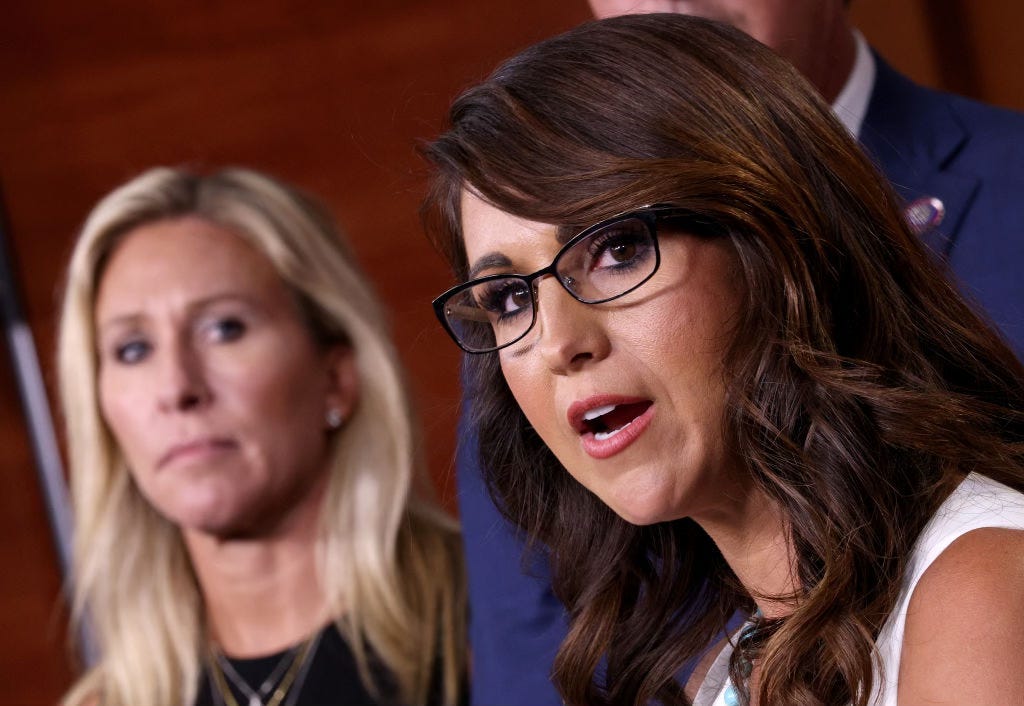
And when the ketchup hits the fan, the MAGA movement may suddenly appear far more fragmented and fractious than it does this week. You can already see the cracks. Two towering ignoramuses like Marjorie Taylor Greene and Lauren Boebert should be BFFs, but they despise each other—the only policy of theirs I agree with.
If things really go south, expect MAGA Republicans to devour each other as hungrily as the worm who feasted on RFK Jr.’s brain—and that, my friends, will be worth binge-watching. I’m stocking up on popcorn now before Trumpflation makes it unaffordable.
Marjorie Taylor Greene (L), wishing a space laser would strike Lauren Boebert (R). (Win McNamee/Getty Images)
One parting thought. Post-election, the mainstream media’s hyperbolic reassessment of Trump—apparently, he’s now a political genius in a league with Talleyrand and Metternich—has been nauseating. It’s also insanely short-sighted. Again, a look at the not-so-distant past is instructive.
In 1984, after Reagan romped to victory with 59 percent of the popular vote and 525 electoral votes, Reaganism was universally declared an unstoppable juggernaut. But only two years later, in the 1986 midterms, Democrats proved the pundits wrong: they regained control of both the House and Senate for the first time since 1980. Those majorities enabled them to slam the brakes on Ronnie’s right-wing agenda, block the Supreme Court nomination of Robert Bork, and investigate Iran-Contra.
The lesson of the 1986 midterms is clear: the game’s far from over and there’s everything to play for. If we want to stem the tide of autocracy and kleptocracy, restore women’s rights and protect the most vulnerable, we don’t have the luxury of despair. The work starts now.
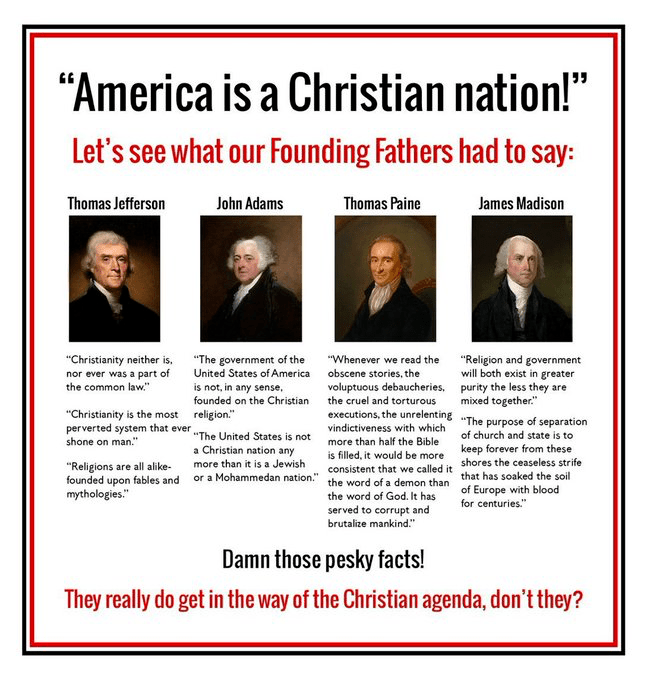
The Founding Fathers went to great lengths to separate church and state. They knew the history of religious wars in Europe, and they wanted the new nation to be free of such rivalries. They inserted into the Constitution the clear mandate that there would be no religious test to hold office. They added in the First Amendment to the institution that Congress was not allowed to establish a state religion and guaranteed freedom to practice one’s own religion.
Someone created this handy compilation of quotes from some of our most prominent men of the Founding era:
Colorado voters, beware! On the November 5 ballot: an amendment to the State Constitution to protect school choice.
If you want to support public schools and a raid on the state’s treasury by privatizers, defeat it!
This proposed amendment is weird. Ever since the founding of this nation, states have had explicit pledges in their constitution to protect public schools, open to all. Colorado’s state Constitution includes such language as well as language explicitly rejecting public funding for religious schools.
Article 9, Section 2 of the Constitution says:
Section 2. Establishment and maintenance of public schools. The general assembly shall, as soon as practicable, provide for the establishment and maintenance of a thorough and uniform system of free public schools throughout the state, wherein all residents of the state, between the ages of six and twenty-one years, may be educated gratuitously.
Article 8, Section 7 of the Constitution says:
Section 7. Aid to private schools, churches, sectarian purpose, forbidden. Neither the general assembly, nor any county, city, town, township, school district or other public corporation, shall ever make any appropriation, or pay from any public fund or moneys whatever, anything in aid of any church or sectarian society, or for any sectarian purpose, or to help support or sustain any school, academy, seminary, college, university or other literary or scientific institution, controlled by any church or sectarian denomination whatsoever; nor shall any grant or donation of land, money or other personal property, ever be made by the state, or any such public corporation to any church, or for any sectarian purpose.
Now, the privatizers want to cancel that language and replace it with language chartering what was previously forbidden.
On November 5, 2024, Colorado voters will weigh in on a hot topic in education today: school choice. Amendment 80 would make the concept of “school choice” a guaranteed right in the Colorado constitution. The text of the amendment reads as follows:
(1) PURPOSE AND FINDINGS. THE PEOPLE OF THE STATE OF COLORADO HEREBY FIND AND DECLARE THAT ALL CHILDREN HAVE THE RIGHT TO EQUAL OPPORTUNITY TO ACCESS A QUALITY EDUCATION; THAT PARENTS HAVE THE RIGHT TO DIRECT THE EDUCATION OF THEIR CHILDREN; AND THAT SCHOOL CHOICE INCLUDES NEIGHBORHOOD, CHARTER, PRIVATE, AND HOME SCHOOLS, OPEN ENROLLMENT OPTIONS, AND FUTURE INNOVATIONS IN EDUCATION. (2) EACH K-12 CHILD HAS THE RIGHT TO SCHOOL CHOICE.
According to University of Southern California Professor Guilbert Hentschke, “school choice has become a catch-all label describing many different programs that offer students and their families alternatives to publicly provided schools.” Since school choice covers many options, it can be confusing, and it is often the “subject of fierce debate in various state legislatures across the United States.” The critical distinction to make regarding school choice is often whether it affects public or private schools.
School choice has been the mantra for voucher-systems currently enacted in at least twenty states. School choice with voucher-type legislation entails using taxpayer dollars for education savings accounts, opportunity scholarships, tax credits, or actual vouchers so families can choose any type of schooling for their child — private, public or home schooling. This idea represents an emphasis on “funding students instead of funding school systems.”
The focus on school choice has resulted in increased enrollment in charter schools, private schools, and home schooling. At the same time, the school choice movement has also created instability, competition, ideological curricula, resource inequities, increased segregation, loss of community, and reduced funding for public neighborhood schools. In Colorado, of all eligible school-age children, about 76% attend public schools, 15% attend charter schools, 8 percent are in private schools, and 1% are homeschooled.
Advance Colorado is the conservative think tank organization that developed the language for Amendment 80, and they coordinated the expensive signature gathering to secure approval for the measure, originally titled Initiative 138. The backers acknowledge that parents already have the right in state statute to “send their kids to a neighborhood school, charter school, private school, home school, or across district lines.”
Advance Colorado’s solution to the “problem” of legislators promoting charter accountability is to put “the right to school choice in the Colorado Constitution” which they assert will give school choice “legal advantages a normal statute does not have.” Over fifty highly paid lobbyists were assigned to kill the charter accountability bill which was publicly opposed by Governor Polis, and was defeated in the House committee.
Even though Advance Colorado states its goal is to protect the charter schools from future legislative interference, Amendment 80 encompasses “private and home schooling” options. Including “private schools as a guaranteed right” is a plan promulgated by Americans for Prosperity and other conservative think tanks in several red states where voucher bills have been passed or expanded. Fields said he thinks “parents should be in charge of education,” adding “I think it’s easier when they have resources to send their kid to the school that they want to.”
Colorado State board of education members Lisa Escárcega and Kathy Plomer wrote in a September 11 op-ed that Amendment 80 is “not just about school choice.” They cautioned that “Amendment 80, brought by wealthy, in and out-of-state organizations, is part of a nationally coordinated master plan to go around voters in states where voucher proponents have been unsuccessful in passing state voucher laws.” They pointed out that in Colorado, “voters turned down three education voucher ballot initiatives in the 1990s.Voucher and private school proponents then tried the legislative route. The Colorado legislature has turned down any type of voucher or education savings account 18 times just since 2016.” While the amendment doesn’t mention vouchers, the state board members expressed their concern that “If parents have a right to send their children to private schools, then shouldn’t the state pay for it?”
Using public taxpayer dollars for children to attend private schools or for home schooling is not legal in Colorado, nor is it currently popular. (They can get some indirect support.) Kevin Welner of the National Education Policy Center stated that “it would be hard to persuade voters or politicians that Colorado should join the ranks of states that provide taxpayer subsidies for private schools or homeschooling.”
Even though Fields insists this amendment “is not paving the way for a voucher program in Colorado,” the far-right conservative groups providing the money to promote Amendment 80 have tried to enact vouchers in Colorado for years.
Vouchers are not necessarily an effective system to improve student learning and according to recent research, they can hinder state budgets significantly. Josh Cowen, senior fellow at the Education Law Center, pointed to decades of evidence showing private school vouchers have led to some of the steepest declines in student achievement on record. He added that measures similar to Amendment 80 passed in Arizona, Florida and Ohio have led to serious budget cuts.
Who is funding this effort to enshrine “school choice” in the state constitution?
In an op-ed about Advance Colorado last year, Colorado Newsline editor Quentin Young wrote that “Coloradans don’t know who’s supplying its money or their true motivations, because nonprofits don’t have to disclose their donors.” Advance Colorado is the same “dark money group” that gathered signatures for Initiative 108, which would have forced over $3 billion in cuts to services to citizens.
Advance Colorado started as “Unite for Colorado” in 2019, which bankrolled almost every major Republican effort in Colorado in 2020. Unite for Colorado spent over $17 million in 2020 on Republican candidates, and they have “become the most important fundraising entity for conservatives and for Republicans,” said Dick Wadhams, a former chairman of the Colorado GOP. Unite for Colorado changed its name to Advance Colorado Action in 2021 due to questionable conflicts over its spending practices, which are still in litigation.
As a “dark money group,” Advance Colorado receives grants from many sources, most of which are unknown, yet there is evidence that connects Advance Colorado to several conservative organizations. There are also reports that tie the group to Phillip Anschutz, Colorado’s richest billionaire. According to Cause IQ, between 2020-2023, over $28 million was funneled to Unite Colorado/Advance Colorado from the Colorado Stronger Alliance.
Colorado Dawn was formed in 2021 to “support organizations who further the efforts to educate the public about western values and economics,” and it has received over $3 million from Unite Colorado (Advance Colorado). Tax records from the Colorado Dawn’s 2022 990’s list state Board of Education member Steve Durham as chairman, Senator Paul Lundeen as Vice-chairman, and Michael Fields as Treasurer. Lundeen announced in 2022 his hopes that Colorado would enact a voucher program after the Supreme Court “cleared the way for public dollars in a Maine tuition assistance program to flow to private religious schools.” The Colorado Secretary of State’s office indicates that Colorado Dawn spent over $1.3 million to collect signatures for Amendment 80.
On Sept 13, 2024, the CEA announced its opposition to Amendment 80 at a press conference in Denver. A coalition of various representatives from across the state, the National Education Association, and the ACLU described their main reasons for opposing Amendment 80.
The speakers at the press conference emphasized that the amendment is unnecessary because school choice is already protected in law and has been for 30 years. In addition, they stated that the amendment opens the door to taking money from public schools to fund private schools. Speakers stressed that funding private schools would drain money away from rural public schools, private schools pose significant civil rights concerns, and they don’t belong in the Constitution.
In interviews with Chalkbeat, several education experts weighed in on the wording in Amendment 80, indicating it could create years of “litigation” order to interpret the amendment’s misleading language, which Kristi Burton Brown also acknowledged in her interview with KOA radio.
Currently, the following groups are opposing the measure: ACLU of Colorado, AFT Colorado, Colorado Fiscal Institute, CEA, The Colorado Association of School Executives (CASE), AFSCME, Advocates for Public Education Policy, Business and Professional Women of Colorado, Colorado Immigrant Rights Coalition, League of Women Voters Colorado, Soul 2 Soul Sisters, Bell Policy Center, Colorado PTA, One Colorado, United for a New Economy, Colorado Democratic Party, American Association of University Women, Colorado WINS, Colorado AFL-CIO, Stand for Children, and New Era Colorado Action Fund.
Colorado voters will need to decide which rationale they support regarding this school choice amendment. Will they agree with Advance Colorado that a constitutional amendment is necessary to ensure that the legislature will not update current charter school laws? Or will they believe that Colorado does not need to go the route of other states and create a pathway to use public funding for private and home schools?
************************************
Mike DeGuire, Ph.D., has been a teacher, district level reading coordinator, and a principal in the Denver metro area for most of his education career.
As a historian of forced population movements and as an American, I don’t think we are taking the consequences of the Trump-Vance deportation plan seriously enough. The reality will be much more personal and awful, and the politics more transformative and durable, than we might think.
I will write this up soon; but I was moved to do a recording by the urgency of this, and by the desire to catch the end of Hispanic Heritage Month.
Please listen and please share.
You might find it useful to read my thoughts about the thousands or tens of thousands of detention camps that would be needed in every state.
Thomas Friedman has been writing about foreign affairs for The New York Times for many years. He has extensive contacts in the region. He writes here about the inner dynamics of the military clashes in the Middle East involving Israel, Hamas, Hezbollah, Lebanon, and Iran.
Friedman writes:
To understand why and how Israel’s devastating blow to Hezbollah is such a world-shaking threat to Iran, Russia, North Korea and even China, you have to put it in the context of the wider struggle that has replaced the Cold War as the framework of international relations today.
After the Hamas invasion of Israel on Oct. 7, I argued that we were no longer in the Cold War, or the post-Cold War. We were in the post-post-Cold War: a struggle between an ad hoc “coalition of inclusion” — decent countries, not all of them democracies, that see their future as best delivered by a U.S.-led alliance nudging the world to greater economic integration, openness and collaboration to meet global challenges, like climate change — versus a “coalition of resistance,” led by Russia, Iran and North Korea: brutal, authoritarian regimes that use their opposition to the U.S.-led world of inclusion to justify militarizing their societies and maintaining an iron grip on power.
China has been straddling the two camps because its economy depends on access to the coalition of inclusion while the government’s leadership shares a lot of the authoritarian instincts and interests of the coalition of resistance.
You have to see the wars in Ukraine, Gaza and Lebanon in the context of this global struggle. Ukraine was trying to join the world of inclusion in Europe — seeking freedom from Russia’s orbit and to join the European Union — and Israel and Saudi Arabia were trying to expand the world of inclusion in the Middle East by normalizing relations.
Russia attempted to stop Ukraine from joining the West (the European Union and NATO) and Iran, Hamas and Hezbollah attempted to stop Israel from joining the East (ties with Saudi Arabia). Because if Ukraine joined the European Union, the inclusive vision of a Europe “whole and free” would be almost complete and Vladimir Putin’s kleptocracy in Russia almost completely isolated.
And if Israel were allowed to normalize relations with Saudi Arabia, not only would that vastly expand the coalition of inclusion in that region — a coalition already expanded by the Abraham Accords that created ties between Israel and other Arab nations — it would almost totally isolate Iran and its reckless proxies of Hezbollah in Lebanon, the Houthis in Yemen and the pro-Iranian Shiite militias in Iraq, all of which were driving their countries into failed states.
Indeed, it is hard to exaggerate how much Hezbollah and its leader, Hassan Nasrallah, who was killed by an Israeli strike on Friday, were detested in Lebanon and many parts of the Sunni and Christian Arab world for the way they had kidnapped Lebanon and turned it into a base for Iranian imperialism.
I was speaking over the weekend to Orit Perlov, who tracks Arab social media for Israel’s Institute for National Security Studies. She described the flood of social media postings from across Lebanon and the Arab world celebrating Hezbollah’s demise and urging the Lebanese government to declare a unilateral cease-fire so the Lebanese Army could seize control of Southern Lebanon from Hezbollah and bring quiet to the border. The Lebanese don’t want Beirut to be destroyed like Gaza and they are truly afraid of a return of civil war, Perlov explained to me. Nasrallah had already dragged the Lebanese into a war with Israel they never wanted, but Iran ordered.
This comes on top of the deep anger for the way Hezbollah joined with the Syrian dictator Bashar al-Assad to crush the democratic uprising there. It is literally as if the Wicked Witch from the Wizard of Oz is dead and now everyone is thanking Dorothy (i.e., Israel).
But there is a lot of diplomatic work to be done to translate the end of Nasrallah to a sustainably better future for the Lebanese, Israelis and Palestinians.
The Biden-Harris administration has been building a network of alliances to give strategic weight to the ad hoc coalition of inclusion — from Japan, Korea, the Philippines and Australia in the Far East, through India and across to Saudi Arabia, Egypt, Jordan and then up through the European Union and NATO. The keystone of the whole project was the Biden team’s proposed normalization of relations between Israel and Saudi Arabia, which the Saudis are ready to do, provided Israel agrees to open negotiations with the Palestinian Authority in the West Bank on a two-state solution.
And here comes the rub.
Pay very close attention to the speech by Prime Minister Benjamin Netanyahu of Israel before the U.N. General Assembly on Friday. He understands very well the struggle between the coalitions of “resistance” and “inclusion” that I am talking about. In fact, it was central to his U.N. speech.
How so? He held up two maps during his address, one titled “The Blessing” and the other “The Curse.” “The Curse” showed Syria, Iraq and Iran in black as a blocking coalition between the Middle East and Europe. The second map, “The Blessing,” showed the Middle East with Israel, Saudi Arabia, Egypt and Sudan in green and a red two-way arrow going across them, as a bridge connecting the world of inclusion in Asia with the world of inclusion in Europe.
Yet if you looked closely at the “Curse” map, it showed Israel, but no borders with Gaza and the Israeli-occupied West Bank (as if it had already been annexed — the goal of this Israeli government).
And that is the rub. The story Netanyahu wants to tell the world is that Iran and its proxies are the main obstacle to the world of inclusion stretching from Europe, through the Middle East, and over to the Asia-Pacific region.
I beg to differ. The keystone to this whole alliance is a Saudi-Israel normalization based on reconciliation between Israel and moderate Palestinians.
If Israel now moved ahead and opened a dialogue on two states for two peoples with a reformed Palestinian Authority, which has already accepted the Oslo peace treaty, it would be the diplomatic knockout blow that would accompany and solidify the military knockout blow Israel just delivered to Hezbollah and Hamas.
It would totally isolate the forces of “resistance” in the region and take away their phony shield — that they are the defenders of the Palestinian cause. Nothing would rattle Iran, Hamas, Hezbollah and Russia, and even China, more.
But to do that Netanyahu would have to take a political risk even greater than the military risk he just took in killing the leadership of Hezbollah, a.k.a. “the Party of God.”
Netanyahu would have to break with the Israeli “Party of God” — the coalition of far-right Jewish settler supremacists and messianists who want Israel to permanently control all the territory from the Jordan River to the Mediterranean, with no border lines in between — just like on his U.N. map. Those parties keep him in power, so he would need to replace them with Israeli centrist parties, which I know would collaborate with him on such a move.
So there you have the big challenge of the day: The struggle between the world of inclusion and the world of resistance comes down to many things, but none more — today — than Netanyahu’s willingness to follow up his blow to the “Party of God” in Lebanon by dealing a similar political blow to the “Party of God” in Israel.
My view: Netanyahu has no willingness to separate himself from “the Party of God” in Israel. Like Trump, he keeps fighting to stay out of jail on charges that were filed before the Hamas attack last October 7.
John Thompson an an historian and a retired teacher in Oklahoma. Here he reviews Max Boot’s new book, Reagan. He wrote this review for this blog.
He writes:
In 2018, Max Boot recounted “his extraordinary journey from lifelong Republican to vehement Trump opponent.” Although Boot once idolized Ronald Reagan, his Reagan: His Life and Legend tells the story how Reagan planted the seeds of “Trumpism.” Boot concluded that “Reagan was both more ideological and more pragmatic than most people realize–or that I realized before starting this book project more than a decade ago.” But, even when retelling Reagan’s success stories, such as working with Gorbachev, Boot exposes his weaknesses, such as those that could have led to nuclear war.
Boot starts with the way Reagan’s rhetoric and falsehoods led to Trumpism. For instance, his advertising for General Electric led to a “convergence of conservatism in the 1950s.” Boot recalls a number of Reagan’s statements that were “all false,” and how they helped “inure the Republican Party to ‘fake news.’”
First, Reagan’s false mythology about preventing a communist takeover of Hollywood contributed to his political rise, as he “avoided becoming tarred with the excesses of McCarthyism,” even though he “served as an FBI informant and an arbiter of the blacklist.”
Moreover, Reagan called John F. Kennedy a “fellow traveler.” He also said America was adopting “temporary totalitarian measures” such as social services and federal regulation, and “we have ten years … to win or lose –by 1970 the world will be all slave or all free.”
But, Boot adds that the press wouldn’t call him out for lying, supposedly because he was sincere in believing his falsehoods. As his spokesman, Larry Speakes, said with a shrug, when asked about Reagan’s repeated lies, “If you tell the same story five times, it’s true.”
Similarly, Reagan’s allies remained silent about what they really believed about him. After visiting Reagan in the White House, Margaret Thatcher “pointed to her head and said, “There’s nothing there.” Thatcher later criticized his war in Grenada, saying, “The Americans are worse than the Soviets.” President Nixon called Reagan a “man of limited mental capacity” and Henry Kissinger said he was “a pretty decent guy” with “negligible” brains.
Reagan said similar things about his allies, for instance, he defended Nixon’s staff that drove Watergate because they were “not criminals at heart.”
However, Reagan’s spin and lies also had more disgusting components, which were not adequately exposed. When he launched his 1980 presidential campaign in Neshoba County, where the band played “Dixie,” his aide acknowledged that, in every election, “race played a role.” There is evidence that, privately, Reagan “shared the rightwing view of (Martin Luther) King as a dangerous subversive.” And, as Tom Wicker, the New York Times journalist, said, Reagan moved racial politics “from a lack of interest in fighting racial discrimination to an active promotion of it.”
And when opposing the anti-apartheid movement, Reagan said that South Africa had already “eliminated the segregation we once had in our own country.”
By the end of his campaign, Reagan’s advisers used President Carter’s stolen debate briefing books to prepare him for his famous victory, using the words, “There you go again.” But Boot concludes, “What has gotten lost – both at the time and subsequently was that Carter was right on the facts and Reagan was wrong”
Then, in regard to efforts to prevent an “October Surprise,” Boot concludes that “credible evidence” later emerged that his campaign reached out to delay a hostage release.
Boot explains that when Reagan took office, plenty of his staff were incompetent and/or wanted to dismantle government. He also had adult conservatives in the room who sometimes succeeded in convincing Reagan to back away from the most outrageous policy proposals. Even so, “Few if any presidents have ever been so totally isolated even from their most senior cabinet members.”
In his first pivotal policy battle, over cutting taxes for the rich to reduce rampant inflation and unemployment, Reagan lacked curiosity and knowledge about economic facts. He once asked Federal Reserve Chairman Paul Volker, who took the lead in fighting inflation, “Why do we need the Federal Reserve?”
After his detailed account of the ignorance Reagan showed when passing his economic plan, Boot concluded that his administration “reached its high water mark in 1981 with its massive Economic Recovery Tax Act.”
But, “Now the nation would have to reckon with its consequences.”
Those consequences included inflation over 9%, and unemployment over 10%; the loss of 1.9 million jobs; a 45% cut in school lunch funding; 45% of jobless persons not receiving unemployment insurance; a 1983 budget deficit of $200 billion; and shrinking the middle class, increasing profits for the rich, and increasing suffering for the poor. Long-term effects included an increase in the death gap between lower and higher income persons of 570%; and by 2020, an inequality gap was wider that those of almost any developed nation.
The same pattern held for Reagan’s foreign affairs decision-making. Boot explained that Reagan apparently believed that he ordered the invasion of Grenada (which was based on falsehoods) because “he had acted as an instrument of God.” Reagan also quoted a U.S. pilot who noted that Grenada produced nutmeg, an ingredient in eggnog. The “Russians were trying to steal Christmas,” the pilot insisted. “We stopped them.”
And, according to Boot, Reagan’s opposition to Cuba could have gone nuclear. Secretary of State Al Haig said about Cuba, “Just give me the word and I’ll turn that f____ island into a parking lot.” But, fortunately, some of his aides settled Reagan down.
And the same behaviors, when Reagan ratcheted up Cold War paranoia, “could have resulted in a nuclear war that neither side wanted.” During his years-long negotiations with Gorbachev, Reagan was sometimes restrained by his professional staff, but sometimes not. And often his absurd beliefs kept reappearing.
Mostly due to Gorbachev’s efforts, an arms reduction treaty was eventually passed. But Boot reminds us that in 1986, “Reagan and Gorbachev nearly agreed to a ten-year plan for total nuclear disarmament, but Reagan wouldn’t abide limits on U.S. outer-space defenses.” Because Reagan had faith in that missile defense system, which other participants knew was impossible and dangerous, he “scotched the deal with Gorbachev over them.” So, now “the United States and Russia collectively possess more than ten thousand nuclear warheads. And, despite Trump’s promises to build ‘a great Iron Dome over our country,’ satellite defenses against nuclear attacks remain unviable.”
By the way, Reagan’s few sources included the 1939 movie “Confessions of a Nazi Spy,” and, perhaps, a movie he was in, “Murder in the Air” (1940).
And Reagan’s baseless beliefs also drove his commitments to mass murderers in Central American. He supported the “psychopath” in El Salvador behind the assassination of Bishop Oscar Romero because he was a favorite of the racist Sen. Jesse Helms.
Reagan’s support for the Contras grew out of a plan to “1. Take the War to Nicaragua. 2. Start killing Cubans.”
And this post doesn’t have room to recount the downing of two airlines, costing 579 lives, during chaos spread by the Reagan administration. Neither is there time to appropriately cover the punch line he told over an open microphone, “My fellow Americans, I’m pleased to tell you today that I’ve signed legislation that will outlaw Russia forever. We begin bombing in five minutes.”
Even before Reagan’s dementia took control, his mental acuity was in severe decline, and he apparently forgot that he was briefed on the arms for hostages deal with Iran. Boot reports, in 1987, the Iran/Contras investigations’ “harsh conclusions” were that Reagan knew about the arms for hostages deal, but it wasn’t proven that he knew about the funding of the contras; “Independent Counsel Lawrence Walsh concluded that Reagan had known about the diversion of funds, … but he could never prove it.”
Even so, the Reagan spin on the investigation was that it was “the lynching that failed”
During this time when Reagan was increasingly disoriented, his administration was burdened by the Housing and Urban Development ( HUD) scandal; the banking and the savings and loans collapses which were due to his deregulation; and the AIDS epidemic, which Reagan ignored, even though his administration did not. Boot then concluded, “It is damning with faint praise to say that Reagan’s record on AIDS was not as bad as it could have been.”
I believe, the same could be said in terms of most, if not all, of Reagan’s “successes.”
Boot’s conclusions include:
While Reagan exaggerated the credit he deserved for the economic recovery, he ducked the blame for the recession.
Even if he read more than Trump and even if “he uttered fewer falsehoods than Trump,” Reagan’s “Often-shocking ignorance of public policy,” and his “repeated false statements” paved the way for Trump.
Reagan “mishandled a pandemic, just as Trump did”
Like Trump, Reagan “catered to white bigotry.”
Reagan “empowered Christian Nationalism” and a “growing white backlash”
Reagan “helped hollow out the middle class, thereby creating the conditions for Trump’s populist movement.”
But, there is more to worry about. Trump’s first term was similar to Reagan’s two terms, in that Trump’s aides sometimes managed to thwart or redirect his ambitions. A second Trump term would likely be more dangerous, and with fewer or no reasonable aides to settle him down.
Timothy Snyder, history professor at Yale University, expresses his alarm about Trump’s turn toward fascistic rhetoric in this post. Trump knows how to excite his base by repeating conspiracy theories and blaming the Jews if anything he wants goes wrong. Snyder does not invoke the reference to Hitler lightly. He knows European history.
He writes:
Trump just had quite a Hitlerian month.
But before broaching the subject of Trump and Hitler I have to say a with a word about the American taboo on “comparisons.”
Anyone who refers to Trump’s Hitlerian moments will be condemned for “comparison.” Somehow that “comparison” rather than Trump’s deeds becomes the problem. The outrage one feels about the crimes of the 1930s and 1940s is transferred from the person who resembles the criminal to the person who points out the resemblance.
This cynical position opposing “comparisons” exploits the emotional logic of exceptionalism. Americans are innocent and good (we would like to believe). We are not (we take for granted) like the Germans between the world wars. We would never (we imagine) tolerate the stereotypes German Nazis invoked. We have learned the lessons of the Holocaust.
Since we are so innocent and good, since we know everything, it just cannot be true — so runs the emotional logic — that a leading American politician does Hitlerian things. And since we are so pure and wise, we never have to specify what it was that we have learned from the past. Indeed, our our goodness is so profound that we must express it by attacking the people who recall history.
And so, in the name of our capacity to remember great evil, we make it impossible to actually remember great evil. A taboo on “comparison” becomes a shield for the perpetrator. Those who invoke the past are the true villains, the real source of the problem, or, as Trump says about journalists, the “enemy of the people.” Indeed, the more Trump resembles Hitler, the safer the man is from criticism on this point.
I hope that the irony of all of this is clear: the idea that “comparison” is a sin rests on the notion of the inherent and unimpeachable virtue of the American Volk, who by definition do nothing wrong, and whose chosen Leader therefore must be beyond criticism. In this strange way, outrage about “comparison” reinforces fascist ideas about purity and politics. We should hate the dissenters. We should ignore whatever casts doubt on our sense of national virtue. We should never reflect.
Democracy, of course, depends on the ability to reflect, and that reflection is impossible without a sense of the past. The past is our only mirror, which is why fascists want to shatter it. In fascist Russia, for example, it is a criminal offense to say the wrong things about the Second World War. The reason why we keep alive the memory of Nazi crimes is not because it could never happen here, but because something similar can always happen anywhere. That memory has to include the details of history, or else we will not recognize the dangers.
“Never again” is something that you work for, not something that you inherit.
Before we think about this past month, we also have to consider the past four years. This entire election unfolds amidst a big lie. It was Hitler’s advice to tell a lie so big that your followers would never believe that you would deceive them on such a scale. Trump followed that advice in November 2020. His claim that we actually won the election in a landslide is a fantasy that opens the way to other fantasies. It is a conspiratorial claim that opens the way to conspiratorial thinking generally. It prepares his followers for the idea that other Americans are enemies and that violence might be needed to install the correct leader.
This year we have seen that explicit Nazi ideas are tolerated in the Trump milieu. The vice-presidential candidate shares a platform with Holocaust deniers, and defends Holocaust denial as free speech. This is a fallacy people should see through: yes, the First Amendment allows Nazis to speak, but it does not ennoble Nazi speech. The fact that people say fascist things in a country with freedom of speech is how we know that they are fascists — and that, if they themselves comes to power, they will end freedom of speech and all other freedoms.
Which brings us to North Carolina and to the gubernatorial candidate Trump once called the country’s hottest politician. No one is denying that Mark Robinson has the right under the First Amendment to call himself a Nazi or to praise Mein Kampf. The question is what we do about this. Trump will not intervene here because he believes that Robinson is more likely to win than a substitute candidate would be. Consider that for a moment: for Trump, the reason not to distance himself a self-avowed Nazi is that he hopes that the self-avowed Nazi will win an election, take office, and hold power.
This is not surprising. Trump and Vance are running a fascist campaign. Its main theme in September was inspired by a lady in Springfield, Ohio, who lost her cat and then found it again. For J.D. Vance, who knew what happened, this became the basis for the lie that Haitian immigrants were eating domestic animals. For Donald Trump, that became a reason to promise that Haitians in Springfield would be deported. He had found people who were both Blacks and immigrants, who could serve as the “them” in his politics of us-and-them.
It is fascist to start a political campaign from the choice of an enemy (this is the definition of politics by the most talented Nazi thinker, Carl Schmitt). It is fascist to replace reason with emotion, to tell big lies (“create stories,” as Vance says) that appeal to a sense of vulnerability and exploit a feeling of difference. The fantasy of barbarians in our cities violating basic social norms serves to gird the Trump-Vance story that legal, constitutional government is helpless and that only an angry mob backed by a new regime could get things done.
It is worth knowing, in this connection, that the first major action of Hitler’s SS was the forced deportation of migrants. About 17,000 people were deported, which generated the social instability that the Nazi government the used as justification for further oppression. Trump and Vance plan to deport about a thousand times as many people….
In international politics, the key moment concerns Ukraine and its head of state. Since February 2022, the Ukrainian president, Volodymyr Zelens’kyi, has been rightly understood and admired as a symbol of physical and political courage. When Russia began its full-scale invasion that month, the American consensus was the Ukraine would crack within days and that Zelens’kyi would (and should) flee. Instead, he stayed in Kyiv despite the approach of Russian assassins and the Russian army, rallied his people, and oversaw the successful defense of his country. He has since visited the front every few weeks.
This is how Trump characterized Zelens’kyi in September, echoing comments that he has made before: “Every time he came to our country, he’d walk away with $100 billion. He’s probably the greatest salesman on Earth.” Trump seems threatened by Zelens’kyi. As Trump has made clear numerous times, his first and only impulse is to give Putin what Putin wants. The idea of taking risks to defend freedom from the Russian dictator is well beyond the pinprick-sized black hole that is Trump’s moral universe.
And of course the claim itself is false. The number is too big. And the money does not go to Zelens’kyi himself, obviously. That Zelens’kyi does personally profit is a favorite idea of Vance, who repeats Russian propaganda to this effect. The money does not even, for the most part, go to the Ukrainian government. Most of the military aid does to American companies who build new weapons for American stockpiles. We then send old weapons to Ukraine, to which we assign a dollar value.
The essential thing, though, is the antisemitic trope Trump chose to express himself. It goes like this. Jews are cowards. Jews never fight wars. Jews stay away from the front. Jews only cause wars that make other people suffer. And then Jews make vast amounts of money from those wars. Volodymyr Zelens’kyi, the Ukrainian president, is Jewish. And thus “the greatest salesman on earth” for Trump. And the corrupt owner of “yachts” for Vance. A war profiteer, as in the antisemitic stereotype, not a courageous commander, as in reality.
Indeed, most of what Trump says about Zelens’kyi, Ukraine, and and the war itself makes sense only within the antisemitic stereotype. Trump never speaks about the Russian invasion itself. He never recalls Russian war crimes. He never mentions that Ukrainians are defending themselves or their basic ideas of what is right. He certainly never admits that Zelens’kyi is the democratically-elected president of a country under vicious attack and who has comported himself with courage. The war, for Trump, is just a scam — a Jewish scam.
And that, of course, is why he thinks he can end it right away: he thinks he can just shoulder the Jew aside and deal with his fascist “friend” Putin, who for him is the “genius” in this situation, and who must be allowed to win. Despite the evidence, Trump says that Russia always wins wars, dismissing both history (regular Russian losses such as the Crimean War, the Russo-Japanese War, the First World War, the Polish-Bolshevik War, the Afghan War) and the actual events of the ongoing Russian invasion, in which Ukraine has taken back half the territory it lost and driven the Russian fleet from the Black Sea. Russia is counting on Trump. They need him in power to win their war, and they know it.
It need hardly be said that if Trump throws American power on the Russian side, the “deal” that follows will not end the war. It will only mean that Russia is able to kill more Ukrainians faster. Trump will then claim that the deal itself was beautiful and perfect — and try to change the subject from the slaughter he brought about through his antisemitic hubris and admiration of Russian fascism.
And, of course, Snyder explains, Trump has warned Jewish groups that if he loses, it will be the fault of Jews. Anti-Semitism will be Trump’s legacy.



 Diane Ravitch's blog