Archives for category: Funding

Steve Berch is a member of the Idaho House of Representatives, one of only 11 Democrats in a body with 70 members. He is serving his third term. His analysis of the attack on public education in Idaho and other states is brilliantly cogent. He understands that privatization is all about the money. This article appeared in the nonprofit IdahoEdNews.org.

Berch describes the playbook of the privatization movement.

Berch writes:

Idaho will spend $2.3 billion on K-12 public education in 2024. There are powerful out-of-state forces who want to get their hands on that money. Some are driven by profit, others by political ideology, religious beliefs, or a combination of interests. They all share one common goal: shift your public schools dollars to the private sector. Here are some of the dots to connect in the “privatizing public education” playbook:

  1. Make public schools look worse than other school choices. The legislature does this by continually underfunding public education. Schools can’t meet parental expectations, accommodate growth, or hire/retain experienced teachers when salaries are not competitive and buildings are falling apart. Idaho has a backlog of over $1 billion in K-12 school building maintenance and we’re still at or near the bottom in per-student investment, even after having a $2.1 billion surplus and a recent budget increase. This makes other school choices look more attractive by comparison.
  2. Undermine confidence in public schools. Propaganda campaigns incite fear and anger against local schools. Parents are bombarded with false claims about porn in libraries, groomers in classrooms, and student indoctrination. Non-stop postings on social media perpetuate these inflammatory accusations. Self-proclaimed “think tanks” funded by third-parties produce official looking reports that create a false perception of legitimacy to these manufactured fears.
  1. Hide the facts. Legislative leaders tried to kill the Office of Performance Evaluations (OPE) – which provides factual, in-depth, unbiased research and analysis to the legislature. The public wouldn’t know about the billion dollar backlog in school building maintenance if OPE didn’t exist. The OPE report that revealed this new information angered political leaders trying to tell a different story. Without facts, false narratives go unchallenged.
  2. Legislative intimidation. New laws are making classrooms a hostile workplace. This includes bills that threaten to sue educators, imprison librarians, fine school districts, muzzle teachers, and empower the Attorney General to aggressively prosecute the targets of these punitive laws. No wonder teachers are leaving Idaho.
  1. Promote “school choice” and “education freedom.” This is clever rhetoric, but it is meaningless since Idahoans already have a myriad of education choices – none of which are going away. It’s not about having choice, but rather having you pay for someone else’s choice. A recent in-depth investigationrevealed a vast network of powerful forces funneling money into Idaho to promote and sell their alternative education choices to the public.
  2. Kill public education with vouchers (deceptively called Education Savings Accounts, or ESAs). An attempt was made earlier this year to convert most of the $2.3 billion public education budget into checks sent to parents to spend however they want – without accountability. This would starve Idaho public schools into oblivion.

The 2023 bill tried to hit a home run and failed. However, the lobbyists behind privatizing public education will be back, fronted by their legislative allies. Expect to see legislation next year that allows public tax dollars to pay for private and religious school tuition in limited amounts and isolated situations.

This is fool’s gold – there is no room for compromise. If the legislature allows just a small amount of public tax dollars to be spent on tuition for any private school, your tax dollars must be made available to all types of private schools and religious schools. Once one bill passes, the flood gates open up to flow your public education dollars to the bottom line profits of private sector businesses.

Your public education tax dollars belong in your public schools, not in their pockets.
Heather Cox Richardson wrote early today about the GOP’s irresponsible politicization of the defense budget. Typically the defense budget passes with a bipartisan vote. But not this year because the House GOP majority is completely cowed by the hard-right extremists. The Republican crazies inserted all their anti-WOKE priorities into the bill, which will not be passed by the Senate. Marjorie Taylor Greene owns House Speaker Kevin McCarthy.

Richardson writes:

Traditionally, the National Defense Authorization Act (NDAA), which funds the annual budget and appropriations of the Department of Defense, passes Congress on a bipartisan basis. Since 1961 it has been considered must-pass legislation, as it provides the funding for our national security. For all that there is grumbling on both sides over one thing or another in the measure, it is generally kept outside partisanship.

Late last night, House Republicans broke that tradition by loading the bill with a wish list from the far right. Republicans added amendments that eliminate all diversity, equity, and inclusion (DEI) programs in the Defense Department; end the Defense Department program that reimburses military personnel who must travel for abortion services; bar healthcare for gender transition; prevent the military academies from using affirmative action in admissions (an exception the recent Supreme Court decision allowed); block the Pentagon from putting in place President Biden’s executive orders on climate change; prevent schools associated with the Defense Department from teaching that the United States of America is racist; and block military schools from having “pornographic and radical gender ideology books” in their libraries.

House speaker Kevin McCarthy (R-CA) tweeted: “We don’t want Disneyland to train our military. House Republicans just passed a bill that ENDS the wokism in the military and gives our troops their biggest pay raise in decades.”

In fact, the events of last night were a victory for right-wing extremists, demonstrating that they hold the upper hand in the House. Representatives Mikie Sherrill (D-NJ) and Chrissy Houlahan (D-PA), both military veterans, expressed shock that so many Republicans voted to strip abortion protections from military personnel. “[T]hey will say, ‘this is a really bad idea,’ ‘this is not where the party should be going,’ ‘this is a mistake,’” Sherill said. “[W]ell then why did everyone but two people in the Republican conference vote for this really bad amendment?”

The bill passed by a vote of 219 to 210, largely along partisan lines. This year’s budget is $886 billion as the U.S. modernizes the military to compete with new threats such as the rise of China, and it provides a 5.2% increase in pay for military personnel.

But Senate Democrats will not vote for it with the new partisan amendments and are working on their own measure. While there will be a conference committee to hammer out the differences between the two versions, McCarthy has offered a position on that committee to Representative Marjorie Taylor Greene (R-GA), one of the extremists. This is an unusual offer, as she is not on the House Armed Services Committee.

House minority leader Hakeem Jeffries (D-NY) said: “Extreme MAGA Republicans have hijacked a bipartisan bill that is essential to our national security and taken it over and weaponized it in order to jam their extreme right-wing ideology down the throats of the American people.”

“We are not going to relent, we are not going to back down, we’re not going to give up on the cause that is righteous,” Representative Scott Perry (R-PA) said.

Representative Sean Casten (D-IL) summed up the vote today on Twitter. “The National Defense Authorization Act (NDAA) is the bill that funds all of our military operations. It is typically bipartisan and is about as serious as Congress gets. What weapons of war we fund, which allies we share them with, how we recruit. National security is a BFD. We can have our political debates about any number of issues but it is generally understood that when Americans are willing to sacrifice their lives to defend us, it’s time to check the crazies at the door. But today, the crazies won.

“They won first because [McCarthy] put the crazies in positions of power. But second because none of the “moderate” Republicans had the courage to stay the hell out of KrazyTown…. Is every member of the [House Republican Conference] a homophobic, racist, science denying lunatic? No. But the lesson of today is that the ones who aren’t are massive cowards completely unfit for any position of leadership.

“There is space—and demand—for reasonable differences of opinion in our democracy. This isn’t about whether we agree. It’s about whether we can trust that—differences aside—we trust that we’ve got each other’s back if we ever find ourselves in a foxhole together. That’s usually a metaphor, conflating the horrors of war with the much lower-stakes lives that most of us are fortunate enough to lead. But today, the entire [House Republican Conference] told us—both literally and metaphorically—that they don’t give a damn about the rest of the unit.”

Bob Shepherd is a polymath who has written curriculum, textbooks, and assessments. He recently retired as a teacher in Florida. We are fortunate to have him as a regular commenter on the blog.

He describes two promising opportunities for Florida, which is poised to transfer billions of dollars from public schools to unregulated, unaccountable private schools.

Vouchers create many business opportunities: Here are a couple that occur to me:

Business Plan 1 (We Put the Duh in Flor-uh-duh):

Come on down to our “Race to the Top of Mount Zion Enrollment Jubilee” in the old K-Mart parking lot this Saturday and sign yore kids up for Bob Shepherd’s Real Good Floruhduh School. You can use yore Florida State Scholarships to pay for it, and so its absolutely FREE!!!! No longer due you havta send yore children to them gobbermint schools run by Socialists whar they will be taut to be transgendered! We offer compleet curriculems, wrote by Bob’s girlfriend Darlene herself, including

World HIS-story (from Creation to the United States of Dimocrat Babylon to the Rapshure)
Political Science (We thank you, Lord, for Donald Trump; the Second Amendmint; and protecting our Borders from invading hoardes of rapists and murderers)
English (the offishul langwidge of the United States, and the langwidge the Bible was wrote in)
Science (the six days of creation; how to make yore own buckshot; and how Cain and Abel survived among the dinosaurs)
Economics (when rich people get tax brakes, that makes you richer)

And much, much more!!! Plus, you don’t havta worry yore hed about safety, cause all are teachers is locked and loaded!

Bob’s Real Good Florurduh Skool, located across from Bob’s Gun and Pawn right next to Wild Wuornos’s Adult Novelties.

It’s been real good runnin’ this here skool. Free innerprize! So much better then tryin to live on Darlene’s disability! Make America Grate Agin!

Business Plan 2 (Akashic Kakistonics, or Opening Heaven’s Gate to Every Child):

Tired of those failing public schools? Want to send your child to a true Akashic Academy where he/she/they can receive nourishment for the mind AND the soul?

Then enroll him/her/them in Enlightened Master Bob’s AYAHUASCA SCHOOL FOR LITTLE COSMIC VOYAGERS.

Here at Enlightened Master Bob’s, your child will learn how he or she can skip breakfast, lunch, and dinner and draw nourishment directly from Father Sun in our Solar Temple.

We offer complete holistic health training, using our proprietary textbooks on the Ethereal Body, including uncapping and aligning children’s Chakras so they can download DIRECTLY from the Mother Ship the Cosmic Light necessary for the coming Transformation from Earth-bound Homo sapiens to Interdimensional Beings.

In our history classes, students will learn all about Atlantis, Lemuria, Camelot and Glastonbury, the Black Rock Desert, and other Places of Power throughout the Ages.

Students will also learn how to protect themselves against the forces of the Evil Galactic Emperor Xenu and his band of sometimes invisible, shape-shifting reptilian aliens from Alpha Draconis.

But don’t delay! Soon, as our galaxy moves into proximity to the Pleiades, the vibrational tone of the entire planet will rise to such a pitch that we will either undergo Ascension or explode, and everything—the FATE OF THE PLANET– depends on how many young Lightworkers we can bring into Alignment and Cosmic Consciousness before then!

Of course, all this is absolutely FREE because you can use your State Scholarship Voucher to pay for it.

And best yet, all classes are taught by the Spiritual Wives of Enlightened Master Bob himself!!!!!

Stephen Dyer, former Ohio legislator, closely follows school funding in the state. After studying the latest budget, he realized that the Legislature was sending more money to private school students than to public school students. The Ohio legislature loves charters, Cybercharters, and vouchers. Apparently, the Republicans who dominate the Legislators don’t care about public schools. Nor do they care about accountability.

Dyer begins:

Look, I’m really excited that the Ohio General Assembly followed through on its promise to continue implementing the Fair School Funding Plan — the state’s second attempt at meeting its constitutional mandate to provide a thorough and efficient system of public schools for its 1.7 million students.

I mean, in nearly 2/3 of Ohio school districts, the state is already meeting or exceeding its promised funding amounts from two years ago. And while the lion’s share of the remaining shortage is felt in the state’s most needy districts (something I expressed concern about earlier this year), the fact that the state is actually starting to fulfill promises made to Ohio’s 1.7 million public school students is encouraging. Again, though, only if they finish the job, of course..

But the massive increase to private school tuition subsidies that accompanied the public school increase is a colossal turd in the punchbowl. How colossal?

Try this on for size:

Because the state increased the private school tuition subsidy to $8,407 per high school student, the state will now provide $210 more per student to parents whose kids are already in private schools than they will to public school students in Ohio’s urban core of Akron, Canton, Cincinnati, Cleveland, Columbus, Dayton, Toledo or Youngstown schools, which educate 173,000 students.

In fact, that $8,407 per pupil amount is greater than the per pupil state aid for nearly 8 in 10 Ohio students. A remarkable 1.13 million Ohio students will get less state aid than the parents of a private school student will receive next year.

Oh, and did I mention that not a penny of these tuition subsidies will be audited by a public entity? So we have no idea if the money is being spent educating kids or buying sweet rides for private school administrators. (Because that’s never happened in this state).

And the disparity is despite Ohio’s historic public school funding increase that occurred in this budget — again, a great accomplishment.

But man. This is crazy….

It would be one thing if vouchers (taxpayer provided private school tuition subsidies) provided better options for students. But study after study has demonstrated pretty clearly that even in urban districts, generally the public schools do better than the private schools — in Ohio, it’s almost in 9 of 10 instances that the public outperforms the private. Never mind that vouchers have also delayed critical investment in the educations of the 1.7 million Ohio public school students or added significantly to racial segregation.

Please open the link to read the rest of this shocking story.

Remember back in the day when vouchers were sold as a way to “save poor kids from failing schools”? Those days are over. The new Republican pitch is “universal vouchers,” vouchers for all, regardless of family income, regardless of whether the students ever attended public schools.

Florida is one of several Republican-led states that have passed universal vouchers. With the new money free-for-all, public schools are hiring marketing directors and communications staff to persuade students to enroll in public schools.

Katherine Kokal of the Palm Beach Post describes how public schools in Palm Beach have responded to the introduction of universal vouchers.

For first time, the Palm Beach County School District will actually need to start convincing parents to send their kids to public school.

That’s because Florida’s expanded school voucher program, which went into effect July 1, opens the door for parents of all incomes to use taxpayer money for tuition at private schools. That money is taken away from the student’s public school district at a cost of about $8,000 per student. In March, Gov. Ron DeSantis signed legislation that removed the previous income and enrollment limits on the program.

The program has left loads of uncertainty in the school district’s budget, but one thing remains clear to school leaders: Public schools need to better “market” themselves if they’re going to compete.

Superintendent Mike Burke announced an idea in the spring to market public schools to families weighing their options. The district launched a kindergarten registration campaign to get Palm Beach County’s youngest students in public school classrooms. Their thinking was that if students start in public school, they’re more likely to stay.

Among the first orders of business for the district’s new chief communications strategist will be expanding its marketing campaign to try to prove to parents considering vouchers that public schools are their best choice.

“I think we’re going to have to dedicate real resources to this beyond our website,” Burke said. “We’ve been competing with charter schools for 20 years. We’ve never competed with private schools.”

New voucher options arrive on Florida’s education scene at a time when public school districts are fighting pressure from fringe candidates, library book bans and new limitations on what teachers can talk about in the classroom.

Coupled with new obligations to pay millions for private school vouchers, some education experts say Florida is eroding its public education system altogether.

“It’s hard not to look at all of this and grieve,” said Joshua Cowen, a professor of education policy at Michigan State University. “Every school has a pitch. What’s different now, particularly in Florida, you’re going to see schools thinking very carefully about how to market themselves vis-à-vis the culture war stuff.”

Not all private schools in Palm Beach County are religious schools, and they’re also separate from charter schools, which are public schools run by private companies.

Palm Beach County is home to 161 private schools registered with the Florida Department of Education as of July 6. Of those schools, 44% are religiously affiliated.

And most accept vouchers.

While 109 private schools accept Family Empowerment Scholarships right now, Burke anticipates that number growing over the next several months.

“I think we’re going to see proliferation of small, ‘mom-and-pop’ private schools,” he said. “Private schools in a strip mall where people think they can turn a profit.”

Please open the link to finish reading the article.

Arizona is a typical voucher state. The program started small, then grew almost every year. Vouchers for the students with special needs, vouchers for the poor, vouchers for children of the military, on and on.

Parents and teachers put a referendum on the ballot in 2019, much to the consternation of the Koch machine; the public overwhelmingly rejected vouchers. The vote was 65-35 against vouchers.

The legislature, buoyed by money from DeVos and Koch, ignored the referendum and expanded vouchers to the ultimate. Now Arizona has a universal voucher program. Every student in the state, whatever their family income, can claim a voucher. But the state is now worrying whether the cost of vouchers will plunge Arizona into bankruptcy. The Staye Superintendent, a hard-right Republican, says there’s no problem.

Public school advocates predict that the voucher program will eventually cost $1 billion a year.

Currently, 75% of those who claimed vouchers never attended public school. They are the biggest drain on the budget.

Mary Jo Pitzl of the Arizona Republic writes:

Backers of Arizona’s universal school voucher program have widely touted it as a money saver for the state. But for most potential participants, the program adds to the state’s costs, a new analysis shows.

The finding comes as legislative budget officials reported a surprising and steep decline in tax collections in May, raising questions about whether the state can sustain the booming price of the voucher program in coming years.

The analysis from the Arizona Association of School Business Officials broke down the different categories of students eligible for the Empowerment Scholarship Account program and showed savings come only when charter school students transfer into the program.

In every other situation — whether the student comes from a public school district, a private school, a homeschool or micro school environment — there is an extra cost to taxpayers for the ESA voucher, the analysis shows. The costs can range from $425 if a student leaves a district public school to $7,148 if the student already attends a private school or home school.

The idea that vouchers save the state money is based on a law that makes each universal voucher worth 90% of what the state pays for a child in a public school, presumably resulting in a 10% savings. The more children who leave the public school system for a voucher, the theory goes, the greater the savings to the education budget.

But the 90% equation isn’t so simple. That percentage is pegged to what the state pays for students in public charter schools, which is higher than for students in public district schools. For example, the basic state aid for a K-8 student in a district public school is $6,339, while it’s $7,515 in the charter system.

At 90% of the charter rate, the average ESA scholarship for an elementary-aged student this past year was $6,764. That saves the state $751 for charter students, but it adds $325 in costs for the state for each public school student who moves to the voucher program.

For high school students, the figures are higher: A $1,380 savings to the budget if a charter student transfers, but a $543 loss per each student who leaves a district public school.

Charter schools account for a minority of students in Arizona’s public school system: 19% in the last school year, according to figures from the Arizona Department of Education.

Voucher expenses are markedly more if a student was never in the public school system, or if a student transfers from one of the two dozen public school districts that get no basic state education aid, such as the Scottsdale Unified School District or Cave Creek Unified School District, because they have wealthy property-tax bases.

In both those cases, the $6,764 for an elementary school voucher (or $7,532 for a high-school voucher) is drawn entirely from the state’s general fund, creating a new education expense…

In the ESA program’s first year, those in private schools or from home-schooling environments are widely believed to have fueled most of the program’s four-fold growth to more than 61,000 students. With the families of these students eligible for state aid when previously they were paying out of pocket, lawmakers had to allocate an extra $376 million from the general fund to cover the higher-than-expected growth of the universal voucher program in its inaugural year.

In late May, state schools superintendent Tom Horne released a report estimating enrollment would climb much higher, hitting 100,000 students by June 2024, at an overall cost of $900 million.

Most of that enrollment growth will come from the district public schools, he predicted at the May news conference, arguing it will save the state money because of the 90% formula….

As the universal voucher program enters its second year, supporters and critics alike are watching to see what enrollment trends emerge and how they will affect state spending….

Some see the state barreling toward a budget crisis, given the onset of the flat income tax, which caused state revenues to drop dramatically in May. Others are less concerned, noting the ESA program takes only a fraction of the state’s K-12 budget.

Lawmakers have repeatedly noted they are obligated by the Constitution to fund education. But if there isn’t enough money to do that and keep the rest of state government running, hard choices could lay ahead.

Steven Singer describes the budget mess in Pennsylvania. The legislature is under court order to change state funding for education to make it equitable. But the Republican-dominated State Senate inserted a voucher proposal, encouraged by the support of Democratic Governor Josh Shapiro. And the State House, with a tiny Democratic majority, opposes vouchers.

Singer writes:

How do you stop the other team from making a goal when you aren’t even sure your own team’s goalie will try to block the shot?

Pennsylvania House Democrats find themselves in that uncomfortable position as they refuse to pass a Republican supported 2023-24 budget on time.

The problem? School vouchers.

Democrats generally oppose them and Republicans love them. But in the commonwealth, new Gov. Josh Shapiro, ostensibly a Democrat, has let it be known that he likes vouchers under certain conditions.

So Republicans designed a bill exactly along those lines hoping that if they can get it through both legislative bodies, the Governor will give it his signature. (Under the previous Democratic administration, Gov. Tom Wolf blocked the worst the GOP could throw at him, stopping all kinds of horrible policies from getting through.)

A budget encrusted with voucher giveaways passed the Republican-controlled Senate on Thursday, but the House – where Democrats now hold a slim majority – refused to go along with it.

So Republicans are holding the entire budget hostage. As usual.

In a time when the state is flush with cash from inflation-juiced tax collections and federal pandemic subsidies, legislators still couldn’t pass a budget on time.

And it all comes down to our schizophrenic education policies.

Fact: the Commonwealth shortchanges public school students.

The state Supreme Court said so after an 8 year legal battle.

Now lawmakers in Harrisburg are rushing to fix the problem by tearing public schools apart and giving the pieces to private and parochial schools.

It’s called the Lifeline Scholarship Program – throw a lifeline of $100 million to failing edu-businesses and religious indoctrination centers on the excuse that that will somehow help kids from impoverished neighborhoods.

You could just increase funding at the poorest public schools – but that would make too much sense.

Better to give taxpayer money to private interests with little to no accountability or track record and just hope it works!

During the election, Shapiro admitted he liked the concept of these kinds of vouchers, but back then the only other choice was Doug Mastriano, a raving MAGA insurrectionist Republican. The Democrat could have said he had developed a taste for human flesh and he would have been the better alternative.

This means only the slim Democratic majority is left to uphold public schools over this wrongheaded policy nightmare.

House Democrats swear the bill is destined to fail.

House Majority Leader Matt Bradford, D-Montgomery, put it this way:

“There are not the votes for it. It’s not coming up, and if it comes up, it will be defeated.”

This seems to be the case. Yesterday, the House Rules Committee voted against sending the tuition voucher bill to the full House for a vote. So it is not scheduled for a vote at all.

However, now that the June 30th deadline has been blown, lawmakers probably will try to use this newest school voucher bid as a bargaining chip to get a spending plan – any spending plan – passed. This could drag on for months – it certainly has in the past.

The current voucher iteration is a taxpayer funded tuition subsidy for students attending private schools.

Under this bill, students in the lowest 15% of schools in the commonwealth (as determined by standardized test scores) would be eligible.

So what’s wrong with school vouchers?

Open the link to learn what’s wrong with vouchers and also to see links that you can use to establish that vouchers are a disastrous policy. Most will be used to subsidize kids from well-off families who never attended public schools.

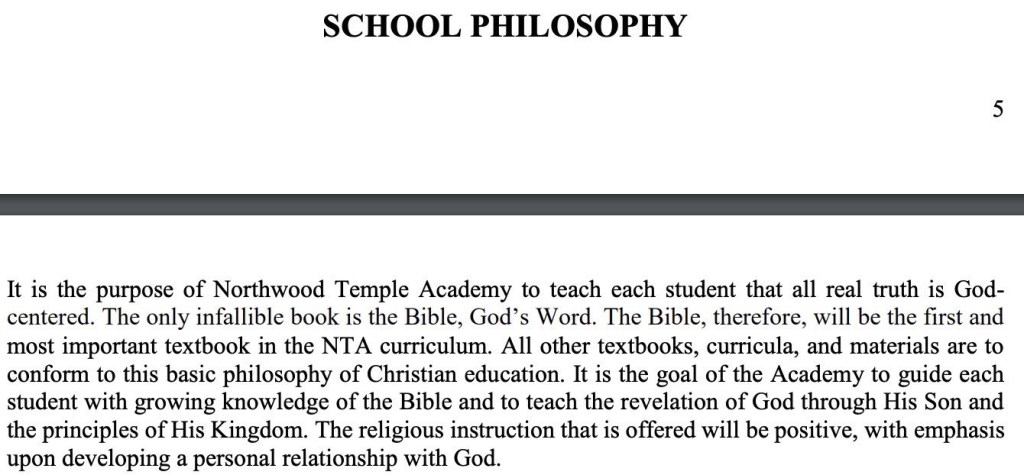
Justin Parmenter, NBCT teacher in North Carolina tweeted that the the state is funding Christian fundamentalist schools with vouchers. He identified on Christian school is not academics but devotion to the words of the Bible.

He tweeted:

Northwood Temple Academy in Fayetteville got more than $1.1 million in NC taxpayer voucher funds this year.

Their school philosophy is “The Bible, therefore, will be the first and most important textbook in the NTA curriculum.”

They should not get public $ #nced #ncga

Michigan is in track to make record investments in the quality of life for children and schools.

My friend Mitchell Robinson, a member of the State board of education, shared the following good news:

The State of Michigan passed a third consecutive historic education budget last night—and did so with bipartisan support, meaning the changes included in this budget can go into effect immediately.

It’s amazing to see what a state education budget can look like when you have pro-education legislators in charge–and teachers chairing the House and Senate Education Committees and the Senate Appropriations Subcommittee on PreK-12.

The budget includes:

•universal school meals

•foundation allowance increase of 5% — the largest in state history

•fully funded special education programs

•expanded Pre-K programs

•student teacher stipends for K-12

The budget also appropriates $11 million to a K-5 Music Education Pilot Program that provides funding to school districts that currently do not have elementary music instruction to hire certified music teachers.

Budgets are about more than dollars—they are moral documents; and in Michigan we are showing that we value our children, our families, and our future by directing funding to programs and initiatives that strengthen our schools and communities.

edbudget2023.jpeg

Paul Bowers, who covered education for the Charleston Post and Courier, writes on his blog Brutal South about deteriorating working conditions for the state’s teachers. Class sizes are rising, and the state has chosen to divert funding from the public schools.

Compared to 15 years ago, South Carolina public school teachers are doing more work, administering more tests with higher stakes, for wages that increasingly get eaten by inflation, under intensifying scrutiny from aggrieved political actors — and in many cases, they’re doing it with more students than ever.

The last time I looked into the growth of K-12 classroom sizes in my state was 2019, and the picture was bleak. While state regulations1 set strict limits on student-teacher ratios in most types of classrooms, the state legislature had started granting waivers to those caps during the Great Recession and had not resumed enforcement.

Predictably, median classroom size soared as the state stopped funding its obligations to school districts, teachers’ promised pay increases were frozen, and teachers quit the profession faster than the colleges of education could graduate new ones. When I wrote about the trend for The Post and Courier in 2019, classroom sizes had begun to shrink but were still significantly larger than they were in the 2007-08 academic year…

I’m a graduate of South Carolina public schools who sends his kids to South Carolina public schools, and despite the bad headlines and flagging test scores, I’ve seen firsthand how our education system can change people’s lives for the better. I’m certainly better for it, and my own kids are flourishing.

But after a decade-and-a-half of austerity and a century-and-a-half of backlash to the universal public good of education in South Carolina, I’m left wondering how many more hits the system can take….

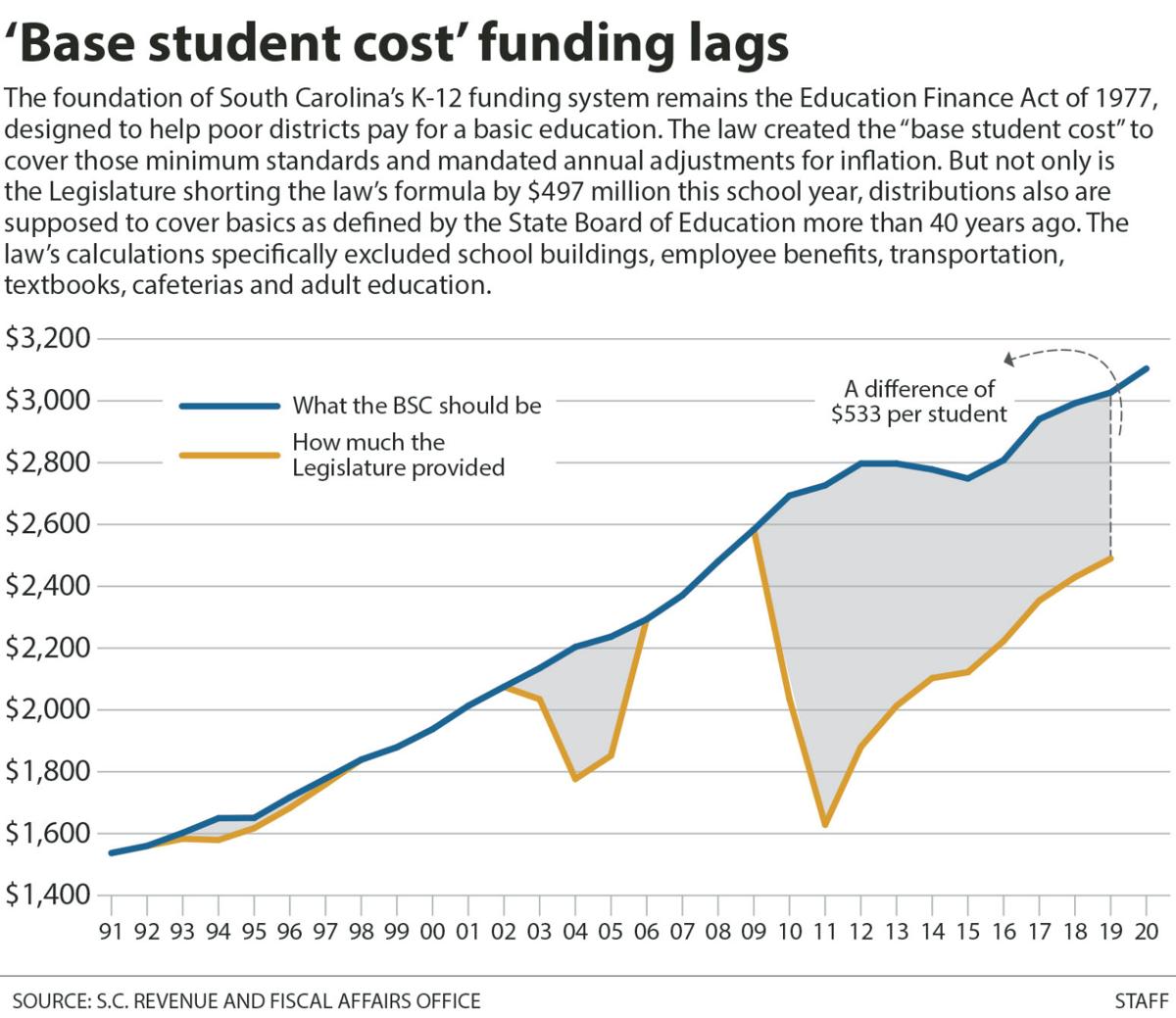
South Carolina Gov. Mark Sanford and the Republican-controlled legislature kneecapped school funding in 2006 with a tax handout to homeowners (Act 388) that routinely wrecks school revenues during economic downturns. As metropolitan school districts have grown thanks in part to an influx of workers for manufacturing concerns like Boeing, Volvo, and BMW, county governments have handed those employers massive tax incentives that cheated schools out of $2.2 billion in the last 5 years alone. And the legislature has not funded its own legally mandated Base Student Cost to districts since 2009, flagrantly violating the law every time it passes a budget — with outsize effects in our poorest rural districts.

Clearly, the leaders of the state don’t understand that their penuriousness towards the schools will hurt the next generation and the future of the state. They think in the moment. They forget about the future. They can attract corporations with a low-wage, non-union workforce, but they can’t build a thriving state unless they educate all the children.