Archives for category: Freedom of the Press

Recently I have been tweeting The Onion, not posting it, even when I thought it was funny.

But this post is so real, so not-funny, and so representative of what is happening that I wanted to share it with you.

It is about Trump’s insistence on intruding into our lives every day, dominating our thoughts with concern about what crazy thing he will do next, what crackpot nonsense he will tweet, which institution he will destroy next, which person he will insult today. It is exhausting and fascinating, like watching a violent car crash and wondering if you too will crash into the wreckage.

It begins like this:

“Good morning, everyone! What a week we’ve got coming up. A tremendous week. The fall season is here, we’re working on huge tax cuts, and there’s a lot of optimism having to do with business in our economy. Also, we’re ending Obamacare. And I’m going to get the wall. But beyond all that, what I’m looking forward to the most is another seven days of infecting every little aspect of your daily lives.

“Oh, you thought you might be able to block me out for even a moment? Good luck with that one. There will be no rest from having to think about me, or my administration, or the latest controversy I’ve thrown myself into. I am inescapable. My name, my face, my voice, my words, and those of my legions of surrogates—no matter how much you try to go about your normal life, I will find a way force myself in. MAGA!

“I will poison every second of quiet reflection that you previously enjoyed.

“I’m like a disease without a cure. There’s not a single thing I haven’t contaminated. News, entertainment, medicine, sports; if there’s a part of culture I haven’t ruined for you yet, just wait. This could be the week. I’ll either claw my way into your waking consciousness or just linger in the back of your mind, ready to pop out at any moment and remind you that I’m the president of the United States and will be for at least the next three years. You know that sickening feeling in the pit of your stomach—the one that’s been there since last November? Well, it’s not going away this week, I’ll tell you that.

“I will poison every second of quiet reflection that you previously enjoyed. No more sitting calmly with a coffee on a park bench. No more carefree drives with the windows down and the radio up. No more tranquil moments reveling in the splendor of a sunset. Just me festering in your brain, befouling all you hold dear.

“The mind is funny like that sometimes. The second you’ve freed yourself from the burden of having to ponder my ironclad stranglehold on absolutely every facet of American life, there I’ll be again, ready to resume the endless cycle of fear, regret, anger, and shame. Go ahead, try and tune me out right now.

“Donald Trump. Donald Trump. Donald Trump.”

Read the rest.

The Washington Post reports that his daily attacks on the free press are undermining public confidence in the media.

“THE BIG IDEA: Donald Trump celebrated Sunday that his campaign to delegitimize the free press is working.

“The president touted a Politico-Morning Consult poll published last week that found 46 percent of registered voters believe major news organizations fabricate stories about him. Just 37 percent of Americans think the mainstream media does not invent stories, while the rest are undecided. More than 3 in 4 Republicans believe reporters make up stories about Trump.

“It is finally sinking through,” the president tweeted.

“The first rule of propaganda is that if you repeat something enough times people will start to believe it, no matter how false. Trump uses the bully pulpit of the presidency to dismiss any journalism he doesn’t like as “fake news.” This daily drumbeat has clearly taken a toll on the Fourth Estate.”

The first rule of a would-be dictator is to destroy confidence in the free press.

Trump swore on the Bible at his inauguration to uphold the Constitution. That includes the First Amendment. His daily attacks on freedom of the press, which he called “the Enemy of the People,” violates the oath he took. The term “Ennemy of the People” was borrowed from Josef Stalin.

He also daily violates the Emoluments Clause of the Constitution by accepting payments from foreign governments in Trump properties and brands around the world and refusing to divest his business interests.

Two grounds for impeachment even without the Russia investigation.

Read the First Amendment. Then read it again.

“Congress shall make no law respecting an establishment of religion, or prohibiting the free exercise thereof; or abridging the freedom of speech, or of the press; or the right of the people peaceably to assemble, and to petition the Government for a redress of grievances.”

It was adopted in 1791.

The freedom of the press and of speech has been challenged again an$ Again, starting as early as the Alien and Sedition Acts of 1798.

Currently, we have a president who complains that the press is “the enemy of the people,” because he is criticized so much. It is questionable whether he is subject to more criticism than Franklin D. Roosevelt or Richard Nixon.

The phrase “enemy of the people” emanated from the Soviet Union, where people or groups were denounced for their deviance using this phrase.

Here is a cartoon about Trump’s dislike for the press.

Senator Ben Sasse of Nebraska, a Republican, has criticized Trump for violating his oath of office by criticizing freedom of the press. Maybe Steve Bannon will find an extremist to unseat Sasse when he runs again.

museum

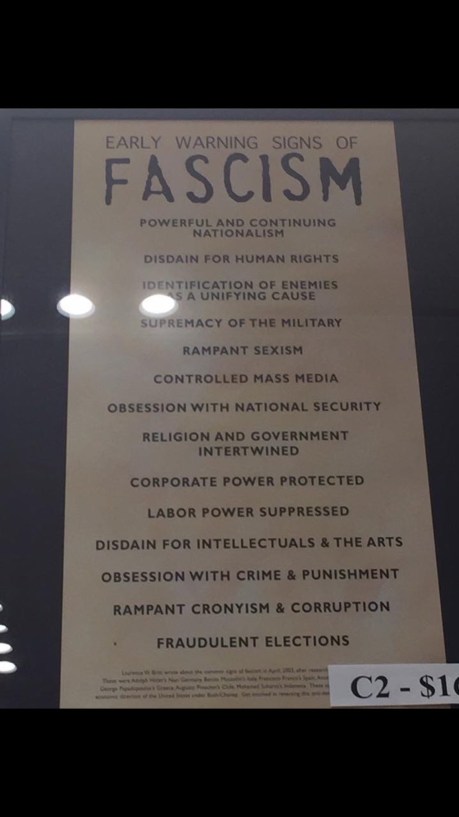
Sound familiar?

Read it again.

Think about it.

Which side are you on?

Snopes says the poster was once available in the gift shop of the Holocaust Museum.

Snopes says:

The list was originally created by Laurence Britt in 2003, for an article published by Free Inquiry magazine (a publication for secular humanist commentary and analysis). While subsequent postings of the list often attribute it to “Dr. Laurence Britt,” the author said that he was not actually a doctor (nor did he claim to be). Britt himself said that he could be more accurately described as an amateur historian

It quotes this note about the poster:

Laurence W. Britt wrote about the common signs of fascism in April 2003, after researching seven fascists regimes. Those were Adolf Hitler’s Nazi Germany, Benito Mussolini’s Italy, Francisco Franco’s Spain, Antontio de Oliveira Salazar’s Portual, George Papadopoulos’s Greece, August Pinochet’s Chile, Mohamed Suharto’s Indonesia. These signs resonate with the political and economic direction of the United states under Bush/Cheney. Get involved in reversing this anti-democratic direction while you still can!

The students are our future. And the students give me hope.

When I hear “reformers” like DeVos and Gates and Klein and Rhee claim that our schools are “failure factories,” that they are “obsolete,” that they are a “deadend,” and that our students are woefully undereducated, I will think of the students at this typical high school in Kansas. They unmasked a fraud. They engaged in critical thinking. No one paid them to do it. They demonstrated initiative, intelligence, and persistence. They are far smarter than the “reformers” who run them and their generation down.

In Kansas, student journalists checked out the credentials of their newly hired principal. The “university” that she cited as the source of her MA and doctorate didn’t exist. They investigated further and broke the story. The new principal resigned without ever taking office.

Connor Balthazor, 17, was in the middle of study hall when he was called into a meeting with his high school newspaper adviser.

A group of reporters and editors from the student newspaper, the Booster Redux at Pittsburg High School in southeastern Kansas, had gathered to talk about Amy Robertson, who was hired as the high school’s head principal on March 6.

The student journalists had begun researching Robertson, and quickly found some discrepancies in her education credentials. For one, when they researched Corllins University, the private university where Robertson said she got her master’s and doctorate degrees years ago, the website didn’t work. They found no evidence that it was an accredited university.

“There were some things that just didn’t quite add up,” Balthazor told The Washington Post.

The students began digging into a weeks-long investigation that would result in an article published Friday questioning the legitimacy of the principal’s degrees and of her work as an education consultant.

On Tuesday night, Robertson resigned.

This is a reminder why freedom of the press is so important to our democracy.

This is the fourth and last editorial published by the Los Angeles Times about Trump. It contains links to the preceding three. These are strange times we live in. We have a president who lies and doubles-down on his lies and is incapable of apologizing; a president who refuses to divest or even disclose his worldwide financial holdings, which may be affected by decisions he makes; a man who trusts his immediate family members more than his cabinet to carry out government functions; a man without honor or integrity or knowledge or decency or even a sense of irony (after declaring April to be Sexual Assault Awareness Month, he defended Fox News host Bill O’Reilly who has settled multiple sexual harassment complaints; Trump said O’Reilly had “done nothing wrong.”)

Here is the editorial:

PART VI
Friday
By THE TIMES EDITORIAL BOARD

APRIL 5, 2017

In Donald Trump’s America, the mere act of reporting news unflattering to the president is held up as evidence of bias. Journalists are slandered as “enemies of the people.”

Facts that contradict Trump’s version of reality are dismissed as “fake news.” Reporters and their news organizations are “pathetic,” “very dishonest,” “failing,” and even, in one memorable turn of phrase, “a pile of garbage.”

Trump is, of course, not the first American president to whine about the news media or try to influence coverage. President George W. Bush saw the press as elitist and “slick.” President Obama’s press operation tried to exclude Fox News reporters from interviews, blocked many officials from talking to journalists and, most troubling, prosecuted more national security whistle-blowers and leakers than all previous presidents combined.

But Trump being Trump, he has escalated the traditionally adversarial relationship in demagogic and potentially dangerous ways.

Support our journalism
Become a subscriber today to support editorial writing like this. Start getting full access to our signature journalism for just 99 cents for the first four weeks.

Most presidents, irritated as they may have been, have continued to acknowledge — at least publicly — that an independent press plays an essential role in American democracy. They’ve recognized that while no news organization is perfect, honest reporting holds leaders and institutions accountable; that’s why a free press was singled out for protection in the 1st Amendment and why outspoken, unfettered journalism is considered a hallmark of a free country.

Trump doesn’t seem to buy it. On his very first day in office, he called journalists “among the most dishonest human beings on earth.”

Since then he has regularly condemned legitimate reporting as “fake news.” His administration has blocked mainstream news organizations, including The Times, from briefings and his secretary of State chose to travel to Asia without taking the press corps, breaking a longtime tradition.

He apparently hopes to discredit, disrupt or bully into silence anyone who challenges his version of reality.

This may seem like bizarre behavior from a man who consumes the news in print and on television so voraciously and who is in many ways a product of the media. He comes from reality TV, from talk radio with Howard Stern, from the gossip pages of the New York City tabloids, for whose columnists he was both a regular subject and a regular source.

But Trump’s strategy is pretty clear: By branding reporters as liars, he apparently hopes to discredit, disrupt or bully into silence anyone who challenges his version of reality. By undermining trust in news organizations and delegitimizing journalism and muddling the facts so that Americans no longer know who to believe, he can deny and distract and help push his administration’s far-fetched storyline.

It’s a cynical strategy, with some creepy overtones. For instance, when he calls journalists “enemies of the people,” Trump (whether he knows it or not) echoes Josef Stalin and other despots.

But it’s an effective strategy. Such attacks are politically expedient at a moment when trust in the news media is as low as it’s ever been, according to Gallup. And they’re especially resonant with Trump’s supporters, many of whom see journalists as part of the swamp that needs to be drained.

Of course, we’re not perfect. Some readers find news organizations too cynical; others say we’re too elitist. Some say we downplay important stories, or miss them altogether. Conservatives often perceive an unshakable liberal bias in the media (while critics on the left see big, corporate-owned media institutions like The Times as hopelessly centrist).

The news media remain an essential component in the democratic process and should not be undermined by the president.

To do the best possible job, and to hold the confidence of the public in turbulent times, requires constant self-examination and evolution. Soul-searching moments — such as those that occurred after the New York Times was criticized for its coverage of the Bush administration and the Iraq war or, more recently, when the media failed to take Trump’s candidacy seriously enough in the early days of his campaign — can help us do a better job for readers. Even if we are not faultless, the news media remain an essential component in the democratic process and should not be undermined by the president.

Some critics have argued that if Trump is going to treat the news media like the “opposition party” (a phrase his senior aide Steve Bannon has used), then journalists should start acting like opponents too. But that would be a mistake. The role of an institution like the Los Angeles Times (or the New York Times, the Wall Street Journal or CNN) is to be independent and aggressive in pursuit of the truth — not to take sides. The editorial pages are the exception: Here we can and should express our opinions about Trump. But the news pages, which operate separately, should report intensively without prejudice, partiality or partisanship.

Given the very real dangers posed by this administration, we should be indefatigable in covering Trump, but shouldn’t let his bullying attitude persuade us to be anything other than objective, fair, open-minded and dogged.

The fundamentals of journalism are more important than ever. With the president of the United States launching a direct assault on the integrity of the mainstream media, news organizations, including The Times, must be courageous in our reporting and resolute in our pursuit of the truth.

The Los Angeles Times is publishing a series of editorials about Donald Trump. This is the first. It was published yesterday.


It was no secret during the campaign that Donald Trump was a narcissist and a demagogue who used fear and dishonesty to appeal to the worst in American voters. The Times called him unprepared and unsuited for the job he was seeking, and said his election would be a “catastrophe.”

Still, nothing prepared us for the magnitude of this train wreck. Like millions of other Americans, we clung to a slim hope that the new president would turn out to be all noise and bluster, or that the people around him in the White House would act as a check on his worst instincts, or that he would be sobered and transformed by the awesome responsibilities of office.

Instead, seventy-some days in — and with about 1,400 to go before his term is completed — it is increasingly clear that those hopes were misplaced.

In a matter of weeks, President Trump has taken dozens of real-life steps that, if they are not reversed, will rip families apart, foul rivers and pollute the air, intensify the calamitous effects of climate change and profoundly weaken the system of American public education for all.

His attempt to de-insure millions of people who had finally received healthcare coverage and, along the way, enact a massive transfer of wealth from the poor to the rich has been put on hold for the moment. But he is proceeding with his efforts to defang the government’s regulatory agencies and bloat the Pentagon’s budget even as he supposedly retreats from the global stage.

It is impossible to know where his presidency will lead or how much damage he will do to our nation.

These are immensely dangerous developments which threaten to weaken this country’s moral standing in the world, imperil the planet and reverse years of slow but steady gains by marginalized or impoverished Americans. But, chilling as they are, these radically wrongheaded policy choices are not, in fact, the most frightening aspect of the Trump presidency.

What is most worrisome about Trump is Trump himself. He is a man so unpredictable, so reckless, so petulant, so full of blind self-regard, so untethered to reality that it is impossible to know where his presidency will lead or how much damage he will do to our nation. His obsession with his own fame, wealth and success, his determination to vanquish enemies real and imagined, his craving for adulation — these traits were, of course, at the very heart of his scorched-earth outsider campaign; indeed, some of them helped get him elected. But in a real presidency in which he wields unimaginable power, they are nothing short of disastrous.

Although his policies are, for the most part, variations on classic Republican positions (many of which would have been undertaken by a President Ted Cruz or a President Marco Rubio), they become far more dangerous in the hands of this imprudent and erratic man. Many Republicans, for instance, support tighter border security and a tougher response to illegal immigration, but Trump’s cockamamie border wall, his impracticable campaign promise to deport all 11 million people living in the country illegally and his blithe disregard for the effect of such proposals on the U.S. relationship with Mexico turn a very bad policy into an appalling one.

In the days ahead, The Times editorial board will look more closely at the new president, with a special attention to three troubling traits:

1. Trump’s shocking lack of respect for those fundamental rules and institutions on which our government is based. Since Jan. 20, he has repeatedly disparaged and challenged those entities that have threatened his agenda, stoking public distrust of essential institutions in a way that undermines faith in American democracy. He has questioned the qualifications of judges and the integrity of their decisions, rather than acknowledging that even the president must submit to the rule of law. He has clashed with his own intelligence agencies, demeaned government workers and questioned the credibility of the electoral system and the Federal Reserve. He has lashed out at journalists, declaring them “enemies of the people,” rather than defending the importance of a critical, independent free press. His contempt for the rule of law and the norms of government are palpable.

2. His utter lack of regard for truth. Whether it is the easily disprovable boasts about the size of his inauguration crowd or his unsubstantiated assertion that Barack Obama bugged Trump Tower, the new president regularly muddies the waters of fact and fiction. It’s difficult to know whether he actually can’t distinguish the real from the unreal — or whether he intentionally conflates the two to befuddle voters, deflect criticism and undermine the very idea of objective truth. Whatever the explanation, he is encouraging Americans to reject facts, to disrespect science, documents, nonpartisanship and the mainstream media — and instead to simply take positions on the basis of ideology and preconceived notions. This is a recipe for a divided country in which differences grow deeper and rational compromise becomes impossible.

3. His scary willingness to repeat alt-right conspiracy theories, racist memes and crackpot, out-of-the-mainstream ideas. Again, it is not clear whether he believes them or merely uses them. But to cling to disproven “alternative” facts; to retweet racists; to make unverifiable or false statements about rigged elections and fraudulent voters; to buy into discredited conspiracy theories first floated on fringe websites and in supermarket tabloids — these are all of a piece with the Barack Obama birther claptrap that Trump was peddling years ago and which brought him to political prominence. It is deeply alarming that a president would lend the credibility of his office to ideas that have been rightly rejected by politicians from both major political parties.

Where will this end? Will Trump moderate his crazier campaign positions as time passes? Or will he provoke confrontation with Iran, North Korea or China, or disobey a judge’s order or order a soldier to violate the Constitution? Or, alternately, will the system itself — the Constitution, the courts, the permanent bureaucracy, the Congress, the Democrats, the marchers in the streets — protect us from him as he alienates more and more allies at home and abroad, steps on his own message and creates chaos at the expense of his ability to accomplish his goals? Already, Trump’s job approval rating has been hovering in the mid-30s, according to Gallup, a shockingly low level of support for a new president. And that was before his former national security advisor, Michael Flynn, offered to cooperate last week with congressional investigators looking into the connection between the Russian government and the Trump campaign.

Those who oppose the new president’s reckless and heartless agenda must make their voices heard.

On Inauguration Day, we wrote on this page that it was not yet time to declare a state of “wholesale panic” or to call for blanket “non-cooperation” with the Trump administration. Despite plenty of dispiriting signals, that is still our view. The role of the rational opposition is to stand up for the rule of law, the electoral process, the peaceful transfer of power and the role of institutions; we should not underestimate the resiliency of a system in which laws are greater than individuals and voters are as powerful as presidents. This nation survived Andrew Jackson and Richard Nixon. It survived slavery. It survived devastating wars. Most likely, it will survive again.

But if it is to do so, those who oppose the new president’s reckless and heartless agenda must make their voices heard. Protesters must raise their banners. Voters must turn out for elections. Members of Congress — including and especially Republicans — must find the political courage to stand up to Trump. Courts must safeguard the Constitution. State legislators must pass laws to protect their citizens and their policies from federal meddling. All of us who are in the business of holding leaders accountable must redouble our efforts to defend the truth from his cynical assaults.

The United States is not a perfect country, and it has a great distance to go before it fully achieves its goals of liberty and equality. But preserving what works and defending the rules and values on which democracy depends are a shared responsibility. Everybody has a role to play in this drama.

Please watch this video.

The president of the United States wrote for the world to see on Twitter that the major media in the United States are “the enemy of the American people.”

No other president ever uttered or wrote these words.

Could someone please brief Trump on the Constitution and its Amendments to which he swore allegiance?

He has already violated that oath by attacking the free press.

He continuously breaks that oath by disregarding the emoluments clause, which forbids him from taking any payments of any kind from any foreign powers.

Trump has embraced terminology that has long been stigmatized.

In his Inaugural Address, he boomed out his endorsement of “America First!” Did he know the historical use of that phrase? Did he know that it was used by isolationists in the late 1930s who wanted America to stay out of the war beginning in Europe? Did he know of its association with isolationism and anti-Semitism? Did Steve Bannon and Stephen Miller, who allegedly wrote the speech, know?

Now he refers to the free press as “an enemy of the people.” Journalists who criticize him are vendors of “fake news” and thus “enemies of the people.” The New York Times says the phrase was frequently used by Stalin to demonized opponents as “enemies of the people.”

“The phrase was too toxic even for Nikita Khrushchev, a war-hardened veteran communist not known for squeamishness. As leader of the Soviet Union, he demanded an end to the use of the term “enemy of the people” because “it eliminated the possibility of any kind of ideological fight.”

“The formula ‘enemy of the people,’” Mr. Khrushchev told the Soviet Communist Party in a 1956 speech denouncing Stalin’s cult of personality, “was specifically introduced for the purpose of physically annihilating such individuals” who disagreed with the supreme leader.

“It is difficult to know if President Trump is aware of the historic resonance of the term, a label generally associated with despotic communist governments rather than democracies. But his decision to unleash the terminology has left some historians scratching their heads. Why would the elected leader of a democratic nation embrace a label that, after the death of Stalin, even the Soviet Union found to be too freighted with sinister connotations?”

Does Trump know that he is echoing the terminology of Stalin? Has anyone told him?

The commander of the Navy Seal raid that killed Bin Laden denounced Trump’s absurd claim that the press is “the enemy of the American people.” Retired Admiral William H. McRaven said that Trump’s charge that the free press “the enemy of the American people” was “the greatest threat to democracy in my lifetime.

“William H. McRaven, a retired four-star admiral and former Navy SEAL, slammed President Trump’s characterization of the media as “the enemy of the American people,” calling that sentiment the “greatest threat to democracy” he’s ever seen.

“That’s coming from a man who’s seen major threats to democracy.

“McRaven, who was commander of the secretive Joint Special Operations Command, organized and oversaw the highly risky operation that killed Osama bin Laden almost six years ago. The admiral from Texas had tapped a special unit of Navy SEALs to carry out the May 2011 raid on the elusive terrorist’s hideout, a high-walled compound in Abbottabad, Pakistan, The Washington Post’s Craig Whitlock reported shortly after bin Laden’s death.

“McRaven left the military in 2014 after nearly four decades and later became chancellor of the University of Texas System. The UT-Austin alumnus, who has a bachelor’s degree in journalism, addressed a crowd at the university’s Moody College of Communication on Tuesday.”

He is not a paid protestor.

At the CPAC meeting, Trump again attacked the media as fake news, dishonest, etc. He is doing his best to destroy the First Amendment. He is an enemy of democracy.

Trump continued his unprecedented, full-force assault on freedom of the press by barring CNN, Politico, and the New York Times from Sean Spicer’s press briefing.

This is the behavior of a fascist.

The media should respond by boycotting his briefings until all credentialed media are welcome.

They should stop covering the clown until he respects the Constitution.