Archives for category: For-Profit

Shortly after Senator Ben Sasse left the U.S. Senate, he accepted the presidency of the University of Florida. Silas Morgan of the Orlando Sentinel relied on reporting by the student newspaper, the Independent Florida Alligator, to describe how former Senator Sasse upped the budget for his office by millions of dollars.

The University of Florida’s student newspaper reported Monday that former university president Ben Sasse spent millions of the school’s money to hire GOP political allies.


Sasse, a former Republican U.S. Senator from Nebraska, gave several one-time Senate staff members and other GOP officials lucrative remote positions at UF, according to records obtained by the Independent Florida Alligator.


Among the Senate staffers who joined him at UF are his former chief of staff, Raymond Sass; his former communications director, James Wegmann; his former press secretary, Taylor Silva; and three other former staffers. Both Sass and Wegmann worked remotely from the Washington D.C. area.


Sass’ salary, at $396,000, was more than double his Senate salary. Wegmann’s new position at UF earned him $432,000, while his predecessor in the position had made $270,000.

The hirings contributed to a $4.3 million increase in presidential salary expenses, part of a tripling of his office’s spending compared to what his predecessor, Kent Fuchs, spent during his last year in office, the Alligator reported. Sasse’s office employed more than 30 staff members, while Fuchs had fewer than 10.


Sasse also hired former Tennessee Education Commissioner Penny Schwinn, who worked remotely from Nashville, in a newly-created position that paid a starting salary of $367,500 and U.S. Senator Lindsey Graham’s former scheduler, Alice James Burns, who also worked remotely and was paid $205,000.


A report obtained by the Alligator says Sasse spent over $20,000 flying his employees to UF between April 29 and July 29. The only hire who lives in Florida received a $15,000 stipend to relocate to Gainesville.


UF hasn’t responded to requests from the Alligator for a complete log of Sasse’s travel expenses. His travel expenses rose to $633,000 over his first full fiscal year, more than Fuchs spent on travel in eight years.

He also spent $7.2 million on consulting contracts, nearly two-thirds of which went to consulting giant McKinsey and Company, where he used to work as an advisor on an hourly contract. This amounts to more than 40 times what Fuchs spent on consulting in eight years.

Sasse abruptly resigned at the end of July, citing his wife’s failing health. The Alligator says the university did not respond to questions about what would happen to the hires now that Sasse is gone. Fuchs has returned as interim president until the UF Board of Trustees can hire a permanent replacement for Sasse.


Sasse’s hiring by the Board in 2022 resulted in the UF Faculty Senate passing a no confidence resolution in Sasse’s presidential search process due to transparency issues. Legislation passed by Florida’s GOP-controlled legislature earlier in 2022 made records relating to public university presidential searches exempt from Florida’s open public meetings and public records requirements.

His appointment by the board of trustees also generated controversy among parts of the student body, especially the LGBTQ+ community, for political positions Sasse had taken while in the Senate.

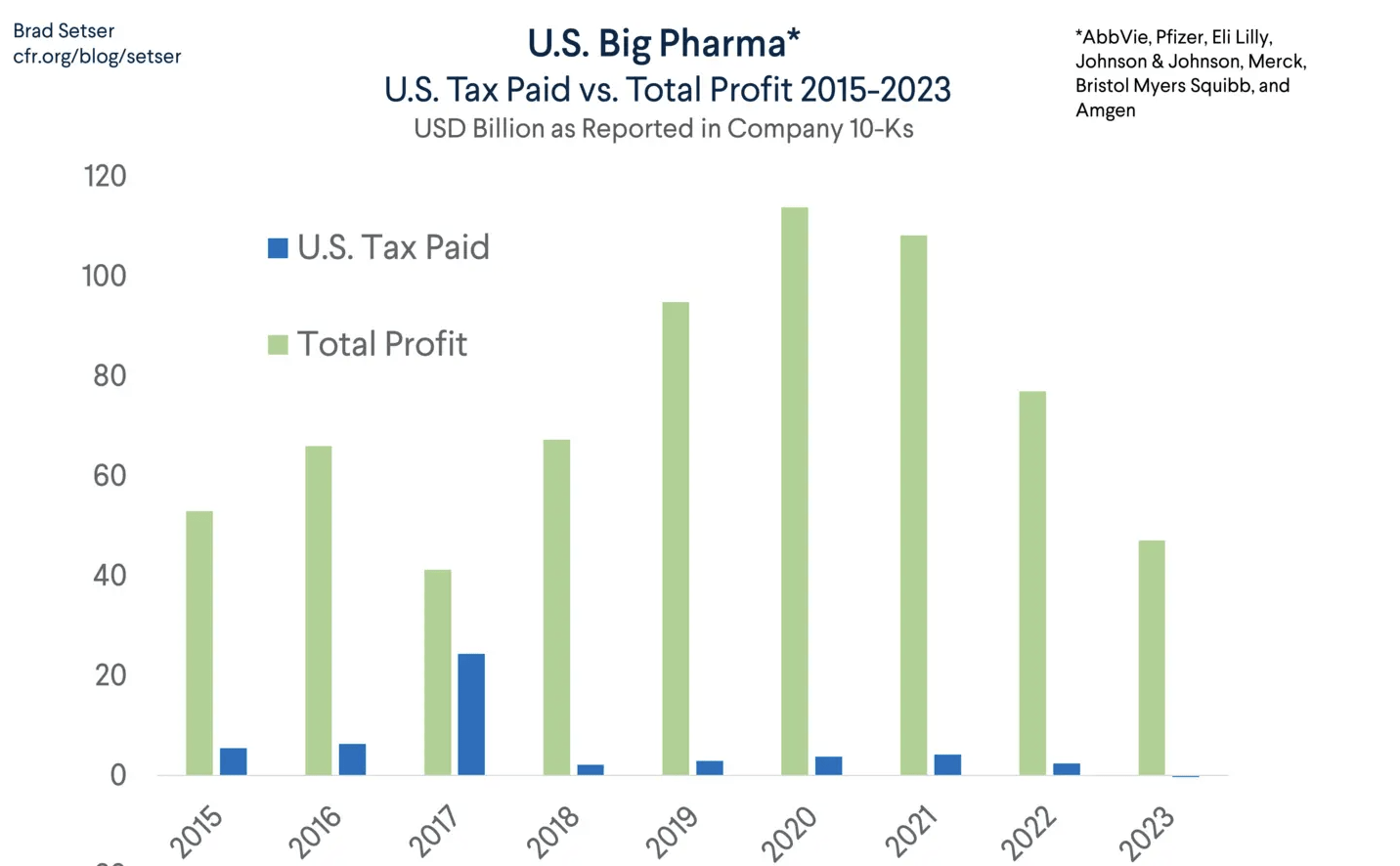
Big Pharma makes big profits in the U.S., but has mastered the accounting trick of paying little or no taxes. Thanks to Trump’s big corporate tax cut in 2017, most of these corporations are able to transfer their profits to other countries where the tax rates are lower.

Although they receive the bulk of revenue from sales in the U.S. and report large overall profits, most large U.S.-based pharmaceutical companies don’t pay any taxes in the country.

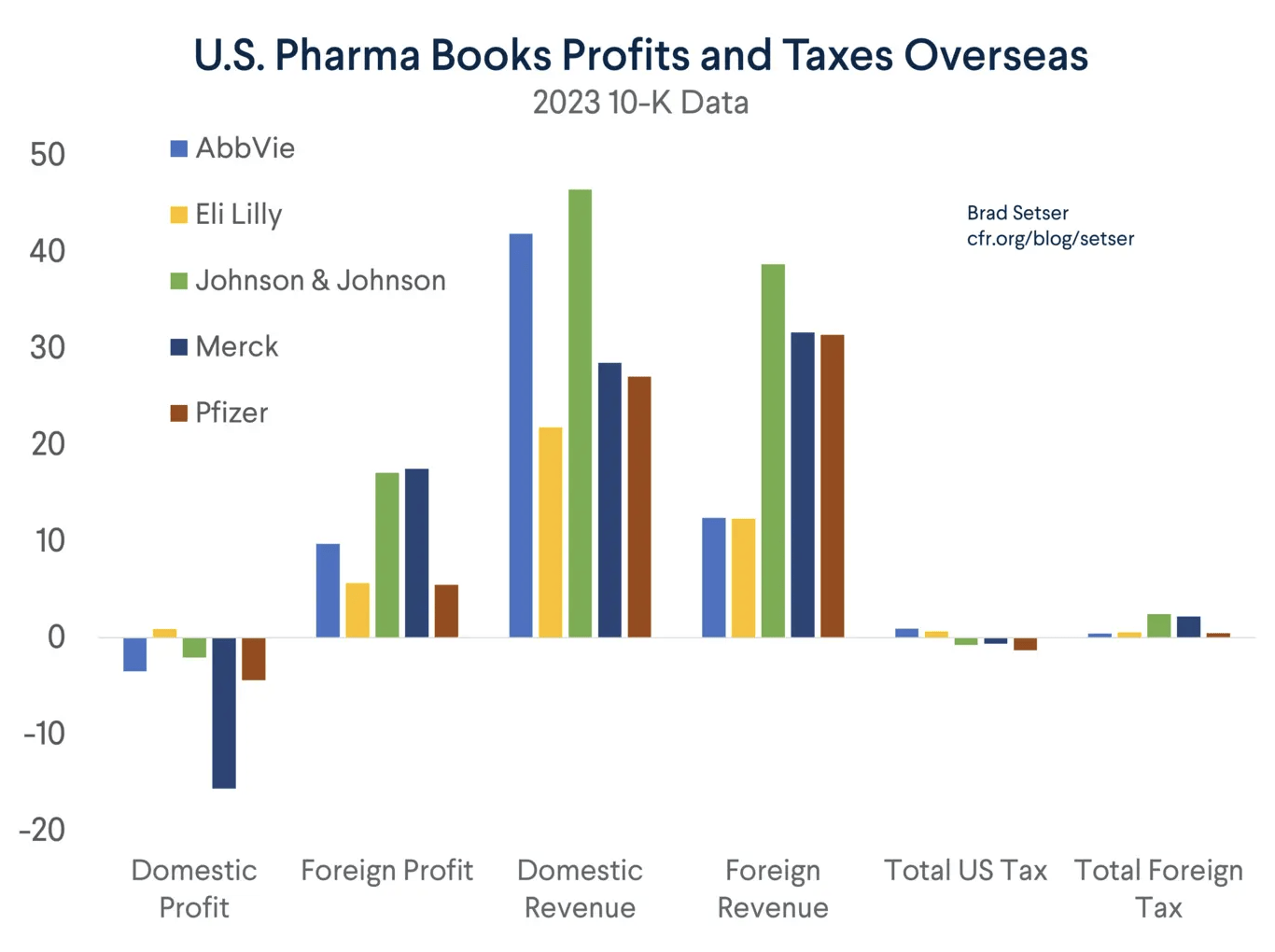
A new analysis of corporate taxes paid by the largest U.S. pharma companies by the Council on Foreign Relations found that in 2023, the top seven based on revenue had a combined U.S. tax obligation of (-)$250M.

The duo also noted that, based on 10-K filings, many pharmas reported losses in the U.S. in 2023. Among them: Pfizer, $4.4B; AbbVie, $3.5B; Merck, $15.6B; and Johnson & Johnson $2B.

However, Setser and Weilandt estimated that Eli Lilly (LLY) reported a $0.9B U.S. profit.

Gilead Sciences (GILD) is an outlier among large biopharmas. It is the eighth largest U.S. biopharma by revenue, yet reported paying $3B in U.S. taxes in 2023.

Setser and Weilandt explain how pharmas can book U.S. profits overseas to save on paying U.S. taxes. The first reason is the Tax Cuts and Jobs Act of 2017, which the pair say provided for lower taxes on foreign profits than U.S. profits, providing an incentive for companies to book more profits overseas.

Second, since many drugs sold in the U.S. market are actually made abroad, pharma companies decide to book those profits in the country of manufacture.

Finally, many pharmas have moved their intellectual property to wholly owned subsidiaries in locations with more favorable tax rates than the U.S.

Open the link to read the rest of the article.

Former President Trump recently discovered that members of his administration had produced a set of plans for his next term. They did this under the guidance of the Heritage Foundation, the Republican Party’s ideological center. If you believed that Trump knew nothing about this 900-page guidebook, I know of a bridge in Brooklyn to sell you.

Project 2025 is a handbook of extremism. It represents the far-right Republicans’ desire to eliminate many federal programs and, as right winger Grover Norquist one memorably said, “Shrink it so it can be drowned in a bathtub.”

North Carolina public school advocates Patty Williams and David Zonderman are public school graduates and parents. They wrote the following about Project 2025:

In the Spring of 2023, the Heritage Foundation released Mandate for Leadership: The Conservative Promise, aka Project 2025. Now, more than a year later, it is finally getting the serious attention that it demands. In its early pages, the Foundation claims to “have gone back to the future—and then some.” We are warned that, “The federal government is a behemoth, weaponized against American citizens and conservative values, with freedom and liberty under siege as never before.” To fight this supposed incubus sucking the life out of the republic, a growing number of conservative organizations have joined the Heritage Foundation in supporting this project and intend to assemble an army to march on Washington to “deconstruct the Administrative State.”


Project 2025 is both breathtaking and scary in its scope. It envisions a far-right rewriting of government missions, policies, and procedures, ranging from the White House, through all Cabinet-level departments, to the Federal Reserve and other independent regulatory agencies.  Tens of thousands of federal employees could be fired or subject to politically-inspired loyalty tests, gutting almost 150 years of civil service reform, and erasing institutional memory, knowledge, and expertise. Whole federal departments—including the Department of Education—and the funding that goes with them could be left on the cutting room floor, with disastrous consequences for the least among us.


This far-right “Playbook” is a frontal assault on honest and competent government, and the underpinnings of our 248-year-old democracy. Project 2025 flips the script on our nation’s foundation of liberty, prosperity, and the rule of law by inverting and perverting fact and data about how government actually functions to protect the environment, ensure safe workplaces, and provide some safety net for those in poverty. 


Project 2025 may appear to come from the right-wing fever swamp, which conjures up something out of science fiction. Indeed, it does remind us of a legendary Rod Serling Twilight Zone episode, first televised in March of 1962. In “To Serve Man,” earth is visited by the Kanamits. Enormously tall aliens, they appear frightening at first, but are eventually welcomed by humans. The Kanamits help end famine, eliminate war, and provide unlimited energy supplies for the betterment of the planet. 


Seemingly altruistic in their efforts, the Kanamits leave a book behind at the United Nations, which a decoding expert, Hero Chambers and his able assistant, Pat, begin to translate. Meanwhile, the Kanamits invite enthusiastic Earthlings to visit their planet, and flight reservations fill up quickly. Only when Pat races up to a space ship about to lift off does she reveal to Chambers that the title of the book—To Serve Man—is a cookbook. A recipe for disaster.


Project 2025 also proclaims to serve man, perhaps not literally on a silver platter like the Kanamits; but it may also cannibalize our government, our nation, and our democracy. Unlike the hapless denizens of earth in the Twilight Zone, we don’t need a decoding expert to see through the myths and deceptions that seek to dismantle our enduring republic and its Constitutional rights.


Let’s not wait until it’s too late and our collective goose is cooked. It’s time to stir the pot. Encourage your friends and family to vote as though their democracy depends on it—because it does.


Many questions have been raised about the $2 billion that the Saudis gave Jared Kushner, Trump’s son-in-law, to invest in profitable deals. Now we know about one of them, thanks to veteran journalist Michael Isikoff, writing at SpyTalk.

After weathering criticism over its reliance on a gusher of Saudi cash, Jared Kushner’s investment fund made its first big splash last month when it announced it had signed a $500 million deal with the Serbian government to develop a high end real estate project in downtown Belgrade on the site of a bombed down army building destroyed during the 1999 Kosovo war.

But the fine print of the deal includes a commitment that seems destined to stir up even more international controversy: a pledge by Kushner’s firm, Affinity Partners, to construct a “memorial dedicated to all the victims of NATO aggression”— an allusion to the U.S.-backed bombing campaign that brought the Serbian government of Slobodan Milosevic to its knees a quarter century ago in response to its relentless campaign of repression and savage massacres of ethnic Albanians in Kosovo. 

Among those exercised over the Kushner deal is retired Gen. Wesley Clark, who served as NATO Supreme Allied Commander during the war. 

While he has no objection to a U.S. firm investing in Serbia, the planned revisionist memorial—officially proclaiming America’s adversary in the war to have been a victim of  “aggression”— “is worse than a reversal” of U.S. policies in the region, said Clark in an interview with SpyTalk. “It’s a betrayal of the United States, its policies and the brave diplomats and airmen who did what they could to stop Serb ethnic cleansing.” 

Just as concerning as the whitewashing of Serbian war crimes, Clark said, is the just announced deal between Kushner’s firm and the Serbian government of Aleksander Vučić, a pro-Russian hardliner who once served as minister of information in Milosevic’s government. The memorial project needs to be viewed in a wider geopolitical context: It serves the Kremlin’s core interests in undermining NATO at a time the alliance is engaged in resisting Russian aggression in Ukraine.

“This is part of a broader Russian intelligence movement to split, discredit and weaken NATO,” Clark said. “It’s Russian imperial pushback…Should Kushner participate in this? Of course he should not.”

Neither Kushner nor representatives of his Miami-based firm responded to requests for comment. But the remarks by Clark are likely to draw further attention to a project that has generated strong  criticism from Serbian opposition leaders as well as questions about potential conflicts of interest if Kushner’s father in law, Donald Trump (for whom he is once again raising money) is elected president in November.

Kushner’s partner in the deal is Richard Grenell, who was Trump’s Ambassador to Germany and who hopes to become Trump’s Secretary of State in a new administration.

Sarah Jaffe wrote in The American Prospect about the latest way to extract profit from consumers: surge pricing. It’s not only Uber and Lyft. It’s spreading into every corner of business.

She writes:

The internet nearly exploded this February when Wendy’s CEO Kirk Tanner announced that the fast-food chain intended to embrace “surge pricing,” raising the prices of a burger and a Frosty in line with customer demand.

The company had included a mention of “dynamic pricing” in its fourth-quarter earnings presentation, but clarified after the kerfuffle that the announcement of its new digital menu displays had been “misconstrued in some media reports as an intent to raise prices when demand is highest,” and said that it had “no plans to do that.” Instead, the new system would merely allow Wendy’s to “offer discounts and value offers to our customers more easily.”

The snark, which included Sen. Elizabeth Warren (D-MA), ranged from pure outrage to questions of whether the company would also offer “surge pay” to its low-wage workforce. But it’s not like Wendy’s invented price-gouging. A quarter-century earlier, Coca-Cola’s CEO mused about equipping its vending machines with thermometers, and triggering them to raise the price of a soda on a hot day. People hated that too; we just didn’t have social media then.

Wendy’s and Coke aside, surge pricing is spreading. Since deregulation in the late 1970s, airlines have used a form of it, with flights costing more at short notice or at high-demand times of year. Now, the practice has crept into golf courses, hotel rooms, gyms, pubs, and concert venues. Amazon alters its prices every ten minutes. Like Wendy’s, brick-and-mortar retailers are moving to digital price tags, allowing them to surge at will. Consulting firms like Sauce Pricing promise automatic surge pricing at restaurants to boost revenues. A chain bowling alley called Bowlero charged $418.90for two lanes one day last year. Surge pricing “will eventually be everywhere,” the Financial Times, that chronicler of modern capitalism, said last September.

Customers tend to want to know in advance how much something will cost, and though we’re used to the cost of a gallon of gas, or even a quart of milk or a can of Coke, changing over time, those things tend not to fluctuate rapidly over the course of a day or even an hour. People make a distinction between things you need right away and things you could wait for; between luxury items, like market-price lobster at the hottest restaurant in town, and something we all know is cheap and easy, like a Wendy’s cheeseburger.

As companies gather more data available on consumer preferences, the process of algorithmically adjusting prices rapidly based on supply and demand will get easier, affecting all sorts of goods and services we’ve grown to count on. And there’s a case study in how this affects not only consumers but the workers who serve them. You encounter it every time you hit up your phone to find a way home.

IN RECENT YEARS, “SURGE PRICING” has been mostly associated with rideshare companies like Uber and Lyft. It was one of Uber’s earliest sources of bad press, even back when the tech press mostly penned breathless paeans to genius founder-disruptors. Uber took advantage of dysfunctional taxi systems in cities like Washington, D.C., to win goodwill, according to Kafui Attoh, associate professor of urban studies at the City University of New York’s School of Labor and Urban Studies and co-author of Disrupting D.C.: The Rise of Uber and the Fall of the City.

The pricing system was justified as a way to encourage drivers to come out at peak times by offering them more money, something that a regulated taxi system could not offer. It worked, ostensibly, by some combination of three incentives: reducing demand for rides because fewer people could afford the higher price; offering drivers a higher rate if they hit the road; and getting already-working drivers to head to the high-rate zone.

But regulated taxi systems at least offered a steady price that users could count on, whereas Uber’s sudden price spikes turned a short ride home into a luxury good. Uber spokespeople would suggest that riders simply wait for prices to fall again, but anyone who’s ever been stranded at closing time or missed the last subway knows that waiting sometimes isn’t an option.

Please keep reading by opening the link.

A reader named Quickwrit summed up why “Medicare Advantage” is inferior to Medicare. Medicare is a federal program. Medicare Advantage is run for profit by private insurance companies. They make a profit by denying services.

Quickwrit writes:

WARNING TO ALL RETIREES!!! So-called “Medicare Advantage” plans TAKE YOU OUT OF FEDERAL MEDICARE and put you into A PRIVATE INSURANCE PLAN!!! So-called “Advantage” plans are aimed at privatizing all of federal Medicare for the profit of private insurance companies. Read pages 61 and 62 of your “Medicare & Me” booklet where it tells you that Medicare Advantage plans are PRIVATE insurance plans and that “each Medicare Advantage plan can charge different out-of-pocket costs and have different rules for how you get your [medical] services.” In so-called “Medicare Advantage” plans you lose your freedom to choose your own doctors and you get hit with all sorts of out-of-pocket costs and copays. And you must use the “Advantage” plan’s so-called “Preferred Provider Organization” (PPO) doctors, specialists, and hospitals. The only “advantage” in a “Medicare Advantage” plan is for the private insurance company’s profits. More and more healthcare providers are dumping so-called “Medicare Advantage” plans and preferring Medicare Supplement (“Medigap”) plans. https://www.usatoday.com/story/news/health/2023/10/27/hospitals-terminate-medicare-advantage-contracts-over-payments/71301991007/

Quickwrit also wrote:

$600 BILLION MEDICARE ADVANTAGE FRAUD THREATENS THE CONTINUED EXISTENCE OF ORIGINAL MEDICARE

A new study published in the respected JAMA Internal Medicine reveals that privatized Medicare Advantage plans have defrauded U.S. taxpayers of at least $600 BILLION in recent years and calls for the abolition of the program before the ongoing fraud kills original Medicare.

“Medicare Advantage plans have, in effect, stolen hundreds of billions from taxpayers,” points out

Dr. Adam Gaffney, professor of medicine at Harvard Medical School and the lead author of the new study, said in a statement that “Medicare Advantage is a bad deal for taxpayers.”

“Money that could be used to eliminate all copayments or shore up Medicare’s Trust Fund is instead lining insurers’ pockets,” said Gaffney. “And the private insurers keep Medicare Advantage enrollees from getting needed care by erecting bureaucratic hurdles like prior authorizations and payment denials.”

Citing data from the nonpartisan Medicare Payment Advisory Commission, the report shows that Medicare Advantage (MA) plans have overcharged the federal government to the tune of $612 billion since 2007 — $82 billion last year alone.

PRIVATE MEDICARE ADVANTAGE INSURANCE COMPANIES ARE BANKRUPTING FEDERAL MEDICARE — which is the purpose for which the Medicare Advantage program was set up in the first place, so that nonprofit government insurance would die and private for-profit insurance companies could go back to business-as-usual.

Gaffney says that the time has come to abolish Medicare Advantage plans in order to save government Medicare.

Today, seniors feel trapped in so-called “Advantage” plans: https://www.npr.org/sections/health-shots/2024/01/03/1222561870/older-americans-say-they-feel-trapped-in-medicare-advantage-plans

Peter Greene wrote in Forbes about a bill just introduced in the House of Representatives to ban federal funding of for-profit charters. He explains how some ostensibly non-profit charters are actually managed by for-profits. Will Congress have the gumption to stop profiteering in charter world? Expect fierce opposition from the charter lobby. Bottom line: charter schools claim to be “public schools.” Public schools do not operate for profit.

He begins:

In almost every corner of the U.S., charter schools are non-profit. And yet, there are numerous ways to run a non-profit for profit.

In two reports (Chartered for Profit and Chartered for Profit II), the Network for Public Education showed numerous examples of the most common techniques. Some charters lease their buildings back from related businesses. In one New York case, a chartering organization leased a space from the diocese, then leased that space to its own charter school for over ten times the amount it was paying.

There are “sweeps” contracts, where a non-profit charter hires a for-profit management organization to handle everything, in return for nearly every dollar the charter takes in. As one EMO contract cited in the report states, it receives “as renumeration for its services an amount equal to the total revenue received” by the school “from all revenue sources.”

In many cases, a non-profit charter school simply serves as a pass through for money headed to a for-profit business.

Why be concerned? Because every dollar spent on students is a dollar that the company doesn’t get to keep. Every dollar that makes it into the classroom doesn’t make it into the company’s pocket. When profit-making businesses provide human services, there is a conflict of interest between the company and its customers.

Don’t public school districts use for-profit contractors? They do, particularly for big ticket items such as for preparation and bus service. But those contracts are overseen and approved by elected school board members who are responsible for looking after the interests of the students, not the vendors. Nor do public schools contract with vendors to conduct the main business of the school.

To address the issue of charter schools operated for a profit, United States Representative Rosa DeLauro (CT-03) and Representative Suzanne Bonamici (OR-01) this month introduced the Championing Honest and Responsible Transparency in Education Reform (CHARTER) Act. Said DeLauro,

The CHARTER Act would ensure that for-profit education management organizations can no longer jump through loopholes that have given them access to funding that has always been intended for nonprofit entities. Educating our children should be for their enrichment and future prosperity – not to maximize the profits of their owners and investors.

The bill adds to the definition of a charter school given in Section 4310 of the Elementary and Secondary Education Act. In addition to the other qualifiers already in the federal definition of a charter school, the bill would add that a charter school

does not enter into a contract with a for-profit entity, or have a charter management organization or other nonprofit entity enter into such a contract on behalf of such school, under which the for-profit entity operates, oversees, manages, or otherwise carries out the administration of such school, which may include curriculum development, budget management, and faculty management (such as hiring, terminating, or supervising school-level staff);

The bill also specifies that a charter school may contract for food, payroll, facilities maintenance, transportation services, classroom supplies or other ancillary services.

The bill then goes on to require the amended definition be used for ESEA and IDEA, thereby blocking charters that don’t meet the amended definition from receiving any federal funds.

The issue of charters operated for profit has been addressed before, when the Biden administration tightened rules governing the Charter School Program grants handed out by the federal government. Those changes required charters to be more transparent about where the money was going, and the grantee had to offer assurances that a for-profit CMO “does not exercise full or substantial control” over the school.

If the CHARTER Act gains traction in Congress, it will continue this trend of seeking greater assurance that federal dollars sent to charter schools will find their way to the classroom, and not some for-profit company’s bank account.

Steve Dyer, former legislator and perennial budget hawk, tracks wasteful spending on charter schools in Ohio in this post. Ohio is throwing away billions on charters and vouchers, at the expense of its public schools, which typically outperform its privatized schools. A pro-charter analyst concluded that Ohio’s charter schools were among the worst in the nation.

Dyer writes on his blog Tenth Period:

It’s difficult to say that a $1.3 billion state program can go under the radar, but lately it seems that Ohio’s charter school industry has done just that, thanks in large part to the absolute explosion of taxpayer funded subsidies given to wealthy private school parents.

And while the state’s largest taxpayer ripoff ever — in excess of $200 million plus — happened as the result of the infamous ECOT scandal (the state is only going after about $100 million of the $200 million plus that I calculated because they just didn’t do the forensic audit of years prior to the couple prior to the school shutting down), the per pupil funding explosion in Ohio’s charter schools has been equally remarkable.

The amount of money the state sends, on average, to Ohio’s charter schools is now more than what 129 Ohio School Districts SPEND per equivalent pupil, including all locally raised property and/or income taxes. 

That’s right. 

Ohio now provides Ohio’s Charter Schools (all but 5 of which rated in the bottom 25% of all schools nationally) more money on average than 1 in 5 Ohio school districts spend per equivalent pupil, including all their local property tax money. 

I’ve included a list of all the school districts that spend less per equivalent pupil than Charter Schools receive on average in state aid.

That’s quite a list, don’t you think?

This explains how Ohio’s charter schools now get nearly $1.3 billion in state aid while having fewer students than they had in the 2013-2014 school year, I suppose. That year — the record for number of charter school students — had about $300 million less going to charters despite having about 1,000 more students than today.

This is why it’s critical to keep our eyes on all the privatization efforts, not just the shiniest one in front of us. 

It is. Inevitable.

Organize and vote accordingly.

Because if there’s one thing I’ve learned in about 25 years of following, analyzing and writing Ohio education policy, it’s that there is nothing more certain than Ohio Republican elected officials taking tax dollars out of the hands of our 1.4 million public school students and instead stuffing the bank accounts of political contributing profiteers and wealthy private school parents. 

The United Federation of Teachers in New York City is the largest chapter in the American Federation of Teachers. The UFT was created in 1960. It represents nearly 200,000 city employees, including about 60,000 retirees.

Since 1960, the UFT has been run by the Unity Caucus, which controls the officers, the executive committee and the delegate assembly. The president of the UFT is a powerful figure in New York City, New York State, and national politics. Its best known leaders were and are Albert Shanker and Randi Weingarten (Sandra Feldman served between their tenures, first as UFT president, then AFT president; she died of cancer at age 65). Shanker was president of the UFT from 1964 to 1985, then president of the AFT from 1974 until his death in 1997. Randi Weingarten was president of the UFT from 1998-2008 and became president of the AFT in 2008. The NEA has term limits, the AFT does not.

Weingarten was succeeded as president of the UFT by Michael Mulgrew. Since the union’s founding, the Unity Caucus has won every internal union election by large margins. Splinter groups came and went. Some persisted, but none ever won an election.

Until last week. Until June 15.

The UFT retirees rebelled. At the union’s annual internal elections, a dissident faction called Retiree Advocate upset the Unity slate. The retirees are angry because Michael Mulgrew made a deal with former Mayor DeBlasio to switch the city’s 250,000 retirees from Medicare to the for-profit Medicare Advantage. This switch was supposed to save the city $600 million a year.

The city government and the UFT told the retirees that the MA plan was better than Medicare.

The retirees were skeptical. How does a for-profit deliver make a profit while delivering better care than Medicare, many wondered. The answer, they soon discovered, were these two tactics: One, the person cannot use a doctor who is out of network; but even more important, the healthcare company may deny services. MA is very profitable for its executives.

Medicare accepts all licensed doctors and does not require the patient to get prior approval before they can get the treatment or surgery recommended by their doctor.

The retirees found a leader in a retired Emergency Medical Technician in the Fire Department named Marianne Pizzitola. She began posting videos on YouTube against the switch and collected a large number of retirees who agreed with her. She founded the NYC Organization of Public Service Retirees, Inc. She posted more videos, explaining that the city had broken its promise to retirees. Their contract promised Medicare, not MA. She argued that the city and some (but not all) unions were collaborating to deceive retirees. The city’s two largest unions—UFT and DC 37, which represents the city’s lowest paid workers—agreed with the city.

Marianne and her allies met with elected officials, organized rallies, and most consequentially, filed lawsuits to block the switch from Medicare to MA. All this activity was funded by retirees’ donations. Despite the huge disparity in resources, the NYC Organization of Public Service Retirees won every lawsuit. Judges agreed with them that the city had broken its promises to provide Medicare and a low-cost secondary plan.

The Retiree Advocate slate won 63% of the vote at the June 15 meeting. A majority of the retirees voted against the Unity Caucus slate because of the Medicare/MA issue. They poked a hole in the ironclad dominance of the Unity Caucus (which still has all the officers, 94 of the 100 members of the executive committee, and the vast majority of the delegates. But the retirees now control the retiree caucus.

I have a personal connection to this battle. I wrote an affidavit for the court case. In 2021, I was told by my cardiologist that I had to have open heart surgery to repair a damaged valve. People with this condition are walking time-bombs. I arranged to have my surgery done at New York Presbyterian-Weill Cornell by an excellent surgeon. I got a second and third opinion. I did not need prior approval because I was covered by Medicare and my wife’s secondary (she is a retired NYC teacher, principal, and administrator). If I had been on Medicare Advantage, I would have been denied coverage because I was asymptomatic. I had no pain, no shortness of breath, none of the symptoms associated with a serious heart problem. But without surgery, I would have died. (P.S.: Al Shanker was a close personal friend. Randi Weingarten is a close personal friend.)

I wrote about the retirees’ most important victory in court here. Just a month ago, the NYC Organization of Public Service Retirees won a unanimous decision in the New York Appellate Division. The city will likely appeal to the State Court of Appeals, the state’s highest court. I wrote “The NYC retirees’ group sued the City, on the grounds that the City was withdrawing benefits that were promised to its members when they were hired. Many had accepted lower pay because of the excellent benefits, especially the healthcare.”

The NYC Organization of Public Service Retirees summarized their victory:

NEW YORK, May 21, 2024 — Today, the New York Appellate Division issued a unanimous decision holding that the City of New York cannot force its roughly 250,000 elderly and disabled retired municipal workers off of their
longstanding Medicare insurance and onto an inferior type of insurance called
“Medicare Advantage.” Unlike Medicare—a public program that has protected City retirees for the past 57 years—the City’s proposed new Medicare Advantage plan was a private, for-profit endeavor that would have limited
retirees’ access to medical providers, prevented retirees from receiving care prescribed by their doctors, and exposed retirees to increased healthcarecosts.


The Court confirmed what retirees have been arguing for months: that they are entitled to the healthcare they were promised for over 50 years. The Court wrote: “The City has made clear, consistent, unambiguous representations – oral and written – over the course of more than 50 years, that New York City municipal worker-retirees would have the option of receiving health care in the form of traditional Medicare with a City-paid supplemental plan. Consequently, the City cannot now mandate the proposed change eliminating that choice.”

The Court permanently enjoined the city from forcing the retirees to leave traditional Medicare and to transfer to a MA plan.

Here is a brief explanation of why the retirees fought against privatization of their healthcare.

Arthur Goldstein, who worked as a high school teacher for 39 years, celebrated the victory in a post called A New Dawn. He followed up with a description of the meeting where Randi spoke and the Retiree Advocate group won control of their caucus. He is a long-time critic of Unity; he’s now vice-president of the UFT Retiree Caucus.

The members and leaders of the Retiree Advocate group are passionately pro-union. They wanted their voices to be heard. The UFT’s acquiescence in the Medicare-to-MA was the straw that broke the proverbial camel’s back. They could not believe that the Union would join with the city government to save money by puttting them into a for-profit plan.

Here is Marianne Pizzitola rejoicing on the day of the Retiree Advocate in the UFT meeting.

Here is Marianne Pizzitola talking about the ramifications of this victory on “Medicare for All.” About half of the nation’s retirees are in Medicare Advantage plans. MA represents the privatization of Medicare and will block Medicare for All.

It’s a shame that the retirees had to fight their own union to preserve their health care. It’s rumored that the city (and the unions?) might go to Albany to try to change the law. The unions should pay attention to their retirees. They may be old, but they are smart and relentless. They will not give up. And I will be with them every step of the way.
Stephen Dyer, former state legislator in Ohio, wrote in his blog “Tenth Period” that the 85% of Ohio’s children who attend public schools are being shortchanged by the state. First the state went overboard for charter schools, including for-profit charters and virtual charters and experienced a long list of money-wasting scandals. Then the state Republicans began expanding vouchers, despite a major evaluation showing that low-income students lost ground academically by using vouchers. As the state lowered the restrictions on access to vouchers, they turned into a subsidy for private school tuition.

He writes:

Since 1975, the percentage of the state budget going to Ohio’s public school students has dropped from 40% to barely 20% this year — a record low.

This is stunning, stunning data. But the Ohio General Assembly and Gov. Mike DeWine today are committing the smallest share of the state’s budget to educate Ohio’s public school kids in the last 50 years. And it’s not really close.

What’s going on here?

Simple: Ohio’s leaders have spent the last 3+ decades investing more and more money into privately run charter schools and, especially recently, have exploded their commitment to subsidize wealthy Ohioans’ private school tuitions. This has come at the expense of the 85% of Ohio students who attend the state’s public school districts. 

Look at this school year, for example. In the budget, the state commits a little more than $11 billion to primary and secondary education. That represents 26.6% of the state’s $41.5 billion annual expenditure. However, this year, charter schools are expected to be paid $1.3 billion and private school tuition subsidies will soar to $1.02 billion (to give you an idea of what kind of explosion this has been, when I left the Ohio House in 2010, Ohio spent about $75 million on these tuition subsidies). So if you subtract that combined $2.32 billion that’s no longer going to kids in public school districts, now Ohio’s committing $8.7 billion to educate the 1.6 million kids in Ohio’s public school districts. That’s a 21.1% commitment of the state’s budget. 

Some perspective:

  • That $8.7 billion is about what the state was sending to kids in public school districts in 1997, adjusted for inflation.
  • The 21.1% commitment currently being sent to kids in public school districts is by far the lowest commitment the state has ever made to its public school students — about 7% lower than the previous record (last year’s 22.2%) and 20% lower than the previous record for low spending in the pre-privatization era. 
  • The voucher expenditure alone now drops state commitment to public school kids by nearly 10%.
  • The commitment to all students, including vouchers and charters, represents the fifth-lowest commitment since 1975. Only four years surrounding the initial filing of the state’s school funding lawsuit in 1991 were lower. The lowest commitment ever on record was 1992 at 25.2% of the state budget. Don’t worry, though. Next year, the projected commitment to all Ohio students will be 25.3% of the state budget.
  • What is clear now is that every single new dollar (plus a few more) that’s been spent on K-12 education since 1997 has gone to fund privately run charter schools and subsidize private school tuitions mostly for parents whose kids already attend private school. 

What’s even more amazing is that even if charters and vouchers never existed and all that revenue was going to fund the educations of only Ohio’s public school students, the state is still spending a smaller percentage of its budget on K-12 education than at any but 4 out of the last 50 years. And next year it’s less than all but 1 of those last 50 years.

Ohio’s current leaders have essentially divested from Ohio’s greatest resource — its children and future — for the last 30 years.

Please open the link and finish reading the post. Ohio has also slashed funding for public higher education.

Does this disinvestment in children and higher education make any sense? Who benefits?