On this somber day, I have had a heavy heart. One year ago, Hamas terrorists launched an invasion of Israel, brutally killing families in their homes and young people at an all-night dance.
The situation has grown progressively worse since then. Israel responded forcefully, as Hamas hoped. Tens of thousands of innocent civilians in Gaza have died as a result of Israel’s punishing response. Hamas knew that would happen.
Hezbollah, the terrorist group that destroyed the government of Lebanon, has rained missiles and rockets on Israel for a year. Israel has now invaded Lebanon to destroy Hezbollah.
There is plenty of blame to go around, including to Netanyahu, who has not been willing to reach a ceasefire in Gaza (nor has Hamas).
A solution must be found, and the only genuine solution involves two states–one for the Israelis, one for the Palestinians. And a genuine commitment to peace.
The AFT posted an excellent commentary, which I share with you.
For Immediate Release
Monday, October 7, 2024
Contact: Andrew Crook 607-280-6603 acrook@aft.orgAFT Responds to Anniversary of Oct. 7 attacks
WASHINGTON—The AFT released a video produced in collaboration with the union’s partners in the Middle East and issued the following statement from President Randi Weingarten commemorating the first anniversary of the Oct. 7, 2023, attacks:
“There are some moments that change the trajectory of our lives. Sept. 11 was one of those moments for the United States. Oct. 7, 2023, was one for Israel, Gaza and now the entire Middle East region.
“That day, Hamas brutally attacked Israelis, Jews, Muslims, Bedouins and Asian guest workers in the worst massacre of Jews since the Holocaust. Twelve hundred people were killed, raped, injured or taken hostage. Since that day, so much more destruction and pain have happened in the ensuing war: The flattening of Gaza by the Israel Defense Forces. The massive humanitarian needs. The relentless attacks on Israeli citizens by Hezbollah. The ongoing and indiscriminate attacks by Jewish settlers on Palestinian land on the West Bank. The holding of hostages by Hamas, and the refusal by Hamas and Israeli Prime Minister Benjamin Netanyahu to consummate a cease-fire. And now, the bombing by Iran and the certain Israeli response.
“The pain is overwhelming in the region; and here at home, the events have deeply affected our schools, our workplaces and our communities.
“We mourn the dead and we pray for the living. We pray for peace, an end to this war, an end to violence, the return of the hostages and a path forward.
“Rather than resolutions or statements (of which we have many) denouncing hate and calling for an end to the war, among other things, on this anniversary of Oct. 7, we wanted to hear and to highlight the voices of Jews and Palestinians who live in the region —who are fighting for another way, who are fighting for peace and security, freedom, justice and self-determination for both peoples.
“Lifting up Jewish and Palestinian voices is essential, which is why our union has brought groups like Standing Together, Parents Circle and Hand in Hand to the U.S., so we can engage with people who are fighting for a better life and for peace. We need to listen to their voices. They show us the path forward.
“It’s clear the only way forward is to forgo the violence that’s defined the region for decades in favor of a peaceful solution.
“Since 2016, our union has been on that path—the path of two states for two peoples, of deepening engagement, of rejecting the binary. That is why we invited some of our allies to reflect on Oct. 7 and the ensuing destruction that has traumatized Israelis and Palestinians, as well as to share their hopes and aspirations for a more peaceful future.
“Please take a few minutes to watch this video and share it with your colleagues, friends and family so they too can hear these remarkable testimonies. You may agree or disagree—that is your right—but hear them. Listen to them. They are trying to forge a path forward for peace, freedom, security and self-determination for the 7 million Palestinians and the 7 million Jews who call Israel and the Palestinian territories their home.”
The AFT represents 1.8 million pre-K through 12th-grade teachers; paraprofessionals and other school-related personnel; higher education faculty and professional staff; federal, state and local government employees; nurses and healthcare workers; and early childhood educators.
The New York Times was recently the target of a protest by a group protesting its “sanewashing” of Trump, that is, publishing stories that made his incoherent speeches sound normal when they were not. Critics have complained that the Times published many stories about Biden’s age and his gaffes and misstatements, but overlooked Trump’s gaffes and persistent lying.
With this story by Peter Baker and Dylan Freedman, with the assistance of two journalists who excerpted relevant videos, the Times may have mollified the critics. The story contains excellent video clips that show Trump making incoherent statements. Unfortunately, I was unable to copy them. Each of them shows Trump saying what is quoted in the article.
The story begins:
Former President Donald J. Trump vividly recounted how the audience at his climactic debate with Vice President Kamala Harris was on his side. Except that there was no audience. The debate was held in an empty hall. No one “went crazy,” as Mr. Trump put it, because no one was there.
Anyone can misremember, of course. But the debate had been just a week earlier and a fairly memorable moment. And it was hardly the only time Mr. Trump has seemed confused, forgetful, incoherent or disconnected from reality lately. In fact, it happens so often these days that it no longer even generates much attention.
He rambles, he repeats himself, he roams from thought to thought — some of them hard to understand, some of them unfinished, some of them factually fantastical. He voices outlandish claims that seem to be made up out of whole cloth. He digresses into bizarre tangents about golf, about sharks, about his own “beautiful” body. He relishes “a great day in Louisiana” after spending the day in Georgia. He expresses fear that North Korea is “trying to kill me” when he presumably means Iran. As late as last month, Mr. Trump was still speaking as if he were running against President Biden, five weeks after his withdrawal from the race.
With Mr. Biden out, Mr. Trump, at 78, is now the oldest major party nominee for president in history and would be the oldest president ever if he wins and finishes another term at 82. A review of Mr. Trump’s rallies, interviews, statements and social media posts finds signs of change since he first took the political stage in 2015. He has always been discursive and has often been untethered to truth, but with the passage of time his speeches have grown darker, harsher, longer, angrier, less focused, more profane and increasingly fixated on the past.
According to a computer analysis by The New York Times, Mr. Trump’s rally speeches now last an average of 82 minutes, compared with 45 minutes in 2016. Proportionately, he uses 13 percent more all-or-nothing terms like “always” and “never” than he did eight years ago, which some experts consider a sign of advancing age.
Similarly, he uses 32 percent more negative words than positive words now, compared with 21 percent in 2016, which can be another indicator of cognitive change. And he uses swearwords 69 percent more often than he did when he first ran, a trend that could reflect what experts call disinhibition. (A study by Stat, a health care news outlet, produced similar findings.)
Mr. Trump frequently reaches to the past for his frame of reference, often to the 1980s and 1990s, when he was in his tabloid-fueled heyday. He cites fictional characters from that era like Hannibal Lecter from “Silence of the Lip” (he meant “Silence of the Lambs”), asks “where’s Johnny Carson, bring back Johnny” (who died in 2005) and ruminates on how attractive Cary Grant was (“the most handsome man”). He asks supporters whether they remember the landing in New York of Charles Lindbergh, who actually landed in Paris and long before Mr. Trump was born.
He seems confused about modern technology, suggesting that “most people don’t have any idea what the hell a phone app is” in a country where 96 percent of people own a smartphone. If sometimes he seems stuck in the 1990s, there are moments when he pines for the 1890s, holding out that decade as the halcyon period of American history and William McKinley as his model president because of his support for tariffs.
And he heads off into rhetorical cul-de-sacs. “So we built a thing called the Panama Canal,” he told the conservative host Tucker Carlson last year. “We lost 35,000 people to the mosquito, you know, malaria. We lost 35,000 people building — we lost 35,000 people because of the mosquito. Vicious. They had to build under nets. It was one of the true great wonders of the world. As he said, ‘One of the nine wonders of the world.’ No, no, it was one of the seven. It just happened a little while ago. You know, he says, ‘Nine wonders of the world.’ You could make nine wonders. He would’ve been better off if he stuck with the nine and just said, ‘Yeah, I think it’s nine….’”
Mr. Trump dismisses any concerns and insists that he has passed cognitive tests. “I go for two hours without teleprompters, and if I say one word slightly out, they say, ‘He’s cognitively impaired,’” he complained at a recent rally. He calls his meandering style “the weave” and asserts that it is an intentional and “brilliant” communication strategy….
How much his rambling discourse — what some experts call tangentiality — can be attributed to age is the subject of some debate. Mr. Trump has always had a distinctive speaking style that entertained and captivated supporters even as critics called him detached from reality. Indeed, questions have been raised about Mr. Trump’s mental fitness for years.
John F. Kelly, his second White House chief of staff, was so convinced that Mr. Trump was psychologically unbalanced that he bought a book called “The Dangerous Case of Donald Trump,” written by 27 mental health professionals, to try to understand his boss better. As it was, Mr. Kelly came to refer to Mr. Trump’s White House as “Crazytown….”
He does not stick to a single train of thought for long. During one 10-minute stretch in Mosinee, Wis., last month, for instance, he ping-ponged from topic to topic: Ms. Harris’s record; the virtues of the merit system; Robert F. Kennedy Jr.’s endorsement; supposed corruption at the F.D.A., the C.D.C. and the W.H.O.; the Covid-19 pandemic; immigration; back to the W.H.O.; China; Mr. Biden’s age; Ms. Harris again; Mr. Biden again; chronic health problems and childhood diseases; back to Mr. Kennedy; the “Biden crime family”; the president’s State of the Union address; Franklin D. Roosevelt; the 25th Amendment; the “parasitic political class”; Election Day; back to immigration; Senator Tammy Baldwin; back to immigration; energy production; back to immigration; and Ms. Baldwin again.
Some of what he says is inexplicable except to those who listen to him regularly and understand the shorthand. And he throws out assertions without any apparent regard for whether they are true or not. Lately, he has claimed that crowds Ms. Harris has drawn were not real but the creation of artificial intelligence, never mind the reporters and cameras on hand to record them.
He mispronounces names and places with some regularity — “Charlottestown” instead of “Charlottesville,” “Minnianapolis” instead of “Minneapolis,” the website “Snoops”instead of “Snopes,” “Leon” Musk instead of “Elon.”
In Rome, Ga., he went on an extended riff about Mr. Biden in swim trunks on a beach. “Look, at 81 — do you remember Cary Grant? How good was Cary Grant, right? I don’t think Cary Grant, he was good. I don’t know what happened to movie stars today. We used to have Cary Grant and Clark Gable and all these people. Today we have — I won’t say names because I don’t need enemies. I don’t need enemies. I got enough enemies. But Cary Grant was like, Michael Jackson once told me, ‘The most handsome man, Trump, in the world.’ Who? ‘Cary Grant.’ Well, we don’t have that anymore. But Cary Grant at 81 or 82 — going on 100, this guy, he’s 81 going on 100 — Cary Grant wouldn’t look too good in a bathing suit either, and he was pretty good-looking, right?…”
He considers himself the master of nearly every subject. He said Venezuelan gangs were armed “with MK-47s,” evidently meaning AK-47s, and then added, “I know that gun very well” because “I’ve become an expert on guns.” He claims to have been named “man of the year” in Michigan, although no such prize exists.
He is easily distracted. He halted in the middle of another extended monologue when he noticed a buzzing insect. “Oh, there’s a fly,” he said. “Oh. I wonder where the fly came from. See? Two years ago, I wouldn’t have had a fly up here. You’re changing rapidly. But we can’t take it any longer.”
But like some people approaching the end of their eighth decade, he is not open to correction. “Trump is never wrong,” he said recently in Wisconsin. “I am never, ever wrong.”
I’m not yet prepared to call Arizona Superintendent of Public Instruction Tom Horne incompetent, though I’d have to admit, he’s recently made a very good case for himself.
The Arizona Republic’s Nick Sullivan outlined in a blow-by-blow article the misrepresentations Horne made while trying to explain to state lawmakers what could have been the loss of millions of Title I federal dollars meant for schools that serve low-income households.
For example, Horne told lawmakers that a deadline for allocating the money had expired. The U.S. Department of Education said such a deadline does not exist.
His administration said there was no possibility of receiving a deadline waiver. The Republic contacted the feds, who, in turn, told Horne’s people it was not too late, and a waiver was subsequently granted.
It goes on. One bumbling bit of misinformation after the next.
All of which would be easy – and even logical – to write off as incompetence, were it not for some of the other things Horne has done.
A lawsuit on accountability Horne wants the state to lose
Most recently, for example, his department was sued by The Goldwater Institute after Attorney General Kris Mayes cracked down on ridiculous purchases being made by people collecting Empowerment Scholarship Account money.
Taxpayer money. Your money.
ESA recipients were buying stuff like $1,000-plus Lego sets, pianos, luxury car driving lessons, ski resort passes and much more.
Given that, new rules came into play requiring school voucher recipients to actually justify their expenses.
The parents suing with Goldwater’s help called such demands “bureaucratic hoops” and “arbitrary paperwork,” instead of, you know, common sense.
Meantime, Horne said he wants the state to lose the lawsuit. Really.
A nonprofit that teaches kids the ‘softer side’ of slavery
You might also recall how, a while back, Horne opened up the education department’s website to lessons from PragerU, an kooky, extremist nonprofit claiming to be an alternative to “dominant left-wing ideology in culture, media and education.”
About this Horne said, “It’s alright for teachers to teach controversial views as long as both sides are presented, and the problem we’ve had is in some classes, only the extreme left side has been presented, so these present an alternative.”
An alternative? One PragerU video shows an animated Christopher Columbus presenting the softer side of slavery, saying, “Being taken as a slave is better than being killed, no? I don’t see the problem.”
Neither does Horne. Which is a problem.
A group that promotes book bans and quoted Hitler
Just as it was a problem when Horne spoke before a group of East Valley supporters of Moms for Liberty, a right-wing operation out of Florida that believes “liberty” involves book banning, victimizing LGBTQ children, suppressing accurate American history and more.
The group has as one of its goals filling school boards with like-minded individuals and Horne pledged to join them in their effort, saying, “That’s going to be my main occupation for 2024.”
A pledge he made even after the group got national attention when the leader of a chapter in Indiana published a newsletter for members that prominently displayed a quote attributed to Adolf Hitler: “He alone who OWNS the youth, GAINS the future.”
Horne is an intelligent man. His official government profile proudly notes that he “graduated Magna Cum Laude from Harvard College and with honors from Harvard Law School.” And that he is a “classical pianist who has soloed with local orchestras” and has “taught legal writing at ASU Law School.”
All of that argues against the notion that Horne is incompetent. In fact, it seems to suggest just the opposite. Something much worse.
The hypocrisy of Republicans is astounding. Right before Hurricane Helena devastated parts of Florida, North Carolina, Georgia, and Tennessee, Congress voted on nearly $20 billion in funding for FEMA.
Every Democratic member of Congress voted for fully funding FEMA. Large numbers of Republicans voted NAY, including some from the states hit hardest by Helene.
Newsweek reported:
As Hurricane Helene careened toward Florida’s Panhandle, numerous Republicans voted against extending funding for the Federal Emergency Management Agency (FEMA).
Last week, Congress approved $20 billion for FEMA’s disaster relief fund as part of a stopgap spending bill to fund the government through December 20. But the measure left out billions of dollars in requested supplemental disaster funding.
The Senate approved the measure by a 78-18 vote on September 25 after it passed the House in a 341-82 vote. Republicans supplied the no votes in both chambers.
Some of the Republicans who voted against the bill represent states that have been hard hit by Helene, including Florida Representative Matt Gaetz.
These are the Republicans who voted NO to FEMA funding. Note how many come from states that were hit hard by the hurricane:
Heather Cox Richardson sums up the previous day’s lies from Trump and his campaign. His most recent blatant lie is that the Biden administration bankrupted FEMA by handing over all its funding to pay for the needs of illegal immigrants. Previously he said that Biden was not helping Georgia because it’s a red state; Governor Brian Kemp corrected Trump and said Biden gave him whatever he asked for (Trump was thinking of his own actions when he withheld emergency federal money from California because it went for Biden). Trump is obsessed with immigrants. He loathes them (they are “poisoning the blood of our country,” he said). He announced that after he is elected, he will strip away the protected status of the Haitians in Springfield, Ohio, and send them back to Haiti.
She wrote:
MAGA Republicans are now lying about the federal response to Hurricane Helene in much the same way they lied about Haitian migrants bringing chaos and disease to Springfield, Ohio. Both disinformation efforts are flat-out lies, and both are designed to demonize immigrants. Immigration was the issue Trump was so eager to run on that he demanded Republican lawmakers reject the strong border bill a bipartisan group of lawmakers had hammered out.
The federal response to Hurricane Helene has drawn bipartisan praise, with Republican governor Henry McMaster of South Carolina thanking Biden by name for what McMaster called a “superb” response.
But on Sunday, September 29, two days after the hurricane hit, the right-wing organization started by anti-immigrant Trump loyalist Stephen Miller posted: “Billions for Ukraine. Billions for illegal aliens. And what for the Americans? Reprogram every single dollar that FEMA has dedicated to support illegal aliens to go towards Americans who are facing unprecedented devastation!”
Yesterday, in Saginaw, Michigan, Trump echoed Miller, claiming that the Biden administration is botching the hurricane response because it has spent all the money appropriated for the Federal Emergency Management Agency (FEMA) on “illegal immigrants.” “They spent it all on illegal migrants.… They stole the FEMA money just like they stole it from a bank, so they could give it to their illegal immigrants that they want to have vote for them,” he said. Today, he claimed that “a billion dollars was stolen from FEMA to use it for illegal migrants, many of whom are criminals, to come into our country.”
Early this morning, X owner Elon Musk posted to his more than 200 million followers: “Yes, they are literally using YOUR tax dollars to import voters and disenfranchise you! It is happening right in front of your eyes. And FEMA used up its budget ferrying illegals into the country instead of saving American lives. Treason.” On Wednesday, Dana Mattioli, Joe Palazzolo, and Khadeeja Safdar of the Wall Street Journal broke the story that Musk has been financing groups with ties to Miller since 2022.
But of course, it is NOT happening in front of anyone’s eyes.
On Wednesday, Alejandro Mayorkas, the secretary of the Department of Homeland Security in which FEMA is housed, told reporters that FEMA’s disaster relief fund is adequately funded for current needs. But, he warned, “extreme weather events are increasing in frequency and severity,” and we are not yet out of hurricane season. If another emergency hits, FEMA’s disaster relief fund will be stretched thin.
Congress also appropriated money for a different fund, the Shelter and Services Program (SSP), which is part of Customs and Border Protection but is administered by FEMA. Established under the Trump administration in 2019, SSP gives grants to states and local governments to provide shelter, food, and transportation to undocumented immigrants. After Trump’s accusation, the Department of Homeland Security said in a statement: “These claims are completely false. As Secretary Mayorkas said, FEMA has the necessary resources to meet the immediate needs associated with Hurricane Helene and other disasters. The Shelter and Services Program (SSP) is a completely separate, appropriated grant program that was authorized and funded by Congress and is not associated in any way with FEMA’s disaster-related authorities or funding streams.”
Glenn Kessler of the Washington Post did not leave the story there. “Trump has a habit of assuming other politicians act in the same way as he would,” Kessler wrote. So he looked into why Trump would have accused Biden “of raiding the FEMA disaster fund to handle undocumented migrants. It turns out that’s because he did this.”
In the middle of hurricane season in 2019, Kessler explains, Trump took $155 million from the FEMA disaster fund and redirected it to pay for detention space and temporary hearing locations for immigrants seeking asylum. “No, Biden didn’t take FEMA relief money to use on migrants,” the article title reads, “but Trump did.”
As in Springfield, a bipartisan group of lawmakers are begging MAGAs to stop the disinformation, which is keeping people from accessing the help they need and gumming up relief efforts as workers and local and state governments, as well as FEMA, have to waste time combating lies. Scammers and political extremists are making things worse by spreading AI-generated images and claiming that the federal government is ignoring the people and emergencies the images depict.
MAGA Republicans launched another major disinformation campaign today when the Bureau of Labor Statistics released another blockbuster jobs report. It showed that the country added about 254,000 jobs in September, far higher than the 140,000 jobs economists expected. It also revised the job numbers for July and August upward. The unemployment rate dropped from 4.2% in August to 4.1%, and wages have outpaced inflation.
Mark Zandi, chief economist for Moody’s Analytics, wrote that the jobs report “cements my view that the economy is about as good as it gets. The economy is creating lots of jobs across many industries, consistent with robust labor force growth, and thus low and stable unemployment. The economy is at full-employment, no more and no less. Wage growth is strong, and given big productivity gains, it is consistent with low and stable inflation. One couldn’t paint a prettier picture of the job market and broader economy.”
Yet MAGA Republicans deny that the economy is strong. Senator Marco Rubio (R-FL) openly called the jobs report fake. And when a reporter asked Trump, “Jobs are up, the stock market hit that all-time high. Do you acknowledge that the economy is improving?” he answered: “No it’s not.”
But, apparently stung, this afternoon Trump posted on his social media site what appeared to be an announcement. After an emoji of a flashing red light, a headline read, “New: Jamie Dimon, the CEO of JPMorgan Chase, has endorsed Trump for President.” A representative for Dimon instantly denied such an endorsement, saying it is false. According to a spokesperson for JP Morgan, Dimon has neither contributed money nor endorsed Trump, or anyone else, in the 2024 presidential race. But Trump has not taken the post down.
Hugo Lowell of The Guardian notes that Trump has admired Dimon for a long time and likely craves his support. Trump has been unable to attract major endorsements, while celebrities throw their influence behind Harris and Minnesota governor Tim Walz almost daily. Yesterday, musician Bruce Springsteen endorsed Harris. Today, businessman and former Los Angeles Lakers basketball player Earvin “Magic” Johnson Jr. endorsed her.
The firehose of lies is designed to make it impossible for voters to figure out the truth. The technique is designed so that eventually voters give up trying to engage, conclude everyone is lying, throw up their hands, and stop voting. Holding on to facts combats the effects of the storm of lies.
Finally, tonight, the X account of Trump’s team and the Republican National Committee—now run by the Trump family and loyalists—showed a clip of Biden unexpectedly entering the White House briefing room today, joking with reporters, and saying, “Welcome to the swimming pool.” Referring to “Biden (or whatever’s left of him),” the post suggested his “swimming pool” reference was a sign of mental incapacity.
In fact, the briefing room was indeed originally a swimming pool. President Franklin Delano Roosevelt added the pool to the White House in 1933 after he found swimming helped to keep him in shape after his 1921 bout with polio. Presidents Harry Truman, John F. Kennedy (who had a mural by Bernard Lamotte installed around it), and Lyndon B. Johnson used the pool frequently. Richard Nixon did not. In 1970, Nixon had the pool covered and the space converted into the White House Press Room.
Nixon ordered the change made in such a way that it could be easily undone in case he got pushback for covering up FDR’s pool, but his successor, Gerald Ford, who was an avid swimmer, largely ended the conversation when he added a new outdoor pool to the White House complex in 1975.
Biden’s reference to the press room as a swimming pool was a historical joke rather than a sign of mental incapacity. This lie deserves the same scrutiny as the other whoppers from today, though, because as Glenn Kessler accurately observed, Trump’s common pattern is projection.
The Economic Policy Institute is a nonpartisan think tank that leans left, which is a rarity in D.C., where billionaires shower their largesse on rightwing think tanks like the Heritage Foundation and the Cato Institute. This is the EPI analysis of the devastating effect of vouchers on public schools. This is their purpose: the privatization of public funding for education.
Here is the EPI report:
Since the early 2000s, many states have introduced significant voucher programs to provide public financing for private school education. These voucher programs are deeply damaging to efforts to offer an excellent public education for all U.S. children—and this is in fact often the intention of those pushing these programs. In this post we argue that:
Public education is worth preserving—it should be seen as one of the most important achievements in our country’s history and crucial for the social and economic welfare of future generations.
The economic logic behind voucher programs is weak; it rests on ideological commitments to markets over public provision of goods and services, even in realms of activity where the virtues of markets do not hold—like public education.
Most damagingly, introducing significant voucher programs has gone hand in hand with steep declines in public school spending relative to states that have not adopted these policies.
This spending stagnation has had profound effects in generating larger “adequacy gaps” in school funding in voucher states.
Paradoxically, even while they take resources away from public schools, many newly introduced voucher programs could result in more total state spending in coming years.
This would be a particularly perverse result given the expansive research literature showing that vouchers do not improve educational outcomes. In essence, states that have introduced large-scale voucher programs are looking to substitute a more expensive and less effective system for educating kids than public education. The only reason for this policy thrust is ideology rooted in hostility to public education.
Background on public education and the voucher debates
Universal public education was perhaps the most important reason why the United States became the richest country in the world in the 20th century. As Claudia Goldin, the most recent Nobel Prize winner in economics, has written:
At the dawn of the twentieth century the industrial giants watched each other cautiously. The British sent high-ranking commissions to the United States and the United States sent similar groups to Britain and Germany. All were looking over their shoulders to see what made for economic greatness and what would ensure supremacy in the future… Earlier delegations focused on technology and physical capital. Those of the turn-of-the-century turned their attention to something different. People and training, not capital and technology, had become the new concerns…For the twentieth century to become the human capital century required vast changes in educational institutions, a commitment by governments to fund education, a readiness by taxpayers to pay for the education of other people’s children, a belief by business and industry that formal schooling mattered to them, and a willingness on the part of parents to send their children to school (and by youths to go). The transition occurred first in the United States and was accompanied by a set of “virtues” or principles, many of which can be summarized by the word “egalitarianism.”
In the 21st century, unfortunately, too many policymakers seem determined to squander this legacy by starving public education of money and legitimacy, often in the name of “school choice.” Their central claim (when they bother to make one with any clarity) is that public provision of goods or services is ineffective by definition and that a dose of private, market-like competition will lead to better schooling outcomes for the nation’s children.
This claim is weak on its logical face, as the conditions needed for market competition to lead to better outcomes clearly do not exist in the educational realm. Take just three obvious examples. First, unlike other goods and services, there is no option to forego education entirely. In other markets, if the private sector is doing a poor job at offering attractive options for a good or service, people can just consume other things. But the United States—rightly—mandates basic education for all kids. Second, competition works well when the cost of switching providers is small. If you get tired of prices or goods at Whole Foods, you can shop at Giant. By contrast, switching schools is an extraordinarily costly decision in time, administrative burden, and severed social networks. Third, competition works well in markets when a transaction only affects the buyer and seller—and not unrelated third parties. But if third parties are affected by a transaction (think of pollution affecting third parties when I decide to buy gasoline for my car), then private markets will fail to match costs and benefits. Universal schooling generates positive spillovers to society at large, meaning that individuals would be inclined to underinvest in education relative to the full benefits it provides.
The easiest way to boost educational outcomes is providing more public resources
To the degree any evidence is mobilized in support of the view that public education needs market-like disruption through “school choice” instruments like vouchers, it generally relies on outdated research claiming that public schools already have “enough” funding, and that additional resources would not generate better outcomes. If one believed that the level of public education resources was sufficient, then strategies aimed at changing the composition of these resources or how they were mobilized—say through privatization via vouchers—might make some sense.
But this is wrong on several fronts.
First, newer research with better methods confirms that more money for public schools does improve educational outcomes. And not only does more money improve schooling outcomes for children, it also has the largest beneficial effects on the performance of particularly disadvantaged students.
Such spending is not random and depends on a number of factors that are correlated with student success. For example, spending in a given district might rise as higher-income families move into the area and property values increase. These higher-income families might also be able to provide greater in home resources that will aid their children’s academic performance. Simple correlations between the level of district spending and student success might hence show a positive relationship, but the causality would not necessarily be running from district spending decisions to student success; both might instead be driven by a third variable, which is simply the level of family resources on average across the district.
Running the opposite direction, much school funding is explicitly compensatory, targeting students facing greater socioeconomic disadvantage to attempt to even out total resources (both in home and public) available to students for academic success. But if this greater spending targets students with fewer in home resources, it could show a negative relationship between levels of spending and student performance, but again will not be reflecting the causal effect of this spending.
The new research has overcome this key challenge in empirical assessments of the relationship between school spending and student outcomes: It found natural experiments that allow truly exogenous changes in school spending to be identified, and hence the effects on student achievement to reflect the causal effect of this spending. The exogenous changes that allowed for these examinations were largely court-ordered school finance reforms (SFRs).
For example, Jackson, Johnson, and Persico (2016)examined the impact of school finance reforms between 1972 and 2010, and found that a 10% increase in school spending for 12 years lead to increases in high school graduation rates, 7% higher wages, and 10% higher family incomes in adulthood for children from districts that saw the spending increase. Gains were concentrated among students in high-poverty households. Lafortune, Rothstein, and Schanzenbach (2018)similarly found that a $1,000 increase in per-pupil spending for low-income districts would reduce the test score gap between low- and high-income school districts within a state by roughly 0.18 standard deviations (SDs) following court-ordered SFRs, or by nearly 40% of the baseline gap.
In short, the evidence indicates that public schooling in the United States simply needs more resources to deliver even better student achievement—not some radical disruption in how it is delivered and by what institutions.
Second, vouchers don’t lead to better student achievement. Several high-quality studies have investigated the impact of recent voucher programs and have found notably worse outcomes for student achievement. In the first two years following Louisiana’s Scholarship voucher program, student achievement in language arts and math both decreased by as much as 0.34 SDs. In Ohio, under the Ed Choice program, students who went to private schools with a voucher performed worse than they would have had they remained in public schools. In Indiana, students that used the Indiana Choice Scholarship voucher program experienced an average achievement loss of 0.15 SDs in mathematics.
The promise of vouchers improving educational outcomes rests on assumptions that the private sector is always and everywhere more efficient than public providers of goods and services. But the private schools that expand or are created in response to the introduction of voucher programs are often of very poor quality. In the case of Milwaukee’s longstanding voucher programs, for example, researchers found that 40% of private voucher schools failed or closed down within the program’s first 25 years. Parents often belatedly realize that these schools are no improvement relative to public schools; this has lead a large share of students that took vouchers to return to public schools shortly after. In Milwaukee, nearly 20% of kids left voucher programs every year, with most coming back to public school.
Vouchers reduce public school resources, but introduce large new fiscal obligations overall
It would be bad enough if the introduction of vouchers simply funneled some students into poorly performing private schools for a stretch of time. But vouchers also affirmatively drain resources from the entire public education system—resources that would reliably produce better outcomes for children if they had stayed in public schools. Paradoxically, while vouchers are associated with significant drains from public school resources, they could actually boost the total fiscal cost of state support for education over time by shoveling more and more resources to (poorly performing, on average) private schools.
Arizona provides a cautionary tale. Arizona’s 2023 universal voucher program was forecast to cost $33 million in the first year and $65 million in the second. Instead, the program ended up costing $587 million in the first year and is projected to cost upwards of $708 million in 2024 fiscal year. Even smaller programs tend to be dramatically underestimated.
Part of this unexpected cost was the subsidy offered to parents who had already enrolled their kids in private schools: 75% of the first wave of applicants to the Arizona program were parents of students with no history of public school attendance, who could now tap taxpayer money to pay for their children’s private schools. Much of the cost of vouchers is essentially a subsidy for parents (many of them affluent) who never intended on using the public school system.
Other states have followed this pattern of introducing programs promised to be small and seeing them balloon in size. New Hampshire’s 2021 Educational Freedom Account was estimated to cost $300,000 in the first year and $3 million in the second, but in reality the bill cost $8.1 million in the first year, $14.6 million in 2022, and $25 million in the 2023-24 school year.
The rise of vouchers in the past 15 years represents an affirmative effort to erode public education by starving it of needed funding. Voucher proponents often want voters to think these programs simply broaden the suite of options enjoyed by parents and students. But the data tell a different story: Where significant voucher programs have been instituted, the resources available to public school children have decreased. Again, highly persuasive recent research shows that public school resources are crucial on the margin, and that more public resources reliably improve student achievement and economic outcomes later in life—while fewer public resources reliably harm education. Voucher programs that starve public resources for education are therefore deeply damaging.
Figure A shows state and local per-pupil funding levels in 2007 and 2021 (expressed in 2020 dollars) for states that passed substantial voucher programs during the period (defined as having >1% of enrolled students using vouchers by 2021) as well as for states without any voucher programs. In 2007, the average difference in per-pupil spending between these two groups of states was around $900 (higher in states that did not subsequently pass significant voucher programs). Between 2007 and 2021, voucher programs grew significantly in one set of these states. By 2021, states without voucher programs were spending $2,800 more per-pupil—essentially more than tripling the spending advantage they had before the rise of voucher programs in the 2010s and early 2020s.
The failure to increase per-pupil funding leads to the erosion of public education services in all forms: everything from school meals, extracurricular activities, mental health and counseling services, vocational and technical programs, and investments in teacher quality and pay. It is also worth noting that flat per-pupil educational spending—even in inflation-adjusted terms—is effectively a decline in the quality of education over time. Take the example of teachers: In a growing economy, simply keeping real pay constant for teachers means that their pay, relative to other skilled and credentialed professionals, is declining. This decline in relative teachers’ pay (even with absolute pay levels flat) will put downward pressure on the quality of the teaching labor pool, as more and more people who could have been excellent teachers decide to choose higher-pay occupations.
Stagnant spending in states with significant voucher programs has also left education funding in those states substantially below measures of funding adequacy. In school finance research, adequacy is defined as the level of funding needed in a district to ensure students reach an average level of student achievement. For the measure of adequacy used below, the outcome is achieving the national average of test scores. Adequacy measures account for needs that differ by district depending on influences like the socioeconomic status of the student population.
FIGURE A
Per-pupil state and local education spendingBy voucher program status, 2007 and 2021
States without voucher programsStates with voucher programs2007$11,211$10,3242021$12,820$10,054
Notes: States with substantial voucher programs, defined as having >1 percent of all students enrolled in 2021, include Arizona, Florida, Georgia, Indiana, Louisiana, North Carolina, Ohio and Wisconsin. States with smaller voucher programs are excluded from analysis.
State constitutions mandate sufficient education funding for students to have access to an adequate education, regardless of students’ economic or social circumstances. For example, students in high-poverty districts will need more education funding than students in low-poverty districts to achieve the same outcome because they live in neighborhoods where there are fewer resources available to help them succeed. Several court cases in recent decades have found a constitutional responsibility for states to provide such adequate funding.
Figure B relies on total per-pupil spending data from the School Finance Indicator Database to assess the adequacy of school spending for states with large voucher programs and states without any voucher program, comparing the gap for students in medium-, high-, and highest-poverty districts in our two groups of states in 2021. A negative gap implies that state spending is inadequate, and students are not receiving the resources required to meet average academic achievement levels. Regardless of poverty status, states with substantial voucher programs in 2021 are not spending enough to meet students’ needs.
FIGURE B
Funding gap for adequate per-pupil spendingBy voucher program status, 2021
States without voucher programsStates with voucher programsMedium Poverty-$249-$4,000High Poverty-$2,202-$5,429Highest Poverty-$8,490-$11,859
Notes: States with substantial voucher programs, defined as having >1 percent of all students enrolled in 2021, include Arizona, Florida, Georgia, Indiana, Louisiana, North Carolina, Ohio and Wisconsin. States with smaller voucher programs are excluded from analysis. Medium poverty is defined as district neighborhood poverty in the 3rd quintile (40-60th percentiles). High poverty is defined as district neighborhood poverty in the 4th quintile (60-80th percentiles). Highest poverty is defined as district neighborhood poverty in the 5th quintile (80-100th percentile).
For medium-poverty districts, the adequacy gap is negative, but quite small in schools without a voucher presence (roughly $220 per pupil). In medium-poverty districts of states with a significant voucher presence, however, the adequacy gap is negative and very large—with actual spending lagging adequacy measures by $3,750 per pupil. In high-poverty districts, even states without vouchers have large adequacy gaps—roughly $2,200 per pupil. But these gaps are double the size in states with significant voucher programs—roughly $5,400 per pupil. Finally, adequacy gaps are shamefully large in both states without vouchers ($8,500 per pupil) and in states with significant vouchers ($11,900), but the difference remains quite high.
These results clearly show that school financing is far from perfect in states without voucher programs, but is far worse in states that have introduced these programs.
Conclusion
Vouchers are not a cost-free policy that simply adds on another education option for children—they are instead an intentional attack on universal public education, one of the crown jewels of U.S. society. Vouchers make no coherent economic sense, and the evidence shows that vouchers harm student achievement and expose state budgets to large future obligations that are hard to forecast, even while they divert spending away from public education. Our analysis shows that states that have introduced significant voucher programs over the past decade and a half have experienced significant declines in per-pupil spending relative to states without voucher programs. In short, the data clearly show that choosing to implement vouchers programs takes funding away from public education. The public spending declines associated with the introduction of vouchers will reliably cause significantly worse educational outcomes and will harm kids in high-poverty neighborhoods more than kids in low-poverty neighborhoods.
The rise of vouchers is especially damaging given that we now know what does boost educational outcomes: more spending on public education. Leaving these potential gains on the table and promoting voucher programs instead of investing in public education demonstrates that kids’ education is not a priority.
As we head toward the November election, Policy Matters Ohio’s Bailey Williams exposes recent history that has been little reported. In The Great Ohio Tax Shift, Williams explores simply and clearly the data showing that Ohio’s new billion dollar private school tuition voucher expansion is not the only factor that has threatened public school funding. For two decades now, legislators have been cutting taxes and reducing investment in public services, including public schools. And Ohio’s legislature has increased the tax burden on Ohio’s poorest citizens and made life easier for our state’s wealthiest citizens.
Even though Ohioans have watched the legislature toss a tax cut into budget after budget instead of funding needed services, the cumulative effects Baily presents in the new report are astounding:
“Ohio families with the least resources—those making less than $24,000—pay more annual taxes on average today than they did before 2005.
The average household among the top 1 of Ohio earners, with incomes above $647,000, now contribute over $52,000 per year less than they once did.
The result is a loss of about $12.8 billion a year in revenue….
Ohioans of color are significantly more likely to pay a higher share of their incomes in taxes… while white Ohioans are more likely to have benefited….
71% of the total value of personal income tax cuts has gone to the richest 20% of households….
Changes to sales taxes, excise taxes, and business taxes have, on average, increased taxes for the bottom 99% of Ohio’s households.
Changes to sales taxes, excise taxes, and business taxes have, on average, allowed the richest 1% of Ohio tax filers to pay nearly $600 per year less than they did before 2005.”
Bailey reminds us why we pay taxes and explains what has been sacrificed in Ohio: “Through the state tax system, Ohio can ensure every child gets a world-class education, every community is vibrant and healthy, and every Ohioan, of every race and gender, has a secure economic foundation on which to build our futures. But for a generation, lawmakers have instead used tax policy to create loopholes for the wealthy and influential, and provide special treatment for powerful corporations… The politicians who write state tax policy often justify their decisions with promises that when billionaires’ pockets overflow with profits, the benefits will trickle down to working families. Year after year—now decade after decade—the consequences have been clear: The people with the lowest incomes are paying a little more, the wealthy are paying much less, and Ohio has too few resources to serve its purpose: creating a state where everyone has what they need to live a good life.”
Ohio’s legislature has reduced progressive taxation as it has reduced dependence on income taxes and increased regressive sales, excise and business taxes: “Ohio policymakers have made significant changes to personal income taxes over the two decades, lowering rates and making our tax structure more regressive. Since 2005, almost every biennial budget passed by the Ohio state general assembly has included some form of reduction to the personal income tax, generally through broad tax rate cuts and elimination of top tax brackets. Some changes have benefited low-paid Ohioans: Increasing the threshold at which households begin to pay taxes means households with income below $26,050 don’t pay state income tax…. The creation of a 30% Earned Income Tax Credit has helped low-paid Ohioans.” However, “Other regressive changes in the tax code have completely erased the meager benefits of income tax cuts for the lowest-paid Ohioans. In fact, the lowest-income 20% now pay more on average in taxes than they did before the legislature began its tax cutting spree in 2005. Sales, excise, and business taxes now cost that group more each year on average—more than cancelling out the annual average $122 in income tax cuts this group benefits from….”
Most Ohioans are not prepared to gather and analyze this kind of technical information. Thanks to Bailey Williams and Policy Matters Ohio for this technical analysis. We have spent this year learning about the fiscal implications of the Legislature’s voucher expansion in the current biennial budget; now we are better prepared to understand why, in addition to perpetual voucher expansion, it has been such a struggle to press the Legislature to enact Ohio’s new public school funding formula, the Fair School Funding Plan, to rectify years of inadequate and inequitably distributed public school funding. Legislators have insisted on a slow, three-budget phase-in of the new formula and even now have been unwilling to commit to completing the full launch of the new plan in the budget they will begin negotiating in January. Many of us have realized that the Fair School Funding Plan’s delayed rollout has derived from perennial tax cutting in addition to the enactment of what’s turning out to be an annual billion dollar voucher explosion. Williams’ analysis, released last week, provides information essential to our grasping the complex fiscal realities that will be part of the upcoming state budget debate.
Please open the link to get the full picture of the tax-cutting that has helped the richest Ohioans, hurt the poorest, and undermined public services.
At the recent Vice-Presidential debate, JD Vance engaged in sanewashing and normalizing Trump, falsely claiming that Trump tried to improve or salvage Obamacare. He lied, as LA Times’ Pulitzer-Prize winning columnist Michael Hiltzik shows. In fact, Trump and most other Republicans tried to kill Obamacare. Trump was also responsible for incompetent management of the federal response to COVID, which increased the death toll.
Every newspaper should either have its own Michael Hiltzik or repost his columns.
I love it more today than ever, because it applies so perfectly to how we must respond to the campaign claims of Donald Trump and JD Vance. Especially Trump’s assertions about his role — heroic, in his vision — in “saving” the Affordable Care Act and fighting the COVID pandemic.
I’ve written before about the firehouse of fabrication and grift emanating from the Trump campaign like a political miasma. On these topics, he has moved beyond his habit of merely concocting a false reality about, say, immigration and crime to deliberately concocting a false reality about himself.
Donald Trump could have destroyed [Obamacare]. Instead, he worked in a bipartisan way to ensure that Americans had access to affordable care.
— JD Vance, flagrantly lying about Trump’s management of the Affordable Care Act
To start by summarizing: Trump did everything in his power to destroy the Affordable Care Act, starting on the very first day of his term in 2017. On COVID, he did everything in his power to make America defenseless against the spreading pandemic.
Let’s take them in order.
Here’s what Trump said about the Affordable Care Act during his Sept. 10 debate with Kamala Harris: “I had a choice to make when I was president, do I save it and make it as good as it can be? Never going to be great. Or do I let it rot? … And I saved it. I did the right thing.”
This was the prelude to his head-scratching assertion that he has “concepts of a plan” to reform healthcare in the U.S. I examined what that might mean in a recent column, in which I explained that it would turn the U.S. healthcare system to the deadly dark ages when people with preexisting medical conditions would be either denied coverage or charged monstrous markups.
“Donald Trump has said that if we allow states to experiment a little bit on how to cover both the chronically ill, but the non-chronically ill … He actually implemented some of these regulations when he was president of the United States. And I think you can make a really good argument that it salvaged Obamacare. … Donald Trump could have destroyed the program. Instead, he worked in a bipartisan way to ensure that Americans had access to affordable care.”
Here’s what Trump actually did to the Affordable Care Act during his presidency. He had made repealing the ACA a core promise of his 2016 presidential campaign, stating on his website, “On day one of the Trump Administration, we will ask Congress to immediately deliver a full repeal of Obamacare.” (Thanks are due to the indispensable Jonathan Cohn of Huffpost for excavating the quote.)
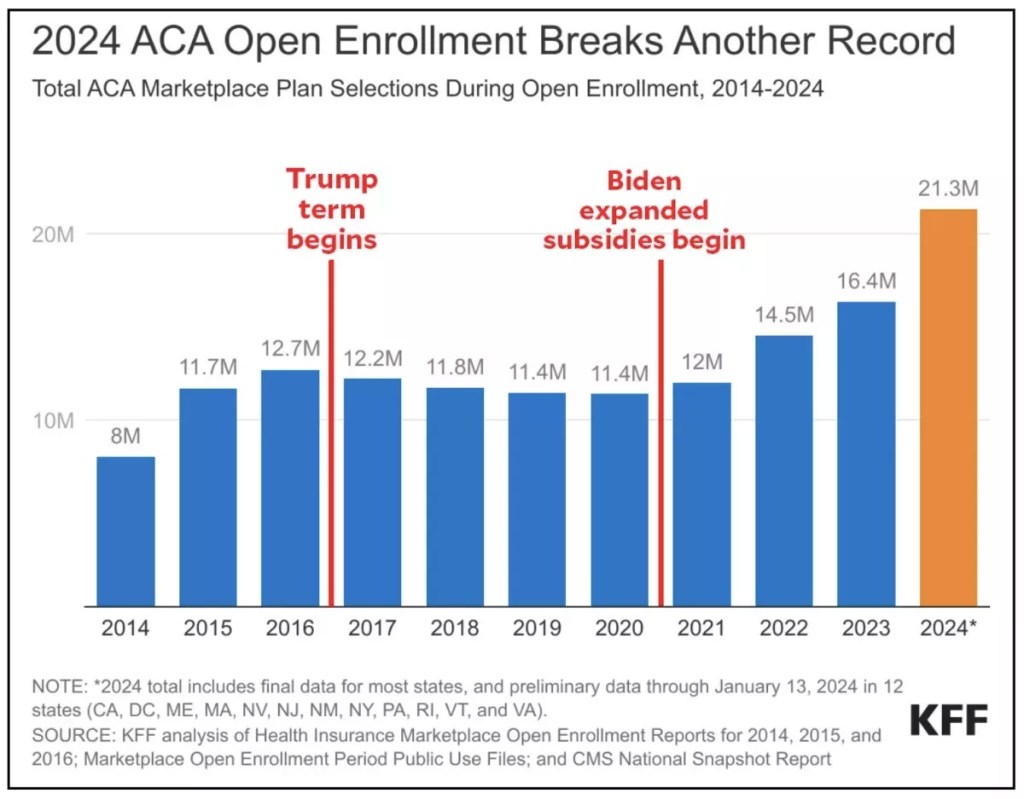
Trump drove down Obamacare enrollment every year he was in office; when Biden removed Trump’s obstacles, enrollment soared.
(KFF / Kevin Drum)
On Inauguration Day, Trump issued an executive order instructing the entire executive branch to find ways to “waive, defer, grant exemptions from, or delay the implementation of any provision or requirement” of the ACA.
During his presidency, he never abandoned the Republican dream of repealing Obamacare, even after July 28, 2017, when the late Sen. John McCain (R-Ariz.) strode to the Senate well and delivered a thumbs-down coup de grace to a GOP repeal bill.
Trump never ceased slandering the ACA as a “disaster.” He returned to the theme during last month’s debate: “Obamacare was lousy healthcare,” he said. “Always was. It’s not very good today.” As president, he threatened to make it “implode,” and used every tool he could get his fingers on to do so.
In September 2017 he slashed the advertising budget for the upcoming open enrollment period for individual insurance policies by a stunning 90%, to $10 million from the previous year’s $100 million. He also cut funds for nonprofit groups that employ “navigators,” those who help people in the individual market understand their options and sign up, by roughly 40%, to $36.8 million from $62.5 million.
Just after taking office, he abruptly canceled the customary last-minute advertising blitz to encourage enrollments in Obamacare plans before open enrollment ended on Jan. 31. The last minute surge in enrollments, which had occurred every previous year, vanished. The drop-off was particularly devastating because it was concentrated among the healthiest potential enrollees — those who often wait until the last minute to sign up and whose premiums generally subsidize older, less healthy patients.
The impact these policies had on enrollment was inescapable. In the three years before Trump took office, ACA marketplace plans experienced annual enrollment increases, to 12.7 million enrollees in 2016 from 8 million in 2014. During every year of the Trump administration, enrollment declined, falling to 11.4 million in 2020.
Every year since Joseph Biden took office, enrollment has increased, reaching a record 21.3 million this year — an 86% increase over Trump’s last year.
As for Vance’s fatuous claim that Trump “worked in a bipartisan way to ensure that Americans had access to affordable care,” you have the right to ask what Vance has been smoking.
The only bipartisanship on the ACA during the Trump years, Cohn observes, were the actions of GOP senators such as McCain and Lisa Murkowski of Alaska to cooperate with Democrats to stave off their fellow Republicans’ anti-ACA vandalism.
Now onto Trump’s fantasy vision of his role in fighting the COVID pandemic. Speaking in a low-energy, exhausted monotone at a speech Tuesday in Milwaukee and reading at times from a binder, he praised himself for instituting Operation Warp Speed, which funded COVID vaccine development in record time and got them rolled out in January 2021.
“We did a great job with the pandemic. Never got the credit we deserved,” he said. He then veered into blaming China for the pandemic, a familiar topic. He said bluntly that the pandemic was “caused by the Wuhan lab. I said that from the beginning, came from Wuhan. And the Wuhan lab, it wasn’t from bats in a cave that was 2,000 miles away. … It’s really the China virus.”
As for the rest of his COVID performance, he said this: “We did a great job with the ventilators, the masks and the gowns and everything. … When we got here the cupboards, our cupboards, I used to say our cupboards were bare. … No president put anything in for a pandemic.” Then he segued into praising himself for a big tax cut, and COVID was forgotten.
A few points about this spiel:
Trump is correct that Operation Warp Speed was a significant achievement. But he didn’t follow up by advocating for its product, the COVID vaccine. Instead, he has thrown in his lot with fanatical anti-vaccine agitators such as Robert F. Kennedy. He has repeated an anti-vax mantra, promising, “I will not give one penny to any school that has a vaccine mandate or a mask mandate.” This is a formula for exposing children to vaccine-preventable diseases such as measles and even polio.
Trump’s reference to the Wuhan Institute of Virology as the source of SARS-CoV-2, the virus that causes COVID, underscores how closely the so-called lab-leak theory of COVID’s origins is tied to right-wing partisan politics. The theory originated with Trump acolytes at the State Department, who saw the accusation as a convenient weapon in Trump’s economic war with China.
To this day, not a speck of evidence has been produced to validate this claim; scientists versed in the relevant disciplines of virology and epidemiology say the evidence overwhelmingly supports the hypothesis that the virus reached humans via the wildlife trade, and that its journey may well have started with bats thousands of miles from Wuhan, China.
Trump is lying when he says his predecessors in the White House left him without resources. The truth is that Trump himself hobbled pandemic response from the start.
In 2016, in the wake of the Ebola epidemic in Africa, President Obama had established the the Directorate for Global Health Security and Biodefense at the National Security Council “to prepare for and, if possible, prevent the next outbreak from becoming an epidemic or pandemic,” in the words of its senior director, Beth Campbell. Trump dissolved it in 2018.
Due to these steps, the U.S. was fated to sleepwalk into the pandemic. The COVID death toll in the U.S. stands at more than 1.2 million, and its reported death rate from COVID of 341.1 per 100,000 population is the highest in the developed world.
Ventilators, masks and gowns? Trump placed the procurement of this essential personal protective equipment in the hands of his son-in-law, Jared Kushner, who handled the task incompetently. Kushner turned away urgent appeals from state and local officials for those supplies.
“The notion of the federal stockpile was it’s supposed to be our stockpile, it’s not supposed to be states’ stockpiles that they then use,” Kushner said at a briefing.
Following his remarks, the website of the government’s national strategic stockpile of medicines and supplies was changed from asserting that its purpose was to “support” the emergency efforts of state, local and tribal authorities by ensuring that “the right medicines and supplies get to those who need them most.” The new language redefined the stockpile’s role as “to supplement state and local supplies … as a short-term stopgap.”
Supplies of ventilators, masks and gowns remained scarce through the first months of the pandemic. A procurement official at a Massachusetts hospital system told me of having had to cut a deal with a shadowy broker offering 250,000 Chinese-made masks at an inflated price, completing the transaction for $1 million at a darkened warehouse five hours from home.
Trump made anti-science incompetence and disregard for the welfare of Americans part of our history. The same thing, or worse, looms on the horizon in a second Trump term.
My comment: who can forget that dramatic moment in 2017 when the late Senator John McCain strode down to the well of the Senate to cast the deciding vote not to repeal Obamacare by dramatically extending his good arm and showing a thumb’s down gesture? Trump forgot.
As to COVID, why didn’t Trump take credit for the vaccines produced by Iperatuon Warp Speed? If the scientists had called it “the TRUMP vaccine, he probably would have boasted about it. Instead, he threw his support to the anti-VAXX conspiracy theorists, which surely contributed to the death toll.
Rachel Maddow often manages to come up with a very different take on the news as compared to other talk show hosts. She is fascinated with history, so she often takes her viewers down new paths.
When she was trying to figure out JD Vance, she discovered two of the men who influenced his views. One is a podcaster named “Jack Murphy,” whose real name is John Goldman. He is known for racism, misogyny, and his association with the alt-right. He is very big on the idea of women’s submission to men. He even wrote a book about it.
The other is a man named Curtis Yarvin, a podcaster who is known for his anti-democratic, anti-egalitarian views.
Mother Jones published an excellent article by Reverend Rob Schenck about how he became a leader of the Christian nationalist movement and why he decided to leave it. He recalls when real estate developer and playboy Donald Trump was first introduced to the world of evangelicals. And he describes his own role in connecting rich donors to Republican Supreme Court justices.
Reverend Schenck begins:
In 2014, at an elegant gala inside the Supreme Court’s gilded Great Hall, a tuxedoed Justice Clarence Thomas turned to me and voiced his approval for my work. I glanced over to where Chief Justice John Roberts and his wife, Jane, were entertaining two of my associates, trustees of the Supreme Court Historical Society, a private, nongovernmental entity for which Roberts served as honorary chair. At that moment, I knew the secretive operation I had run, aimed at emboldening Thomas and his conservative colleagues to render the strongest possible decisions in favor of our right-wing Christian agenda, had succeeded.
My organization, Faith and Action in the Nation’s Capital, had created an initiative we called “Operation Higher Court” that trained wealthy couples as “stealth missionaries,” befriending Thomas and his wife, Ginni; Samuel and Martha-Ann Alito; and Antonin and Maureen Scalia—lavishing them with meals at high-end restaurants and invitations to luxurious vacation properties. Alongside these amenities, our ministry offered prayers, gift Bibles, and the assurance that millions of believers thanked God for the decisions this trio of justices rendered on abortion, health care, marriage, and gun ownership….
But Reverend Schenck began to understand that his activities and beliefs were toxic to democracy. What triggered his change? Perhaps it was his late-in-life doctoral studies, when he read about the German Christian movement in the 1930s, which supported the Nazi party. He wrote: One of the most respected Bible scholars of that period, Paul Althaus, declared Hitler’s ascent to the chancellorship to be a “gift and miracle from God.”
He was shaken by his research. He began to change his views. He wondered whether Christian evangelicals in the U.S. were on the same dangerous path.
Following the insurrection of January 6, when Christian banners, Bibles, and prayers in Jesus’ name appeared in the assault on the Capitol, I felt even greater urgency in warning my fellow evangelicals of the grave danger Trump and his MAGA cult posed to Christianity and US democracy.
My change of course so late in life has been painful, disorienting, and costly. Besides losing decades-long friendships and enduring menacing threats, my wife and I have faced a significantly reduced income. I’ve even driven Uber to cover household expenses. One night, I picked up an organizer of the National Prayer Breakfast, an event in which I had once played a significant role. I was wearing a mask and said little, but then, with trepidation, I realized I would be dropping him at the home of a congressman I had worked with closely for more than 20 years. When my passenger got out, I was relieved to have gone unrecognized. Still, I’ve never questioned the decisions that brought me to that moment.
In my third conversion, I realized that when religion is placed at the service of a political party, it corrupts both. To claim that one political figure uniquely represents God’s will for the body politic is a form of anti-Christian idolatry. To elevate one set of spiritual beliefs above another and do it by force of law removes a nonnegotiable tenet of evangelical faith—free will. We are born again when we choose to believe in the Lord Jesus Christ, not when we’re forced to do so.
Because it is immoral, I believe Christian nationalism is inevitably doomed. But in the meantime, the pain, suffering, and injury it will inflict will be enormous—just consider women facing difficult pregnancies, trans children seeking care, librarians attacked for certain books. “We want to fill our culture again with the Christian spirit. We want to burn out all the recent immoral developments in literature, in the theater, and in the press—in short, we want to burn out the poison of immorality, which has entered into our whole life and culture as a result of liberal excess.” This may sound familiar—maybe some overheated Republican talking points. In fact, it’s what Adolf Hitler promised the German people in 1933.