Archives for category: Extremism

Yesterday, President Donald Trump began a trade war with Colombia after that country’s president refused to permit two U.S. military airplanes full of deportees to land in Colombia. As Regina Garcia Cano and Astrid Suárez of the Associated Press pointed out, Colombia and the U.S. had an existing agreement for deportations under former president Joe Biden, and it accepted 475 deportation flights from 2020 to 2024, accepting 124 flights in 2024 alone. But the Biden administration used commercial and charter flights, while as national security analyst Juliette Kayyem noted, Trump used a military plane that arrived unannounced.

As Tim Naftali of Columbia University’s School of International and Public Affairs explained: “If a foreign country tries to land its military planes—except in an emergency—without an existing agreement that is an infringement of sovereignty.” Colombia rejected the military planes without prior authorization and offered the use of its presidential plane instead.

Colombia also asked the U.S. to provide notice and decent treatment for its people, an issue that had been raised and resolved in 2023 after migrants arrived in hand and foot cuffs. Colombian president Gustavo Petro noted that the U.S. had committed that it would guarantee dignified conditions for the repatriation of migrants. The plane of migrants landed in Honduras, where Columbia sent its presidential plane to pick them up.

Trump announced that Colombia’s “denial of these flights has jeopardized the National Security and Public Safety of the United States,” and slapped a 25% tariff on products from Colombia, which include about $6 billion of crude petroleum, $1.8 billion of coffee, and $1.6 billion of cut flowers. In addition, he said, the U.S. would revoke the visas of all Colombian “Government Officials, and all Allies and Supporters.” He promptly deported Colombian staff members of the World Bank who were working for international diplomatic organizations in the U.S., and canceled visa appointments at Colombia’s U.S. Embassy.

Rather than backing down, President Petro threatened to levy a retaliatory tariff on U.S. products. Colombia imports 96.7% of the corn it feeds its livestock from the U.S., putting Colombia in the top five export markets for U.S. corn. According to a letter written by a bipartisan group of lawmakers eager to protect that trade, led by Senator Todd Young (R-IN), in 2003 the U.S. exported more than 4 million metric tons of corn to Colombia, which translated to $1.14 billion in sales. “American farmers cannot afford to lose such a vital export market,” the lawmakers wrote, “especially when access to the top U.S. corn export market, Mexico, is already at risk.”

By this morning the economic crisis appeared to be over, although U.S. visa restrictions apparently remain. With prior authorization and better treatment of migrants, Colombia is willing to accept the migrant flights. The White House declared victory, saying: “Today’s events make clear to the world that America is respected again. President Trump will continue to fiercely protect our nation’s sovereignty, and he expects all other nations of the world to fully cooperate in accepting the deportation of their citizens illegally present in the United States.”

The administration’s handling of the situation with Colombia reveals that their power depends on convincing people to ignore reality and instead to believe in the fantasy world Trump dictates.

White House Press Secretary Karoline Leavitt announced yesterday morning that “[d]eportation flights have begun.” In fact, nothing is “beginning.” In 2024, Colombia accepted on average more than two U.S. flights of migrants a week. And, as immigration scholar Austin Kocher noted, “everyone on this deportation flight was arrested and detained by the Biden administration.”

Over the past four years, Trump and MAGA Republicans repeatedly insisted that Biden had maintained “open borders,” while in fact, what the administration did was to try to address a situation made worse by the coronavirus pandemic.

As Katie Tobin of the Carnegie Endowment for International Peace explains, before the coronavirus pandemic, Venezuela, where the economy was particularly bad under rising authoritarian Nicolás Maduro, sent migrants abroad. By June 2022, 6 million Venezuelans had fled their country; by September 2024, that number was 7.7 million. South American governments welcomed the Venezuelan migrants and others, including Haitians fleeing their country’s political chaos.

But as economies collapsed after the coronavirus crisis, Tobin explains, migrant populations that had settled in South American countries were forced out. From 2019 to 2021, Colombia’s per capita gross domestic product fell 4.6%; Peru’s, 5.3%; Ecuador’s, 2.8%; Brazil’s, 11.7%; and Venezuela’s, 20%. As the U.S. economy grew by 8.38%, Canada’s grew by 13.1%, and Mexico’s dropped only by 0.7%, migrants headed north. In September 2021, when 15,000 Haitians who had originally migrated to Brazil arrived at the U.S. border with Mexico, countries throughout the hemisphere realized that they needed a new regional approach to migration.

After nine months of negotiations, 21 countries announced that they had created a new migration pact for the Western Hemisphere. It provided economic support for Latin American countries that were original destinations for migrants, expanded formal pathways for immigration, and increased border security across the region.

Canada and Mexico were the first countries to buy into the new agreement. The U.S. turned next to strong ally Colombia, which agreed in March 2022, after which Vice President Kamala Harris brought on board Caribbean countries. By June 10, when the Los Angeles Declaration on Migration and Protection was announced, twenty-one nations had signed on. U.N. observers were present to demonstrate their support.

The Biden administration insisted that countries begin immediate action, and they did. Tobin notes that Belize, Costa Rica, Ecuador, Panama, and Peru have made sweeping new offers of legal status to hundreds of thousands of migrants already living in their countries, while Colombia has offered legal status to 2 million Venezuelans and Brazil has welcomed more than 500,000. Mexico and Guatemala have offered legal pathways to workers.

Canada, Costa Rica, Colombia, Ecuador, Guatemala, Spain, and the U.S. launched a virtual platform to enable migrants to apply for admission remotely. When Mexico agreed to accept Venezuelans who had crossed into the U.S. unlawfully and at the same time the U.S. announced a legal pathway for 24,000 Venezuelans, border crossings dropped 90% within a week. Biden and Mexican president Andrés Manuel López Obrador expanded that initiative to include Cubans, Haitians, and Nicaraguans.

By 2023, border arrests had fallen by about half. Although Congress failed to pass a strong bipartisan measure to increase border security and fund immigration courts, arrests fell by half again after Biden in June 2024 issued a proclamation that barred migrants from being granted asylum when U.S. officials deemed the border was overwhelmed. By the end of Biden’s term, unlawful border crossings had plummeted to lows that hadn’t been seen since June 2020.

There are new challenges to managing migration as wars, climate change, and economic pressures push migrants out of various parts of Africa and out of China. Many of those migrants are finding their way to Latin America and from there to the U.S. The U.N. Refugee Agency estimates that 117 million people were displaced by the end of 2023.

Trump won election in part by vowing to shut down immigration, and as soon as he took office he canceled the CBP One app, the virtual platform that allowed migrants to apply for asylum. During the campaign, he vowed to deport those migrants he claimed were criminals, which many interpreted to mean he would only remove those who had committed violent crimes (which the U.S. has always done). But in his first term, Trump’s people considered anyone who entered the U.S. outside of immigration law to be a criminal, and this appears to be the definition his people are using now.

Daily deportation raids in which U.S. Immigration and Customs Enforcement (ICE) agents arrested a few hundred people in sweeps began almost as soon as Trump took office. Josh Campbell, Andy Rose, and Nick Valencia of CNN reported that the federal government has flooded the media with video and photos of agents in tactical gear, their vests bearing the words “Police ICE” and “Homeland Security” as they lead individuals in handcuffs. The journalists report that this is not an accident: agents were told to have their agency names clearly displayed for the press.

The presence of television talk show host Dr. Phil (McGraw) with an ICE team in Chicago reinforces the sense that these arrests are designed for the cameras. So does yesterday’s report by Nick Miroff and Maria Sacchetti of the Washington Post that Trump is disappointed with the sweeps so far and has directed officials to ramp up arrests aggressively, providing quotas for ICE field offices. Today, new secretary of defense Pete Hegseth said the department will “shift” to “the defense of the territorial integrity of the United States of America at the southern border.”

Yesterday’s spat with Colombia’s president enabled Trump to declare victory, but Colombia has been the top U.S. ally in Latin America, a close partner in combating drug trafficking and managing migration. That relationship, which has taken years of careful cultivation, is now threatened.

Will Freeman of the Council on Foreign Relations, a think tank specializing in U.S. foreign policy, posted: “I can’t think of many *worse* strategic blunders for the U.S., as it competes w/ China, than going nuclear against its oldest strategic ally & last big country in S. America where it enjoys a trade advantage…. Trump certainly expects that b[ecause] 1/3 of Colombian exports go to the U.S. Petro will be forced to back down. But Petro seems to welcome the fight & has already signaled wishes to deepen ties w/ China. Colombia will lose partnership on security it badly needs. Only China stands to gain from this.”

Indeed, China’s ambassador to Colombia promptly noted that “we are at the best moment of our diplomatic relations between China and Colombia, which are now 45 years old.”

Meanwhile, according to former ambassador Luis G. Moreno, the Trump administration has shut down 2,100 courses in the premier training facility for State Department foreign service officers, ostensibly because they are too associated with diversity, equity, and inclusion. Moreno adds: “Dismantling of a professional diplomatic corps is underway.”
Trump is determined to remove all diversity, equity, and inclusion programs from the federal government.

Through the Office of Management and Budget, the Trump administration has cut off almost all federal funding. This is called “impoundment,” meaning that the…

Unprecedented: Trump Shuts Down All Federal Funding

D.C. Judge freezes Trump’s halt to federal programs until February 3:

The New York Times reported:

President Trump’s order to freeze trillions of dollars in federal grants and loans led to confusion, outrage and threats of legal action on Tuesday as it interrupted the Medicaid system that provides health care to millions of low-income Americans and other programs that depend on the flow of federal money.

As the White House moved to rapidly put in place Mr. Trump’s plan to purge the government of what he calls a “woke” ideology, federal health researchers, nonprofits and programs for early childhood education also reported that their usual access to federal funds had gone down, raising alarms about whether the order meant people would lose access to jobs, health care services, reduced-price meals and more.

Trump has said that DEI programs are “immoral and illegal” The Smithsonian Institution closed its diversity office. Any institution that depends on federal funding must immediately halt any outreach to Black, Hispanic, and Asian job candidates, as well as women.

The white patriarchy is in charge again!

Through the Office of Management and Budget, the Trump administration has cut off all federal funding. This is called “impoundment,” meaning that the President refuses to spend money for programs authorized by Congress. It is illegal. It is unprecedented. This is the action of a dictator, not a President in a democratic society.

I received the following notice:

Potential Implications of Trump’s Sweeping, Illegal Funding Freeze


January 28, 2025


Late Monday, the acting director of the Office of Management and Budget issued a
memorandum ordering federal agencies to immediately halt vast swaths of federal funding set to go out to states, families, and communities in every part of the country.


The sweeping, unprecedented directive builds on unlawful executive orders President Trump has signed to deny the American people investments Congress has made. It is not only illegal, but will have severe consequences for real people in every part of the country—in red states and blue states and everywhere in between.


As Senator Patty Murray wrote to OMB last night alongside House Appropriations Ranking Member Rosa DeLauro:


“The scope of what you are ordering is breathtaking, unprecedented, and will have
devastating consequences across the country. …. The law is the law—and we demand you in your role as Acting OMB Director reverse course to ensure requirements enacted into law are faithfully met and the nation’s spending laws are implemented as intended.”


The sweeping directive is effective at 5 PM ET on Tuesday, January 28.


If implemented broadly, as written, this action by the Trump administration could block
hundreds of billions of dollars in approved funding—sowing chaos nationwide, hurting
American families and businesses, killing jobs, and undermining our national security and
emergency preparedness.


Among much else, the directives in the memo could block funding for:


 PUBLIC SAFETY: Grants for law enforcement and homeland security activities will
cease to go out the door, undermining public safety in every state and territory.


 DISASTER RELIEF: Public assistance and hazard mitigation grants from the Disaster
Relief Fund (DRF) to state, tribal, territorial, and local governments and non-profits to
help communities quickly respond to, recover from, and prepare for major disasters will
be halted—right as so many communities are struggling after severe natural disasters,
most recently in Florida, Georgia, North Carolina, and California.


 INFRASTRUCTURE PROJECTS: All federally-funded transportation projects across
the country—roads, bridges, public transit, and more—will be halted, including projects
already under construction.


 COMBATTING FENTANYL CRISIS: Funding for communities to address the
substance use disorder crisis and combat the fentanyl crisis will be cut off.


 988 SUICIDE AND CRISIS LIFELINE: Funding for the 988 Suicide and Crisis Lifeline, as well as grants for mental health services, will be cut off.


 BIOMEDICAL RESEARCH: There will be immediate pauses on all funding for
critical health research, including research on cancer, Alzheimer’s disease, and diabetes,
as well as clinical trials at the NIH Clinical Center and all across the country—disrupting
lifesaving and often time-sensitive research.


 EMERGENCY PREPAREDNESS: Critical preparedness and response capability
funding used to prepare for disasters, public health emergencies, and chemical,
biological, radiological, or nuclear events will be frozen.


 FIREFIGHTING: Grants to support firefighters across the country will be halted—this includes grants that help states and localities purchase essential firefighting equipment.


 HEAD START: Funding for Head Start programs that provide comprehensive early
childhood education for more than 800,000 kids and their families will be cut off.
Teachers and staff would not get paid and programs may not be able to stay open.

 CHILD CARE: Child care programs across the country will not be able to access the
funding they rely on to keep their doors open.


 K-12 SCHOOLS: Federal funding for our K-12 schools will be halted. School districts
may not be able to access key formula grant funding including Title I, IDEA, Impact Aid,
and Career and Technical Education, which would pose tremendous financial burdens on
schools in the middle of the school year.


 HIGHER EDUCATION AND JOB TRAINING: Millions of students relying on Pell
grants, federal student loans, and federal work study will have their plans to pursue
postsecondary education and further their careers thrown into chaos as federal financial
aid disbursements are paused.


 HEALTH SERVICES: Federal funding for community health centers that provide
health care for over 30 million Americans will be immediately frozen, creating chaos for
patients trying get their prescriptions, a regular checkup, and more.


 SMALL BUSINESSES: The Small Business Administration will have to halt loans to
small businesses—including those in disaster ravaged communities in North Carolina,
Texas, and Florida.


 VETERANS CARE: Federal grants to help veterans in rural areas access health care and
grants to help veterans get other critical services, including suicide prevention resources, transition assistance, and housing for homeless veterans, will be cut off.


 NUTRITION ASSISTANCE: Millions of American citizens who rely on nutrition
assistance programs like SNAP, WIC, and school lunch programs will be left hungry as
funding is cut off and non-profits who provide additional assistance lose federal funding.


 TRIBES: Funding to Tribes for basic government services like health care, public safety, programs, Tribal schools, and food assistance will be halted.


 PREVENTING VIOLENCE AGAINST WOMEN: All Violence Against Women Act
(VAWA) grants, as well as funding for victims assistance and state and local police, will
be cut off.


 U.S. COMPETITIVENESS: Existing grants to support research for AI and quantum
computing will be halted and any new grant funding would be paused—undermining
U.S. innovation and competitiveness with China and putting American jobs at risk.


 ENERGY JOBS: Grants for critical energy projects nationwide will be cut off—halting
billions of dollars in investment nationwide and jeopardizing good-paying American
jobs. The Department of Energy Loan Program Office will halt loans in 28 states,
impacting hundreds of thousands construction and operations jobs.


 FOOD INSPECTIONS: Some states will have to take on the full financial burden of
ensuring the nation’s meat supply is safe if federal cooperative agreements for meat
inspection are halted.


 SUPPORT FOR SERVICEMEMBERS: Support for a host of DOD financial assistance and grant programs supporting servicemembers and their families will be halted, including the Fisher House, Impact Aid, community noise mitigation, ROTC language training, STEM programs, and the USO.


 WEAKENS MILITARY READINESS: Grants and other assistance appropriated to
strengthen military effectiveness and defense capacity will be halted, including Defense
Production Act support for the defense industrial base, basic research grants necessary to advance key technologies, and small business support to strengthen supply chains.


 AMERICANS OVERSEAS: Programs that track and combat the spread of infectious
diseases, create business opportunities for American companies in emerging markets,
combat terrorism, and counter the influence of the PRC, Russia, and Iran—and efforts to
ensure the safety and security of Americans implementing these programs—are all
suspended and could be terminated.

#

Trump’s picks for his Cabinet are appalling. His choices for #2 are a five-alarm fire. For the #2 position at the Environmental Protection Agency, he selected a lawyer who represents corporations who oppose EPA regulations.

ProPublica reports:

The man tapped by President Donald Trump to be second-in-command of the federal agency that protects the public from environmental dangers is a lawyer who has represented companies accused of harming people and the environment through pollution.

David Fotouhi, a partner in the global law firm Gibson Dunn, played a key part in rolling back climate regulations and water protections while serving as a lawyer in the Environmental Protection Agency during Trump’s first administration.

Most recently, Fotouhi challenged the EPA’s recent ban of asbestos, which causes a deadly cancer called mesothelioma. In a brief filed in October on behalf of a group of car companies called the Alliance for Automotive Innovation, he argued that, for the specific uses that were banned, the “EPA failed to demonstrate that chrysotile asbestos presents an unreasonable risk of injury.”

The EPA banned the carcinogen in March, long after its dangers first became widely known. More than 50 other countries have outlawed use of the mineral. The agency had worked toward the ban for decades, and workers died while lobbyists pushed to delay action, as a 2022 ProPublica investigation showed.

Less than a day after Trump’s inauguration this week, the White House webpage that celebrated the historic ban was gone.

Dr. Glenn Rogers, a staunch conservative from a rural district in Texas, opposed vouchers because the people who elected him didn’t want vouchers. Governor Greg Abbott promised his deep-pocketed donors that he would get vouchers. So Republican legislators like Glenn Rogers had to go.

Dr. Rogers is now a contributing columnist for The Dallas Morning News. He is a rancher and a veterinarian in Palo Pinto County. He served in the Texas House of Representatives from 2021-2025.

He explains here that Governor Abbott has no mandate for vouchers.

The 2024 Texas Republican primary was brutal and unprecedented in the volume of unwarranted character assassination, misdirection and, of course, money spent from both “dark” and “illuminated” sources.

Despite Gov. Greg Abbott’s persistent opposition to rural Republican House members and a fourth special legislative session, a bipartisan majority defeated school vouchers (called education savings accounts) by stripping off an amendment in Rep. Brad Buckley’s ominous omnibus education bill that tied critical school funding to vouchers.

The governor then proceeded to launch his scorched-earth attack on rural Republicans. Of the 21 that voted for their districts instead of Abbott’s pet project, five did not seek re-election, four were unopposed, nine lost their seats and three were victorious. Only one third remain in the House.

Reducing Republican opposition to vouchers was a resounding success for the governor and he has been crowing ever since that the 2024 slaughter proves Texans across the state desire vouchers (“school choice” in governor speak). But does it?

During the primary campaign, polling data clearly demonstrated vouchers were not a priority for Texas voters, including those in my district. The border, followed by property taxes and inflation were top of mind, with vouchers barely making the top 10.

With four special sessions, Christmas and a week with a major freezing-weather event, block-walking time before the early March primary was limited to about six good weeks. I hit the pavement hard and, true to the polling data and my consultant’s advice, the border and property taxes were on everyone’s mind. In fact, after knocking on thousands of doors throughout the district, I had only a handful of questions about vouchers and usually from current or retired educators who were anti-voucher.

Abbott frequently referred to Republican ballot Proposition 9 as proof of massive voucher support. “Texas parents and guardians should have the right to select schools, whether public or private, for their children, and the funding should follow the student,” the ballot measure read.

With only around 20% primary voter turnout and questions designed by the State Republican Executive Committee to confirm their often-radical views, the results are hardly a reputable referendum for anything. The wording and structure of the voucher proposition were flawed. Professional surveyors suggest that to receive the most genuine responses, questions should be asked one at a time. The proposition fails to follow this fundamental rule by asking two questions at once and only allowing for a single “Yes” or “No” response.

Of course, everyone wants choice and thankfully we already have a choice of public, charter, private and home school opportunities

The proposition also failed to ask whether voters supported taking tax dollars away from public education to fund a voucher program. That question certainly would have told a different story.

The goal was vouchers, but the tactic was misinformation about completely different issues that captured voters’ attention. The governor repeatedly stated that my fellow rural Republicans and I were weak on the border or that we couldn’t be trusted on border issues. He referred to my F rating from Tim Dunn-financed scorecards.

Ironically, the governor was fully supported by me on every one of his legislative priorities, especially the border, but with one major exception: school vouchers.

I served on the House Republican Caucus Policy Committee the last two sessions and voted 97.5% with caucus recommendations. I voted 96% of the time with the Republican majority. Yet Abbott stated in his rallies in my district that I consistently voted with Democrats. These are disingenuous tactics straight out of the Texas Scorecard playbook.

The governor may have an out-of-state mandate for vouchers, funded by Pennsylvanian TikTok billionaire and voucher profiteer Jeff Yass, who poured over $10 million into Abbott’s crusade to purge Republican House members.

But here in Texas, the mandate simply does not exist.

If Texans truly supported diverting public-school funds to private interests, there would have been no need for fearmongering and smear campaigns to achieve it. The fact that the governor resorted to such underhanded methods is not a show of strength or conviction. It is a tacit admission that Texans are not buying what he is trying to sell.

John Thompson, historian and retired teacher in Oklahoma, keeps close watch on state politics. He looks for rays of hope in a gerrymandered state.

He writes:

In Oklahoma, where rightwing MAGAs, led by Governor Kevin Stitt, State Superintendent Ryan Walters, and our most extreme state legislators, continue to double down on irrational and, above all, cruel agendas, it remains unclear whether Democrats and adult Republicans will be successful in pushing back. But there are still reasons for hope.

Although Walters remains the best known voice for absurdity, I still believe that Gov. Stitt’s agenda would be the most destructive – if he could get it done. For instance, the Oklahoma Supreme Court was as thoroughly corrupt as any in the nation – before we created an apolitical Judicial Nominating Commission. Stitt’s attempt to dissolve the commission failed. But dark money PACs tied to Stitt fueled a campaign to remove the three justices who were appointed by Democrats.

In the last month, Stitt said that “Oklahomans see that you need one neck to choke, and it’s usually the governor,” [so] “let the governor (…) put these people in place and then hold them accountable.” Clearly, he was implying that he, the outgoing governor, should appoint “most state-wide officials,” including the Oklahoma Corporation Commission, and the Superintendent of Public Instruction. That would be the path back to our state’s corrupt oligarchy of my youth.

And, as the legislative session is about to open, the Oklahoma Voice recalls Gov. Stitt’s signing of “Oklahoma’s legislative darling.” The law has been “dubbed the ‘Women’s Bill of Rights.’” It “claims to champion fairness and safety for women” by setting “legal definitions for ‘male’ and ‘female,’ tying them firmly to biological sex assigned at birth.”  The Voice further explains, “Oklahoma’s law isn’t just tone-deaf to this reality — it pours gasoline on the fire.” Then it reminds Stitt that the law will clearly undermine efforts to attract businesses to Oklahoma.

The 2025 legislative session also creates opportunities for extremists to show how brutal they can be, but it also provides opportunities to push back against the worst of the worst. In 2023, Republican Rep. Jim Olsen successfully opposed a bill that would “ban schools from physically punishing disabled children.” Olsen said, “He that spareth his rod hateth his son.” So the Bible “tells us that if you will not use the rod on a disobedient child, you do not love that child.”

Now, after an interim study, on the “effectiveness of properly administered corporal punishment,” there is reason to hope that Olsen will allow that simple, humane provision to become law.

But, Republican Sen. Lisa Standridge seems to have drawn from the political tactic of shipping immigrants to northern cities in order to deny the basic human rights of homeless persons in small town Oklahoma, as well as our two biggest cities.  Sen. Standridge, “would prevent municipalities in all cities with a population under 300,000 from using city resources to operate homeless shelters or perform homeless outreach.” It would both outlaw smaller communities’ efforts to serve the unhoused, but provide  an incentive for them to move to Oklahoma City and Tulsa, which are both facing homelessness crises. Oklahomans have condemned the proposed law as “cruel,” “heartless,” “horrible.” “disgusting,” “shameless,” and a continued attack on democracy.

And that brings us back to Ryan Walters, who has a long history of calling teachers unions “terrorist organizations.” He has received national headlines by calling classrooms “terrorist training camps.” He then linked teachers unions to the New Year’s terrorist attack in New Orleans. The Oklahoma Voice’s Janelle Stecklein pushed back, asking, “Does our state superintendent have a screw loose?”

Stecklein noted Walters’ use of taxpayer resources to bolster his national reputation. She then contrasted his behavior with the “Oklahoma Standard,” which was illuminated by our response to Timothy McVeigh’s 1995 bombing of the Alfred P. Murrah Federal Building in Oklahoma City, killing 168 people. She also noted Walters’ campaign to stir up fear and hatred, comes at a time when there were 39 school shootings in 2024, in which 18 people were killed.

And most recently, Walters has filed a $474 million lawsuit claiming “The United States Departments of Homeland Security and Immigration and Customs Enforcement, and Education, along with United States Border Patrol and Safety must be held accountable for their failure to properly secure the nation’s border.”

Perhaps the most noteworthy, recent evidence that Oklahomans are starting to reject rightwing MAGA-ism can be found in a recent poll in The Oklahoman, which graded Ryan Walters’ performances. After all, as The Oklahoman notes, “Legislative leaders acknowledge that they have few levers at their command to force Walters to change course,” leaving that to the voters.

More than 4,000 readers took part in the online poll conducted Jan. 6-10, which asked the question: What grade would you give School Supt. Ryan Walters for his job performance this year?

An overwhelming 95% of those who responded gave him an “F.”

Comments by the poll-takers were especially illustrative. Here are just a few examples:

“My out-of-state friends LOVE to poke fun at Oklahoma whenever they read news stories about Walter’s’ idiotic antics. Don’t think for a minute that this doesn’t hurt our state’s ability to attract and retain economic development prospects. If my out-of-state friends are aware of what is happening to our public school system, so are professional site locators.” 

“Walters is what happens when people vote a straight party ticket … people’s children and grandchildren are paying the price of Ryan Walters and his lofty political ambition. He will literally do anything to get his name in the paper, online, and live media. 

“Religious zealots should not be in charge of the public schools.” 

“Walters is an unqualified incompetent under whose ‘leadership’ our children’s education has nosedived for the bottom. He’s also misused public funds for his own promotion and travel, for which he should be prosecuted. Not even addressing his unconstitutional mandates, he simply can’t or won’t do his job and needs to be removed from office.” 

“Worst Oklahoma state superintendent of education ever. His rhetoric is damaging to public education.” 

“I have never heard one kind word about public teachers come from this Ryan Walters’ mouth. He has never once given us any kind of encouragement. On the contrary, he insults us and makes false accusations. He accuses us of teaching hate. He has no idea that we not only teach our state standards, but we also teach a host of other things like kindness, citizenship, love of country, and just being good human beings.”

“Wasting our money on Bibles! I am religious, and spiritual, and Bibles can be found online. Also, he is a homophobe who is not interested in the rights of all, just the rights of some.”

And my favorite:

“Your grading scale didn’t go far enough. I would give Walters a ‘Z minus’ with the minus being an infinity’s worth. He is doing nothing but destroying Oklahoma schools.” 

Due to gerrymandering, Republican extremists – and their funders – have obtained unchallengeable political power. But we may be approaching a point where voters will back away from straight party voting, and perhaps empowering Democrats and reasonable Republicans. After all, their new Senate Pro Tem Lonnie Paxton, says in regard to Ryan Walters that Republican leaders will “continue to continue to try to inspire him to do the things that need to be done to educate our kids.” But falling short of the courage we need, Paxton adds, “at the end of the day, it’s his decision on what he does.”

I have frequently criticized Bill Gates for his half-baked efforts to “reform” American public schools, all of which have done terrible damage to the schools.

Now Elon Musk is sticking his nose into elections in other countries, and Bill Gates is calling him out.

This article appeared in Business Insider:

Bill Gates doesn’t like how Elon Musk has involved himself in the politics of foreign countries such as the UK and Germany.

“It’s really insane that he can destabilize the political situations in countries,” Gates said in an interview with the UK newspaper The Times published Saturday.

Musk has become increasingly vocal about his views on UK and German politics in recent weeks.

Earlier this month, Musk called for the removal of British Prime Minister Keir Starmer. The TeslaCEO accused Starmer of not doing enough to prevent the rape of girls when he was Britain’s chief prosecutor from 2008 to 2013.

And on Saturday, Musk spoke virtually at a campaign rally for the Alternative for Germany, Germany’s far-right party. Germany is set to hold national elections in February.

In December, Musk said in an op-ed for Welt am Sonntag, a prominent German newspaper, that the AfD was “the last spark of hope for this country.” He also praised the party for its “controlled immigration policy.”

“I think in the US foreigners aren’t allowed to give money. Other countries maybe should adopt safeguards to make sure superrich foreigners aren’t distorting their elections,” Gates told The Times.

Musk’s political influence has increased significantly following President Donald Trump‘s victory in November. Musk spent at least $277 million backing Trump and other GOP candidates in last year’s elections.

That bet has since paid off for Musk, who called himself Trump’s “first buddy.” The billionaire has joined Trump on calls with world leaderssuch as Turkish President Tayyip Erdogan.

Gates previously criticized Musk for his obsession with going to Mars. Gates said he would rather spend money on vaccines than on rockets. Go, Bill!

If only WE had laws limiting the contributions of billionaires to political campaigns!

Governor Gavin Newsom has been fighting a two-front war: the devastating fires in Los Angeles and the massive amount of disinformation about the state’s efforts.

One widespread rumor is that Governor Newsom cut the state’s firefighting budget by $100 million in the year before the LA fires.

Politifact reviewed the facts. As usual, it’s complicated. Newsom did cut the fire budget by $100 million at the same time that the overall fire budget increased. If you want to see how this happened, read the report in full.

Here is the conclusion.

Cal Fire’s budget and spending have grown

Cal Fire’s total base wildfire protection budget has nearly tripled over the past 10 years (from $1.1 billion in 2014‑15 to $3 billion in 2023‑24), according to a March analysis by the Legislative Analyst’s Office before the 2024-25 budget was approved.

Cal Fire’s overall budget also has increased, with its combined budget for fire protection, emergency fire suppression, resource management and fire prevention more than doubling over the past 10 years from $1.7 billion in 2014‑15 to $3.7 billion in 2023‑24. (Newsom’s office sent us similar information showing budget increases.)

The number of staff members working in fire prevention have similarly grown during that same decade rising from 5,756 to 10,275.

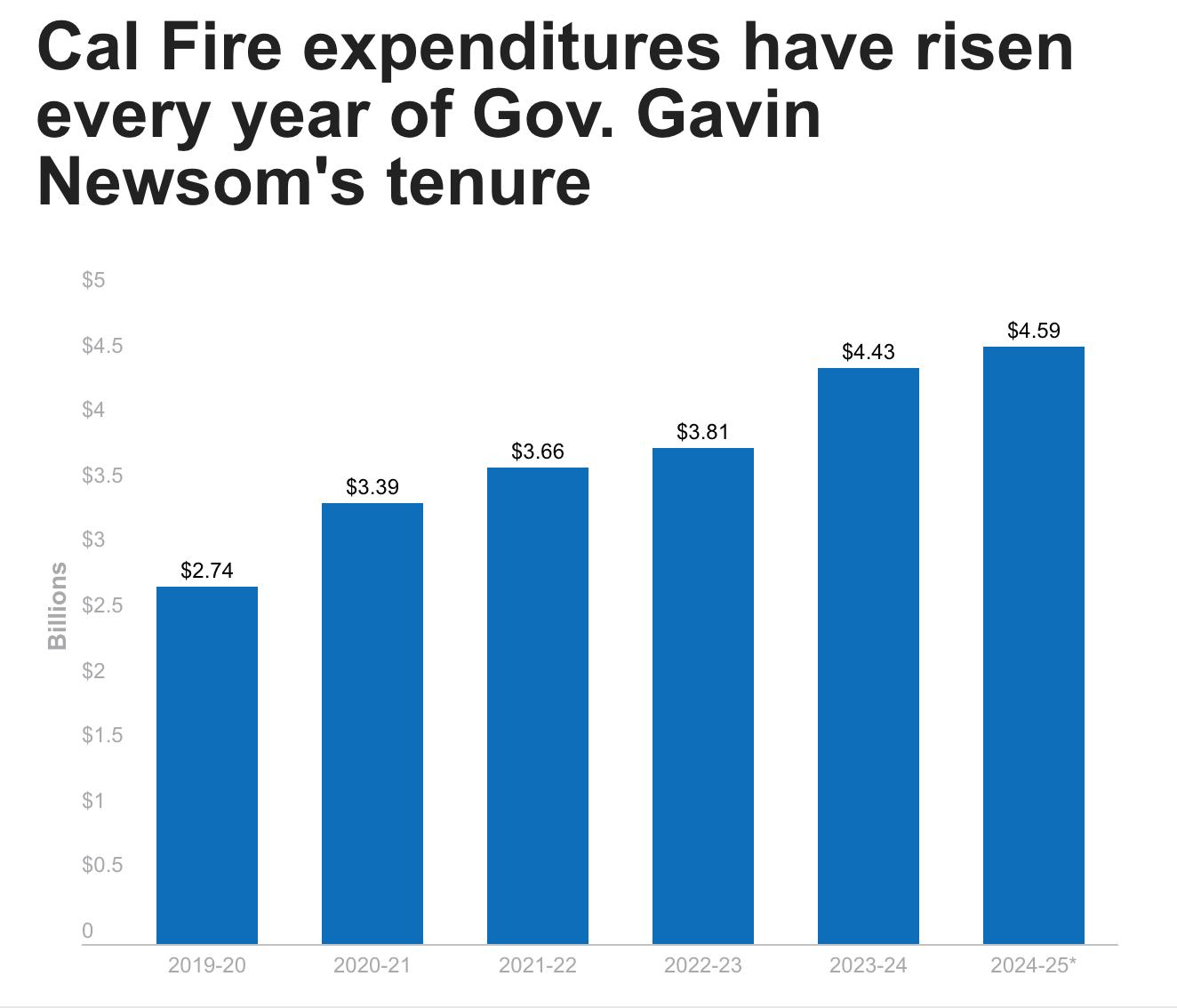
Another way to look at Cal Fire is through expenditures rather than the budgeted amount because it’s not unusual for the state to dip into other pots of money to spend more than budgeted for addressing fires. 

The legislative analyst’s office estimated total Cal Fire expenditures have risen during Newsom’s tenure:

* The 2024-25 amount does not yet reflect additional costs being incurred for the current Los Angeles-area wildfires.

Source: California Legislative Analyst’s office estimate, not adjusted for inflation, provided to PolitiFact

When I worked in George H.W. Bush’s administration from 1991-92 as Assistant Secretary of Education, I quickly learned about the importance of the Department’s Inspector General. He or she is nonpolitical, a guardian of the Department’s integrity, a watchdog. The IG is a crucial safeguard against corruption. Trump fired a bunch of them Friday night.

He acts as though he is a king or a dictator and the laws do not apply to him.

Heather Cox Richardson explained that his firing of them was illegal:

We have all earned a break for this week, but as some of you have heard me say, I write these letters with an eye to what a graduate student will need to know in 150 years. Two things from last night belong in the record of this time, not least because they illustrate President Donald Trump’s deliberate demonstration of dominance over Republican lawmakers.

Last night the Senate confirmed former Fox News Channel weekend host Pete Hegseth as the defense secretary of the United States of America. As Tom Bowman of NPR notes, since Congress created the position in 1947, in the wake of World War II, every person who has held it has come from a senior position in elected office, industry, or the military. Hegseth has been accused of financial mismanagement at the small nonprofits he directed, has demonstrated alcohol abuse, and paid $50,000 to a woman who accused him of sexual assault as part of a nondisclosure agreement. He has experience primarily on the Fox News Channel, where his attacks on “woke” caught Trump’s eye.

The secretary of defense oversees an organization of almost 3 million people and a budget of more than $800 billion, as well as advising the president and working with both allies and rivals around the globe to prevent war. It should go without saying that a candidate like Hegseth could never have been nominated, let alone confirmed, under any other president. But Republicans caved, even on this most vital position for the American people’s safety.

The chair of the Senate Armed Services Committee, Roger Wicker (R-MS), tried to spin Hegseth’s lack of relevant experience as a plus: “We must not underestimate the importance of having a top-shelf communicator as secretary of defense. Other than the president, no official plays a larger role in telling the men and women in uniform, the Congress and the public about the threats we face and the need for a peace-through-strength defense policy.”

Vice President J.D. Vance had to break a 50–50 tie to confirm Hegseth, as Republican senators Lisa Murkowski of Alaska, Susan Collins of Maine, and Mitch McConnell of Kentucky joined all the Democrats and Independents in voting no. Hegseth was sworn in early this morning.

That timing mattered. As MSNBC host Rachel Maddow noted, as soon as Senator Joni Ernst (R-IA), whose “yes” was secured only through an intense pressure campaign, had voted in favor, President Trump informed at least 15 independent inspectors general of U.S. government departments that they were fired, including, as David Nakamura, Lisa Rein, and Matt Viser of the Washington Post noted, those from “the departments of Defense, State, Transportation, Labor, Health and Human Services, Veterans Affairs, Housing and Urban Development, Interior, Energy, Commerce, and Agriculture, as well as the Environmental Protection Agency, Small Business Administration and the Social Security Administration.” Most were Trump’s own appointees from his first term, put in when he purged the inspectors general more gradually after his first impeachment.

Project 2025 called for the removal of the inspectors general. Just a week ago Ernst and her fellow Iowa Republican senator Chuck Grassley co-founded a bipartisan caucus—the Inspector General Caucus—to support those inspectors general. Grassley told Politico in November that he intends to defend the inspectors general.

Congress passed a law in 1978 to create inspectors general in 12 government departments. According to Jen Kirby, who explained inspectors general for Vox in 2020, a movement to combat waste in government had been building for a while, and the fraud and misuse of offices in the administration of President Richard M. Nixon made it clear that such protections were necessary. Essentially, inspectors general are watchdogs, keeping Congress informed of what’s going on within departments.

Kirby notes that when he took office in 1981, President Ronald Reagan promptly fired all the inspectors general, claiming he wanted to appoint his own people. Congress members of both parties pushed back, and Reagan rehired at least five of those he had fired. George H.W. Bush also tried to fire the inspectors general but backed down when Congress backed up their protests that they must be independent.

In 2008, Congress expanded the law by creating the Council of Inspectors General on Integrity and Efficiency. By 2010 that council covered 68 offices.

During his first term, in the wake of his first impeachment, Trump fired at least five inspectors general he considered disloyal to him, and in 2022, Congress amended the law to require any president who sought to get rid of an inspector general to “communicate in writing the reasons for any such removal or transfer to both Houses of Congress, not later than 30 days before the removal or transfer.” Congress called the law the “Securing Inspector General Independence Act of 2022.”

The chair of the Council of Inspectors General on Integrity and Efficiency, Hannibal “Mike” Ware, responded immediately to the information that Trump wanted to fire inspectors general. Ware recommended that Director of Presidential Personnel Sergio Gor, who had sent the email firing the inspectors general, “reach out to White House Counsel to discuss your intended course of action. At this point, we do not believe the actions taken are legally sufficient to dismiss” the inspectors general, because of the requirements of the 2022 law.

This evening, Nakamura, Rein, and Viser reported in the Washington Post that Democrats are outraged at the illegal firings and even some Republicans are expressing concern and have asked the White House for an explanation. For his part, Trump said, incorrectly, that firing inspectors general is “a very standard thing to do.” Several of the inspectors general Trump tried to fire are standing firm on the illegality of the order and plan to show up to work on Monday.

The framers of the Constitution designed impeachment to enable Congress to remove a chief executive who deliberately breaks the law, believing that the determination of senators to hold onto their own power would keep them from allowing a president to seize more than the Constitution had assigned him.

In Federalist No. 69, Alexander Hamilton tried to reassure those nervous about the centralization of power in the new Constitution that no man could ever become a dictator because unlike a king, “The President of the United States would be liable to be impeached, tried, and, upon conviction of treason, bribery, or other high crimes or misdemeanors, removed from office; and would afterwards be liable to prosecution and punishment in the ordinary course of law.”

But the framers did not anticipate the rise of political parties. Partisanship would push politicians to put party over country and eventually would induce even senators to bow to a rogue president. MAGA Senator John Barrasso of Wyoming told the Fox News Channel today that he is unconcerned about Trump’s breaking the law written just two years ago. “Well, sometimes inspector generals don’t do the job that they are supposed to do. Some of them deserve to be fired, and the president is gonna make wise decisions on those.”

The U.S. Supreme Court announced yesterday that it will rule on whether Oklahoma taxpayers should pay for a religious charter school. The Court has been inching closer to shattering the wall of separation beteeen church and state. Its 6-3 rightwing majority seems to be eager to find a case where they can rule that states that refuse to pay tuition at religious schools are denying freedom of religion.

Is this the case?

If the Court does decide that Oklahoma must pay tuition for students at religious schools, the majority will have to stop claiming that they are Originalists, bound by the original intent of those who wrote the Constitution. It has never been the policy of any state to pay tuition at any religious school. The Supreme Court has issued a long line of decisions that rule against taxpayer responsibility for religious school tuition.

The effects of such a ruling would be to reduce funding for public schools, which enroll 85-90 percent of all students, to promote racial and religious segregation, and to endorse discrimination since religious and private schools are exempt from federal laws requiring the admission of students without regard to race, religion, gender, or disability.

Troy Closson of The New York Times reported:

The Supreme Court agreed on Friday to consider a high-profile case that could open the door to allowing public dollars to directly fund religious schools.

The widely watched case out of Oklahoma could transform the line between church and state in education, and it will come before a court whose conservative majority has broadly embraced the role of religion in public life.

The case centers on a proposal for the nation’s first religious charter school, St. Isidore of Seville Catholic Virtual School. The school would be online, and its curriculum would embed religious teachings throughout lessons, including in math and reading classes.

As a charter school, it would be run independently from traditional public schools. But public taxpayer dollars would pay for the school, and it would be free for students to attend.

The question of whether the government can fully finance a religious school has proved especially divisive within the school choice movement and across Oklahoma. Some conservative Christian leaders, including Gov. Kevin Stitt and Ryan Walters, the firebrand state superintendent who has sought to require teaching from the Bible in public schools, have backed St. Isidore’s creation.

They urged the Supreme Court to take up the case, believing the conservative-leaning court would decide in the school’s favor.

A coalition of religious leaders, advocates of public schools and some other state Republicans say the proposal is unconstitutional. Oklahoma’s Republican attorney general, Gentner Drummond, argued it would “open the floodgates and force taxpayers to fund all manner of religious indoctrination, including radical Islam or even the Church of Satan.”

After St. Isidore was approved by a state board in June 2023 in a narrow 3-to-2 vote, the Oklahoma Supreme Court blocked its creation. The justices wrote in a majority opinion that the school would “create a slippery slope” that could lead to “the destruction of Oklahomans’ freedom to practice religion without fear of governmental intervention.”

Still, as more Republican state legislatures move to support school vouchers and other options for parents to use public money to educate their children in private schools, including religious schools, some legal experts believe that charter schools would become another major arena in the debate.

Justin Driver, a professor at Yale Law School, said that a Supreme Court decision that allows religious charter schools “would represent nothing less than a sea change in constitutional law.”

“It is difficult to overstate the significance of this opinion for our constitutional order and the larger American society,” Mr. Driver said.

The case will present new education questions for the U.S. Supreme Court’s 6-to-3 conservative majority, which has shown an openness to religion in the public sphere. Justice Amy Coney Barrett, a member of the conservative bloc, recused herself from the case but did not explain why.

In a 2022 ruling, the court ruled that a high school football coach had the right to pray on the field after his team’s games.

Other recent cases have barred Maine and Montana from excluding religious schools from state tuition programs or scholarships to students in private schools. Chief Justice John G. Roberts Jr. wrote in both cases that states are not required to support religious education, but that those that opt to subsidize private schools cannot discriminate against religious ones.

Supporters of St. Isidore argue that blocking a religious charter school from receiving funding violates the First Amendment’s protection of religious freedom. Jim Campbell, the chief legal counsel for Alliance Defending Freedom, a legal group representing the Oklahoma state charter board, praised the court’s decision to hear the case.

“Oklahoma parents and children are better off with more educational choices, not fewer,” Mr. Campbell said in a statement. “There’s great irony in state officials who claim to be in favor of religious liberty discriminating against St. Isidore because of its Catholic beliefs.”

The school was initially set to open in August and would be managed by the Roman Catholic Archdiocese of Oklahoma City and the Diocese of Tulsa. Leaders of the school say it would accept students of all faiths.

But opponents say that it would run into conflict with the constitutional prohibition on government establishment of religion, infringing on religious freedom. “Converting public schools into Sunday schools would be a dangerous sea change for our democracy,” several organizations, including Americans United for Separation of Church and State, said in a joint statement on Friday.

For decades, the hybrid nature of charter schools — sharing features of both public schools and private institutions — has made it difficult for courts to determine how different education issues should apply to them, according to Preston Green, a professor at the University of Connecticut who studies educational law.

Still, Mr. Green said he believes St. Isidore’s argument “could be very attractive” to the conservative justices — and that if the court ultimately sides with the charter school, “the implications are potentially huge.”

In the movement to remove barriers to funding religious education, “charter schools are really the next frontier,” Mr. Green said. “And it doesn’t end here.”