Archives for category: Education Reform

Retired teacher Nancy Bailey has a way of putting school issues into perspective. In this post, she explains what recess is, why it’s important, what it is not, and why parents should beware of the programmed substitutes that are offered up instead of real recess. The war against play began with the Reagan-era report “A Nation at Risk,” then went into high gear with the passage of George W. Bush’s “No Child Left Behind” law and was reinforced by NCLB’s wicked stepchildren: Race to the Top and the Every Student Succeeds Act. What everything since 2001 stressed was the importance of test scores, not children’s health and well-being. Play in the era from 2001-2023 was a waste of time that would be better spent practicing for the next test.

Bailey wrote:

The lack of breaks for children and the misrepresentation of what constitutes recess continues to flourish.

School reformers try unsuccessfully to replace recess. But recess is not Playworks, Phys.Ed., meditation, or Brain Breaks controlled by adults who tell children what to do, denying them the ability to learn academic and social skills that recess provides when children are free to learn.

Recess is unstructured play. It’s supervised (supervision is critical) but not controlled by adults. It’s one of the easiest and inexpensive ways to help children flourish in school, and studies have highlighted its importance.

Removing recess from the school day involved one of the terrible school reforms in the ’90s connected to high-stakes standardized tests, with the bizarre belief (see A Nation at Risk) that children need more classwork without breaks.

After a while, adults realized the severe health problems that could arise if children don’t have breaks. Still, now they focus on physical activity and need to understand the significance of the critical social interactions children learn during recess.

In some places like Florida, parents have had to fight for a recess mandate, where they are always at risk of losing even 20 minutes of recess. Fortunately, the legislature allowed 20 minutes for now!

Recess involves unstructured play. As Mr. Rogers said, Play is often talked about as if it were a relief from serious learning. But for children, play is serious learning. Play is the work of childhood.

Conflict resolution and working out difficulties are critical parts of recess and another critical variable involving what children learn with unstructured play.

Playworks

The Pulse’s reporter Grant Hill, a Philadelphia NPR/PBS station, recently reviewed recess and its role in conflict resolution, especially after COVID-19. In Getting Better at Resolving Conflict, the recess discussions are at the end, and Hill covers recess’s importance. I get a short spot criticizing Playworks. The CEO misinterprets what recess involves and seems not to understand the impact of controlling what children do. This is not actual recess.

Playworks is a nonprofit run by volunteers from Americorps. It cashes in with donations from various outside corporations, people who likely confuse actual recess with an organized version of what is like Phys. Ed.

If charitable organizations were looking to assist with play and actual recess, they’d seek out poor schools with lousy playgrounds and fund those or find a way to offer children actual recess.

It’s also insulting to hear volunteers in a nonprofit getting donations and tax dollars say one of their purposes is to show teachers the importance of play. If Americorps volunteers want to work with children, they might consider becoming teachers.

Playworks is not alone in skewing the meaning of recess. Recess has been replaced with other inadequate substitutes like Phys. Ed., meditation, and Brain Breaks. Some classes have children sitting on bouncy balls, thinking that nonstop balancing keeps them on their toes!

Please open the link to learn about other efforts to supplant recess.

Chalkbeat reports that the Chicago school board wants to de-emphasize school choice and reinvigorate neighborhood schools. Chicago has been through a quarter-century of school choice, and leaders believe it’s time for a change.

Chalkbeat says:

Chicago school leaders want to move away from the district’s system of school choice — in which families apply to a myriad of charter, magnet, test-in, or other district-run programs — according to a resolution the Board of Education will vote on this week.

The move puts in motion Mayor Brandon Johnson’s campaign promise to reinvigorate Chicago Public Schools’ neighborhood schools. On the campaign trail, Johnson likened the city’s school choice system to a “Hunger Games scenario” that forces competition for resources and ultimately harms schools, particularly those where students are zoned based on their address.

District leaders’ goals include ensuring “fully-resourced neighborhood schools, prioritizing schools and communities most harmed by structural racism, past inequitable policies and disinvestment,” the resolution, which was released Tuesday, said.

The board wants to pursue that policy goal — and several others — as part of the district’s five-year strategic plan, which will be finalized this summer. In an interview with reporters on Tuesday, CPS CEO Pedro Martinez, Board President Jianan Shi, and Board Vice President Elizabeth Todd-Breland declined to specify changes or say how far they want to move away from the choice system. That’s because they want to collect community feedback on how far the district should go, which would be outlined in a final five-year strategic plan this summer, they said.

The board is expected to vote Thursday on the resolution, which doesn’t create or get rid of any policies; rather, it formalizes and publicizes the district’s goals.

The district wants to “transition away from privatization and admissions/enrollment policies and approaches that further stratification and inequity in CPS and drive student enrollment away from neighborhood schools,” the resolution says.

This marks the first time the board has formally stated it wants to move away from selective admissions and enrollment policies. It says the school choice system, as it exists today, “reinforces, rather than disrupts, cycles of inequity” and must be replaced with “anti-racist processes and initiatives that eliminate all forms of racial oppression.”

Some selective enrollment and magnet schools lack the diversity of the city, enrolling larger shares of white and Asian American students, while others remain largely segregated by race and class.

Martinez said it is painful to hear of students traveling far distances to attend school, or when parents ask if they should get their 4-year-old child tested for gifted programs. He said he can “scream as loud as I can” about all that he believes neighborhood schools can offer to families versus highly sought-after magnet or selective enrollment schools — but “it’s not going to be enough.”

“We see this as an opportunity to, again, build trust, because I want to keep calling that out — that is a huge challenge for us,” Martinez said.

The board will scrutinize charter schools carefully when they apply for renewal.

A complicating factor in the board’s action is that the board is about to make a major change from a mayoral-appointed board to an elected board.

The board’s policy priorities come less than a year before Chicago will for the first time elect school board members. State law currently says 10 members will be elected and the mayor is to appoint another 11. That shift is one reason the board is focused on getting a lot of community feedback on their vision, so new board members “understand this is the direction that the district is moving in,” Shi said.

Political shifts, such as this transition to an elected school board, could upend what the current board wants to do, said Jack Schneider, an education policy expert and professor at the University of Massachusetts at Amherst.

John Thompson, retired teacher and historian in Oklahoma, noticed that the mainstream media loves bad news about public schools. Even when the news is good, the media somehow twist it into an indictment of public schools, teachers, and/or kids today. This drumbeat of negative coverage feeds into the narrative of the privatizers like DeVos and Koch. The latest example, he notes, are the recently reported scores from an international test.

He writes:

I recently wrote about the two tales of the Oklahoma school Report Card – the alt facts used by State Superintendent Ryan Walters to disparage public education, and the more nuanced view of a serious journalist. This is about the more subtle, but more important, two tales of the OECD’s PISA test scores.

I have become more worried that the newspapers I most respect are paying more attention to winners and losers of edu-political horse races, as opposed to the complexities of public schooling. Then, it was called to my attention by The Grade that “big international wire services tended to emphasize the dismal overall results (Reuters, A.P.). Mainstream national outlets tended to highlight the poor showing from U.S. kids, especially when it comes to math (New York Times, Washington Post, Axios).”So, I followed its links.

I also worry that this might be part of a larger pattern where the press is paying relatively more attention to polling data and attention-grabbing bad news for the Biden administration, such as inflation, immigration, and populist anger, and under-reporting the often more upsetting, complex, problems in other affluent nations.

Starting with the A.P. coverage, it began with “the average international math score [which] fell by the equivalent of three-quarters of a year of learning. Reading scores fell by the equivalent of half a year.” Granted, there are flaws in the way that those numbers are reached, but these “setbacks spanned nations rich and poor, big and small, with few making progress.” And the A.P. quickly noted that Germany, Iceland and the Netherlands “saw drops of 25 points or more in math scores.”

Then, it reported, “In the U.S., which historically has lagged in math, the average math score fell by 13 points.” But its reading and science “stayed mostly even, in contrast to an international drop of 10 points.” The A.P. then explained that the U.S. “improved to No. 26 in math, up three spots from 2018. It ranked No. 6 in reading and 10th in science, up two and one spots, respectively.”

Moreover, the A.P. addressed the endless headlines about learning loss during Covid, which are continually used as weapons against educators; School closures “didn’t always lead to lower scores.” There was “no clear difference” in performance trends between countries that had limited closures, including Iceland and Sweden, and those with longer closures, including Brazil and Ireland, according to the report.” And the A.P. quoted the OECD, “Many other factors impacted learning during this period, such as the quality of remote teaching and levels of support granted to struggling students.”

Similarly, Reuters quoted OECD director of education Andreas Schleicher who said, “Covid probably played some role but I would not overrate it.” Moreover, “Poorer results tended to be more associated with higher rates of mobile phone use for leisure and where schools reported teacher shortages.”

The New York Times began with, “The math performance of U.S. teenagers has sharply declined since 2018, with scores lower than 20 years ago, and with American students continuing to trail global competitors.” Two paragraphs later, it reported, “The bleak math results were offset by a stronger performance in reading and science, where the United States scored above average internationally.” But for the next 5 paragraphs, the Times focused on the bad news for U.S. schools, as well as saying “Countries that kept schools closed longer generally saw bigger declines.”(In fairness, however, the Times also reported, “In a surprising result, the PISA test did not find a growing gap in math and reading between the highest and lowest U.S. performers during the pandemic.”)

The article briefly reported:

The United States lost less ground than some European countries that prioritized opening schools more quickly. And the United States held steady in reading and science.

The United States even moved up in world rankings — largely because of the declines of other nations.

However, the next 15 paragraphs focused on math declines, which admittedly are extremely upsetting, while often implicitly criticizing schools. It wasn’t until the last paragraph that this context was added:

On other measures, the United States stood out for having more children living with food insecurity (13 percent, compared with an average of 8 percent in other O.E.C.D. countries), more students who are lonely at school (22 percent, versus 16 percent) and more students who do not feel safe at school (13 percent, versus 10 percent).

I also agree with criticism of Axios’ coverage, but I’d push back on the complaint about the Washington Post, at least for now. The Post’s headline, justifiably, was alarming, “Math scores for U.S, students hit all-time low on International exam,” but its subtitle was, “Even so, U.S. students performed better relative to their peers than in past years.” Its article was shorter, not leaving room for details about European declines, but it quoted Peggy Carr, commissioner of the National Center for Education Statistics on the math declines, “Only now can we see that it is a global concern.”

The most balanced report was published in Chalkbeat, which gave equal space to how “The U.S. ranked sixth in reading and 10th in science among the 81 school systems that gave the PISA last year. In 2018, the U.S. ranked eighth in reading and 11th in science.” Moreover:

The steady reading results among U.S. high schoolers run counter to the significant reading declines observed last year for younger students on the National Assessment of Educational Progress, or NAEP. Academic recovery in reading has also been uneven. Carr said that could indicate that the NAEP has a higher difficulty level than the PISA.

Chalkbeat also quoted U.S. Secretary of Education Miguel Cardona who:

Pointed to the results as an indicator of the impact of the federal investments made in schools during the pandemic, much of which was spent on academic recovery initiatives, such as tutoring and mental health support for students.

That spending “kept the United States in the game,” Cardona said. Without it, he said, the U.S. would be “in the same boat” as other countries that didn’t spend as much and saw steeper declines. .

And that brings me back to my wider worry that the press, in a time when the presidential race could determine whether our democracy survives, is headlining American problems, without revealing that affluent European nations are doing worse in many areas where President Biden is being blamed for not solving long term challenges, ranging from inflation to anti-immigrant-driven populism.

The news media keep a set of stock headlines at the ready whenever national or international test scores are posted: SCORES DECLINE! U.S. STUDENTS FAILING! A SPUTNIK MOMENT! OUR SCHOOLS ARE FAILING!

All these cries of “failure” feed the phony narrative of the privatization movement. Organizations funded by rightwing billionaires promote the idea that students will get higher scores in charters or voucher schools (we now know that this claim is not true, that charter schools are no better (and often worse) than public schools, and that vouchers subsidize wealthy families and do not save poor kids.

It is a fact that U.S. students have never performed well on international tests, as I explained in my book REIGN OF ERROR. Since the 1960s, when the first international tests were administered, our scores on these tests were mediocre to awful. Nonetheless, our economy has outperformed nations whose students got higher scores decades ago.

Now for the good news.

The latest international test scores were released a few days ago, and scores went down everywhere due to the pandemic. David Wallace-Wells, an opinion writer for The New York Times, reported that even with dropping scores, U.S. students outperformed the rest of the world!

He writes:

By now, you’ve probably registered the alarm that pandemic learning loss has produced a “lost generation” of American students.

This self-lacerating story has formed the heart of an indictment of American school policies during the pandemic, increasingly cited by critics of the country’s mitigation policies as the clearest example of pandemic overreach.

But we keep getting more data about American student performance over the last few years, and the top lines suggest a pretty modest setback, even compared to how well the country’s students performed, in recent years, in the absence of any pandemic disruption.

Now, for the first time, we have good international data and can compare American students’ performance with students’ in peer countries that, in many cases, made different choices about whether and when to close schools and whether and when to open them.

This data comes from the Program for International Student Assessment, coordinated by the Organization for Economic Cooperation and Development in almost 80 countries typically every three years — a long-running, unimpeachable, nearly global standardized test measure of student achievement among the world’s 15-year-olds in math, reading and science.

And what it shows is quite eye-opening. American students improved their standing among their international peers in all three areas during the pandemic, the data says. Some countries did better than the United States, and the American results do show some areas of concern. But U.S. school policies do not seem to have pushed American kids into their own academic black hole. In fact, Americans did better in relation to their peers in the aftermath of school closures than they did before the pandemic.

The performance looks even stronger once you get into the weeds a bit. In reading, the average U.S. score dropped just one point from 505 in 2018 to just 504 in 2022. Across the rest of the O.E.C.D., the average loss was 11 times as large. In Germany, which looked early in the pandemic to have mounted an enviable good-government response, the average reading score fell 18 points; in Britain, the country most often compared with the United States, it fell 10 points. In Iceland, which had, by many metrics, the best pandemic performance in Europe, it fell 38 points. In Sweden, the darling of mitigation skeptics, it fell 19 points.

In science, the United States lost three points, about the same decline as the O.E.C.D. average and still above the level Americans reached in 2016 and 2013. On the same test, German students lost 11 points, and British and Swedish students dropped five; performance by students in Iceland fell by 28 points.

In math, the United States had a more significant and worrying drop: 13 points. But across the other nations of the O.E.C.D., the average decline from 2018 to 2022 was still larger: 16 points. And in historical context, even the 13-point American drop is not that remarkable — just two points larger than the drop the country experienced between the 2012 and 2015 math tests, suggesting that longer-term trajectories in math may be more concerning than the short-term pandemic setback. Break the scores out to see the trajectories for higher-performing and lower-performing subgroups, and you can hardly see the impact of the pandemic at all.

Of course, the Program for International Student Assessment is just one test, with all the limitations of any standardized measure. It is not good news, in general, if the world is struggling academically. And none of this is an argument for American educational excellence or never-ending remote learning or a claim there was no impact from closures on American kids or a suggestion that the country’s schools should have stayed closed as long as they did.

It is simply a call to assess the legacy of those closures in the proper context: a pandemic that killed 25 million people globally and more than a million in the United States and brought more than a billion children around the world home from school in 2020. In the 18 months that followed, American schools were not choosing between universal closures and an experience entirely undisturbed by Covid-19. They were choosing different ways of navigating the pandemic landscape, as was every other school system in the world. A good first test of whether the country bungled school closures is probably whether peer countries, in general, did better. The test scores imply that they didn’t.

So why do we keep telling ourselves the self-lacerating story of our pandemic educational failure?

One reason could be that while some state-level testing data shows no correlation between school closures and learning loss, some analysis of district-level data has shown a closer correlation. But this suggests that learning loss is not a national problem but a narrower one, requiring a narrower response.

Another is that testing is blind to other markers of well-being. Chronic absenteeism, for instance, is up significantly since before the pandemic and may prove a far more lasting and concerning legacy of school closure than learning loss. And the American Academy of Pediatrics declared a national mental health emergency — language that has been echoed by the American Medical Association.

But while American teenagers have reported higher levels of emotional distress in several high-profile surveys, here, too, the details yield a subtler picture. In the first year of the pandemic, according to a study supported by the National Institute of Mental Health, 17 percent fewer American teens made mental-health visits to emergency rooms than in the year before; in the second year, they made nearly 7 percent more. According to the Centers for Disease Control and Prevention, the proportion of teenage girls reporting persistent feelings of hopelessness and sadness rose from 47 percent in 2019 to 57 percent in 2021 — a concerning rise, though only slightly larger than the six-point increase from 2017 to 2019. The number of male teens reporting the same barely grew, from 27 percent to 29 percent, having risen much faster from 2017 to 2019.

Each of these data points should probably be understood in the context of mental health surveys of older Americans, such as the General Social Survey, which found that the percentage of American adults describing themselves as “very happy” fell from 31 percent in 2018 to 19 percent in 2021 and those describing themselves as “not too happy” nearly doubled to 24 percent. It is hard to disentangle the effects of school closure here from the experience of simply living through an anxious and disruptive time. To judge by the bleakest standard, youth suicide declined during the period of school closure and returned to prepandemic levels only after schools reopened.

Overall, American adults lost some confidence in the country’s school system in those years, with national approval dropping from 50 percent to 42 percent. But the drop is not from current parents of kids in school, whose approval rose throughout the pandemic, according to Gallup, from 72 percent in 2020 to 73 percent in 2021 to 80 percent in 2022. (Other recent surveys, including ones from Pew and The Times, have found similar postpandemic parental approval, between 77 percent and 90 percent.) Instead, as Matt Barnum suggested on ChalkBeat, the decline has been driven by the perspective of people without kids in those schools today — by childless adults and those who’ve opted out of the public school system for a variety of personal and ideological reasons. [Ed.: bold added]

Could we have done better? Surely. We might have done more to open all American schools in the fall of 2020 and to make doing so safe enough — through frequent pooled and rapid testing, more outdoor learning and better indoor ventilation, among other measures — to reassure parents, 71 percent of whom said that summer that in-person school was a large or moderate risk to their children and a majority of whom said that schools should remain closed until there was no Covid risk at all. We could have provided more educational and emotional support through the darkest troughs of the pandemic and probably been clearer, throughout the pandemic, that the risk of serious illness to individual kids was relatively low.

But we could do better now, too, by sidestepping pandemic blame games that require us both to exaggerate the effect of school closures on educational achievement and the degree to which policymakers, rather than the pandemic, were responsible.
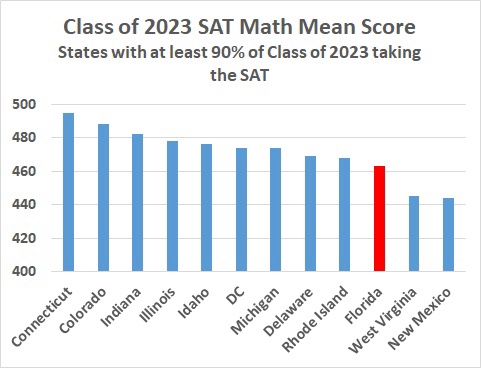
When you hear Jeb Bush or Ron DeSantis boast about the success of education in Florida, don’t believe it. Laugh out loud. Fourth grade reading scores are high, but could it be because low-scoring third graders are retained? Eighth grade reading scores are at the national average on NAEP—nothing to brag about. Florida’s SAT scores are embarrassingly low for a state that brags about test scores. Apparently those impressive reading scores in fourth grade ebb away as each year passes.

Scott Maxwell, opinion columnist for The Orlando Sentinel, called out the fraudsters by pointing to Florida’s pathetic SAT scores.

New rankings show Florida students are posting some of the lowest SAT scores in America.

We’re talking 46th place. Down another 17 points overall to 966, according to the combined reading and math scores shared by the College Board.

Florida trails other Southern states like South Carolina and Georgia. We trail states where more students take the test, like Illinois and Indiana.

We somehow now even slightly trail Washington, D.C. — a district long maligned as one of the supposedly worst in America, where all students take the test.

This should be an all-hands-on-deck crisis. Yet what are Florida education officials obsessing over?

Pronouns. And censoring books.

While other states focus on algebra and reading comprehension, Florida’s top education officials are waging wars with teachers about what kind of pronouns they can use and defending policies that have led to books by Ernest Hemingway and Zora Neale Hurston being removed from library shelves. We are reaping what they sow.

But perhaps the most disturbing thing about Florida’s current crop of top education officials isn’t just the misguided policies they’re pushing, it’s the way they behave. Like it’s all a joke. Like Twitter trolls.

They’re calling names, mocking those trying to have serious conversations about education and generally reveling in owning the libs.

A few months ago, Orlando Sentinel education reporter Leslie Postal spent weeks trying to get public records about a newly hired state education employee. Postal just wanted to explain to taxpayers how their money was being spent. But state officials refused to answer questions.

So Postal wrote up the piece, and Florida Education Commissioner Manny Diaz shared the piece on Twitter (now X) with a two-word comment: “Cry more!”

For those of you who don’t speak troll, “Cry more” is a response used by some social-media users — usually those juvenile in age or intellect — to mock someone who is unhappy. The folks at Urban Dictionary, who revel in all things trolly, define “Cry More” as a “phrase used in online games when someone is getting owned, and they b*tch about it.”

The game in question here, mind you, was the Sentinel’s two-month quest to get answers about how the state was spending tax dollars. And the response from the state’s top education official was: “Cry more!” What a role model for students.

That’s just one example. Last week, after I wrote a column about rampant book-censorship in the state — with one district shelving 300 titles — State Board of Education Member Ryan Petty responded (at quarter ’til 1 in the morning): “Just dumb. This passes as journalism.” Followed by a clown emoji.

OK, for argument’s sake, let’s say I’m the dumbest clod to ever set foot in the Sunshine State. Petty still wouldn’t answer any of the direct questions posed in both the column and on Twitter. Specifically, if the goal isn’t widespread book-banning, why won’t his education department provide a definitive list of what books it believes students shouldn’t have access to in school?

Petty opted for emojis over answers, because that’s what trolls do.

The responses on Twitter to Diaz and Petty — both appointees of Gov. Ron DeSantis — were about what you’d expect. One user told Petty: “My ninth grader could have crafted a more articulate response.” Several users responded similarly to Diaz’s “Cry More!” post, questioning his ability to maturely discuss policy and referring back to a Miami Herald investigation into student claims of “inappropriate behavior” by Diaz back when he was a teacher; claims Diaz said were bogus smears.

None of this did a thing to address this state’s education issues. Yet that’s where we are in Florida these days, mired in culture wars and trolling each other.

We also saw something similar last week when Diaz refused to directly answer questions from Orange County Public Schools about whether teachers were allowed to honor the requests of transgender students who wanted to be addressed with different pronouns — if the teachers wanted to and if those students also had their parents’ written permission. (Think about how bizarre it is that schools must even ask that question … in the so-called “parental rights” state.)

In his response to the district, Diaz offered a theatrical and condescending response that referred to “false” pronouns but which school officials concluded didn’t actually answer the question in a straightforward manner. Just more troll games … involving a population of teens more prone to self-harm and suicide, no less.

As far as the SAT goes, the test certainly has its share of legitimate critics. But it’s still one of the best apples-to-apples metrics we have for student learning.

Yet hardly any Florida media organizations even covered the October release of the new SAT scores that showed Florida’s poor showing. Why? Because we’ve been trained to follow the bouncing-ball, culture-war debate of the day.

So we see plenty of coverage about Florida supposedly ranking No. 1 in “educational freedom” by partisan political groups and scant addition to real education issues.

Call me old-fashioned, but I like hard numbers more than political posturing or magazine rankings. So do others who actually care about and study education.

Paul Cottle, a physics professor who authors a blog that focuses on STEM education, noted Florida’s increasingly cruddy SAT scores back in October when they were released — when everyone else was focused on the debate-of-the-day.

Cottle noted that Florida’s math scores for 4th graders were solid but that the SAT scores for graduating seniors were so bad, they suggested something was going awry for students before Florida schools sent them into the real world.

Cottle called the showing “a sad state of affairs.”

He’s right. Yet we’re getting precisely the educational environment and results that our culture-warring politicians are cultivating — an environment where trolls thrive, even if students don’t.

John Thompson, historian and retired teacher, write about what matters most to students today: learning to pay attention in a world of screens and distractions.

He writes:

D. Graham Burnett, Alyssa Loh, and Peter Schmidt begin their New York Times opinion piece, “Powerful Forces Are Fracking Our Attention. We Can fight Back,” with an eloquent version of a statement that should have long been obvious:

We are witnessing the dark side of our new technological lives, whose extractive profit models amount to the systematic fracking of human beings: pumping vast quantities of high-pressure media content into our faces to force up a spume of the vaporous and intimate stuff called attention, which now trades on the open market. Increasingly powerful systems seek to ensure that our attention is never truly ours.

Then Burnett, Loh, and Schmidt use equally insightful language to explain why “We Can Fight Back” against “the little satanic mills that live in our pockets.” They recall that “for two centuries, champions of liberal democracy have agreed that individual and collective freedom requires literacy.” Today we face widespread complaints that reading is being undermined by “perpetual distraction,” due to commercial use of digital technologies. They add, “What democracy most needs now is an attentive citizenry — human beings capable of looking up from their screens, together.”

“Powerful Forces Are Fracking Our Attention. We Can Fight Back” calls for a “revolution [which] starts in our classrooms.” They explain, “We must flip the script on teachers’ perennial complaint. Instead of fretting that students’ flagging attention doesn’t serve education, we must make attention itself the thing being taught.” They draw upon the work of “informal coalitions of educators, activists and artists who are conducting grass-roots experiments to try to make that possible. Burnett, Loh, and Schmidt call it “attention activism.

Due to these worldwide efforts, “common ground is rediscovered in the weave of collective attention.” They seek ways “to create, beyond the confines of our personalized digital universes, something resembling a shared world.” One set of starting places, museums, public libraries, universities, as well as classrooms, remind me of a time when I was a student, and the first half of my teaching career, when field trips were widely celebrated, and before critical thinking was subordinated to test prep.

“Powerful Forces Are Fracking Our Attention. We Can fight Back” recommends another practice that I’ve long struggled with, “observations of absolutely whatever unfolds in the world,” in order pay “particular attention to the supposedly mundane … events that might under normal circumstances have gone unnoted.” It reminded me of a conversation with a student where we agreed that we don’t want to depend on beer or marijuana in order to fully appreciate a sunset. It was hard for me to later realize that I also took that shortcut in order to slow down and fully appreciate such beauty.

Next, I left my computer, and my dog and I got into our complicated new hybrid car to take a short ride to the park for a walk. Of course, the irony of driving to the walk is obvious. Then I figured out how to push the buttons for defrosting the window, rather than scrape the ice off. But then, technology taught me a new skill for paying attention to “normal circumstances” that had “gone unnoted.” I became enthralled the bubbles that broke loose from the coat of ice as it melted and dripped down the windshield. (Perhaps due to that experience, the park’s beautiful fall colors were even more awesome.)

Burnett, Loh, and Schmidt also reminded me of conversations I had had as a young Baby Boomer with family members, neighbors and other mentors. So many adults coached me on developing “inner directedness,” not “outer-directedness,” and to not be “like the Red River, a mile wide and a foot deep.” I was taught that my real goal shouldn’t be higher grades, but “learning how to learn.” And I’ll never forget the elementary school principal who took us to the junior high to watch Edward R. Murrow interviewing John Maynard Keynes, about the real purpose of school – which was not getting a job. Our goal should be learning how to learn how to be creative after technology reduced the workweek into 15 hours.

Of course, that hopefulness seems laughable today, but it brings us back to Burnett, Loh, and Schmidt and their diagnosis of why today’s technology has become so destructive. They linked to ATTENTION LIBERATION MOVEMENTS(or ALMS) that resist the “powerful new financial, commercial, and technological system that is commodifying human attention as never before.” It promotes “RADICAL HUMAN ATTENTION” to nurture “unrivaled access to the goodness of life;” and second, “that present circumstances present new and imperiling obstacles to human attentional capacities.” For instance, these bottom-up efforts seek to educate young people how, “We operate in a world in which attention is increasingly bought and sold. Bought and sold by powerful interests, pursuing wealth — pursuing ‘eyeballs,’” on screens.

And, of course, the subsequent undermining of inner-directedness, social ties, and critical thinking paved the way to today’s rightwing assault on democracy.

Although I was never as eloquent as Burnett, Loh, and Schmidt, but I’ve unsuccessfully advocated for their type of approach for a quarter of a century. My first encounter with a cell phone occurred the day after a gang-related murder when my students affiliated with the “Crips” stared at a new student, a “Blood,” who was secretly typing into a gadget I’d never seen before, who was requesting armed backup. Given the way that cell phones, predictably, increased violence and, predictably, undermined classroom instruction, I lobbied for our school to commit to regulating phones and engaging in cross-generational conversations about digital literacy and ethics.

Although I personally communicated with my students about “using digital technology,” but “not being used by it,” our school system refused to touch these issues. Before long, watching students who were glued to their phones, it seemed obvious we were also facing a crisis of loneliness, made much, much worse by screen time.

My personal experience thus gives me reasons for both hope and pessimism. Burnett, Loh, and Schmidt build on the same human community strengths that were crucial for me, and embraced by students in our phone-free classroom. But I can’t ignore the three decades of refusals by the systems I’ve worked with to tackle the challenge.

Then again, on the same day that the New York Times commentary was published, National Public Radio reported that California “joins a growing movement to teach media literacy.” The next day, the Washington Post called on parents to support a ban on smartphones. So, maybe the time is right for the wisdom of Burnett, Loh, and Schmidt, who make the case for “what democracy most needs now is an attentive citizenry — human beings capable of looking up from their screens, together.”

The National Education Policy Center at the University of Colorado posted a useful analysis of research in the field of reading and how it should inform practice.

Key Takeaway: Some research claims of the “science of reading” movement are overly simplistic, so policymakers should seek different approaches to legislating reading.

Find Documents:

Publication Announcement: https://nepc.colorado.edu/publication-announcement/2022/09/science-of-reading
NEPC Publication: https://nepc.colorado.edu/publication/science-of-reading

Contact:

Alex Molnar(480) 797-7261nepc.molnar@gmail.com
Faith Boninger(480) 390-6736fboninger@gmail.com
Paul Thomas(864) 294-3386paul.thomas@furman.edu

Learn More:

NEPC Resources on Reading Instruction

BOULDER, CO (September 13, 2022) – How students learn to read and how reading is best taught are often the focus of media, public, and political criticism. In a new NEPC policy brief, The Science of Reading Movement: The Never-Ending Debate and the Need for a Different Approach to Reading Instruction, Paul Thomas of Furman University explores the controversial history of the reading reform movement.

Throughout the decades, a striking amount of attention has sporadically been focused on how teachers teach reading—typically with a specific concern for phonics instruction. This attention has then spread to standardized test scores (including international comparisons) and a changing list of hypothetical causes for disappointing test scores (including progressivism, whole language, and balanced literacy).

Disappointing reading achievement has been sometimes attributed to how reading is taught, sometimes to social influences on students (such as technology and media), and sometimes to both. Widespread and ongoing criticism over the last 80 years has targeted a wide array of culprits:

  • State and federal reading policy;
  • The quality of teacher education and teacher professional development;
  • Theories of learning to read and reading instruction;
  • The role of phonics and other reading skills in teaching reading; and
  • The persistent gaps among classroom practices, reading policy, and the nature or application of science and research.

These discussions have not been evidence-free. In fact, scholars and literacy educators have over this time conducted extensive research into these and other issues. But the research has only limited impact on policy and practice.

Specifically, in contrast to much of the public debate and policymaking, these researchers have found reading instruction and learning to be complex, complicating the design of effective policy and classroom practice. Overall, this robust research base supports policies and approaches that acknowledge a range of individual student needs and that argue against “one-size-fits-all” prescriptions. Among literacy educators and scholars, then, important reading debates continue but do so without any identified silver-bullet solutions.

The current public debate is different. Since 2018, the phrase “science of reading” has been popularized as loosely defined shorthand for the broad and complex research base characterizing how children learn to read and how best to teach reading. Simplifying the issue for the public and for political readers, and failing to acknowledge the full complement of research findings, prominent members of the education media have used the term when framing the contemporary debate—often as pro-phonics versus no phonics. Various types of vendors have also found the shorthand term “science of reading” highly useful in branding and marketing specific phonics-oriented reading and literacy programs.

As the “science of reading” movement has grown, scholars have cautioned that advocates and commercial vendors often exaggerate and oversimplify both the problems and solutions around reading achievement and instruction. Yet these advocates have been extremely effective in lobbying for revised and new phonics-heavy reading legislation across most states in the U.S., producing rigid and ultimately harmful policy and practices. Still, in pursuing reform to address identified challenges, the movement does provide an opportunity for policymakers to investigate different approaches to reading instruction and to develop more nuanced policy.

Accordingly, Professor Thomas provides recommendations for state and local policymakers to provide teachers the flexibility and support necessary to adapt their teaching strategies to specific students’ needs.

Find The Science of Reading Movement: The Never-Ending Debate and the Need for a Different Approach to Reading Instruction, by Paul Thomas, at: https://nepc.colorado.edu/publication/science-of-reading

On Twitter (“X”), The Recount reports that the newly elected president of the Central Bucks County school board, Karen Smith, was sworn into office on a stack of banned books, not the Bible.

https://x.com/therecount/status/1732425364675203121?s=42&t=9ko2QEoKmRIlvHb1PdtjSw

The new board swept out a board of rightwing zealots.

In Bucks County, Pennsylvania, voters elected a new school board pledged to reverse the policies of their Moms-for-Liberty style predecessors. That meant ending censorship of library books and ending the ban on gay-friendly displays, among other things. The old school board gave the retiring superintendent a $700,000 going-away gift; the new one is trying to recover the gift.

The Philadelphia Inquirer reported:

The new Democrat-controlled Central Bucks school board moved quickly Monday to roll back some of its GOP-led predecessors’ most controversial actions — from suspending policies restricting library books to authorizing potential legal action into the former superintendent’s $700,000 payout.

What shape the new board’s actions will ultimately take isn’t yet clear. The board’s new solicitor, for instance, said earlier Monday that he needed to learn more about the separation agreement reached between the prior board and now-resigned superintendent Abram Lucabaugh before pursuing a lawsuit.

But the crowd that lined up outside the Central Bucks administrative building to witness the swearing-in of new members Monday was ready to celebrate regardless — cheering new leadership after what numerous speakers described as two years of “chaos,” bookended by highly contentious, big-money elections.

Republicans who cemented their majority in 2021 enacted bans on teacher “advocacy” in classrooms — including the display of Pride flags — and “sexualized content” in library books, and faced a federal complaint alleging the district had discriminated against LGBTQ students.

But Democrats swept the Nov. 7 school board elections — as they did in a number of area districts where culture-war issues had dominated debate.

“Two years ago, I stood in this room a broken woman,” said Silvi Haldepur, a district parent. But “this community banded together and stood up against the hate.”

Keith Willard, a social studies teacher, told the board it was “incredibly difficult” to work for the district when the previous board had “actively marginalized people” and pushed the “belief that staff are indoctrinating kids.”

“What I ask of this board is that you help steer the ship… and return the stewardship to the people that do the real work every day” — teachers and staff, said Willard, who drew a standing ovation.

The room again broke into applause as the board voted to suspend the library and advocacy policies,as well as a policy banning transgender students from participating in sports aligned with their gender identities — a measure the former board passed at its final meeting in the wake of last month’s elections.

Has the U.S. Supreme Court stripped away all limits on the right to buy and carry arms? We are soon to find out, as the Court just heard a case challenging restrictions on domestic violence abusers. A federal appeals court decided that even violent people should have the right to bear arms, because that is what the Founders wanted. Some states allow open carry of weapons; some require no background checks for purchasers. We may soon be living in the “O.K. Corral,” where shootouts are a common occurrence.

Rachel Barkow of the website CAFE analyzes the case and the likely ruling of the High Court. Barkow is a professor at the New York University School of Law, specializing in criminal law.

She writes:

Since 2008, there has been no greater obstacle to confronting America’s epidemic of gun violence than the Supreme Court. That was the year five justices on the Court decided the Heller case, which held, for the first time in the country’s history, that the Second Amendment of the Constitution protected an individual’s right to bear arms and was not, in spite of its plain language, cabined to protecting the collective right of a militia to bear arms. The Court’s majority claimed its view was consistent with the original meaning of the clause, but legal historians have demolished that claim. The Court’s decision was instead the product of an orchestrated campaign by the National Rifle Association over decades to shift opinion on the Constitution’s meaning. Heller was the culmination of those efforts and the decision drastically curtailed the ability of voters to limit gun possession because it entrenched a constitutional right to possess firearms. The actual holding of Heller covered only the ability to possess a gun inside one’s home for self-defense, but it was just the first step in the Court’s takeover of gun policy.

Despite widespread criticism by legal scholars and historians of the Court’s interpretation of the Second Amendment, the Court (pardon the pun) stuck to its guns. Last Term in Bruen, the Court expanded the scope of the Second Amendment by striking down a New York law that required people to show “proper cause” to get a permit to carry guns for self-defense in public. That decision not only expanded the right to bear arms to include carrying a weapon in public, but it also changed the manner in which the Court would analyze Second Amendment claims to make it even harder for sensible gun regulations to survive the Court’s review.

The Court, in an opinion authored by Justice Thomas, rejected the argument that a regulation that covers guns outside the home can be upheld if it promotes an important interest. Instead, “The government must affirmatively prove that its firearms regulation is part of the historical tradition that delimits the outer bounds of the right to keep and bear arms.”

In other words, no matter how much the government might want to address the scourge of gun violence and mass shootings, its hands are tied by what the Court believes white men in the 18th century would have wanted. Moreover, this is an inquiry that the Court typically gets wrong because it is not a body composed of trained historians, but of lawyers doing back-of-the-envelope history (derisively and accurately referred to as “law office history”) that typically just so happens to yield the very result a majority of justices would like to see.

That is how we have arrived at the surreal moment at the Court on Tuesday in which the justices heard arguments about whether the government can remove guns from domestic violence abusers. That is the issue in United States v. Rahimi, a case out of the Fifth Circuit, a conservative federal intermediate appellate court that covers Louisiana, Mississippi, and Texas. The Fifth Circuit believed it correctly followed the framework from Bruen and struck down a federal law that prevents people subject to domestic violence restraining orders from possessing firearms. To obtain such a restraining order, a court must find, after notice and a hearing, that a person presents a credible threat to their intimate partner or child, and that the order is necessary to protect the partner or child from “domestic gun abuse.”

In a sane world, the question of whether someone should lose access to weapons would turn on the adequacy of the procedures for making that determination and the evidence that the person poses a threat. In the Supreme Court’s world, in contrast, whether someone is stripped of access to guns depends solely on whether the government of the 18th century disarmed similarly situated people. According to the Fifth Circuit, the government’s evidence from the 18th century about taking guns from “dangerous” people was not sufficiently similar, so the federal law could not pass muster.

Will five justices of the Supreme Court agree with the Fifth Circuit that the historical record is too thin to support the domestic violence law? The Court’s three liberal justices will almost certainly side with the government. Justices Kagan and Sotomayor have already expressed their disagreement with the Court’s flawed framework for deciding these issues by joining Justice Breyer’s dissent in Bruen. Justice Jackson was not on the Court in Bruen, but she expressed skepticism about the Bruen framework in her questioning at oral argument in Rahimi. She got to the heart of the insanity of the matter when she asked Rahimi’s lawyer if the Court’s task, in his view, was to look for “the regulation of white Protestant men related to domestic violence,” or if it was possible to take the level of generality up a notch.

The question is whether at least two of the six conservative justices will agree, and all signs from the oral argument are that the government has amassed enough evidence to get five votes to uphold this particular law. Justice Barrett wrote an opinion when she was on the Seventh Circuit that recognized firearms can be removed from dangerous people, and her questions at argument suggested she sees Rahimi as falling into that category. Indeed, she talked about domestic violence as being in the heartland of danger. Justice Gorsuch also gave indications that the facts of this case would survive Second Amendment scrutiny because he kept carving out issues for future cases. It is likely other justices will join this decision as well, given the clear finding of danger under the facts of the case. Even Rahimi’s counsel had a hard time arguing his client was not a danger when asked at oral argument.

It is less clear that there are enough votes to shift the framework for deciding these cases so that the government in 2023 and beyond is not hamstrung by what the government did in the 18th century. Part of the debate at oral argument was over how specific a historical analog has to be to allow a gun regulation today. If the Court does not make clear that governments today can identify threats and dangers – even if the Framing generation did not identify those same threats and dangers – as suitable for disarmament, the government in Rahimi will have won a battle, but not the war, on gun violence. Whether gun regulations survive will depend on what five lawyers on the Supreme Court think.

The Court’s track record in Second Amendment cases does not inspire confidence. The Court got the history of the Second Amendment’s scope wrong in Heller. It is not an individual right but a collective one in the service of militias. The Court then made matters far worse in Bruen by broadening the scope of that right and preventing the government from regulating firearms unless the Framers passed a similar regulation. Everything comes down to an interpretation of 18th century America’s approach to guns, despite the fact that almost nothing about firearms is the same as it was at the time of the framing.

Nor does the Court limit itself to history so rigidly in other contexts. That is what led legal scholar Khiara Bridges to declare “the right to bear arms the most protected of rights in the Constitution.”

The Court’s inconsistent approach to originalism is the reason people can more easily lose their liberty than their right to keep a firearm. Although we are supposed to have a presumption of innocence in America and that is a concept firmly rooted in the original meaning of due process, if you are merely charged with a crime – not convicted – you can be locked in jail, according to the Supreme Court, as long as a judge thinks you are dangerous. No originalist should permit this, as the Framing generation did not condone incarceration on the basis that someone was merely accused of a crime and then deemed dangerous by a judge before conviction. Yet we have hundreds of thousands of people incarcerated on just this basis because the Court has not taken the same strict originalist approach to pretrial detention. We can only ponder why we ended up with a regime that would allow liberty to be taken away so cavalierly, but that treats gun rights as inviolate without a sufficiently precise historical analog.

The Framers were not so foolish as to place greater protections on guns than freedom. But the Supreme Court does not seem to understand the relevant history. Whatever the Court decides in Rahimi, we are a long way from a sensible constitutional framework for thinking about these issues as long as the inquiry will depend on the Court’s faulty historical analysis. Tragically, this is an area where the Court’s law office history is literally killing us.