Archives for category: Education Reform


The Florida House of Representatives passed another voucher program, this time directly funded by taxpayers.

The Florida Senate already approved the program. They rejected all Democratic amendments, even one to stop people who had been previously convicted of fraud from opening a charter school!

The state constitution prohibits use of public funds for religious schools, and in the past lawmakers used a “work-around,” like tuition tax credits, to pretend that public funds were not going directly to religious schools. This bill avoids the pretense. Money to pay for religious schools will come out of the public fund for public schools. This will harm the public schools that enroll more than 80% of the state’s students.

In 2012, Florida voters opposed Jeb Bush’s effort to change the state constitution to permit the kind of bill that passed yesterday.

Recent studies agree that students who use vouchers do not make academic gains and are likely to suffer academic losses.

Voucher schools in Florida are unregulated, need not have certified teachers, and are not subject to state standards or tests. They are, as a series in the Orlando Sentinel said, “schools without rules.”

At the same time, the legislature tightly regulates public schools with burdensome mandates, and there is a statewide teacher shortage.

The decision yesterday in the Florida House was not conservative. Conservatives don’t destroy vital public goods. Conservatives conserve. The vote taken was a display of radical extremism, driven by money and ideology.

The vote was not about the best interests of children, most of whom will attend schools with an anti-science, anti-modern Biblical curriculum.

The Republican Party of Florida has no shame.


The privatizers got badly beaten in 2016, when they tried to lift the cap on charter schools in Massachusetts. Funded by the Waltons and the usual coven of billionaires, they asked the public to endorse a proposal to launch 12 charter schools every year, wherever they wanted to open. The referendum was overwhelmingly defeated, much to the surprise of its sponsors.

Governor Charlie Baker is a Republican who has appointed a choice-friendly State Board, so the privatizers have not given up hope for undermining democracy.

Now they are back with a proposal for “innovation zones.” 

Jonathan Rodrigues writes:

In a world where we’re more and more accustomed to jargon inherited from corporate start up world like “disruption” and “big data”, “innovation” stands out as one of the most empty vessels in which we project meaning without much thought of it.

In the education world in particular, almost anything can be “innovative”. Even bringing back purposeful segregation and differential treatment under the guise of educational opportunity. Governor Baker’s latest “Innovation Partnership Zones” may be clever, but it’s certainly not very innovative.

If only segregationist Alabama Governor George Wallace had known it would be this easy to fool people, he’d had changed his 1963 speech to “innovation today, innovation tomorrow, innovation forever!”.


So what are “Innovation Partnership Zones” (IPZs), and what would the governor’s bill do? It’s important to note here this idea has prominent Democratic support as well, it was only last year that Education Committee co-chair Alice Peisch (D-Wellesley) and Senator Eric Lesser (D-Longmeadow) sponsored very similar legislation.

The bill allows groups of 2 schools or more (or one school with more than 1,000 students) to create an IPZ which would allow an outside organization to manage these schools and give the “zone” autonomy over things like budget, hiring, curriculum, etc. Essentially third-partying away the public good, but doesn’t “partnership” sounds so much better than “takeover”?

The IPZ can be triggered in two main ways.

  1. Through local initiative of school committee members, a superintendent, a mayor, a teachers group or union, and parents. .
  2. Through the state’s Department of Elementary and Secondary Education (DESE) Commissioner’s choice from schools determined to be “underperforming” by high stakes testing metrics.

The process would then call for proposals jointly with an outside entity that may include nonprofit charter operators and higher ed institutions….

If past is prologue, the results should look familiar. Brown University Annenberg Institute’s 2016 report “Whose Schools?” analyzed the board composition of charter schools in Massachusetts. 60% of charter schools in the Commonwealth had no parent representation at all. 31% of charter board members were from the corporate sector, heavily from finance.

We should all look forward to our IPZs filled with executives from places like TD Bank, who certainly might live in the “region,”, but have no respect for Boston’s biggest neighborhood.

It is especially worrisome that IPZs will be inevitably pushed on communities of color, continuing a nationwide trend of stripping away voice from families of color from Philadelphia to Chicago, Detroit to New Orleans.

A 2015 Alliance to Reclaim Our Schools “Out Of Control” report examined the disenfranchisement of black and brown families through mechanisms such as appointed school boards, and state and district turnovers. In their 2014–15 analysis, there were 113 state takeover districts nationwide. 96 were handed to charter operators. 98% of affected students were Black and/or Latinx. In New Orleans, parents had to navigate 44 different governing authorities; in Detroit, 45.

The most important innovation of all would be the full funding of schools in poor communities.

He concludes:

In no place where black and brown families are the majority in the school district is the innovation of a fully funded quality public school with adequate staffing, special education services, mental health supports, art and music, full-time librarians, and school nurses ever even attempted.


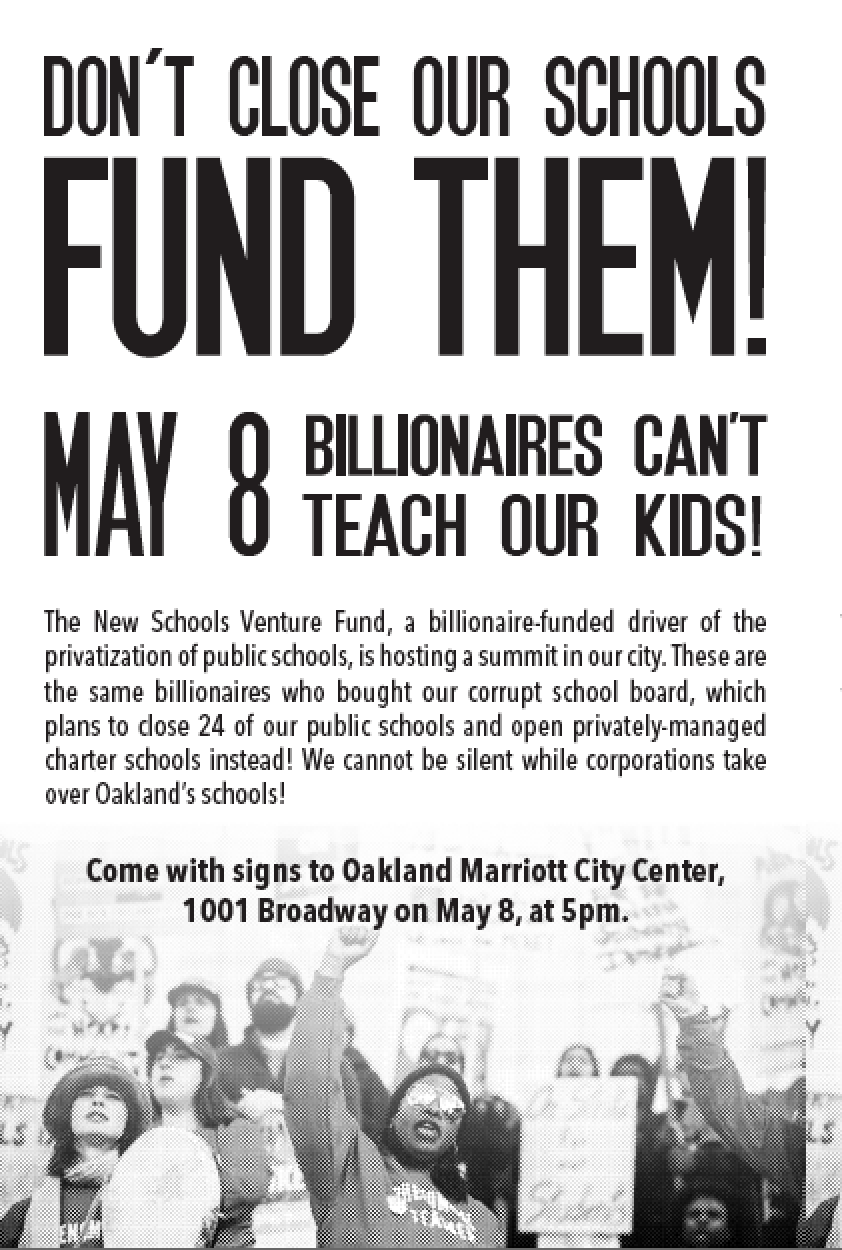
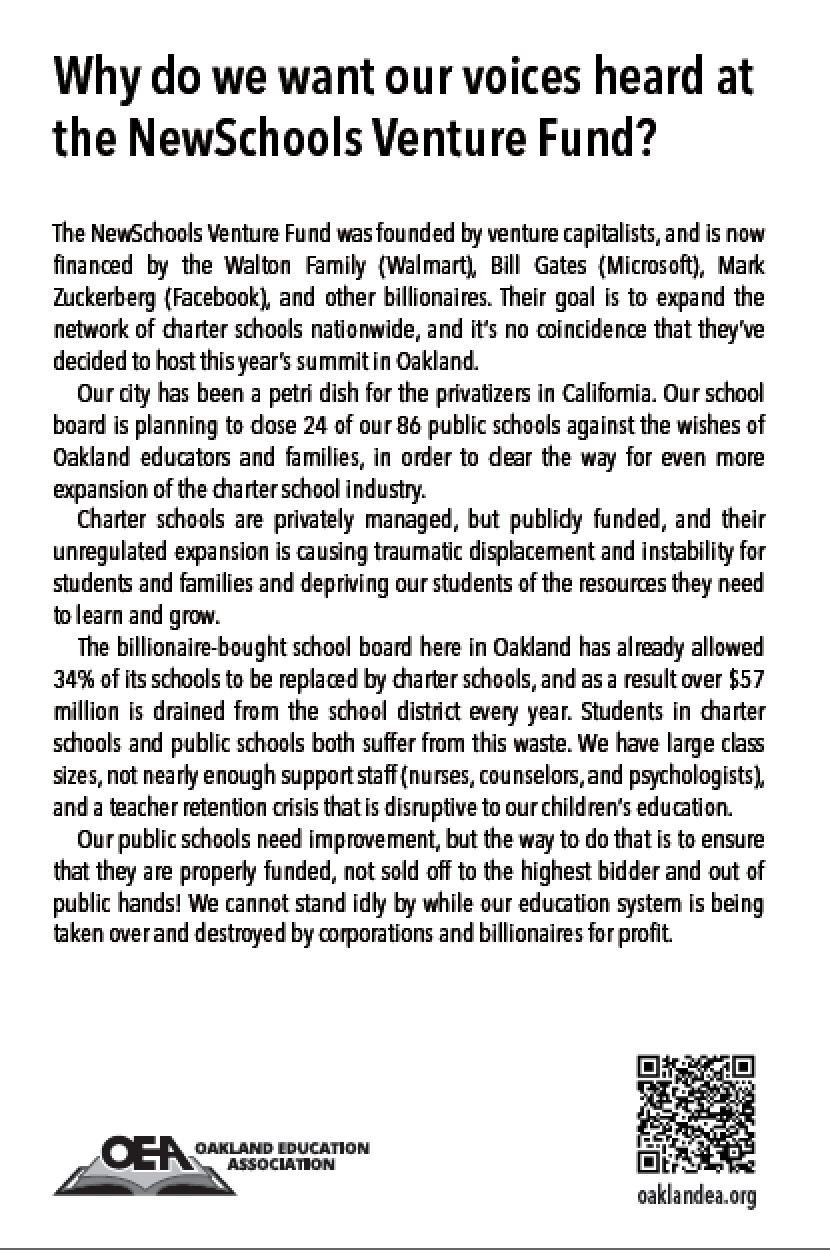
The NewSchools Venture Fund will hold its annual meeting in Oakland on May 8. This is appropriate because Oakland has been one of the cities targeted by the billionaires who support NSVF, with the goal of eradicating public schools. As you will read, a significant number of public schools have been turned into charters, draining $57 million from public schools, which must cut services and programs to satisfy the greed of the billionaires. Make no mistake: their goal is privatization and they don’t care how much suffering they cause to public school students to get what they want. The public schools and their students are collateral damage.


Sara Roos, the blogger known the Red Queen in L.A., is an intrepid investigator, following the money. She has learned inevitably that the charter school lobby is very rich and spends lavishly to buy politicians’ favor.

In this post, she scratches the surface of the charter lobby’s complex political-financial machinations. Given the known gaps that are not included in this excellent report (e.g., the funding for Marshall Tuck in his race against Tony Thurmond), the actual spending by the charter lobby may be five to ten times what she writes here.

”The Charter industry lobby has expended a total of $91.4 million dollars in California between 11/18/08 and 12/31/18, according to political financial information stored online by the Secretary of State through “Cal-Access”…

”What is so confusing is the multi-stage process by which the California Charter Schools Association (CCSA) lobby dispenses its largesse. There is a direct process and a derivative one. Over this time period CCSA has opened 25 distinct “Recipient Committees”, entities raising contributions from others, nine of which have been subsequently terminated. These 25 Committees have operated under 54 different names. Some of this multiplicity is reasonable because the lobbying effort is state-wide and different Committees will make expenditures to different local issues and candidates. But some of it is a succession of evolving names associated with a specific Committee. Sure, it all traces back to the same ideological pot of gold so while the zeitgeist shifts, the named Committee can just get a slight upgrade in verbiage since the spigot is unchanged. But it feels shifty in intention too, as if the Committee-As-Palimpsest were a deliberate effort to overwrite and obscure the group’s underlying, persistent and singular, special interest.”

The names of the organizations paid by the lobbyists is deliberately meant to fool voters into thinking that the lobby represents teachers, students, public schools, even the downtrodden, when it is actually a front for billionaires.

“Parent Teacher Alliance,” “Families and Educators for Public Education,” “Students for Educational Reform,” “L.A. Parents, Teachers, and Students for Great Public Schools,” are just a few of the deceptive shells advancing the cause of privatizing public schools.

Roos writes:

“The pattern of marketing hype is plain as can be:  “Teachers and Parents”, “Excellent Public Schools”, “Great Public Education”, “Public Charter Schools Now”. A bot could mix and match phrases but credibility or accountability is harder to design.”

Roos includes a list of the candidates to whom the charter lobby has given large sums, as well as those it spent big to defeat.

As she notes, her list is far from comprehensive. For example, it shows an expenditure of only $1,050,000 for Marshall Tuck by the charter lobby, when the actual amount spent on his campaign for State Superintendent of Public Instruction was about  $30 million.

The best news is that the massive spending of the charter lobby is no guarantee of victory.

“While undeniably the charter lobby is comprised of far more IECs than this limited set which display the “Charter Schools Association” label, something approaching the 40%-50% mark of charter lobby expenditures may have catastrophically failed in influencing anyone of late. It’s encouraging to recognize the discouragement of dark money and dark forces. Civil Justice is served when resources are distributed fairly and equitably.  There is no true way to describe jerry-rigged redistributions as anything but a favoritism scheme for the anointed. And there is no way that spending ungodly sums on persuasion and trickery is in the best interests of anyone but those with something to hide.”


I just finished reading a compelling book about the famed Atlanta Cheating Scandal. It is titled None of the Above: The Untold Story of the Atlanta Public Schools Cheating Scandal, Corporate Greed, and the Criminalization of Educators. I found it hard to put down.

It was written by Shani Robinson, one of the teachers convicted in 2015 of racketeering, for changing her students’ answers on a state test, and journalist Anna Simonton. It is Shani’s story, and with Anna’s help, it is a very good read.

Shani was a Teach for America teacher who taught first graders at Dunbar Elementary School in Atlanta. She was one of dozens of teachers and administrators accused of cheating to raise her students’ test scores. Being arrested, charged, threatened, tried, and convicted was an ordeal, which she describes in detail. Throughout this ordeal, she maintained her innocence. She very credibly insists that she never changed her students’ test answers. Her student scores were not counted towards the school’s “AYP” and had no bearing on the school’s rating because first grade scores were not part of the No Child Left Behind dragnet.

She never received a bonus or any other monetary reward. Yet she and other educators were accused and convicted on a racketeering charge (the federal RICO statute that was designed to snare members of the Mafia and other organized criminals). She did not conspire with anyone, she writes, and to this day she insists upon her innocence.

What is especially shocking is her account of the “justice” system. At every step along the way, she and the others who were accused were offered the opportunity to get out of the charges if only they agreed to plead guilty. They got off scot free if they were willing to accuse others. Repeatedly she was told that she had a choice: If you stick with your plea of innocence, you face 20 years in prison; if you confess your criminal behavior, you will get probation, community service, and a nominal fine. Those who were convicted lost their job, their reputations, their careers, and in some cases, their freedom.

Others whom Shani trusted confessed to crimes they had not committed. She insisted upon her innocence and refused to lie to win her freedom. She cannot help comparing the longest trial in Georgia’s history with the cheating scandal in Washington, D.C., where no one was charged and there was no trial or punishment, nor even a credible investigation.

Somehow the whole procedure sounds like a story from the old Soviet Union, but this is American “justice” as practiced in Georgia.

What makes the story even more interesting is the way she connects her personal dilemma with the history of racism and injustice in Georgia and with the manipulation of politics by corporate interests. She notes again and again that the media created a feeding frenzy because of allegations that educators cheated, but were not interested at all in reporting how corporate interests shifted or stole hundreds of millions of dollars from the schools for real estate development or gentrification.

She describes Atlanta’s history as the first city to build public housing, which became home to many thousands of black families, and the first city to tear down all of its public housing, ostensibly to woo middle class families back to the city (and to push out poor black families).

She became disenchanted with Teach for America as she saw its recruits—funded by out-of-state billionaires and trained by TFA’s Leadership for Educational Equity– organize a takeover of the Atlanta school board so as to make way for corporate education reform, especially charter schools.

She details the efforts of for-profit Charter Schools USA to open a charter in Atlanta, and the determination of the black community to keep them out.

Hypocrisy?

She writes:

“I tried to keep my cool as I came to terms with the fact that some very bad things had happened in my school district, worked to remain self-assured that my name would be cleared, and attempted to quell my outrage at the naked hypocrisy of some of the public figures who scrambled to condemn educators for ‘cheating the children.’ There were so many ways that children, particularly black children, were being cheated out of a decent life. During the decade that some APS staff members were tampering with tests, most teachers were doing the best they could with few resources for contending with kids who suffered generational trauma stemming from urban renewal, racialized violence, the drug epidemic, mass incarceration, and the obliteration of public housing. Meanwhile, real estate moguls and financiers were finagling ways to line their pockets with the education dollars that should have been going to the classroom.”

The most memorable line in the trial was uttered by the utterly reprehensible Judge Baxter, who said that the cheating scandal was “the sickest thing to ever happen in this town.” Shani wonders if he never gave any thought to slavery, Jim Crow, and the many other attacks on blacks as equally “sick.”

Shani Robinson’s appeal has not yet been heard. She may yet be sent to prison. Her book is a persuasive argument that some of the worst criminals in Atlanta were never tried for their crimes against the children of Atlanta.
 

This statement was released today by the Alliance for Quality Education in New York City.


Despite years of advocacy, court mandates and promises from politicians, the new NYS budget plan once again locks in educational inequality. And while politicians refuse to cough up $1.6 billion to begin fully funding our schools, the state spends over $1.5 billion a year on its high stakes standardized testing program.

For years, Albany has told parents that standardized tests will help close the “achievement gap” in our schools – but year after year of testing, while refusing to fully fund our schools, has not closed this gap, which is an “opportunity gap” and NOT an “achievement gap.”

The truth is, you won’t heal the inequities that plague our schools by administering something that is toxic, and these high stakes tests are toxic, for our kids, and for our schools. You want to close the gap? Start by funding our schools.

While Albany keeps expecting our schools to do more with less, while the tests lay the foundation for closing and privatizing more neighborhood public schools, we keep calling, writing, traveling to Albany, meeting with legislators, rallying and petitioning. We keep working within a system that won’t respond to our needs.

What do we do with a system that won’t respond?

We break it. Albany has ignored us for years. We succeed when we make ourselves impossible to ignore.  Enough is enough. We are joining the hundreds of thousands of parents and educators that have had deep concerns on the corrosive effects of these tests.

Math exams administration dates are May 1–2, with make-up exams on May 3, and May 6–8. You have a right to opt out with no consequence to your child. The right to refuse the state tests in encoded in ESSA, the federal law that governs education policy, which explicitly recognizes that right.

As we know from history, the power of a boycott is huge. If Albany won’t comply with a court ruling to fully fund our schools, why should we give Albany what they want? Join the hundreds of thousands of New York State families who making their voices heard in a most powerful way, and consider joining boycott the state tests this week. A sample opt out letter is here and questions can be sent to nycoptout@gmail.com.


Peter Greene found an insightful article at The 74 about the serial failures of the Democracy Prep Charter Chain.

Betsy DeVos gave the chain $21.8 million to expand but it is having trouble growing beyond its New York City home base.

It was invited to take over the massive disaster that was Andre Agassi’s charter school (which had principal churn, teacher churn, abysmal academics, etc.), and Democracy Prep is struggling to hold on to teachers and students. (Andre Agassi, of course, has abandoned the role of charter founder to become a builder of charter schools in partnership with a venture capitalist. More money, fewer headaches.)

Democracy Prep was asked to take over a failing charter in D.C., where it too failed.

Greene notes:

“The DC school was in trouble from the start. The Executive Director was Sean Reidy who graduated from Loyola with a BS in business administration, did two years with TFA, taught another two years at Harlem DP, went on to get his MBA from Georgetown, and then took over the DC school. (DP, like many charters, likes its TFA recruits, but Mahnken doesn’t really address that, though I’d argue that the culture of edu-amateurs is part of the root of DP’s problems.)”

Greene concludes:

Educational amateurism combined with Big Apple hubris leads to people who don’t think they have to learn anything about the culture where they want to set up shop. This is not unique to DP, or even charters, or even education– it’s just extra-ironic because DP is supposed to be all about being informed effective citizens. Of course, public schools that are owned and operated by the people in the community (and not run from an office thousands of miles away), aren’t so prone to this problem.

No excuses schools are a lousy idea. I know there are students here and there who thrive in them, but they’re still a lousy idea. No wealthy white parents would put their kids in a No Excuses school.

One size does not fit all. Charter folks insist that charters are the solution to OSFA [Editor’s Note: “One Size Fits All”], but their insistence on having everything under one roof be a tightly united philosophical whole has the opposite effect. Public schools have room for many cultures and many philosophies under one roof, which means that students can find a corner of the school that “fits” without having to start over at a whole new school. There’s no reason that charters can’t operate the same way.

Solve problems; don’t walk away from them. This article just gives a peek at the world where charter after charter after charter is taken over, turned around, handed off to some other business. DP moves in, tries their one thing, waits, makes some tiny tweaks, and if it fails, they walk away. Public schools may not always live up to the promise of their commitment, but they don’t just walk out the door saying, “Good luck, kid. Hope somebody happens by to help you out.”

Education concerns and business concerns don’t fit together. Again– business concerns are not evil or wrong, but they don’t match the considerations of education. Good business decisions are not good education decisions.

One of the selling points of charters has always been that they will figure out great new things that the rest of the education world can then pick up and run with. But most of what Democracy Prep needed to know they could have learned from a public school teacher.


Shawgi Tell, a professor of education at Nazareth College in Rochester, New York, says that charter schools areprivate schools and should not receive any public funding.

Efforts to make them accountable and transparent are a waste of time, he argues.

if the billions wasted on charter schools had been spent on public schools, they would be well funded, and society would be far better off.

He writes:

“The notion that thousands of charter schools engaged in all sorts of fraud, corruption, waste, and other serious problems can be fixed by implementing “smarter” policies, laws, or regulations that somehow “rein them in” ignores the fact that charter schools are deregulated and have loopholes by conscious design. The “Wild West” feature of charter schools is deliberate, inherent, and directly related to their “free market” underpinnings. This is not some aberration, oversight, or the result of poor thinking and planning. Far more importantly though, such a notion ignores the fact that charter schools have no legitimate claim to public funds or assets because they are not public entities in any way, shape, or form. Charter schools are not public schools; they never have been. Public funds belong only to public schools, no one else. To funnel public wealth to private competing interests under the banner of high ideals is irrational, destructive, and unethical.

“A school cannot be public in the proper sense of the word if its structures, functions, aims, practices, policies, owners, and results differ significantly from public schools that have been around for generations. Furthermore, something does not become public just because it is blindly called public over and over again, or because it is supposedly “tuition-free,” or because it receives public funds.

“Charter schools fail and close for a variety of reasons all the time, namely financial malfeasance and poor academic performance. Thousands of charter schools have closed in under 25 years, leaving many families abandoned and betrayed. “Here-one-day-gone-the-next” is not unusual or shocking in the unstable charter school sector, which is heavily dominated by wealthy private interests. Of course, churn, volatility, instability, and upheaval are the opposite of what a modern education system in a society based on industrial mass production needs. Modern society does not need any more chaos, anarchy, and violence….

”Government is not serving the best interest of the people when, with or without oversight, it annually funnels billions of public dollars to privatized, marketized, corporatized charter schools. Public funds belong to the public, not private competing owners of capital. Charter schools, whether they are transparent or not, have no valid claim to public funds, wealth, and property.”

Edward Johnson, a quality control consultant in Atlanta, wrote a message to the school board of Charleston, South Carolina: Do not copy Atlanta’s radically disruptive experiment as a “portfolio district.” It is a failure.

Johnson is steeped in the highly successful methods of W. Edwards Deming. To learn more about Deming, read Andrea Gabor’s book The Man Who Invented Quality and her recent book, After the Education Wars.

Johnson wrote this letter to the Charleston school board:


Urgent Open Letter to Charleston County School District Trustees seeking to do like Atlanta

26 April 2019

Board of Trustees
Charleston County School District
75 Calhoun Street
Charleston SC 29401

Rev. Dr. Eric Mack, Chair
Eric_Mack@charleston.k12.sc.us

Mrs. Kate Darby, Vice Chair
kate_darby@charleston.k12.sc.us

Mrs. Cindy Bohn Coats
cindy_bohn-coats@charleston.k12.sc.us

Rev. Chris Collins
chris_collins@charleston.k12.sc.us

Mr. Todd Garrett
todd_garrett@charleston.k12.sc.us

Mr. Kevin Hollinshead
kevin_hollinshead@charleston.k12.sc.us

Ms. Priscilla Jeffery
priscilla_jeffery@charleston.k12.sc.us

Ms. Joyce Green
joyce_green@charleston.k12.sc.us

Mr. Chris Fraser
chris_fraser@charleston.k12.sc.us

Dr. Gerrita Postlewait, Superintendent
superintendent@charleston.k12.sc.us

Dear Charleston County School District Trustees:

Please, don’t do it.

Please don’t look to Atlanta Public Schools as a model.  More specifically and correctly, please do not look to the Atlanta Board of Education and the APS superintendency as embodying a model of quality public education leadership worthy of emulation.

As regards academic outcomes for especially children labeled “black,” please understand that the leadership of APS continually show they know only to steer the district to experience change after change after change, but never improvement.

Also please understand that the leadership of APS imbibe and entangle private interests, free-market ideology, behaviorism, racialism, and other regressive traits of today’s school reform movement and charter schools, not unlike yesteryear’s institution of slavery.

Since the “school turnaround” strategy they implemented just over four years ago is starting to show signs of failure—predictably so, by the way—the APS leadership are now trying to get ahead of that looming failure by steering the district to change yet again.  However, their change this time portends the most egregious, inherently unethical, anti-public education, and anti-democracy change ever.

Now the APS leadership are actively driving the district to become a free market-styled “portfolio of schools.”  As such, it will be required to manage district schools as one would manage a portfolio of stocks—viz., continually assess performance, keep the top performers, sell off the lowest performers—and even as eighteenth century planters managed portfolios and schedules of “hands” on their plantations (see Accounting for Slavery: Masters and Management).

Deceitfully marketed as “Creating a System of Excellent Schools,” APS, as a portfolio of schools, will serve the interests of charter school operators and other private actors known to contribute to destroying public education as a public good fundamental to sustaining and advancing democratic practice ever closer to democratic ideals.

So, with that said, if you, Charleston County School District Board of Trustees, are honestly and genuinely interested to learn what authentic education system improvement looks like, academically and otherwise, consider visiting and learning from public school districts that have “walked the walk” and not merely “talked the talk”—districts such:

Moreover, in case you have yet to know it, the destructive wave of education reform much as the APS leadership know it and have practiced it, especially during the last five years, is beginning to subside and crash.

Even a leading charter schools proponent admits as much:

  • “The era of the nontraditional ‘no excuses’ urban superintendents is finished. Michelle Rhee, Joel Klein, and Tom Boasberg have all moved on. There are few comparable replacements. The vision of a radically transformed public education system with virtual schools, new charter models, and online personalization has crashed on the shores of reality.” —Van Schoales
Surely, you, the leadership of the Charleston County School District, do not wish to drive your district back to the trailing edge of the now subsiding wave only to have public education in Charleston County eventually crash along with where the leadership of Atlanta Public Schools is driving public education in Atlanta to crash.

Kindly set me straight if I am wrong about what you want to accomplish for the Charleston County School District.

Ed Johnson
Advocate for Quality in Public Education
Atlanta GA | (404) 505-8176 | edwjohnson@aol.com

So you assumed Trump assembles a group of knowledgeable experts to discuss policy. Wrong. He assembles his e Peet’s and calls on commentator Lou Dobbs of FOX News to tell them what to do.

Trump should stop pretending and put Hannity, Dobbs, Pirro, and other FOX hosts into his Cabinet.

https://www.washingtonpost.com/lifestyle/style/hardline-views-made-lou-dobbs-a-fox-powerhouse-now-hes-shaping-trumps-border-policy/2019/04/26/cb8ebd6c-5fa4-11e9-bfad-36a7eb36cb60_story.html

”One day in mid-March, President Trump gathered his top economic team at the White House to get its read on the state of the nation’s financial health.

“But before the Council of Economic Advisers finished its annual get-together with the nation’s chief executive, a basso profundo voice thundered into the room via speakerphone. With the council sitting by, Trump had placed a call to his unofficial policy whisperer — Lou Dobbs, the Fox Business Network host. The call ushered Dobbs into a traditionally private gathering, shielded from the media and investors eager to get a crystal-ball view of what lies ahead.

“The Dobbs-Trump mind meld on display that day is emblematic of a White House where the unusual has become the norm. Day by day, the relationship between the bombastic president and the cranky anchorman has become an object of curiosity and amusement. But it is also something much more profound.

”An echo chamber on ideology and policy has evolved; Trump often takes steps urged by Dobbs, such as declaring a national emergency to pay for a wall on the U.S.-Mexico border, pushing out Homeland Security Secretary Kirstjen Nielsen and pulling back from a proposed cessation of the trade war with China.

“Born just nine months apart, the 70-somethings share a penchant for schoolyard-style name-calling, grumbling about enemies seen and unseen, an apocalyptic view of illegal immigration and a deep embrace of hair-color shades not found in the natural world.

“Dobbs and Trump, among the most vocal border hawks in recent American history, also both happen to be married to women with recent immigrant heritages. First lady Melania Trump emigrated from Slovenia, and Dobbs’s wife, former CNN sports reporter Debi Lee Segura, is from a family with Mexican American roots.

”In public, Trump and Dobbs have engaged in a kind of lovefest. In a much-discussed October 2017 interview of Trump, Dobbs gushed, “You have accomplished so much” in his introduction and signed off by adding, “You are, if I may say, everything as advertised as you ran for president.” A left-leaning columnist dubbed the sit-down “a masterpiece of sycophancy.”

“Trump, in turn, typically refers to the television host as “The Great Lou Dobbs.” At the New Year’s Eve gala at Mar-a-Lago two months later, the president asked Dobbs to stand and be recognized: “I just wanted to tell you, you are fantastic and we appreciate it,” Trump said…

”Managing Dobbs can be treacherous. Former deputy White House chief of staff Bill Shine, a onetime top Fox News executive, strained to reassure Dobbs that Trump would follow through on promises to take dramatic immigration measures. A White House official, who was not authorized to speak publicly, said Trump grew frustrated with Shine as Dobbs carried on with monologues saying Trump was not taking a hard enough line on immigration.

“The president noticed that, and that was the start of Bill’s problems, in some ways,” the official said.

“The firebrand anchor was pushing for quick action.

“This is the president of the United States,” Dobbs told his audience in January. “He says a wall should be built. That it’s a national emergency. At that point the nation should rally behind him.”

“A month later, Dobbs got his wish: the president declared a national emergency.

“Shine, in office for just eight months, was out of a job before the national emergency went to a vote in Congress.

“Even after the national emergency declaration, Dobbs was grumpy. He set his sights on Nielsen, the beleaguered DHS secretary, who’d managed to anger immigrant advocates who thought she was too tough and the president who was pushing her to be tougher.

“In early March, Dobbs was asking, “Why doesn’t Trump fire Kirstjen Nielsen?”

“Within weeks Nielsen was announcing her resignation.

“Many Trump allies say Dobbs’s repeated criticism of Nielsen, more than anything else, made her position untenable in the administration.

“Think about it,” said one ally who works closely with the administration on immigration and requested anonymity to speak candidly. “Every night at 7 p.m. on Fox you’re getting slammed by Lou as the president watches.”